

★★★★★ 4.6/5 — The night is sending pictures. Read one.
Best for: Anyone who shrugs at a dream, or who treated a personality quiz as the whole map of the inner life
Reading time: ~8 hrs for the Dell paperback · ~10 min for this guide
Difficulty to apply: Medium — you have to write one dream and act on one image, not decode a whole myth
Man and His Symbols in one minute
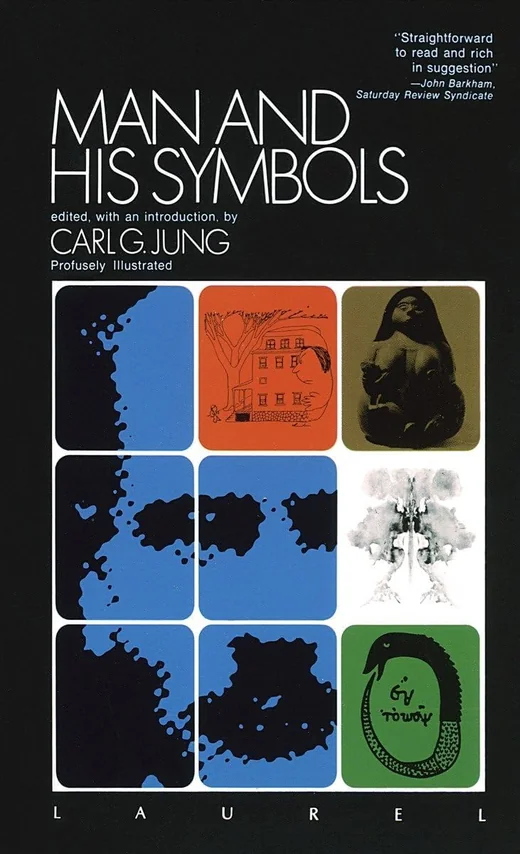
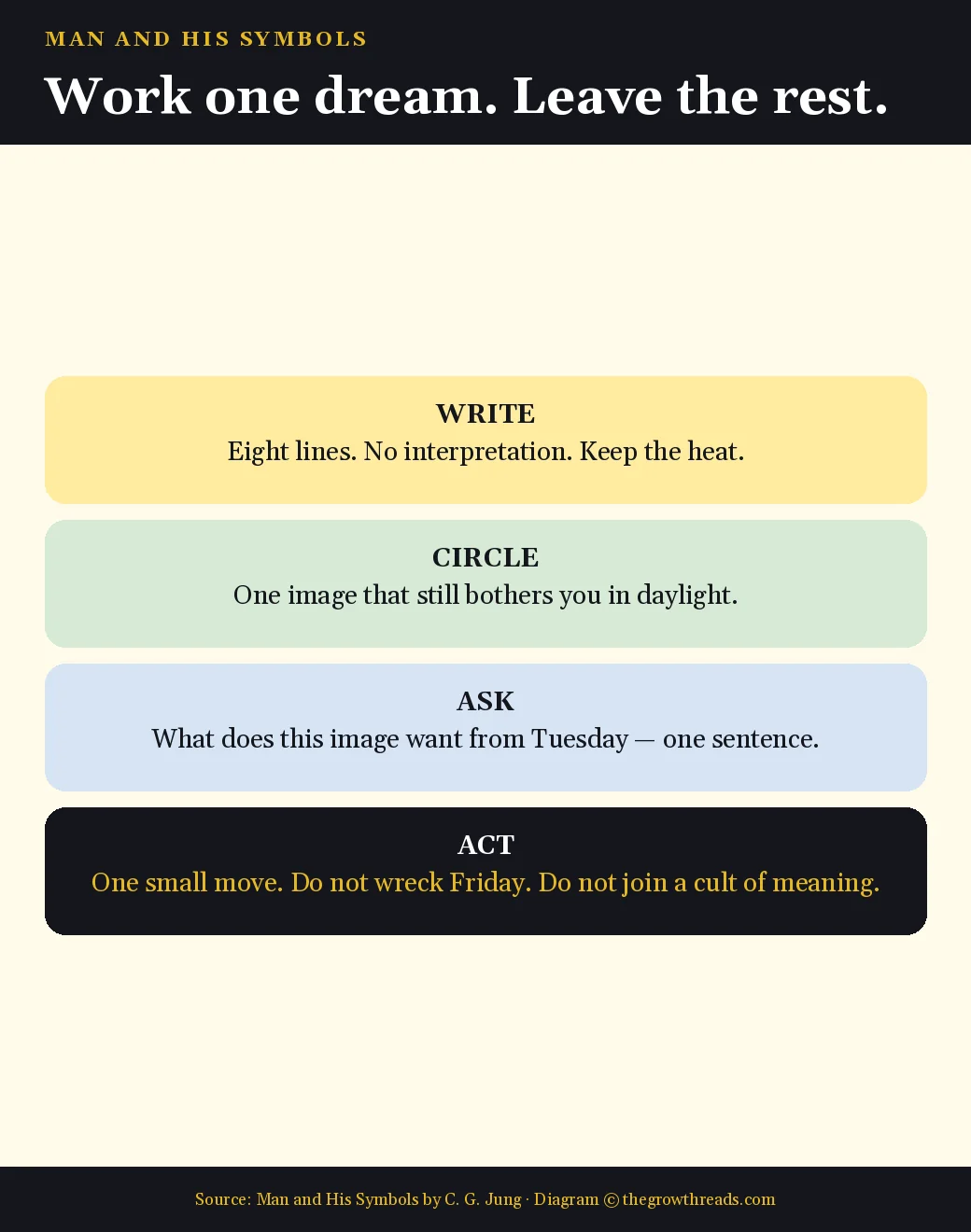
A dream is not a riddle with a prize answer. It is a living picture that compensates the day you just lived. Man and His Symbols is the last work C. G. Jung took on before he died in 1961 — a general-reader book he agreed to write after a BBC interview, a pile of mail, and a dream in which he spoke to a crowd that actually listened. He wrote Part 1 in English. Henderson, von Franz, Jaffé, and Jacobi wrote the rest under his eye. The steal for Tuesday is smaller than the myth catalog: treat last night’s image as a symbol, not a sign. Write it. Circle one picture. Ask what it wants. Do one small thing. Leave the rest.
Key takeaways
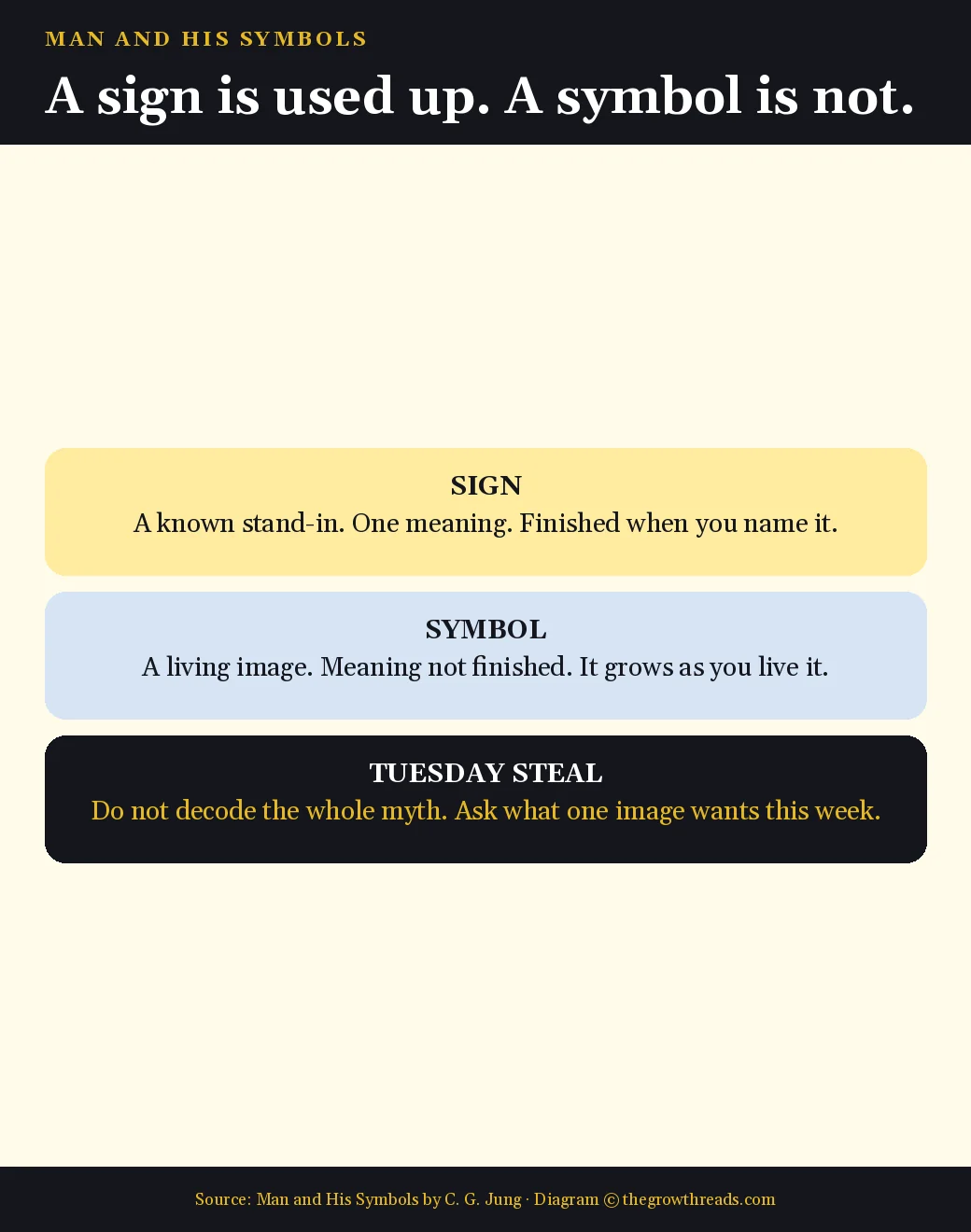
- Sign versus symbol: A sign is used up when you name it. A living image is not.
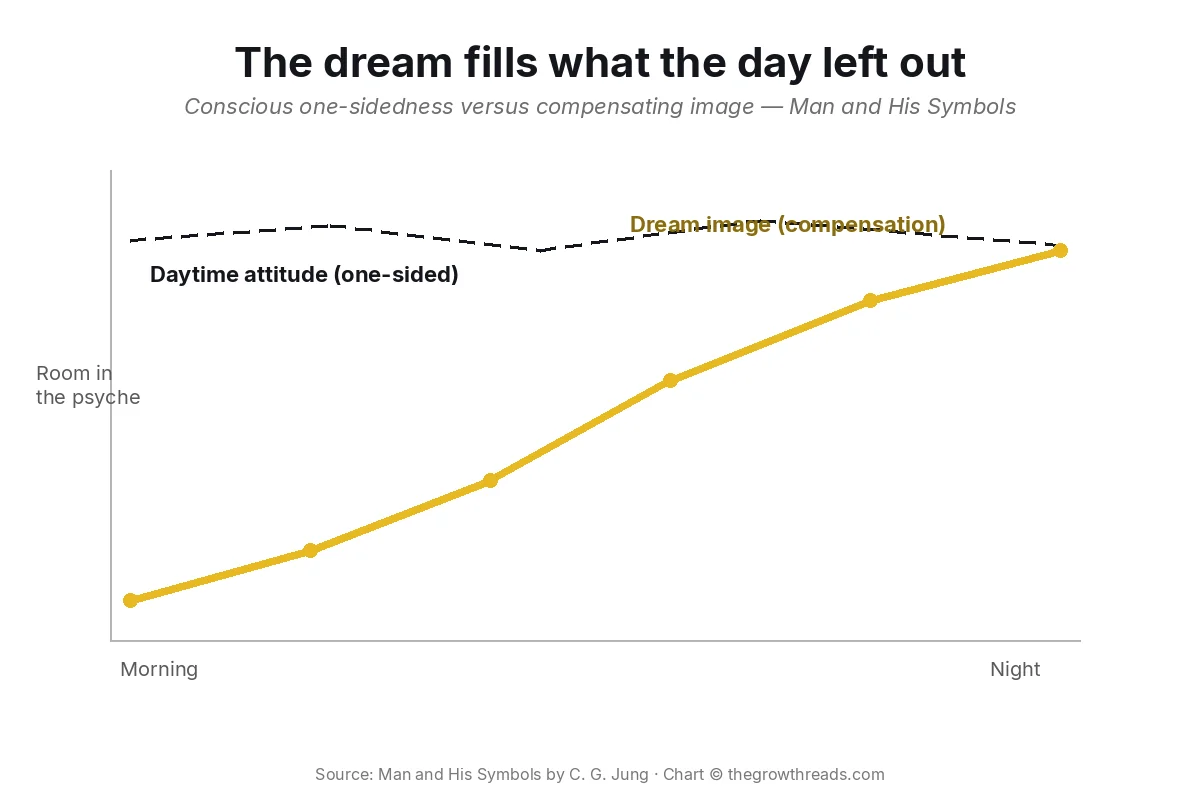
- Dreams compensate: The night fills the attitude the day overplayed. That is the frame, not a prophecy.
- The unconscious is not only a basement of trouble: It is also the source of the next move you will not think up at a desk.
- Archetypes are patterns, not costumes: Hero, shadow, anima — useful when they describe a Tuesday, fatal when they become a brand.
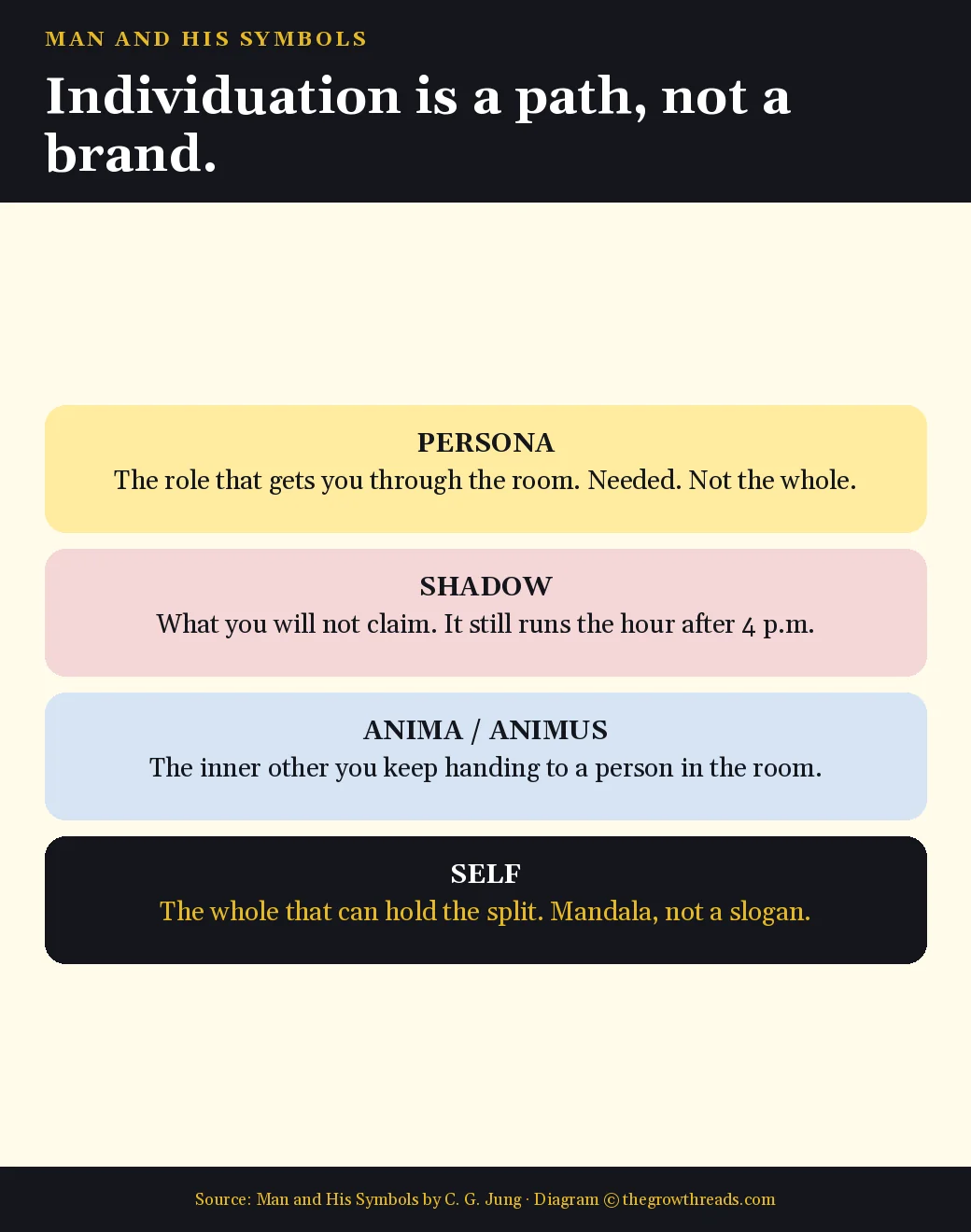
- Individuation is a path: Persona, shadow, inner other, Self. You do not finish it. You notice which station is running the hour.
- Myths still run offices: Henderson’s chapter is not anthropology homework. Name the story you are in.
- Art is a statement you did not plan: Jaffé’s pictures include the doodle you keep making in meetings.
- One analysis is enough of a model: Jacobi shows symbols over time in one person. Work your series, not a dictionary.
- The steal is one image: Eight lines. One circle. One sentence. One act that cannot wreck Friday.
What is Man and His Symbols about?
Man and His Symbols is Jung’s last general-reader book: dreams as living images rather than signs, myth still running modern life, individuation as a path through persona and shadow toward a Self that can hold a split, and a method — write the picture, ask what it wants, act small.
About the author
Carl Gustav Jung (1875–1961) was a Swiss psychiatrist who began as Freud’s heir apparent and then refused to let the inner life be only repressed sexuality. After the 1913 break he sat, wrote, and painted until the psyche answered in scenes — work later issued as The Red Book. In 1959 the BBC’s Face to Face sent John Freeman to Küsnacht. The broadcast produced mail, then a dream of speaking to a listening crowd, then this book: Jung plus four colleagues, aimed at people who would never enter an analytic hour. He finished his chapter about ten days before the illness that ended him. The steal is not a Jungian identity. It is a Tuesday habit: read one image as a living symbol, and answer it with one act. Explore all C. G. Jung book summaries →
Key concepts at a glance
| Concept | What it means | Use it when |
|---|---|---|
| Sign | A known stand-in. One meaning. Finished when named | You labelled the dream and felt nothing |
| Living symbol | An image that still implies more than its obvious meaning | The picture has heat after you name it |
| Compensation | The dream fills the attitude the day overplayed | You were only competent, only kind, only in control |
| Collective unconscious | Shared patterns beneath personal memory | A private dream keeps borrowing public myth |
| Archetype | A pattern of image and action, not a Halloween costume | You are living a hero, orphan, or trickster week |
| Persona / shadow | The role that gets you through the room; what you will not claim | The hour after 4 p.m. does not match the meeting |
| Anima / animus | The inner other you keep handing to a person | A partner or boss is carrying a god or a wound |
| Self / mandala | The whole that can hold the split; the psyche’s attempt to centre | You keep drawing circles, squares, fourfold maps |
| Amplification | Ask where else the image lives, then return to your Tuesday | You are stuck between a dictionary and a shrug |
Part 1: Dreams compensate — they are not puzzles to solve
Jung did not want this book. Foges at Aldus asked Freeman to persuade him after Face to Face. Jung said no. Then the mail arrived, and a dream put him in front of a crowd that listened. He set two conditions: colleagues would write with him, and Freeman would keep it aimed at a general reader. He wrote “Approaching the Unconscious” in English and finished it in the last weeks of his life. That origin is the method. He would not write a textbook. He would write for the person who remembers a dream on the train and does not know what to do with it.
A sign points to a known thing and is used up: a logo, a formula, an abbreviation. A word or an image is symbolic when it implies something more than its obvious meaning. H2O is a sign for water. Water in a dream may still be water, and it may also be the feeling you would not have in the meeting. You honour a symbol by staying with the picture until it asks for a deed, not by forcing a single translation. Jung’s other move is compensation. Consciousness gets one-sided — only sharp, only nice, only in charge. The dream brings the left-out attitude. The night is not mocking you. It is trying to complete the day.
TGR Note: The Interpretation of Dreams is Freud’s royal road — wish, disguise, the day’s residue. Jung’s compensation frame is a different Tuesday: the dream fills what the ego overplayed, not only what it repressed. Keep Freud when you need the childhood plot. Keep this chapter when you need one living image and one act. Thinking, Fast and Slow is the lab’s two systems; it will not read the picture for you.
Part 2: Myths are still running Tuesday
Joseph L. Henderson’s chapter, “Ancient Myths and Modern Man,” is the warning against sophistication. You can work in a glass office and still be inside a hero trial, an initiation you did not schedule, or a trickster week that punctures the plan. Myth here is not a library subject. It is a pattern of action that uses your biography as a stage. The modern mistake is to think the old stories stopped because you no longer tell them at dinner. They moved into the pitch, the breakup, the late message, the fantasy of rescue.
Henderson walks hero, trickster, and initiation without a costume party. The hero leaves the known room and pays. Initiation changes the name you can honestly use. The trickster punctures inflation when a team believes its own deck. Name the myth you are in without becoming it. In a hero week, the neglected move may be to ask for help. In a trickster week, it may be to tell the true number. You do not need a metaphysics. You need to notice that last night’s dragon has a calendar invite.
TGR Note: The Hero with a Thousand Faces is Campbell’s map of the call, the road, the return — a later public cousin of this myth chapter. Use it when you need the plot beats. Use Henderson when you need to see the myth inside an ordinary week. The Denial of Death is Becker on immortality projects; a symbol can be a living image or a shield against ending. If your “myth” is only a brand that cannot die, start there.
Part 3: Individuation is a path, not a brand
Marie-Louise von Franz wrote “The Process of Individuation” and, after Jung’s death, held the book together. This is the practical spine. The ego is not the enemy — you need someone at the wheel. The persona gets you through the room; it becomes a problem the moment you think it is the whole. The shadow is what you will not claim. It runs the hour after 4 p.m. Anima and animus are the inner other. You will hand them to a person and then fight that person for a quality that was yours to retrieve.
The Self is not a slogan about “being authentic.” It is the whole that can hold the split. Mandalas show up in dreams and doodles when the psyche tries to centre that whole. You do not finish individuation. You notice which station is running the week, then take one step: a persona you can take off, a shadow you can name without a confession tour, a projection you reel back. Von Franz is stern in a useful way. Inner work that never returns to a Tuesday is inflation with better lighting.
TGR Note: Psychological Types is Jung’s map of energy and functions — extraversion, introversion, the stack, the basement tool. Read it when the fight is “the right way to decide.” The Red Book is the private descent this public book was written to introduce. If you want inner figures and active imagination, start there. If you want a path you can walk without a Liber Novus, stay with von Franz and do one station this week.
Part 4: Read the image in the work and in the hour
Aniela Jaffé’s “Symbolism in the Visual Arts” and Jolande Jacobi’s “Symbols in an Individual Analysis” prove you do not need a professional dream life. You already make art you did not plan: the doodle in the margin, the same doorway in every photograph, the playlist that is a mood you will not name. Those are data. Jacobi shows one analysis over time — symbols change when they are lived with, not catalogued. Universal meaning is a temptation. Your series is the method. The snake in a book is not automatically your snake. Stay with the picture that arrived in your night.
Amplification is a walk around the picture, not a dissertation: where else does this image live, then come back. The deed is the end of the walk. If the image wants a boundary, say the sentence. If it wants rest, put the phone in another room for an hour. If it wants the neglected function, practise it on a task that cannot wreck Friday. Jung’s last public book is illustrated on purpose. He wanted your eye trained, not your vocabulary padded. Read the picture. Answer it. Go back to the work.
Who is Man and His Symbols best for — and who should read something else first?
Best for people who remember a dream and shrug, who turned a four-letter quiz into a personality, or who keep handing an inner figure to someone in the room. The Dell paperback is the illustrated general-reader door into Jung. This guide is the steal: sign versus symbol, compensation, one path, one image, one Tuesday act.
Read something else first if you want Jung’s private descent — start with The Red Book. If you want the type map rather than the picture method, Psychological Types. If you want Freud’s dream book, The Interpretation of Dreams. If you want myth as a call to adventure, The Hero with a Thousand Faces. If you want meaning without dreams, Man’s Search for Meaning. If you want presence without symbols, The Power of Now. If a dream is flooding you, this is not psychotherapy — talk to a clinician and keep the act small.
Questions to reflect on
- What attitude did you overplay yesterday — control, charm, analysis, rescue — and what picture arrived after?
- Which image from the last week still has heat when you name it?
- Where have you treated a living symbol as a sign, and felt the picture die?
- Who in the room is carrying a quality that might be yours to retrieve?
- What is one act this week that would answer the picture without wrecking Friday?
🔥 Ready to read the dream you keep ignoring?
Get Man and His Symbols and steal a Tuesday method for living images, not signs.
How to apply Man and His Symbols (7-day plan)
- Day 1 — Catch the day. After one real meeting, write the attitude you overplayed in six words. That is the one-sidedness the night may compensate.
- Day 2 — Write the dream. Eight lines. Objects, places, the feeling in the body. No interpretation. If you remember nothing, sit ten minutes and write the first image that arrives.
- Day 3 — Circle one picture. The one that still bothers you in daylight. Not the whole cast. One image.
- Day 4 — Amplify once. Where else does this picture live — a myth, a film, a room from childhood? Three notes. Then stop. Do not start a thesis.
- Day 5 — Ask the image. One sentence: what do you want from Tuesday? Write the answer as if the picture could speak. Keep it under twenty words.
- Day 6 — Act small. One move that cannot wreck Friday: a sentence, a boundary, ten minutes of the neglected function, the phone in another room for an hour.
- Day 7 — Leave the myth. Write: I treated this image as a living symbol, not a sign. Then go back to the task. Do not join a cult of meaning.
Frequently asked questions
What is Man and His Symbols about?
Man and His Symbols is C. G. Jung’s last book, written for people who will never enter an analytic hour. He finished “Approaching the Unconscious” in English about ten days before his final illness. Four colleagues — Henderson, von Franz, Jaffé, and Jacobi — wrote the rest under his eye. The steal is practical: a dream is not a puzzle with one answer. A sign is used up when you name it. A living image is not. Write one dream. Circle one picture. Ask what it wants from Tuesday. Act small. Leave the rest.
What does Jung mean by a “living symbol”?
A sign stands for a known thing: H2O, a traffic light, the letters UN. You are done when you have the referent. A living symbol still implies more than its obvious meaning. The tree in last night’s dream is not a dictionary entry you can close. The psyche speaks in pictures whose meaning grows as you live with them. If naming the image kills it, you treated a symbol as a sign. If the picture still has heat, stay. Ask what it wants this week. Then do one small thing.
How do you work a dream from this book?
Do not start with a symbol dictionary. Write the dream in eight lines — objects, places, the feeling in the body. Circle one image that bothers you in daylight. Amplify once: where else does this picture live in a myth, a film, a childhood room? Ask the image what it wants from Tuesday, in one sentence. Act with a move that cannot wreck Friday. Compensation is the frame: the night fills the attitude the day overplayed. You are not decoding a prophecy. You are answering a picture.
Is Man and His Symbols the same as The Red Book?
No. The Red Book is Jung’s private Liber Novus, painted after the break with Freud and issued in 2009. Man and His Symbols is the public doorway he agreed to write after the 1959 BBC Face to Face interview, when a dream of speaking to a crowd reversed his refusal. Same psyche, different job. Want inner figures and active imagination? Start with The Red Book. Want a general-reader map of signs, dreams, myth, and one analysis? This is the book. Keep Psychological Types for the function stack; keep this for the pictures.
Who should read Man and His Symbols?
Read it if you remember a dream and shrug, if a personality quiz became the whole map of your inner life, or if you keep handing an inner figure to a person in the room. The Dell paperback is illustrated on purpose: Jung wanted the pictures to train the eye. You do not need a training analysis to steal the week’s work. Want Freud’s dream book? Start with The Interpretation of Dreams. Want myth as a call? The Hero with a Thousand Faces. Want the type map? Psychological Types. If a dream is flooding you, talk to a clinician and keep the act small.
What is individuation in this book?
Individuation here is not a personal brand. Von Franz treats it as a path: the ego is needed, the persona gets you through the room, the shadow is what you will not claim, anima and animus are the inner other you project, and the Self is the whole that can hold the split. Mandalas show up when the psyche tries to centre that whole. You do not finish this on a Sunday. Notice which station is running the hour. Name one shadow move. Retrieve one projection. Path, not costume. Picture, not slogan.
How do you apply Man and His Symbols at work this week?
After one real meeting, write the attitude you overplayed: control, charm, analysis, rescue. Write a dream, or the first image that arrives when you sit. Circle one picture. Ask what it is compensating — the day left something out. Translate that into one workplace move that cannot wreck Friday: say the thing you dressed as competence, ask the person you keep mythologising a factual question, or practise the function you mocked for ten minutes. End with one sentence: I treated this image as a living symbol, not a sign. Then go back to the task.
Related summaries
- The Red Book — Jung’s private descent; this book is the public door.
- Psychological Types — the function stack beside the picture method.
- The Interpretation of Dreams — Freud’s royal road, a different Tuesday.
- The Hero with a Thousand Faces — myth as a call, not a living image in your night.
Browse the full list on our Best Psychology Books pillar.
How we analyze books: our summaries are built from a full read of the source text, cross-referenced against the author’s published interviews and research where relevant, and structured around practical application rather than critique. We disclose our editorial process and affiliate relationships in full. Read our full methodology.