

★★★★★ 4.8/5 — You have a type. You are not a cage.
Best for: Anyone who keeps fighting about “the right way to decide,” or who turned a four-letter quiz into a personality
Reading time: ~16 hrs for the Princeton Bollingen paperback · ~10 min for this guide
Difficulty to apply: Medium — you have to notice the function you hate using, not take a quiz
Psychological Types in one minute
People do not take in the world the same way, and the difference is not a moral failing. C. G. Jung’s 1921 book is the map he wrote after he and Freud could not meet on the same fact. Extraversion and introversion are directions of energy, not party scores. Four functions of consciousness — thinking, feeling, sensation, intuition — do the rest. One leads. One helps. The opposite lives in the basement and will ambush you. Myers-Briggs later built a questionnaire on this vocabulary; Jung warned against becoming the label. The steal for Tuesday: after one meeting, write where the energy went. Name the function you used. Practice the one you mock on a task that cannot wreck the week. Use the type. Then leave it.
Key takeaways
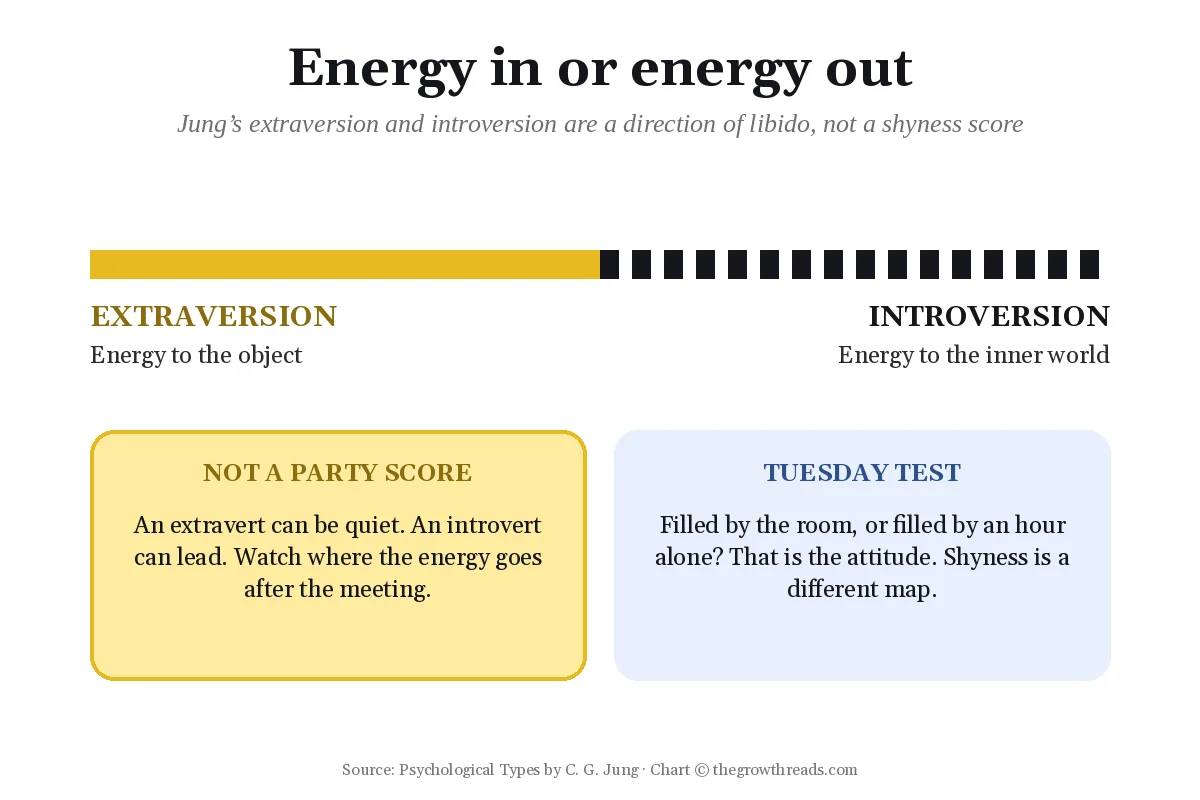
- Energy, not shyness: Extraversion goes out to the object. Introversion goes in to the inner world. Restock is the tell.
- Four functions, not four costumes: Thinking and feeling judge. Sensation and intuition perceive. You have all of them.
- Feeling is a judging function: It decides worth. It is not a synonym for being emotional, and it is not EQ.
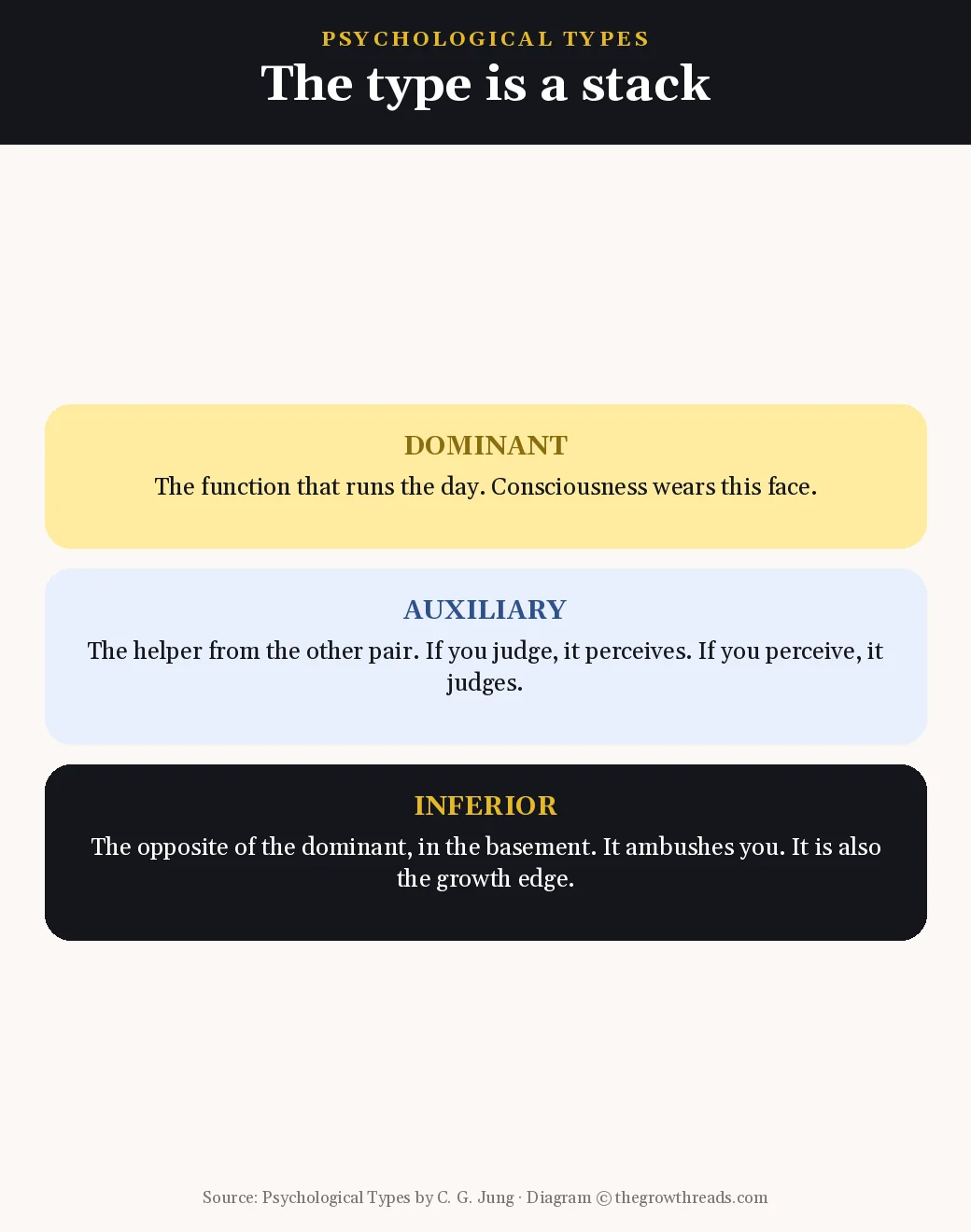
- A type is a stack: Dominant, auxiliary, inferior. Consciousness wears the first. The last arrives clumsy.
- Eight principal combinations: Each function can extravert or introvert. That is the scheme, not sixteen quiz letters.
- One-sidedness is the cost: The leading function gets brilliant. The neglected one gets you in the meeting after 4 p.m.
- The person you mock is data: The function you dismiss in others is usually the one in your basement.
- Do not become the label: Jung wrote a map. Later tests made a brand. Observation beats a four-letter identity.
- The steal is a Tuesday: Watch energy. Name the function. Practice the inferior one on a small task. Then drop the costume.
What is Psychological Types about?
Psychological Types is C. G. Jung’s 1921 account of why people take in the world so differently — extraversion and introversion as directions of energy, four functions of consciousness, and a practical warning that a type is a preferred stack, not a cage you should live in.
About the author
Carl Gustav Jung (1875–1961) was a Swiss psychiatrist who began as Freud’s heir and then refused to let the inner life be only repressed sexuality. After the 1913 break he spent years asking why two intelligent people could look at the same fact and not meet. Psychological Types, issued in German in 1921 and later Volume 6 of the Collected Works, is that map: two attitudes, four functions, and a warning not to become your label. He built a practice at Burghölzli, a tower at Bollingen, and a vocabulary — persona, shadow, individuation — that still sits under every personality quiz. The steal from this book is not a four-letter code. It is a Tuesday habit: notice where your energy went, and practice the function you mock. Explore all C. G. Jung book summaries →
Key concepts at a glance
| Concept | What it means | Use it when |
|---|---|---|
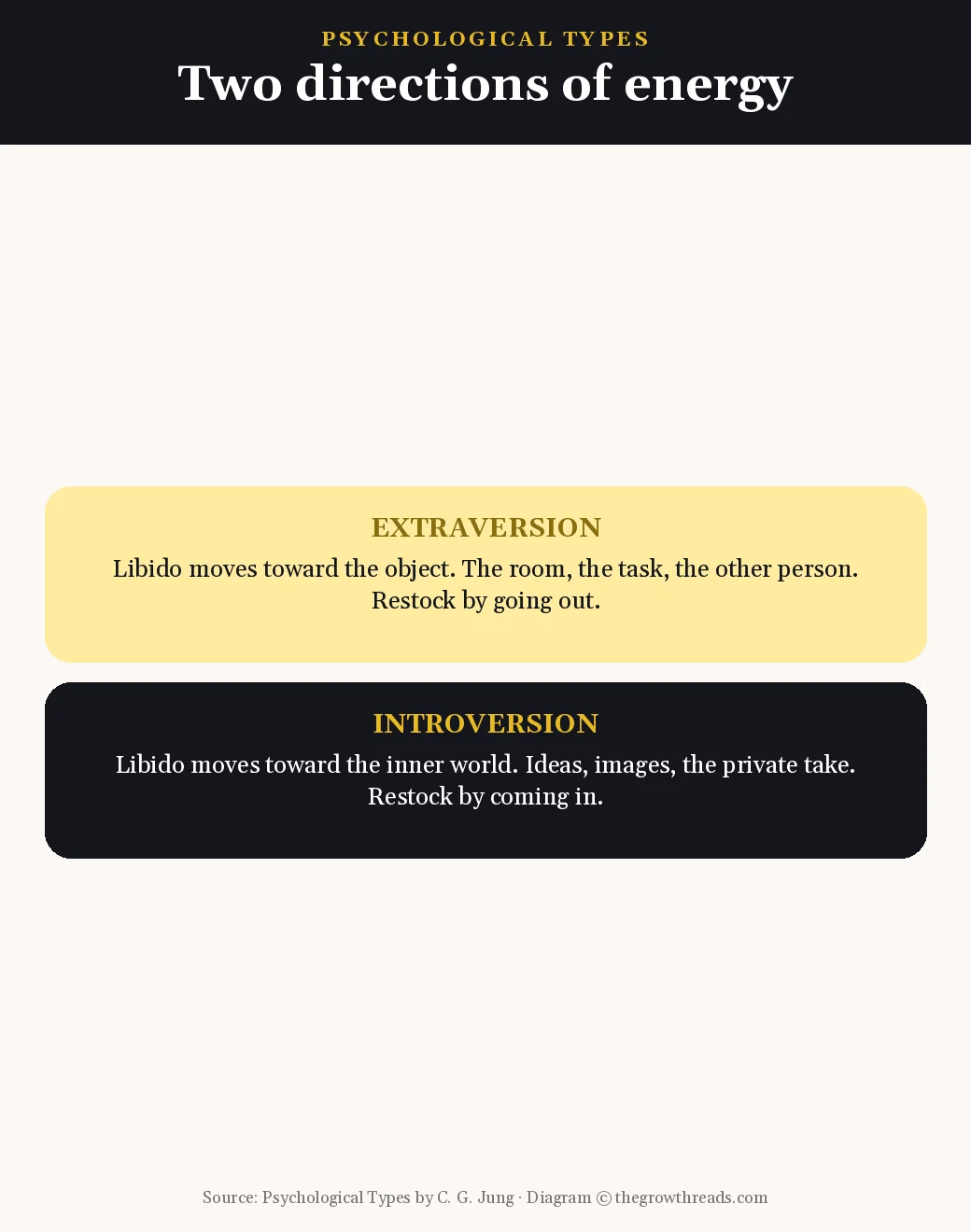
| Extraversion | Libido turns toward the object — room, task, other person | You restock by going out, even if the room was loud |
| Introversion | Libido turns toward the inner world of images and private takes | You restock by coming in, even if you just led the room |
| Thinking | A rational function that judges true or false | The fight is about the argument, not the relationship |
| Feeling | A rational function that judges worth, not a mood storm | The decision is like/dislike, and logic keeps talking past it |
| Sensation | A perceiving function that takes in what is, through the senses | You need the present fact, not the next possibility |
| Intuition | A perceiving function that takes in pattern, hunch, the next room | The facts are on the table and nobody can see the shape |
| Dominant / inferior | The leading function in consciousness; its opposite in the basement | You are brilliant until 4 p.m., then the neglected tool ambushes you |
| Type as stack | A preferred attitude plus a preferred function, not a costume | A quiz result is starting to replace watching what you actually do |
Part 1: Extraversion and introversion are energy, not shyness
Jung did not start this book as a personality brand. He started it as a peace treaty with a fight he had lost. Freud looked at a dream or a slip and saw repressed sexuality. Jung looked at the same material and saw a psyche that also moved toward meaning and image. Two intelligent men, one fact, no meeting. Psychological Types is his answer: people differ in the direction their energy prefers to go, and in the tool they prefer when they take the world in. Skip Schiller, Nietzsche, and William James if you must. Keep the sentence those chapters argue for. Difference is not always resistance. Sometimes it is type.
Extraversion is an outward-turning of libido — energy toward the object, the room, the other person. Introversion is an inward-turning — energy toward the image and the private take. That is not a party score. An extraverted thinker can be icy in a crowd and still restock by going out. An introverted feeler can host a dinner and still restock by coming in. The Tuesday test is crude on purpose: after a meeting, filled by the people, or filled by an hour alone with the notes? Sleep and fear can fake a type for a day. Watch a week. Then you have something you can use in a pairing or a fight that keeps the same shape.
TGR Note: Quiet is Cain’s cultural case for introverts in a loud century — a later, usable cousin of Jung’s inward turn, not a replacement for his energy definition. Flow is Csikszentmihalyi on absorption; introversion is not the same as flow, and extraversion is not the same as distraction.
Part 2: Four functions, two of them badly named
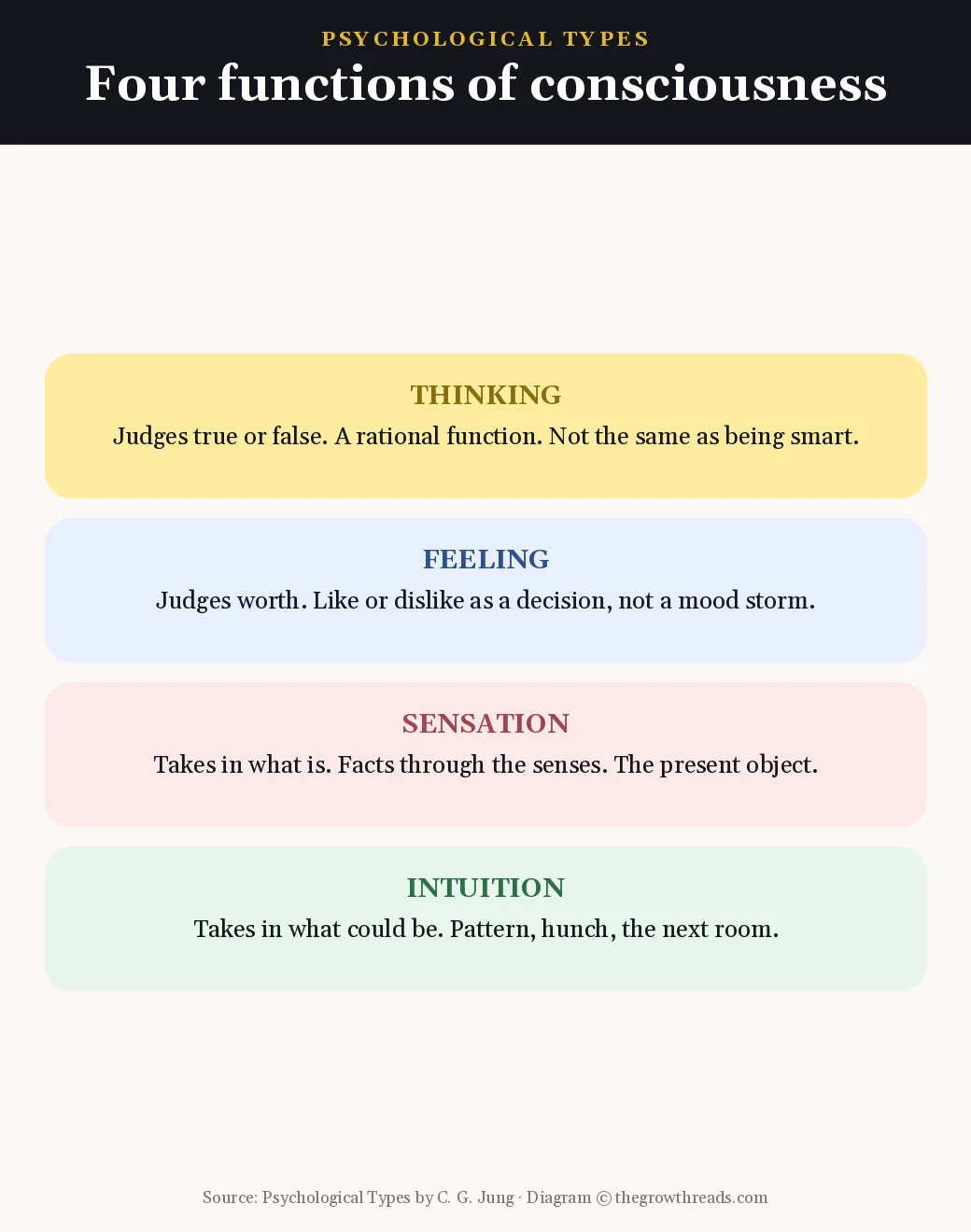
Attitude is only the first axis. Two functions judge: thinking decides true or false; feeling decides worth — like or dislike as a judgement, not a tantrum. Two perceive: sensation takes in what is; intuition takes in what could be. Jung calls the first pair rational and the second irrational, which only means the second pair does not proceed by a reasoned yes or no. A surgeon’s sensation is not a vibe. Feeling, in this book, is not “being emotional.” It is a judging function that ranks value. One person asks “is it true.” One asks “does it matter.” They think they are in the same conversation. They are not.
Each function can extravert or introvert, which gives eight principal types. Jung spends long chapters on the portraits. You do not need to memorise them to steal the method. Notice which function you reach for under load, and which function you treat as a defect in other people. The first is usually dominant. The second is often inferior. Eight combinations are already a lot. Sixteen letters on a mug are a later industry.
TGR Note: Thinking, Fast and Slow is Kahneman’s two systems from the lab — a different cut than Jung’s four functions, useful when the room is tired and skipping the slow check. Emotional Intelligence is Goleman on EQ; it is not Jung’s feeling function, and mixing the two will send you on the wrong Tuesday.
Part 3: Dominant, auxiliary, inferior — the type is a stack
Jung’s practical move is to stop talking as if a person were one function. Consciousness has a leading function that feels like “me,” usually plus an auxiliary from the other pair: if you judge, the helper perceives, and the reverse. The opposite of the dominant lives in the basement as the inferior function. It is not missing. It arrives late, clumsy, and often as a mood. A brilliant extraverted thinker can turn strangely sentimental at midnight. A leading intuitive can become pedantic about a receipt when tired. The basement does not wait its turn.
One-sidedness is the cost. The leading function gets better because you use it. The neglected one waits for load. The ethic is not “balance all four by Friday.” It is: know the stack well enough that the ambush is recognisable. Individuation, here, is a development task — enough relationship with the inferior function that it stops kidnapping the day. A type is a photograph of a preference, not a permission slip. The person whose leading function you mock is often carrying the tool your Tuesday is missing.
TGR Note: The Red Book is Jung’s inner work after the break with Freud — the depths this type map was built to survive. Read it when you want the images, not the scheme. The Courage to Be Disliked is Adler, Jung’s other early neighbour: a different account of how a person moves, useful if type talk is starting to sound like fate.
Part 4: Use the type, then leave it
The Definitions section is dry and keeps later readers honest. Extraversion is not sociability. Feeling is not emotion. In a conflict, ask which function is on the table before you ask who is being difficult: true/false, worth, facts, or possibility. You will still have to decide. You will decide faster if you stop prosecuting character for a type mismatch. Pairing is the other Tuesday. The person whose feeling function is awake can see the value ranking you postpone. The sensation type can tell you whether the door is actually locked. Stop staffing every room with copies of your dominant function, then wondering why the basement explodes at quarter-end.
Then leave the label. Myers-Briggs made this vocabulary famous, and it can still be a door. It is not the method. Jung’s method is observational: watch energy, watch the function under load, watch the function you mock, practise the inferior one on a task that cannot wreck Friday, and refuse to become a four-letter identity. The book is six hundred pages because he would not reduce a person to a stamp. Steal the stack. Use it this week. Do not join a type.
Who is Psychological Types best for — and who should read something else first?
Best for people who keep fighting about the right way to decide: managers pairing a team, partners stuck in the same argument, anyone who took a quiz and started living inside four letters. The Princeton volume is long. This guide is the steal: two attitudes, four functions, one stack, one inferior function to practise on a small Tuesday.
Read something else first if you want introversion as a cultural argument — start with Quiet. If you want two thinking systems from the lab, Thinking, Fast and Slow. If you want Jung’s inner work rather than his type map, The Red Book. If you think “feeling” means EQ, Emotional Intelligence is that book; this one is a judging function. If you want Adler’s freedom talk rather than Jung’s stack, The Courage to Be Disliked. If you came for a habit loop, Atomic Habits is that book; this one is a map of how you take the world in.
Questions to reflect on
- After the last meeting that mattered, did the room fill you or drain you — and what did you do next to restock?
- Which function did you actually use to decide: true/false, worth, present fact, or hunch?
- Which function do you mock in a colleague, a partner, or a sibling — and what if that is your basement talking?
- What is one low-stakes task this week that requires the function you like least?
- Where have you used a type label as a permission slip, and what would change if you dropped the costume?
🔥 Ready to use your type without becoming it?
Get Psychological Types and steal a Tuesday map for energy, functions, and the tool in the basement.
How to apply Psychological Types (7-day plan)
- Day 1 — Watch the energy. After one real meeting, write one line: filled by the room, or filled by an hour alone. That is attitude, not a shyness score.
- Day 2 — Name the function you used. True/false, worth, present fact, or hunch. Circle one. Do not circle a quiz letter.
- Day 3 — Name the function you mocked. Write the remark you made about someone else’s “overthinking,” “softness,” “nitpicking,” or “vibes.” That is probably the basement.
- Day 4 — Practise the inferior function for ten minutes. Pick a task that cannot wreck Friday. If you live in logic, make a worth call. If you live in hunches, check one stubborn fact.
- Day 5 — Translate one conflict as type, not character. Is this a true/false fight, a worth fight, a facts fight, or a possibility fight? Say that out loud before you prosecute the person.
- Day 6 — Pair once with the missing tool. Ask the person whose leading function is yours in the basement to look at one live task with you. Ten minutes. One artefact.
- Day 7 — Leave the label. Write one sentence: I am not my type; this week I practised X. Put the four letters, if you have them, in a drawer.
Frequently asked questions
What is Psychological Types about?
Psychological Types is C. G. Jung’s 1921 book on why people take in the world so differently. He names two attitudes — extraversion and introversion — as directions of psychic energy, not as shyness scores, and four functions of consciousness: thinking, feeling, sensation, and intuition. Each person leads with one function in one attitude; the opposite lives in the basement and will ambush you. The book is long on history and definitions. The steal for Tuesday is smaller: notice where your energy went after a meeting, and practice the function you mock on a task that cannot wreck the week.
What does Jung mean by extraversion and introversion?
Jung is not scoring how much you like parties. Extraversion is an outward turn of libido — energy moves toward the object, the room, the other person. Introversion is an inward turn — energy moves toward the inner world of images and private takes. An extravert can be quiet in a crowd and still restock by going out. An introvert can lead a room and still restock by coming in. The Tuesday test is what happens after the meeting: filled by the people, or filled by an hour alone. Shyness, social skill, and type are three maps. This book is the third.
What are Jung’s four functions?
Two functions judge, two perceive. Thinking judges true or false. Feeling judges worth — like or dislike as a decision, not a mood storm. Sensation takes in what is, through the senses. Intuition takes in what could be: pattern, hunch, the next room. Jung calls thinking and feeling rational, sensation and intuition irrational, which only means they do not proceed by a reasoned yes or no. You have all four. One leads. One helps from the other pair. The opposite of the leader lives in the basement. That stack, plus extraversion or introversion, is the type — eight principal combinations, not a personality costume.
Is Psychological Types the same as Myers-Briggs or MBTI?
No. Katharine Briggs and Isabel Myers later built a questionnaire inspired by this book. Jung did not write sixteen types, did not invent a test, and warned against using typology to put people in boxes. MBTI can be a door into the vocabulary. It is not the book. If you only remember four letters, you have the souvenir, not the method. Jung’s steal is observational: watch energy, watch which function you reach for under load, and notice the function you mock in other people. That last one is usually your inferior function asking to be practiced, not a verdict on their character.
What is the inferior function?
The inferior function is the opposite of your dominant one, living mostly outside ordinary awareness. If thinking leads, feeling is in the basement. If sensation leads, intuition is the neglected twin. Jung’s claim is not that you lack it. It is that it arrives clumsy, late, and often as a mood or a fight. The Tuesday use is small: pick a low-stakes task that needs the neglected function — a value call if you live in logic, a fact check if you live in hunches — and do it for ten minutes without turning it into a new identity.
Who should read Psychological Types?
Read it if you keep fighting about “the right way to decide,” if you have been called shy when you are introverted, or if a four-letter quiz became a personality. The Princeton volume is long. You do not need the whole historical survey to steal the week’s work. If you want introversion as a cultural argument, start with Quiet. If you want two thinking systems from the lab, start with Thinking, Fast and Slow. If you want Jung’s inner work rather than his type map, start with The Red Book. This book is for people who will actually watch their energy after a meeting.
How do you apply Psychological Types at work this week?
After one real meeting, write where the energy went: out to the room, or in to a private take. Name the function you used to decide — true/false, worth, fact, or hunch. Then name the function you mocked in someone else; that is probably the basement. On a task that cannot wreck Friday, use the neglected function for ten minutes. In one conflict, translate the fight as a type mismatch before you prosecute character. Pair once with someone whose leading function is yours in the basement. End the week with one sentence: I am not my type; this week I practised X.
Related summaries
- The Red Book — Jung’s inner work; this book is the map he built to survive it.
- Quiet — introversion as a cultural argument, not a libido definition.
- Thinking, Fast and Slow — two lab systems when the room is tired.
- The Courage to Be Disliked — Adler’s freedom talk beside Jung’s stack.
Browse the full list on our Best Psychology Books pillar.
How we analyze books: our summaries are built from a full read of the source text, cross-referenced against the author’s published interviews and research where relevant, and structured around practical application rather than critique. We disclose our editorial process and affiliate relationships in full. Read our full methodology.