

★★★★½ 4.6/5 — Writing is a habit aimed at one reader, then published as a service — not a gift you wait to feel.
Best for: marketers, founders, and operators who must ship useful pages and keep stalling on the blank one.
Reading time: ~9 hours (guide: 50 min).
Difficulty to apply: Medium — the rules are simple; a weekly cadence is the work.
Everybody Writes in one minute
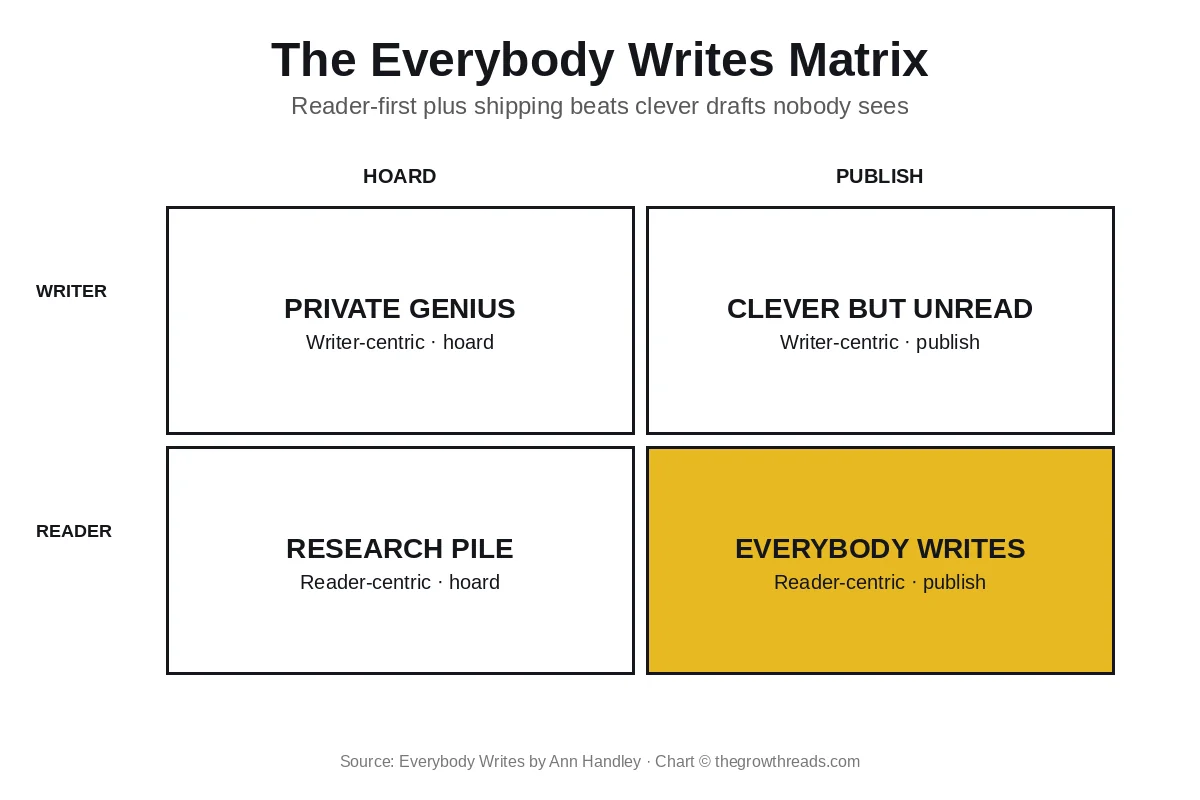
You already write. The job is to treat that as a habit aimed at one human, then hit publish before the draft becomes furniture. Ann Handley’s Everybody Writes (Wiley, 2022 second edition) is a desk manual for people whose title is not Writer and whose week still includes emails, posts, landing copy, and the newsletter they keep postponing. She is not asking you to become a novelist. She is asking you to stop waiting to feel literary.
The engine is small: show up in a shed, write an ugly draft, rewrite for one named reader, cut anything that fails the so-what test, and ship on a cadence you own. Grammar is in the book. It serves the reader, not a red pen. Content is a service. If the page does not help, it is decoration. That is the whole argument, told in short chapters you can steal one at a time.
Key takeaways
- Writing is a habit, not a gift: The people who sound natural wrote yesterday. Mood is a bonus, not a gate.
- Ugly drafts are the entry fee: Pass one exists so pass two has something to cut. Waiting for a clean first sentence is how weeks vanish.
- Write for one reader: A demographic is a blur. A named person has a Tuesday and a reason to leave.
- Ask so what: If that person would shrug, the line is a throat-clear. Cut it.
- First words do the work: Lead with the point. Buried ledes are how busy people bounce.
- Short is a kindness: Short sentences and short paragraphs are not dumbing down. They are respect for a phone screen.
- Voice is a person: Sound like someone who would answer a reply, not a press kit.
- Publishing is a service: Help first. A clever file nobody sees is still a diary. Own a cadence.
What is Everybody Writes about?
Everybody Writes is Ann Handley’s practical system for creating useful content on purpose: a writing habit, reader-first rules, grammar used as clarity, and a publishing practice that treats pages as service. The 2022 edition adds a sharper framework, newer examples, and a newsletter chapter for people who still have to ship this week.
About the author
Ann Handley is a marketer and the chief content officer at MarketingProfs, the training company that has spent two decades teaching teams how to talk like humans online. She started as a journalist, which is why the book sounds like an editor sitting on the corner of your desk rather than a brand theorist. In 2011 she co-wrote Content Rules with C.C. Chapman. Everybody Writes followed in 2014 and became the desk book a lot of marketing teams actually finished; Wiley published this expanded second edition in October 2022 (432 pages). She is a Wall Street Journal bestselling author and a frequent keynote speaker. There is no Wikipedia page under her name — her own site is the clean trail if you want talks. This title is the front door: how ordinary work writing gets good enough to publish. Explore all Ann Handley book summaries →
Key concepts at a glance
| Concept | What it means | Use it when |
|---|---|---|
| Writing habit / the shed | A recurring time and place. You sit down before you feel ready. | You only write after inspiration, and the calendar stays empty. |
| Ugly first draft | Pass one is clay. Pass two is the sculpture. | You rewrite sentence one for forty minutes. |
| One reader | A named human, not a persona slide. | The draft tries to please a committee. |
| So-what test | If that person would shrug, cut the line. | The page is long and nothing happens. |
| First words first | The lede carries the point. Throat-clears go. | The useful sentence is in paragraph four. |
| Human voice | A person who would answer a reply, not a press kit. | Every sentence could have been written by a template. |
| Content as service | The page helps first. Attention is a side effect. | You are decorating instead of answering a job. |
| Owned cadence | A newsletter or site you control, on a schedule. | You only publish when a platform is in a good mood. |
Part 1: Writing is a habit you keep, not a mood you wait for
Handley opens where most work-writing advice pretends not to: you already write. Slack, email, the deck comment, the half-finished post. The problem is not talent. It is that those words never get a second pass or a publish button. She treats writing the way a runner treats miles. You do not negotiate the session because you do not feel like an athlete this morning. You put on the shoes. The shed — her word for a protected place and time — is the same idea as a gym: if the session depends on inspiration, the session will lose to the inbox.
The ugly draft is the permission slip. Taste, she argues in the spirit of every working writer since the first newspaper deadline, is what you apply after there is clay on the table. Teams that wait for a clean first sentence are not holding a high standard. They are avoiding the only step that makes a standard possible. Pass one can be messy, too long, and slightly wrong. Pass two is where you become a writer. Pass three is where you become someone a stranger can trust.
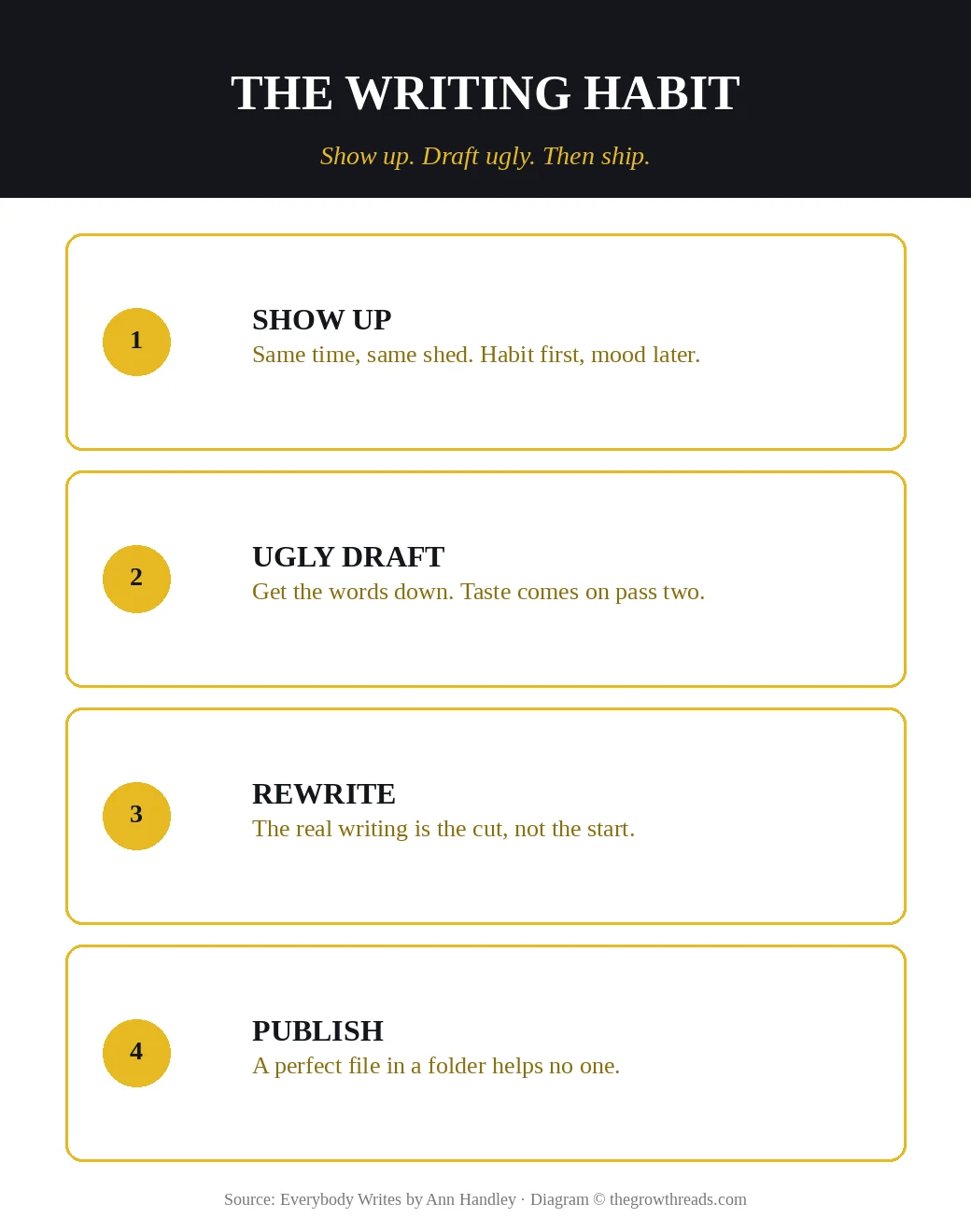
The 2022 edition makes the sequence explicit: idea, messy draft, rewrite, polish, publish. Do not fact-check while you are still finding the point, and do not hunt commas while the lede is hiding. Mixing jobs is how a 400-word update takes three days. Separate the passes. You do not need to call yourself a Writer. Skipping the shed is a missed block, same as skipping the only hour that would have filled next month’s pipeline.
TGR Note: The shed is the same fight as The Practice and Bird by Bird — show up, make the short assignment, do not wait to feel like an artist. Handley just aims the habit at pages that have to work for a business, not a novel.
Part 2: Write to one person, then cut what fails the so-what test
The middle of the book is a reader argument dressed as style tips. Handley’s one-reader rule is the one most teams skip because it feels unscalable. It is the opposite. A page written to “CMOs 35–54 in SaaS” is a blur. A page written to Maya, who has twelve minutes between stand-ups and a leaky trial, can be forwarded to a hundred Mayas. Name the person. Keep a sentence about her Tuesday at the top of the draft. When you get cute or vague, ask whether she would stay.
The so-what test is how you enforce that. Handley wants you to read each claim as if the reader said, out loud, “so what?” If you cannot answer in a line that changes what they do next, the sentence is furniture. Corporate goals, origin myths, and “we are excited to announce” almost always fail. A specific next step almost always passes. This is not anti-story. It is anti-sludge. Story earns its keep when it makes the next action obvious.
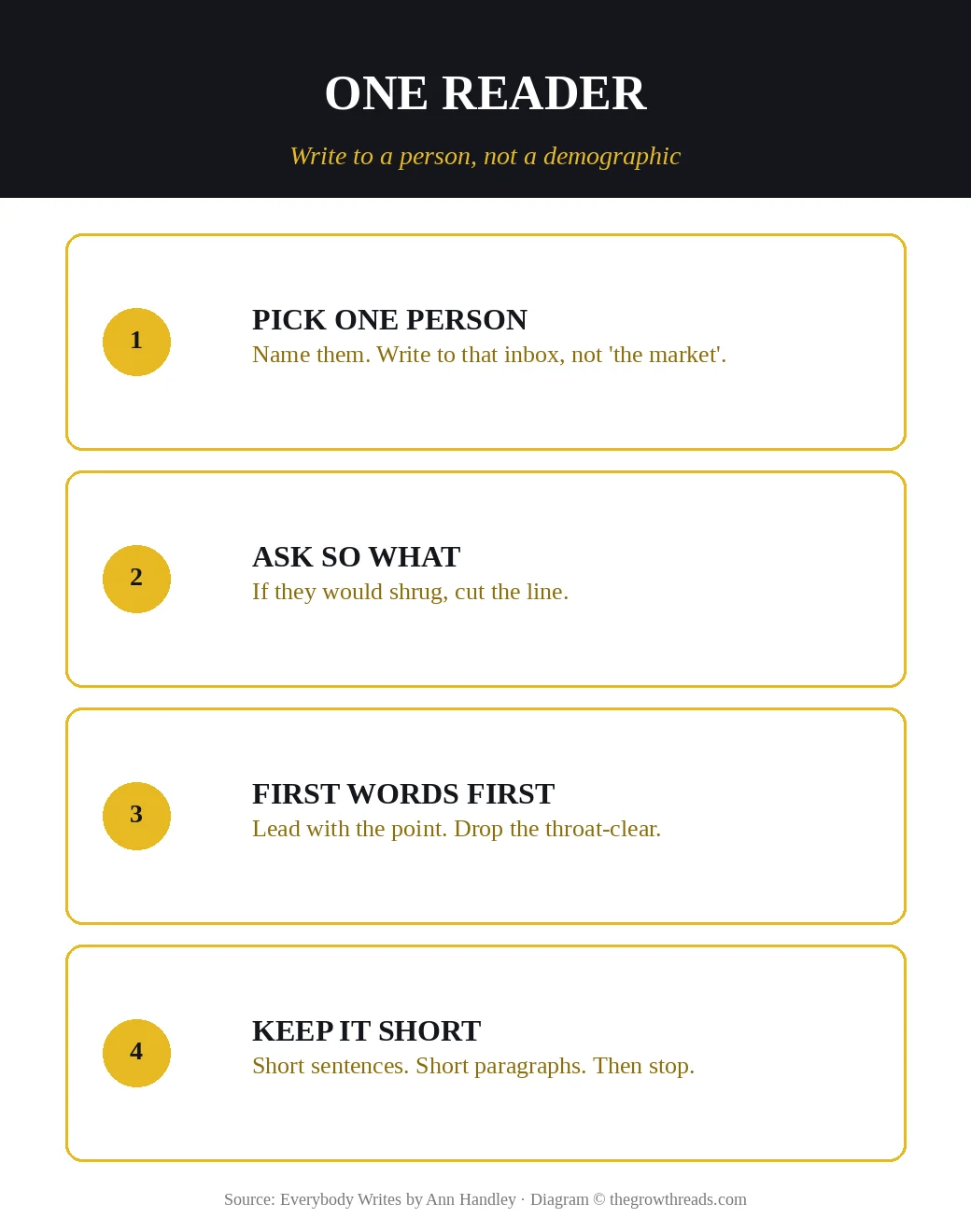
First words first is the other half of the same idea. Busy people decide in the opening. If the useful sentence is in paragraph four, most of them will never meet it. Lead with the point, then give the proof. Throat-clears — “in today’s fast-paced world,” “as a leading provider” — are how writers stall while they look for courage. Cut them the way you would cut a throat-clear in a meeting. Short sentences and short paragraphs are the mobile version of the same respect. They are not a style affectation. They are how a page survives a phone.
Voice is whether a human would answer a reply. Handley would rather you sound slightly too casual and clear than perfectly on-brand and empty. Jargon is allowed when the one reader uses it. Specificity is the tell: a number, a name, a time. Vague competence is what everyone else is already publishing.
TGR Note: If the draft exists and still sounds stiff, On Writing Well is the style class. If the sentence itself is muddy, The Elements of Style is the short manual. Handley gets you to the draft and the publish button; Zinsser and Strunk clean what you shipped.
Part 3: Grammar is a courtesy, not a costume
The usage chapters train people who will hit publish at 4:50 p.m., not copy editors for a 1950s desk. Grammar is whatever keeps the reader from stumbling. Read the page aloud. If you run out of air, the sentence is too long. If you would never say the clause to Maya, do not type it. Active voice is the default because it names who did what. Passive is allowed when the actor does not matter.
The usual sins: clichés that now mean “I stopped thinking,” fake energy, hedging until the claim disappears. Say the thing. Then stop. If a style-guide rule fights the reader, the reader wins. A perfectly punctuated page that helps no one still fails. Edit last, after the point is true. Do not use the red pen to avoid publish.
TGR Note: If you want the same courtesy applied to slides instead of paragraphs, Presentation Zen is the glance test for decks. If you want the private notebook that feeds the public page, Building a Second Brain is the capture system — just do not let PARA become a place drafts go to die.
Part 4: Publish as a service, on a cadence you own
The last movement is operational. Content, for Handley, is customer service that happens to be written down. The page should do a job: answer the question, reduce the risk, show the next step. Attention is a side effect of being useful, not a prize you extract with a trick headline and then waste. That is why she spends real pages on the path of the reader — where they are, what they already tried, what would make the next click feel like help instead of a funnel.
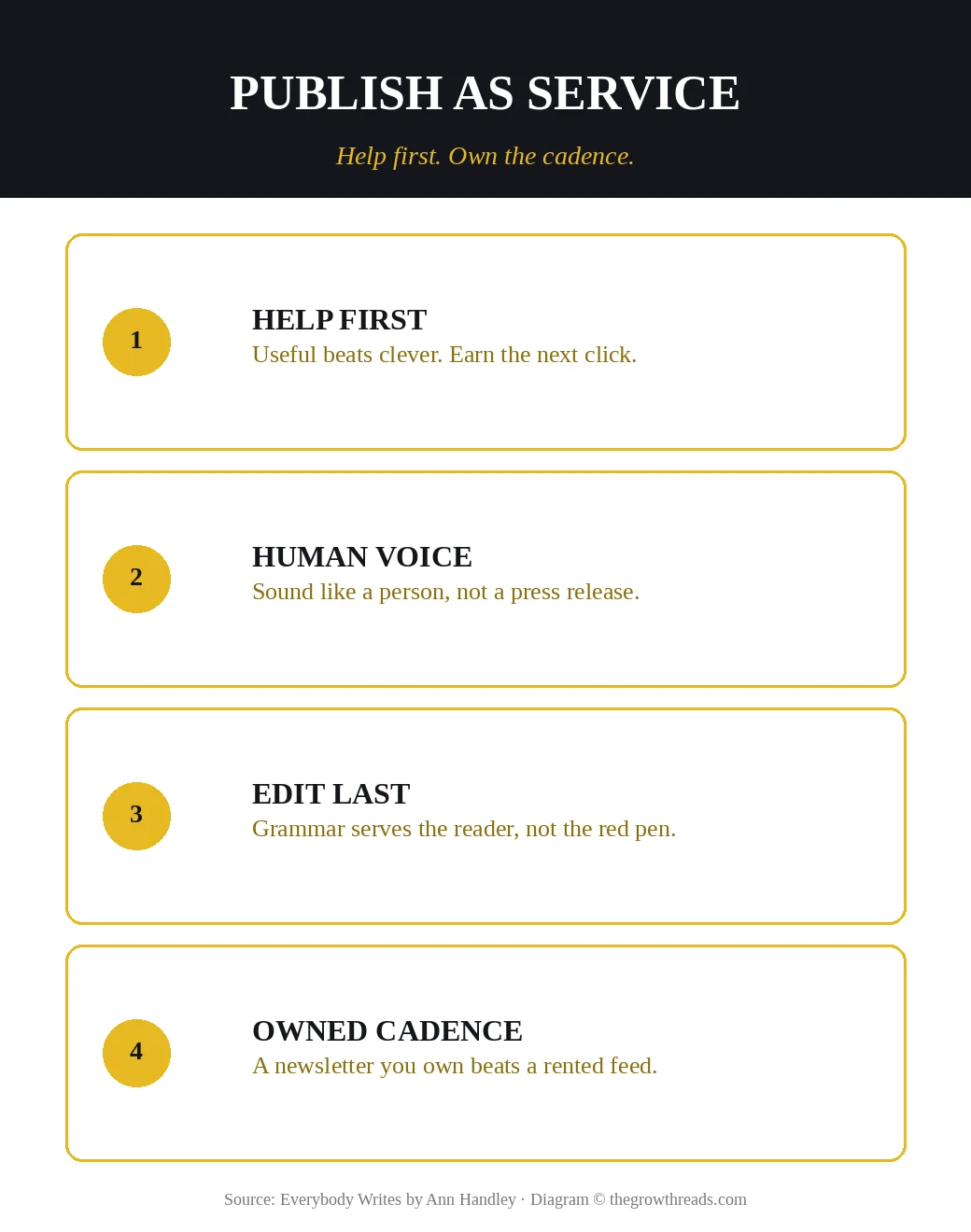
The second edition leans harder on formats you actually have to produce: emails, landing pages, posts, case studies, and, newly, newsletters. A newsletter is the owned cadence. The algorithm does not get a vote. You promise a useful thing on a schedule and you keep the promise. That sounds small. It is how a writer becomes someone a stranger expects to hear from, which is the only reliable distribution most operators will ever have.
Headlines and tools are where good drafts hide. A buried lede with a cute title still fails. Tools do not replace the shed. If the page helps Maya, hit the button, then put the next shed on the calendar. At team scale, track drafts started, pages published, and replies that prove the page did a job. Traffic alone keeps you decorating.
Who is Everybody Writes best for — and who should read something else first?
Best for marketers, founders, operators, and support leads who must ship useful pages and keep waiting to feel ready. It is also a fit for subject-matter experts who can talk for an hour and freeze at a blank CMS.
Read something else first if you want a fiction workshop — start with On Writing. If the draft already exists and the problem is stiff nonfiction, start with On Writing Well. If the sentence itself is the mess, start with The Elements of Style. If you have notes everywhere and no publishing problem yet, Building a Second Brain is the capture layer. Come back to Handley when the issue is not ideas — it is a missing weekly hour that ends in publish.
Questions to reflect on
- Who is the one named reader for the next page I owe — not a persona, a person?
- Where, exactly, is the shed on next week’s calendar, and what is allowed to cancel it?
- Which sentence in my last post would that reader answer with “so what?”
- Am I mixing jobs — hunting commas while the lede is still hiding?
- What cadence do I own that does not require a platform’s permission?
🔥 Ready to stop waiting to feel like a writer?
Install the habit this week: one shed, one named reader, one useful page that actually ships.
How to apply Everybody Writes (7-day plan)
- Day 1 — Name the reader. Write four sentences: who they are, what Tuesday looks like, the job they hired a page to do, and the so-what they would ask. Keep it at the top of the draft.
- Day 2 — Open the shed. Block 45 minutes. Ugly-draft 300 words toward that job. No editing. If you stall, write the worst possible version on purpose, then continue.
- Day 3 — So-what pass. Cut every line that does not change what the reader does next. Target half the length. Keep the specific numbers and names.
- Day 4 — First words. Rewrite the opening so the point is in sentence one. Delete the throat-clear. Read only the first 80 words to someone else and ask what the page is for.
- Day 5 — Read it aloud. Fix the sentences that make you run out of air. Swap sludge for words you would say to the named reader. Edit last, not first.
- Day 6 — Publish. Ship the page to a place you own — site, newsletter, or a list you control. One ask or next step. Then close the tab.
- Day 7 — Put the cadence on the calendar. Schedule the next four sheds before Sunday night ends. One useful page a week beats a perfect quarterly essay you never start.
Frequently asked questions
What is Everybody Writes about?
It is Ann Handley’s field guide for people whose job includes writing whether they like the word writer or not. The 2022 second edition walks through a habit (show up, draft ugly, rewrite, publish), a set of reader-first rules (one person, so what, first words first), grammar used as clarity, and publishing as a service — including newsletters and the formats marketers actually ship. Read it when the blank page is the bottleneck, not when you need a novelist’s workshop.
Who is Ann Handley?
Ann Handley is a marketer and the chief content officer at MarketingProfs. She came up as a journalist, then spent years teaching companies to sound like humans online. She co-wrote Content Rules in 2011 and published the first Everybody Writes in 2014; the 2022 edition is the one this summary uses. She is a Wall Street Journal bestselling author and a frequent keynote speaker. There is no Wikipedia page for her — her own site and MarketingProfs are the clean trail if you want talks and interviews.
What is the one-reader rule in Everybody Writes?
Handley wants you to pick a single human and write to that inbox. A demographic is a blur. A person has a Tuesday, a job, and a reason to leave the tab. Name them. Ask what would make them stay. Then run the so-what test: if that person would shrug, cut the line. The rule is not anti-scale. It is how scale stays readable. One clear letter beats a page that tries to please a committee and ends up pleasing no one.
Everybody Writes vs On Writing Well vs The Elements of Style?
Everybody Writes is for people who must publish useful pages as part of work — posts, emails, landing copy, newsletters. On Writing Well is Zinsser’s class on nonfiction style: humanity, simplicity, and the cut. The Elements of Style is a short manual for clean sentences. Use Handley when the problem is starting and shipping. Use Zinsser when the draft exists and sounds stiff. Use Strunk and White when the sentence itself is muddy. They stack; they do not replace each other.
Is the 2022 second edition worth it if I already have the first?
Yes if you still write for work. The habit and one-reader core are the same, which is why the first book lasted. The second edition adds a clearer writing framework, newer examples, a newsletter chapter, and a longer list of the formats marketers actually have to produce. If you already run a weekly publishing cadence and only wanted permission to write ugly drafts, the first edition already gave you that. If your job changed since 2014, use 2022.
How long does Everybody Writes take to read?
The Wiley hardcover second edition runs about 432 pages of short chapters. Most readers finish it in eight to ten hours. You can pull the habit, the one-reader rule, and the so-what test in an afternoon, then install them over a week. The hard part is the calendar, not the prose. Treat it as a desk manual: one rule, one draft, not a weekend binge you forget by Monday.
Is Everybody Writes only for marketers?
No. Founders, operators, support leads, and anyone whose work includes an email or a page will recognize the freeze. Handley uses marketing examples because that is her beat, but the mechanism is general: writing is a habit, the reader is one person, and publishing is a service. Skip it if you want a fiction workshop or a grammar textbook. Those jobs belong to On Writing and The Elements of Style. Come back here when the job is a useful page that has to ship this week.
Related summaries
- On Writing Well Summary & Review — the style class once the draft exists
- The Elements of Style Summary & Review — the short manual for clean sentences
- The Practice Summary & Review — show up and ship creative work
- Bird by Bird Summary & Review — short assignments and ugly first drafts
- Best productivity books — the full Productivity silo
How we analyze books: we paraphrase arguments, add original application notes, and skip chapter-by-chapter reproduction. Read our full methodology.