

★★★★½ 4.6/5 — talk to a customer every week, then map what you learned.
Best for: product trios and product coaches who already believe in discovery and still skip customers when the sprint gets loud
Reading time: ~6 hours (Product Talk paperback, 2021, 244 pp) · this guide ~14 min
Difficulty to apply: Medium — booking the interview is easy; comparing opportunities instead of jumping to a solution is the hard habit
Continuous Discovery Habits in one minute
If the product trio did not talk to a customer this week, they did not do discovery. That is Teresa Torres’s whole argument. Continuous Discovery Habits is not a research-methods textbook. It is a cadence: a product manager, a designer, and an engineer share one outcome, sit in the same customer conversations, map what they hear onto an Opportunity Solution Tree, and test the riskiest assumption before they scale a build.
Most teams still run discovery as a phase. They book a study, write a readout, then go dark until the next kickoff. Torres treats that gap as the product. The weekly habit is the product. If you only remember one move, put three customer conversations on this week’s calendar and refuse to start a solution until you can point to the opportunity it sits under.
Key takeaways
- Discovery is a weekly habit. A research project you reopen next quarter is not continuous.
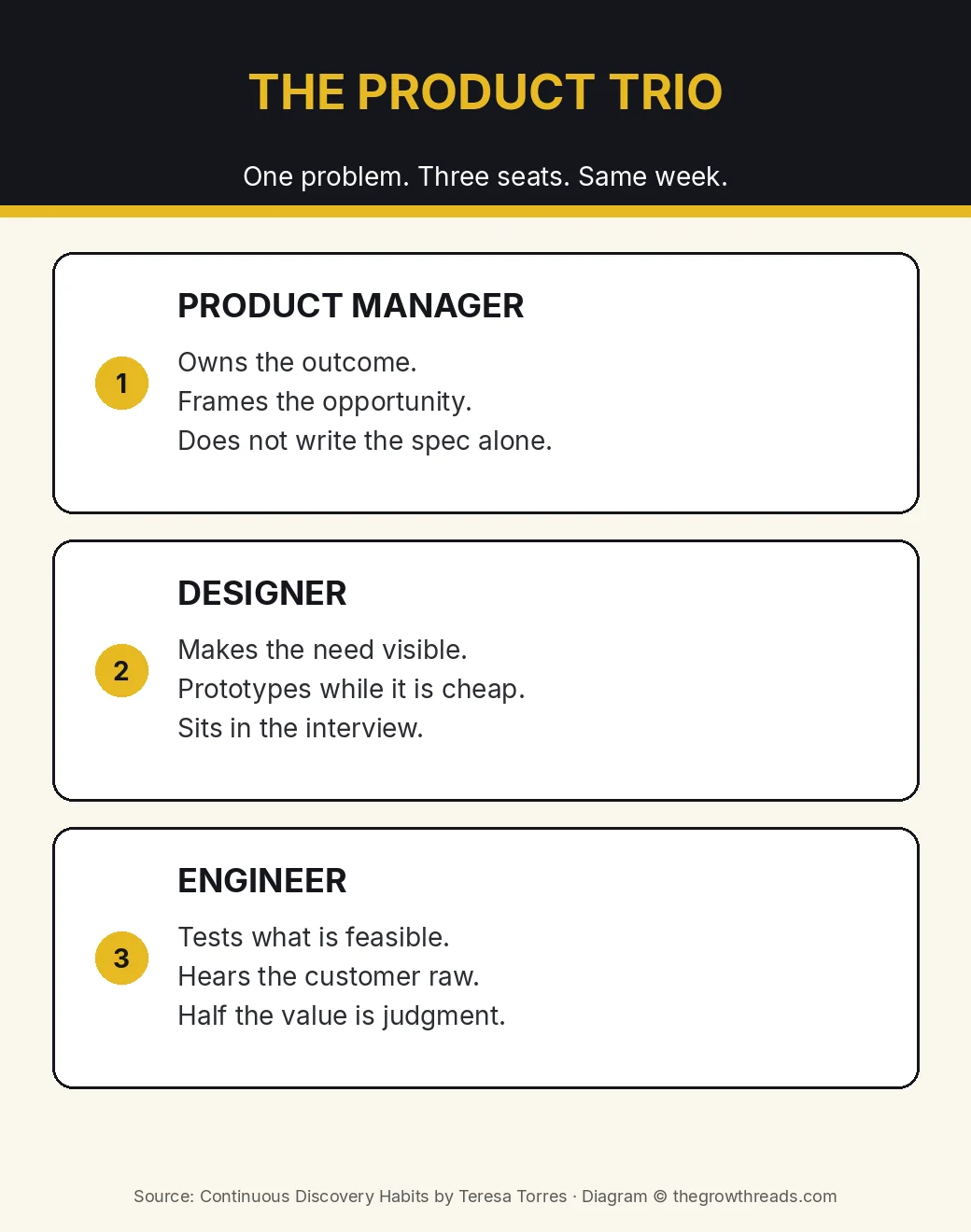
- The product trio owns it. PM, designer, and engineer hear the customer together — not as a handoff.
- Start with an outcome. A feature name is a solution wearing a metric costume.
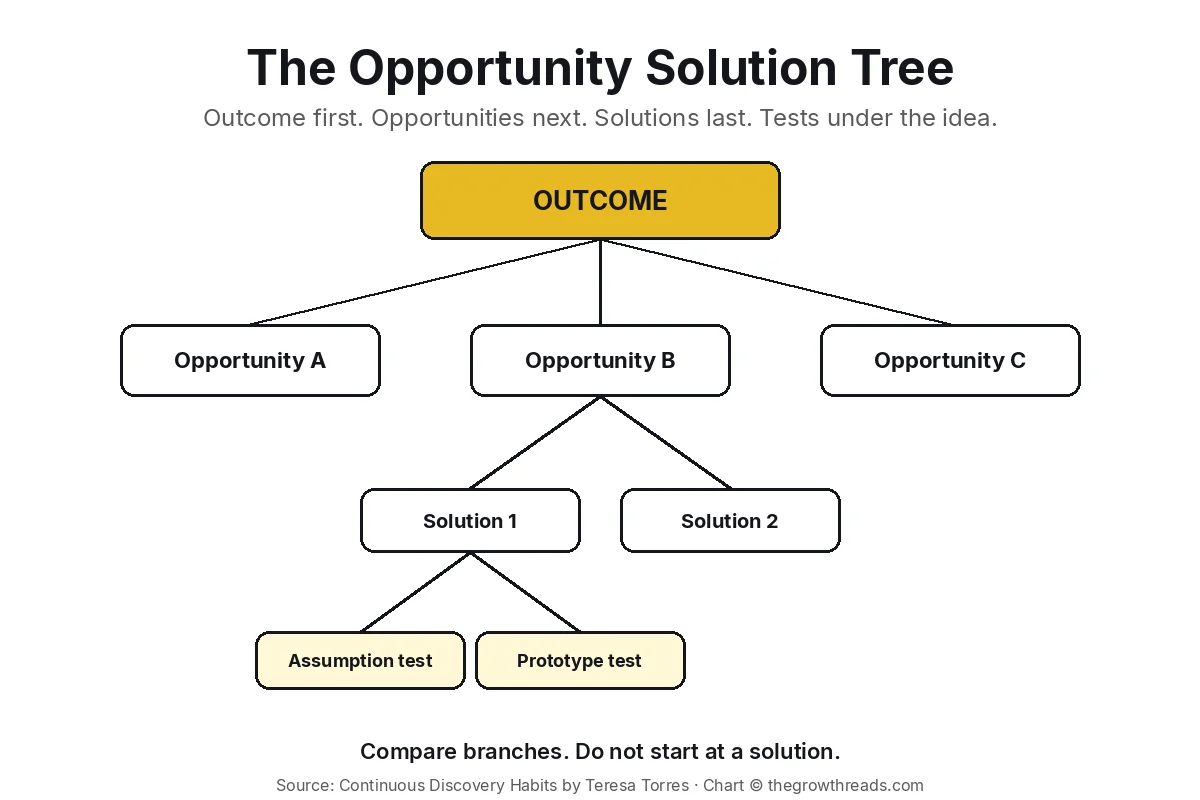
- Draw the Opportunity Solution Tree. Outcome at the top, opportunities next, solutions last, tests under the idea.
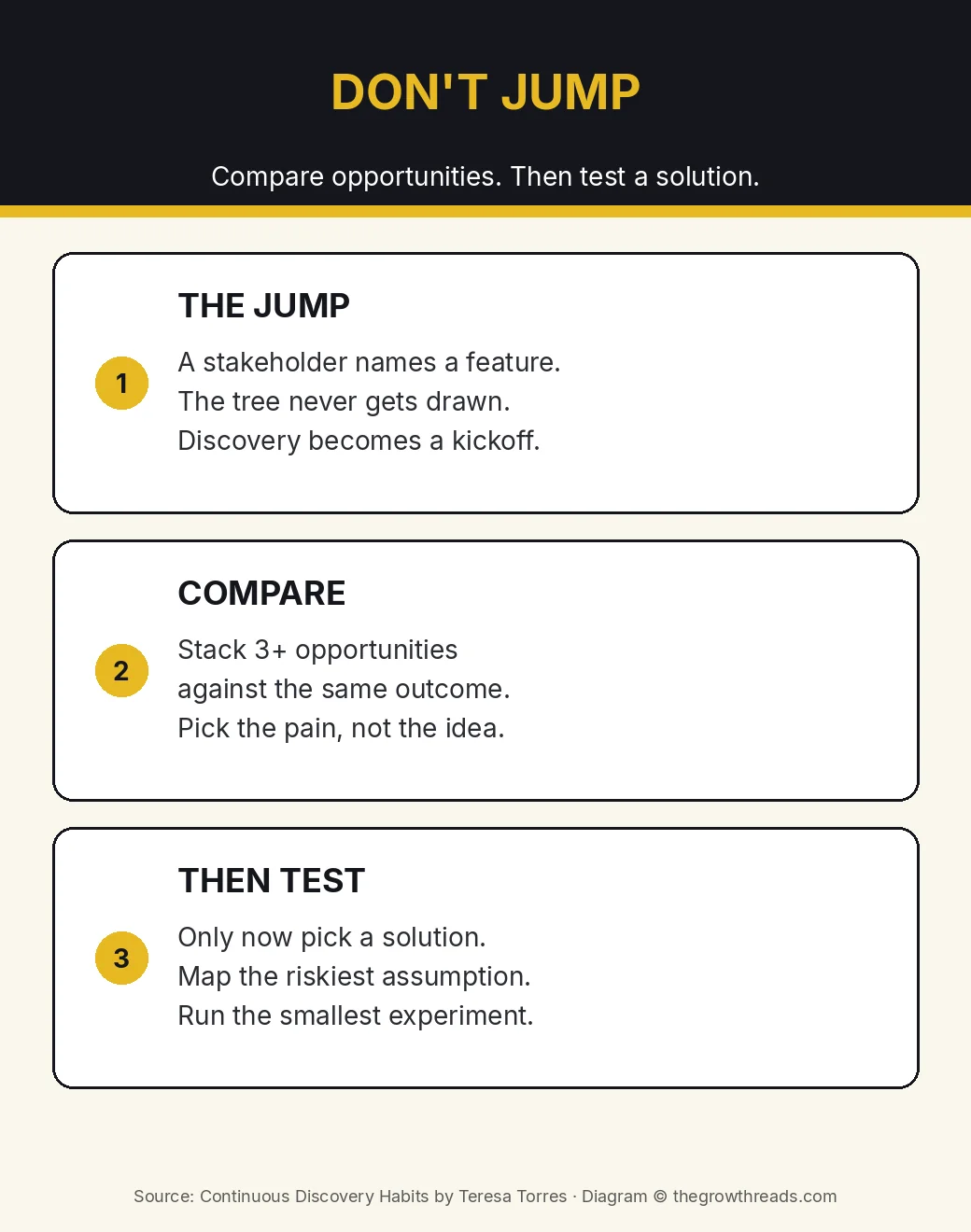
- Compare opportunities. Do not jump to the first request a stakeholder named.
- Interview for stories, not requests. Ask what they did, not what you should build.
- Capture a snapshot. One page beats a 40-slide readout nobody rereads.
- Test assumptions, not opinions. Map what must be true; run the smallest experiment that could kill the idea.
- The backlog is why you need the habit. Wait until it is clean and you will never start.
What is Continuous Discovery Habits about?
Continuous Discovery Habits is Teresa Torres’s manual for making customer discovery a weekly practice instead of a project. A product trio talks to customers every week, maps opportunities on a tree, and tests assumptions before they scale a build. It is a cadence, not a research phase.
About the author
Teresa Torres is a product-discovery coach and the founder of Product Talk, where she has taught thousands of product people a structured way to talk to customers every week. She coaches teams from early-stage startups to global enterprises and is the person Marty Cagan points to when a trio needs the operating system, not just the job description. Continuous Discovery Habits (2021) is her field guide: the Opportunity Solution Tree, the interview snapshot, and the assumption test, written so a busy team can run them without a research department. She does not argue that you should care about customers. She argues that caring is not a habit until it is on the calendar. That is why the book is short, stubborn, and built for people who already have a backlog. Explore all Teresa Torres book summaries →
Key concepts at a glance
| Concept | What it means | Use it when |
|---|---|---|
| Continuous discovery | Weekly customer touchpoints, not a research phase | You last spoke to a customer at kickoff |
| Product trio | PM, designer, and engineer share one outcome | Research is someone else’s job |
| Outcome | A measurable customer or business change | The roadmap is a list of features |
| Opportunity Solution Tree | Map of outcome → opportunities → solutions → tests | You jumped from a request to a build |
| Interview snapshot | One-page story, quote, opportunity, clip | Learnings live in a 40-page deck |
| Compare and contrast | Stack opportunities before picking a solution | The first idea always wins |
| Assumption mapping | What must be true, sorted by risk and unknown | The debate is still opinion |
| Smallest test | The cheapest experiment that could kill the idea | You are about to build to learn |
Part 1: A weekly habit, not a research project
Torres opens with a diagnosis every product person has lived. The team ran interviews. They wrote a readout. Then delivery swallowed the calendar, and the next time a customer sat in the room was the launch. That gap is not a motivation problem. It is a design problem. Project-based discovery produces a burst of learning and a long silence. Continuous discovery produces a weaker burst and a stronger week: at least one customer conversation, captured while it is still cheap to change the bet.
The unit of work is the product trio. A product manager who interviews alone comes back with a story the designer did not hear and an engineer cannot challenge. A designer who joins after the spec is frozen is decoration. An engineer invited only to estimate is half-used. Torres wants all three in the conversation because discovery is a decision, not a transcript. The weekly minimum is stubborn on purpose. If the trio skipped customers this week, they did not do discovery — they did delivery with a research costume. Put the conversations on the calendar first, the way you put standup on the calendar. Then defend them.
TGR Note: If the trio does not yet know the job — four risks, discovery beside delivery, prototypes instead of a PRD — send them to Cagan’s Inspired first. Torres will not land if nobody in the room has seen discovery up close. If the conversations themselves are polite and useless, pair with Fitzpatrick’s The Mom Test.
Part 2: Outcomes and the Opportunity Solution Tree
A habit without a map still jumps. Torres’s map is the Opportunity Solution Tree. The outcome sits at the top: a customer or business change you can measure — time-to-value, activation, a workflow people trust. Under it, opportunities branch: unmet needs, pain, jobs to be done. Solutions hang under a chosen opportunity. Experiments hang under a solution. The tree is how you stop a stakeholder’s feature from becoming the whole strategy. A feature name is already a solution. If it is sitting at the top of your board, you skipped the work.
The move that feels slow and saves months is compare-and-contrast. Stack three opportunities against the same outcome before you pick one. Teams skip this because the first request arrived with a slide and a date. Torres wants the trio to argue about which pain is worth a week, not which mock is prettier. Only then do you generate more than one solution for that opportunity. One solution is a hope. Two is a start. The tree also keeps tests in their place: an experiment answers a question under a solution, it does not replace the outcome. If you cannot point to the branch you are on, you are collecting stories.
TGR Note: Cagan’s Empowered is the leadership twin of this chapter: give the team a problem and an outcome, not a roadmap of solutions. Torres then gives that team the map. If you need a five-day prototype once an opportunity is chosen, use Knapp’s Sprint inside the week rather than waiting for a perfect tree.
Part 3: Interviewing for opportunities
The weekly conversation is not a focus group and not a demo. Torres wants stories about the past: what the person tried, where they got stuck, what they did next. Asking “would you use this?” produces compliments. Asking “walk me through the last time this broke” produces opportunities. The trio listens for unmet needs, not for feature requests. A request is already a solution. An opportunity is the pain underneath it. If you cannot retell the story without your product in it, you interviewed your roadmap.
Synthesis has to be as light as the interview. Torres’s snapshot is one page: the story, a short quote, the opportunity it suggests, a clip if you have one. That page is what goes on the tree. A 40-slide readout is how learning dies in a folder. After a few weeks you compare snapshots, look for repeating opportunities, and resist the urge to average unique stories into a persona nobody met. Hidden opportunities show up when two customers describe the same workaround in different words. The workaround is the product they already built. Your job is to notice it before you invent a worse one.
TGR Note: Fitzpatrick’s The Mom Test is the conversation craft this chapter assumes: talk about their life, not your idea. Torres then tells you where the quote goes — on a snapshot, then on a branch of the tree. If you only fix the questions and never map the week, you will still jump to a solution. If you only draw the tree and never hear a story, the branches are guesses.
Part 4: Testing solutions on a weekly cadence
Once an opportunity is worth a week, Torres does not want a six-month build to learn. She wants the assumption map: what must be true for this solution to work, sorted by how important and how unknown. The riskiest unknown goes first. The test should be the smallest experiment that could kill the idea — an unmoderated prototype, a concierge run, a fake door, one question in a survey, a Wizard of Oz. Building the full product to “get data” is how teams launder a guess into a roadmap.
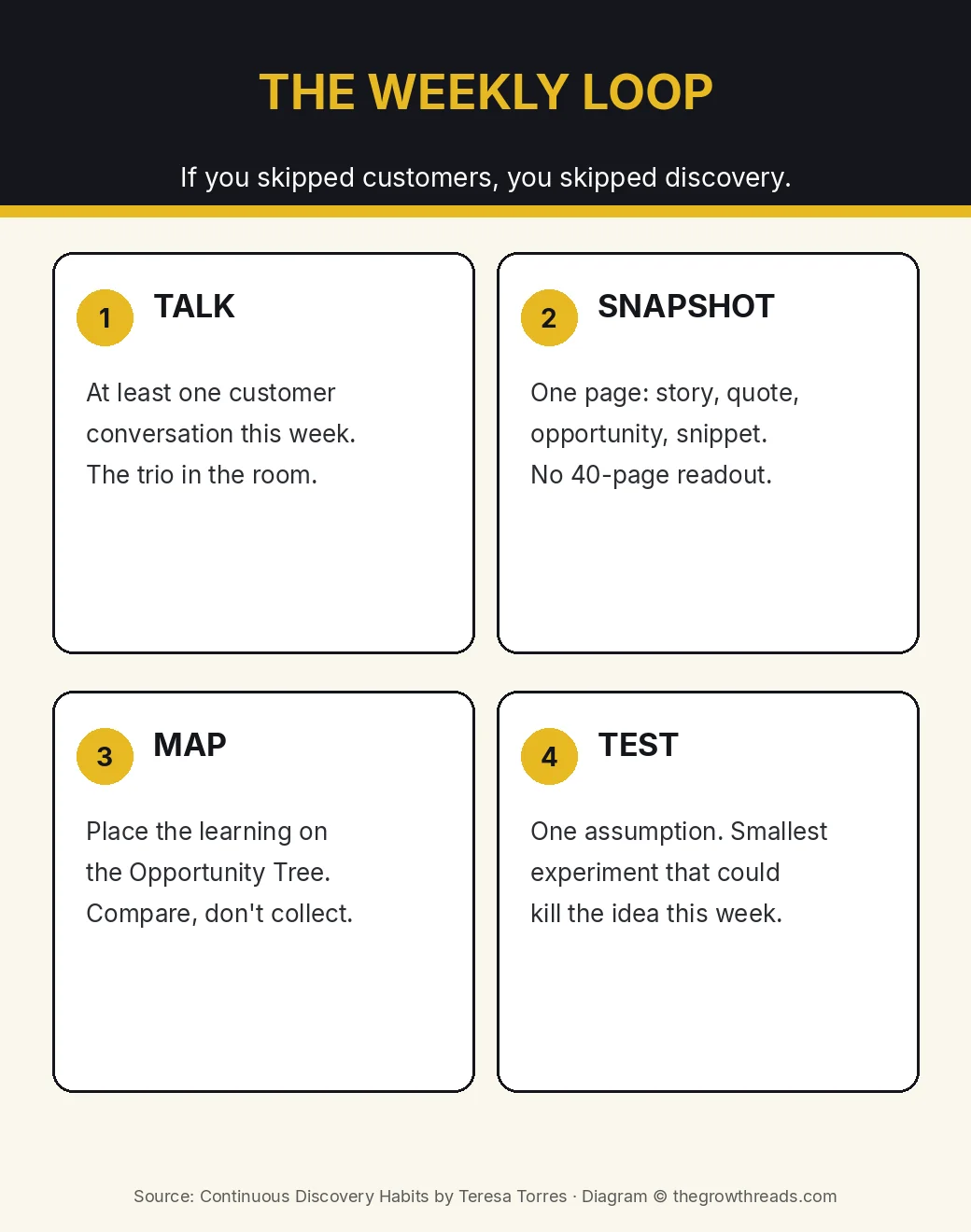
Story mapping keeps the solution honest: the customer’s steps, not your screens. Measure the outcome you put at the top of the tree, not tickets closed. Then run the loop again. Torres’s cadence is daily, weekly, quarterly without turning any of it into theater. Daily: look at the tree. Weekly: talk, snapshot, map, test. Quarterly: check whether the outcome is still the right top node. Overcoming the usual objections — legal, sales, “we already know our customers” — is part of the job. The backlog will never grant you a discovery month. That is why the habit is weekly, and why a week with no customer is a week with no discovery.
TGR Note: Ries’s The Lean Startup gave a generation the build-measure-learn slogan. Torres specifies the weekly version for a product trio that already has customers. If delivery itself is the constraint, pair with The Phoenix Project. If you need a customer narrative before the tree, Working Backwards is the altitude above this chapter.
Who is Continuous Discovery Habits best for — and who should read something else first?
Best for product trios, product coaches, and founders who already sit close to the work. If you can put a customer on this week’s calendar, this book names the job you are actually in.
Read something else first if you have never seen discovery as a job — start with Inspired. If the gap is how you talk, read The Mom Test. If leadership still assigns solutions on a date, Empowered is the companion. If the gap is personal focus rather than product cadence, Deep Work will move this week more. Come back when you can change what the trio does on Wednesday.
Questions to reflect on
- When did this trio last sit in a customer conversation together — not a demo, a conversation?
- Which item on the roadmap is a solution with no opportunity under it?
- If you had to draw your current work as a tree, what sits at the top: an outcome or a feature name?
- What is the riskiest unknown on the idea you are about to build, and what is the smallest test that could kill it?
- What would you cancel this week to defend three customer conversations?
🔥 Ready to put a customer on this week’s calendar?
Get Continuous Discovery Habits, then use the 7-day plan to run one weekly loop.
How to apply Continuous Discovery Habits (7-day plan)
- Day 1 — Name the outcome. Write one measurable customer or business change. Delete any feature name from the sentence. If you cannot measure it, it is not an outcome yet.
- Day 2 — Draw a first tree. Outcome at the top. Three opportunity branches from what you already know. No solutions on the page until the opportunities exist.
- Day 3 — Book three conversations. Put them on the trio’s calendar this week or next. The PM, designer, and one engineer all attend. Treat a cancel like skipping standup.
- Day 4 — Run one interview. Ask about the last time the job broke. Write a snapshot the same day: story, quote, opportunity. Do not schedule a readout meeting.
- Day 5 — Compare, then choose. Put the new opportunity on the tree. Stack it against two others. Pick one branch. Generate two solutions for that branch only.
- Day 6 — Map assumptions. For the leading solution, list what must be true. Circle the riskiest unknown. Design the smallest test that could kill the idea this week.
- Day 7 — Close the loop. Look at the tree. Kill or demote one solution with no evidence. Put next week’s customer conversations on the calendar before you open the backlog.
Frequently asked questions
What is Continuous Discovery Habits about in one paragraph?
Continuous Discovery Habits is Teresa Torres’s field guide for product teams who still treat customer research as a project. She argues that discovery has to be a weekly habit: the product manager, designer, and engineer talk to customers together, map what they hear onto an Opportunity Solution Tree, and test the riskiest assumption before they scale a build. The book is a working manual, not a manifesto. If you already know you should talk to customers and still ship features nobody asked for, this is the structure that makes the habit survive a busy sprint.
Is Continuous Discovery Habits still relevant in 2026?
Yes. Tools got faster. The failure mode did not. Teams still run a research phase, then go dark for a quarter, then wonder why the product missed. Torres’s weekly minimum — at least one customer conversation, a one-page snapshot, a living tree — still fits a 2026 calendar of Slack and tickets. Faster prototypes make testing cheaper; they do not replace hearing a customer describe the job. The 2021 Product Talk paperback is the edition people search for as a Continuous Discovery Habits summary: the same trio, the same tree, the same weekly loop.
What is an Opportunity Solution Tree?
It is Torres’s map of a product space. The outcome sits at the top — a customer or business change you can measure. Opportunities branch under it: unmet needs, pain, jobs. Solutions hang under a chosen opportunity. Experiments hang under a solution. The point is not a pretty diagram. It is to stop jumping from a stakeholder’s feature to a build. You compare opportunities against the same outcome before you fall in love with an idea. If you cannot point to the branch you are on, you are not doing discovery; you are collecting stories.
How often should you talk to customers in continuous discovery?
At least once a week. Torres is blunt: if the product trio did not speak with a customer this week, they did not do continuous discovery. The interview is not a research project and not a 40-page readout. It is a conversation the product manager, designer, and engineer attend together, then capture in a snapshot — story, quote, opportunity, clip. Three conversations in a week beat one giant study you never reopen. Put them on the calendar first, then defend them the way you defend standup.
Should I read Continuous Discovery Habits or Inspired first?
If you need the job description for a product trio, start with Cagan’s Inspired: four risks, discovery beside delivery, prototypes instead of a PRD. Continuous Discovery Habits is the weekly operating system that trio actually runs. Read Torres first if you already believe in discovery and still skip customers when the sprint gets loud. Pair them. Inspired without the weekly habit becomes a slide. The habit without Inspired’s risks becomes interviews with no decision. The Mom Test is the third book if the conversations themselves are polite and useless.
How long does it take to apply Continuous Discovery Habits?
You can start this week. Pick an outcome, draw a first tree on a whiteboard, and book three customer conversations. The 7-day plan at the end of this Continuous Discovery Habits summary is deliberately small: one snapshot, one compared opportunity, one assumption test. Building a durable cadence takes a month or two of protected calendar, not a transformation offsite. Do not wait until the backlog is clean. The backlog is why the habit has to be weekly. If leadership still assigns solutions on a date, read Empowered alongside this book.
Is Continuous Discovery Habits only for product managers?
No. Torres writes for the product trio — product manager, designer, and engineer — because discovery is a shared job. A designer who joins after the spec is frozen is decoration. An engineer invited only to estimate is half-used. Founders and heads of product should read it to see why a research phase is not a habit. Skip a cover-to-cover pass if you do not influence what gets built this month; The Mom Test or Sprint will move a solo week faster. Come back when you can put a customer on the trio’s calendar.
Related summaries
- Inspired — the job description for the trio this book puts on a weekly cadence.
- The Mom Test — customer conversations that do not compliment your solution.
- Empowered — the leadership twin: give problems, not roadmaps.
- Sprint — five days of evidence once an opportunity is chosen.
More in this silo: best productivity books.
How we analyze books: every book on The Growth Reads is read cover to cover, summarized in thousands of words of original analysis, and rated against our five-criteria rubric (lasting impact, evidence quality, practical application, writing & originality, external consensus). Read our full methodology.