

★★★★½ 4.5/5 — A full inner-and-outer stack: raise the self-image, write the goal, then move it daily.
Best for: Knowledge workers who already know they “should set goals” and still run a busy week that does not match the life they say they want.
Reading time: ~7 hrs (guide: 14 min)
Difficulty to apply: Easy to write one goal tonight; honest on daily action and the inner picture that keeps shrinking the week.
Maximum Achievement in one minute
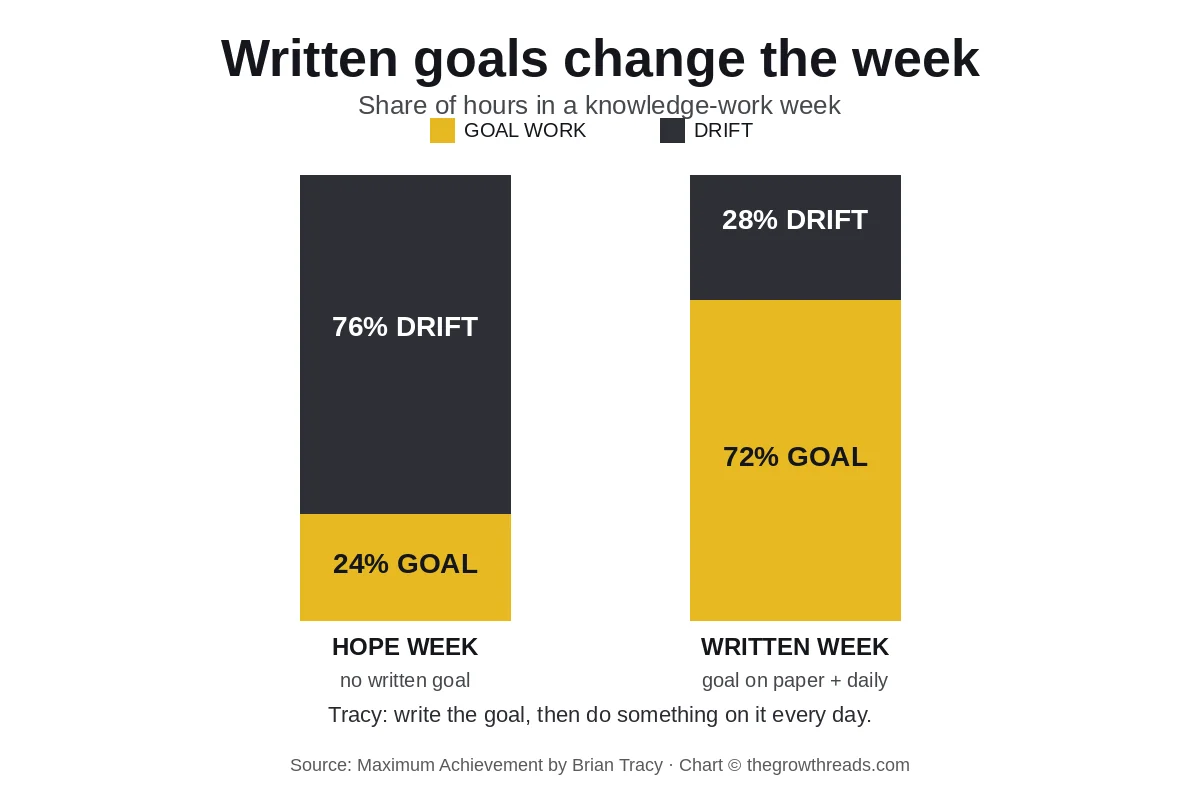
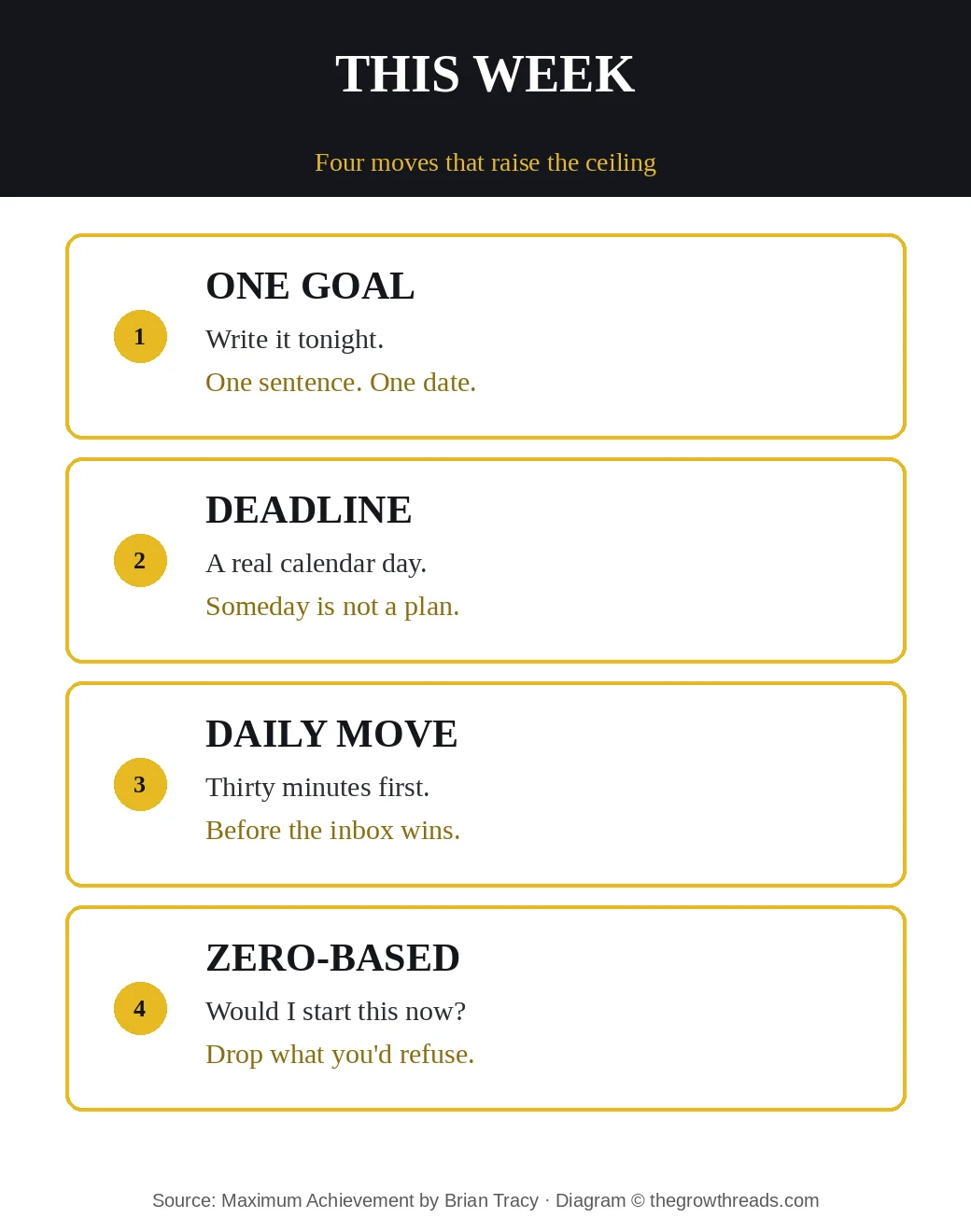
Most people try to outwork a self-image that has already decided how far they are allowed to go. Brian Tracy’s Maximum Achievement (Simon & Schuster, 1993; this paperback 1995) is the long-form manual underneath Eat That Frog and Goals!: your self-concept is the ceiling, seven inner laws run the week whether you name them or not, and a written goal with a daily move is the master skill. If you take one move from this Maximum Achievement summary, write one goal in a sentence tonight, put a date on it, and do thirty minutes on it tomorrow before the inbox opens.
Key takeaways
- Self-concept is the ceiling: Results cannot outrun the inner picture of who you are. Raise the picture, then the week can follow.
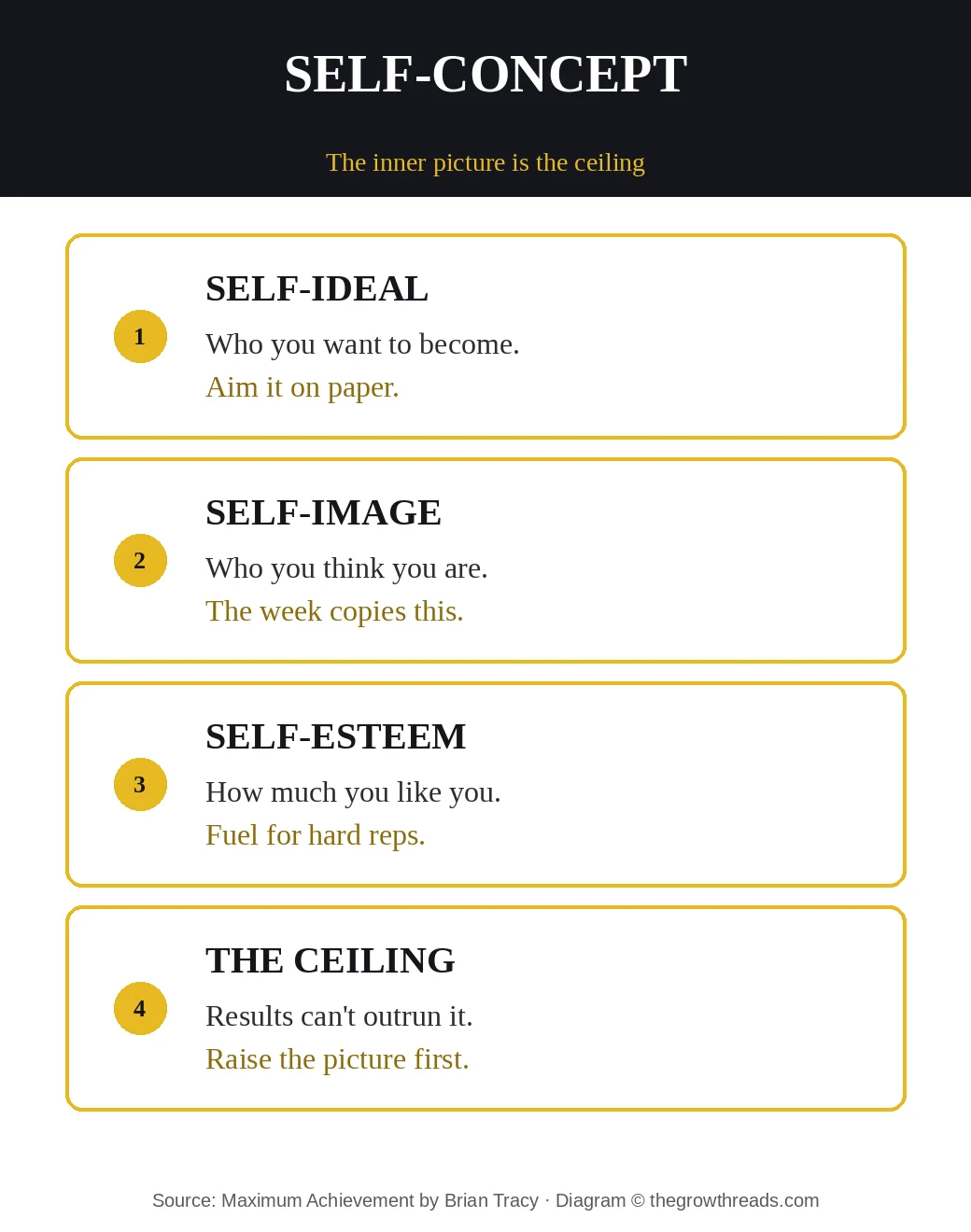
- Three parts, one limit: Self-ideal (who you want to become), self-image (who you think you are), self-esteem (how much you like yourself).
- Cause and effect still applies: Thoughts and actions are causes. The calendar is the effect. Hope is not a mechanism.
- Belief and expectation steer behavior: What you believe with feeling, and expect with confidence, shows up as the tasks you start or dodge.
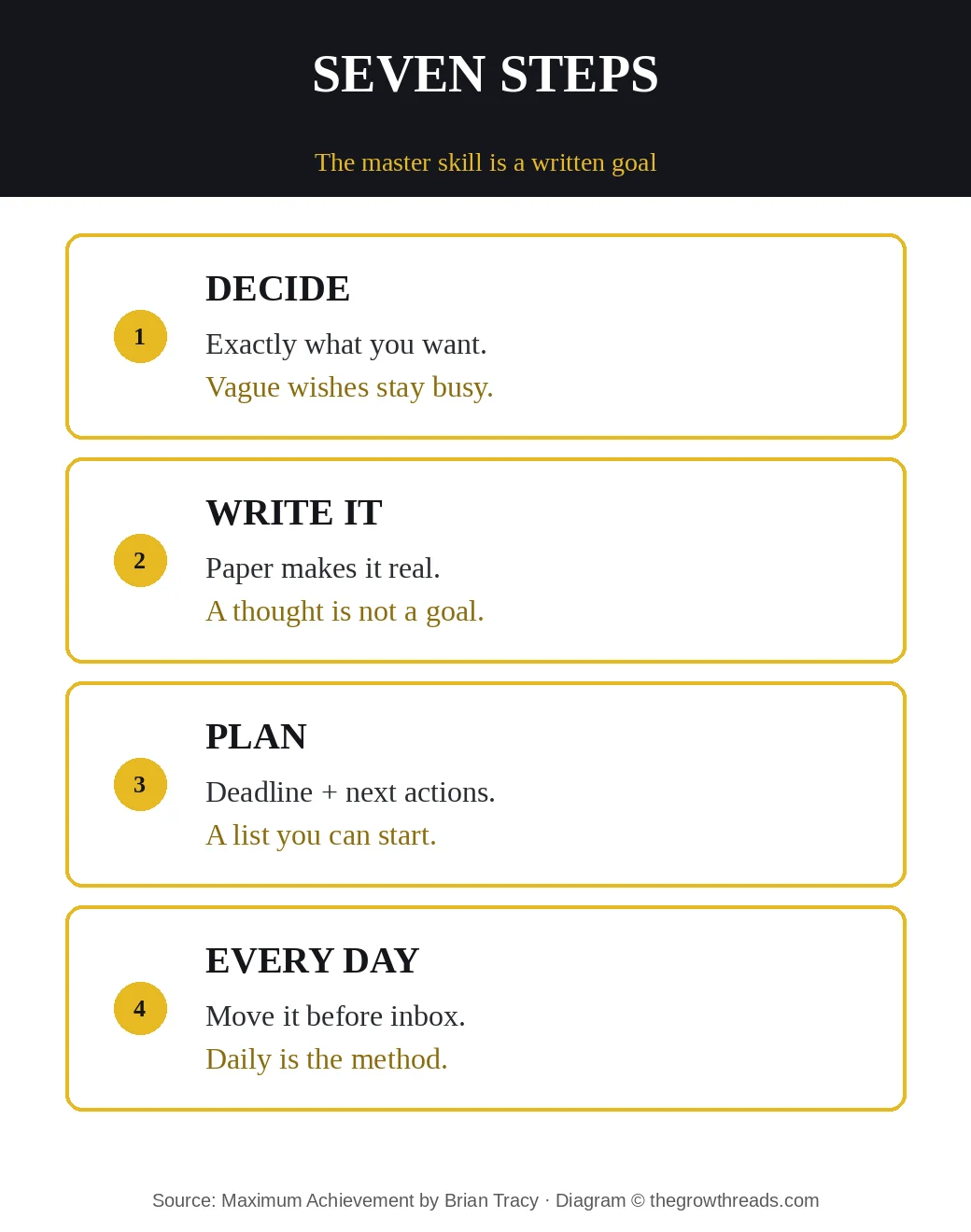
- Goals are a written technology: Decide exactly, write it, deadline it, plan it, start now, move it daily. A wish in your head is not a goal.
- Zero-based thinking: Knowing what you now know, would you start this again? If not, stop feeding it.
- Comfort is a fence: People perform to the level that still feels like “me.” Stretch the identity on purpose.
- Courage is the multiplier: Do the uncomfortable move while you are still unsure. Waiting to feel ready is a stall.
- The extra few percent read and practice: Skill compounds. Scrolling does not. Protect a learning hour.
What is Maximum Achievement about?
Maximum Achievement is Brian Tracy’s full playbook for raising performance by raising the inner picture — self-concept, seven mental laws, and a written seven-step goal method — so a busy professional can stop hoping the week will magically match the life they describe in conversation.
About the author
Brian Tracy is a Canadian-American writer and speaker whose name is attached to eating the frog: do the hard thing first. He spent years in sales, then built a training company around goals, time use, and self-discipline. Eat That Frog! is the thin weekly tool. No Excuses! is the discipline spine. Goals! is the written-target drill. Maximum Achievement is the earlier, thicker synthesis: why the inner picture caps the outer week, and what to do about it on a Tuesday. He is asking you to write one goal and live as if the ceiling can move. Explore all Brian Tracy book summaries →
Key concepts at a glance
| Concept | What it means | Use it when |
|---|---|---|
| Self-concept | Inner picture that caps results | You work hard and stay at the same level |
| Self-ideal / image / esteem | Who you want, who you think you are, how you like you | The week does not match the talk |
| Law of control | You feel better when you choose the next move | The inbox is running you |
| Cause and effect | Thoughts and acts are causes | You treat luck as the plan |
| Seven-step goal | Decide, write, deadline, list, plan, start, daily | The goal still lives in your head |
| Zero-based thinking | Would I start this again, knowing what I know? | A project is a sunk-cost hobby |
| Comfort zone | The identity fence around “people like me” | You shrink back after a good week |
| Courage as a skill | Act while uncertain | You wait to feel ready |
Part 1 — Self-concept is the ceiling
Tracy opens where most productivity books skip: the inner picture. Self-concept is not a mood. It is the operating limit. He splits it into three working parts. The self-ideal is the person you most want to become — values, standards, the future you can describe. The self-image is the current inner snapshot: what you think you are like at work, in money, in health, in a hard conversation. Self-esteem is how much you like that person. Performance, in this model, cannot stay above the snapshot for long. A good week that feels “not like me” gets quietly undone. That is not mysticism. It is how people return to the size of life that still feels true.
The useful cruelty is this: extra hours on a goal your self-image has not accepted will look like hustle and feel like fraud. Tracy’s first job is not a longer list. It is to write a clearer ideal, tell the truth about the current image, and keep one small public standard that belongs to the person you want to be.
For a knowledge worker the drill is small. Write three lines tonight: the professional you want to be in twelve months, the professional you actually behaved like last week, and one standard you will keep tomorrow that belongs to the first person, not the second. If those three lines are identical, you do not have a goal problem. You have a honesty problem. If they diverge, the gap is the week’s real work — not another app.
TGR Note: Psycho-Cybernetics is Maxwell Maltz on the same ceiling: the self-image as a thermostat. As a Man Thinketh is the older, shorter version — thought as the inner weather. Use Maltz when you need the servo-mechanism metaphor. Use Allen when you need a ten-page reset. Use Tracy when you want that inner picture wired to a written goal and a Tuesday calendar, not left as a philosophy.
Part 2 — Seven inner laws that already run the week
The middle of the book is a set of mental laws Tracy treats as cause-and-effect, not decoration. Control: you feel better when you choose the next move. Cause and effect: thoughts and actions are causes; the calendar is the effect. Belief and expectation filter what you attempt. Attraction, in his practical reading, is the people and tasks your dominant thoughts keep putting in front of you. Correspondence: the outer week matches the inner conversation. Mental equivalency: you need a clear inner version of the result before the week can aim at it.
You do not have to accept every label to use the stack. Control is the one that pays on a Monday. If the inbox, the chat, and other people’s fires set the sequence, you will feel small even after a “full” day. Cause and effect is the one that kills magical thinking: the unread goal document is a cause. Belief and expectation show up as the meeting you postpone. Correspondence is why a contemptuous inner monologue and a generous calendar rarely coexist for long.
Make it physical. For one week, mark each work block as chosen or inherited. Chosen means you decided it against a written goal. Inherited means it arrived. You do not need a new personality. You need a higher ratio of chosen blocks before noon. That is the law of control in a spreadsheet.
TGR Note: How Successful People Think is Maxwell on aiming the week with better questions. Use Maxwell when the stall is sloppy thinking. Use Tracy’s laws when the stall is a week that is already “full” and still not yours — you have activity, and you still do not have control.
Part 3 — Goals are the master skill
Tracy calls goal-setting the master skill of success, and then he refuses to leave it as a slogan. The seven-step method is the book’s engine: decide exactly what you want; write it down; set a deadline; list everything you can think of that would help; organize the list into a plan; take action immediately; do something every day that moves it. A goal that stays in your head is a wish. A goal without a date is a poster. A plan you do not start today is a hobby. Daily action is the method that turns the other six steps into a life.
He also gives you an exit ramp: zero-based thinking. Knowing what you now know, would you start this job, this project, this commitment again? If the honest answer is no, stop pouring hours into a sunk story. That question is more useful than another motivational chapter. It clears the calendar so the written goal has somewhere to live.
This is where Goals! later became the dedicated field manual. Maximum Achievement is the why plus the method in one cover. Eat That Frog is how you protect the first hard block. Together they are one system: a picture, a sentence, a date, a first action tomorrow morning. If you only collect the laws and never write the sentence, you have bought a poster of achievement.
TGR Note: Goals! is Tracy’s later, tighter drill on written targets worked daily. Eat That Frog is the morning sequence that defends the first move. Use Goals! when you already believe in writing it down and need the weekly ritual. Use the frog when the stall is starting. Use Maximum Achievement when the stall is deeper: you will not even write the goal because the inner picture says it is not for people like you.
Part 4 — Courage, character, and the extra few percent
The last movement is character under pressure. Courage, for Tracy, is not a mood you wait for. It is doing the uncomfortable thing while you are still unsure — the call, the draft, the ask, the workout, the honest no. The comfort zone is the identity fence: after a stretch week, people often shrink back to the size that still feels like them. That is the self-image reasserting the ceiling. The counter is a small public standard, repeated, until the new size feels ordinary.
He also argues that a small slice of people keep learning on purpose while everyone else consumes. The 1990s examples are dated; the ratio is not. A protected hour with a book, a course, or deliberate practice will still beat a feed. Combine that with relationships you choose on purpose — people who expect more of you — and the week has a different gravity. Tracy’s line you can actually use: you become what you think about most of the time. If the dominant thought is the inbox, the inbox wins. If the dominant thought is the written goal, the calendar starts to look like it.
Make a card: one goal, one date, one daily block, one thing you would not start again. That is Maximum Achievement without the seminar. No Excuses! will hold you when the feeling drops. Grit will hold you when the timeline is years. Tracy would still start with the sentence on paper tonight.
TGR Note: No Excuses! is Tracy’s later discipline book — do it whether you feel like it. The 10X Rule is Cardone’s volume dial, useful when you are still under-acting after the goal is clear. Use those when the picture is already raised and the week is still timid. Use Maximum Achievement when the timid week is coming from the inner snapshot, not from a missing pep talk.
Who is Maximum Achievement best for — and who should read something else first?
Best for professionals who already agree that goals matter and still cannot point to a written target with a date and a daily block. Especially useful if you have outgrown thin hacks and need the inner picture named, not just another morning routine.
Read something else first if you need a short weekly system — start with Eat That Frog or Goals!, then come back for the self-concept chapters. If the wound is specifically the inner snapshot, start with Psycho-Cybernetics. If you need permission to drop a sunk project before you add a goal, use Tracy’s zero-based question on one commitment this week, then write the new sentence. Come to this book when the bottleneck is the ceiling, not a missing app.
Questions to reflect on
- What inner picture of “people like me” is currently capping the week?
- Which block on tomorrow’s calendar is chosen against a written goal — and which is inherited?
- What exact result would you want if you had to write it in one sentence tonight?
- Knowing what you now know, which project would you not start again?
- What thirty-minute move will you do before the inbox, five days in a row?
🔥 Ready to raise the ceiling this week?
Write one goal, put a date on it, and move it daily before the inbox opens.
How to apply Maximum Achievement (7-day plan)
- Day 1 — Three lines. Write self-ideal, last week’s actual self-image, and one standard that belongs to the first. Keep the page.
- Day 2 — One sentence. Decide exactly one result. Write it in one sentence. If you cannot, it is still a mood.
- Day 3 — A date. Put a real deadline on the sentence. Someday is not a plan. Put the date where you will see it.
- Day 4 — The list. Brain-dump every action that would help. Circle the first one you can do in thirty minutes.
- Day 5 — Start before inbox. Do that thirty minutes first. Mark the block chosen, not inherited.
- Day 6 — Zero-based cut. Name one commitment you would not start again. Stop feeding it this week.
- Day 7 — Review the picture. Did the week match the sentence. Keep the daily block. Rewrite the ideal if it was vague.
Frequently asked questions
What is Maximum Achievement about?
Maximum Achievement is Brian Tracy’s 1993 playbook for raising results by raising the inner picture. He argues that self-concept — self-ideal, self-image, and self-esteem — sets a ceiling on performance, that a handful of mental laws already run your week, and that a written seven-step goal is the master skill. The usable residue is not a seminar of slogans. It is one exact goal on paper, a date, a daily move before the inbox, and a willingness to drop work you would not start again. It is the thicker Tracy book underneath Eat That Frog and Goals!.
What is self-concept in Maximum Achievement?
Tracy treats self-concept as the inner operating limit made of three parts. Self-ideal is who you want to become. Self-image is who you currently believe you are. Self-esteem is how much you like that person. The week tends to return to the image, even after a stretch of good days, because people perform at the size that still feels like them. The TGR application is to write the three parts down, pick one standard that belongs to the ideal, and keep it tomorrow morning. You do not wait for a new personality. You move the picture with a kept standard.
Is Maximum Achievement worth reading if I already read Goals! or Eat That Frog?
Yes if you want the inner ceiling named, not another thin weekly tactic. Eat That Frog is the first hard block. Goals! is the written-target ritual. Maximum Achievement is why those tools stall when the self-image has not accepted the result — plus the seven-step method and zero-based thinking in one cover. If Tracy already got you to write goals and eat the frog, this book is useful when the week still snaps back to the old size. Skip it as a first Tracy if you need a 100-page field manual; start with the frog or Goals!, then return for the self-concept chapters.
How is Maximum Achievement different from Psycho-Cybernetics?
Psycho-Cybernetics is Maltz on the self-image as a thermostat and a mental servo-mechanism. Maximum Achievement takes that ceiling and wires it to Tracy’s goal technology: decide, write, deadline, plan, start, daily — plus control, cause and effect, and a zero-based cut on work you would not start again. Use Maltz when you need the inner snapshot explained. Use Tracy when you need that snapshot connected to a Tuesday calendar. They rhyme. They are not the same book. If you only read the laws and never write a dated sentence, you have used neither.
Who should read Maximum Achievement?
Professionals who already agree that goals matter and still cannot point to one written target with a date and a daily block — especially people whose busy weeks do not match the life they describe. It is useful if you have outgrown list hacks and need the inner picture named. Skip it as a first book if you want a short system; go to Eat That Frog or Goals!, then come back. Come here when the bottleneck is the ceiling: you work hard, you stay the same size, and you are ready to write the sentence that the current self-image has been refusing.
How long is Maximum Achievement and how should I read it?
The Simon and Schuster paperback runs about 352 pages; most readers need six to eight hours. Do not collect every named law as a poster. Read for three jobs: name the self-concept, write one seven-step goal, cut one commitment with zero-based thinking. Then run one of them the same day. If you highlight every law and never write a goal, you have bought a seminar recording. If you land a dated sentence and a morning block by Friday, you have used the book.
Did Harvard really prove that written goals make you rich?
Tracy and many 1990s success books cite a Harvard or Yale class study on written goals and later net worth. That specific study has been debated and is likely apocryphal; treat the statistic as folklore, not a lab result. The practical advice is still uncontroversial: a goal you can reread, date, and move daily is easier to defend than a wish you only mention at dinner. Use the seven steps as a calendar habit. Do not use a famous campus legend as your proof. If a chapter leans on that story, keep the writing habit and skip the legend.
Related summaries
- Goals! — the later, tighter written-target drill
- Eat That Frog — protect the first hard block
- No Excuses! — do it whether you feel like it
- Psycho-Cybernetics — the self-image as a thermostat
- More on the best productivity books pillar
How we analyze books: we read for application, not for a takedown — then we add a plan you can run this week. Read our full methodology.