

★★★★½ 4.5/5 — Yesterday and tomorrow steal the only day you can spend. Make today the masterpiece.
Best for: People with a written future and an empty Tuesday — operators, parents, students, and anyone whose notes app is full of decades.
Reading time: ~5.5 hrs (guide: 12 min)
Difficulty to apply: Easy to name the dozen; honest on repeating one practice when the inbox shouts.
Today Matters in one minute
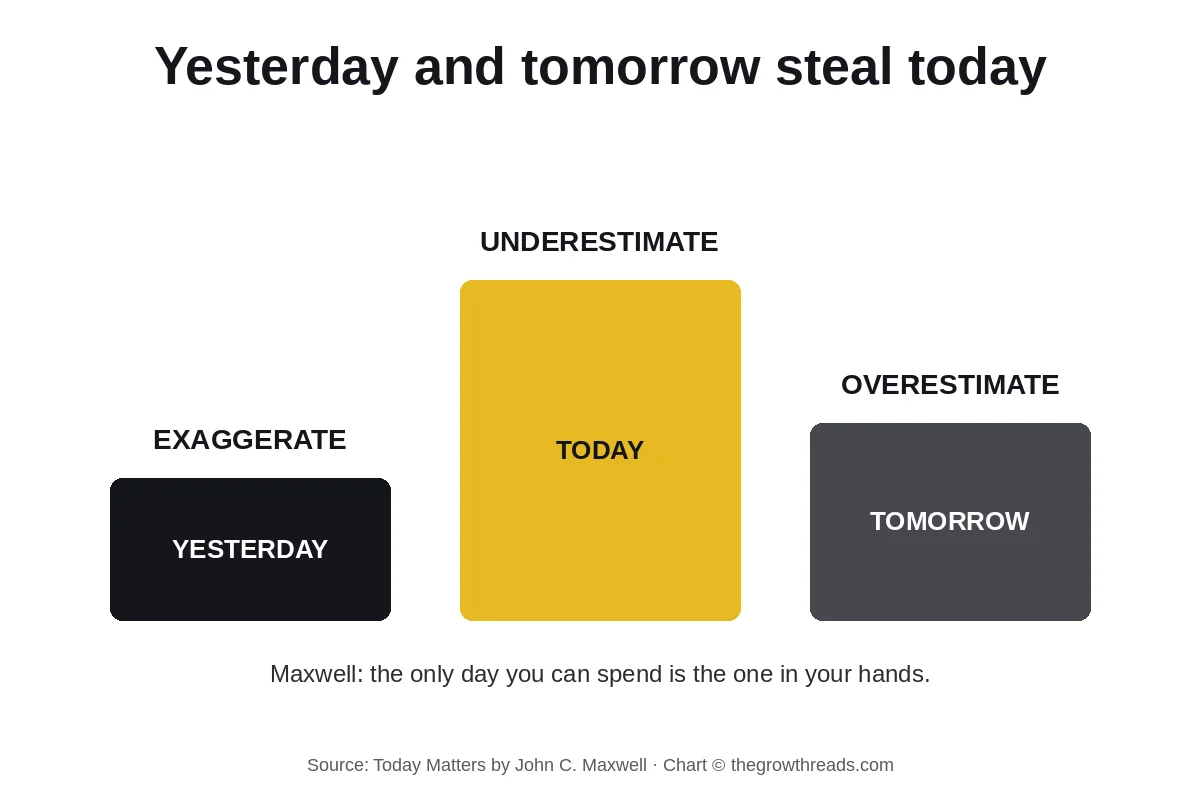
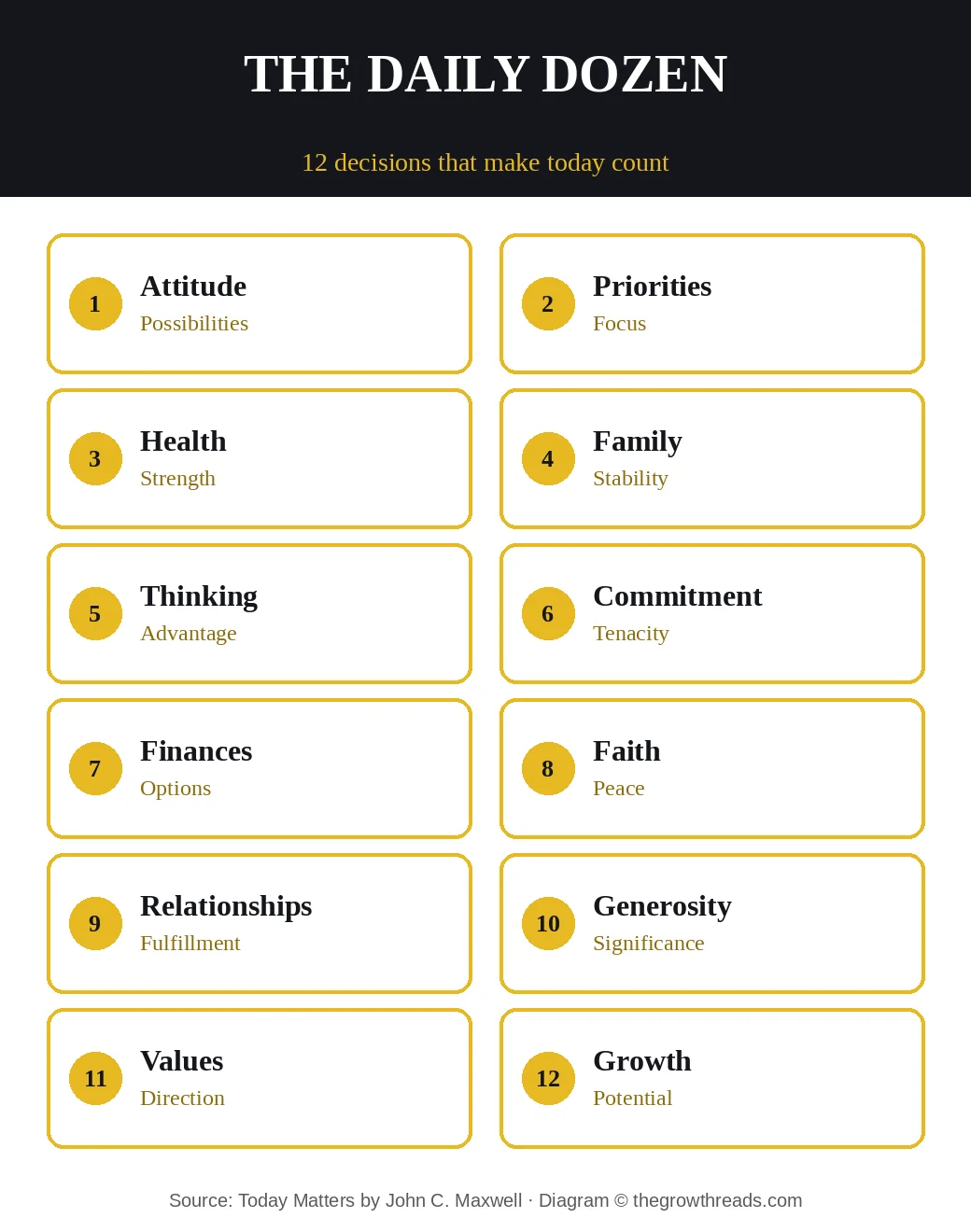
Most people try to live in three tenses at once and finish none of them. John C. Maxwell’s Today Matters (Warner Faith, 2004) is the shortest usable argument that success is not a future mood. We exaggerate yesterday. We overestimate tomorrow. We underestimate today. The book’s “daily dozen” is twelve decisions — attitude, priorities, health, family, thinking, commitment, finances, faith, relationships, generosity, values, growth — that you practise on this calendar date, not on the life you will start after the next launch. If you take one move from this Today Matters summary, pick the one practice you skipped yesterday and run it before lunch.
Key takeaways
- Today is the unit: Decades are stacked Tuesdays, not a speech in 2030.
- Three-tense tax: Yesterday’s regret and tomorrow’s fantasy empty the hour you have.
- Twelve decisions, one day: Attitude through growth — you do not pick a favourite and ignore the rest.
- Attitude first: The story you tell at 7 a.m. writes the calendar.
- Priorities are a cut: If everything is important, nothing is.
- Health and family are infrastructure: Energy and stability are not rewards you cash after the work.
- Thinking and commitment: A better idea without tenacity is a poster.
- Money and faith: Options and peace keep the day from being owned by panic.
- People, then gifts: Relationships and generosity are how a day becomes larger than you.
- Values plus growth: Direction without a lesson is a rut with a slogan.
What is Today Matters about?
Today Matters is Maxwell’s field manual for treating this calendar date as the only day you can spend: twelve named decisions — the daily dozen — that turn a written future into a Tuesday with a cut list, a body, a person, and a lesson.
About the author
John C. Maxwell is an American leadership teacher and writer whose books have sold tens of millions of copies and whose organisations — EQUIP and the John Maxwell Company — turned classroom drills into a global practice. He pastored first, then spent decades teaching that influence is a learnable skill, not a title. Today Matters arrived in 2004 as the daily companion to the larger Maxwell shelf: less origin story, more Tuesday. The authority is volume plus repetition. He has watched operators confuse a five-year plan with a spent morning for a long time, and he wrote a book so they could stop doing it this week. Explore all John C. Maxwell book summaries →
Key concepts at a glance
| Concept | What it means | Use it when |
|---|---|---|
| Today as unit | The only spendable day is this one | The vision is huge and Tuesday is empty |
| Three-tense tax | Yesterday and tomorrow empty the hour | You prosecute last month or live in 2030 |
| Daily dozen | Twelve decisions practised today | You improve one area and ignore eleven |
| Attitude | The morning story writes the day | You narrate failure before the work |
| Priorities | A cut, not a longer list | Everything is equally loud |
| Knowing–doing gap | A decision without discipline is a poster | You reread the book instead of practising |
| Masterpiece day | Design the date, do not inherit it | The inbox is already the map |
| Growth today | One lesson before you sleep | You only grow when a crisis arrives |
Part 1 — The missing piece, then the cut
Maxwell’s opening diagnosis is unfashionable in a culture that treats “someday” as a plan. Today often falls to pieces because it is asked to carry three jobs: finish yesterday, perform tomorrow, and still answer this inbox. The missing piece is not another app. It is the decision to treat this date as a masterpiece — a day you design — instead of leftover attention you inherit. He is blunt: we exaggerate yesterday, overestimate tomorrow, and underestimate today. A ten-year speech that never touches a calendar is still a speech.
Attitude is the first of the dozen because the sentence you tell yourself at 7 a.m. is already writing the hour. If the line is “I’m behind,” you will spend the morning proving it. If the line is “I choose the next right practice,” the calendar has somewhere to land. One sentence, written the night before, read once, then acted on. Priorities are the cut that follows. If you cannot name what this Tuesday is for, the loudest task will name it for you.
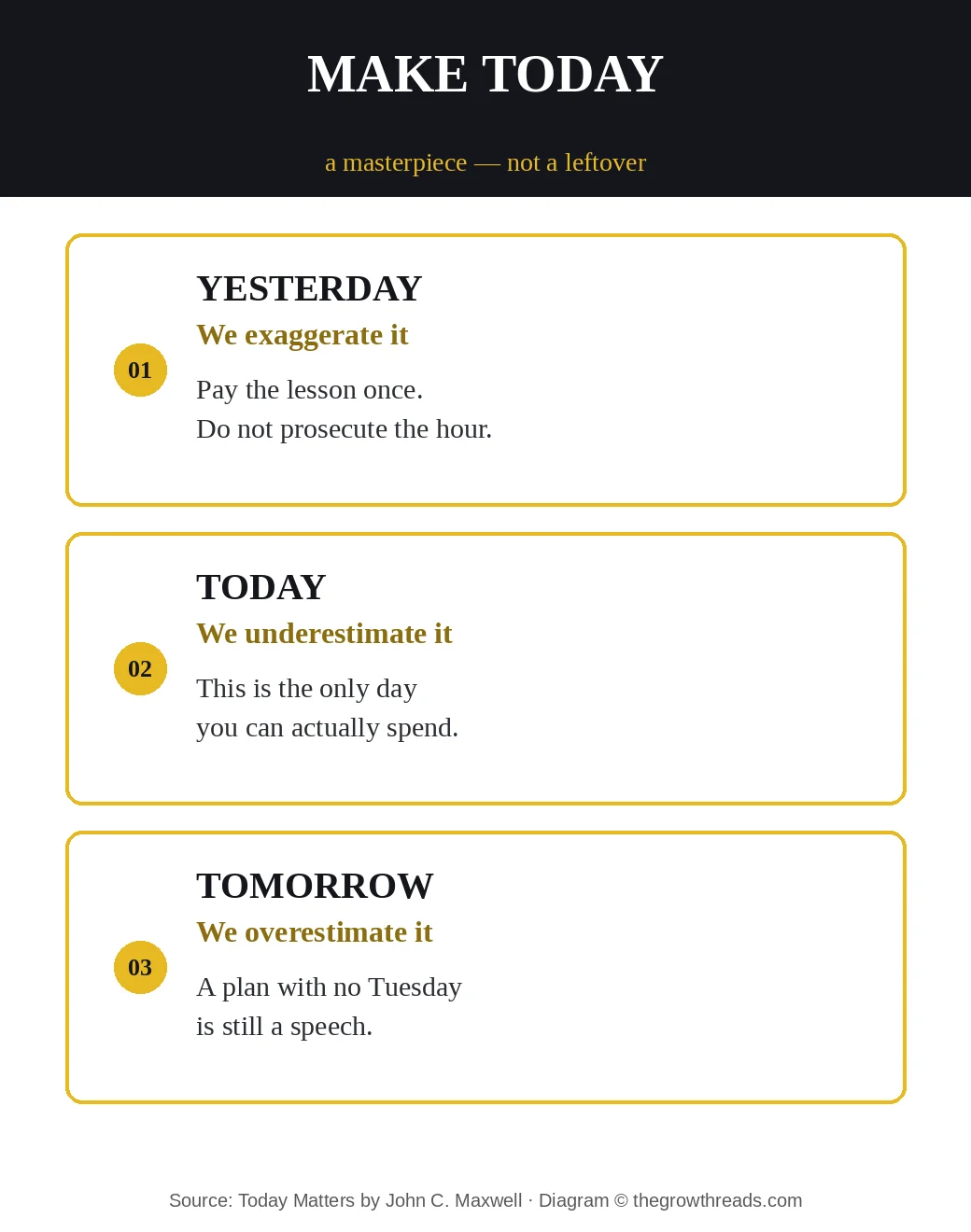
Most knowledge workers reverse the order. They open the laptop, inherit leftover attention, and call the first fire “priority.” Write the picture. Cut to one important thing. The feeling of being behind is often a missing picture, not a missing hour. A masterpiece day is a designed date: one sentence, one cut, no rerun of last month.
TGR Note: The cut is cousin to The One Thing and Essentialism: one problem, designed exclusion. Win the Day is the newer seven-habit sibling — frog, kite, rope — for a thin Tuesday. Use Maxwell when you need names for the whole life, not only the first hard task. Do not collect all three as a way to delay the one-sentence picture.
Part 2 — Strength, a household, a thought, a promise
The next four practices stop a “productive” day from being a body and a home you quietly loot. Health gives strength. Maxwell is not writing a training manual. He is refusing the bargain that you will cash energy after the launch. Sleep, food, and a walk are today’s infrastructure, not a reward. Family gives stability. The people who share your table are not a weekend project. A short, undistracted hour at home is a practice, not a mood you wait to feel on Friday.
Thinking gives advantage. This is the compact version of the later Maxwell on trained thought: see the week, test the facts, land a sentence. A day spent reacting is a day another person aimed. Commitment gives tenacity. A better idea without a promise you keep when it is boring is a poster. Maxwell’s classroom is full of people who can talk about discipline and still negotiate the extra mile at 11 a.m. The drill is small. Name the practice. Do it once. Do not add a second until the first survives a loud inbox.
Teams skip health because it feels disloyal to the deadline. Individuals skip family because the work is louder. Both skips show up as a short fuse and a week that looks full and feels empty. Write three facts that would still be true if you were not in the room: your sleep, your household’s next meal, the one thought that aims the work. Then take the next step those facts allow. “I’ll rest later” is how people arrive at Thursday already spent.
TGR Note: How Successful People Think is the later, narrower Maxwell: eleven thinking skills for the hour before the work. Today Matters is the wider day — body, table, promise — around that hour. Eat That Frog is the scalpel for the ugly task first. Use Tracy when the stall is the first file. Use this book when the stall is a life that only works in one column.
Part 3 — Options, peace, and someone else
Finances give options. Maxwell’s money chapter is not a markets book. It is the refusal to let panic own the afternoon. A small, boring money practice today — a number you look at, a transfer you make, a no you say — is how tomorrow’s options get built. Faith gives peace. He writes as a pastor. TGR readers can keep the practice without the pulpit: a quiet that is not a scroll, a gratitude that is not a performance, a stop that says the day is not only output. If a story uses scripture, keep the habit and spend the hour.
Relationships give fulfillment. A won day includes one honest contact that is not a status update: a check-in, an apology, a thank-you, a question. Maxwell is blunt that success that isolates is a private hobby. Shared thinking in the later book is the work version. Here it is the life version. You cannot stack a decade of empty evenings and call the career a masterpiece. The drill is one name, one message, same day. Not a networking binge. A person.
These three practices are easy to skip because they do not show up on a task list. They show up as a shorter fuse and a calendar full of people who only need something from you. Options, peace, and a person belong on the same card as the frog. If you only win the task list, you still lost the day.
TGR Note: The Compound Effect is the math of tiny repeats — including the money and health ones Maxwell names. Tiny Habits shrinks a practice so Tuesday does not need another speech. Use Hardy or Fogg when the first rep is still too big. Use Maxwell when you already know the dozen and still live in yesterday and tomorrow.
Part 4 — Give it away, then grow it
The last three practices are how a day becomes larger than your output. Generosity gives significance. It is not sainthood and it is not a year-end donation as a personality. It is a gift with a name today: time, attention, credit, a door opened. Values give direction. If you cannot name what you will not trade, the inbox will trade it for you. Growth gives potential. Maxwell’s later 15 Invaluable Laws of Growth is the longer book on becoming a person who can carry more. Here the rule is smaller: one lesson before you sleep, written in a sentence a tired colleague could repeat.
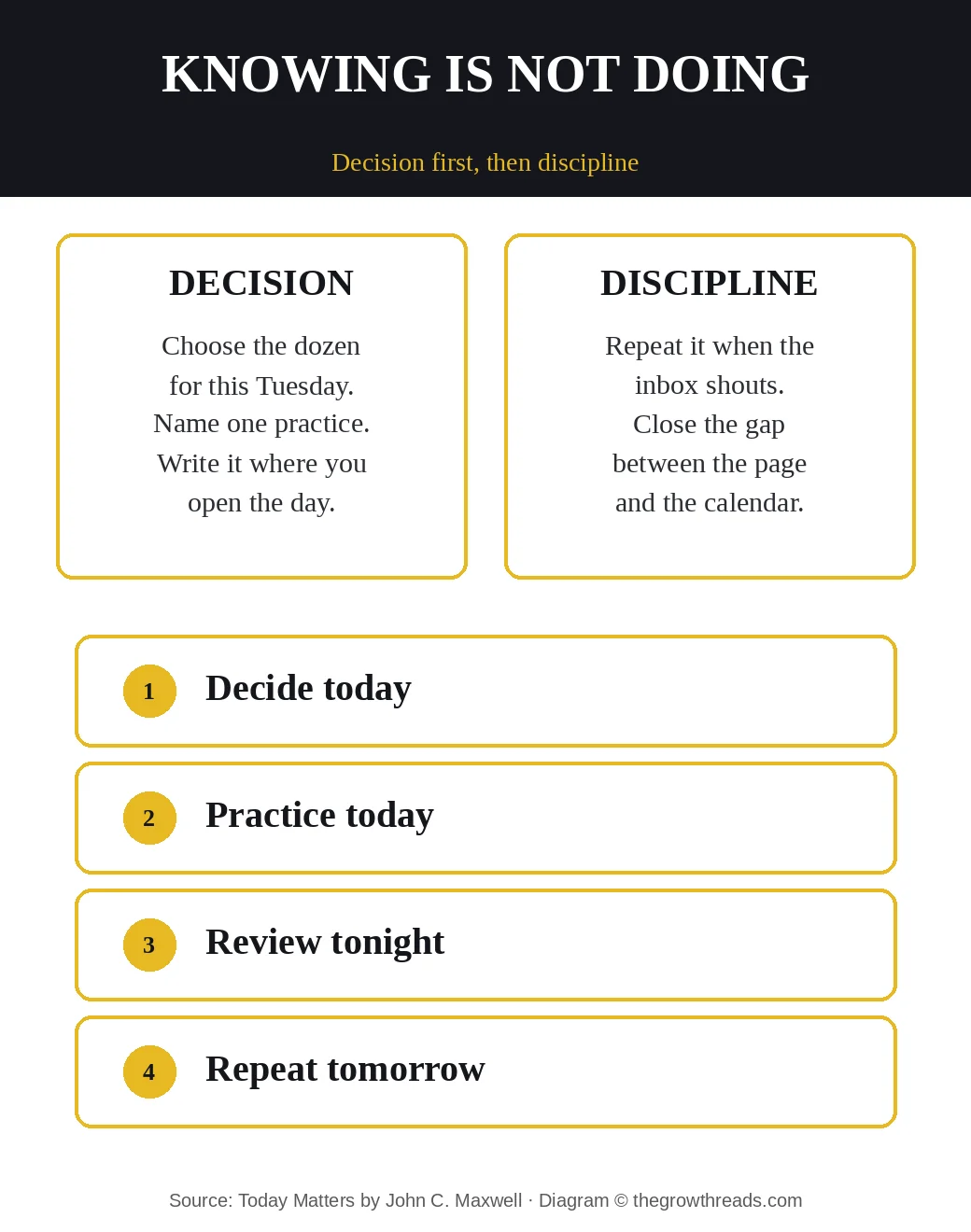
The hidden thesis of the last chapters is the knowing–doing gap. Maxwell has watched rooms full of people who can recite the dozen and still live in leftover attention. A decision without discipline is a poster. The close is not a thirteenth practice. Pick one, practise it today, review it tonight, repeat it tomorrow. The landing is the work.
Make it physical. One index card: the sentence, the cut, the body, the person, the gift, the lesson. Tomorrow, another card. Atomic Habits would keep the cue alive after the sentence. Maxwell would put the missing practice first. The refusal to spend today on purpose is the same as the refusal to start.
TGR Note: The 15 Invaluable Laws of Growth is the longer Maxwell on becoming someone who can carry more; Failing Forward is the companion for staying in after a miss. Use this book for the date on the calendar. Use those two for the year around the date. Do not reread all three as a way to skip the card. Pick the practice you skipped yesterday. Land it by Friday.
Who is Today Matters best for — and who should read something else first?
Best for people whose job includes a week of decisions and who still spend the week in leftover attention: operators, founders, managers, specialists, parents, students, independent knowledge workers. Especially if you already work hard and keep repeating the same class of miss — no picture, no cut, no body, no person, no lesson.
Read something else first if you cannot yet start a twenty-minute sitting — Tiny Habits or Eat That Frog, then come back. If the enemy is a hijacked hour, start with Deep Work. If you need a seven-habit Tuesday and not a twelve-area life, start with Win the Day. If you need a life-design prototype rather than a daily dozen, Designing Your Life fits that job. Come to Maxwell when the bottleneck is the quality of the day, not the size of the vision.
Questions to reflect on
- Which of the twelve practices did you skip yesterday, named in one word?
- What is this Tuesday for, in one sentence a tired colleague could repeat?
- Where are you still prosecuting yesterday or living in a year that has not started?
- Who is the one person you will actually contact today, and what gift has a name?
- What lesson will still matter tonight, and what is only noise wearing a badge?
🔥 Ready to make today the masterpiece?
Pick the practice you skipped yesterday, run it before lunch, and write one lesson tonight.
How to apply Today Matters (7-day plan)
- Day 1 — Name the missing practice. Write yesterday’s worst hour in one line. Circle the dozen you skipped. That is this week’s drill, not all twelve.
- Day 2 — Attitude on a card. One sentence you will read before the inbox. Put it where you open the laptop.
- Day 3 — Cut. List seven loud tasks. Keep one. The rest wait. Work the one for twenty-five minutes.
- Day 4 — Body and table. One health practice you will not negotiate, and one undistracted contact at home. Write both the night before.
- Day 5 — Money or peace. Look at one number, or take one quiet ten minutes that is not a scroll. Not both unless the first already lives.
- Day 6 — A person and a gift. One honest message. One named generosity. Do not send a novel.
- Day 7 — Land it. What counted. Who is better if it is true. One lesson a tired colleague could repeat. Tomorrow, a new card.
Frequently asked questions
What is Today Matters about?
Today Matters is John C. Maxwell’s field manual for treating this calendar date as the only day you can actually spend. He argues that we exaggerate yesterday, overestimate tomorrow, and underestimate today, then offers twelve decisions — the daily dozen — that turn a written future into a Tuesday: attitude, priorities, health, family, thinking, commitment, finances, faith, relationships, generosity, values, and growth. Each chapter is a practice, not a personality test. The book is a life-width checklist for knowledge work and home, not a biography of famous minds or a markets course.
What are the 12 daily practices in Today Matters?
Maxwell’s daily dozen is attitude, priorities, health, family, thinking, commitment, finances, faith, relationships, generosity, values, and growth. You do not pick a favourite and ignore the rest. Attitude without a cut is a mood. Priorities without health is a short week. Thinking without commitment is a poster. Money without people is a private score. Values without growth is a rut with a slogan. The usable picture is a stack you run on a real date: one sentence, one cut, one body practice, one person, one gift, one lesson. That sequence is the book.
Is Today Matters worth reading if I already read Maxwell?
Yes if you want a daily life checklist you can run on Tuesday, not another leadership origin story. The 15 Invaluable Laws of Growth is about becoming a person who can carry more. Failing Forward is about staying in the work after a miss. How Successful People Think is the hour before the work. This book is wider: the date on the calendar, when leftover attention is making your choices at home and at the desk. If those three already changed how you recover, grow, and aim, this one changes how you spend the day. Skip it as a first Maxwell if you still cannot start a two-minute action.
How is Today Matters different from Win the Day or Eat That Frog?
Mark Batterson’s Win the Day is seven habits for a thin Tuesday: script, wave, frog, kite, rope, clock, seed. Brian Tracy’s Eat That Frog is the scalpel for the ugliest important task first. Maxwell is neither a seven-move day nor a single-task book. He hands you twelve life areas and asks you to practise the missing one today. Use Batterson when the vision is written and the day is empty. Use Tracy when the stall is the first file. Use Maxwell when you can start, you can cut, and you still live in yesterday and tomorrow across health, home, money, and people.
Who should read Today Matters?
Operators, founders, managers, parents, students, and independent knowledge workers whose weeks are full and whose days are still accidental: the person who answers email with leftover attention and calls it a life. It is especially useful if you already work hard and still repeat the same class of miss — no picture, no body, no person, no lesson. Skip it as a first book if you cannot yet sit down for twenty focused minutes — go to a start-small habit book, then return. Come here when the bottleneck is the quality of the day, not the size of the vision board.
How long is Today Matters and how should I read it?
The Warner Faith hardcover is about 312 pages; later paperbacks run near 336. Most readers finish it in five to six hours. Do not study it like a textbook. Read one chapter, then run that practice the same day: a one-sentence attitude, a cut list, a walk, a message. One practice, one problem, same afternoon. If you highlight all twelve and never pick one, you have bought a poster. If you land a lesson by Friday, you have used the book.
Is Today Matters only for leaders or people of faith?
No. The stories lean on teams, pulpits, and organisations because that is Maxwell’s classroom, but the method is for anyone whose work includes a decision and a day. A researcher choosing a question, a parent guarding an hour, a founder picking a product — each of those stalls the same way a manager stalls. Leftover attention fills the gap. Keep the habit if a story uses scripture: one sentence, one cut, one practice. Faith in the dozen is a peace practice, not a membership test. Bottom-line thinking is not a title. It is the habit of asking what will still matter when the day ends.
Related summaries
- How Successful People Think — the later Maxwell on the hour before the work
- The 15 Invaluable Laws of Growth — the longer Maxwell on becoming someone who can carry more
- Win the Day — seven habits for a thin Tuesday
- Eat That Frog — the scalpel for the first ugly task
- More on the best productivity books pillar
How we analyze books: we read for application, not for a takedown — then we add a plan you can run this week. Read our full methodology.