

★★★★★ 4.8/5 — The week-by-week map that turns a noisy pregnancy into the next small step.
Best for: First-time expecting parents, partners who want the same page, and anyone drowning in forums who needs a week — not a verdict
Reading time: ~10–14 hrs for the Workman 656-page fifth edition · ~40 min for this guide
Difficulty to apply: Easy to open this week’s chapter. The work is using it with your clinician, not as a midnight diagnosis engine.
What to Expect When You’re Expecting in one minute
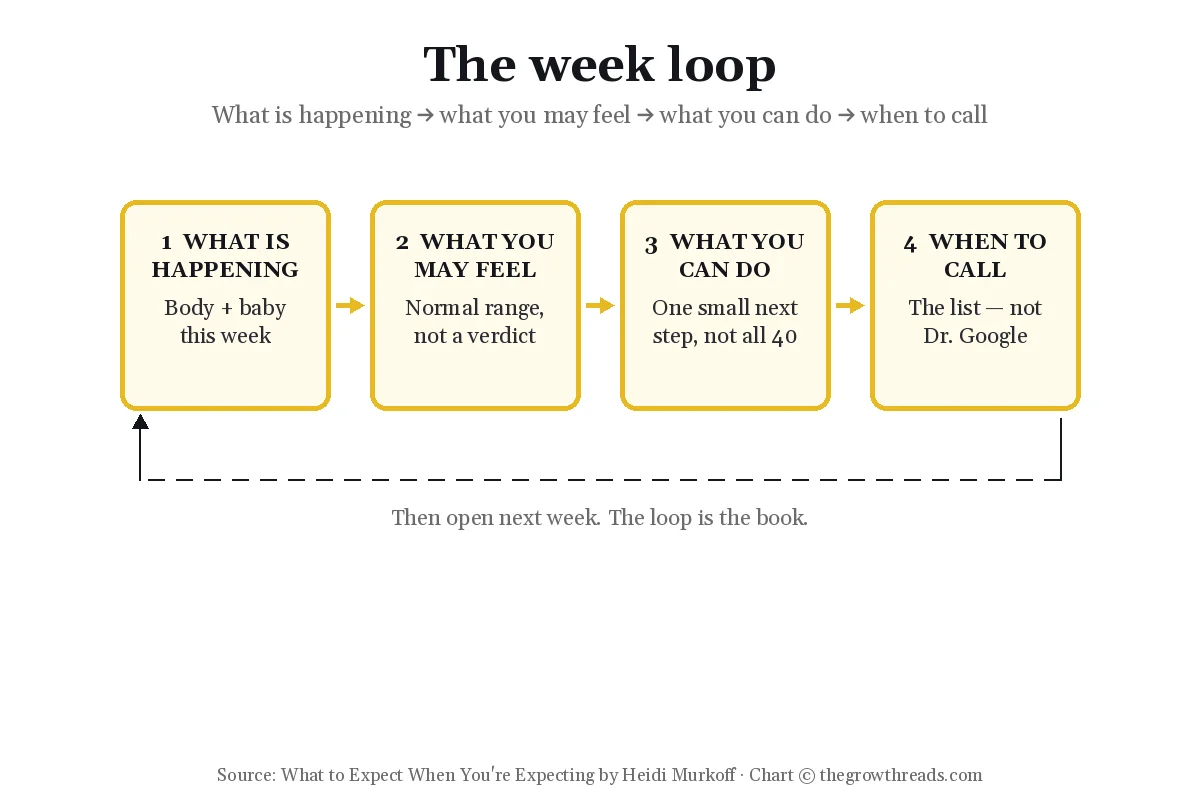
Heidi Murkoff’s 1984 pregnancy guide (fifth edition 2016, reprints still updated) is a week-by-week map: what is happening in your body, what is happening with the baby, what you may feel, what you can do, and when to call. She wrote it after her own first pregnancy left more questions than a short appointment could hold. The usable move is to name this week, read that chapter, and take one next step — a question, a meal, a preference drafted as a conversation. Diagnostic: last symptom — did you open the week, or a forum? If you cannot find the week, that is the curriculum. A map for prenatal care, not a replacement for it.
Key takeaways
- The unit is the week, not the whole pregnancy: Open the chapter you are in. The year is too big; the hour is too small.
- Four questions sit under every month: Body, baby, feeling, action. A fifth is implied: when to call the clinician, not the thread.
- Symptoms come with a range, not a verdict: “You may feel” is not “you will get.” Read the range, then keep the list of true alarms.
- Partners belong in the same book: Later editions write the other adult into the week, not into a preface they never open.
- Food is a short list, not a personality: What to skip, what to favor, how to eat when you cannot eat. One meal counts.
- Lifestyle chapters are the rest of the week: Work, sex, travel, movement, skin. The pregnancy is not only the bump.
- Birth preferences are a draft: Place, pain, plan B. Bodies revise. The conversation still helps the room.
- The first weeks after birth are still the book: Sleep, feeding, bleeding, mood. Keep the when-to-call list on the fridge.
- IVF, multiples, and complications get their own rooms: You do not have to steal a chapter written for a different pregnancy.
- A question written down beats a spiral: Five lines for the next appointment is the whole method in miniature.
What is What to Expect When You’re Expecting about?
What to Expect When You’re Expecting is Heidi Murkoff’s week-by-week pregnancy guide. It tells you what is happening in your body and with the baby, what you may feel, what you can do this week, and when to call a clinician — a map for prenatal care, not a substitute for it.
About the author
Heidi Murkoff wrote What to Expect When You’re Expecting after her own first pregnancy in the early 1980s left her with more questions than a short obstetric visit could hold. The 1984 first edition, written with her mother Arlene Eisenberg and her sister Sandee Hathaway, became the longest-running New York Times bestseller in its category and a USA Today “most influential” title — tens of millions of copies, and the book most people mean when they say they read a pregnancy guide. Later editions are hers. She built WhatToExpect.com and the What to Expect Project, a nonprofit for maternal health. The stance is warmth plus a list: name the week, then take the next small step. She is not selling a vibe. She is handing you a map you can open at 1 a.m. and still use at the next appointment. Explore all Heidi Murkoff book summaries →
Key concepts at a glance
| Concept | What it means | Use it when |
|---|---|---|
| Week as unit | Read the chapter you are in, not the whole 40 | You opened page one and felt behind |
| Four questions | Body, baby, feeling, action — plus when to call | A symptom arrived and you only have a feed |
| Range, not verdict | “You may” is a window, not a sentence | A list of rare events is running the night |
| When-to-call list | The short alarms that belong to a clinician | You are about to search a forum at 1 a.m. |
| Partner on the same page | The other adult reads the week, not a summary text | One person holds all the questions |
| Lifestyle chapters | Food, work, sex, travel, movement, skin | The pregnancy is only being treated as a bump |
| Birth preferences | A one-page conversation, not a contract | You think a plan will freeze the day |
| Fourth trimester | The first weeks after birth are still in the book | You closed it in the parking lot after delivery |
Part 1: The month-by-month map — why the week is the unit
Murkoff’s first gift is architectural. A pregnancy is long enough to drown in and short enough to panic about. The book cuts it into months, then weeks, and gives each slice the same furniture: body, baby, feeling, action, what to discuss at the visit. You do not earn the next chapter. You arrive in it. That is a kinder clock than a forum, which will always show someone three months ahead and someone in a crisis you do not have.
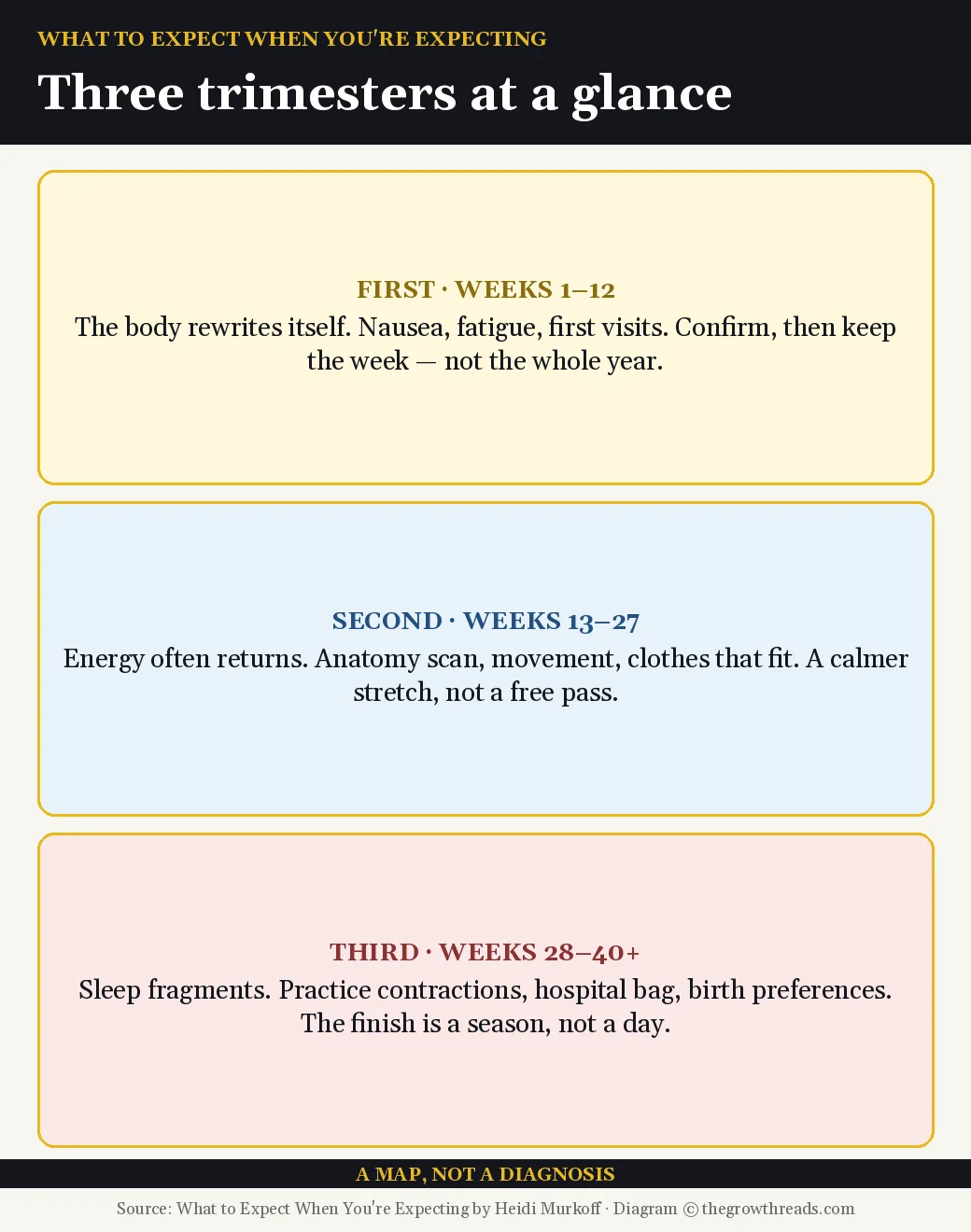
The first trimester is the rewrite: nausea, metallic taste, sleep that is not sleep, a test that made it real before a bump did. The job here is confirmation plus the first visits. The second trimester is the stretch people claim they will “enjoy.” Energy may return. The anatomy scan arrives. Movement becomes a fact. The week still has a list. The third trimester is the finish as a season: practice contractions, a bag, sleep in pieces, a birth conversation allowed to stay a draft. You do not have to like the furniture. You have to know which room you are in.
TGR Note: If the medical decisions around a body that will not last forever are the adjacent fear — not this pregnancy, but the fact of being mortal in a clinic — read Being Mortal. Gawande is the conversation about what medicine is for. Murkoff is the week you are actually in. For the memoir of a life cut into a shorter clock, When Breath Becomes Air is the other door. Neither replaces a prenatal visit.
Part 2: Body, baby, feeling — symptoms with a range
The middle of the method is how she writes a symptom. A headache, a cramp, spotting, a kick that stopped, a mood that will not lift: each can be ordinary in a range and urgent at an edge. The book lists both — that is the point of a reference. Read the range first, then keep the short list of true alarms. “You may feel” is not a dare to collect every item. The baby chapters do the same job the other way: size and systems you can picture, not a lecture you have to pass.
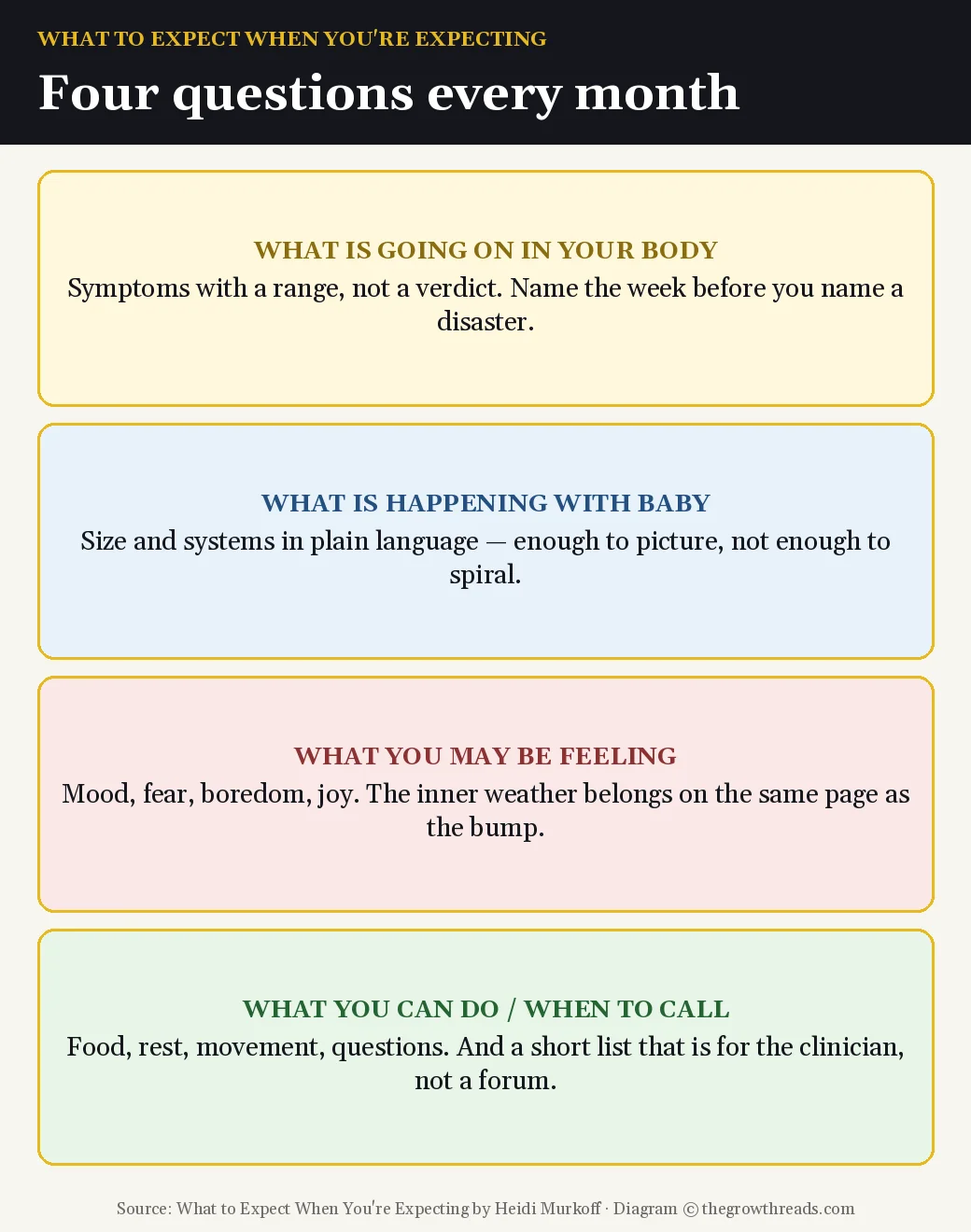
Feeling gets its own chair. Fear, boredom, joy, the strange grief of a life that is already changing, the partner who is not nauseous and does not know what to do with their hands — Murkoff puts the inner weather on the same page as the bump. That is why the book still gets opened at night. A feed will sell you a rare disaster. A week chapter will tell you what is common, what can wait until morning, and what does not wait. Write the question down either way. The appointment is where the map meets a person who has your chart.
TGR Note: If the night is a nervous system, not a symptom list, Full Catastrophe Living is the ten-minute floor practice this book will not teach. Kabat-Zinn is attention under load. Murkoff is the week. For trauma stored as physiology rather than as a question you can bring to a visit, start with The Body Keeps the Score and a clinician — not a forum.
Part 3: The rest of the week — food, work, movement, sex, travel
A pregnancy is not only a bump in a waiting room. The lifestyle chapters are the rest of the calendar: what to eat when you cannot eat, what to skip without turning dinner into a personality, work, travel, sex, movement. The usable move is one swap, not a new identity. If fish is the spiral, you need the short list your clinician already uses plus a meal you can keep down. If work is the spiral, you need rights and a sentence you can send — not a speech about leaning in while nauseous.
Movement is the same size. The book will not install a training block. It will tell you what usually stays and what usually waits, then send you back to the person who knows your joints and your chart. That is the opposite of a protocol account. Partners get chores that are not “support” as a mood: the list, the snack, the ride, the second set of ears at the visit. IVF, multiples, and higher-risk chapters exist so you are not stealing advice written for a different pregnancy. If that is your door, start there. The week still applies. The generic forum does not.
TGR Note: If food is the whole argument, In Defense of Food is the seven-word philosophy (eat food, not too much, mostly plants) this book will not pause to preach. For a body that is done with rules, Intuitive Eating is the anti-diet cousin — useful after the window, not a dare to ignore prenatal guidance. For the glucose piece of the same meal, Glucose Revolution is the hack layer. None of them replace the when-to-call list.
Part 4: Labor, preferences, partners, and the first weeks after
The last movement is the day people treat as a test. Murkoff will not grade you. She walks the signs of labor, practice versus the real thing, and the options in the room — hospital, birth center, home, epidural, unmedicated, planned cesarean, VBAC — plus the fact that a body can revise the draft. Preferences still help. They are not a contract with physics. Write one page. Bring it. Let it change. The partner’s job is concrete: questions, water, the list, one person who is not performing the birth on a phone.
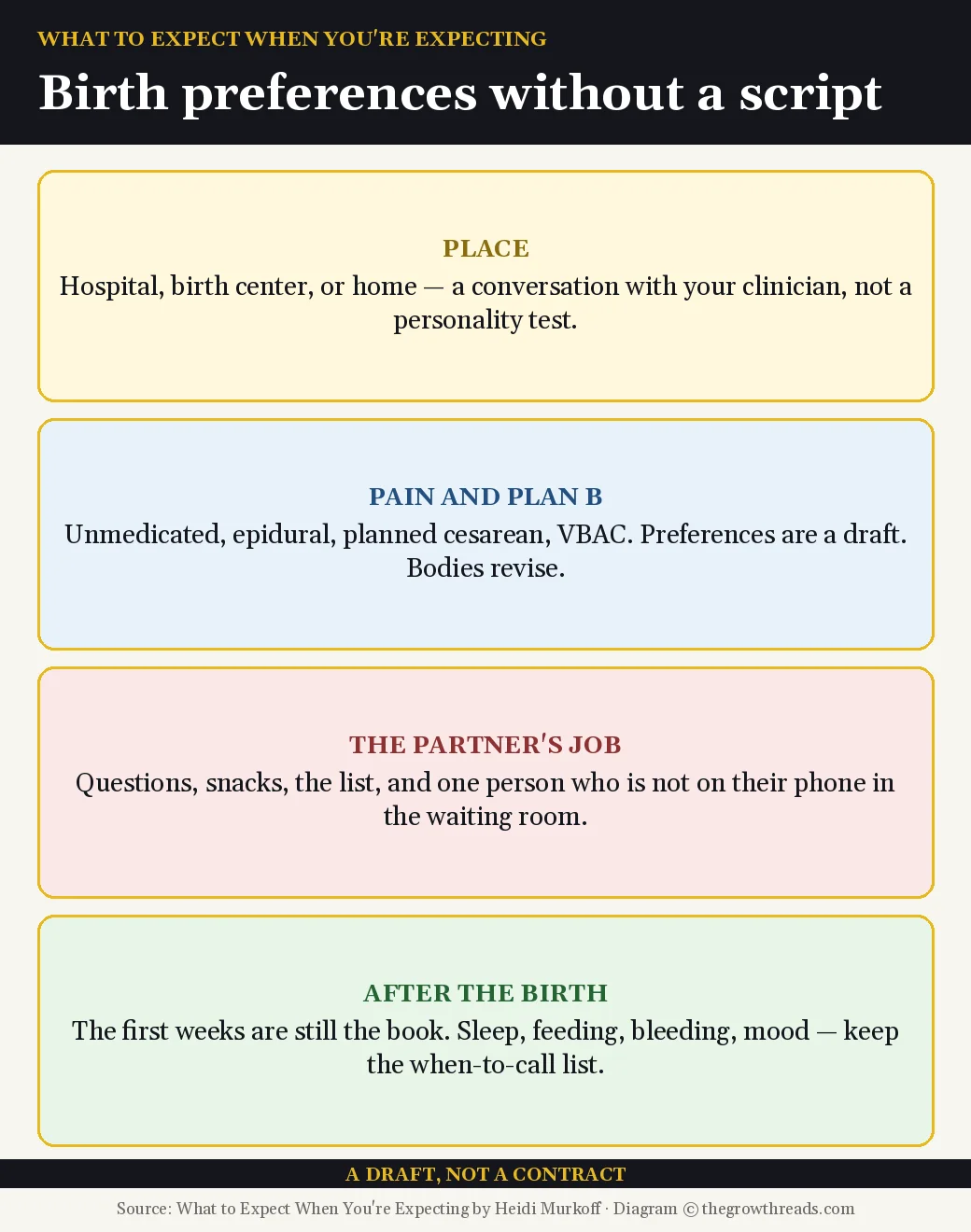
Then the book keeps going. Bleeding, feeding, sleep in pieces, a mood that is more than tired. The first weeks are still a week-by-week problem. Close the pregnancy chapters if you want. Do not close the when-to-call list. If you steal one object from 656 pages, steal that list and five written questions. The encyclopedia can wait on the nightstand. The book is how you use the time between visits without handing the night to a stranger’s comment.
TGR Note: If the night shift after birth is the actual emergency, Why We Sleep is the recovery lecture this book assumes you will eventually keep — and cannot, at first. For the longer clock of a body you want at 90, Outlive is the training plan; it is not a prenatal guide. For the day’s built-in clock, The Circadian Code is the light-and-meal cousin. Stack them after the week you are in, not instead of it.
Who is What to Expect When You’re Expecting best for — and who should read something else first?
Read it if you are newly expecting and want one shared map, you are a partner who is tired of getting the news as a text, or you are drowning in forums and need this week’s chapter. It is a reference you open, not a manifesto you finish.
Read something else first if you want food philosophy without a pregnancy clock — start with In Defense of Food. If you want longevity training, start with Outlive. If trauma is the door, start with The Body Keeps the Score and a clinician. This is not medical advice and not a replacement for prenatal care.
Questions to reflect on
- Which week are you actually in — and did you open that chapter, or a thread about month nine?
- What are five questions for the next visit, written in one sitting?
- Which item on the when-to-call list have you never looked at in the light?
- What is the partner’s job this week as one action, not a mood?
- If birth preferences were one page, what is plan A and what is the allowed revise?
🔥 Ready to name this week and take the next small step?
Open the chapter you are in, write five questions for the visit, and put the when-to-call list where you can see it.
How to apply What to Expect When You’re Expecting (7-day plan)
- Day 1: Find your week. Read only “what is happening” and “when to call.” Close the rest.
- Day 2: Write five questions for the next appointment. One sitting. No research extra credit.
- Day 3: One meal from the eating chapter — a swap you can keep down, not a new identity.
- Day 4: The partner reads the same week and names one job (list, snack, ride, second ears).
- Day 5: Move the way your clinician already allowed. A walk counts. A new protocol does not.
- Day 6: Draft birth preferences as one page: place, pain, plan B. Label it a conversation.
- Day 7: Put the when-to-call list on the fridge. Leave the forums closed for 24 hours.
Frequently asked questions
What is What to Expect When You’re Expecting about?
It is Heidi Murkoff’s week-by-week pregnancy guide, first published in 1984 and still updated in reprints of the 2016 fifth edition. Each slice of the calendar gets the same furniture: what is happening in your body, what is happening with the baby, what you may feel, what you can do, and when to call a clinician. The usable move is to open this week, not to swallow 656 pages. It is a map you bring to prenatal care, not a substitute for a person who has your chart. Partners are written into the week, not parked in a preface.
What does “when to call” actually mean in this book?
It is the short list of alarms that belong to a clinician tonight, not a forum. Murkoff writes symptoms as a range — you may feel this, it can wait until morning, this does not wait. “When to call” is the edge of that range: bleeding that is not spotting, a kick count that dropped, a headache with a story, a mood that is more than tired. Write the item down and use the visit or the after-hours line. The phrase is a door to care, not a dare to diagnose yourself from a chapter you read at 1 a.m.
Is What to Expect When You’re Expecting still relevant in 2026?
Yes. The Workman fifth edition still carries the live Bookshop and Amazon listing, tagged “Updated in 2026” on reprints. Screening language, medications, and birth options have been refreshed across printings; the week as a unit did not age. Forums got louder. That makes a shared paper map more useful, not less. If you want longevity training or food philosophy, those are other books. If you want this week’s chapter plus a when-to-call list, this is still the reference most expecting parents mean when they say they read a pregnancy guide.
What to Expect vs Outlive vs In Defense of Food — which first?
Read What to Expect When You’re Expecting first if you are pregnant and need this week. Read In Defense of Food first if you want a food philosophy without a prenatal clock — eat food, not too much, mostly plants. Read Outlive first if you are training for a 90-year-old body and you are not expecting. They stack after the week you are in. Murkoff will not teach zone-2. Attia will not tell you what to do with this Tuesday’s nausea. Pollan will not hold the when-to-call list. Start with the clock you are actually on.
Do I have to read all 656 pages in order?
No. The book is a reference. Open the month and week you are in, then the lifestyle chapter that matches tonight’s argument — food, work, travel, sex, movement. Skip ahead to labor when you are ready to draft preferences, not as extra credit in month two. IVF, multiples, and higher-risk chapters exist so you are not stealing a page written for a different pregnancy. If you try to read it like a novel you will feel behind by Thursday. The 7-day plan below is our application layer: one week, five questions, one list on the fridge.
How long is What to Expect When You’re Expecting and which edition should I buy?
The Workman paperback we link is ISBN-13 9780761187486, ASIN 0761187480, about 656 pages, published 31 May 2016 as the fifth edition, with reprints still updated. Most readers use it as a reference, not a 14-hour sit. Read this week, then return. Buy the edition you will leave on the nightstand. UK sixth-edition printings exist; commerce here is the US Workman listing that title-checks on Bookshop as “What to Expect When You’re Expecting: (Updated in 2026).” This guide is not a replacement for a visit. The 7-day plan is ours, not her workbook.
Is this medical advice — and does the book replace prenatal care?
No, and no. Murkoff wrote a map for people who already have — or are about to have — a clinician. The book will not tell you how to treat bleeding, preeclampsia, gestational diabetes, or a baby’s movement change. Those are clinical decisions. Use this as a week-by-week map, then take personal questions to the person who has your chart. If a chapter makes you more frightened than informed, close it and call. The 7-day plan is not a treatment protocol and not a substitute for prenatal or postpartum care.
Related summaries
- Being Mortal — what medicine is for when a body has a clock.
- In Defense of Food — eat food, not too much, mostly plants.
- Why We Sleep — the night shift this book cannot protect at first.
- Full Catastrophe Living — ten minutes on the floor when the week is loud.
Browse titles on our Best Health Books pillar page.
How we analyze books: our summaries are built from a full read of the source text, cross-referenced against the author’s published interviews and research where relevant, and structured around practical application rather than critique. Read our full methodology.