

★★★★★ 4.7/5 — A neurosurgeon’s memoir on how to make a meaningful life when the future stops being a ladder.
Best for: Readers facing a diagnosis, a shortened horizon, or a career that has swallowed the question of why the work matters
Reading time: ~4–5 hrs for the Random House hardcover · ~14 min for this guide
Difficulty to apply: Emotionally demanding, technically simple — the work is telling the truth about time
When Breath Becomes Air in one minute
Paul Kalanithi spent a decade becoming a neurosurgeon so he could work at the millimetre where identity lives — then stage IV lung cancer, at thirty-six, made him the patient he had been trained to guide. The book is not a protocol for beating cancer. It is a record of what happens to ambition, marriage, and a child when the future flattens into a perpetual present. He had already asked what makes a virtuous life given that everyone dies. The scan only removed the luxury of postponing the answer. Diagnostic: if the ladder of “later” disappeared this week, what would you still do this afternoon?
Key takeaways
- The question precedes the scan: He chose medicine to study meaning in bodies, not to dodge mortality. Illness only removed the delay.
- Identity lives in the brain: A millimetre is not a technicality when it is someone’s speech, memory, or self.
- Technical excellence is a duty, not a personality: Good intentions are not enough when a family is waiting on your hands.
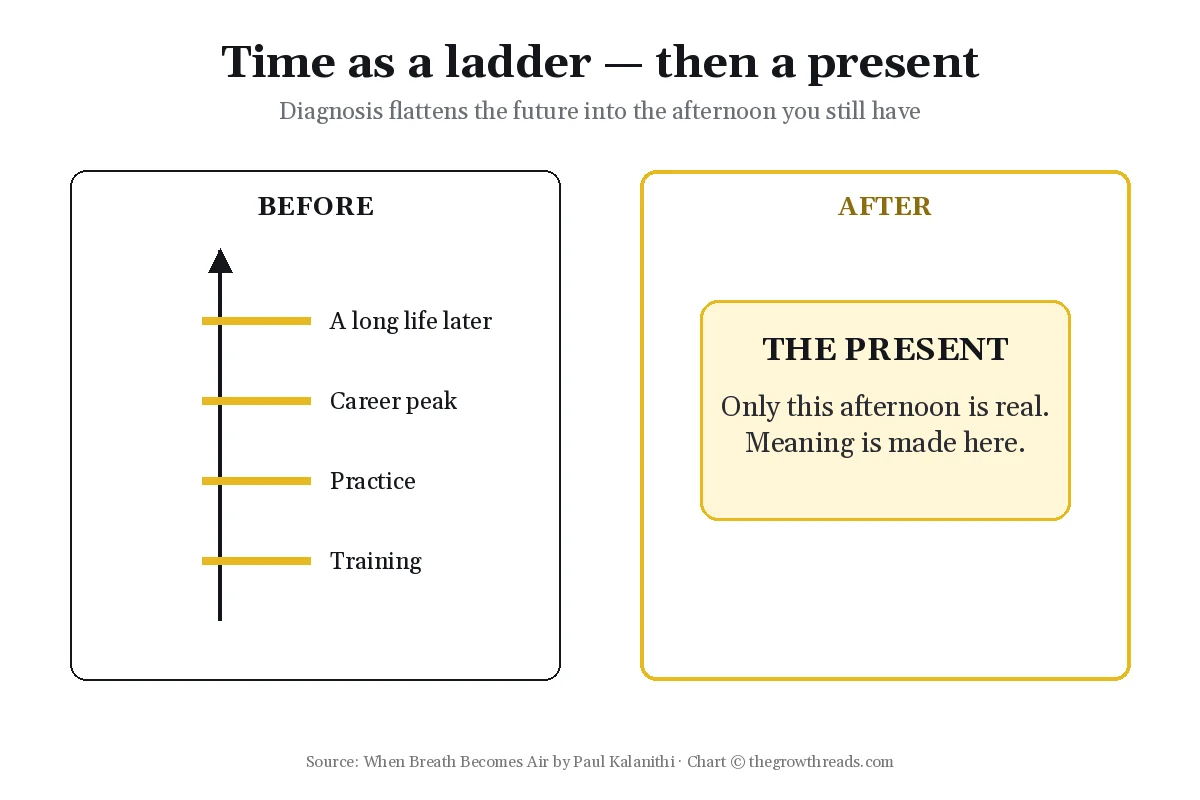
- Time can stop being a ladder: After diagnosis, goals stacked into a future collapse into the afternoon you still inhabit.
- Doctor and patient are one life: The person who explained death has to learn how to be on the other side of the bed without abandoning judgment.
- A child can be a yes to the present: He and Lucy chose to have Cady knowing he might not see her grow. That is not denial. It is a vote for a life that is still happening.
- Literature and medicine are two languages for one problem: Words make a life intelligible; scalpels keep the organ of that life intact.
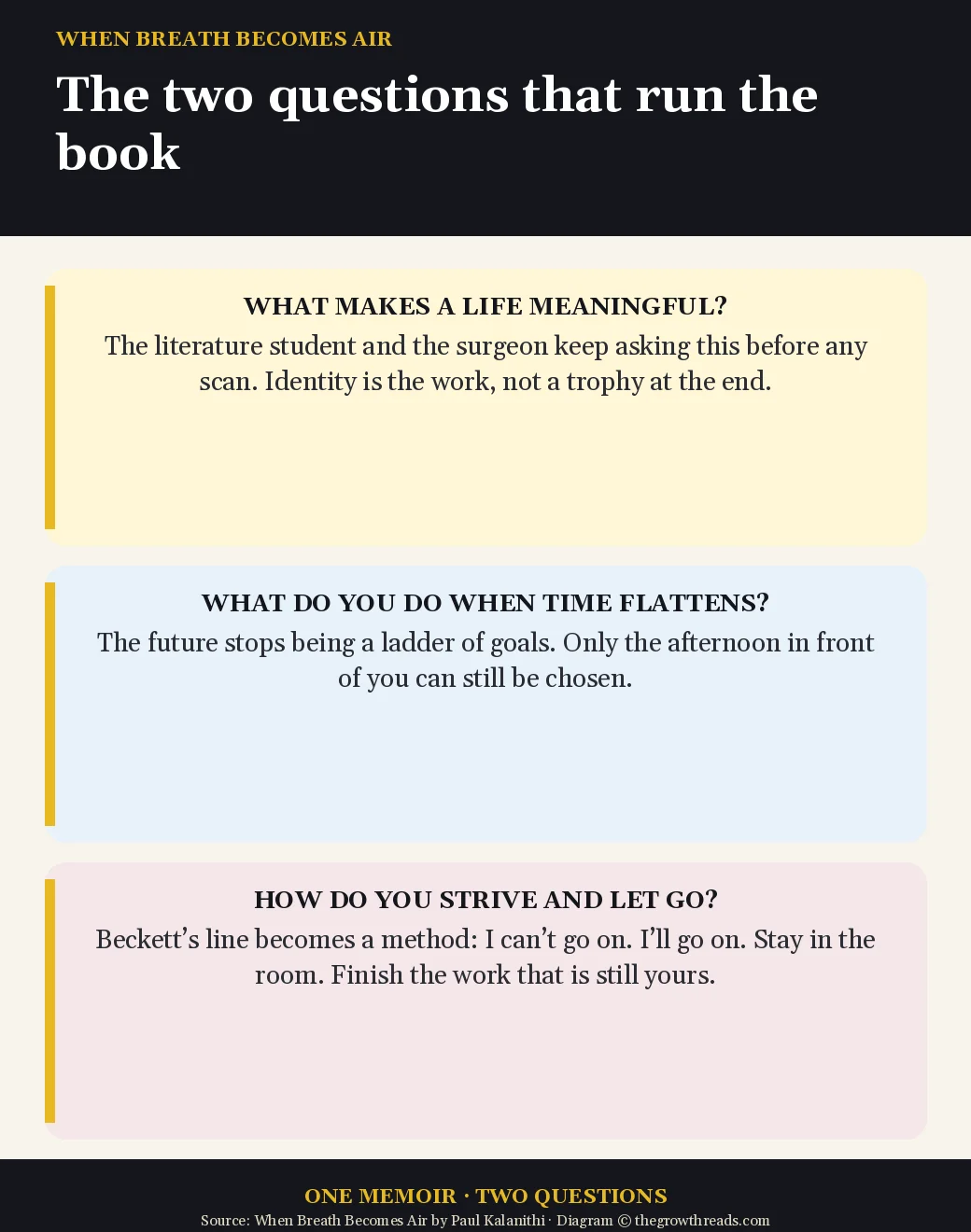
- You can strive and let go in the same hour: Beckett’s line — I can’t go on. I’ll go on. — Stay in the room. Finish the work that is still yours.
- The people in the room are not a delay: Competence that starves a marriage is not excellence. Lucy’s presence is part of the argument.
What is When Breath Becomes Air about?
When Breath Becomes Air is Paul Kalanithi’s memoir of becoming a Stanford neurosurgeon and then living with stage IV lung cancer. It asks what makes a life meaningful when the future is no longer a ladder of goals, and how to keep working, loving, and writing in the time that remains.
About the author
Paul Sudhir Arul Kalanithi (1977–2015) grew up in Kingman, Arizona, after his family moved from New York so his father, a cardiologist, could practise in a town that needed doctors. He studied English literature and human biology at Stanford, completed an MPhil at Cambridge in the history and philosophy of science and medicine, then took an MD at Yale. He returned to Stanford for neurosurgery residency. In his last year of that training he was diagnosed with metastatic lung cancer. He died on 9 March 2015, age thirty-seven, while still writing. Random House published When Breath Becomes Air on 12 January 2016; it became a number-one New York Times bestseller and a Pulitzer Prize finalist. Explore all Paul Kalanithi book summaries →
Key concepts at a glance
| Concept | What it means | Use it when |
|---|---|---|
| The two questions | What makes a life meaningful? What do you do when time is no longer a ladder? | You are postponing “why this work” until after the next promotion |
| Identity in millimetres | The brain is where selfhood can be saved or ruined by a tiny error | You treat precision as optional in work that other people have to live inside |
| Moral excellence | Skill is an ethical requirement when someone else’s life hangs on it | You are substituting warmth or busyness for being actually good at the job |
| Flattened time | The future collapses; only the present can still be chosen | A diagnosis, a layoff, or a clock you cannot bargain with arrives |
| Doctor / patient | The explainer of death has to inhabit it without dumping judgment | You have moved from expert to the person in the gown and want a script |
| Literature + medicine | Stories make suffering intelligible; science keeps the organ of the self intact | You are picking only data or only memoir and calling that a full education |
| Beckett’s method | I can’t go on. I’ll go on. Strive and release in the same hour | You are waiting to feel ready before you write, operate, or show up |
| A child as a yes | Having Cady was a vote for a life still underway, not a denial of death | You are treating an uncertain horizon as a reason to freeze every relationship |
Part 1: The literature student who chose the brain
The book’s first movement is a vocation story with a philosophical engine. Kalanithi is not a teenager who likes hospitals. He is a reader who wants to know what, given that all organisms die, makes a life virtuous and meaningful. English at Stanford is the first laboratory: novels give him a language for suffering, but not hands on the organ where personhood can vanish in a bleed. That is the turn toward medicine, then neurosurgery. If the self lives in the brain, saving a life is also saving a someone.
Cambridge sits between those poles — history and philosophy of science and medicine. Yale’s M.D. and Stanford’s residency are the apprenticeship. He does not want only to be employed. He wants the job that puts identity into every case, because a millimetre in the wrong place is a different person in the bed.
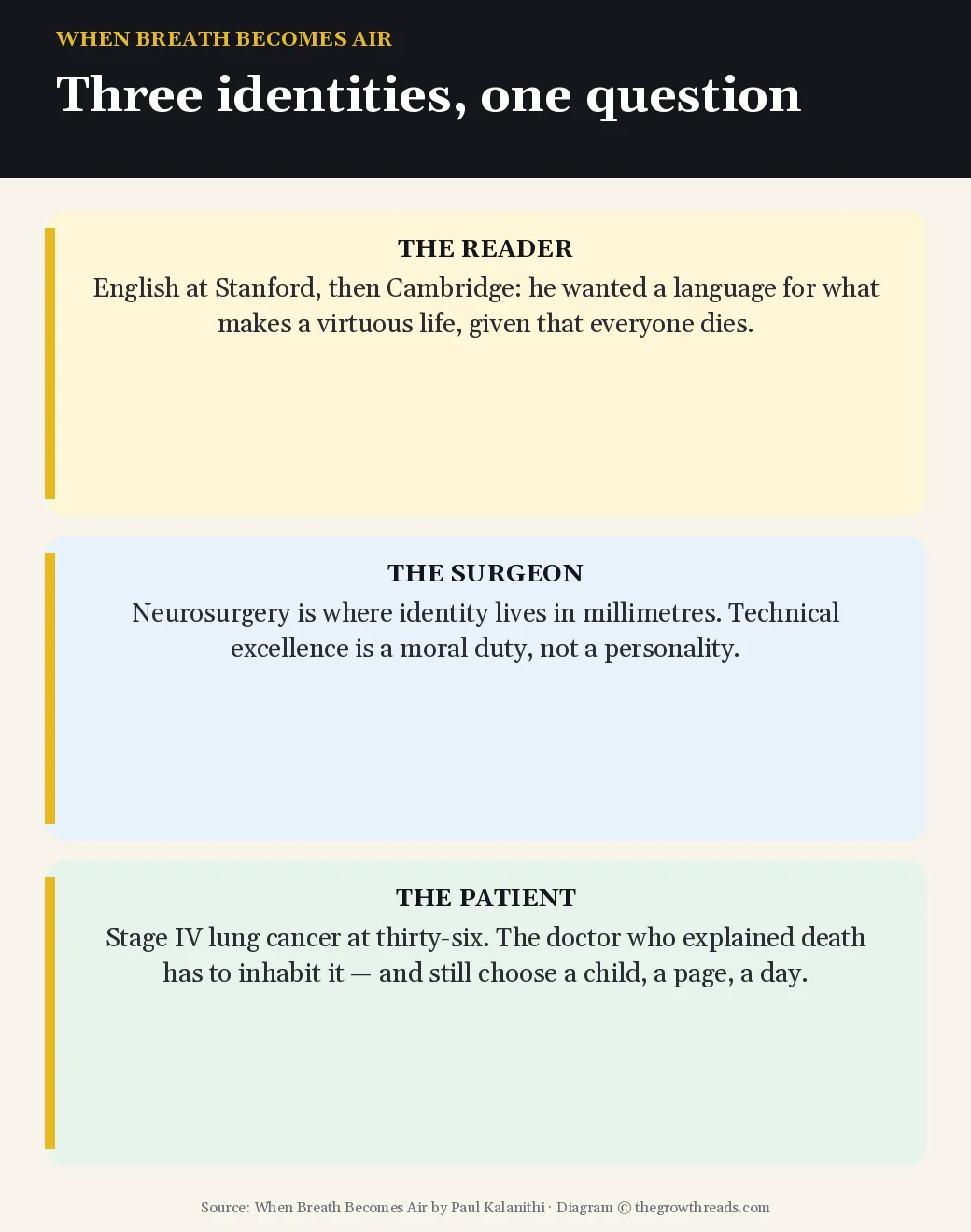
Kingman, Arizona, is the origin texture: a cardiologist father, a town that needed physicians, a son who could have inherited a simpler script. He takes the long way. When the scan arrives, purpose had just become a job he was finally allowed to do.
TGR Note: If you want the clinician’s view of systems around dying, read Being Mortal next. For meaning without a hospital, Man’s Search for Meaning is the older sibling. Kalanithi is the person who tried to hold both shelves in one life.
Part 2: Millimetres, families, and excellence as a duty
Residency is where the book earns its medical authority. Neurosurgery is moral geometry, not adrenaline. A tumour sits a millimetre from the tract that lets a person speak. Save the tissue, risk the self; spare the function, leave disease. He learns to judge whose life can be saved, whose cannot, and — harder — whose should not be prolonged into an existence they would have refused. That last cut, he later says, can be a worse failure than death: a body kept running when the person is gone.
He is blunt about skill. Good intentions do not keep a hand steady. Technical excellence is a moral requirement. Families do not need a charming resident. They need someone who can do the operation. If your work other people have to live inside, “I meant well” is not a complete sentence. Find the millimetre in your job and treat it as ethics.
The cost shows up at home. Lucy, an internist, names the silence. Hours and withheld fear starve a marriage even when both people know the hospital’s grammar. If identity is relational, disappearing into competence is a clinical error in another room. The health of a life includes the person who has to live with the doctor.
TGR Note: The millimetre argument pairs with The Brain That Changes Itself — the organ is plastic, and still not casual. For the body keeping score when you override it for the job, see The Body Keeps the Score.
Part 3: The scan that flattened the future
Symptoms arrive before the name: weight loss, back and chest pain, a fatigue that does not match a thirty-six-year-old’s story. A chest film looks clear. Workload is the easy story. Then the symptoms return harder. In New York he says cancer out loud to a friend. Back in San Francisco the scan is unambiguous: lungs, widely metastatic. One day he sits with families at the end of a life. The next he is the person in the gown. He still has a physician’s mind and a patient’s terror. He has to use both without letting either lie.
The future — finish residency, a chair, years of operating, a long life with Lucy — flattens. That metaphor is the one to steal. You can be healthy and still live as if only the next rung is real. He returns to surgery for a stretch, then, when his body will not do the operation, toward writing, fatherhood, being a patient who can still teach. These overlap in a week. Stop waiting for a clean identity before you act.
TGR Note: Flattened time is the opposite of the longevity ladder in Outlive and Lifespan. Those books try to lengthen the ladder. This one teaches you to live on the rung you occupy.
Part 4: Cady, the page, and Lucy’s last word
The decision to have a child is the book’s most practical parable. Lucy and Paul know the horizon is short. A baby is not a cure and not a denial. It is a yes to a life that is still happening. Cady is born into a house that already knows the ending. He holds her and writes to her. If you are postponing a relationship until the career is “done,” you are using a ladder that can be kicked away without your permission.
He writes until he cannot. Seven words from Samuel Beckett become a refrain: “I can’t go on. I’ll go on.” Strive — operate, write, love — and release the fantasy that striving buys a guaranteed later. He dies on 9 March 2015. Lucy’s epilogue refuses the costume of tragedy-as-identity: what happened to him was tragic, and he was not a tragedy. A life can contain a terrible medical fact without being reduced to it.
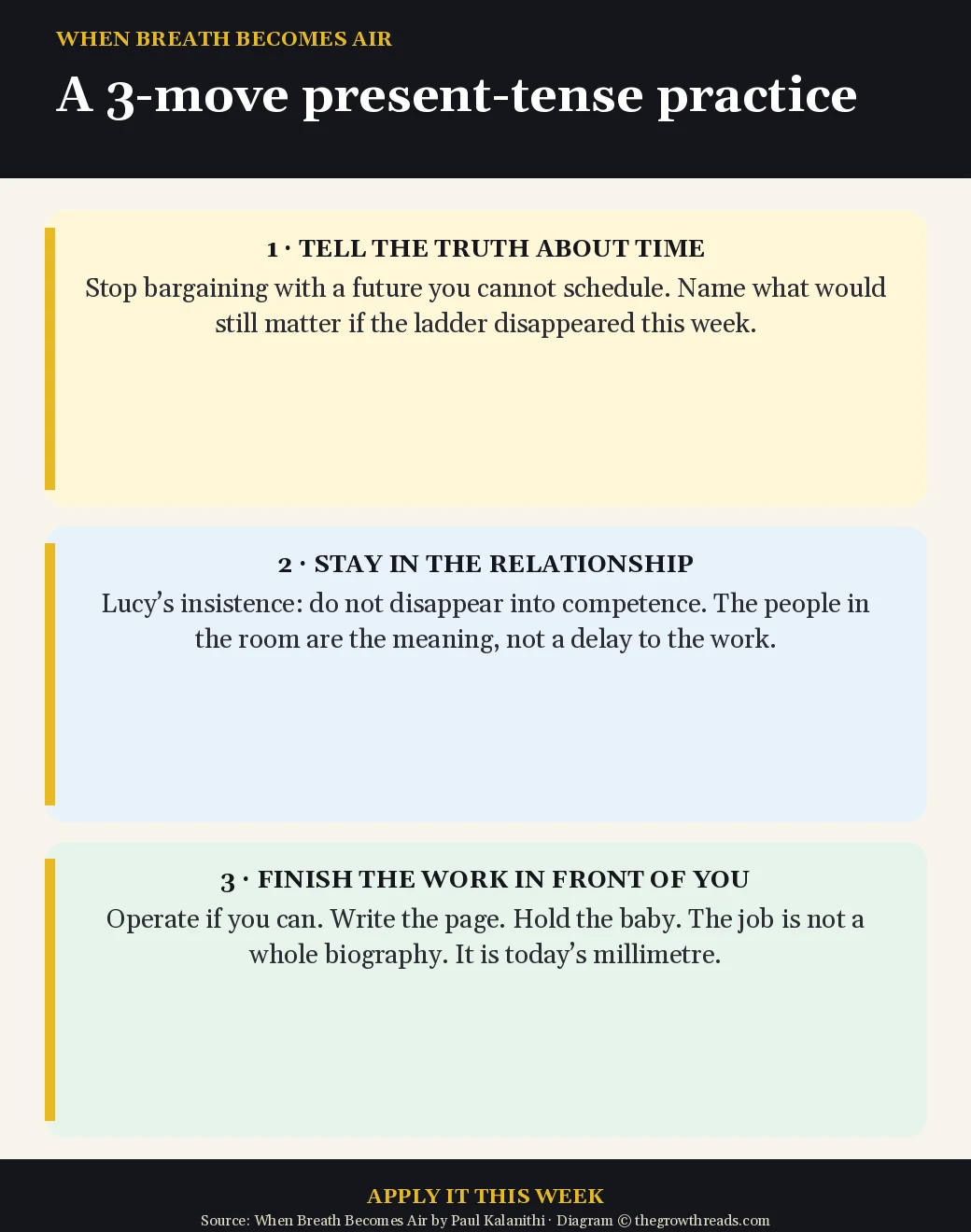
Abraham Verghese’s foreword places the book inside medicine as a moral craft, not a cancer pamphlet. Then do one thing that would still make sense if your own ladder shortened this year.
TGR Note: For a gentler longevity-and-purpose frame, Ikigai is the softer sibling. For choosing discomfort on purpose rather than having it assigned, The Comfort Crisis. This memoir stays the one to read when the discomfort is not a workout.
Who is When Breath Becomes Air best for — and who should read something else first?
Read it if you work in medicine, care for someone who is ill, or have just watched a future collapse into a set of Thursdays. It is also the right book if your career is so loud you have not asked what the millimetres are for. It is a short hardcover. The demand is emotional, not technical.
Read something else first if you need a protocol — start with Outlive, How Not to Die, or Why We Sleep. For how hospitals treat the dying, Being Mortal. For meaning without a ward, Man’s Search for Meaning. This is not medical advice; it is a memoir of how one physician made a life intelligible inside an illness.
Questions to reflect on
- If the ladder of “later” disappeared this week, which three hours of your calendar would still be worth doing?
- Where in your work is the millimetre — the small error other people would have to live inside — and are you treating it as ethics or as hassle?
- Where have you disappeared into competence and starved a relationship that is supposed to be part of the meaning?
- What would a “yes” look like now (a conversation, a child, a page, a trip) that you have been postponing until the career is finished?
- Which sentence are you using as a stall: “I can’t go on,” without the second sentence?
🔥 Ready to read the memoir itself?
Start with Part I — the question before the scan.
How to apply When Breath Becomes Air (7-day plan)
- Day 1: Write the two questions at the top of a page: What makes my life meaningful? What would I do if time were no longer a ladder? Answer in six lines, not a manifesto.
- Day 2: Circle the millimetre in your actual job — the small error someone else would have to live with. Block forty minutes to improve that one motion, not your brand.
- Day 3: Have one conversation you have been postponing until “later.” Use the afternoon you have. Do not wait for a cleaner identity.
- Day 4: Name where competence has starved a relationship. Restore one ordinary presence (a meal, a walk, an honest sentence) without turning it into a project.
- Day 5: Choose one “yes” that only makes sense in the present: a page written, a visit booked, a decision un-stalled. Do the smallest version.
- Day 6: Read Lucy’s idea as a rule: do not let a hard fact become your entire name. Write one sentence about your work that would still be true if the worst calendar arrived.
- Day 7: Practise Beckett on purpose. When you want to stall, say both halves: I can’t go on. I’ll go on. Then do the next millimetre — send, call, rest, or show up.
Frequently asked questions
What is When Breath Becomes Air about?
It is Paul Kalanithi’s memoir of becoming a neurosurgeon and then living with stage IV lung cancer in his thirties. The through-line is not a treatment plan. It is the question he was already asking as a literature student: what makes a life meaningful when everyone dies, and what do you do when the future is no longer a ladder of goals. He trains at Stanford, learns that identity can sit a millimetre from a surgical instrument, becomes a patient, returns to the OR for a stretch, chooses to have a daughter, and writes until he cannot. Lucy Kalanithi’s epilogue and Abraham Verghese’s foreword complete the book.
Is When Breath Becomes Air a true story?
Yes. It is an autobiography, not a novel. Kalanithi was a Stanford neurosurgery resident, diagnosed with metastatic lung cancer in his mid-thirties, and died on 9 March 2015. The book was published posthumously by Random House in January 2016, with a foreword by Abraham Verghese and an epilogue by his wife, Lucy, a Stanford internist. Anecdotes from the ward are his own cases and training, rendered as memoir rather than a case log. Read it as one physician’s testimony, not as a textbook or a promise about your own prognosis. For clinical decisions, use your own doctors.
What is the main message of When Breath Becomes Air?
Meaning is made in the time you actually have, not in the biography you were still scheduling. He had already chosen a craft that put identity under the knife; cancer removed the delay. The usable message is to stop treating “later” as a warehouse for your real life — the marriage, the child, the page, the honest conversation. Strive hard at the millimetre in front of you, and release the fantasy that striving purchases a guaranteed future. Beckett’s refrain is the method: you do not wait to feel ready. You go on.
Should I read Being Mortal or When Breath Becomes Air first?
Read When Breath Becomes Air if you want one life from the inside — training, marriage, a scan, a child, a page. Read Being Mortal first if you want Atul Gawande’s map of how medicine handles aging, independence, and the end of life as a system. They sit in the same silo for a reason. Kalanithi is the person in the bed who still thinks like a surgeon. Gawande is the surgeon thinking about the bed as policy and practice. If you only have one evening, start with Kalanithi; it is shorter. Then use Gawande to ask better questions of a hospital, not as a substitute for this memoir.
How long is When Breath Becomes Air and how long does it take to read?
The Random House hardcover is a short book: Verghese’s foreword, two parts, and Lucy’s epilogue, on the order of 220–256 pages depending on the edition. Most readers finish it in four to five hours, often in two sittings — Part I (vocation and the OR) then Part II (illness, fatherhood, the page). This guide is about fourteen minutes and is not a replacement for his sentences. If you are in a hard medical season, read in daylight and with someone nearby; it is not a thriller, but it does not look away. There is no workbook. The 7-day plan above is our application layer, not his.
What does “when breath becomes air” mean?
The title names the instant a life is no longer being lived as breath — the body still a fact, the person gone or going. Neurosurgery sits on that line. In the memoir it becomes personal: his own breath is the clock. The difference between a life and its absence is thinner than a career plan. That is why he trained on the brain, and why the book keeps returning to language: words are how a still-breathing person makes that thinness intelligible to the people in the room.
Is When Breath Becomes Air sad — and is it medical advice?
It is sad in the ordinary sense: a young surgeon dies, a daughter is born into that fact, a marriage has to hold both. It is not bleak as a philosophy. He keeps choosing work, a child, and sentences. Lucy’s epilogue refuses to let “tragic” become his whole name. The book will not tell you which oncology protocol to pick, whether to have a child during illness, or how to treat lung cancer. Those are clinical and personal decisions. Use this as a companion for meaning and time, then take treatment questions to clinicians who have your chart. Education, not a prescription.
Related summaries
- Being Mortal — how medicine should handle the end of a life as a system, not only a failure.
- Outlive — the science of stretching the ladder this memoir teaches you to live without.
- The Body Keeps the Score — what happens in the body when threat will not end.
- Ikigai — a gentler purpose-and-longevity frame when you want meaning without a ward.
Browse titles on our Best Health Books pillar page.
How we analyze books: our summaries are built from a full read of the source text, cross-referenced against the author’s published interviews and research where relevant, and structured around practical application rather than critique. We disclose our editorial process and affiliate relationships in full. Read our full methodology.