

★★★★★ 4.6/5 — The clinic book that still teaches you to inhabit a hard hour instead of outrunning it.
Best for: People whose stress lives in the jaw and the calendar, readers in chronic pain who are tired of being told to “relax,” and anyone who has collected mindfulness quotes without a floor practice
Reading time: ~12–16 hrs for the Bantam 720-page revised paperback · ~40 min for this guide
Difficulty to apply: Ten minutes on the floor is easy to start and easy to skip. The work is keeping the date when the hour is already a mess.
Full Catastrophe Living in one minute
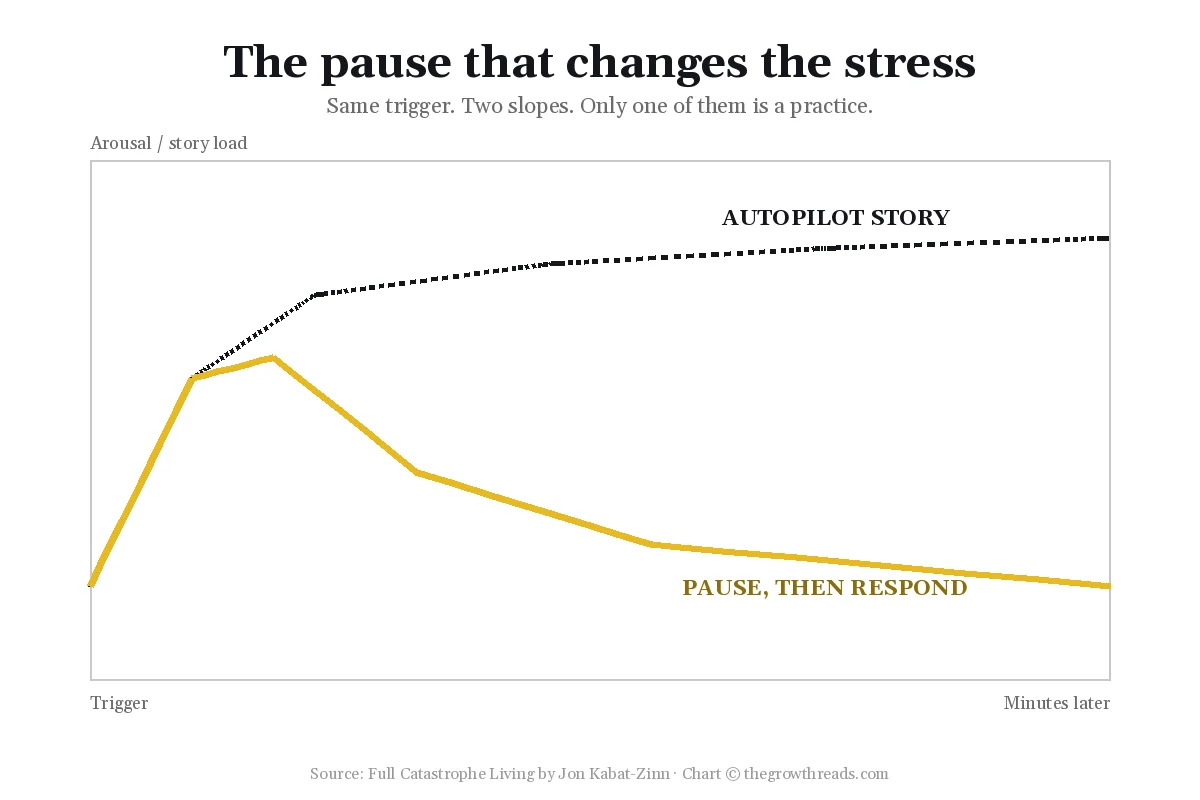
Jon Kabat-Zinn’s 1990 clinic book (revised 2013) argues that stress, pain, and illness get louder when you live on autopilot — and that the way through is not a new personality, but training attention. He founded the Stress Reduction Clinic at UMass in 1979 so physicians could send the patients falling through the cracks. The eight-week course, mindfulness-based stress reduction, teaches the body scan, sitting, yoga, and walking as ways to meet the “full catastrophe” of a human life without running. The usable move is a pause: feel the reaction, then choose a response. Diagnostic: the last time something went wrong today, how many seconds passed before you tensed, reached for a screen, or told a story? If you cannot find a gap, that is the curriculum.
Key takeaways
- The catastrophe is the whole of life, not a disaster-only club: Bills, scan results, kids, joy, a body that will not behave. You do not wait for a quieter year to inhabit it.
- Mindfulness is a kind of attention, not a mood: Paying attention on purpose, in the present moment, non-judgmentally — and, he insists, with the heart in it, not as a cold stare.
- Seven attitudes sit under the techniques: Non-judging, patience, beginner’s mind, trust, non-striving, acceptance, letting go. Without them a sit becomes another contest.
- Formal practices are few and physical: Body scan, sitting, yoga, walking, plus informal mindfulness of meals, showers, and walking to the car. The body is the classroom.
- Body and mind are one system: Thoughts change physiology; physiology changes thoughts. Treating them as two countries is the old medical cartoon.
- Most modern stress is an old alarm on a new problem: A memo is not a lion. The story you add can keep the alarm on all afternoon anyway.
- React versus respond is the whole game: Automatic tightening, reaching, and narrating compound the first event. A gap — even three breaths — is where choice lives.
- Pain plus resistance is often worse than pain: The sensation is one thing. “I cannot live like this” is another. Attention can unstick them without pretending the hurt is gone.
- You already have the capacity: The course does not install a new organ. It trains a human ability that hurry keeps covering.
- Eight weeks is a training course, not a vibe: Daily practice beats collecting ideas about attention.
What is Full Catastrophe Living about?
Full Catastrophe Living is Jon Kabat-Zinn’s 1990 (revised 2013) book on mindfulness-based stress reduction. It teaches how paying attention — on purpose, in this moment, without running — can change the way a person inhabits stress, pain, and illness, using the body scan, sitting, yoga, and the rest of an ordinary week as the classroom.
About the author
Jon Kabat-Zinn was born in 1944 and trained as a molecular biologist at MIT, completing a Ph.D. under Salvador Luria before turning that lab discipline toward attention. In 1979 he founded the Stress Reduction Clinic at the University of Massachusetts Medical Center so physicians could refer patients who were not getting better on usual care — chronic pain, heart trouble, anxiety, the people falling through the cracks. He taught an eight-week course that became mindfulness-based stress reduction: meditation and yoga in hospital language, without a religious wrapper. He is professor emeritus of medicine at UMass and the author of Wherever You Go, There You Are and Coming to Our Senses. Full Catastrophe Living is the curriculum in book form. He is not selling a mood. He is teaching a way to inhabit a body that already hurts, hurries, and hopes. Explore all Jon Kabat-Zinn book summaries →
Key concepts at a glance
| Concept | What it means | Use it when |
|---|---|---|
| Full catastrophe | Zorba’s name for a whole human life — not a dare to collect more disasters | You are waiting for a quieter year before you inhabit this one |
| Mindfulness | Awareness from paying attention on purpose, in the present, non-judgmentally | You only have quotes about calm, not a practice on the floor |
| Seven attitudes | Non-judging through letting go — the stance under every drill | Your sit has become another performance |
| Body scan | Attention through the body as a map, not a problem to fix | You live from the neck up and the jaw is a fist |
| Non-striving | The sit has no trophy. You practice being where you already are | You are trying to win relaxation in under ten minutes |
| Stress reaction vs response | Autopilot tightening versus a pause that lets you choose the next move | A small event owns the next three hours |
| Pain and extra suffering | Sensation plus the story that you are the sensation, plus the fight against it | A headache has become a self and a future |
| Informal practice | Meals, walking, showers, one email — the week is the monastery | You only “do mindfulness” when an app is open |
Part 1: The practice of mindfulness — seven attitudes and the formal drills
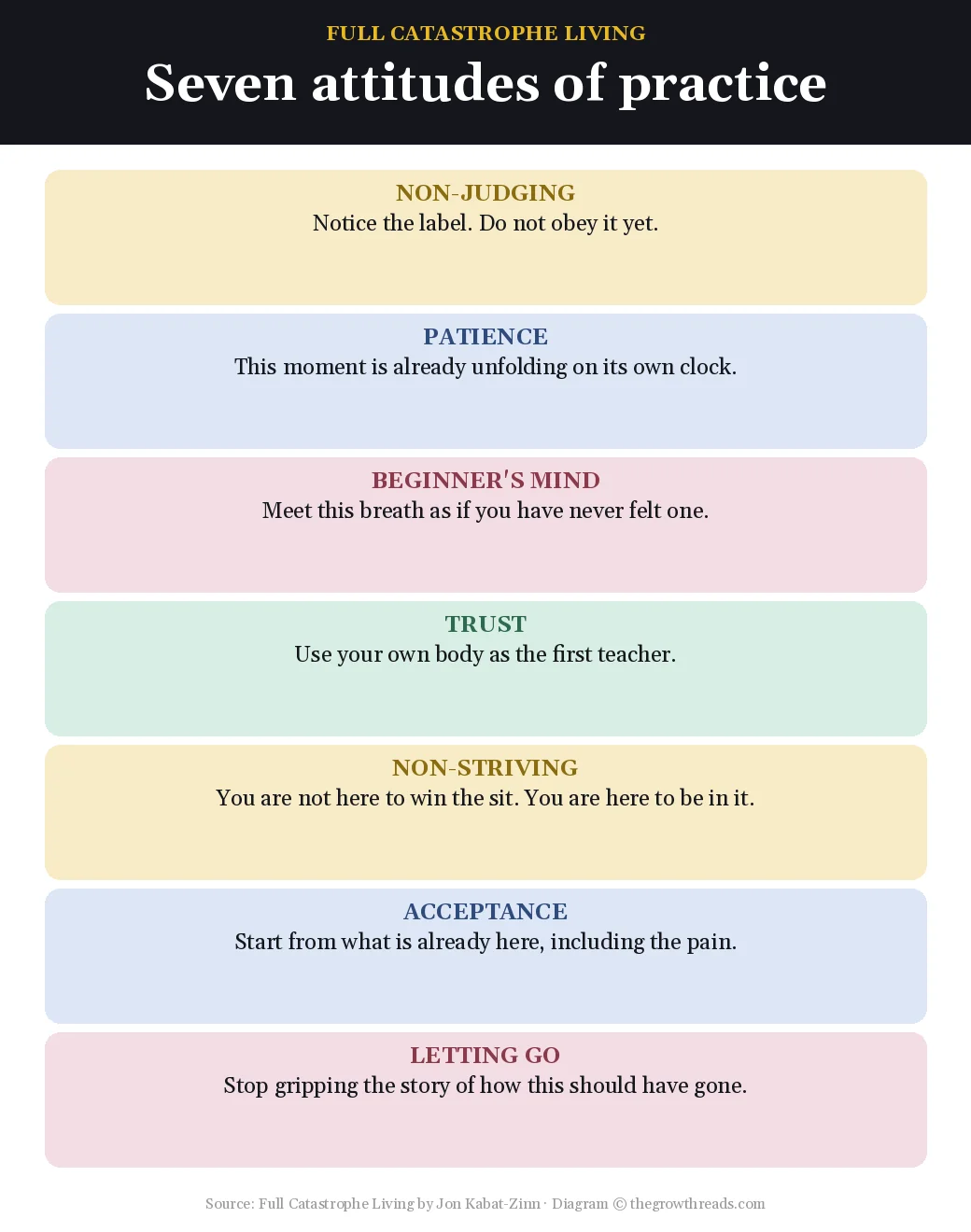
Kabat-Zinn opens with attitude because technique without it becomes another contest. Non-judging means you notice the label — good sit, bad sit — and do not immediately obey it. Patience means this breath has its own clock. Beginner’s mind means this inhale is not last Tuesday’s. Trust means the body is a teacher, not a broken appliance. Non-striving is the hard one for achievers: you are not here to win the sit. Acceptance is not approval; it is starting from what is already here. Letting go is unclenching the story of how the hour should have gone. He defines the work as “the awareness that arises by paying attention on purpose, in the present moment, and non-judgmentally.”
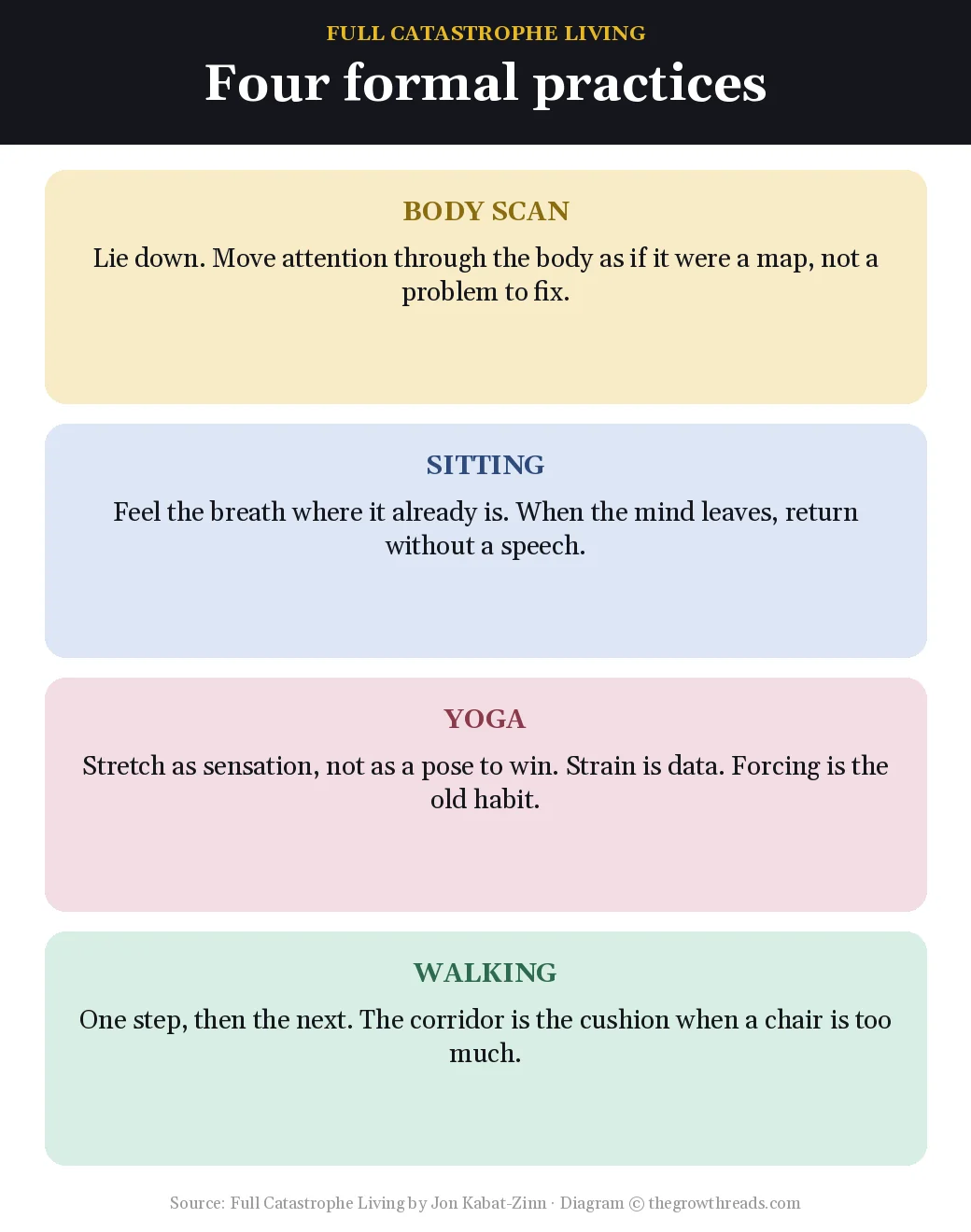
Then come the drills, physical rather than poetic. The body scan is usually done lying down: attention moves through the body the way a flashlight moves through a room. You are not fixing a calf. You are finding it. Sitting is feeling the breath where it already is and returning when the mind leaves, without a speech. Yoga is sensation in a stretch, not a pose to win. Walking is one step, then the next; a corridor counts. Eating, showering, and a red light are informal practice. You need the willingness to stay with one region of your own body without bargaining.
TGR Note: If the biology of why a memo can feel like a chase is the missing layer, read Why Zebras Don’t Get Ulcers. Sapolsky is the lecture. Kabat-Zinn is the lab session. For the breath as a lever you can actually pull this afternoon, add Breath.
Part 2: The paradigm — body and mind are one system
The middle of the book is a change of medical cartoon. Health is not a body over here and a mind over there. They are one dynamical pile. Optimism, helplessness, hostility, a sense that life coheres — these show up in immunity, in the heart, in recovery. Kabat-Zinn is careful: this is not a dare to smile cancer away. It is a dare to stop pretending that the way you inhabit a diagnosis is medically irrelevant. The clinic was built for people whose tests were incomplete answers. Something still hurt. The missing variable was often the relationship to the symptom.
He also widens “wholeness” past the skin. Sleep, food, other people, the news, the chair — they are the field the nervous system is answering. If you treat a tight chest as a private moral failure, you miss the week that produced it. If you treat it as information in a system, you can change one input — a walk, a meal, a sit — without a new personality first. The paradigm is permission to include your attention in the treatment plan you already have.
TGR Note: For trauma stored as physiology rather than as a story you can talk out, The Body Keeps the Score is the adjacent map. Kabat-Zinn will teach you to inhabit a sensation. Van der Kolk will tell you why some sensations have a history that needs more than a scan. They are allies, not substitutes.
Part 3: Stress — why autopilot makes ordinary life feel like a chase
Part III is the user’s manual for a nervous system that did not get the memo about offices. Drawing on Lazarus and Folkman, Kabat-Zinn treats psychological stress as a relationship: a person, an environment, an appraisal that this is too much. The primitive alarm is excellent at lions and sloppy at inboxes. A lifetime of unexamined reactions — jaw, overwork, a feed, rumination — is a health exposure. The first event is often small. The second event is what you do next without noticing.
The book’s offer is not “never get activated.” It is: see the activation while it is happening, so you can influence the next ten minutes. Hyperarousal plus a story (“this always happens to me,” “I will never get through this”) turns a solvable Tuesday into a siege. Mindfulness is the skill of being in the flow of the event at the moment you would usually vanish into the story. Then you can respond: send the shorter email, take the walk, tell the truth, lie down for the scan instead of arguing with the ceiling. Comfort here is not numbness. It is the comfort of being whole while the problem is still a problem. That is a different promise from “calm down.”
TGR Note: If the chase is a dopamine loop rather than a lion-that-is-a-memo, Dopamine Nation is the clinical cousin. Lembke is about pleasure-pain balance. Kabat-Zinn is about attention under load. For the night shift of the same nervous system, Why We Sleep is the recovery chapter this book assumes you will eventually keep.
Part 4: Applications — pain, time, work, and the rest of the catastrophe
The last movement is where the clinic shows. Chronic pain is the flagship application because people arrive when pills and procedures have already been tried. The instruction sounds wrong on purpose: do not immediately fight the sensation or distract from it. Put out a welcome mat for what is already here, even for ten seconds. Feel it as burning or tightness rather than as a self named “my ruined back.” “A headache” is different from “I cannot live like this.” The second sentence recruits the whole future. Clinic studies and patient stories suggest this unsticking can change how much of a life the pain occupies. It is a direction of work, not a guarantee.
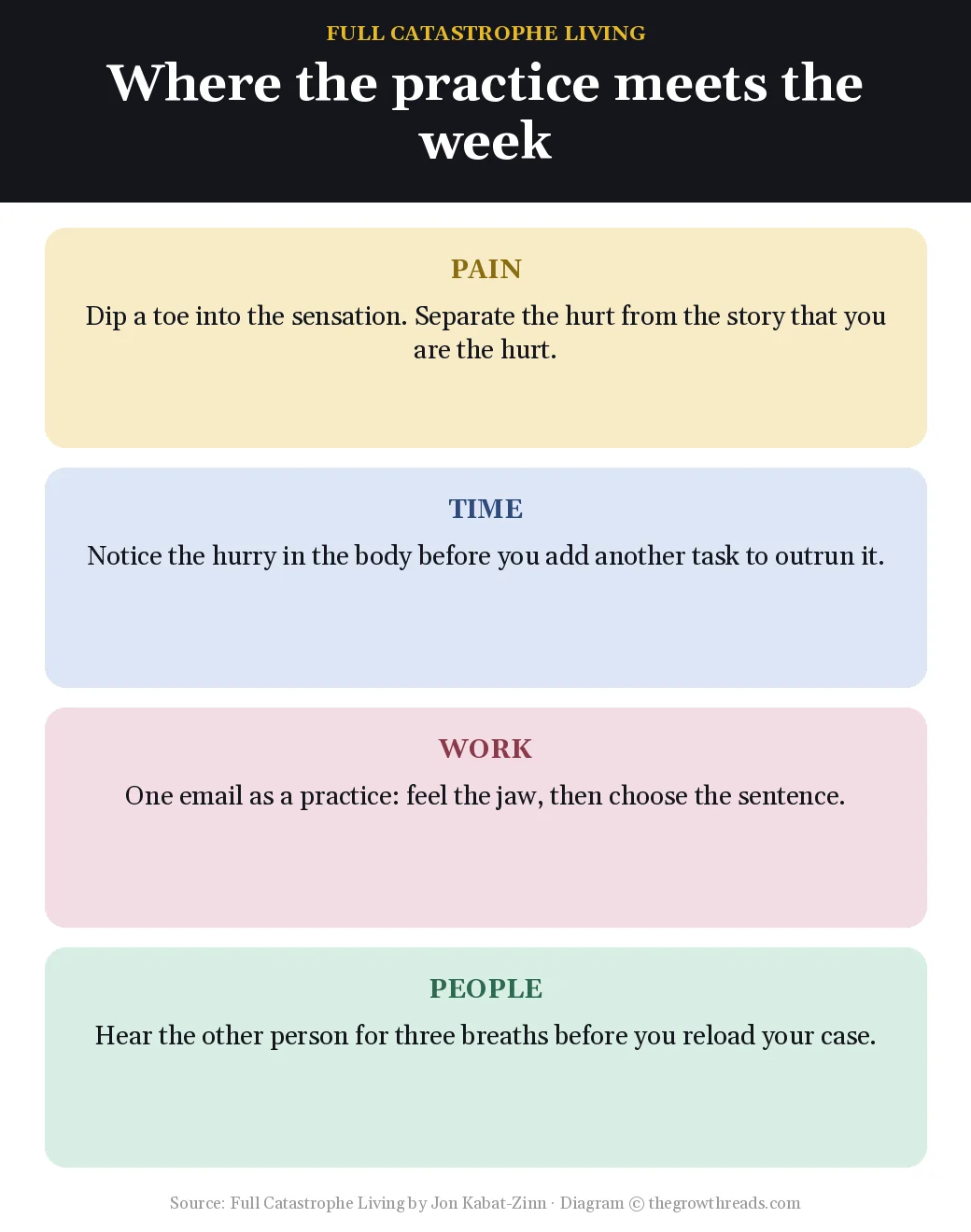
Time, work, other people, and the news get the same treatment. Hurry is visible in the body before it is visible on the calendar. One email can be a practice: jaw, then sentence. One conversation can be three breaths of actually hearing the other person. World events will not pause because you sat. The question is whether you add rumination as a second catastrophe. Informal practice is how a 720-page book becomes a Tuesday: the shower, the walk, three bites. If you can join the eight-week container, do. If not, steal the attitudes and one drill, then keep the date. You do not have to abandon yourself in the pile.
TGR Note: If your “practice” is only more intensity — cold plunges, longer miles, another protocol — read The Comfort Crisis next to this, not instead of it. Discomfort can train you. So can staying. For movement as a brain intervention rather than a grind, Spark is the exercise chapter Kabat-Zinn will not write.
Who is Full Catastrophe Living best for — and who should read something else first?
Read it if your stress lives in your jaw and your calendar, you have chronic pain or a racing mind and you are tired of being told to relax, or you have mindfulness quotes and no floor practice. It is a clinic course in book form.
Read something else first if you want the biology lecture without the sits — start with Why Zebras Don’t Get Ulcers. If trauma is the main door, start with The Body Keeps the Score and a clinician. For a slim introduction, Wherever You Go, There You Are is shorter. This is not medical advice and not a replacement for treatment.
Questions to reflect on
- The last time something went wrong today, how many seconds before you tensed, reached, or told a story?
- Which of the seven attitudes do you already use as a weapon (especially non-striving)?
- If you did a ten-minute body scan tonight, which region would you bargain not to feel?
- Where does hurry show up in your body before it shows up on the calendar?
- What would informal practice be this week as one action — three bites, one email, one walk?
🔥 Ready to meet the next hard hour without running?
Start with the seven attitudes, then do one body scan this week — ten minutes is enough to begin.
How to apply Full Catastrophe Living (7-day plan)
- Day 1: Ten-minute body scan. When the mind leaves, return. No score.
- Day 2: One meal with the phone in another room. Taste three bites on purpose.
- Day 3: Sit ten minutes. Feel the breath in one place. No speeches about failure.
- Day 4: Ten minutes of slow stretching. Notice strain versus the story you should be more flexible.
- Day 5: Catch one live reaction — jaw, thumb, a sentence you always say. Three breaths, then choose.
- Day 6: Walk ten minutes as walking. A corridor counts.
- Day 7: A four-word house rule where you hurry. Example: “Feel it, then choose.”
Frequently asked questions
What is Full Catastrophe Living about?
It is Jon Kabat-Zinn’s 1990 (revised 2013) account of mindfulness-based stress reduction, the eight-week UMass clinic program for patients who were not getting better on usual care. He teaches the body scan, sitting, yoga, and walking as ways to meet stress, pain, and illness without running. The title is Zorba’s joke about a full human life, not a disaster-only book. The application is a pause: feel the reaction, then choose a response. A course in book form, not a mood, and not a diagnosis.
What does “full catastrophe” actually mean in this book?
It is not a dare to collect more disasters. Kabat-Zinn borrows Zorba the Greek’s line about marriage — wife, house, kids, the full catastrophe — to name a whole human life: bills, scan results, arguments, joy, a body that will not behave. The practice is to inhabit that pile without waiting for a quieter year. You are not asked to like it. You are asked to stop postponing your life until it is gone. A ten-minute body scan on a messy Tuesday is more faithful than a retreat you never book.
Is Full Catastrophe Living still relevant in 2026?
Yes. Clinic language aged; the nervous system did not. Phones and a calendar with no slack are new costumes for the old alarm. The revised edition already folded in two extra decades of research; the drills are still the drills. For a two-hour introduction, Wherever You Go, There You Are is shorter. For the medical-center curriculum — attitudes, practices, stress, pain, time — this is still the book. Apps can time a sit. They will not replace feeling a headache as a headache, not as a self.
Full Catastrophe Living vs Why Zebras Don’t Get Ulcers vs The Body Keeps the Score — which first?
Read Full Catastrophe Living first if you want a practice on the floor this week. Read Why Zebras Don’t Get Ulcers first for the biology of why a memo can feel like a lion. Read The Body Keeps the Score first if trauma is the door. They stack: Kabat-Zinn is the clinic course, Sapolsky the lecture, van der Kolk the trauma map. If you only have one busy month and the issue is hurry plus a tight jaw, start here, then steal the zebra for the science.
Do I have to sit for forty-five minutes or join an eight-week MBSR class?
No. The UMass course is the gold-standard container — weekly class, daily practice, a day of silence — and the book describes it honestly. Your version can start at ten minutes: a body scan on the floor, three mindful bites, one email felt in the jaw. The book will not scold you for missing a class you did not enroll in. It will notice if you only collect ideas. If you can join a live MBSR group, do. If not, steal the attitudes and one drill, then keep the date.
How long is Full Catastrophe Living and which edition should I buy?
The Bantam revised paperback we link is ISBN-13 9780345536938, ASIN 0345536932, about 720 pages, published 24 September 2013 (originally 1990). Most readers need twelve to sixteen hours; it is a course, not a weekend essay. Read attitudes and practices first, then stress, then pain and time. This guide is not a replacement for a body scan you have never done. Buy the edition you will open on a weeknight. The 7-day plan below is our application layer, not his clinic workbook.
Is this medical advice — and does the book replace treatment?
No, and no. Kabat-Zinn built MBSR inside a hospital as a complement to care, not a substitute. The book will not tell you how to treat a disc, panic, cancer, or a child’s sleep. Those are clinical decisions. Use this as a map of attention under stress, then take personal health questions to clinicians who have your chart. If practice makes symptoms worse, or a trauma history means flooding would harm, stop and get help. The 7-day plan is not a treatment protocol.
Related summaries
- Why Zebras Don’t Get Ulcers — why a memo can feel like a lion.
- The Body Keeps the Score — trauma as physiology, when a scan is not the first door.
- Dopamine Nation — when the chase is a feed, not a deadline.
- Breath — the lever you can pull when sitting still is too much.
Browse titles on our Best Health Books pillar page.
How we analyze books: our summaries are built from a full read of the source text, cross-referenced against the author’s published interviews and research where relevant, and structured around practical application rather than critique. Read our full methodology.