

★★★★★ 4.7/5 — A surgeon’s unflinching, deeply humane case for making the end of life about living well, not just surviving longer.
Best for: Adult children navigating a parent’s care, clinicians and caregivers, and anyone who wants a calmer relationship with mortality.
Reading time: ~6 hrs to read the book · 22 min to read this guide
Difficulty to apply: Moderate — the ideas are simple, but the conversations they call for are hard.
Being Mortal in one minute
Modern medicine is very good at fighting disease and very bad at helping people live well while dying. Surgeon Atul Gawande argues that medicine’s obsession with safety and survival has quietly pushed aside a more important question: what actually makes someone’s remaining time worth having? Through the history of nursing homes, the invention of assisted living, groundbreaking hospice research, and the story of his own father’s fatal brain tumor, Gawande builds a case that a good ending isn’t about trying everything possible — it’s about knowing, specifically, what a person is trying to protect, and building care around that answer.
Key takeaways
- Medicine treats aging and dying as problems to solve: when they’re better understood as a phase of life to be lived as well as possible.
- Safety isn’t the same as a life worth living: institutions built to minimize risk often strip away the autonomy that gives people a reason to get up in the morning.
- Nursing homes were built for hospitals’ convenience: not designed from scratch around what elderly residents actually need.
- Assisted living began as a rebellion: Keren Brown Wilson designed it around her mother’s wish for a door she could lock herself.
- Small additions can transform institutional life: Bill Thomas’s Eden Alternative added plants, animals, and children to nursing homes and measurably cut deaths and infections.
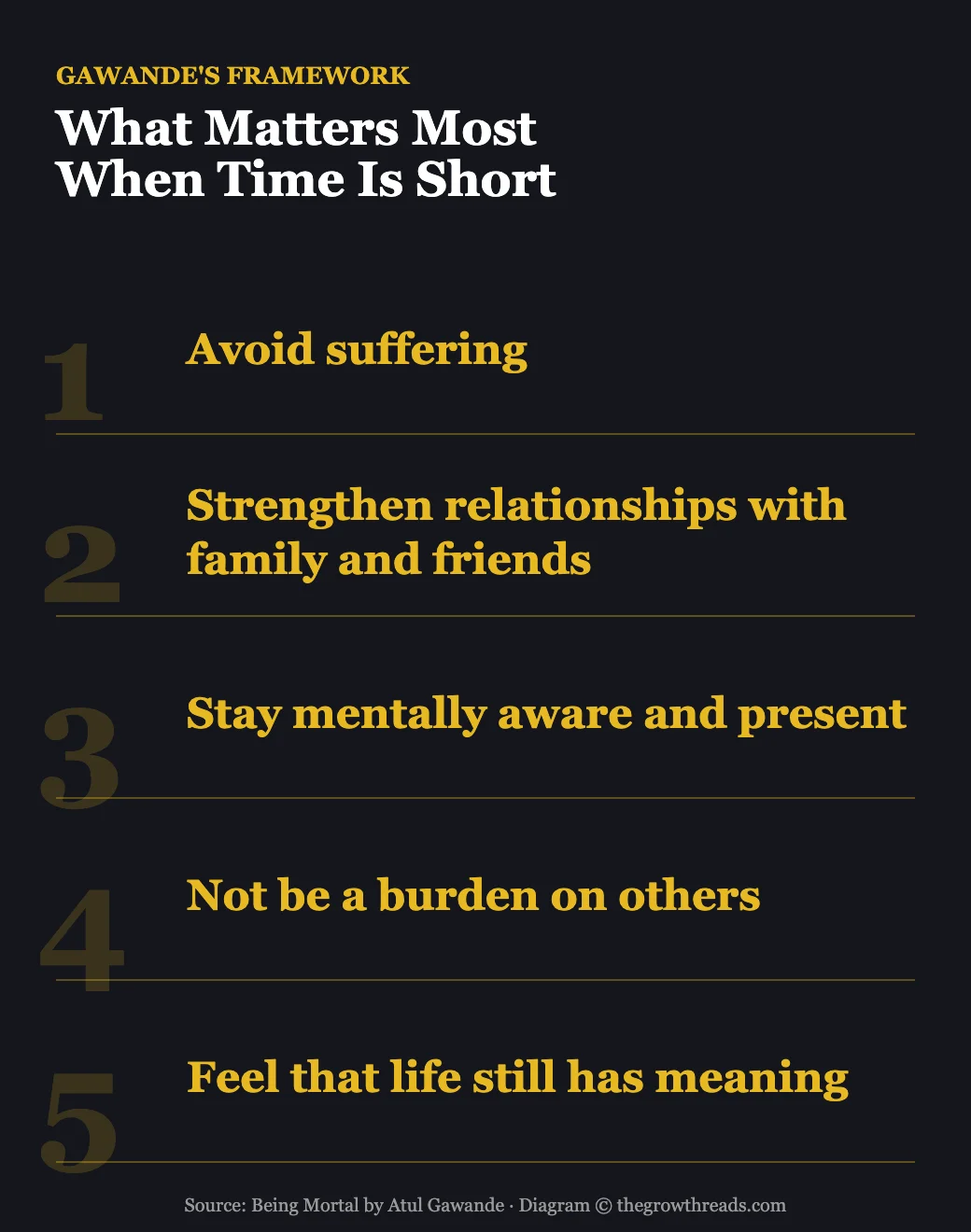
- People near the end usually want more than survival: avoiding suffering, staying connected, remaining lucid, and not becoming a burden often outrank simply living longer.
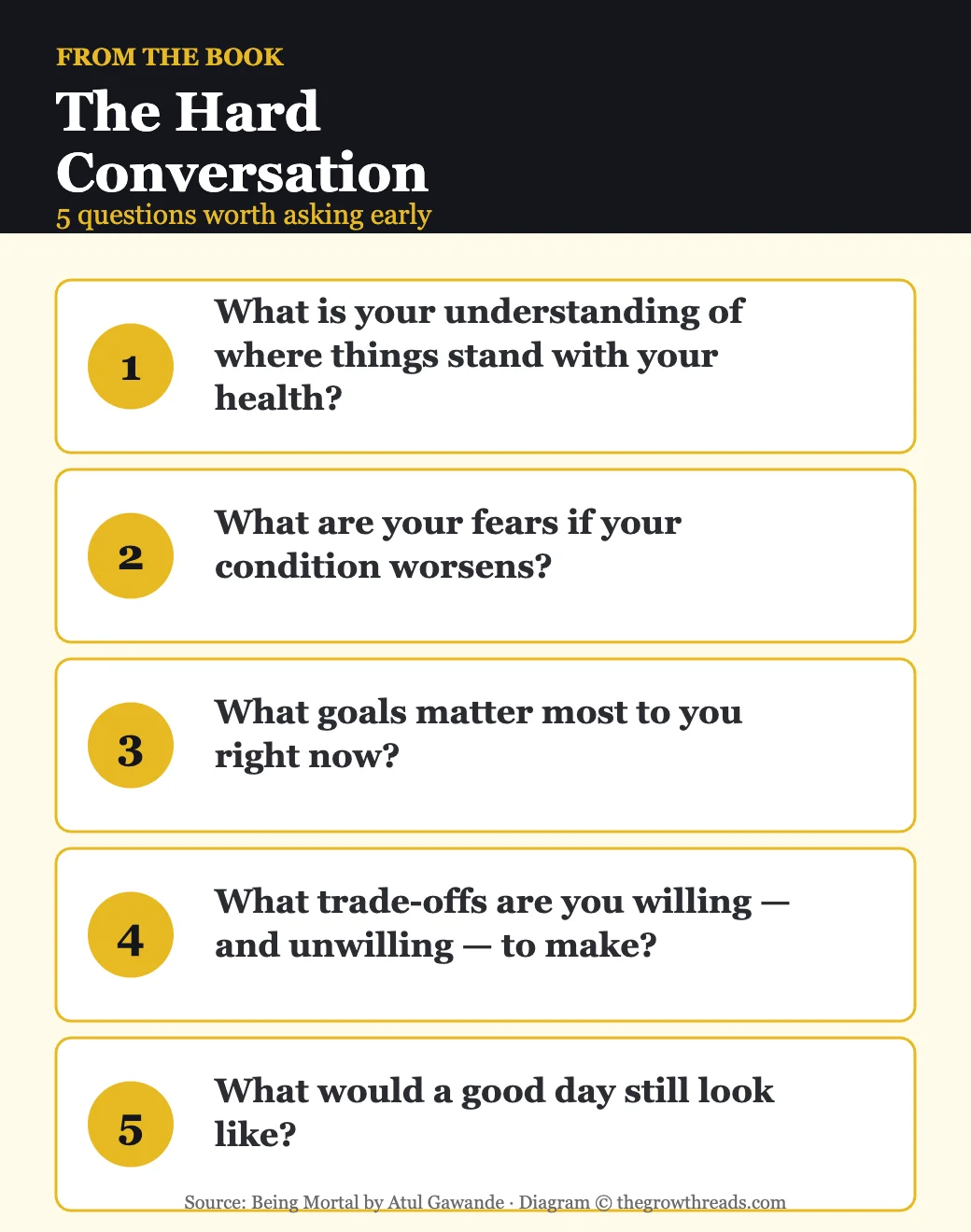
- The “hard conversation” works best asked early: a short set of questions about understanding, fears, goals, and trade-offs beats waiting for a crisis.
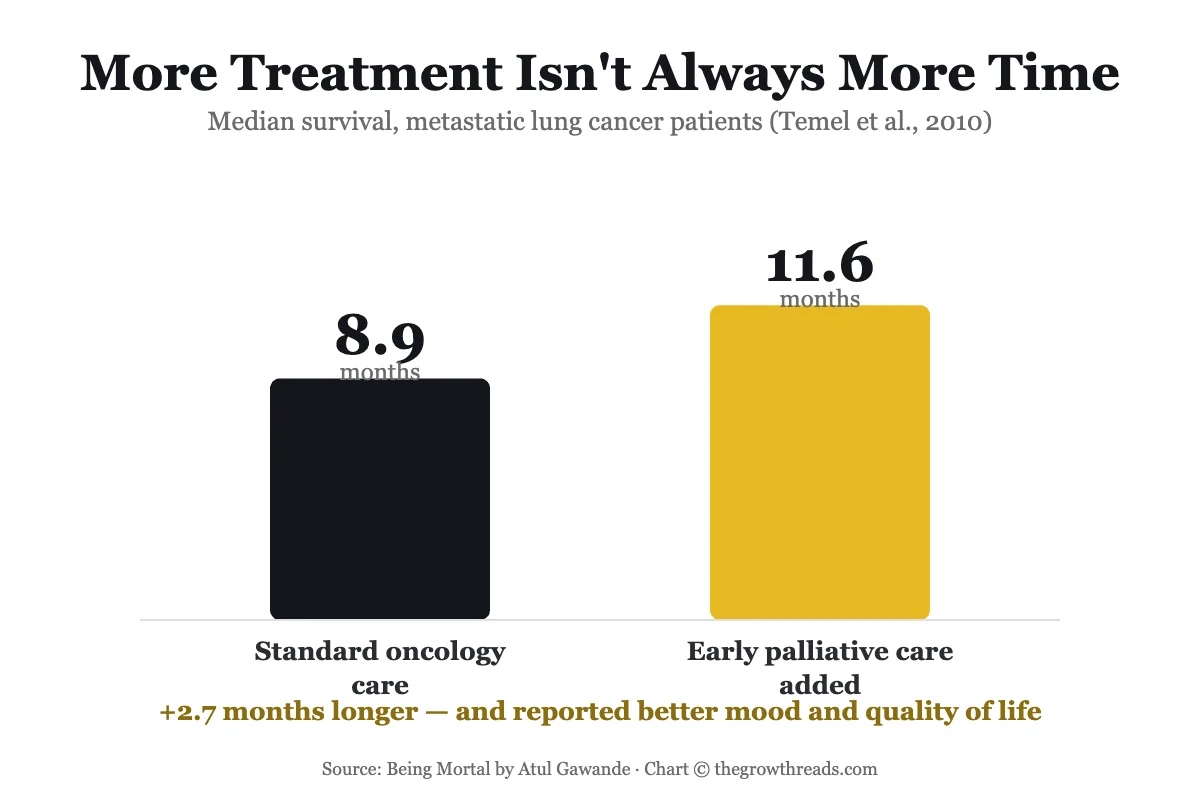
- Early palliative care can extend life, not just comfort it: a landmark study found patients who got it lived longer than those who received aggressive treatment alone.
- A good doctor asks before acting: the real failure isn’t choosing treatment or hospice — it’s never asking the patient which one actually serves their goals.
What is Being Mortal about?
Being Mortal is Atul Gawande’s exploration of aging, serious illness, and dying in modern medicine. Drawing on patient stories, the history of nursing homes and hospice, and his father’s terminal illness, Gawande argues medicine should prioritize what makes life worth living, not just survival — and shows how honest conversations make that possible.
About the author
Atul Gawande is a surgeon, writer, and public health leader whose work examines how simple ideas — checklists, honest conversations, better systems — can dramatically improve outcomes in fields that resist change. A professor at Harvard Medical School and practicing surgeon at Brigham and Women’s Hospital, he has spent two decades writing for The New Yorker on the gap between what medicine can do and what it should do. Being Mortal grew out of a personal reckoning: watching his own father, also a surgeon, navigate a fatal brain tumor forced Gawande to confront how poorly his profession prepares patients, families, and doctors for the realities of aging and death. He later served as CEO of Haven and as USAID’s Assistant Administrator for Global Health. Explore all Atul Gawande book summaries →
Key concepts at a glance
| Concept | What it means | Use it when |
|---|---|---|
| Medicalization of dying | Treating aging and death as problems to defeat rather than a phase of life to live well | A loved one’s care plan only asks what’s medically possible, never what they actually want |
| The nursing home model | Institutions built around safety, efficiency, and liability, modeled on hospitals rather than homes | Choosing a facility — judge it by a resident’s actual day, not just staff ratios |
| Assisted living | A model built around autonomy, where residents keep control over small daily choices | A parent needs support but still wants to run their own routine |
| The Eden Alternative | Filling institutions with plants, animals, and purpose to fight loneliness and boredom | Evaluating whether a facility gives people something to live for, not just care for |
| The hard conversation | A structured set of questions about understanding, fears, goals, and trade-offs | Right after a serious diagnosis, or before a major treatment decision |
| Priorities beyond survival | What most people want most isn’t more time — it’s a specific quality of the time left | A treatment’s side effects would cost the very things that make life meaningful |
| Hospice and palliative care | Care focused on comfort and quality of life, which research shows can sometimes extend it too | Aggressive treatment starts costing more in suffering than it adds in time |
Part 1: The Limits of Medicine
Gawande opens with his grandfather in India, who lived to 110 surrounded by generations of family in his own home — cared for, consulted, and needed until the end. He contrasts this with the typical modern American old age: institutionalized, medicalized, and often stripped of the small decisions that make a life feel like one’s own. Industrialization and smaller households, he notes, broke the extended-family model that once made this kind of ending possible almost by default — which is part of why medicine and institutions had to step in at all.
Gawande admits his own medical training taught him to fight disease relentlessly but gave him almost no instruction in how to help someone die well, or even how to recognize when fighting had stopped helping. He calls this the “war” mentality of medicine: every problem is assumed to have a fix, and when a fix doesn’t exist, many doctors keep offering marginal interventions anyway, because it feels like doing something. He recalls patients who spent their final weeks in an ICU, tethered to machines, after a surgery that offered a small chance of extra time and a near-certainty of a worse death than they would have had otherwise. The cost of this reflex, he argues, is borne by patients and families who never get asked what they’re actually hoping for.
TGR Note: If Being Mortal is about protecting the quality of the years you have left, our Outlive summary is the natural companion — Peter Attia’s focus is adding healthy years in the first place. Read Attia for prevention, Gawande for what to do once time is already short.
Part 2: The Nursing Home Trap
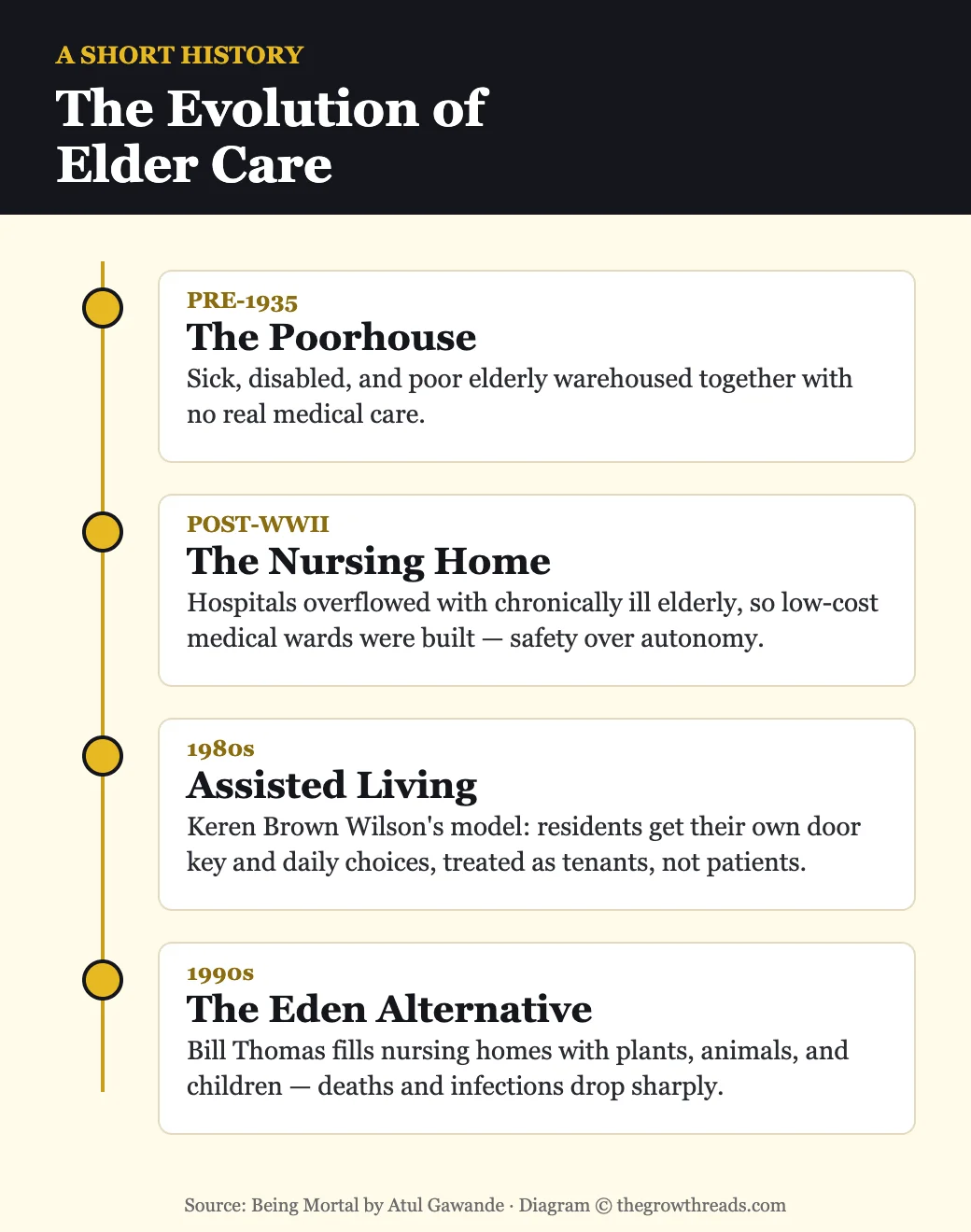
Nursing homes, Gawande explains, weren’t designed from first principles — they emerged almost by accident, as postwar hospitals needed somewhere to send patients who were medically stable but too frail to go home. Medicare and Medicaid later locked this hospital-derived model in place by reimbursing care organized around medical tasks and checklists, not around anything resembling a normal life. The result was a facility built around a hospital’s priorities: medical safety, staff efficiency, and legal liability, not a resident’s sense of purpose.
He tells the story of Lou Sanders, whose family placed him in a well-run, highly rated facility — and who nonetheless found his days empty of anything he actually wanted to do, his schedule set by staff shifts rather than his own preferences. The tragedy Gawande identifies isn’t neglect; most of these institutions are staffed by caring people working within a broken design. It’s that the entire model answers a question nobody asked: how do we keep this person safe, rather than how do we help this person live.
Part 3: Reinventing Old Age
The book’s most hopeful chapters follow the people who tried to fix this. Keren Brown Wilson, watching her mother’s independence disappear inside a nursing home, designed the first assisted living facility around a simple idea: residents get their own door key and decide their own routines, with help available rather than imposed. Physician Bill Thomas went further, filling a New York nursing home with two dogs, four cats, a hundred birds, and an after-school program for staff’s children. Within two years, deaths fell, infections dropped, and prescription use was cut nearly in half — not because of any new treatment, but because residents had something to care for and look forward to. Gawande’s conclusion is a hierarchy hiding inside these stories: what people actually need, once basic safety is met, is autonomy, connection, and a reason to keep living — not just more protection.
TGR Note: The idea that purpose, not just comfort, is what keeps people going echoes our Ikigai summary — Okinawan centenarians in the book stay engaged and needed well into old age, which Gawande’s research suggests may matter as much as any medical intervention.
Part 4: Letting Go
The final chapters turn to the hardest question: how do we talk about dying before it’s too late to talk about it well? Gawande leans on palliative care physician Susan Block’s framework — a short list of questions about a patient’s understanding, fears, goals, and acceptable trade-offs — and shows how asking them early changes outcomes, often calming patients rather than frightening them, because it hands back a measure of control.
He cites a 2010 study of metastatic lung cancer patients in which those who received early palliative care alongside standard treatment reported better mood and quality of life, and also lived measurably longer than patients who received aggressive treatment alone — a finding that upends the assumption that comfort-focused care necessarily means giving up time. The most personal chapter follows Gawande’s own father, also a surgeon, through a spinal cord tumor — and how asking these exact questions helped the family choose a path that honored his father’s priorities, including which risks were worth taking and which weren’t, instead of defaulting to every available intervention. The book closes not with a rejection of medicine, but with an argument for asking better questions before deciding what medicine should do.
TGR Note: Community shows up again and again in longevity research — our Blue Zones summary covers cultures where elders stay woven into family life until the end, which lines up closely with what Gawande found actually helps people thrive in their final years.
Who is Being Mortal best for — and who should read something else first?
Being Mortal is best for adult children navigating care decisions for aging parents, clinicians and caregivers, and anyone who wants a calmer, more prepared relationship with mortality. It is especially useful right before or right after a serious diagnosis enters a family, when decisions are still being made in a hurry and nobody has yet asked what the patient actually wants. If you’re more interested in extending healthy lifespan in the first place, start with our Outlive summary. If you want a gentler entry point built around daily purpose and habits rather than end-of-life care, try Ikigai or The Blue Zones first.
Questions to reflect on
- If your time were limited, what would matter more to you — more time, or a specific quality of time?
- Have you had the “hard conversation” with your parents or partner about what they’d want?
- What does “a good day” look like for someone you love who is aging or seriously ill?
- Where in your own life are you choosing safety over what actually makes your days worth living?
- Who in your life should you ask Dr. Block’s five questions before a crisis forces it?
🔥 Ready to read Being Mortal in full?
Gawande’s stories will change how you think about aging, illness, and the conversations that matter most.
How to apply Being Mortal (7-day plan)
- Day 1: Write down your own answers to Dr. Block’s five questions, just for yourself.
- Day 2: Ask one aging parent or loved one what “a good day” looks like for them right now.
- Day 3: Research what hospice and palliative care actually offer in your area, before you need them.
- Day 4: If a loved one is in or considering a facility, visit and watch a resident’s actual day, not just the tour.
- Day 5: Look into advance directive or healthcare proxy paperwork where you live.
- Day 6: Have the hard conversation with one family member, using the five questions as a guide.
- Day 7: Write down your own priorities beyond survival, and share them with someone who would need to know.
Frequently asked questions
What is Being Mortal about in simple terms?
Being Mortal is surgeon Atul Gawande’s examination of how modern medicine handles aging, serious illness, and dying — and how it often gets this wrong by prioritizing safety and treatment over quality of life. Drawing on patient stories, historical research on nursing homes and hospice, and his own father’s terminal illness, Gawande argues the central question shouldn’t be “how do we extend life” but “what makes life worth living, and how do we protect that for as long as possible.” It’s ultimately a practical, humane guide to having honest conversations about mortality before a crisis forces them.
Is Being Mortal only relevant if you work in healthcare?
No. While Gawande writes as a practicing surgeon, the book is aimed at a general audience navigating aging parents, personal illness, or their own mortality. Its core tools — the hard-conversation questions, the idea of priorities beyond survival, and the history of how elder care evolved — are directly useful for anyone making decisions about a loved one’s care or their own end-of-life wishes, regardless of medical background.
What is the “hard conversation” Gawande describes?
It’s a structured set of questions, drawn from palliative care specialist Susan Block, meant to surface what someone actually wants as their health declines: their understanding of their situation, their fears, their goals, the trade-offs they will and won’t accept, and what a good day would still look like. Gawande argues these questions work best asked early and repeatedly, not saved for a crisis in an ICU waiting room.
Did the Temel palliative care study really show people lived longer?
Yes. The 2010 New England Journal of Medicine study Gawande cites followed patients with metastatic lung cancer, comparing standard oncology care to standard care plus early palliative care. Patients who received early palliative care reported better mood and quality of life — and also lived a median of 11.6 months versus 8.9 months for standard care alone, despite receiving less aggressive treatment near the end. Results like this are specific to this study population and shouldn’t be read as guaranteed for every diagnosis.
What’s the difference between a nursing home and assisted living, according to the book?
Gawande traces nursing homes to a hospital-model history built around medical safety, staff efficiency, and liability, where residents are treated primarily as patients. Assisted living, pioneered by Keren Brown Wilson, was designed around autonomy: residents keep their own door key and make daily choices, with support available rather than imposed. In practice today the terms overlap, so Gawande’s advice is to judge any facility by what a resident’s actual day looks like, not by its label.
Does Being Mortal argue against medical treatment?
No — Gawande is a surgeon who spends much of the book defending good medicine. His argument is against treatment decisions made by default, without first asking what the patient actually wants and can realistically expect. He’s explicit that aggressive treatment is often the right choice; the failure he describes is skipping the conversation that would reveal whether it’s the right choice for this particular person.
Is Being Mortal sad or depressing to read?
Parts of it are difficult, since it centers on serious illness and death, including Gawande’s own father. But most readers describe it as clarifying and even hopeful rather than bleak — the stories of the Eden Alternative, assisted living pioneers, and patients who got a good ending on their own terms are genuinely uplifting, and the practical frameworks give readers something concrete to do with the discomfort rather than just sitting in it.
Related summaries
- Outlive by Peter Attia — the case for extending healthy lifespan in the first place.
- Ikigai — the Okinawan case for purpose as a driver of a long, engaged life.
- The Blue Zones — the cultures and habits behind the world’s longest-lived communities.
- See all of our best health books.
How we analyze books: Every TGR summary is built from a full read of the source material, cross-checked against the author’s interviews and cited research, and structured around practical application rather than just recap. Read our full methodology.
Related Health Summaries
Fiber Fueled Summary & Review: The Science of Why Plant Diversity Transforms Your Health
Salt Sugar Fat Summary & Review: How the Food Giants Hooked Us
The Circadian Code Summary & Review: Optimize Your Health by Aligning with Your Body Clock
You Are the Placebo Summary & Review: How Your Mind Rewires Your Body
Younger Next Year Summary and Review