

★★★★ 4.4/5 — Name the hero-system, then pick a project that can survive your job title.
Best for: Readers whose ambition feels like armor, and anyone whose week collapses when a role wobbles
Reading time: ~6 hrs for the Free Press paperback · ~10 min for this guide
Difficulty to apply: The map is plain; using it on a title, a marriage, or a brand is the work
The Denial of Death in one minute
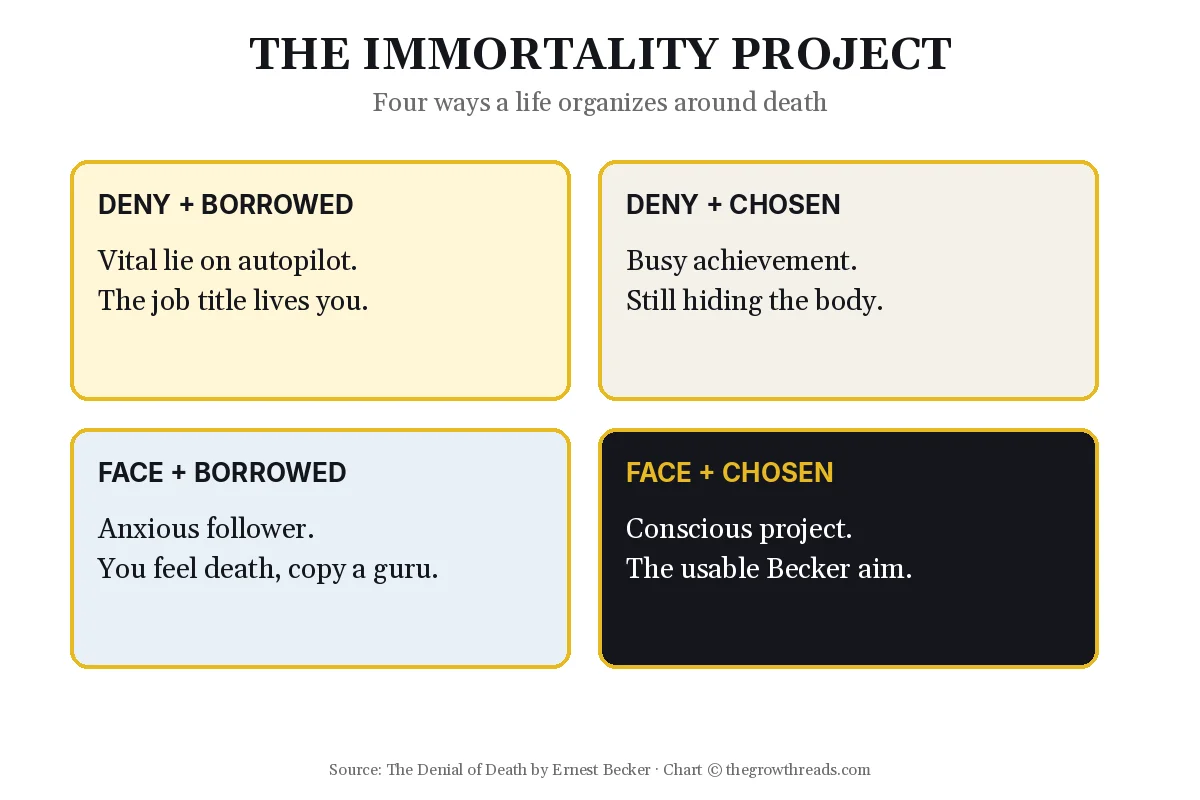
You are an animal that knows it will die — and you built a story so that fact cannot run the day. Ernest Becker’s 1973 Pulitzer argument is not a dare to brood. It is a map of why a performance review can feel like a funeral, why cultures fight over flags, and why a partner can become a private religion. The body is creaturely. The name wants to be a hero. Between those two facts we invent character, careers, nations, and gods. Call the invention a vital lie if you want the book’s phrase. Call it a hero-system if you want a tool. Either way the practice is the same: write the immortality project you are already in, stop asking it to cancel the body, and take one action this week that would still matter if the title vanished.
Key takeaways
- Death writes the script: Anxiety, status, and a lot of “discipline” sit on top of mortality, not on top of a personality quirk.
- You are two selves: A decaying body and a symbolic name. Character is the truce.
- The vital lie is useful: You need a story to get through Tuesday. The lie fails when you forget it is a story.
- Heroism is an immortality project: Craft, children, company, creed — same move, different scale.
- Culture is a shared scoreboard: A group lends you a part so you do not invent meaning alone.
- Transference is everyday: Guru, partner, brand, nation — we hand our forever to someone who looks sure.
- Mental strain is often failed heroism: The costume no longer fits and the body is back in the room.
- Religion and science both console: Each can be a cosmic project. Neither erases the animal.
- The usable close is a chosen project: Face the limit, keep the people, pick work that can survive a title change.
What is The Denial of Death about?
The Denial of Death is Ernest Becker’s 1973 argument that the fear of death sits under character, culture, and ambition. We build hero-systems — jobs, families, nations, gods — so a finite body can feel it still matters. The book’s usable steal is to name that system and choose a project with both eyes open.
About the author
Ernest Becker (27 September 1924 – 6 March 1974) was an American cultural anthropologist. Born in Springfield, Massachusetts, to Jewish immigrant parents, he served in the U.S. infantry in World War II and helped liberate a Nazi camp — a fact that later sits under his insistence that death is not a metaphor. He took a PhD at Syracuse in 1960, taught psychiatry students, lectured at Berkeley, resigned from San Francisco State over campus crackdowns, and finished at Simon Fraser in Burnaby. He wrote The Birth and Death of Meaning, then this book, then drafted Escape from Evil while dying of colon cancer at 49. The Pulitzer arrived two months after the funeral. Later lab work — Terror Management Theory — turned the thesis into a testable claim. Explore all Ernest Becker book summaries →
Key concepts at a glance
| Concept | What it means | Use it when |
|---|---|---|
| Creatureliness | You are an animal that will die, age, and need food | A status hit feels like a body blow |
| Symbolic self | The name, role, and story that want to outlive the body | You cannot rest after a good week |
| Vital lie | The necessary story that keeps Tuesday livable | You treat the story as physics |
| Hero-system | A shared scoreboard for mattering | Your group’s praise is the only oxygen |
| Immortality project | Work or creed that makes a finite life feel durable | You cannot say why the grind is worth it |
| Transference | Handing your forever to a sure-looking person or brand | A guru, partner, or logo is doing your thinking |
| Failed heroism | The costume no longer holds and anxiety returns | A layoff or breakup empties the week |
| Chosen project | A story you can keep after the title moves | You want ambition without the panic |
Part 1: The terror of death and the vital lie
Becker opens where polite psychology often looks away. The human animal can picture its own ending in high resolution. “The idea of death, the fear of it, haunts the human animal like nothing else,” he writes — then he shows what we do with the haunt. We do not stare at it all day. We build character. Character, here, is not a personality quiz. It is armor: habits, jokes, ambitions, and taboos that keep the body from walking into the meeting.
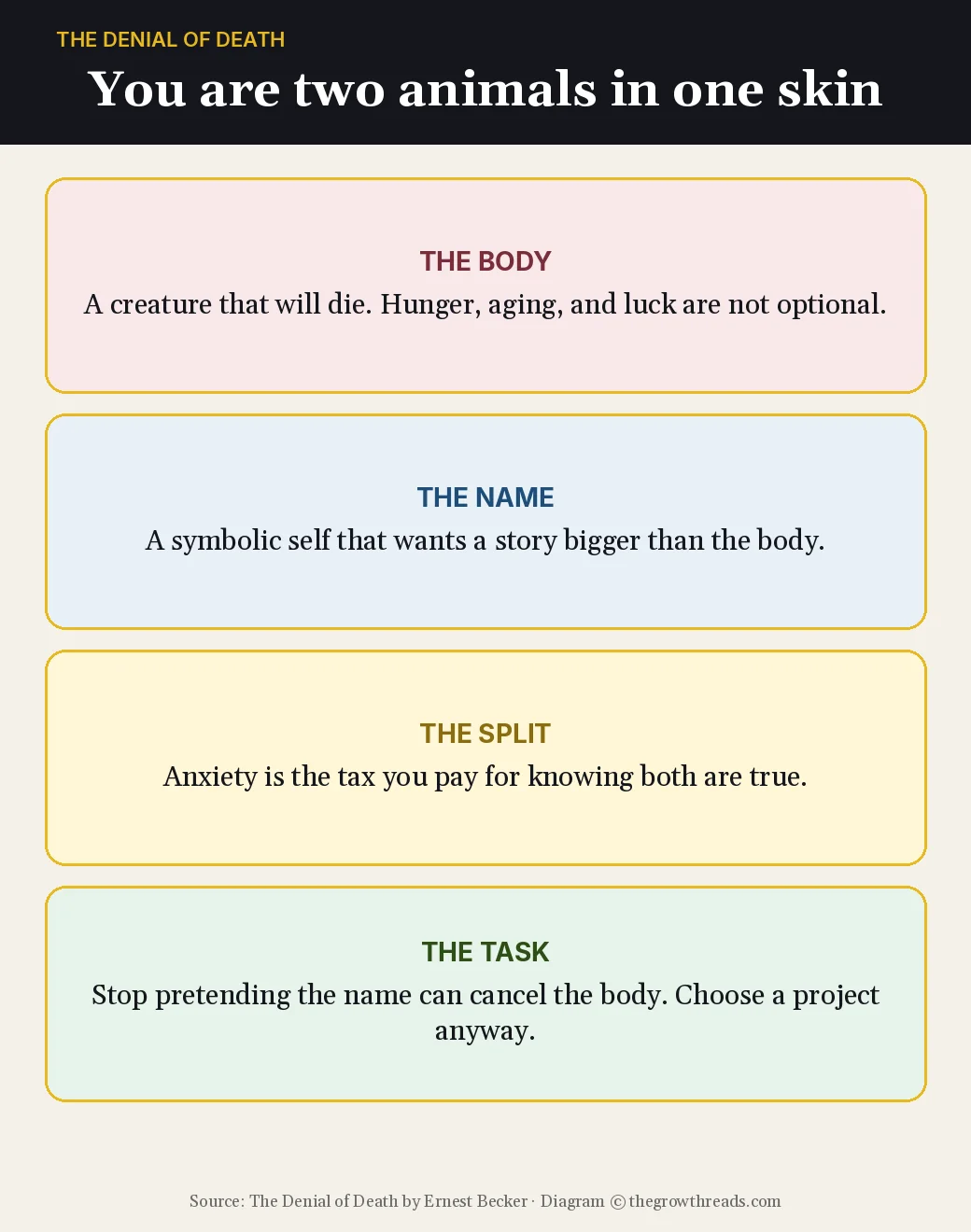
He splits you into two facts that will not reconcile. One is creaturely: you hunger, age, and can be hit by a car on the way to a promotion. The other is symbolic: a name, a résumé, a private myth. Freud mapped desire. Becker, reading Otto Rank beside him, relocates the engine. Sex and shame still matter. The deeper tax is mortality. You are meat that thinks, and the thinking wants a story bigger than meat.
That story is the vital lie. Becker is not calling you a fraud for wanting a good name. He is saying the story is a tool. A child needs a parent who looks like they will not vanish. An adult needs a role that makes the calendar feel like a plot. The lie fails when you forget it is a tool — when a title has to prove you will not die. Then a lukewarm review ruins a Saturday because it graded the immortality project, not just the slide deck.
TGR Note: Man’s Search for Meaning gives you a next act. Becker gives you the reason a small status hit felt like a verdict. Tuesdays with Morrie is the same mortality as a Tuesday visit, not a theory.
Part 2: Heroism as an immortality project
If the first move is armor, the second is a quest. Becker’s hero is not a comic-book type. A hero is anyone who translates a small life onto a larger scoreboard — a craft, children, a company, a lab, a church, a nation. The content changes. The structure does not. A finite person borrows duration from a story that claims to last.
Culture, on this reading, is a shared hero-system. It hands you a part and a way to be praised. That is a gift: you do not invent meaning from scratch every Monday. It is also a trap. If the only oxygen is the group’s applause, you will defend the scoreboard when someone questions it. Later researchers called a version of this terror management: remind people they will die, and many cling harder to the flag they already hold. Becker wrote the map before the lab studies. The studies are why it still earns a weekday.
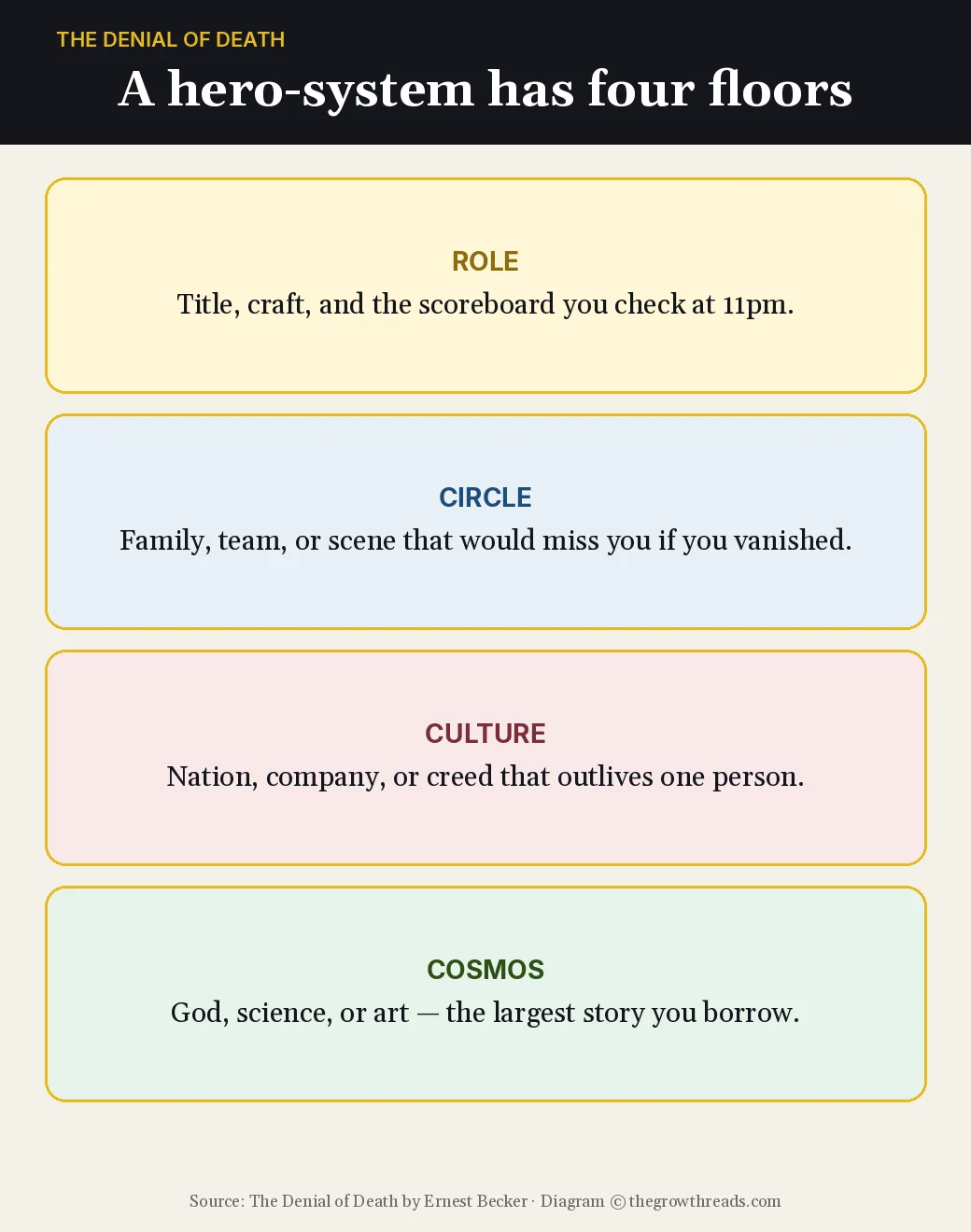
The practical steal is to draw four floors. Role: the title and the private scoreboard you check at 11pm. Circle: the people who would feel the hole if you vanished. Culture: the company, scene, or nation that outlives one person. Cosmos: the largest story you borrow — God, science, art, “the work.” Most of us live on the first two floors and pretend the top two are someone else’s hobby. Becker’s claim is that the top two are already running. You are already in a religion of some kind. The only choice is whether you can name it.
TGR Note: The Hero with a Thousand Faces maps the same hunger as myth. Becker maps it as a project you can write on a card. 12 Rules for Life borrows the death-and-responsibility pair; start here if you want the source.
Part 3: Transference and the failed hero
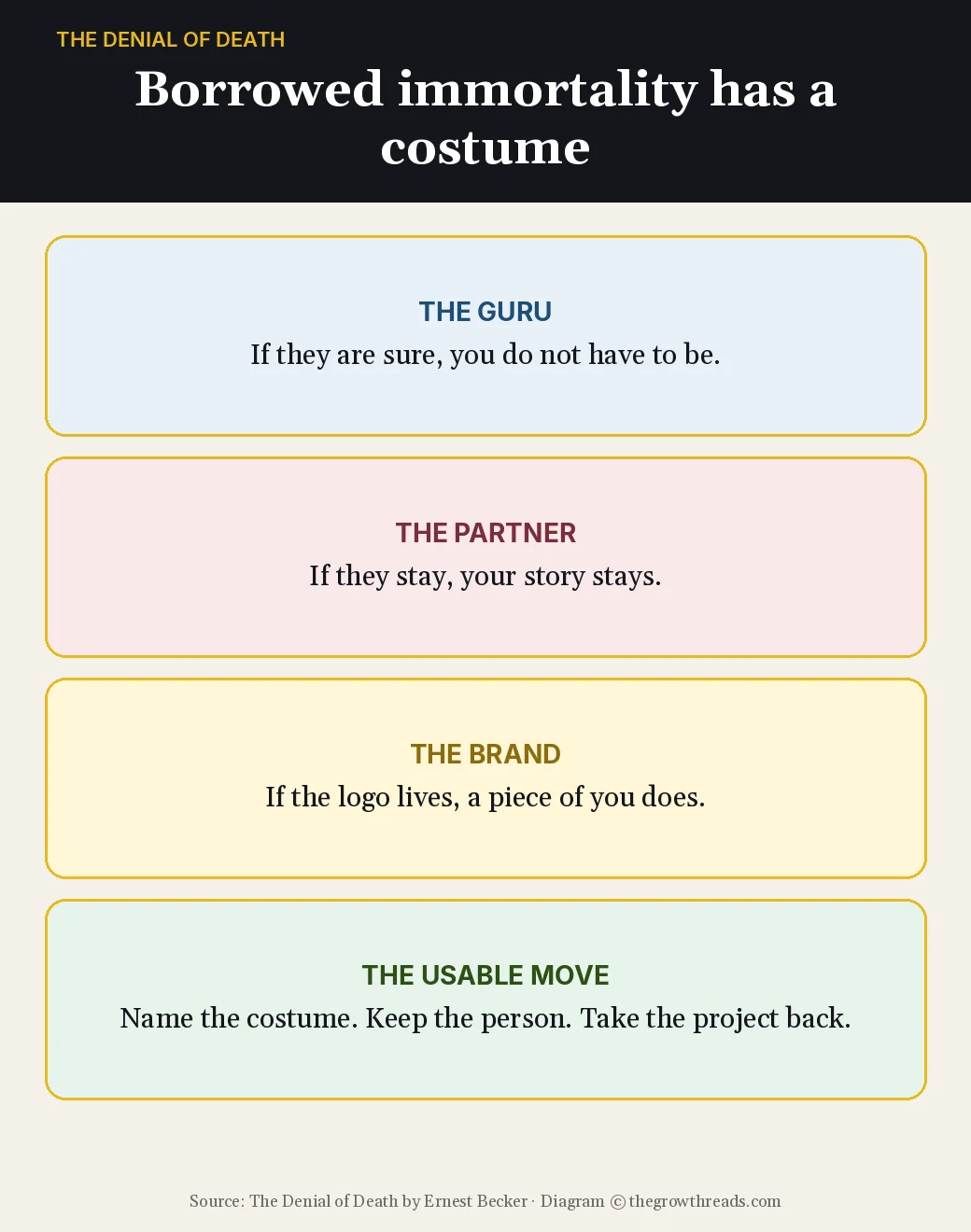
Transference, in the clinic, is the moment you treat the therapist as a parent. Becker widens the word until it fits a life. We look for a person, a brand, or a movement that looks more sure than we feel, and we park our forever there. The guru has the map. The partner will not leave, so the story stays. The logo will outlive the quarter. None of this is cartoon villainy. It is how a frightened animal borrows a spine. The cost is that you stop authoring the project.
A boss can be a private god. A political figure can be a parent you never met. A “personal brand” can be a portable shrine. When the shrine wobbles — a layoff, a silent text, a public miss — the body comes back into the room. That return is failed heroism. It is not a moral grade. It is a description: the costume no longer holds, and the creature is audible again.
Becker also reads some mental strain as a failed or rigid hero-system. He is not writing a diagnostic manual, and this review is not one. The usable line is smaller. When your week empties after a role-hit, ask which immortality project just failed — before you invent a new personality. Often the next honest move is not a reinvention. It is a smaller project you can keep without a witness.
TGR Note: The Power of Now is the ten-minute reset when the symbolic self is loud. Becker explains why it got loud. When Breath Becomes Air faces the same limit without the theory.
Part 4: Kierkegaard, Rank, and a project you can live
The last movement is a conversation among Freud, Otto Rank, and Kierkegaard. Rank gives him the artist: someone who makes a work that can stand after the hands stop. Kierkegaard gives him the knight of faith: someone who accepts creatureliness and still says yes to a finite life. Becker does not ask you to join a church on page 300. He asks you to stop pretending a résumé can do the work of a cosmos.
Religion, on his reading, is one honest answer to a real problem. Science is another, when it becomes a cosmic project — the field that will remember you. Both can console. Both can harden into a club. The test is not the vocabulary. The test is whether the project leaves you more able to love a person who will also die. If the system needs enemies to feel real, it is still a vital lie in a loud costume.
The 7-day plan below is that maturity in small pieces. You will not solve death. You will write the project you are already in, notice one borrowed costume, and take one action that would still make sense if the title moved. That is enough for a week. It is also, in Becker’s sense, a kind of faith: not a slogan, a willingness to live as a creature with a name.
TGR Note: Becker died before Escape from Evil was finished; you do not need the sequel to use this book. Stay with The Power of Now for presence, or Man’s Search for Meaning for a meaning you can carry into a hard shift. Come back when you want to name the system those books already assume.
Who is The Denial of Death best for — and who should read something else first?
Best for the ambitious reader who feels a performance review in the stomach, and anyone who keeps asking a partner to guarantee the story. Read something else first if you need a grief companion this week — Tuesdays with Morrie — or meaning-in-suffering without the theory — Man’s Search for Meaning. For a body-level reset, use The Power of Now. For the myth version of the same departure, use The Hero with a Thousand Faces. This review is not medical advice. If death anxiety is disrupting sleep or work, talk to a licensed clinician.
Questions to reflect on
- If your job title vanished on Friday, which part of you would still have a project on Monday?
- Whose certainty are you currently borrowing — a partner, a boss, a brand, a feed?
- When did a small status hit last feel like a body blow? What immortality project was on the line?
- Which floor of your hero-system do you actually live on: role, circle, culture, or cosmos?
- What is one action this week that would still matter if no one witnessed it?
🔥 Ready to name the hero-system running your week?
Get The Denial of Death and steal one project you can keep after the title moves.
How to apply The Denial of Death (7-day plan)
- Day 1 — Write the project. One page, no audience. “The story that makes my week feel like it matters is ___.” Include the scoreboard you check at 11pm.
- Day 2 — Mark a wobble. When a small status hit arrives, write the sentence it threatened. Not the facts. The immortality claim.
- Day 3 — Name a costume. Guru, partner, brand, or nation. Keep the person. Write the line you handed them: “If they stay sure, I don’t have to.”
- Day 4 — Touch the creature. A walk, a meal you taste, a night of honest sleep. Ten minutes where the name is off duty.
- Day 5 — Edit one floor. Drop one borrowed line from the role floor — a meeting you attend only to be seen, a metric that is not yours.
- Day 6 — Do unwitnessed work. One hour on the project that would still count if the title vanished. No post. No status ping.
- Day 7 — Tell one human. Say one honest fear to someone who does not need to be your shrine. Then keep the project. Do not make them the new forever.
Frequently asked questions
What is The Denial of Death about?
Ernest Becker’s 1973 Pulitzer book argues that the fear of death sits under character, culture, and ambition. We build a symbolic self — a name, a role, a creed — so the animal body does not have the last word. That “vital lie” keeps a Tuesday livable. It also writes wars, status games, and the panic you feel when a title wobbles. This summary is a field guide: name the hero-system, keep a chosen project, and stop asking a job or a partner to make you immortal.
What is an “immortality project” in The Denial of Death?
An immortality project is any story that lets a finite person feel they will still matter after the body stops. A craft, a child, a company, a nation, a god, a scientific field — Becker treats them as the same human move at different scales. The project is not fake. It is how a symbolic animal stays sane. The usable question is whether you chose it, or whether it is running you on borrowed lines. Name it on paper. Then keep one action this week that belongs to you.
Is The Denial of Death still relevant after Terror Management Theory?
Yes — and the lab work helps. After Becker died, social psychologists Greenberg, Pyszczynski, and Solomon tested a clean prediction: remind people they will die, and they cling harder to their cultural worldview. Hundreds of studies later, the pattern still shows up in prejudice, self-esteem, and political heat. Read Becker for the map of character and culture. Use the later research as a reason to treat the map as a weekly practice, not a museum piece. The 7-day plan below is that practice.
How does Becker differ from Freud in The Denial of Death?
Freud put sex at the center. Becker, reading Otto Rank and Kierkegaard beside Freud, puts mortality there instead. Desire still matters. Shame still matters. But the deeper engine is creatureliness: you are an animal that knows it will die, and you spend a life building a hero-story so that fact does not swallow the day. Transference is not only a clinic event. It is how you hand your immortality to a boss, a partner, or a brand. That is the steal you can use on a Thursday.
Is The Denial of Death a depressing book?
It is a serious book. It is not a grief manual and it is not a dare to brood. Becker’s close is a call to live: once you stop asking a role to cancel the body, you can pick a project with both eyes open. Readers who need a companion for a funeral this week should start with Tuesdays with Morrie or Man’s Search for Meaning, then come back. If you are in a clinical crisis, talk to a licensed clinician — this review is not therapy and not medical advice. For a working reader, the book is a permission slip to stop performing immortality.
Who should read The Denial of Death first?
Read it if your ambition feels like armor, if a performance review can ruin a Saturday, or if you keep asking a partner to guarantee your story. Skip it as a first book if you need a short grief companion or a presence practice without the theory. In those cases start with Tuesdays with Morrie or The Power of Now, then return when you want the why under the habit. The 336-page Free Press edition is a weekend if you annotate; the usable steal is one named project, not a new identity overnight.
What should I read after The Denial of Death?
Pair Becker with Man’s Search for Meaning when you want a meaning you can practice in a hard week. Pair him with The Hero with a Thousand Faces when you want the myth version of the same departure. Pair him with The Power of Now when the symbolic self is loud and you need a body-level reset. Escape from Evil, Becker’s unfinished sequel, extends the social argument; it is optional. The next move is not another theory. Write the immortality project you are already in, and take one action that would still make sense if the title vanished.
Related summaries
- Man’s Search for Meaning — a meaning you can practice in a hard week.
- The Hero with a Thousand Faces — the same departure, told as myth.
- The Power of Now — presence when the symbolic self is loud.
- Tuesdays with Morrie — mortality as a Tuesday visit, not a theory.
Browse the full list on our Best Psychology Books pillar.
How we analyze books: our summaries are built from a full read of the source text, cross-referenced against the author’s published interviews and research where relevant, and structured around practical application rather than critique. We disclose our editorial process and affiliate relationships in full. Read our full methodology.