

★★★★★ 4.8/5 — A living-room class on how to love while you still have Tuesdays: short, human, and built to use the same week you finish it.
Best for: Anyone postponing a hard conversation, drifting in a “busy” career, or caring for someone who is running out of time
Reading time: ~4 hrs for the full book · ~14 min for this guide
Difficulty to apply: Easy to read; the work is showing up — to a person, not a to-do list
Tuesdays with Morrie in one minute
Everyone knows they will die. Almost nobody lives as if that is true. That is Morrie Schwartz’s starting claim, delivered from a recliner in West Newton while ALS takes his body a little further each week. Mitch Albom, once Morrie’s student at Brandeis and later a sportswriter who had no time, flies back every Tuesday. Fourteen visits become a last course: love, family, work, aging, forgiveness, money, and a “perfect day” that is ordinary on purpose. The book is a conversation you can steal from — not a theory to admire.
Key takeaways
- Death is a teacher, not a spoiler: Once you stop treating the end as theoretical, the week’s fake emergencies get quieter.
- Love is the only rational act: Status fades. The people who will sit in the room with you do not.
- Feel fully, then let go: Morrie’s “detach” is not numbness. Name the weather, refuse to rent it a house, return to the person in front of you.
- Culture will hire your attention: Youth, money, and more stuff are a scoreboard. Morrie offers a different one: community, honesty, time.
- Family is a practice, not a feeling: Show up on a boring Tuesday, not only at the funeral.
- Aging is not a failure of youth: You trade speed for perspective. Envy of twenty-year-olds is a refusal to inhabit your actual age.
- Forgiveness clears the room: The grudge you rehearse is a class you keep taking. Release it so a new conversation can start.
- A perfect day is small on purpose: Breakfast, a walk, a talk, music. Design one and put it on the calendar.
- Death ends a life, not a relationship: What you said, and what you lived, keeps teaching after the last Tuesday.
What is Tuesdays with Morrie about?
Tuesdays with Morrie is Mitch Albom’s 1997 account of fourteen Tuesday visits with his dying Brandeis professor, Morrie Schwartz. Between ALS, Nightline, and a living-room classroom, Morrie teaches a last course on love, work, family, aging, forgiveness, and how to live before the Tuesdays run out.
About the author
Mitch Albom was born in New Jersey in 1958 and became one of America’s most-read sportswriters at the Detroit Free Press. He had studied sociology at Brandeis under Morrie Schwartz, then lost the habit of calling while the bylines piled up. In 1995 he saw his old professor, living with ALS, on Nightline with Ted Koppel. Albom flew to West Newton and started a Tuesday ritual: a class of one, with a yellow legal pad. Those visits became Tuesdays with Morrie, a 1997 Doubleday book that spent years on the New York Times list and later an Oprah-backed film. He kept writing novels and running charities in Detroit and Haiti. The through-line is the same classroom: show up for people while they can still hear you. Explore all Mitch Albom book summaries →
Key concepts at a glance
| Concept | What it means | Use it when |
|---|---|---|
| The Tuesday classroom | A repeating, protected hour with one person — not a someday conversation | You only talk when there is a crisis or a calendar invite |
| Learn how to die | Treat death as a fact that clarifies the week, not a mood to avoid | Your days are full and none of them feel like yours |
| Detach | Feel an emotion completely, then let it pass without building a story-house in it | One slight owns the afternoon |
| Love or perish | Connection is the work; isolation dressed up as independence is the risk | You are “fine” and also lonely |
| Culture’s scoreboard | Youth, money, and status as the default measures of a life | A raise still leaves you hungry for the next one |
| Aging as arrival | Each decade adds a lens; wanting only the previous body is a refusal to live here | You apologise for getting older |
| Forgiveness as space | Dropping a rehearsed grievance so a new sentence can be said | You are still arguing with someone in the shower |
| The perfect day | An ordinary sequence you would happily repeat: food, air, people, music | Happiness is always scheduled after the next project |
Part 1: The classroom — a sportswriter goes back to Brandeis
Albom’s first honesty is professional, not spiritual. He had been a student who loved Morrie’s classes, then a sportswriter whose job was other people’s games. Phone calls went unreturned. The reunion is a media accident: Nightline puts Morrie on television, Albom sees a face he had filed under “college,” and shame does the rest. He buys a ticket to Boston. Most of us will not get a national TV prompt. We will get a rumour, an obituary we almost had, a voicemail we keep skipping.
Morrie has ALS. The body is becoming a negotiation — walking, then sitting, then being lifted. He refuses to make the disease the only subject. The living room is a classroom because he still has a syllabus: how to live. Albom’s yellow pad is a gift as much as a tool. It says: what you are saying is worth keeping. Pity talks about the weather. Attention takes notes.
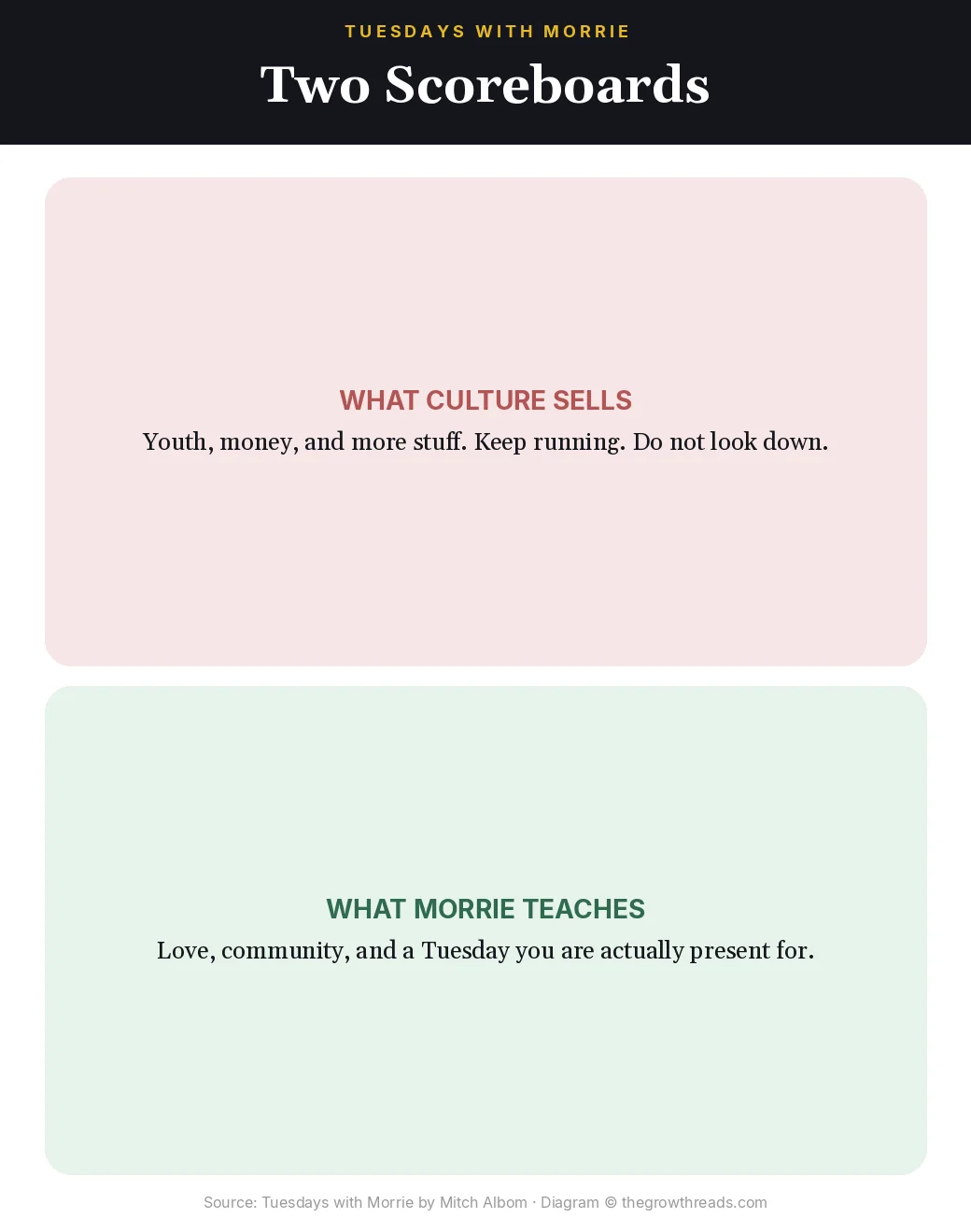
The first Tuesdays establish the bargain. Albom will keep coming. Morrie will keep teaching. The original deal is time. Morrie is blunt about culture: it will sell you more youth, more stuff, more applause, then act surprised when you feel empty on a Sunday. He is not anti-work. He is anti-hypnosis. A career can be a contribution or a hiding place with better lighting. His test is rude and practical: if this were the last term, who would still get a Tuesday?
TGR Note: Morrie’s last class sits next to Viktor Frankl in Man’s Search for Meaning: meaning is chosen under constraint. Scale differs; the assignment does not. For the stoic version, Meditations treats death as a daily clarifying fact.
Part 2: Death, aging, and self-pity — feel it, then let go
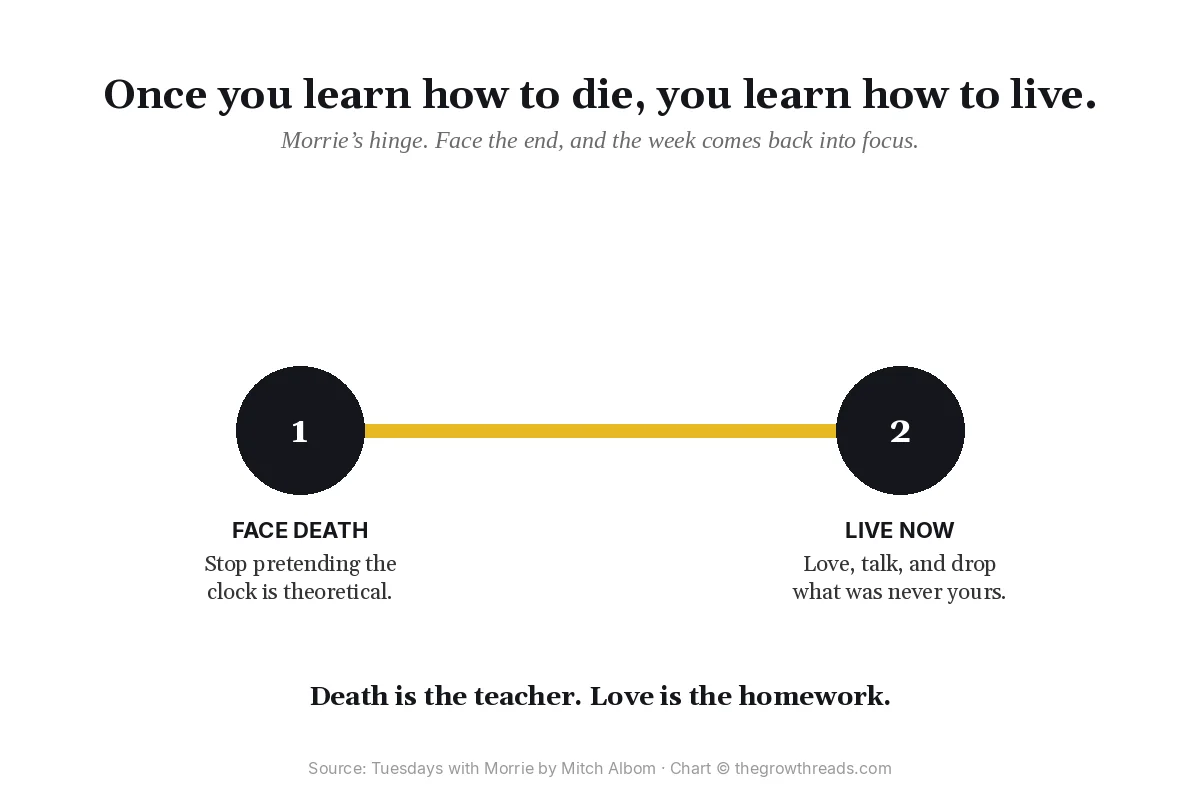
Morrie will not let Albom skip death. His line, which the book is built around, is simple enough to tattoo and hard enough to live: once you learn how to die, you learn how to live. He does not mean rehearsing the funeral. He means refusing the trance that your years are an unlimited subscription. When the subscription is visibly cancelling, the inbox looks different. So do grudges. So does the friend you have been “meaning to” call.
Self-pity gets a Tuesday because Morrie is not performing serenity. He cries. He names the losses — dancing, driving, wiping himself — without a TED-style bow. Then he practices detaching. You do not suppress the wave. You let it arrive, feel it in the body, and decline to build a second career out of it. Grief that is felt can pass. Grief that is argued with becomes a personality. Morrie is teaching emotional hygiene in a culture with two settings: numb, or flooded.

Aging is death’s cousin in the syllabus. Culture treats getting older as a branding problem. Morrie treats it as a transfer: you hand over some speed, and you receive a clearer view of what was never going to save you. Wanting to be twenty again is, in his framing, a way of insulting the life you actually have. The antidote is inhabiting this age as a student — asking what it can see that the last decade could not.
TGR Note: “Feel it, then return” is close to The Power of Now and to The Untethered Soul: you are the one watching the inner roommate. Morrie’s version is more Tuesday: cry, then look at the person still in the chair.
Part 3: Love, family, and money — the only rational act
If death is the teacher, love is the homework. Morrie keeps returning to a sentence he borrowed and meant: without love, we perish — not always dramatically, often as a slow thinning. Independence, as culture sells it, can be a beautiful apartment with nobody who knows how you take your coffee. He is not anti-solitude. He is against the story that needing people is a defect. Albom thinks he is visiting a dying man. Morrie thinks the student has finally brought homework to a course on interdependence.
Family here is not a holiday card. It is the people who will lift you when the body will not. The instruction is forward: be the relative you needed. Call. Sit. Make the soup. Albom’s own story runs under the visits — a father he struggles to know, a brother who is ill, the habit of loving people from a press box. A career that looks like devotion from the outside can be abandonment in slow motion. The Tuesday is the repair tool: a repeating hour that does not wait for a perfect mood.
Marriage and friendship get the same test: can you talk, apologise, and stay when the other person is not impressive? Romance as a highlight reel fails on contact with ALS, or with an ordinary bad year. Money is stripped of mystique faster. Morrie is not pretending bills are imaginary. He is noticing that past a point, more money is often a costume for more fear. The question worth stealing: what would you do with a smaller scoreboard if the people stayed?
TGR Note: The Alchemist sends Santiago across a desert to inhabit his life. Morrie points at the recliner. The Gifts of Imperfection is the research cousin: belonging requires being seen. If you only have one hour, make the call.
Part 4: Culture, forgiveness, and the perfect day
By the later Tuesdays, Morrie’s body is a narrower instrument and his commentary on culture is wider. The culture will always have a new outrage, a new product, a new way to feel behind. His counter is not niceness. It is a media diet plus a people diet: fewer broadcasts, more conversations. You cannot love a demographic. You can love a name.
Forgiveness is the cleaning of the classroom. Stop dragging old cases into new hours. A rehearsed grievance uses the same attention you would need to say a true thing to someone who is still alive. Sometimes forgiveness is a conversation. Sometimes it is a private release because the other person will not come to class. Either way, the Tuesday gets bigger when the old trial adjourns.
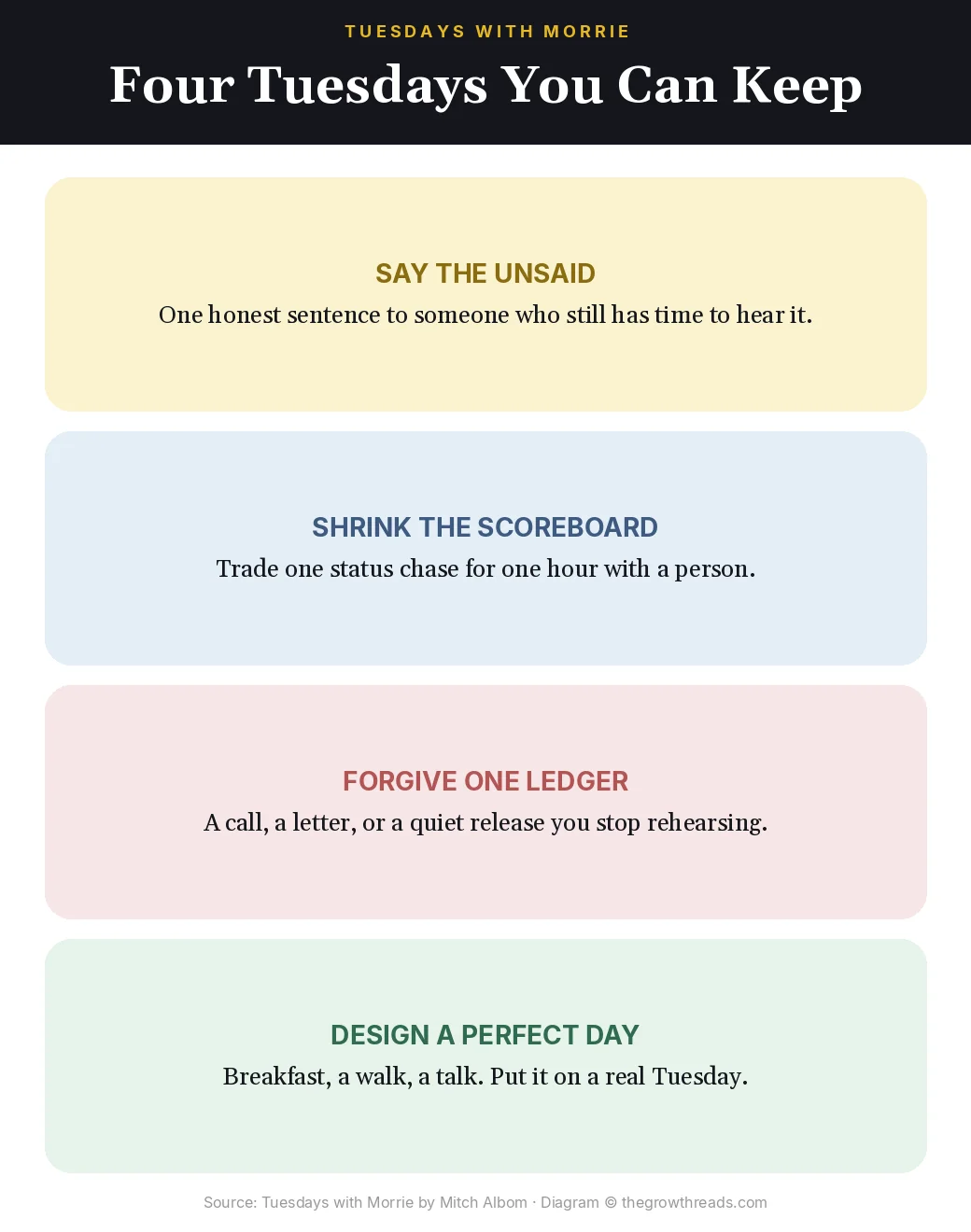
The “perfect day” is Morrie’s most stealable assignment. He does not describe a yacht. He describes a sequence he would still want if he could walk: wake, breakfast, a walk, friends, dancing, a meal. Ordinary on purpose. The point is not to copy his menu. It is to notice that your fantasy of a good life may already be available on a Tuesday you keep spending on other people’s scoreboards. Morrie dies. The class does not. Death ends a life, not a relationship. What you practiced together keeps teaching.
TGR Note: A designed ordinary day is the application layer of The Obstacle Is the Way. For a physician’s last curriculum, see When Breath Becomes Air. Same lesson, two accents.
Who is Tuesdays with Morrie best for — and who should read something else first?
Best for the person whose calendar is full and whose important conversations are empty: caregivers, adult children, anyone who has been “meaning to visit.” It is a clean entry into meaning-of-life reading if denser philosophy bounces off. Pick a Tuesday and a person.
Read something else first if you need a clinical protocol rather than a conversation — start with Feeling Good. For meaning under atrocity, Man’s Search for Meaning. For presence without a dying teacher, The Power of Now. Morrie is a companion, not a treatment plan. This is not medical advice.
Questions to reflect on
- If this were the last term of your life, which person would still get a protected Tuesday — and do they know that?
- What emotion did you build a house in this week, instead of feeling and releasing?
- Which number on culture’s scoreboard (title, followers, savings) is currently standing in for love?
- Who are you still trying in the shower, and what would a finished ledger sound like in one sentence?
- If you designed a perfect ordinary day for this Saturday, what would actually be on it — not the fantasy version, the walkable one?
🔥 Ready to use the Tuesdays you still have?
Get Tuesdays with Morrie and start the last class this week.
How to apply Tuesdays with Morrie (7-day plan)
- Day 1: Read the opening. Write one sentence: the person who would get your last class, and why.
- Day 2: Put a 45-minute Tuesday (or the nearest weekday) on the calendar with that person. No agenda except showing up.
- Day 3: Practice detach once: when a slight hits, name it out loud, set a ten-minute timer, then return to the next task.
- Day 4: Shrink one scoreboard item. Mute a feed, skip a status meeting, or leave the office on time for a walk.
- Day 5: Write — do not send yet — a one-page letter of thanks or forgiveness. See what is actually unsaid.
- Day 6: Design your perfect ordinary day on paper. Put one piece of it on tomorrow morning.
- Day 7: Have the visit, or send the letter. Review the week: where did busyness win, and what will you protect next Tuesday?
Frequently asked questions
What is Tuesdays with Morrie about?
It is Mitch Albom’s record of fourteen Tuesday visits with Morrie Schwartz, his former Brandeis professor, who is dying of ALS. The visits become a last course on how to live: love, family, work, aging, money, forgiveness, and a deliberately ordinary “perfect day.” Albom arrives as a busy sportswriter who had lost the habit of showing up. Morrie uses the shrinking body as a teaching tool, not a tragedy to stare at. You finish with a method — protect a Tuesday, tell the truth, detach from the weather of a mood — more than with a plot twist.
What is the main lesson of Tuesdays with Morrie?
The hinge is Morrie’s claim that once you learn how to die, you learn how to live. Death, taken as a fact instead of a rumour, demotes fake emergencies and promotes love, honesty, and time with people. The supporting lessons are practical: feel emotions without moving into them, refuse culture’s youth-and-money scoreboard, forgive so the room is free, and design a good day that does not require a new life. The book’s argument is that you already have enough Tuesdays to start, if you will stop spending them on a scoreboard nobody will remember.
Is Tuesdays with Morrie a true story?
Yes. Morrie Schwartz was a Brandeis sociologist. Albom was his student, then a Detroit sportswriter. Nightline’s Ted Koppel interviewed Morrie after ALS had already narrowed his life, and those broadcasts prompted Albom to return. The Tuesday visits happened in West Newton in 1995. The book, published in 1997, is Albom’s crafted account of those conversations, not a transcript, and not a novel. Readers sometimes meet it in school as “memoir.” Treat it as a reported last class: the people, the disease, and the ritual are real; the sentences are written for a reader who still has time to use them.
How long does it take to read Tuesdays with Morrie?
The Broadway edition runs about 192 to 224 pages depending on printing, and most readers finish in three to five hours. It is built as short Tuesday chapters, which makes it easy to read in two sittings or across a week of commutes. A common approach is to finish the book in a weekend, then spend the following week on one visit, one letter, and one ordinary “perfect day” item. This guide takes about fourteen minutes and covers the classroom, detach, the love-or-perish test, and a 7-day plan. The book is short enough to use the same week you buy it.
What disease did Morrie Schwartz have?
Morrie had amyotrophic lateral sclerosis, ALS, often called Lou Gehrig’s disease — a progressive condition that takes the body’s motor control while leaving the mind intact. In the book that intact mind is the point: he can still teach while he needs more help each week to sit, eat, and breathe. Albom does not write a medical textbook. He writes what the disease does to a Tuesday: the appointments, the crying, the humour, the need to be lifted. If you are reading as a caregiver, the useful takeaway is not diagnosis. It is how Morrie keeps a syllabus when the body is the constraint.
How do you apply Tuesdays with Morrie in real life?
Pick a person and a repeating hour. Put it on the calendar before you feel ready. Use one visit to say a true thing you have been dressing up as small talk. When a mood takes the afternoon, try Morrie’s detach: feel it for a set number of minutes, then come back to the room. Design a perfect ordinary day on paper and actually walk one piece of it. Forgive one ledger you have been rehearsing. The book fails if it stays a moving story you recommend. It works if next Tuesday has a name on it that is not your employer’s.
Why is Tuesdays with Morrie still assigned in schools?
Teachers assign it because it is short, narrative, and argues about a life without requiring a philosophy major. Students meet death, love, and culture’s scoreboard in a living room instead of a treatise. That can look like “easy reading.” The better reason to keep it in a syllabus is the same reason to keep it on a nightstand: it asks for a behaviour, not a book report. Who would get your Tuesday? What would a perfect ordinary day include? Those questions survive the test. This is not a substitute for counselling; it is a companion for people who still have time to show up. Not medical advice.
Related summaries
- Man’s Search for Meaning — meaning chosen under a harder constraint than a recliner.
- The Power of Now — presence without a dying teacher in the room.
- The Alchemist — a fable about inhabiting the life that keeps calling you back.
- Meditations — death as a daily clarifying fact, written from a different century.
Browse every title in our Best Psychology Books pillar page.
How we analyze books: our summaries are built from a full read of the source text, cross-referenced against the author’s published interviews and research where relevant, and structured around practical application rather than critique. We disclose our editorial process and affiliate relationships in full. Read our full methodology.