

★★★★½ 4.5/5 — fill knowledge and skills before you chase the reputation bucket.
Best for: Founders and operators who got visible before they got dangerous
Reading time: ~9 hours (Portfolio 2023, 368 pp) · this guide ~12 min
Difficulty to apply: Medium — three laws will move a week; thirty-three will freeze it
The Diary of a CEO in one minute
Reputation is the last bucket, not the first. Steven Bartlett’s The Diary of a CEO turns a decade of building companies and thousands of podcast interviews into 33 laws under four pillars: the Self, the Story, the Philosophy, and the Team. The Self chapter is the one most readers needed yesterday — Knowledge, Skills, Network, Resources, then Reputation, in that order. Skip ahead to a personal brand and the other four stay empty. The Story chapter is about the first five seconds: if they can wallpaper over you, they will. Philosophy is compounding and inversion: a small miss now is a big miss later, and you should pre-live the failure. Team is the Sullivan overlap — ask who, not how — plus bars you refuse to drop. Use three laws. Leave the poster of all thirty-three on the wall of people who do not ship.
Key takeaways
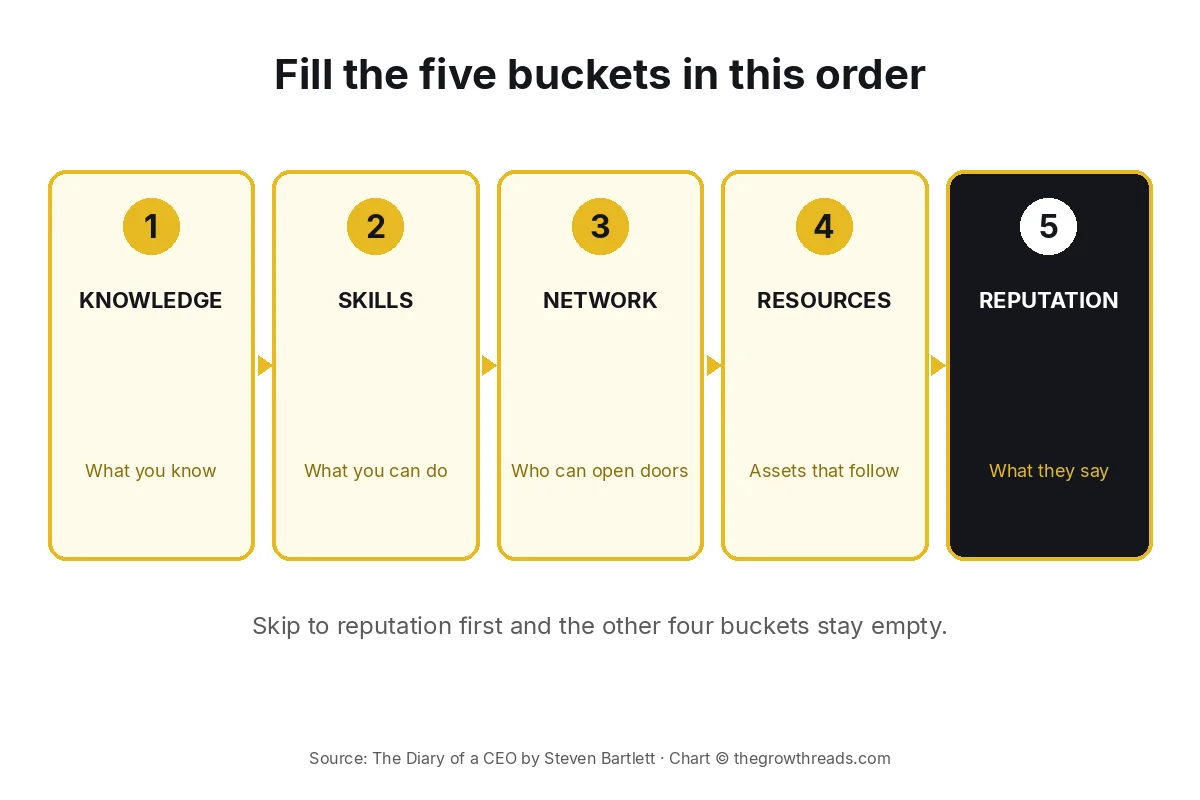
- Five buckets, strict order: Knowledge → Skills → Network → Resources → Reputation. Reverse it and you get applause with no craft.
- Teach it to keep it: Mastery is an obligation to explain. If you cannot teach the skill, you rented it.
- Do not attack the belief: “Never disagree” means do not kick someone’s identity. Ask, then offer a better story.
- Replace the habit: Fighting a bad habit is still a relationship with it. Swap the cue; do not white-knuckle the urge.
- First foundation is the body: Sleep, training, and food are not self-care extras. They are the machine the other laws run on.
- Win the first five seconds: Distinct beats merely useful. Wallpaper is the death of an offer.
- Small miss, big miss: Tiny sloppiness compounds. Out-fail the field, then sweat the boring millimetres.
- Who, not how: If you will never be world-class at it, the next move is a name. Raise the bar to join and the bar to stay.
What is The Diary of a CEO about?
The Diary of a CEO is Steven Bartlett’s 33-law playbook for business and life, grouped into Self, Story, Philosophy, and Team. It argues that lasting excellence is mostly sequence: fill skill before reputation, make a story they cannot ignore, treat small misses as future disasters, and staff the work by asking who, not how.
About the author
Steven Cliff Bartlett was born in Gaborone, Botswana, on 26 August 1992 and grew up in Plymouth, England. He left school at 18, started on a Manchester bedroom floor, and built Social Chain into a listed social-media company. In 2021 he joined BBC One’s Dragons’ Den as an investor. He hosts The Diary of a CEO, the long-form interview show that became one of the UK’s most-listened podcasts and a huge YouTube channel. He later founded FlightStory (studio and fund) and other ventures. This 2023 book is the operator cut of those interviews plus his own scars — 33 named laws instead of another highlight reel. The earlier Happy Sexy Millionaire is the personal-philosophy volume; this one is the working manual. Explore all Steven Bartlett book summaries →
Key concepts at a glance
| Concept | What it means | Use it when |
|---|---|---|
| Five buckets | Knowledge, Skills, Network, Resources, Reputation — in that order | You are posting before you can do the thing in a room |
| Teach to master | An obligation to explain locks the skill in | You “know” it until someone asks you to demo |
| Never disagree | Do not kick identity; ask, then offer a new frame | Feedback turns into a fight in under a minute |
| First five seconds | If they can ignore the opening, they will | Your page is correct and still invisible |
| Psychological moonshot | Change how it feels before you change the spec | You keep adding features and the vibe stays cheap |
| Small miss → big miss | Tiny sloppiness is a future public failure | The same 2% error has a nickname |
| Who not how | The next move is a person, not a tutorial | You are the bottleneck in a skill you will not master |
| Three bars | A bar to join, a bar to stay, a bar you keep raising | You hired in panic and now you manage the panic |
Part 1: Fill the five buckets before you chase reputation
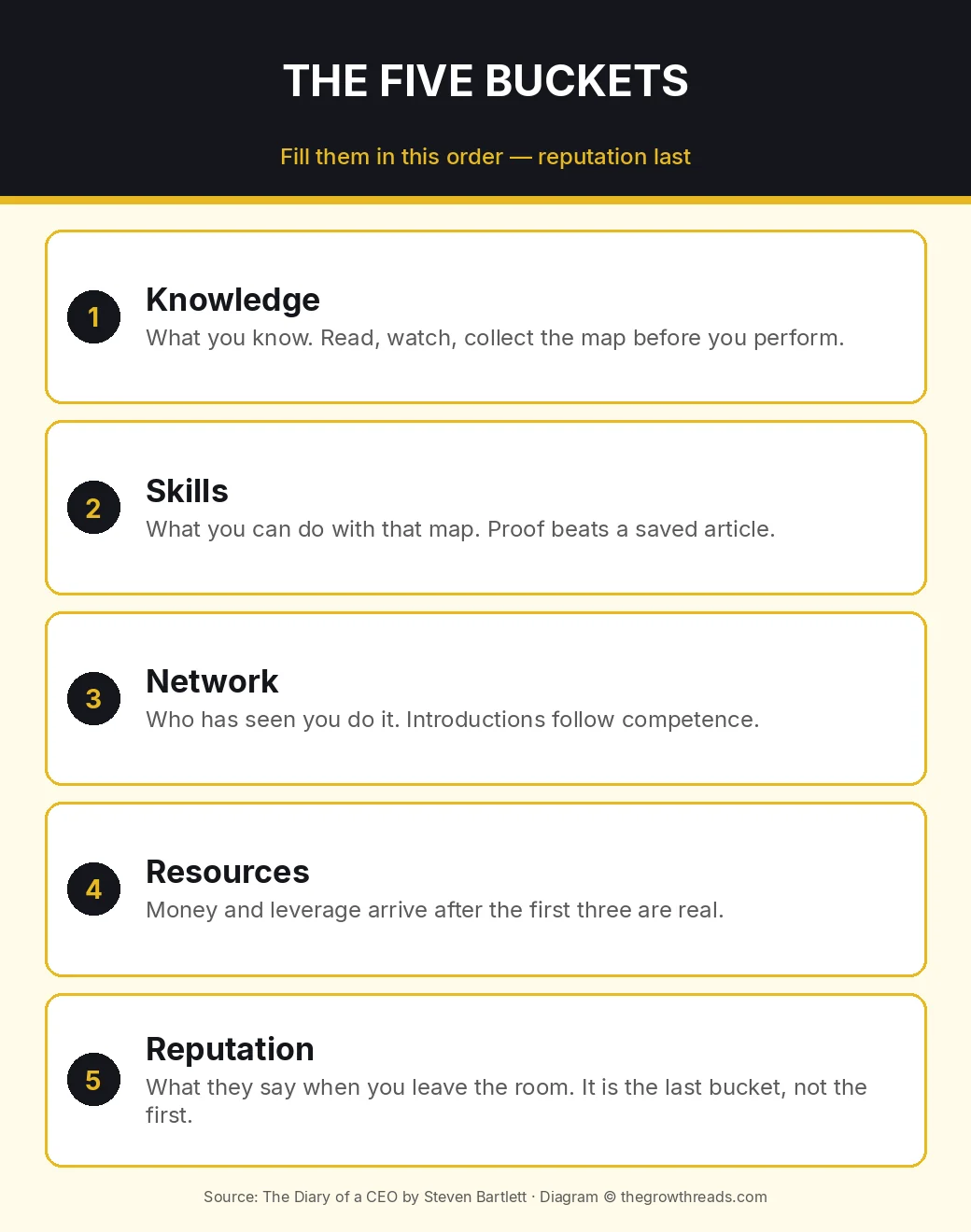
Bartlett’s Self pillar is a sequence, not a mood board. Knowledge is what you have studied. Skills are what you can do with it when the room is watching. Network is who has seen that proof. Resources — cash, leverage, time you can buy — show up after the first three are real. Reputation is the story other people tell, and it is last because it cannot be faked for long. The common failure of the podcast era is jumping to bucket five: a face, a slogan, an empty calendar of “content.” The fix is boring and specific. Score each bucket from one to five. Work the lowest number that sits early in the line.
Two supporting laws make the buckets stick. To master a skill you accept an obligation to teach it — a lunch-and-learn, a checklist, a demo on Friday. And you do not get to choose your beliefs in a vacuum; inputs write them. Design the room, the feed, and the people you repeat. “Never disagree” sounds like manners. It is tactical: people defend identity faster than they update models, so you ask until the better frame can land. Habit work is the same humility. Do not fight the old loop. Replace it. The first foundation underneath all of this is the body. A clever law on no sleep is still a leak.
TGR Note: The skills-before-passion cousin is So Good They Can’t Ignore You. The habit-replacement cousin is Atomic Habits and Tiny Habits. Bartlett’s addition is the order: do not spend the month on a reputation campaign while bucket two is still a two.
Part 2: Make a story they cannot wallpaper over
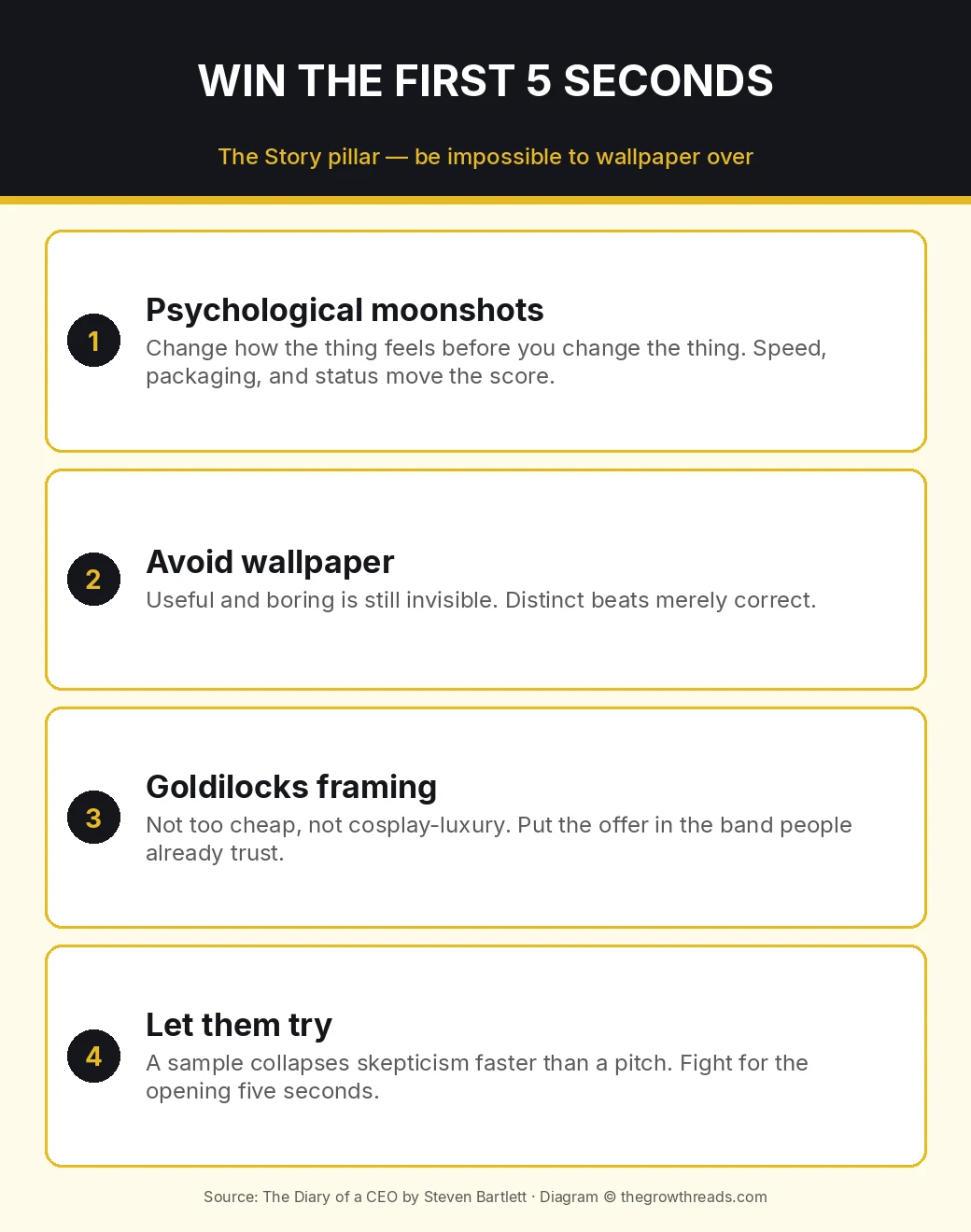
The Story pillar is about being impossible to skip. Bartlett’s warning is that useful and boring still dies on the wall. Wallpaper is the work that is correct, on-brand, and forgettable by lunch. The opening five seconds of a page, a pitch, or a first meeting are the whole game for people who do not owe you their attention. Fight for those seconds with something true and sharp, not with a longer preamble.
Psychological moonshots are the cheaper twin of a product overhaul: change perceived speed, packaging, or status before you rebuild the factory. Framing beats the picture — the same offer in a Goldilocks band (not costume-cheap, not costume-luxury) will clear. Friction can create value when it signals scarce care; a waitlist is sometimes the product. Let them try and they will buy is the sample that collapses a paragraph of claims. And yes, some people must dislike it. If nobody is allergic, nobody is for it. That is not a license to be cruel. It is a test: a story that tries to please the entire internet is already wallpaper.
TGR Note: If the wound is “they do not remember us,” Made to Stick and Contagious are the lab notes. If the wound is “they do not know why we exist,” Start With Why is the cleaner spine. Bartlett is the five-second stopwatch on top of those books.
Part 3: Out-fail, sweat the small stuff, use the clock
Philosophy here is not a quote wall. It is how you treat error, pressure, and time. A small miss now is a big miss later — the 2% you shrugged at becomes the story people tell about you. Sweat the millimetres: names, dates, the last slide, the follow-up that landed an hour late. Out-fail the competition means more cycles, not more theatre. Plan-A thinking is the hard cousin: a loud Plan B leaks attention. Put the backup in a drawer for ninety days so the main bet can actually starve or grow.
Do not be an ostrich when the number is ugly. Pressure is a privilege if you already chose the arena; it means the work matters. Negative manifestation is inversion — write the failure in advance so you can remove one cause this week. Skills without context are cheap: the same craft in the wrong room looks like a hobby. The discipline equation sits on death and time. Remember you will die, remember the hours are finite, and the gym at 6 a.m. stops being a personality and starts being arithmetic. None of this is a dare to burn out. It is a dare to stop negotiating with the calendar as if it were infinite.
TGR Note: Compounding misses are The Compound Effect in operator clothes. If the gap is toughness rather than sequence, Can’t Hurt Me is the louder gym. Use Bartlett when the miss is a millimetre you keep calling a vibe.
Part 4: Ask who, raise the bar, keep learning
Law 28 is the sentence most ambitious people need tattooed on the laptop lid: ask who, not how. If you will never be world-class at the task, a tutorial is a stall. The next move is a name — a hire, a specialist, a partner who already lives in that room. Culture is a shared language, not a hoodie. Bartlett’s “cult mentality” is dense belief plus standards, not abuse. The three bars are practical: a bar to join, a bar to stay, and a bar you keep raising as the work gets harder. Drop any of them to fill a seat and you will manage that seat for a year.
People stay where they can see themselves getting better this week. Make progress visible — a shipped artefact, a scoreboard, a before/after. “Inconsistent leader” here means situational, not chaotic: the same speech does not fit every person. Keep the standard; change the format. Law 33 is the closer. Learning never ends. The second the team decides it has arrived, the five buckets start to empty from the top.
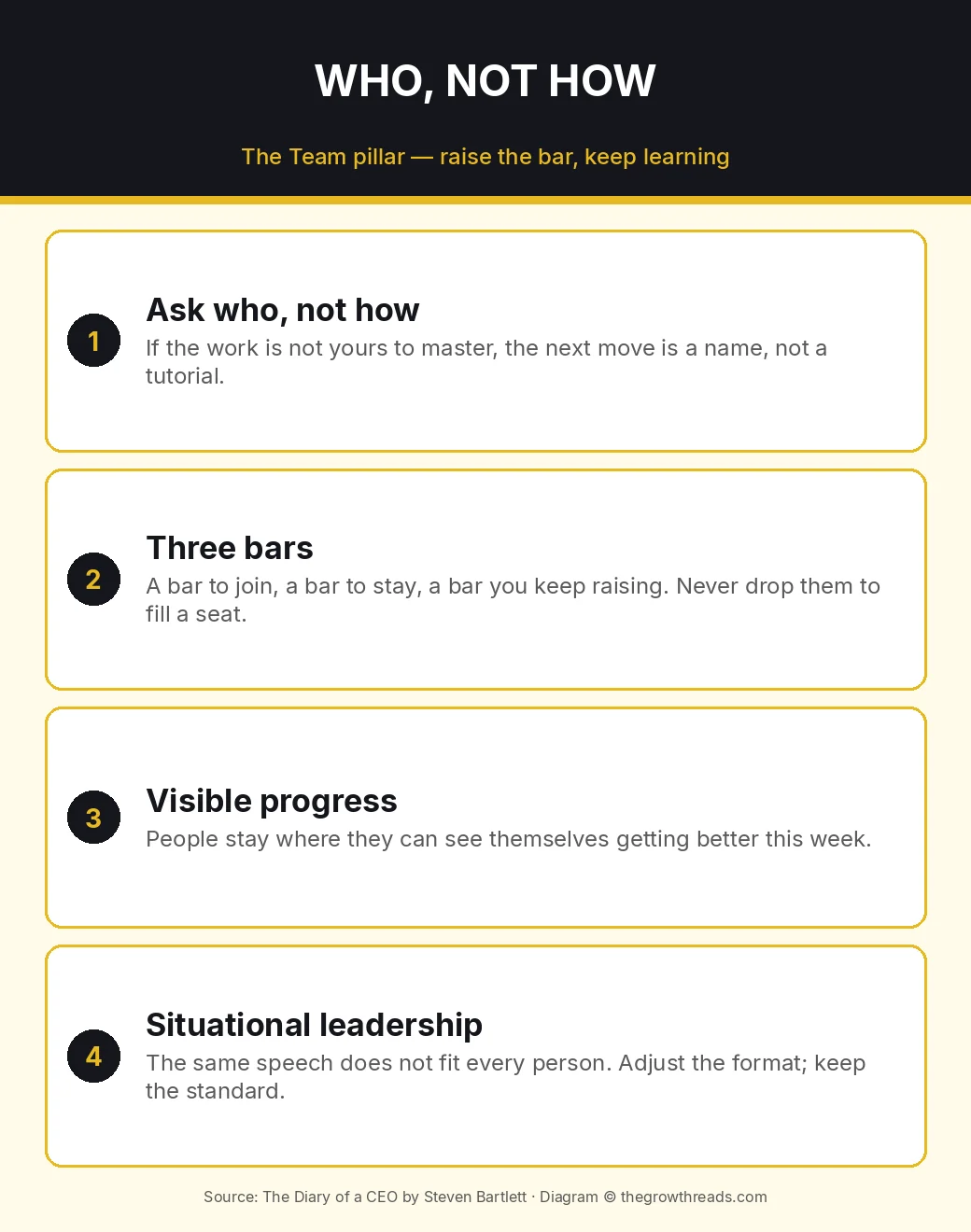
TGR Note: The full-length version of law 28 is Who Not How. If the wound is that you are still the machine, Work the System and Clockwork document the company so a competent stranger could run it. Bartlett tells you to stop being that stranger’s only option.
Who is The Diary of a CEO best for — and who should read something else first?
Best for founders, operators, and creators who got a microphone before they got a craft, and for competent people who are still invisible because the first five seconds of their story are wallpaper. It is also a clean map if you like interviews and want a table of contents those episodes never give you.
Read something else first if your actual problem is one habit loop — start with Atomic Habits. If you are the bottleneck in a company that has no documents, start with Work the System. If you already know you should stop doing the work, Who Not How is the dedicated book. Come back to Bartlett when you need one sequence across self, story, philosophy, and team rather than a deeper dive in a single wound.
Questions to reflect on
- Which of the five buckets is actually a two — and which one have you been decorating instead?
- What would you have to teach on Friday for a skill you claim to own?
- Where does your offer become wallpaper in the first five seconds?
- Which task will you never be world-class at, and who already is?
- What 2% miss, if it compounds for a year, becomes the story people tell about you?
🔥 Ready to fill the right bucket this week?
Get The Diary of a CEO, then use the 7-day plan to score the five buckets and rewrite your first five seconds.
How to apply The Diary of a CEO (7-day plan)
- Day 1 — Score the buckets. Rate Knowledge, Skills, Network, Resources, and Reputation from 1–5. Circle the lowest early bucket. That is the week’s job, not a new bio.
- Day 2 — Teach one skill. Record a 10-minute demo or write a one-page checklist for the skill you claim. If you cannot teach it, you do not have it.
- Day 3 — Replace, don’t fight. Pick one leak (phone in bed, skipped lunch). Swap the cue for a boring replacement. Protect sleep as the first foundation.
- Day 4 — First five seconds. Rewrite the opening of your page, pitch, or intro until a stranger could repeat it. Cut anything that sounds like wallpaper.
- Day 5 — Premortem Friday. Write the failure of your main project in a paragraph. Remove one cause before the weekend.
- Day 6 — Who, not how. List three tasks you will never master. Put a real name next to each. Send one message.
- Day 7 — Write the bars. One sentence for who gets in, one for who stays, one you will raise next quarter. Then stop. Do not add an eighth law.
Frequently asked questions
What is The Diary of a CEO about in one paragraph?
The Diary of a CEO is Steven Bartlett’s working manual of 33 laws, drawn from building companies, sitting on Dragons’ Den, and interviewing thousands of guests on his podcast. Strategy expires; these laws are meant to last. He groups them into four pillars — Self, Story, Philosophy, and Team — and the spine is sequence: fill knowledge and skills before reputation, tell a story people cannot wallpaper over, treat small misses as future disasters, and staff work by asking who, not how. Pick three laws this week. Do not try to live all thirty-three at once.
What are the five buckets in The Diary of a CEO?
The five buckets are Knowledge, Skills, Network, Resources, and Reputation, filled in that order. Knowledge is the map. Skills are proof you can use the map. Network is who has watched you do it. Resources — money, leverage, time bought back — follow proof. Reputation is what they say when you leave the room, and it is last on purpose. Reverse the order and you get a personal brand with nothing underneath. Score each bucket from one to five tonight; the lowest early bucket is the job for this month, not a new logo.
How many laws are in The Diary of a CEO?
There are 33 laws in four pillars: nine on the Self, nine on the Story, nine on the Philosophy, and six on the Team. Bartlett’s claim is that the list is a filter, not a religion. You will not run a company on all thirty-three in one quarter. The useful move is to choose one law per pillar that names a wound you already have — empty skills, a forgettable pitch, a leaking Plan B, a team you are still trying to clone yourself into — and run those four for thirty days. The rest stay on the shelf until the first four stick.
Is The Diary of a CEO worth reading if I already listen to the podcast?
Yes, if you want the interviews turned into a sequence you can run on a Tuesday. The podcast is long, guest-led, and easy to treat as ambient motivation. The book is the operator’s cut: 33 named laws, four pillars, and a repeating demand to put knowledge and skills before reputation. You will hear familiar stories. You will also get the missing table of contents those episodes never give you. If you already take notes after every episode, start with the five buckets and the first-five-seconds chapter and skip the rest until those two change a week.
Who should read The Diary of a CEO?
Builders who are visible before they are competent, and operators who are competent and still invisible. It is a strong fit for founders, podcast-era creators, and managers who keep asking “how” when the real constraint is “who.” If your actual problem is one tiny habit, start with Atomic Habits. If your actual problem is that you are the system, start with Work the System. If you already know you should stop doing the work yourself, Who Not How is the full book on Bartlett’s twenty-eighth law. This volume earns its place when you need one map across self, story, philosophy, and team.
How long does it take to read The Diary of a CEO?
The US Portfolio hardcover is 368 pages. Most readers finish in eight to ten hours. The laws are short, so you can also treat it as a desk book: one law a morning for a month, with a notebook. That slower pass is closer to how Bartlett wants it used — as a filter on real decisions, not as a binge. This guide is a twelve-minute pass so you can pick three laws before you buy. If you only have a weekend, read the five buckets, the first five seconds, the small-miss chapter, and who-not-how, then stop and apply those four on Monday.
How do I apply The Diary of a CEO without doing all 33 laws?
Score the five buckets, then pick the emptiest early bucket and give it seven days of proof, not content. On a separate card, rewrite the first five seconds of the thing you sell. On a third card, name one task you will never become world-class at and write the person who already is. That is Self, Story, and Team in one week. Philosophy is the maintenance: a Friday premortem on the one project that can still embarrass you. Stop when those four cards exist. Adding a fifth law before the first four have a calendar slot is how the book becomes wallpaper.
Related summaries
- Who Not How — the full book on staffing the work instead of becoming the tutorial.
- Atomic Habits — the habit-replacement system underneath Bartlett’s “never fight a bad habit.”
- Never Eat Alone — how the network bucket actually fills after you have proof.
- So Good They Can’t Ignore You — career capital before the personal brand.
More in this silo: best productivity books.
How we analyze books: every book on The Growth Reads is read cover to cover, summarized in thousands of words of original analysis, and rated against our five-criteria rubric (lasting impact, evidence quality, practical application, writing & originality, external consensus). Read our full methodology.