

★★★★★ 4.7/5 — A year-long mind-training: forgive the meaning you glued onto this slight, and the day changes before the facts do.
Best for: People stuck in a grievance loop who will do a short daily lesson — not readers hunting a weekend manifesto
Reading time: ~30 hrs for the Text; the Workbook is 365 daily lessons · ~16 min for this guide
Difficulty to apply: Each lesson is small; refusing to prosecute the person in front of you is the work
A Course in Miracles in one minute
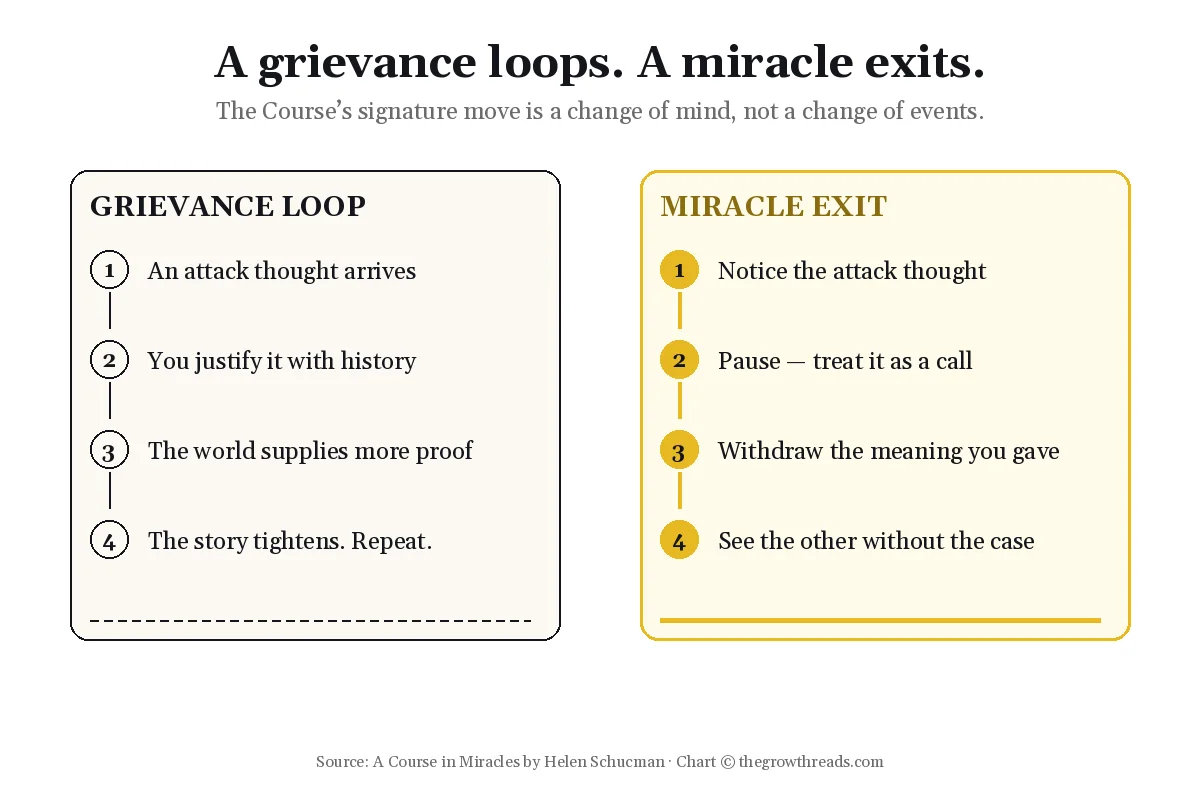
A miracle is a change of mind, not a rearrangement of events. Helen Schucman’s Course says you live in one of two thought systems. The ego writes a world that proves you are separate and right to attack. The other teacher uses the same day as a classroom: notice the attack thought, withdraw the meaning you gave, look again. The Combined Volume is three books (Text, Workbook, Manual). The steal is smaller than 1,333 pages. Take one lesson. Forgive one script.
Key takeaways
- Two teachers, not two worlds: You consult ego or right-mind in the next hour. The scenery can stay. The interpreter changes.
- A miracle is a shift in seeing: Not a parking space, a healed scan, or a rewritten past. Perception yields first.
- Guilt writes the world you see: Projection is not a metaphor here. The case file in your head paints the faces in the room.
- Forgiveness withdraws meaning: You do not have to bless the facts. You drop the story that the facts prove you are the victim-hero.
- Special relationships are bargains: “Love me so I do not feel this.” A holy relationship uses the other as a way to wake, not a supply.
- The Workbook is the gym: 365 short lessons. Theory without practice is the ego’s favourite degree.
- Ask for another way: The origin story is a fight at work. The practice is the same sentence in a meeting that is going badly.
- Nothing real can be threatened: The opening lines name the filter. What can be attacked was never the thing you actually wanted.
What is A Course in Miracles about?
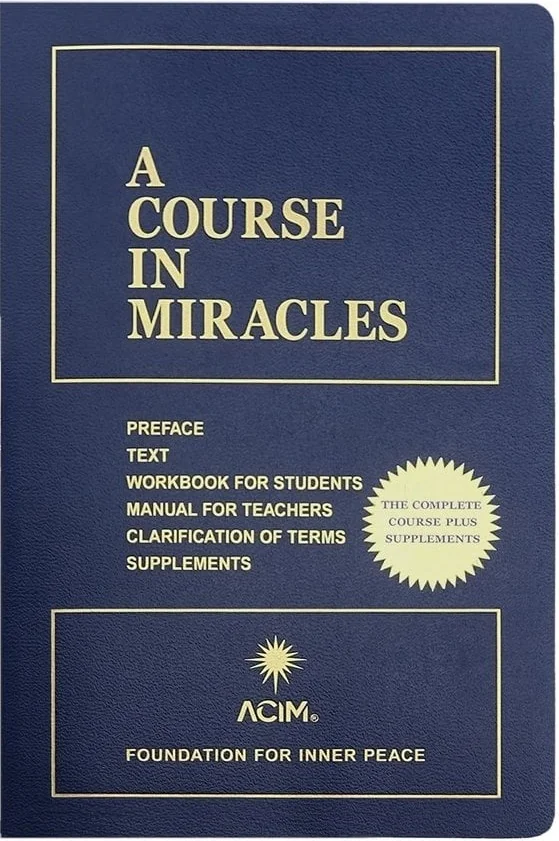
A Course in Miracles is a 1976 mind-training published as a Combined Volume — Text, 365-lesson Workbook, and Manual. It teaches forgiveness as a shift in perception: change the teacher you consult this hour, rather than winning the argument the ego set up.
About the author
Helen Cohn Schucman (1909–1981) was a clinical and research psychologist at Columbia-Presbyterian, working with William Thetford. In 1965 their meetings had become so hostile that Thetford said there must be another way. She later described inner dictation beginning 21 October 1965: this was a course in miracles, and she should take notes. She was often uncomfortable and kept going. Thetford typed as she read. The three main sections were finished around 1972. The Foundation for Inner Peace published the work in 1976; the Combined Volume third edition used here appeared in 2007. Courts treated Schucman as author for copyright. The method she left is a daily lesson that changes how you see the person in front of you. Explore all Helen Schucman book summaries →
Key concepts at a glance
| Concept | What it means | Use it when |
|---|---|---|
| Miracle | A change of mind — usually forgiveness — not a rearranged event | You are waiting for the world to apologise before you will be sane |
| Ego | The thought system of guilt, attack, and specialness; treated as an illusion, not a soul | You need the other person to be wrong so you can exist |
| Holy Spirit | The right-mind / inner teacher that uses the day as a classroom | You only have the prosecutor’s voice and want a second chair |
| Projection | Inner guilt painted onto faces, inboxes, and news | The same slight keeps arriving in new costumes |
| Forgiveness | Withdrawing the meaning you gave; not condoning harm | You are rehearsing a verdict instead of doing the next task |
| Special relationship | A bargain: supply me so I do not feel this | Love has become a ledger and a threat |
| Holy relationship | The other as a way to wake, not a vending machine | You want closeness without the hostage-taking |
| Workbook lesson | One idea, kept for a day, against the ego’s curriculum | You keep reading and never practise |
Part 1: There must be another way
The Course opens as an office problem. Two psychologists are good at their work and bad at each other. Thetford’s sentence — there must be another way — is the method in civvies. You need the moment a meeting or a marriage has become a courtroom and someone in you is willing to be wrong about the plot.
The Text restates one claim until it is harder to dodge: you are not seeing a neutral world. You are seeing a world that matches the thought system you are in. Guilt finds evidence. Attack finds enemies. The opening lines are a filter, not a poster: “Nothing real can be threatened. Nothing unreal exists. Herein lies the peace of God.” What can be threatened was never the thing you actually wanted. When heat arrives, ask whether you are protecting something real or a story that needs a villain.
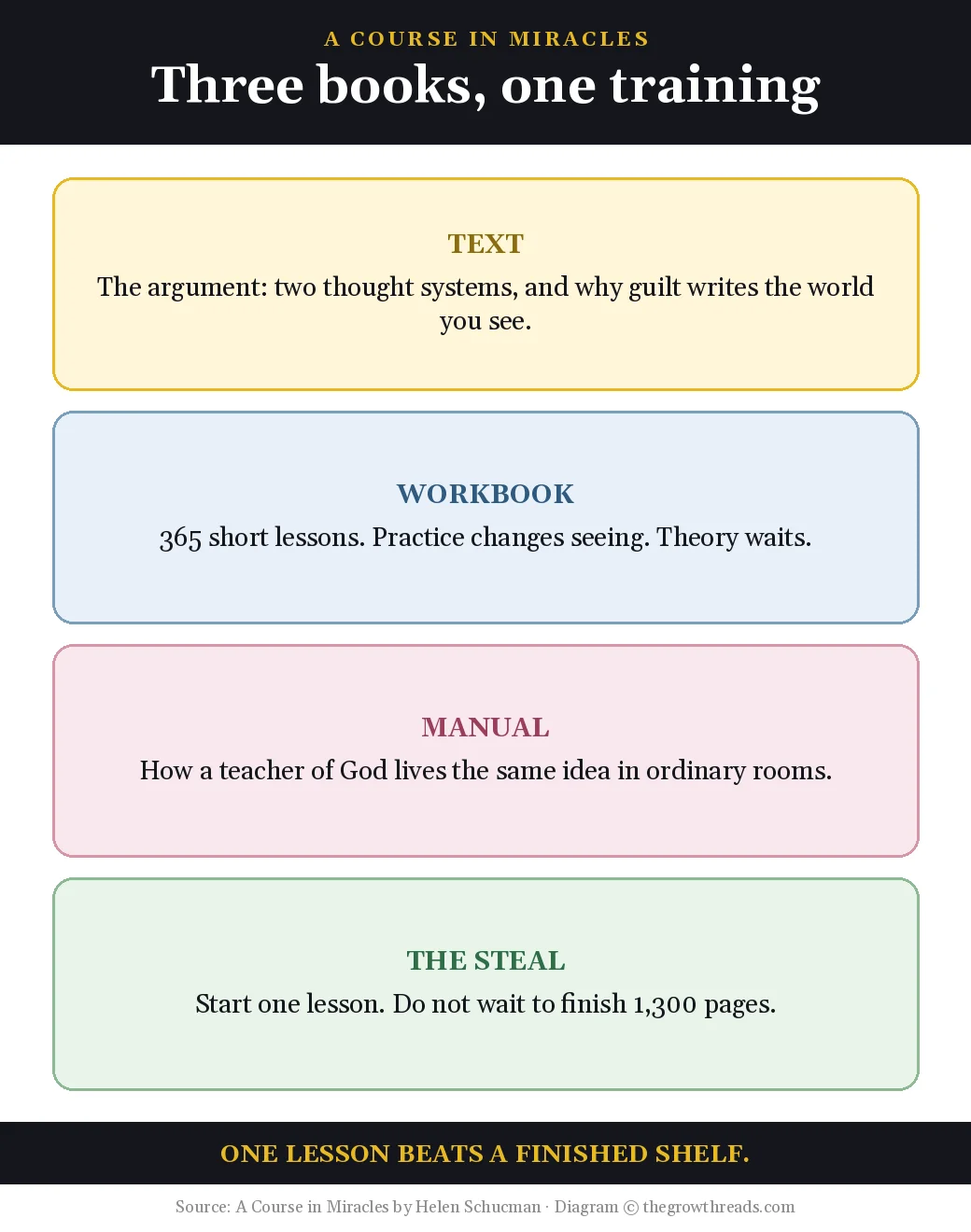
The Combined Volume is three books because argument is not training. The Text says why. The Workbook does reps. The Manual is for the room you are actually in. Starting with the doorstop and never reaching Lesson 1 is how the ego agrees to be spiritual.
TGR Note: The Power of Now starts with a collapse and a voice that goes quiet. A Course in Miracles starts with a workplace truce and a voice that keeps talking. Use Tolle if you cannot find the narrator. Use the Course when the narrator is obvious and still wants a verdict. Both refuse to wait for the world to improve before you change the interpreter.
Part 2: Two thought systems — ego and the right mind
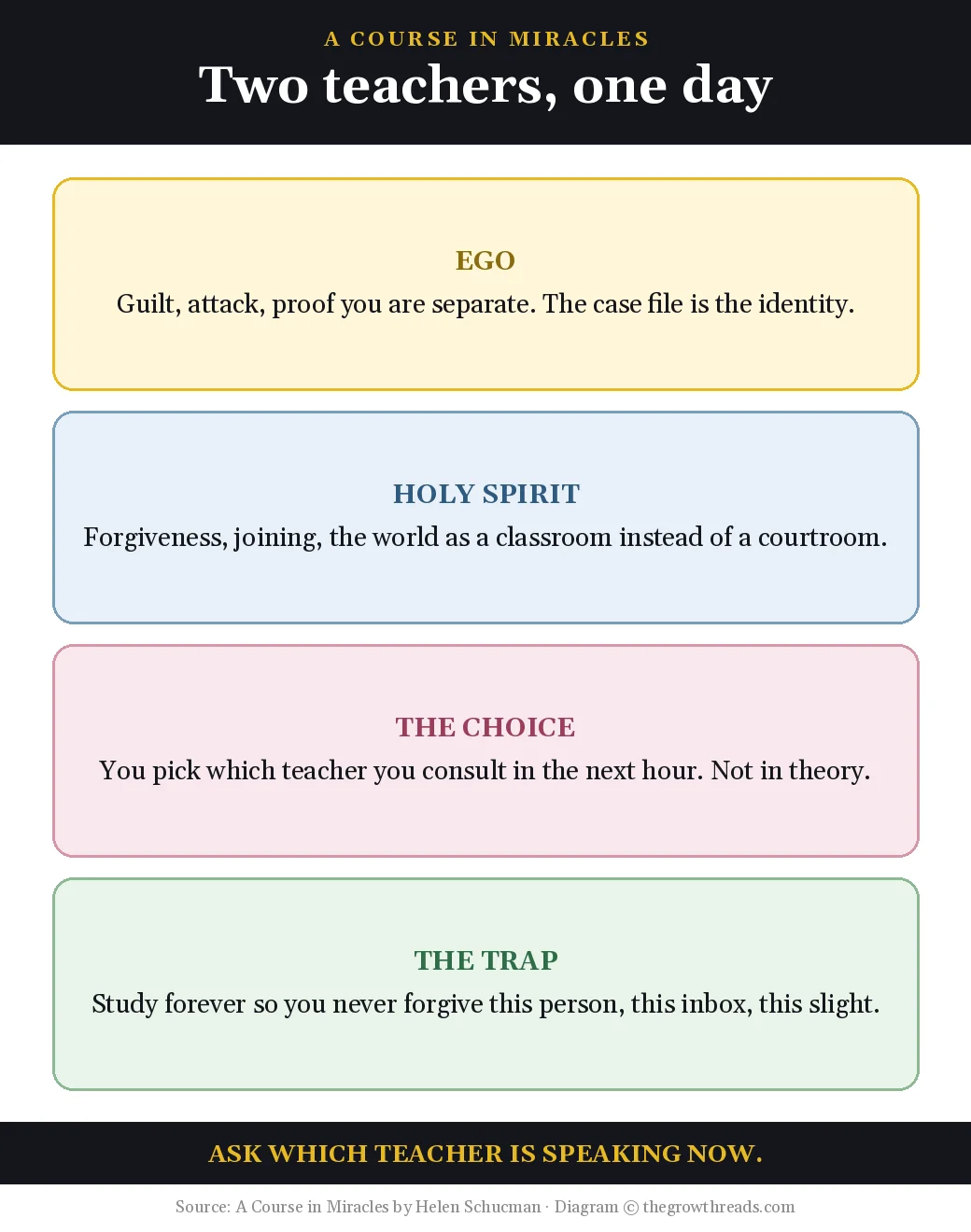
The ego here is not your personality. It is a thought system whose job is separation. It needs guilt, a past, and someone to prosecute so you stay identified with the prosecutor. Laying it down is not self-hatred. It is noticing the case file is not you. The other teacher is named Holy Spirit — practically, the voice that does not need the other person to be wrong. It treats the day as a classroom. You pick a teacher in the next hour, not in a memoir. Mapping two systems and then spending the afternoon as the prosecutor is how the ego gets a spiritual hobby.
Projection is the mechanism. Guilt you will not look at gets painted onto a partner, a boss, an inbox. Then the painting attacks you and you feel justified. Winning the argument never yields peace because you won inside the ego’s rules. The world will send another exhibit. In the next heated hour, name the teacher on paper: prosecutor or classroom. You can still set a boundary. Forgiveness here is the end of using the boundary as proof that you are the innocent one in a two-person play.
TGR Note: A New Earth names the ego and the pain-body in public language. The Course names two teachers and then assigns homework. If you need a diagnosis of the voice, start with Tolle. If you need a daily way to stop feeding it, stay here. The Untethered Soul is the spectator version: you are the one who hears the roommate. The Course asks you to forgive what the roommate glued onto a face.
Part 3: Forgiveness is the miracle
Popular talk uses miracle for a parking space. The Course uses it for a change of mind. The event may stay ugly. Forgiveness is not saying the harm was fine. It is withdrawing the meaning you added — that this proves you are cursed, or finally justified to punish. You can still leave. You cannot keep the holy war and call it healing.
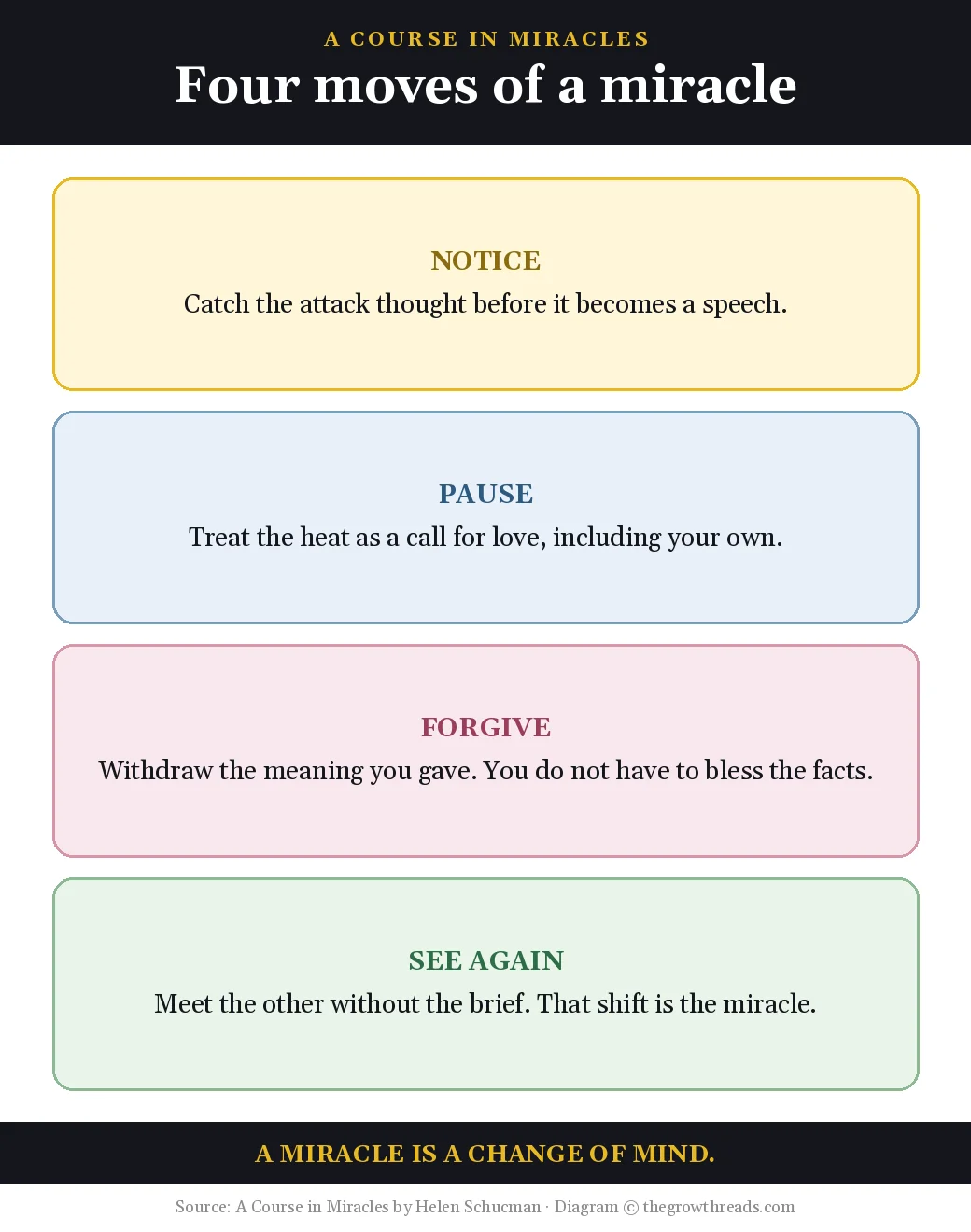
A special relationship is a bargain: supply me so I do not feel this. When the contract fails, attack feels like honesty. A holy relationship uses the same closeness as a way to wake. The other is not your missing half. They show you where you still need a villain. Four moves keep this from becoming a speech: notice the attack thought, pause, withdraw the meaning, look again. You will fail this on Thursday. The Workbook exists because Thursday exists.
If you are in danger or in acute distress, get human help first. This forgiveness is a tool for rumination — the replay that keeps the wound employed after the event has ended — not a reason to skip a clinic or stay unsafe.
TGR Note: The Secret trains you to ask and feel as if. A Course in Miracles trains you to drop the grievance that is already broadcasting. Attraction without forgiveness still treats people as vending machines. Radical Acceptance is the clinical cousin: stop the war with this moment. The Course adds a target — the meaning you gave a person. Use Brach if you need permission to feel. Use Schucman when feeling has become a prosecution.
Part 4: The Workbook — 365 lessons, one day at a time
The Workbook is the honest part. One idea. One day. Often a few minutes. Early lessons strip meaning from objects so you can feel how fast the mind names and prosecutes. Later lessons install a different habit. Steal the structure even if you skip some metaphysics: keep one sentence for a waking day. When you forget, begin again. Do not write a thesis about the miss.
The Manual is shorter. A teacher of God, here, is anyone who learns by teaching — parenting, managing, talking to yourself in a kitchen. The qualities it names (trust, honesty, patience, open-mindedness) are what a day looks like when the prosecutor is off duty. Marianne Williamson and Oprah sent millions to the Combined Volume. That is history, not homework. You need tomorrow morning, not a movement. Commentary after the sitting, not instead of it.
Return is the test. If the lesson cannot survive an inbox, it was tourism. Ask for another way in the meeting that is already going badly — not later, when you are spiritual on the sofa. The origin story was an office. Honour it by using the office you actually have.
TGR Note: The Power of Your Subconscious Mind is the older daily method: inner conversation, repeated. The Course is stricter about what you stop saying — the attack. Autobiography of a Yogi installs an outer guru and a technique. This Workbook installs an inner teacher so you are not forever renting a class. If you want a person to follow, start with Yogananda. If you want a lesson you cannot outsource, stay with the 365.
Who is A Course in Miracles best for — and who should read something else first?
Best for readers who already know they live in their heads and are tired of winning arguments that do not yield peace. Also for people who will actually do a short daily lesson. Not a first book if you need a tool for this week’s panic — start with Feeling Good. If you only need to notice the voice, The Power of Now is cleaner. If family trauma is the live wire, Adult Children of Emotionally Immature Parents is more specific. If you want manifestation without forgiveness, The Secret. Come here when the problem is the case file you keep opening on people you love.
Questions to reflect on
- Which teacher ran your last heated hour — prosecutor or classroom — and what did the other one not get to say?
- What meaning did you glue onto a slight this week that the facts did not actually require?
- Where is a relationship still a bargain: supply me so I do not feel this?
- What commentary, origin debate, or “I’ll start when I finish the Text” is protecting you from Lesson 1?
- If you asked for another way in the next meeting that goes badly, what would you stop saying first?
🔥 Ready to forgive the script you keep replaying?
Get A Course in Miracles and take one lesson this week.
How to apply A Course in Miracles (7-day plan)
- Day 1: Read the opening of the Text until you can say, in one sentence, that there are two teachers. Write the sentence. Do not start a study group.
- Day 2: Catch three attack thoughts before they become speeches. For each, write the extra meaning you added that the facts did not require.
- Day 3: Pick one person you are prosecuting. Withdraw the meaning for ten minutes. You may still keep the boundary. Drop the holy war.
- Day 4: Take one Workbook-style morning: one idea on a card, kept until dinner. When you forget, begin again. No essay.
- Day 5: Inventory one special relationship. Where is it a bargain? Name the supply you are demanding. Ask what a classroom would do instead.
- Day 6: In a meeting or message that is going badly, ask for another way before you send the clever line. Send the shorter true thing.
- Day 7: Review. Keep the one move you will run for the next seven days — notice, pause, forgive, or see again. Schedule Lesson 1 on the calendar, not on a someday shelf.
Frequently asked questions
What is A Course in Miracles about?
A Course in Miracles is a mind-training in three books: a Text that argues you live in one of two thought systems, a Workbook of 365 short lessons, and a Manual for how a teacher of God uses the same idea in ordinary rooms. A miracle, here, is not a rearranged event. It is a change of mind — usually forgiveness, which means withdrawing the meaning you glued onto a person or a slight. The Course says guilt writes the world you see, and peace is the result of choosing a different teacher for the next hour. This guide is the usable map, not a substitute for the lessons.
Who wrote A Course in Miracles?
Helen Schucman, a clinical psychologist at Columbia-Presbyterian, scribed the material from 1965 to 1972 after her colleague William Thetford said there must be another way than their hostile meetings. She described an inner voice and read her notes to Thetford, who typed. Kenneth Wapnick later helped edit. The Foundation for Inner Peace published the Combined Volume; this summary uses the 2007 third edition (ISBN 9781883360245). U.S. courts treated Schucman as author for copyright. Readers still disagree about the source. The practice does not require you to settle that argument before Lesson 1.
Do I have to believe it was dictated by Jesus?
No. Schucman identified the inner voice with Jesus; the Text never hangs the whole training on that biography. You can treat the voice as a literary teacher, a right-mind, or a religious claim. The Workbook still asks the same small thing: notice an attack thought, pause, withdraw the meaning, look again. If the Jesus language blocks you, keep the four moves and skip the cosmology until a lesson actually helps. If the language helps you pray, use it. Either way, studying the origin story so you never forgive this week’s slight is the ego’s favourite seminar.
How is A Course in Miracles different from The Secret or The Power of Now?
The Secret trains attention toward a wanted future. A Course in Miracles trains you to drop the grievance that is already writing this afternoon. The Power of Now teaches you to notice the narrator. The Course asks you to forgive the meaning the narrator glued onto someone. Presence without forgiveness can still prosecute the past in a quieter voice. Attraction without forgiveness can still treat people as vending machines. Use Byrne if you need a feeling-first ask. Use Tolle if you cannot even see the voice. Use the Course when you can see it and still want a verdict.
How do I start the Workbook without drowning in the Text?
Do not wait to finish 1,300 pages. The Combined Volume is a library. The Workbook is the gym. Read the first chapters of the Text until you can say, in one sentence, that there are two teachers. Then take Lesson 1 tomorrow morning. One idea, kept for a day, beats a highlighted doorstop. If a lesson feels like nonsense, do it anyway for the assigned time and stop. The Manual can wait until you are actually teaching someone — including yourself — in a kitchen. Skip the commentary pile until you have seven days of practice. Insight that cannot survive an inbox is tourism.
Is A Course in Miracles therapy — or a religion I have to join?
It is a spiritual mind-training, not a clinic and not a membership card. It uses God, Holy Spirit, and miracle because that is the vocabulary of the text. You do not enrol in a church by doing Lesson 5. You also do not replace a clinician, medication, or crisis care with a workbook. If you are in acute distress, get human help first. For rumination, grievance, and the habit of prosecuting the people you live with, the daily lesson is a practical tool. The FAQ note is simple: this is not medical advice. It is a way to spend the next hour without the case file.
How long does it take to read A Course in Miracles?
The Combined Volume is 1,333 pages. Plan thirty hours if you read the Text like a book, then a calendar year if you actually do the Workbook — one short lesson a day, not a binge. This guide is about sixteen minutes. You do not finish the Course by finishing the pages. You finish a day when you have caught one attack thought and withdrawn the meaning. Buy the Foundation for Inner Peace Combined Volume if you want Text, Workbook, and Manual in one. Do not wait for a perfect edition, a study group, or a settled theory of dictation before tomorrow’s lesson.
Related summaries
- The Power of Now — notice the narrator without the Course’s two teachers.
- A New Earth — ego and pain-body in public language.
- The Secret — ask and feel as if, if grievance is not the live problem.
- The Untethered Soul — watch the inner roommate; the Course asks you to forgive what it glued on.
Browse the full list on our Best Psychology Books pillar.
How we analyze books: our summaries are built from a full read of the source text, cross-referenced against the author’s published interviews and research where relevant, and structured around practical application rather than critique. We disclose our editorial process and affiliate relationships in full. Read our full methodology.