

★★★★★ 4.8/5 — A lab notebook for the inner life: talk with the figures that run you, then bring one sentence back to Tuesday.
Best for: Capable people whose outer life works and whose inner weather still has no chair — therapists, midlife rebuilders, and anyone tired of quoting Jung without a method
Reading time: ~14 hrs for the book · ~14 min for this guide
Difficulty to apply: The method is simple; staying with an image without explaining it away is the work
The Red Book in one minute
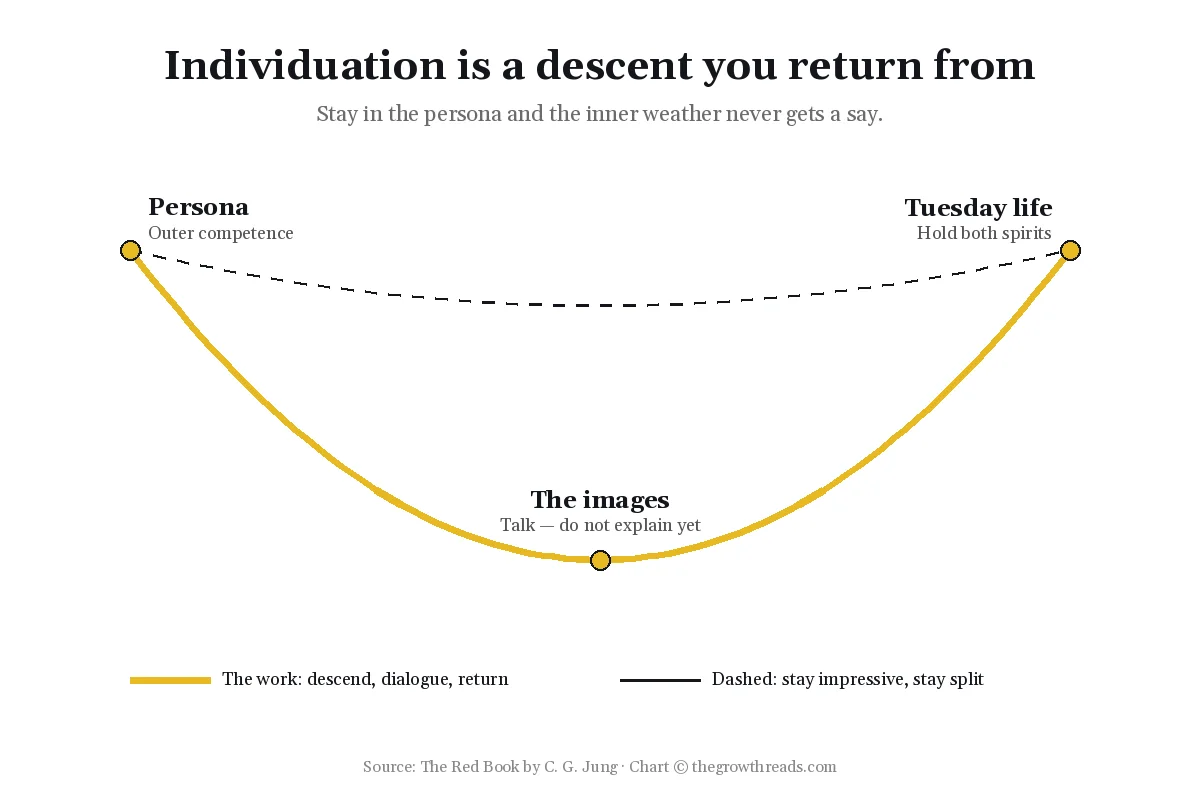
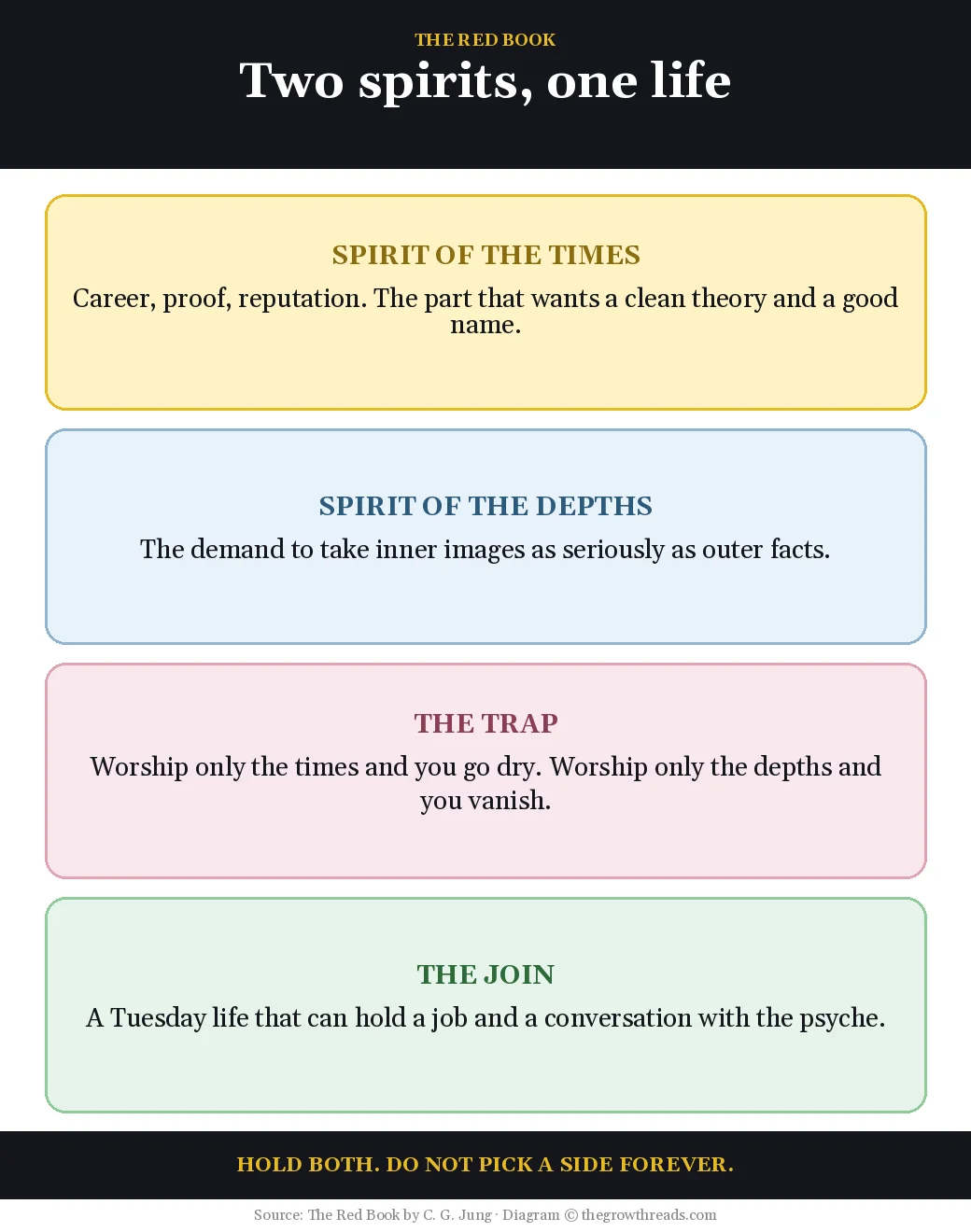
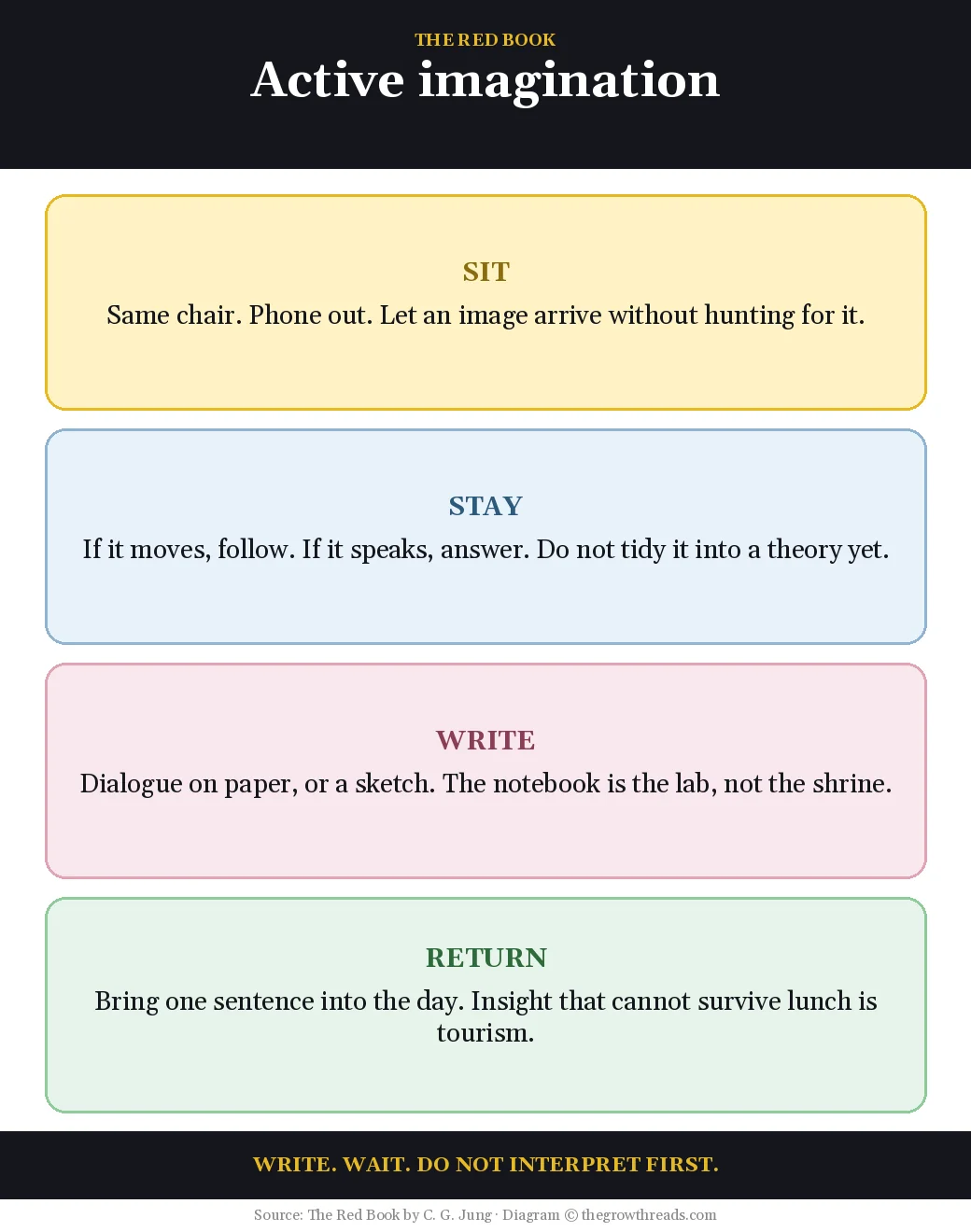
The Red Book is not a theory of the psyche. It is Jung’s lab notebook from the years he stopped explaining himself and started talking back. After the break with Freud he met two demands: the Spirit of the Times (career, proof, a respectable science) and the Spirit of the Depths (take inner images as seriously as outer facts). He wrote, painted, and argued with figures who had their own will. The method is active imagination: sit, stay, write, return. If the insight cannot survive lunch, it was tourism.
Key takeaways
- Two spirits, one week: The Times want a clean theory and a good name. The Depths want a conversation. A usable life holds both.
- Talk with the psyche, not only about it: Interpretation is cheap. Dialogue on paper is the experiment.
- Images have will: Inner figures are not moods you rebrand. They interrupt. Answer them.
- Kill the hero you perform: The Siegfried scene is the death of the impressive specialist who cannot be taught.
- Active imagination is timed work: Same chair, phone out, a page. Stop when the timer ends.
- Philemon is an inner teacher: Grow one so you are not forever renting a guru.
- Joy belongs in the work: The Red One is the body and play you parked to look professional.
- Science stripped the sky — meaning still needs a form: Izdubar is what happens when explanation wins and wonder has nowhere to stand.
- Return is the test: Bring one sentence into the next ordinary block. Mysticism that cannot do Tuesday is incomplete.
What is The Red Book about?
The Red Book is C. G. Jung’s Liber Novus, the private record of his inner work after the break with Freud. He holds two spirits, talks with figures who have their own will, and practices active imagination so individuation can survive an ordinary week.
About the author
Carl Gustav Jung (1875–1961) was a Swiss psychiatrist who began as Freud’s heir apparent and then refused to let the inner life be only repressed sexuality. After the 1913 break he sat, wrote, and painted until the psyche answered in scenes. That private work, edited by Sonu Shamdasani and issued by W. W. Norton in 2009 as The Red Book: Liber Novus, is the underground of the public Jung. He built a practice at Burghölzli, a tower at Bollingen, and a psychology that treats images as facts you can talk to. The point was never to become interesting. It was to become whole enough for the next ordinary day. Explore all C. G. Jung book summaries →
Key concepts at a glance
| Concept | What it means | Use it when |
|---|---|---|
| Spirit of the Times | The demand for proof, career, and a clean theory | You only trust what you can present in a meeting |
| Spirit of the Depths | The demand to take inner images as seriously as outer facts | Your résumé is fine and your nights are not |
| Active imagination | A timed dialogue with an image, written or drawn | You keep interpreting your life and never answer it |
| Inner figures | Persons in the psyche with their own will, not rebranded moods | The same interruption keeps arriving with a different costume |
| Killing the hero | Letting the impressive specialist die so a student can appear | You cannot be taught because your identity is competence |
| Individuation | A descent into the images and a return that can hold opposites | You want a new personality instead of a usable week |
| Tension of opposites | Do not pick Times or Depths forever; carry both | You swing between grind and retreat |
| Philemon | The inner teacher you grow so authority is not only rented | Every insight still needs a podcast to feel real |
Part 1: The descent — Spirit of the Times vs Spirit of the Depths
The book opens in a crisis that looks, from the outside, like success. Jung is a doctor with patients, a theory, and a famous older colleague. Then the collaboration with Freud ends, and the nights fill with images he cannot file under a diagnosis. Liber Primus names the split without flattering either side. The Spirit of the Times is not a villain. It is the part that wants evidence, a career, a name that will still mean something in a faculty meeting. It built the hospital. It pays the rent. The Spirit of the Depths is not a holiday. It is the part that says: the dream, the painting, the figure at the desk are facts too, and you will go dry if you only serve the first spirit.
Jung’s move is not to quit science and become a prophet. It is to refuse the lie that only one spirit is adult. “My soul, where are you?” is the first experiment: address the missing inner partner as if someone might answer. The Siegfried episode is the death of the competent specialist who has already won. If that figure cannot die, nothing new can teach you.
What to steal is smaller than the mythic furniture. Notice which spirit is running the next hour. Polishing a theory so nobody sees you are scared is the Times without a chair. Collecting symbols so you never send the email is the Depths as an alibi. The join is a Tuesday: do the outer task and keep a twelve-minute appointment with the image that has been knocking.
TGR Note: The Hero with a Thousand Faces is the same descent in public costume: leave, change, return with a gift. Jung’s version is ruder and more private — the call is a soul you have to address, not a village you can narrate. If you only want the map, start with Campbell. If you want the sitting, stay here.
Part 2: Active imagination — a method, not a museum
The Red Book is easy to treat as a museum: red cloth, gold type, paintings you never answer. Jung’s procedure is ruder. He sits. An image arrives. He does not immediately translate it into a concept. He stays until it moves or speaks, then he writes the dialogue or paints what he saw. That is active imagination — not daydream, not a caption. The notebook is a lab.
Three rules keep the method from turning into a second career as a mystic. First, time-box it. Twelve to fifteen minutes, same chair, phone in another room. The Depths do not get your whole calendar; they get a sitting. Second, do not interpret first. Interpretation is the Times sneaking in dressed as wisdom. If a serpent appears, talk to the serpent. You can theorise after the timer. Third, return. Close the book and do the next ordinary block — the call, the sink, the school run — with one sentence from the sitting in your pocket. Insight that cannot survive lunch is tourism.
Shamdasani’s edition lets you watch a clinician refuse to outsource his inner life to a system — including his later one. The paintings are not illustrations of ideas he already had. They are the ideas, met before they had names. Skim the plates and you have visited. Copy the procedure once this week and you have started the experiment.
TGR Note: The Power of Now trains you to notice the voice. The Red Book trains you to answer it. Use Tolle if you cannot even see the narrator. Use Jung when the narrator is obvious and still running the week.
Part 3: The figures — Elijah, the Red One, Izdubar, Philemon
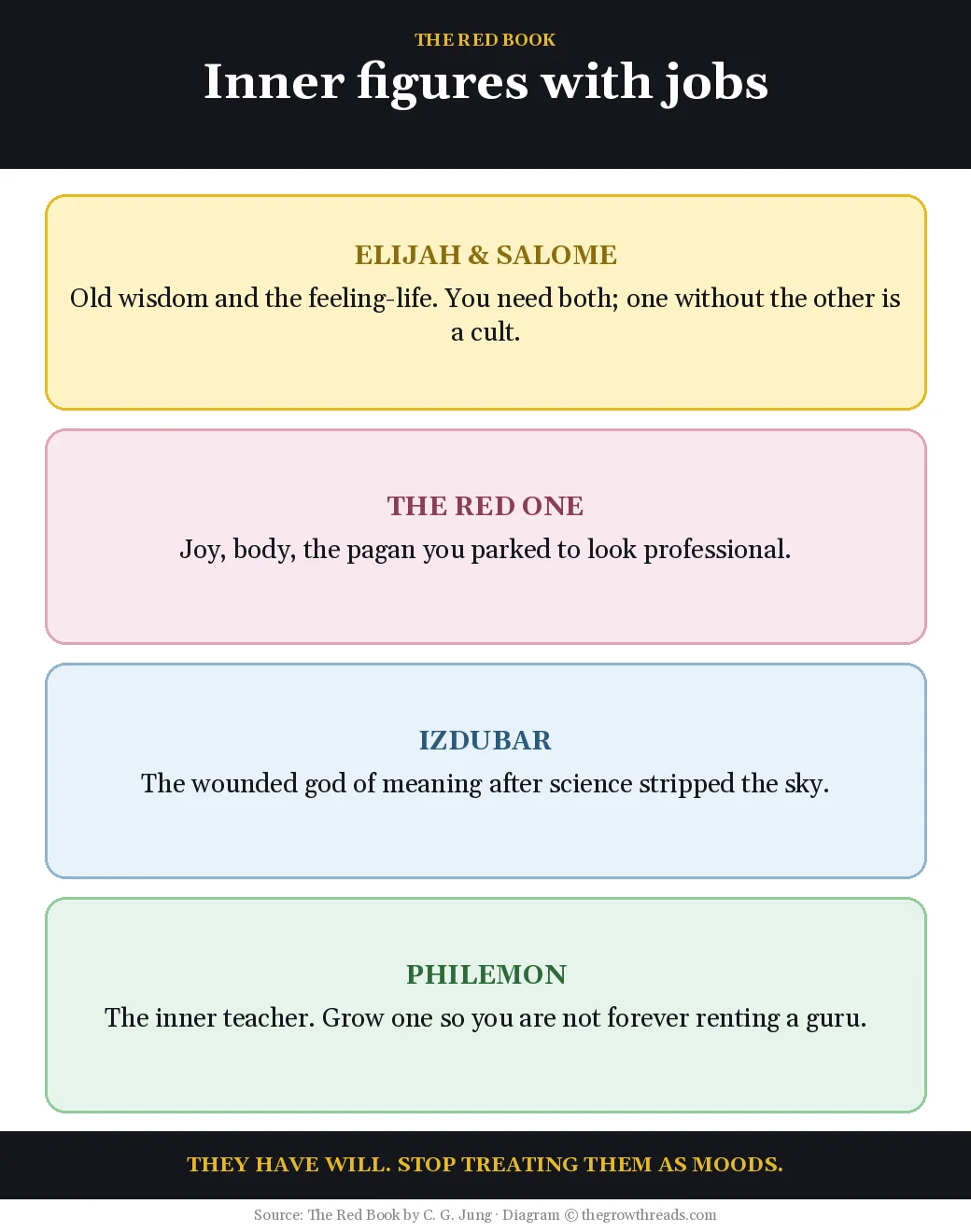
Liber Secundus is a sequence of encounters. The figures interrupt and refuse the Times’ schedule. Elijah and Salome arrive as a pair: old wisdom and the feeling-life. One without the other becomes a cult — a dry sage, or a feeling that will not be taught. Stay in the room with both. That is already the practice if you only trust analysis, or only trust vibe.
The Red One is joy, body, the pagan colour you parked to look professional. He is not a productivity hack. He is the reminder that a life run only as a clinic will go grey, and greyness will then call itself maturity. Izdubar (Jung’s giant, a wounded god of meaning) is what happens after explanation wins. Science stripped the sky; the god of the old stories cannot breathe in a laboratory, and yet the hunger for meaning did not clock out. The task is not to reject measurement. It is to stop pretending measurement is a cosmology.
Philemon is the inner teacher — kingfisher wings and a patience Jung’s persona did not have. The practical steal is not to collect a new guru with better branding. It is to notice when you are still renting authority: a feed, a supervisor, a dead writer who cannot talk back. Active imagination is how an inner teacher gets a chair. You will still read books. You will still have mentors. You will not need every insight countersigned before it is allowed to change how you spend the next hour.
TGR Note: Autobiography of a Yogi installs an outer guru. Philemon is the inner one you grow so obedience is not only rented. 12 Rules for Life drinks from the same well in a public, ordered voice. If you need someone else to hold the line this month, Yogananda or Peterson will travel lighter. If the problem is that every teacher is still outside, stay with the figures.
Part 4: Scrutinies — hold the opposites and come back useful
The later layers — including the material readers meet as the Seven Sermons to the Dead — push the same demand further. Do not split the world into a clean good you can perform and a dirty remainder you hide. Abraxas, in that Gnostic costume, is a name for the union you would rather not hold. You do not need to adopt the cosmology. You do need the homework: the parts of you that want to be only light will sabotage the week, and the parts that want to be only dark will call that honesty. Individuation is the capacity to carry both without making a religion of either.
Scrutinies also answer the tourist’s question: why come back? Because the underworld that cannot wash a cup is not wisdom. Jung returns to patients, to the tower, to a psychology other people can use. The public books are the Times doing its honest job with what the Depths handed over. If you use The Red Book to leave your post and never send a postcard, you have taken the descent and refused the gift. The painted book still expects you at the desk tomorrow.
TGR Note: Man’s Search for Meaning is the return under extreme pressure: meaning as responsibility, not as a vibe. Jung’s return is quieter and still strict — wash the cup, see the patient, do not make a religion of the underworld. If you need meaning with no paintings, start with Frankl. If you need a method for the nights when the résumé is not enough, this is the lab notebook.
Who is The Red Book best for — and who should read something else first?
Best for readers whose outer competence is not the problem. If the résumé works and the inner weather still has no appointment, this is your book. Also for people who quote Jung and have never sat with an image for twelve timed minutes. Not a first book if you need a tool for this week’s panic — start with Feeling Good. If you only need to notice the voice, The Power of Now is cleaner. For the mythic map without the private theatre, The Hero with a Thousand Faces. For an outer teacher and a repeatable technique, Autobiography of a Yogi.
Questions to reflect on
- Which spirit ran your last working hour — Times or Depths — and what did the other one not get to say?
- What “hero” would have to die for you to be teachable again this month?
- If an inner figure knocked today, would you interpret it or write it a reply?
- Where are you still renting a teacher so you never have to grow Philemon?
- What one sentence from a sitting would be allowed to change how you spend the next ordinary block?
🔥 Ready to talk back to the psyche that runs you?
Get The Red Book and run the four moves this week.
How to apply The Red Book (7-day plan)
- Day 1: Name the spirit that ran yesterday in one line (Times or Depths). Put the phone in another room and sit twelve minutes. Write whatever image arrives. No interpretation.
- Day 2: Repeat the sit. If yesterday’s image returns, greet it. If it speaks, answer on paper. Close the notebook and do the first work block without a second screen.
- Day 3: Kill a small hero. Pick one impressive habit that blocks teaching (the extra tab, the preemptive take). Drop it for one meeting.
- Day 4: Invite the Red One for ten minutes: a walk, a meal without a podcast, something bodily that is not a workout for the résumé.
- Day 5: Write five lines to an inner teacher. Ask one question you keep outsourcing to a feed. Do not send it to anyone.
- Day 6: Hold an opposite in public. In one conversation, let two true things sit without picking a winner to look consistent.
- Day 7: Return. Choose one sentence from the week and spend it on an ordinary task. If you cannot name the sentence, the sitting was tourism — sit once more, shorter.
Frequently asked questions
What is The Red Book about?
The Red Book is C. G. Jung’s private Liber Novus, written and painted after his break with Freud, and published by Norton in 2009. It is not a textbook of types. It is a lab notebook: he meets two demands — the Spirit of the Times and the Spirit of the Depths — then talks with inner figures who have their own will. The method is active imagination. The aim is individuation you can bring back to an ordinary Tuesday, not a new identity as a mystic. Read it as a practice book that happens to be an art object.
Do I need the facsimile, or is the Reader’s Edition enough?
If you want the paintings at full size, the 2009 Norton facsimile is the art object — red cloth, gold type, the pages Jung actually made. If you want to do the work this week, the Reader’s Edition carries the same English without the museum weight. This summary follows Liber Novus either way. Buy the facsimile to sit with the images. Buy the Reader’s Edition to sit with a notebook. Do not wait for the perfect copy before you try fifteen minutes of active imagination.
How is The Red Book different from Memories, Dreams, Reflections?
Memories, Dreams, Reflections is the public life: childhood, Freud, the tower, the late interviews. The Red Book is the underground years those chapters compress. One is a story you can tell at dinner. The other is the dialogues and paintings that made the later psychology possible. If you want orientation, start with the memoir. If you want the method — sit, stay, write, return — Liber Novus is the source. The memoir explains why he went down. The Red Book shows what he did there.
Is The Red Book a religious book?
It uses religious language because the psyche does. Prophets, gods, sermons, a kingfisher-winged teacher — Jung did not swap those images for laboratory nouns. That does not make the book a creed you must join. The practical demand is simpler: take inner images as seriously as outer facts, then test them in the day. You can be secular and still run active imagination. You can be devout and still refuse to rent an inner teacher forever. Treat scripture-like passages as a figure speaking, not a doctrine.
How do I practice active imagination without getting lost?
Keep it small and timed. Same chair, phone in another room, twelve to fifteen minutes. Let an image arrive; if it moves, follow; if it speaks, answer in writing. Stop when the timer ends. Bring one sentence into the next ordinary block of work. Do not skip sleep or meals to “go deeper.” This is not emergency psychiatry and not a substitute for a clinician in crisis — get human help first. The book’s test is return: a practice that cannot survive lunch is tourism.
Who should read something else first?
If you need a tool for this week’s panic or delay, start with a shorter behavioural book — Feeling Good for thoughts you can test, or The Power of Now if you only need to notice the voice. If you want the mythic map without Jung’s private theatre, The Hero with a Thousand Faces is cleaner. If you want an outer teacher and a repeatable technique, Autobiography of a Yogi is more obedient by design. Come here when outer competence is fine and the inner weather still has no chair.
How long does it take to read The Red Book?
The 2009 facsimile is 404 oversized pages; plan on two slow weeks if you actually look. The Reader’s Edition is the same English you can hold on the sofa — about twelve to fourteen hours, longer if you pause to write. This guide is about fourteen minutes. You do not finish Jung by finishing the pages. You finish a sitting when you have one sentence you will use today. Skip the urge to collect commentary before you have tried the method once.
Related summaries
- The Hero with a Thousand Faces — the mythic map of descent and return, without Jung’s private theatre.
- The Power of Now — presence without interviewing the figures.
- Autobiography of a Yogi — an outer teacher and a technique you can repeat.
- 12 Rules for Life — order and chaos in a public voice that still drinks from this well.
Browse the full list on our Best Psychology Books pillar.
How we analyze books: our summaries are built from a full read of the source text, cross-referenced against the author’s published interviews and research where relevant, and structured around practical application rather than critique. We disclose our editorial process and affiliate relationships in full. Read our full methodology.