

★★★★½ 4.5/5 — A blunt, funny shove out of the story that you are not allowed to want more.
Best for: people who already know the next move and then talk themselves out of it.
Reading time: ~4.5 hours (254 pages) · this guide ~12 min
Difficulty to apply: Easy. The unit is a decision plus one visible action, not a new personality.
You Are a Badass in one minute
The life you want is not waiting for you to feel ready. Jen Sincero’s You Are a Badass is a loud, funny argument that self-doubt is a practiced story, not a fact about your talent. Love yourself on purpose. Name a specific want. Line up your thoughts with that want. Then do the next scary small thing while your stomach is still tight. The book’s spiritual language is optional. The loop is not: decide, commit, act, notice you survived, repeat.
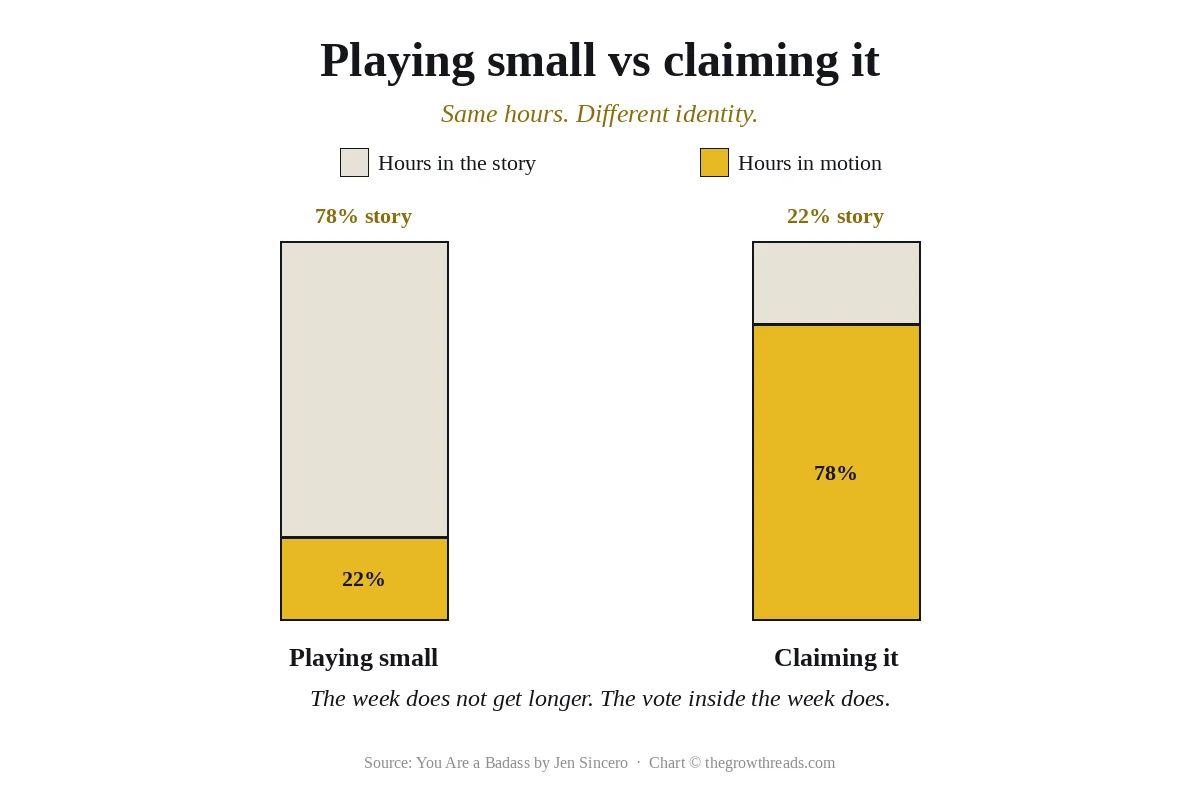
You do not need a new personality by Friday. You need a sentence on paper and one action that matches it before the week ends.
Key takeaways
- Self-love is a practice: Speak to yourself the way you would speak to a friend who is trying. Mean self-talk is not honesty. It is a habit.
- Stop arguing for your limitations: The story about why you cannot is often a well-rehearsed excuse that keeps you safe and stuck.
- Decide what you want, specifically: Vague hopes do not give the week a job. A picture a stranger could understand does.
- Thoughts are the room you live in: What you repeat, you rehearse. Change the rehearsal, then move your feet.
- Faith is an action, not a mood: Do the thing while you are still scared. Bravery is the send, not a feeling you wait for.
- Guard who you listen to: Comparison is an identity diet. Mute the feed that makes you smaller, on purpose.
- Receive without flinching: Compliments, money, and yeses count as practice. Joking them away is another form of playing small.
- Identity follows the reps: Act like the person who already has the life, in small public ways, until the story updates.
What is You Are a Badass about?
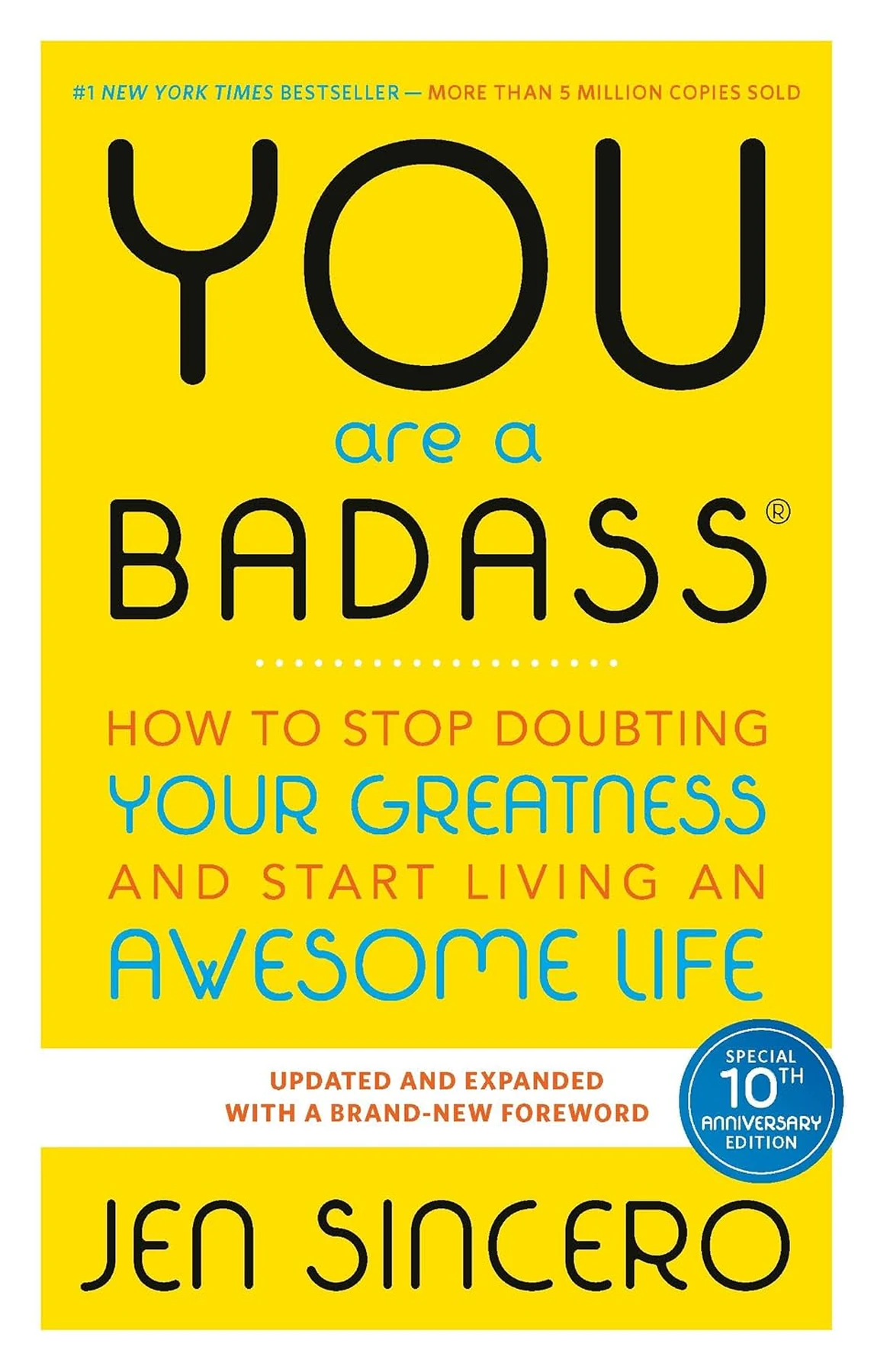
You Are a Badass is Jen Sincero’s practical system for leaving self-doubt: love yourself on purpose, decide a specific life, line your thoughts up with that life, and take the next visible action while you are still scared. It is a decision-and-action manual, not a calendar system and not a money book.
About the author
Jen Sincero is an American writer, speaker, and success coach who turned a broke freelance life into a blunt, funny voice that millions of readers actually finished. After years of undercharging and over-explaining, she studied mindset and wealth psychology, then wrote the book she had needed in the cheap apartment: You Are a Badass (2013), followed by You Are a Badass at Making Money and You Are a Badass Every Day. The tone is irreverent on purpose. Traditional self-help felt too polite; she wrote like a friend who will not let you stay small. The authority is not a lab. It is a public before-and-after plus a series that stayed on bestseller lists because people could use it the same afternoon. Explore all Jen Sincero book summaries →
Key concepts at a glance
| Concept | What it means | Use it when |
|---|---|---|
| Self-love as practice | Treat yourself like someone whose effort counts. | Your inner narrator is meaner than the work. |
| The old story | A rehearsed explanation for why you cannot. | You can recite the excuse faster than the plan. |
| A specific want | A picture a stranger could understand. | Your goals are vibes, not sentences. |
| Thoughts as rehearsal | What you repeat becomes the room you live in. | You spend the day narrating failure in advance. |
| Faith over fear | Action while the stomach is still tight. | You wait to feel brave before you send. |
| Input diet | Who you listen to shapes what feels possible. | The feed makes you smaller by lunch. |
| Receiving | Let the good thing land without a joke. | You deflect praise, money, or a yes. |
| Act like it | Small public reps of the new identity. | You only feel different in private journals. |
Part 1: Love yourself and drop the old story
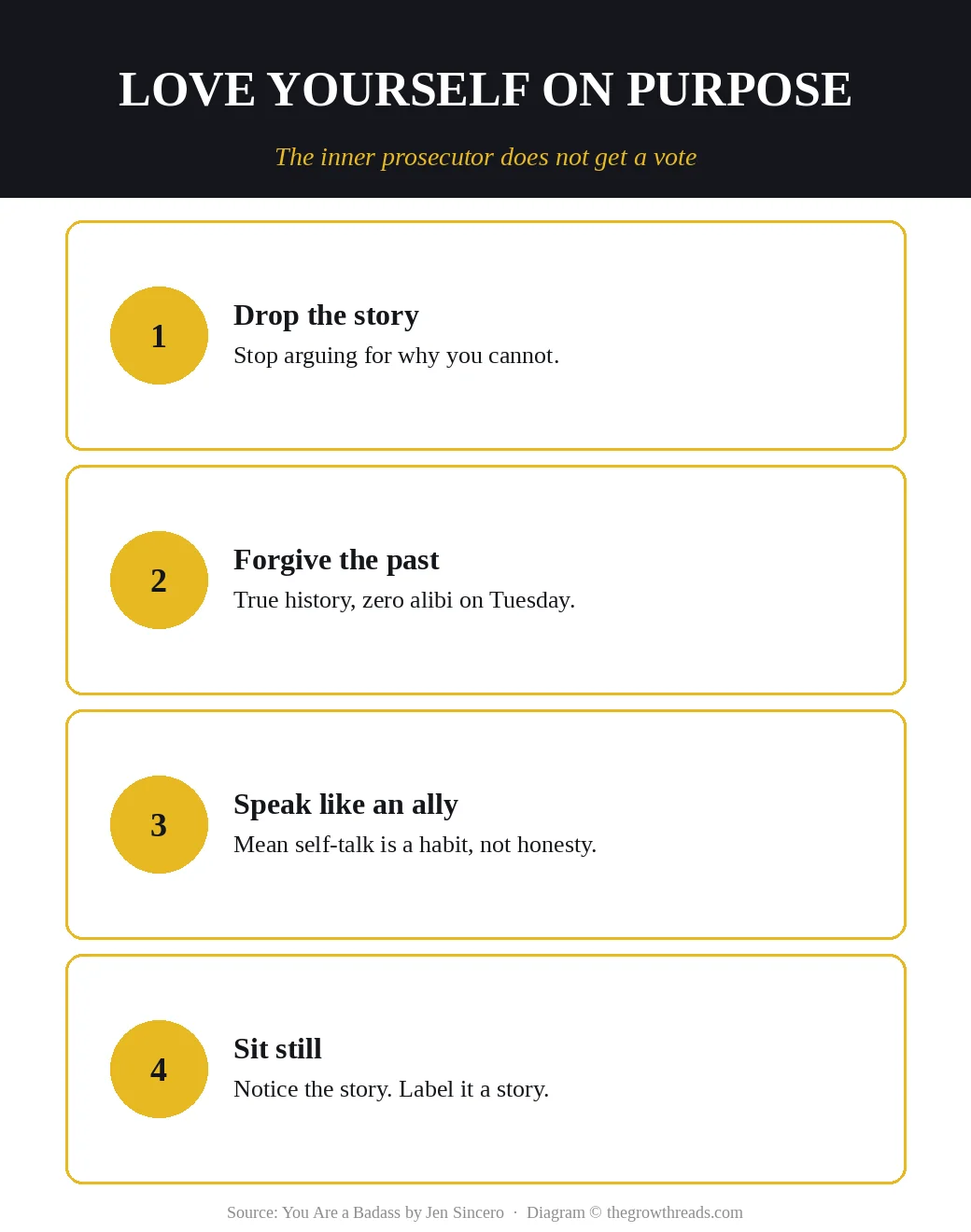
Sincero starts where most productivity books skip: the way you talk to the person doing the work. If the inner voice is a prosecutor, no calendar will save the week. Loving yourself is not a spa day. It is a practice of speaking like an ally while you still have unpaid invoices and a messy kitchen. Forgive the past enough that it stops being the alibi. The childhood, the failed launch, the partner who rolled their eyes — they can be true and still not get a vote on Tuesday’s email. Meditation shows up here as hygiene, not as a personality. Sit still long enough to notice the story, then label it as a story. That is the opening move.
The old story is usually a loyalty program. You stay small because small is known. Sincero’s shove is affectionate and rude at once: stop decorating the walls of the comfort zone with favorite excuses. You do not have to hate the old life. You have to stop arguing for it when a better one is already named. The first visible change is often language. “I could never” becomes “I have not yet.” That is not magic. It is a sentence you can practice before the next meeting.
TGR Note: If the inner prosecutor is the thing that keeps you from sitting down at all, The War of Art names Resistance. If the job is a smaller first step so the story has less to fight, Mini Habits shrinks the unit. Sincero is the ally in the chair before either of those books get a turn.
Part 2: Decide what you want and match the energy
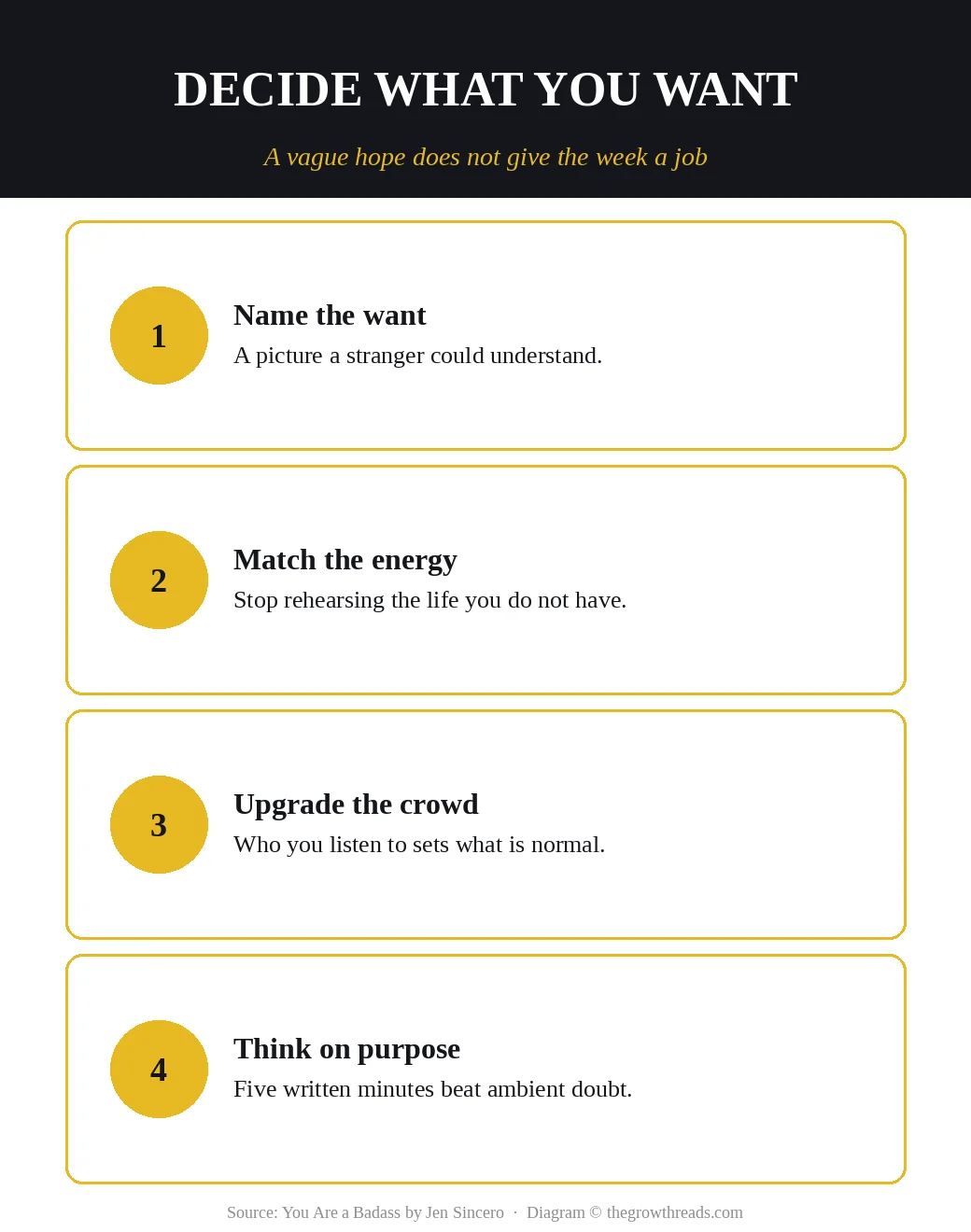
Vague wanting is how a year disappears. Sincero insists on a picture: money, city, body, work, love — specific enough that you would recognize it on a Tuesday. Then she asks you to match the frequency, which in TGR language is simpler: stop living all day in the thoughts of the person who does not have it. If you want the book deal, you do not spend the commute narrating why people like you do not get book deals. You spend it on the next page and on a sentence that assumes the page matters. Thoughts are rehearsal. Rehearsal is a room. Change rooms on purpose.
Two more levers sit next to the decision. Upgrade the crowd: who you listen to teaches you what is normal. Mute the feed that makes you feel behind. Sit nearer the people who already did the scary small yes. And think on purpose: a five-minute written intention beats a day of ambient doubt. This is the part of the book that mentions the Universe. Keep the behavior if the metaphor is not yours. Attention plus a calendar is the same physics, with fewer capital letters.
TGR Note: Once the want is a sentence, Atomic Habits is the cleaner install for cues and identity. If the want itself makes you flinch because good weeks feel unlike you, The Big Leap is the Upper Limit map. Sincero is the decision that has to happen before either system has something to serve.
Part 3: Faith over fear
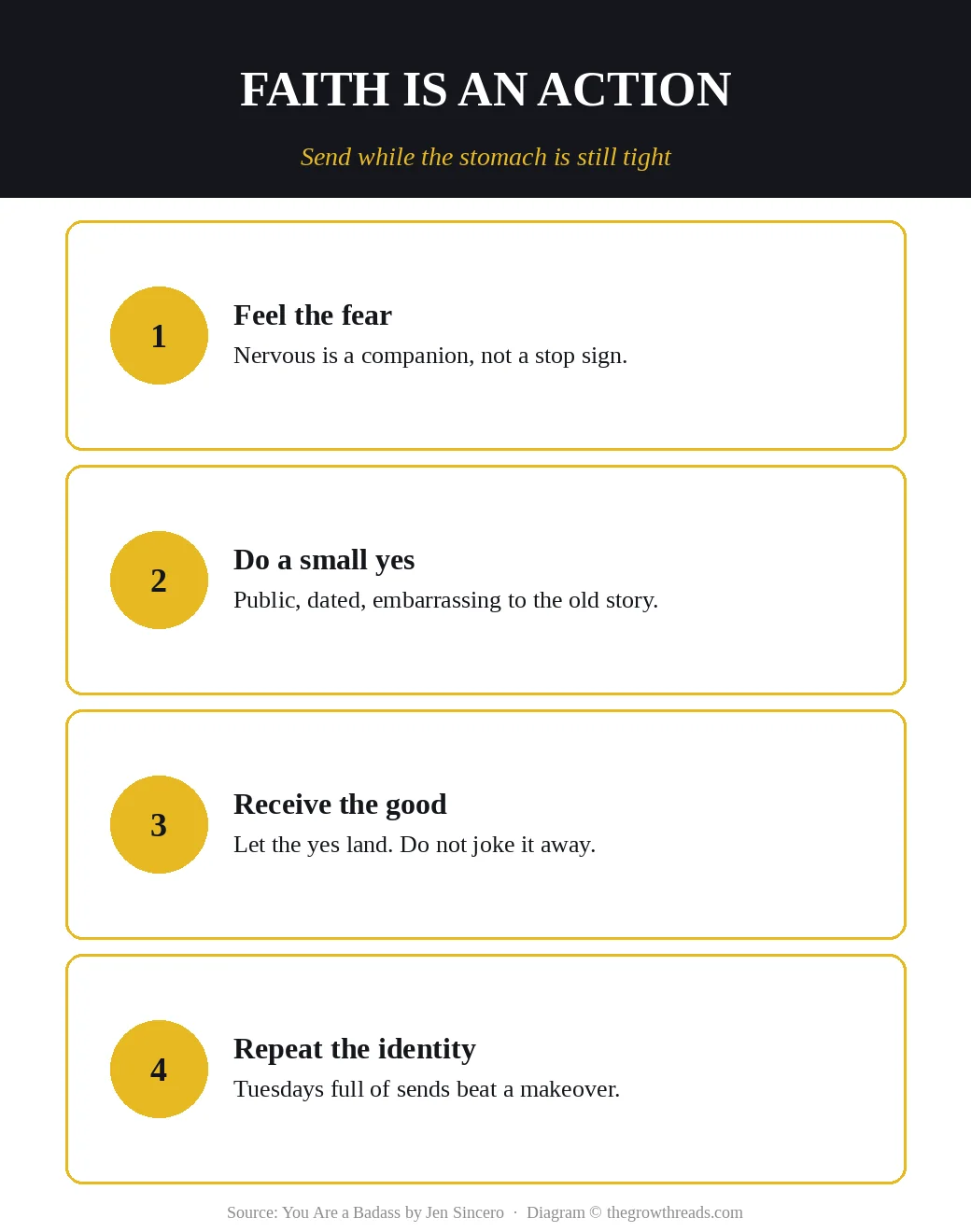
Fear, in this book, is not a stop sign. It is a companion you take to the appointment. Faith is sending the email while your hands are still cold. Sincero’s own stories are about asking, pricing, and showing up looking like someone who belongs in the room — not because the butterflies left, but because she went anyway. The useful test is public and small: a price you say out loud, a class you book, a stranger you ask. Private journaling about bravery does not count. The nervous system updates after the send, not before it.
This is also where the book gets honest about waiting. Waiting to feel ready is the old story wearing a productivity hat. A plan with no send date is a hiding place. Pick the smallest yes that would embarrass the old story, put it on a clock, and let the feeling catch up later. You will not think your way into a quiet stomach. You will act, then notice the volume drop because the hands were busy.
TGR Note: For changing your state on purpose before a hard ask, Unlimited Power is the older, more technical cousin. For thinking bigger without waiting for a new personality, The Magic of Thinking Big is the classic. Sincero is shorter, funnier, and more likely to get the email out this week.
Part 4: Act, receive, and stay in the new identity
Action without receiving is how people stay broke in the story even after the yes arrives. Sincero treats a compliment, a payment, a booked calendar as training. If you joke it away, you teach your nervous system that good things are unsafe. Write them down. Say thank you. Let the number sit in the account overnight without immediately discounting your work. That is not greed. It is keeping the vote you already won.
The close of the book is a loop, not a makeover. Decide. Commit. Act. Succeed. Repeat. Identity follows the reps: you become the person who sends, who prices, who walks into the room, because that is what your Tuesdays now contain. A garden of small public yeses beats one dramatic reinvention you will not maintain. If money is the remaining leak after the identity is willing, that is what You Are a Badass at Making Money is for. This original is the series start: stop doubting, then live like it, in motions a calendar can hold.
TGR Note: If the job after the decision is simply to keep showing up on dull Tuesdays, Keep Going is the verb manual. If the fear is creative more than personal, Big Magic lets fear ride in the car without driving. Sincero is the identity shove that makes those later books have somewhere to land.
Who is You Are a Badass best for — and who should read something else first?
Best for people who already know the next move and then talk themselves out of it: freelancers, career-switchers, makers, anyone whose narrator is meaner than the work. If you want a cue-and-habit install, start with Atomic Habits. If success itself makes you sabotage a good week, start with The Big Leap. If the leak is specifically income, go to You Are a Badass at Making Money.
Read something else first if you need a calendar, an inbox, or a deep-work protocol. Those are other books. If you will not sit down at all, read The War of Art. If you need a tiny first step so the story has less to fight, read Mini Habits. Come to Sincero when the stall is a story about who you are allowed to be.
Questions to reflect on
- What sentence do you keep using to explain why the life you want is not for people like you?
- If a stranger had to picture your want, what would they actually see on a Tuesday?
- Which feed, friend, or inner voice makes you smaller by lunch, and what would muting it for one work block look like?
- What is the smallest public yes you could send this week while you are still scared?
- When a compliment or a payment last arrived, did you keep it or joke it off the table?
🔥 Ready to stop playing small?
Name the want. Send the small yes. Repeat next Tuesday.
How to apply You Are a Badass (7-day plan)
- Day 1 — Write the want. One sentence: the life you actually want, specific enough that a stranger could picture it. Not “be happier.” A city, a rate, a book, a Tuesday that looks different. Put it where you will see it tomorrow morning.
- Day 2 — Catch the old story. When you hear “people like me don’t,” write the sentence down and finish it: “…and I am arguing for that because.” Do not debate it. Label it as a story. That is the whole job today.
- Day 3 — One ally sentence. Speak to yourself for one sitting the way you would speak to a friend who is trying. Write the ally version of yesterday’s story. Say it once out loud. Then do a ten-minute task the old story said you were not ready for.
- Day 4 — A scary small yes. Pick the smallest public action that matches Day 1: send the email, price the offer, book the class, ask the question. Do it while you are still nervous. The point is the send, not a feeling of bravery first.
- Day 5 — Guard the input. For one work block, mute the feed that makes you feel behind. Replace twenty minutes of comparison with twenty minutes on the want. Who you listen to is part of the identity, not a side hobby.
- Day 6 — Receive without flinching. If a compliment, a payment, or a yes arrives, say thank you and write it down. Do not joke it away. Practice keeping the good thing instead of shoving it off the table.
- Day 7 — Repeat the loop. Rewrite the want if it got clearer. Schedule three more small yeses on next week’s calendar. Grade the week on whether you acted, not on whether you felt like a new person yet.
Frequently asked questions
What is You Are a Badass about?
You Are a Badass is Jen Sincero’s 2013 field manual for dropping the story that you are not the kind of person who gets what you want. Love yourself on purpose, name a specific life, match your thoughts to that life, and take the next visible action while you are still scared. It is mindset work with a timer, not a personality transplant. The unit is a decision you can keep this week, not a new identity you wait to feel.
How long does it take to read You Are a Badass?
The Running Press paperback is 254 short, punchy pages, about four and a half hours for most readers. This summary is a twelve-minute pass: self-love, the decision, faith over fear, and a seven-day plan. If you only have lunch, write one sentence about the life you actually want and one action you can finish before Friday. Come back to the later chapters once that action is on a calendar, not once you feel ready.
Is You Are a Badass just positive thinking?
Sincero talks about thoughts, energy, and Source, and some readers hear that as vision-board spirituality. The usable core is more boring and more useful: the story you repeat becomes the room you live in, so you change the story and then you move your feet. Loving yourself is a practice, not a mood. Deciding is a sentence on paper. Faith is taking the call while your stomach is still tight. If a chapter feels too cosmic, keep the behavior and leave the metaphor.
How is You Are a Badass different from Atomic Habits or The Big Leap?
Atomic Habits is the cue-and-identity install: make the next action obvious and let the identity catch up. The Big Leap names the Upper Limit Problem — the moment you sabotage a good week because it feels unlike you. You Are a Badass sits in front of both. It is the permission and the decision: stop arguing for your limitations, pick a life, and act like the person who already has it. Read Clear when you need a cue. Read Hendricks when success itself makes you flinch. Read Sincero when the stall is a mean story about who you are.
Do I need You Are a Badass at Making Money first?
No. The money book is the sequel, filed in our Money silo, and it applies the same voice to income, pricing, and asking. Start here if the problem is self-doubt, playing small, or waiting to feel worthy before you try. Go to the money book if the mindset is already willing and the leak is specifically cash, rates, or a story that rich is dirty. This original is the series start. The money title is the specialist.
Who is You Are a Badass best for?
People who already know what they would do if they were braver, and then talk themselves out of it by Thursday. Freelancers, career-switchers, makers, and anyone whose inner narrator is meaner than the actual work. It is less useful if you want a calendar system, a GTD inbox, or a deep-work protocol. Those are other books. This one is for the identity fight that happens before the calendar even opens.
What should I do on day one with You Are a Badass?
Write one specific want in a sentence a stranger could understand, and one action that takes under thirty minutes. Put both on a sticky note. Do the action before you reread the book. Sincero’s loop is decide, commit, act, then notice you did not die. The first sitting is not a vision board. It is a visible move that matches the sentence, even if your voice still sounds unconvinced.
Related summaries
- The Big Leap — raise the cap when good weeks start to feel unlike you.
- Atomic Habits — turn the decision into a cue you can repeat.
- Unlimited Power — change your state before the hard ask.
- The Magic of Thinking Big — think at the size of the life, then act.
- Best productivity books — the full Productivity silo.
How we analyze books: every book on The Growth Reads is read cover to cover, summarized in thousands of words of original analysis, and rated against our five-criteria rubric (lasting impact, evidence quality, practical application, writing & originality, external consensus). Read our full methodology.