

★★★★½ 4.6/5 — A dancer’s field manual for turning creativity into a weekday practice you can start cold.
Best for: makers who wait to feel inspired before they sit down, then wonder why the room stays empty.
Reading time: ~5 hours (256 pages) · this guide ~12 min
Difficulty to apply: Moderate. The work is a start ritual plus one packed box, not copying Tharp’s gym hour.
The Creative Habit in one minute
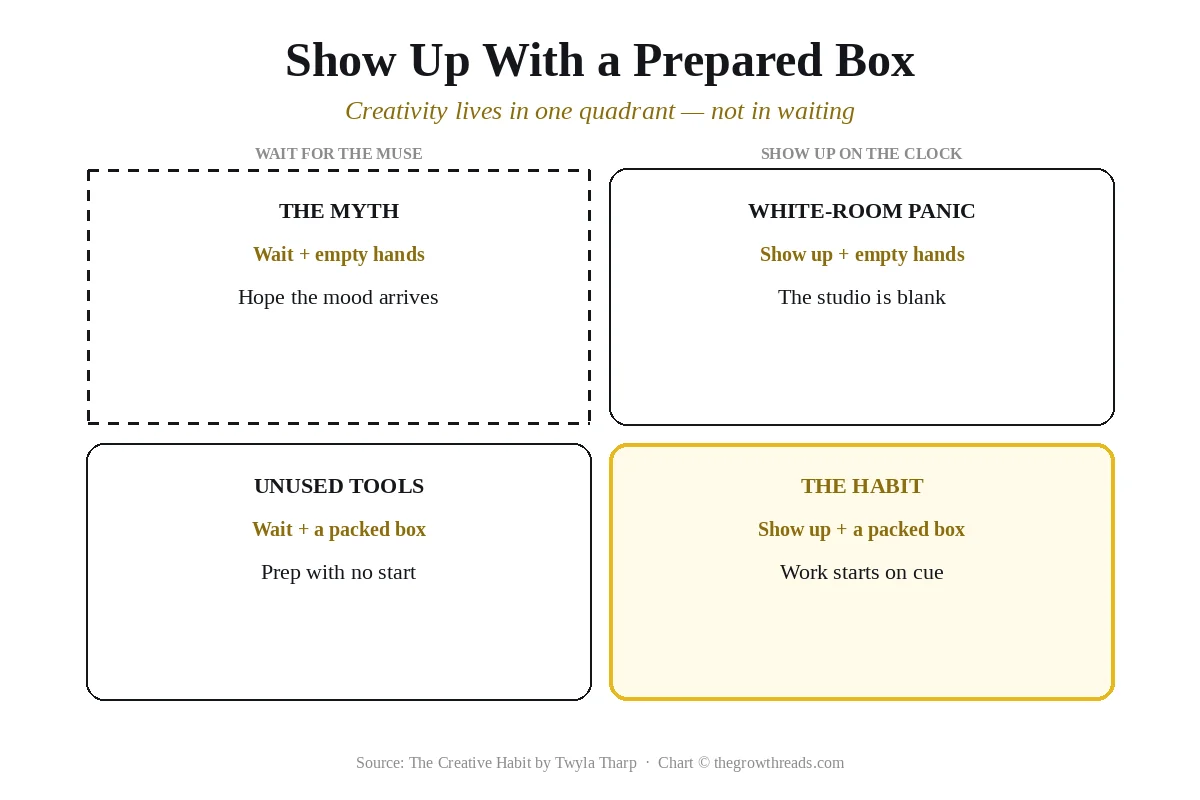
Creativity is not a mood you wait for. It is a habit you install — a repeated start, a packed box of tools, and a first move you can do while you still feel cold. Twyla Tharp has walked into empty studios for six decades. Her 2003 book is the operating system behind that walk: ritual so you do not negotiate the start, a literal box so the work does not begin with a scavenger hunt, scratching so material shows up before you demand a masterpiece, and a spine so the sitting has a job. The muse, in her telling, is what happens after you have already begun.
You do not need to choreograph. You need a white room — a page, a deck, a lab bench — and a way to enter it on a Tuesday. Pack the box tonight. Put a start time on tomorrow. Open the box before you ask whether you feel like it.
Key takeaways
- Ritual first: The start has to be automatic. Tharp’s yellow cab to the gym is the model: a cue so blunt you cannot argue with it at 5:30 a.m.
- Pack a box: One carton (or folder) per project. Tools in one place. You cannot think outside a box you never packed.
- Start cold: Warmth is the product of the sitting, not the ticket in. The white room is supposed to feel empty at minute one.
- Scratch before you commit: Gather fragments until one kernel keeps surviving.
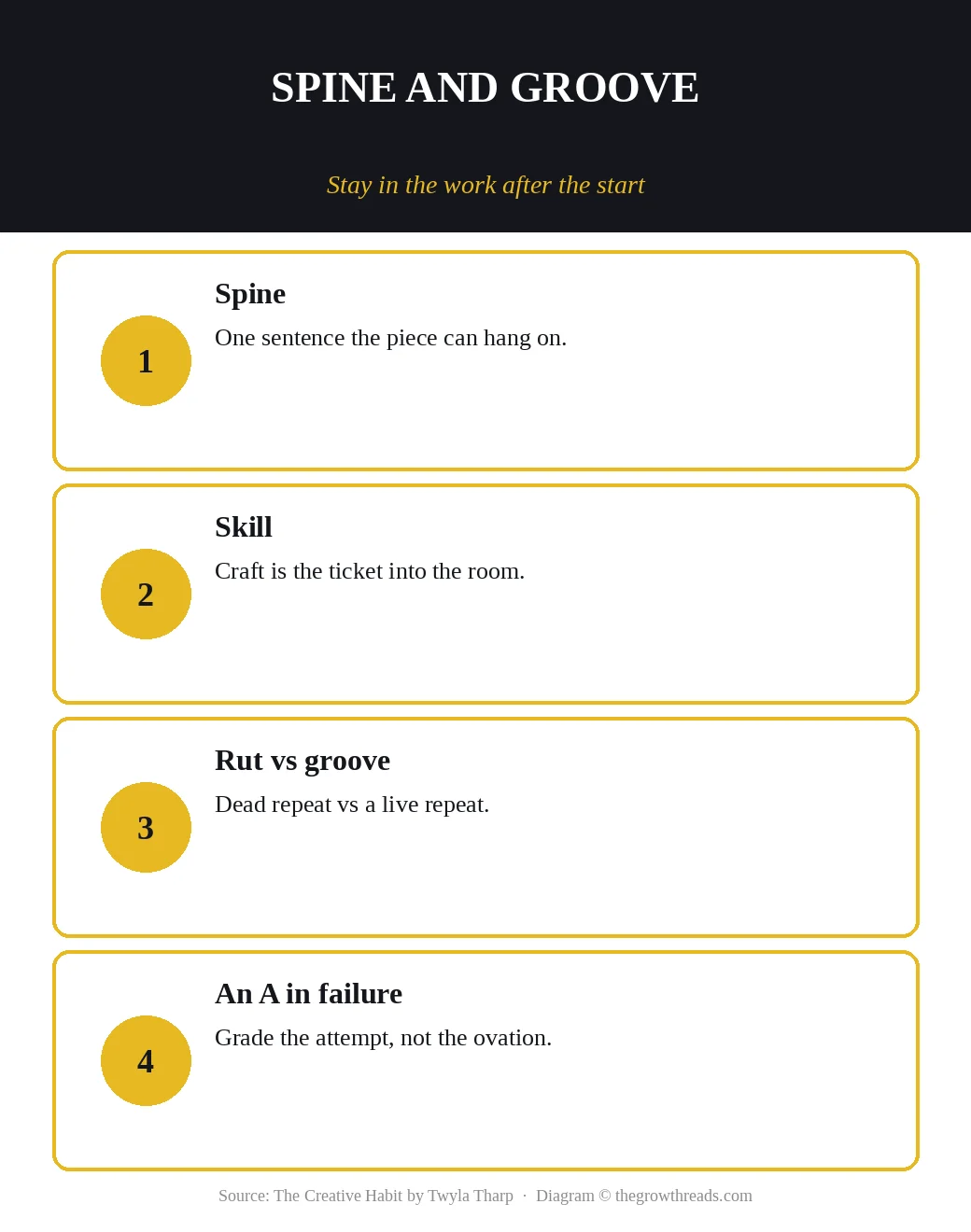
- Name a spine: One sentence the piece can hang on. If you cannot say it, you are still collecting.
- Skill is the ticket: Improvisation without craft is a stall with better lighting. Drill the move the piece needs.
- Rut versus groove: A dead repeat is a rut. A live repeat is a groove. Change the prompt or stay — but name which one you are in.
- An A in failure: Grade the attempt and the ritual, not the ovation. A sitting that ran still counts.
What is The Creative Habit about?
The Creative Habit is Twyla Tharp’s practical system for making original work on ordinary days: install a start ritual, pack a box of tools, scratch for material, name a spine, and stay in a groove instead of a rut. It is a studio manual, not a pep talk about talent.
About the author
Twyla Tharp was born in 1941 and built a life in the empty room. She founded Twyla Tharp Dance in 1965, made work for American Ballet Theatre, and took the same appetite for popular music onto Broadway with Movin’ Out. The through-line is not a brand of “genius.” It is decades of walking into a studio whether or not an idea was waiting. She wrote The Creative Habit in 2003 with Mark Reiter as a field guide for that walk, then kept writing about collaboration and longevity. The authority here is not a theorist of creativity. It is a practitioner who had to solve the white room on Monday mornings, on tour, and after the reviews were in. Explore all Twyla Tharp book summaries →
Key concepts at a glance
| Concept | What it means | Use it when |
|---|---|---|
| The ritual | A start so automatic you do not get a vote at the worst minute. | You renegotiate every morning whether today is a work day. |
| The box | One container of tools per project, ready before you sit. | The first twenty minutes are a scavenger hunt. |
| The white room | The empty studio is the job, not a sign you picked the wrong life. | Blankness feels like a verdict on your talent. |
| Scratching | Gathering fragments until one kernel wants a home. | You demand a finished idea before you will begin. |
| Creative DNA | Your default tempo, tools, and appetites — the instrument you have. | You keep copying someone else’s process and stalling. |
| Spine | One sentence the piece can hang on. | Every sitting becomes a new project in disguise. |
| Rut vs groove | A dead repeat versus a live one. | You are busy and nothing living is showing up. |
| An A in failure | Grade the attempt and the ritual, not the ovation. | One quiet sitting makes you want to quit the practice. |
Part 1: Walk into the white room — ritual and the box
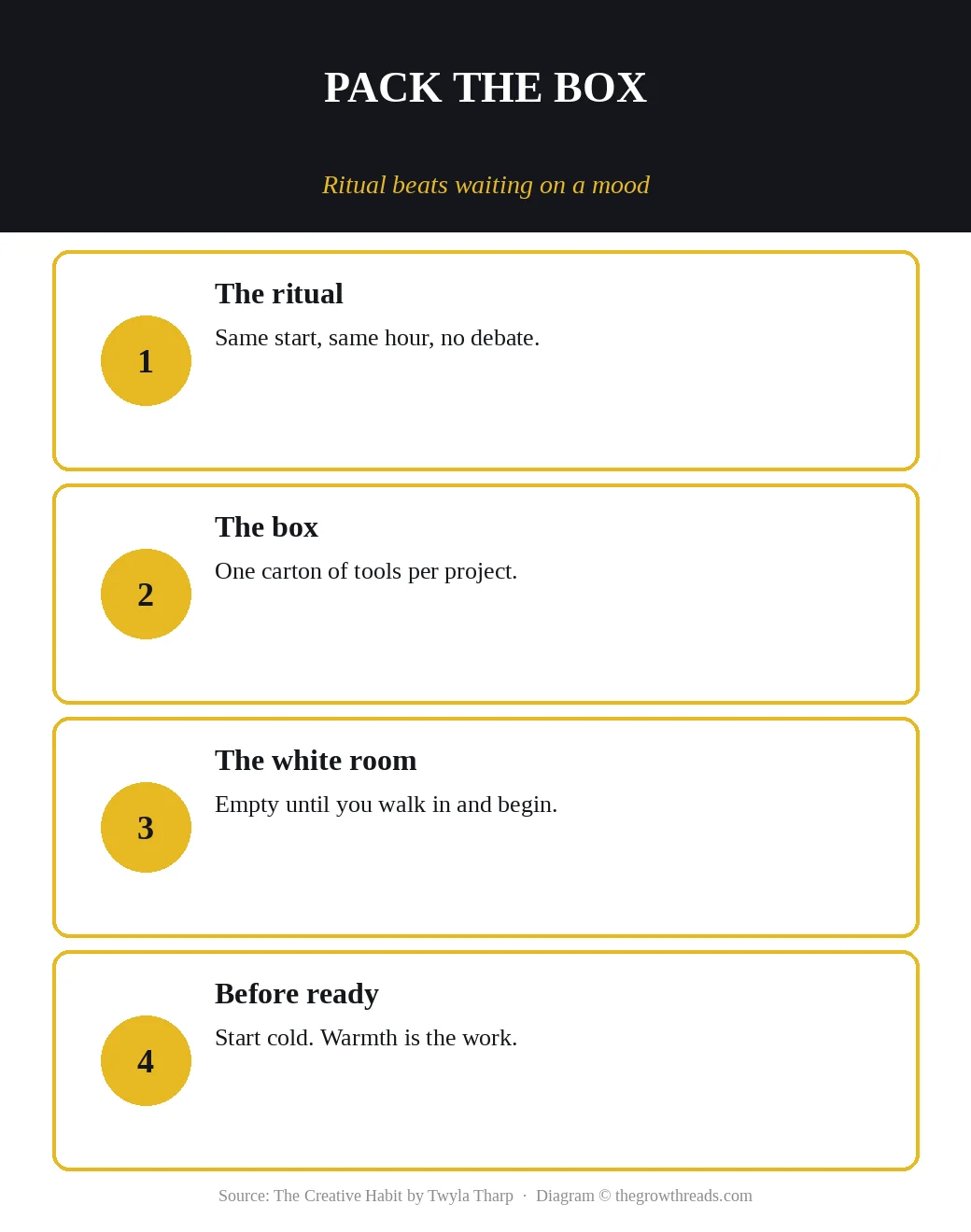
Tharp opens in an empty studio. No music, no dancers, no alibi. The white room is the condition of the work, not a glitch. People who wait to feel ready are waiting for the room to furnish itself. It will not. Her answer is a ritual so blunt it survives a bad night of sleep. For years that ritual was a yellow cab at dawn to the gym. The cab was not the workout. The cab was the decision, already made, so 5:30 a.m. did not get a debate. Steal the structure without stealing the hour: After I pour coffee, I open the box. The point is a cue you can trip over.
Then she packs a box. Literal cardboard. One per project. Tapes, notes, clippings, shoes, a book. When the box exists, beginning is not a scavenger hunt plus a mood. You sit, you open, you start. You cannot think outside a box you never packed. Digital work gets the same treatment — one folder, one document, one playlist — as long as “start” does not mean “search for twenty minutes.” If you need to feel warm before you will begin, you have made warmth a gate. Tharp starts cold. Heat is what the sitting produces. The white room is allowed to be empty at minute one. Your job is to walk in anyway.
TGR Note: If you want the cue-and-identity architecture under a ritual, Atomic Habits is the cleaner install. Tharp is what you do after the cue has put you in the chair: pack the room so the first twenty minutes are not a hunt. Daily Rituals is the sister catalog of start times, without her box.
Part 2: Scratching, memory, and creative DNA
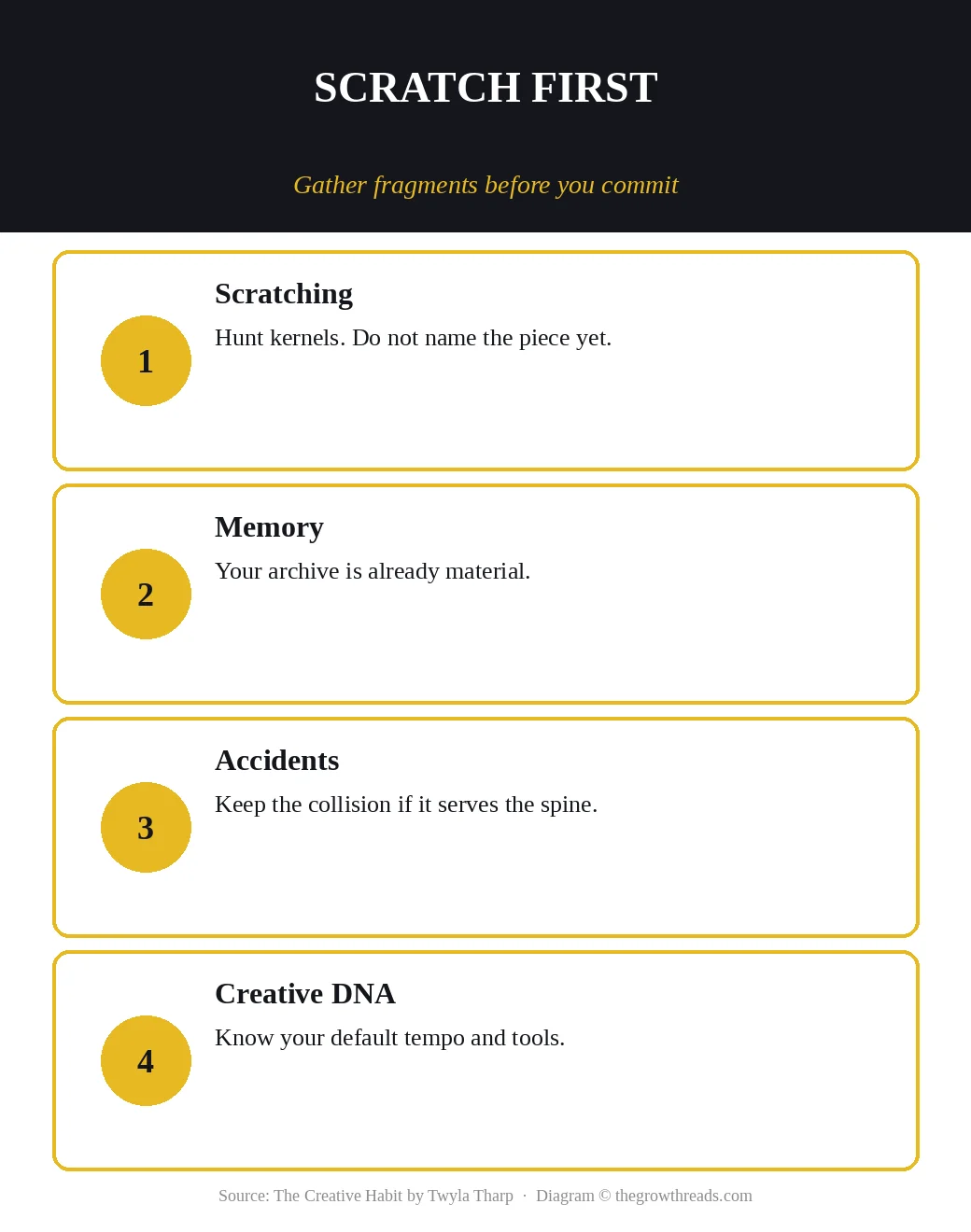
Once you are in the room, you still may have nothing. Tharp’s word for the hunt is scratching. A hen scratches dirt looking for a kernel. You scratch notebooks, other people’s work, a walk, a remembered argument, a clip you almost threw away. Scratching is not the piece. It is the middle between “I have nothing” and “I have a spine.” People who skip it try to leap from empty to elegant, then call the leap a talent problem. It is usually a gathering problem.
Memory is a scratch pile you already paid for. A fragment that still has heat next to today’s problem is useful; a memory that only describes the past is a diary entry. Creative DNA is the instrument you actually have: tempo, appetite, favorite tools. If you are a collector, collect on purpose for a sitting. If you are a reducer, start by cutting a bad page. DNA is not destiny. It is the default you stop fighting for the first ten minutes so the work can start. Accidents get a maybe, not an automatic yes: keep the collision if it gives you a kernel, throw it away if it is only novelty.
TGR Note: Scratching is cousin to Austin Kleon’s collect-then-transform loop in Steal Like an Artist. Kleon gives permission to take; Tharp gives a time box for the taking. If the freeze is moral — “I am not a creative person” — the Kelley brothers’ Creative Confidence is the identity thaw; come back here for the studio mechanics.
Part 3: Accidents, spine, and skill
The spine is the sentence the piece can hang on. Not a poster slogan. A load-bearing line: this dance is about a woman who will not leave the party; this chapter is about the first hour of a hard day. If you cannot say it, you are still scratching — allowed for a while, not forever. An endless scratch pile is how projects die of richness. Write the sentence. Put it in the box. Tomorrow’s sitting has to serve it or you have started a second project without admitting it.
Skill is the unfashionable chapter. Tharp has no patience for inspiration as a substitute for craft. The ticket into a room where accidents are useful is drills that look nothing like the premiere: a turn you can do tired, a paragraph typed while the sentence is still ugly. The muse prefers people who can do the move when she arrives. “An A in failure” means the attempt can pass even when the result does not. You ran the ritual, opened the box, served the spine. Take the data. Keep the ritual. The sitting still counts.
TGR Note: A spine is a creative cousin of a next action: one sentence that lets the rest of the sitting have a job. If you want the inner fight that shows up once the spine is named, The War of Art is the Resistance manual. If you want the craft hours that make improvisation legal, Peak and Talent Is Overrated are the deliberate-practice pair.
Part 4: Ruts, grooves, and the long run
A rut is a repeat with the life gone out of it: the same warm-up, the same kind of sentence, nothing living. A groove is also a repeat, but it still produces heat. The diagnosis is not “blow up your life.” It is “this gesture died — change the prompt, the tool, or the order.” Sometimes the fix is a new first exercise. Sometimes the spine is wrong and you pack a new box. Both beat waiting for a personality transplant.
The long run is the point. Tharp’s career is decades of pieces, some adored, some not, none of them available to a person who required a mood to enter the room. Longevity is a lot of Tuesdays. Ritual gets you through the door, the box removes the hunt, scratching fills the floor, the spine chooses, skill makes the choice executable, and the rut/groove test tells you whether to stay or swerve. None of that requires you to be Twyla Tharp. It requires a calendar and a container.
TGR Note: Rut versus groove is the same fork as process versus product in The Practicing Mind: stay with the live repeat, drop the dead one. Seth Godin’s The Practice is the shipping cousin — the habit of going to work, then letting the world see it in Show Your Work.
Who is The Creative Habit best for — and who should read something else first?
Best for people whose job includes a blank page and who keep waiting to feel like a creative person before they will sit down. Writers, designers, founders, teachers, researchers, anyone who has a white room and a talent for decorating the delay. If you already start on cue and need help shipping in public, go to Show Your Work. If the freeze is moral — “people like me don’t make things” — start with Creative Confidence, then come back for the studio mechanics.
Read something else first if the unit of work is still a fantasy novel. Bird by Bird shrinks the bird. Steal Like an Artist is the permission slip if “original” has you frozen. The War of Art is the book when you know the sitting and still will not enter. Tharp assumes you will walk in and then need something to do with your hands.
Questions to reflect on
- What is the yellow-cab version of your start — the cue you could not argue with on a bad morning?
- If you packed one box tonight, what would actually go in it, and what are you still pretending is “somewhere in the files”?
- Where are you demanding a finished idea before you will scratch for twenty minutes?
- Can you say the spine of your current piece in one sentence? If not, what are you still collecting?
- Looking at last week, were you in a rut or a groove — and what would a tiny swerve look like?
🔥 Ready to walk into the white room?
Pack one box tonight. Put a start time on tomorrow. Begin before you feel like it.
How to apply The Creative Habit (7-day plan)
- Day 1 — Pack one box. Pick the project you have been circling. Put its tools in one place: a carton, a folder, a bag. Notes, links, the book you keep meaning to use, the playlist, the ugly first file. When the box exists, the scavenger hunt is over. Do not add a second project.
- Day 2 — Install the start. Choose a time you can actually hit this week, not a fantasy 5:00 a.m. Write one sentence: After I [cue], I open the box and work for 25 minutes. Put it on the calendar. The ritual is the taxi to the gym — the part you do even when the work still feels cold.
- Day 3 — Scratch for twenty minutes. Do not try to finish a chapter or a dance. Collect fragments: five lines, three images, a remembered conversation, a bad idea you almost threw away. Stop at twenty minutes. Circle the one fragment you would be willing to see again tomorrow.
- Day 4 — Name the spine. Write one sentence the piece can hang on. If you cannot say it in a sentence, you are still scratching. Tape the sentence inside the box. Tomorrow’s sitting has to serve that sentence or it is a new project in disguise.
- Day 5 — Drill one skill. Pick the craft move this project actually needs — a transition, a chorus, a headline, a demo reel cut — and practice only that for one sitting. Tharp’s point is that inspiration does not replace skill. The drill is how you earn the right to improvise later.
- Day 6 — Rut or groove? Look at the last five sittings. If you repeated the same gesture and nothing living showed up, you are in a rut: change the prompt, the tool, or the order. If the repeat still produces heat, stay. Do not romanticize either state. Name it and pick the next move.
- Day 7 — Schedule the next four starts. Put four more start times on the coming week. Leave the box packed. Grade the week on whether you entered the room, not on whether the piece is good yet. An A in failure still counts if the ritual ran.
Frequently asked questions
What is The Creative Habit about?
It is Twyla Tharp’s 2003 field manual for treating creativity as a weekday practice. Waiting for a mood is a stall. A repeated start — ritual, a packed box, a first move you can do cold — is what produces work. The middle of the book shows how to scratch for material, name a spine, and stay out of a rut. You do not need to choreograph. You need a studio you can enter on an ordinary morning.
How long does it take to read The Creative Habit?
The Simon & Schuster paperback is 256 pages, about five hours for most readers. This summary is a twelve-minute pass: ritual, box, scratching, spine, and the rut-versus-groove test. If you only have a lunch break, read “I Walk into a White Room,” pack one box, and put a start time on tomorrow. The rest of the book is fuel for that first sitting.
Is The Creative Habit only for dancers and artists?
No. Tharp writes from the studio because that is her laboratory, but the moves are for anyone whose job includes a blank page: writers, designers, founders, teachers, researchers. The white room is a spreadsheet as easily as a rehearsal hall. If you delay the inventive part of a real job until you “feel like it,” this is the book that names the delay and replaces it with a start.
What is the box in The Creative Habit?
The box is a literal carton Tharp assigns to each project — notes, tapes, clippings, shoes, a book — so beginning is not a scavenger hunt. Metaphorically it is the prepared environment: one folder, one playlist, one open document. You cannot think outside a box you have never packed. The test: can you sit down and start in under two minutes because the tools are already in one place?
How is The Creative Habit different from The War of Art or Atomic Habits?
Steven Pressfield names Resistance — the force that keeps you from sitting down. James Clear names the cue-routine architecture that makes a practice automatic. Tharp names the studio: ritual, box, scratch, spine. Read Pressfield when you know the sitting and still will not enter. Read Clear when the habit has to survive a messy Tuesday. Read Tharp when the room is blank and you need a way to generate material once you are in it.
What does Twyla Tharp mean by scratching?
Scratching is gathering before you commit. A hen scratches dirt for a kernel; you scratch files, walks, notebooks, other people’s work, and memory for a fragment that wants a home. It is not the finished piece and it is not busywork. Stop when one fragment keeps surviving contact with the others. That survivor is usually the start of the spine, not a reason to collect forever.
Who should read something else before The Creative Habit?
If the goal is still a fantasy novel, read Bird by Bird and shrink the unit. If “original” means unused, read Steal Like an Artist and get permission to collect. If the day has no container, read Daily Rituals and steal a clock time, not a personality. Come back to Tharp when you have a slot and a surface and still freeze at the empty room. Her gift is the first twenty minutes after you arrive.
Related summaries
- Steal Like an Artist — collect, transform, and keep making on a schedule.
- The War of Art — name Resistance once you know the sitting.
- Daily Rituals — 161 start times, no two of them a moral personality.
- Atomic Habits — identity and cues under the ritual.
- Best productivity books — the full Productivity silo.
How we analyze books: every book on The Growth Reads is read cover to cover, summarized in thousands of words of original analysis, and rated against our five-criteria rubric (lasting impact, evidence quality, practical application, writing & originality, external consensus). Read our full methodology.