

⭐⭐⭐⭐⭐ 4.4 / 5 — A practical, science-backed guide to managing blood sugar with simple food hacks that reduce cravings, boost energy, and improve long-term health.
Best for: Anyone who experiences energy crashes, cravings, brain fog, or wants to improve metabolic health without restrictive dieting.
Reading time: ~5 hours (this guide: 14 min)
Difficulty to apply: Low — the hacks are simple, require no special equipment, and can be implemented one at a time starting today.
Glucose Revolution in one minute
Your energy crashes, cravings, brain fog, and afternoon fatigue are not character flaws — they are glucose spikes. Jessie Inchauspé, a biochemist who wears a continuous glucose monitor and has analyzed thousands of people’s glucose data, reveals that the order in which you eat foods matters more than what you eat. Eating fiber first, then protein and fats, then starches and sugars can reduce a meal’s glucose spike by up to 75% — without changing the meal itself. The book presents ten evidence-based “glucose hacks” that flatten blood sugar curves, reduce cravings, improve energy, clear skin, balance hormones, and lower the risk of chronic diseases including type 2 diabetes, heart disease, and PCOS. No calorie counting, no food elimination — just smarter sequencing.
Key takeaways
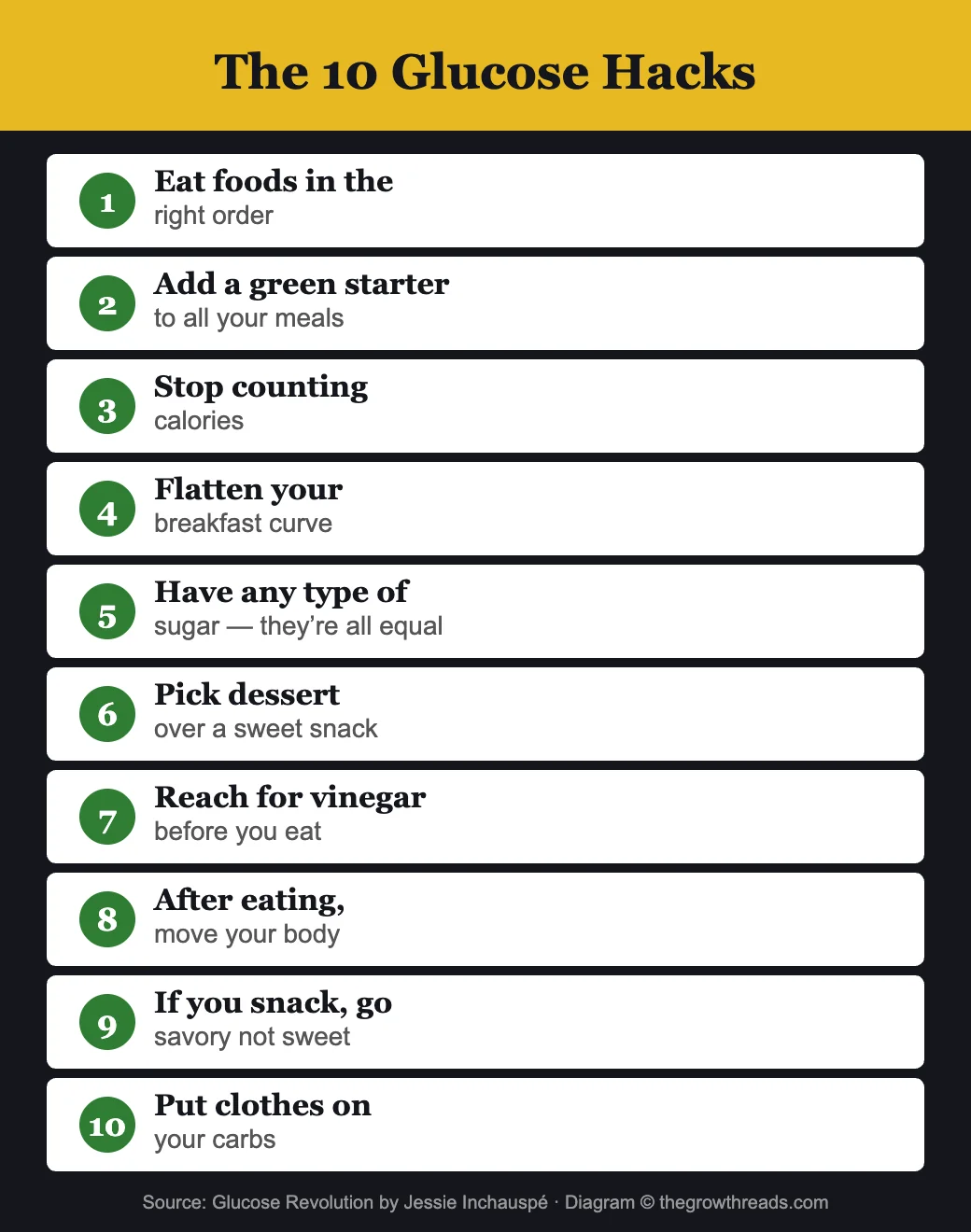
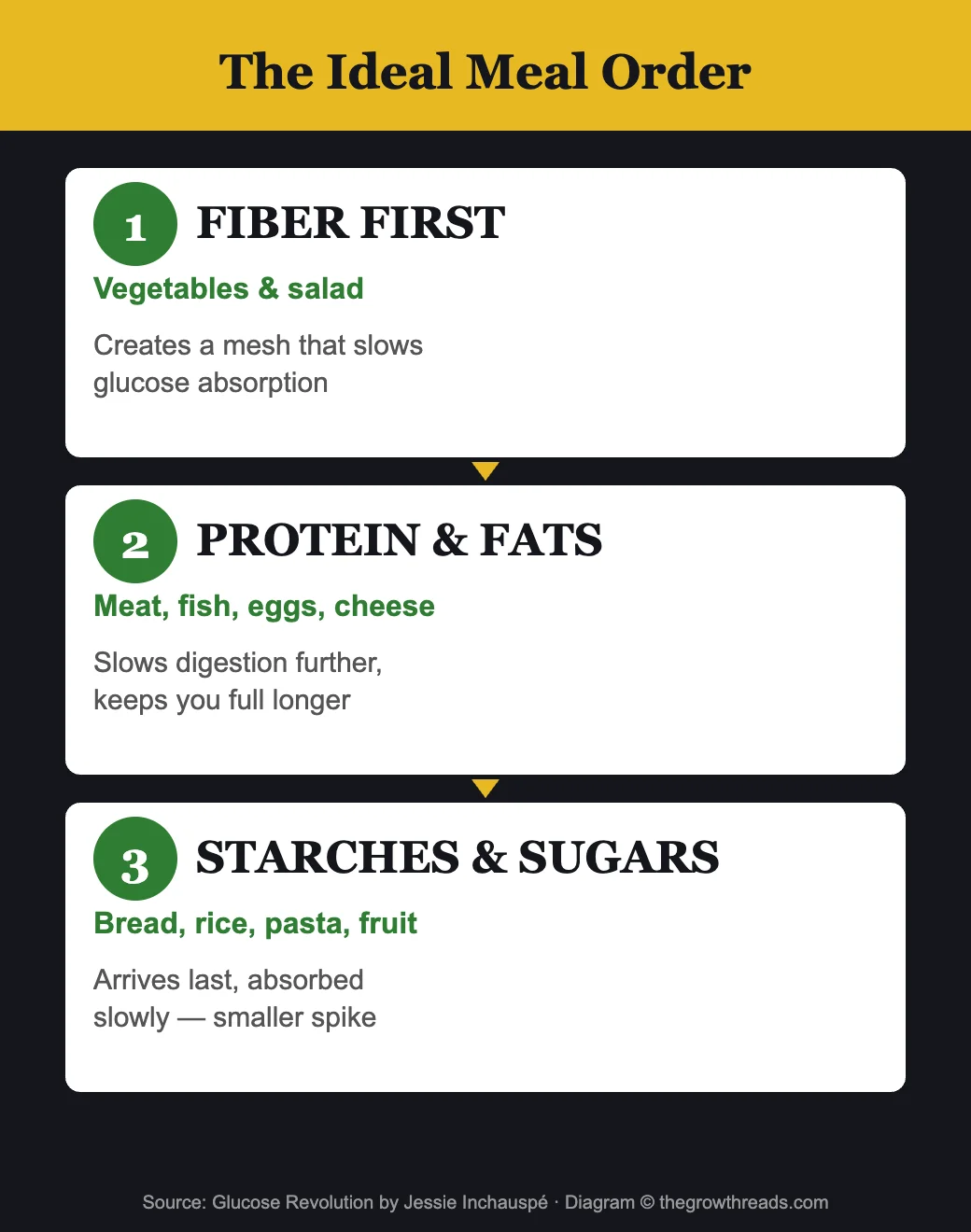
- Eat foods in the right order: Fiber first (vegetables, salad), then protein and fats, then starches and sugars last. This simple reordering can reduce a meal’s glucose spike by up to 75%.
- Start every meal with a green starter: A handful of spinach, a small salad, or some cucumber before your main course creates a fiber mesh in your intestine that slows glucose absorption.
- Flatten your breakfast curve: A savory breakfast (eggs, avocado, cheese) sets the metabolic tone for the entire day. Sweet breakfasts (cereal, juice, toast with jam) create a glucose rollercoaster.
- All sugars are biologically equal: Honey, agave, coconut sugar, and table sugar all cause similar glucose spikes. Marketing “healthy sugars” is misleading — manage the spike, not the source.
- Dessert beats sweet snacks: Eating something sweet after a full meal (when fiber, protein, and fat are already slowing digestion) causes a much smaller spike than eating the same sweet thing on an empty stomach.
- Vinegar is a glucose hack: One tablespoon of vinegar in a glass of water before a meal can reduce the glucose spike by up to 30% by slowing the enzyme that breaks down starch.
- Move after eating: Even a 10-minute walk after a meal uses the glucose in your bloodstream for energy instead of letting it spike and crash. Any movement works — cleaning, stairs, dancing.
- Put clothes on your carbs: Never eat starches or sugars “naked” (alone). Always pair them with fiber, protein, or fat to slow absorption. Bread with butter spikes less than bread alone.
- Savory snacks beat sweet ones: If you must snack, choose nuts, cheese, or hummus over fruit, granola bars, or cookies. Savory snacks maintain stable glucose.
- Stop counting calories: Glucose management is more effective than calorie restriction for weight management, energy, and health. Two meals with identical calories can have wildly different glucose effects.
What is Glucose Revolution about?
Glucose Revolution is a practical health guide that explains how blood sugar spikes affect your body and provides ten simple, science-backed hacks for flattening glucose curves. Jessie Inchauspé uses continuous glucose monitor data and biochemistry research to show that changing when and how you eat matters more than restricting what you eat.
About the author
Jessie Inchauspé is a French biochemist and author who studied mathematics at King’s College London and earned a master’s degree in biochemistry from Georgetown University. After a spinal injury in her teens led her to explore the connection between food and physical recovery, she became fascinated by glucose and its effects on the body. She founded the Glucose Goddess movement, an Instagram account with over four million followers where she shares glucose experiments, before-and-after glucose curves, and practical food hacks. Her work has been featured in the New York Times, Forbes, and The Times of London. Glucose Revolution, published in 2022, became an international bestseller translated into over 40 languages. Explore all Jessie Inchauspé book summaries →
Key concepts at a glance
| Concept | What it means | Use it when |
|---|---|---|
| Glucose Spike | A rapid rise in blood sugar after eating, followed by a crash | You feel tired, foggy, or hungry 2 hours after eating |
| Fiber First | Eat vegetables before starches to create a protective intestinal mesh | You sit down for any meal with carbohydrates |
| The Right Order | Fiber → Protein/Fat → Starches/Sugars | You want to reduce a meal’s glucose impact without changing the menu |
| Savory Breakfast | Protein and fat-based morning meals that flatten the daily glucose curve | You experience mid-morning energy crashes or cravings |
| Vinegar Hack | 1 tbsp vinegar in water before a meal reduces spikes by up to 30% | You’re about to eat a carb-heavy meal |
| Clothes on Carbs | Never eat starches alone — pair with fiber, protein, or fat | You’re reaching for bread, rice, pasta, or a sweet snack |
| Post-Meal Movement | 10 minutes of movement after eating uses glucose for energy | You feel the post-lunch slump coming on |
Part 1: Why glucose matters — the hidden cause of your symptoms
Inchauspé opens by explaining that glucose is not just a concern for diabetics — it affects every single person. When you eat, your blood sugar rises. How much it rises and how fast it comes back down determines how you feel for the next several hours and, over years, your risk of chronic disease.
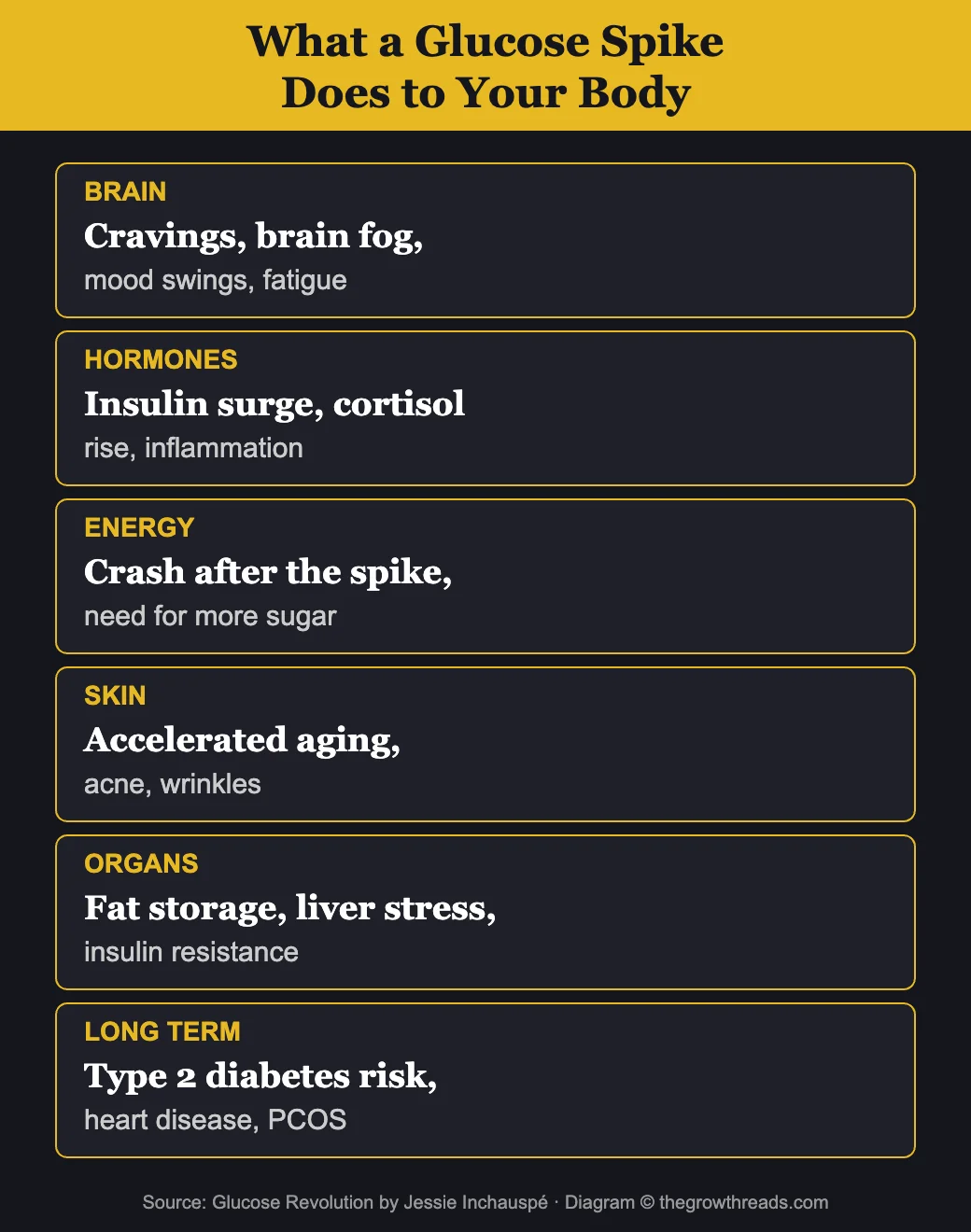
A glucose spike triggers a cascade of responses. Your pancreas floods your bloodstream with insulin to bring the glucose down, which often overshoots — causing a crash that makes you tired, irritable, and craving more sugar. Meanwhile, the excess glucose that insulin couldn’t store as glycogen gets converted to fat. Over time, repeated spikes lead to insulin resistance (your cells stop responding to insulin), which is the precursor to type 2 diabetes, heart disease, Alzheimer’s, and PCOS.
The author uses her continuous glucose monitor data to show that two people can eat the exact same meal and have wildly different glucose responses — and that the same person can eat the same foods in a different order and cut their spike dramatically. This is the core insight: it’s not just what you eat but how and when you eat it.
Inchauspé catalogs the symptoms of glucose spikes that most people accept as normal: afternoon energy crashes, constant hunger, brain fog, mood swings, poor sleep, acne, accelerated aging, and weight gain concentrated around the midsection. By flattening glucose curves, she argues, many of these symptoms resolve within days.
Part 2: The ten glucose hacks — simple changes, dramatic results
The heart of the book is ten practical hacks, each backed by clinical studies and illustrated with real glucose monitor data. The most powerful hack is food sequencing: eating the components of a meal in the right order (fiber first, then protein and fats, then starches and sugars) can reduce the resulting glucose spike by up to 75%.
The science is elegant: fiber from vegetables creates a physical mesh in the upper intestine that slows down the absorption of everything eaten afterward. Protein and fat trigger hormones that slow gastric emptying. By the time starches and sugars arrive, the digestive system is moving slowly enough to handle them without a dramatic spike.
The breakfast hack is equally transformative. Inchauspé shows that a sweet breakfast (cereal, orange juice, toast with jam) creates the worst possible glucose start to the day, setting up a rollercoaster of spikes and crashes that drive cravings until bedtime. A savory breakfast (eggs, avocado, cheese, vegetables) creates a flat, steady glucose curve that supports sustained energy and mental clarity for hours.
The vinegar hack has particularly strong evidence: acetic acid in vinegar inhibits alpha-amylase, the enzyme that breaks down starch into glucose. One tablespoon of any vinegar (apple cider, white wine, balsamic) in a tall glass of water before a starchy meal can reduce the glucose spike by up to 30%. The key is to drink it before eating, not during or after, and always dilute it to protect tooth enamel.
Part 3: The meal order revolution — fiber, protein, then carbs
Inchauspé dedicates an entire section to the meal order hack because it’s the single most impactful change most people can make. She presents continuous glucose monitor data from dozens of experiments showing the same meal eaten in different orders producing dramatically different glucose curves.
The “clothes on your carbs” principle is a practical extension: never eat starches or sugars “naked” (alone). Bread with olive oil and cheese spikes less than bread alone. Pasta with meat sauce spikes less than plain pasta. A cookie after a full meal spikes far less than the same cookie eaten as a standalone snack on an empty stomach. This means dessert after dinner is metabolically smarter than a sweet snack between meals.
The book addresses common objections directly. Does food order matter if everything gets mixed in your stomach anyway? Yes — studies show that the intestinal mesh created by fiber eaten first persists even after stomach mixing. Does this mean you can eat unlimited sugar if you eat it last? No — the hacks reduce spikes, not eliminate them. But they make every meal significantly less damaging without requiring you to give up any foods you enjoy.
Part 4: Beyond food — movement, sleep, and long-term health
The final section connects glucose management to broader health outcomes. Inchauspé presents research linking chronic glucose spikes to aging (through glycation, which damages collagen and elastin), hormonal imbalances (PCOS, thyroid issues, fertility challenges), mental health (anxiety, depression, and brain fog), and cardiovascular disease.
The post-meal movement hack is backed by studies showing that just 10 minutes of walking after eating can reduce the glucose spike by up to 30%. The mechanism is simple: working muscles pull glucose directly from the bloodstream for energy, reducing the amount that needs to be processed by insulin. Any movement works — walking, cleaning the kitchen, taking the stairs, even standing and pacing during a phone call.
Inchauspé also addresses the relationship between glucose and mental health. Stable glucose levels are associated with more stable moods, better focus, and reduced anxiety. Several studies she cites show that people who flatten their glucose curves report improved mental clarity and emotional regulation within the first week of implementing the hacks.
Who is Glucose Revolution best for — and who should read something else first?
This book is ideal for anyone who experiences energy crashes, cravings, or brain fog and wants a science-based approach that doesn’t involve restrictive dieting. It’s particularly valuable for people with PCOS, prediabetes, or insulin resistance, and for anyone interested in longevity and metabolic health. The hacks are so simple that even implementing one or two can produce noticeable results within days.
If you have diagnosed diabetes, this book is a helpful complement to medical treatment but should not replace your doctor’s guidance. For a broader dietary approach to disease prevention, start with How Not to Die. For understanding the role of sleep in metabolic health, Why We Sleep is the essential companion. For obesity specifically, The Obesity Code addresses the hormonal roots of weight gain.
Questions to reflect on
- What does your typical breakfast look like — and is it setting you up for an all-day glucose rollercoaster?
- When you experience an afternoon energy crash, what did you eat for lunch and in what order?
- How often do you eat starches or sugars “naked” — without fiber, protein, or fat to buffer the spike?
- Could a 10-minute post-meal walk become a non-negotiable daily habit?
- Which of the ten hacks would be easiest for you to implement this week — and what would you notice if your glucose stayed stable?
🔥 Ready to flatten your glucose curves?
Ten simple hacks to boost energy, reduce cravings, and improve your health — no dieting required.
How to apply Glucose Revolution (7-day plan)
- Day 1 — Audit your breakfast. Write down what you ate for breakfast and note your energy at 10 AM and noon. Tomorrow, switch to a savory breakfast and compare.
- Day 2 — Savory breakfast experiment. Eat eggs, avocado, or cheese for breakfast instead of cereal or toast with jam. Track your energy, hunger, and cravings until lunch.
- Day 3 — Try food sequencing. At lunch, eat your vegetables first, then your protein, then any starches or bread last. Notice if you feel different afterward.
- Day 4 — Add a green starter. Before dinner, eat a small salad or handful of raw vegetables. Then eat the rest of your meal normally. This alone can significantly reduce your glucose spike.
- Day 5 — The vinegar hack. Drink one tablespoon of vinegar in a tall glass of water 10-20 minutes before a carb-heavy meal. Note any difference in how you feel afterward.
- Day 6 — Walk after dinner. After your evening meal, take a 10-minute walk around the block. Pay attention to your evening energy and sleep quality.
- Day 7 — Put clothes on your carbs. For every starch or sugar you eat today, pair it with fiber, protein, or fat. Bread with butter, not alone. Fruit with nuts, not alone. Review how your energy felt this week compared to before.
Frequently asked questions
Does the order you eat food really matter for blood sugar?
Yes — clinical studies consistently show that eating fiber first, then protein and fats, then starches and sugars last can reduce the resulting glucose spike by 40-75% compared to eating the same foods in the opposite order. The mechanism is physical: fiber creates a mesh in the intestine that slows absorption, and protein/fat trigger hormones that slow gastric emptying. These effects persist even after food mixes in the stomach.
Is apple cider vinegar actually effective for blood sugar?
Yes — the acetic acid in vinegar inhibits alpha-amylase, the enzyme that breaks down starch into glucose. Studies show that one tablespoon of any vinegar (apple cider, white wine, balsamic) diluted in water before a starchy meal can reduce the glucose spike by up to 30%. Always dilute it in a tall glass of water to protect tooth enamel, and drink it before the meal, not during or after.
What is the best breakfast for stable blood sugar?
A savory, protein-rich breakfast is ideal: eggs (any style), avocado, cheese, nuts, smoked salmon, Greek yogurt with nuts (not granola), or leftovers from dinner. The worst breakfasts for glucose are sweet ones: cereal with milk, orange juice, toast with jam, smoothie bowls with honey, and sweetened oatmeal. A sweet breakfast creates a glucose spike and crash that drives cravings for the rest of the day.
Do I need a continuous glucose monitor to benefit from this book?
No — a continuous glucose monitor is not necessary. Inchauspé used one for her research, but the ten hacks work whether or not you can see your glucose data in real time. Most people notice improvements in energy, cravings, and mental clarity within the first week of implementing the hacks, which is feedback enough. CGMs can be helpful for experimentation but are not required to get results.
Can these hacks help with weight loss?
Yes, indirectly. Flattening glucose curves reduces insulin spikes, and insulin is the primary fat-storage hormone. When insulin stays low, your body can access stored fat for energy more easily. Additionally, stable glucose eliminates the cravings and hunger that drive overeating. Many readers report gradual weight loss — especially around the midsection — without counting calories or restricting food groups.
Is honey or coconut sugar better than regular sugar?
From a glucose perspective, no. Inchauspé shows that honey, agave, coconut sugar, maple syrup, and table sugar all cause similar glucose spikes. The marketing of “natural” or “healthy” sugars is misleading — your body processes them almost identically. The better strategy is not to find a “healthier” sugar but to manage when and how you consume any sugar: after fiber and protein, never on an empty stomach.
How long does it take to read Glucose Revolution?
The book is approximately 304 pages and takes about 5 hours to read. Inchauspé writes in an accessible, engaging style with plenty of before-and-after glucose curves, food photos, and practical examples. The audiobook runs about 6.5 hours. Many readers finish it in two sittings and start implementing the hacks immediately — the advice is that actionable.
Related summaries
If you enjoyed this summary, explore more from our best health books collection:
- How Not to Die Summary — the evidence for plant-based nutrition in preventing chronic disease.
- The Obesity Code Summary — why insulin, not calories, drives weight gain.
- Why We Sleep Summary — how sleep quality affects blood sugar and metabolic health.
- Lifespan Summary — the science of aging and how metabolic health extends your healthspan.
Related Health Summaries
Food Fix Summary & Review: How to Save Health and Planet One Bite at a Time
Immune Summary & Review: A Visual Tour of Your Body’s Hidden Defense System
The Blue Zones Summary & Review: 9 Lessons From the World’s Longest-Lived People
The Hungry Brain Summary & Review: Why Your Brain, Not Your Willpower, Decides What You Eat
The Plant Paradox Summary & Review: Are “Healthy” Foods Making You Sick?