

⭐⭐⭐⭐⭐ 4.6/5 — The clearest neuroscience explanation yet for why “just eat less” doesn’t work, and what actually helps.
Best for: Anyone who has tried willpower-based dieting and wants to understand the biology behind cravings and overeating.
Reading time: ~9 min guide (book: ~7 hrs)
Difficulty to apply: Moderate — the ideas are simple, but they call for changing your food environment, not just your intentions.
The Hungry Brain in one minute
You don’t overeat because you lack willpower — you overeat because your brain is doing exactly what it evolved to do. Neuroscientist Stephan Guyenet spent over a decade studying the hypothalamus and reward circuits that regulate hunger, and in The Hungry Brain he lays out, in plain language, how those circuits decide when you start eating, when you stop, and how much you crave in between. The modern food environment — hyperpalatable, engineered, and endlessly available — exploits reward pathways that never evolved to handle it. The fix isn’t more discipline. It’s redesigning the environment your brain reacts to, so the easy choice and the healthy choice become the same choice.
Key takeaways
- Appetite is a brain circuit, not a character trait: The hypothalamus integrates hormonal and sensory signals to set how much you eat, mostly below conscious awareness.
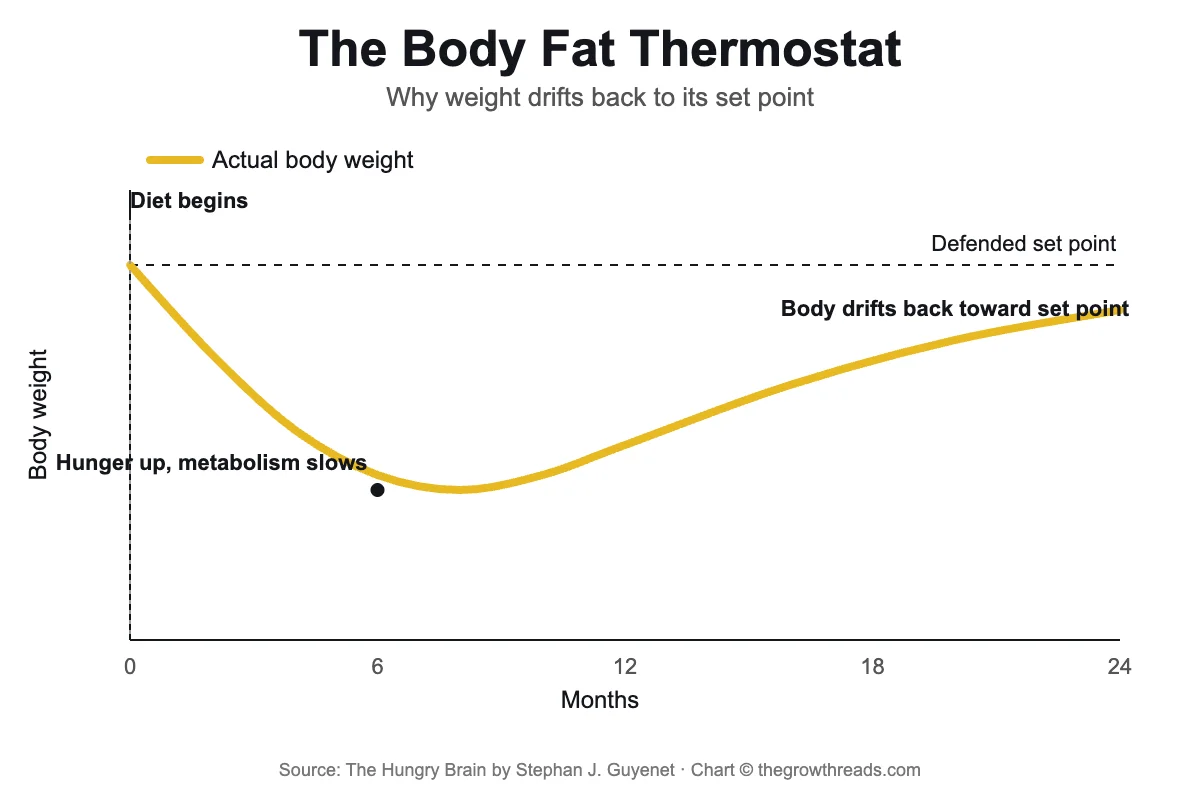
- Your body defends a fat “set point”: Weight loss triggers hunger increases and metabolic slowdowns designed to pull you back toward a defended range.
- Hyperpalatable combinations override fullness: Sugar-plus-fat and salt-plus-fat-plus-carb hit the brain’s reward system harder than any whole food alone.
- Variety increases intake: A table of different flavors makes you keep eating past comfortable fullness — the “buffet effect.”
- Food companies engineer the “bliss point”: Formulators optimize sweetness, fat, and crunch specifically to maximize reward, not nutrition.
- Diets fail for biological, not moral, reasons: The brain interprets significant fat loss as a threat and actively works to reverse it.
- Sleep and stress shift appetite upward: Poor sleep and elevated cortisol both increase food-seeking behavior independent of hunger.
- Protein and fiber blunt reward-driven eating: Meals that start with protein and fiber create satiety signals that compete with reward cues.
- Environment beats willpower: Removing hyperpalatable food from easy reach changes behavior more reliably than resolve alone.
- Small, repeatable routines outperform dramatic diets: Low-variety, whole-food meals sustain results long after short intense diets rebound.
What is The Hungry Brain about?
The Hungry Brain (2017) is neuroscientist Stephan Guyenet’s explanation of why people overeat in the modern food environment. It shows how the hypothalamus and dopamine reward circuits — not conscious choice — regulate appetite, and how engineered, hyperpalatable food overrides those systems, making lasting weight control a matter of environment design rather than willpower.
About the author
Stephan J. Guyenet, PhD, is a neuroscientist who spent over a decade researching the brain circuits that control appetite and body fatness, including postdoctoral research at the University of Washington. Long before writing a book, he built a following through his blog, Whole Health Source, translating dense neuroscience and nutrition research for a general audience. That work became the foundation for The Hungry Brain, published in 2017 to wide acclaim from scientists and health writers alike. Guyenet has since consulted on nutrition science and continues to write and speak about the biology of eating behavior, consistently arguing that food environment — not willpower — is the real lever for lasting change. Explore all Stephan J. Guyenet book summaries →
Key concepts at a glance
| Concept | What it means | Use it when |
|---|---|---|
| Set point | The body-fat level your brain actively defends via hunger and metabolism | Explaining why weight often rebounds after a diet |
| Hyperpalatable food | Sugar+fat or salt+fat+carb combinations engineered for maximum reward | Auditing why certain foods feel impossible to moderate |
| Food reward | The dopamine-driven “wanting” that can override fullness signals | Understanding cravings that hit even when you’re not hungry |
| Bliss point | The food-industry term for the taste intensity that maximizes craving | Reading a nutrition label with a more skeptical eye |
| Sensory-specific satiety | Fullness for one flavor doesn’t reduce appetite for a different one | Explaining why there’s “always room for dessert” |
| Leptin resistance | When the brain stops responding properly to the hormone that signals fullness | Understanding why hunger regulation gets harder over time with obesity |
| Food environment design | Deliberately shaping what’s available, visible, and convenient at home | Building a plan that doesn’t rely on willpower alone |
Part 1: How Your Brain Decides When to Eat
Guyenet opens by dismantling a common assumption: that eating is mostly a conscious decision, guided by hunger you can feel and willpower you can summon. Decades of neuroscience say otherwise. Deep in the brain, the hypothalamus runs a set of circuits that integrate signals from the gut, fat tissue, and bloodstream — hormones like leptin and insulin, nutrient levels, even the sight and smell of food — and use them to set an automatic, largely subconscious appetite level. Classic experiments make the mechanism vivid: rats with damage to a specific hypothalamic region will eat until obese, not because they’ve lost self-control, but because the circuit that tells them “enough” has been physically disrupted.
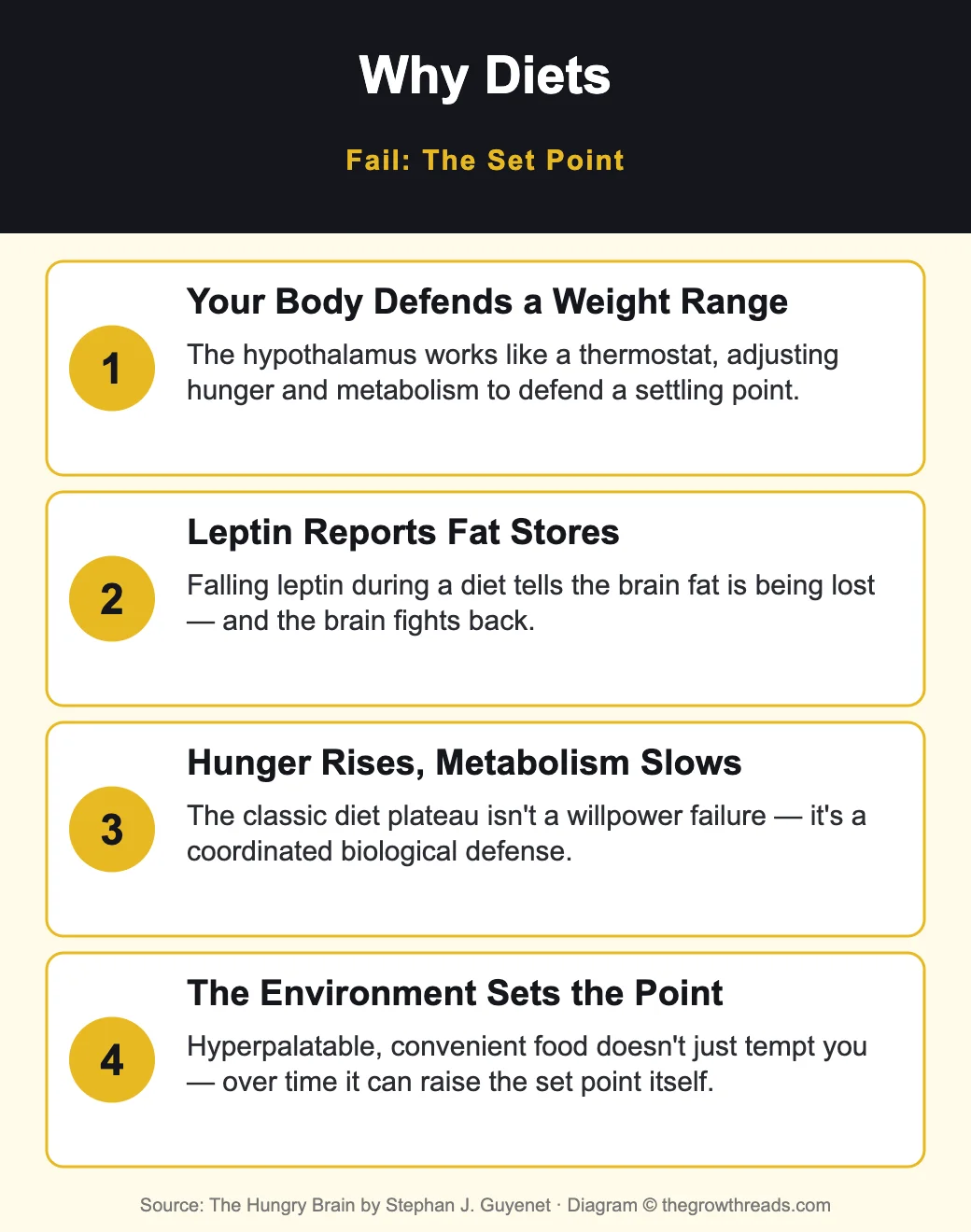
Guyenet calls the overall system a kind of settling mechanism — sometimes described as a “lipostat,” modeled loosely on a thermostat for body fat. It doesn’t aim for a single fixed number so much as a range it will actively defend, adjusting hunger and energy expenditure to pull you back if you drift too far in either direction. This single idea reframes most of what follows in the book: if appetite is regulated by a defended system rather than a moral failing, then lasting change has to work with that system, not against it through sheer resolve.
TGR Note: Gary Taubes reaches a related but distinct conclusion in Why We Get Fat, focusing specifically on insulin’s role in fat storage. Guyenet’s hypothalamic model is broader — insulin is one input among many the brain weighs, not the sole driver of body fatness.
Guyenet is careful to distinguish this from strict genetic determinism. The set point isn’t a single fixed number stamped in at birth — it responds to environment over months and years, which is both the bad news and the good news. It’s bad news because a long stretch in a hyperpalatable, low-effort food environment can gradually raise the defended range. It’s good news because the same plasticity means a sustained change in environment can move it back down, just slowly, and rarely in a straight line.
Part 2: The Food Environment That Broke the System
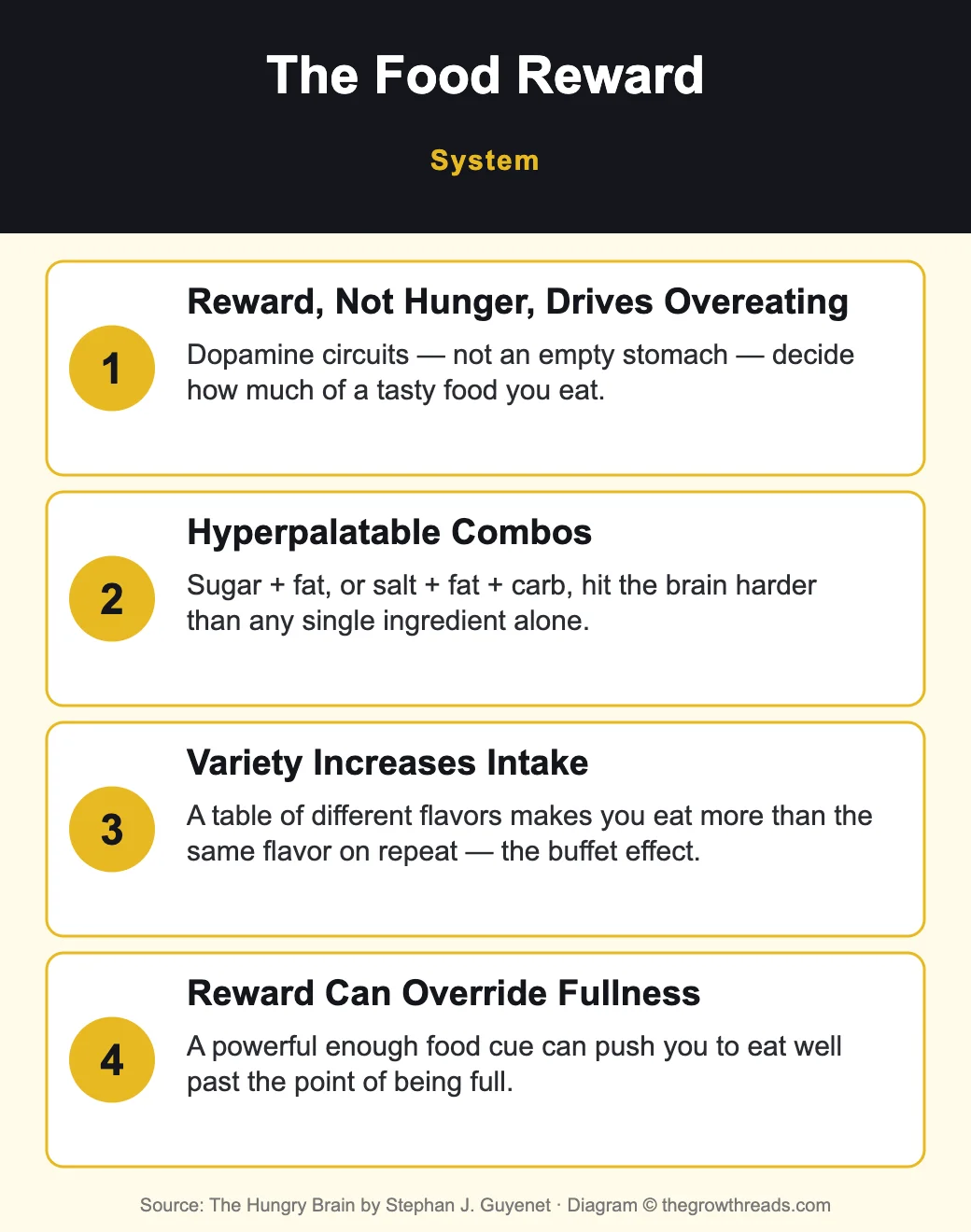
If the hypothalamus evolved to manage appetite in a world of scarce, unprocessed food, it was never built for the environment most people eat in today. Guyenet traces how food manufacturing shifted over the twentieth century toward products engineered specifically to maximize palatability — what industry researchers themselves call the “bliss point”: the precise combination of sugar, fat, salt, and texture that produces the strongest reward response without triggering the sensory boredom that would make you stop eating.
Two mechanisms do most of the damage. First, hyperpalatable combinations — sugar paired with fat, or salt and fat paired with refined carbohydrate — rarely occur in nature, but they dominate processed food, and they trigger dopamine responses that whole foods simply can’t match. Second, variety itself increases intake: a dinner plate with several different flavors keeps the reward system engaged well past the point where a single flavor would have triggered sensory-specific satiety, the phenomenon behind “always having room” for a different-tasting dessert. Guyenet is careful not to frame this as a conspiracy so much as a predictable outcome of competitive food markets optimizing for what sells — which happens to be exactly what overrides the brain’s natural stopping signals.
He also draws a useful distinction between homeostatic eating — driven by genuine energy need — and hedonic eating, driven by reward alone. Most people can tell the difference in principle (finishing a satisfying meal versus reaching for ice cream twenty minutes later while full), but the two systems physically overlap in the brain, which is exactly why “I’m not even hungry” rarely stops the reaching. Recognizing which system is firing in a given moment is, in Guyenet’s framing, the first step toward doing anything useful about it.
TGR Note: Michael Moss documents the industry side of this same story in Salt Sugar Fat, showing how food companies systematically optimized products for the bliss point Guyenet describes at the neuroscience level.
Part 3: Why Willpower Loses to Biology
This is where The Hungry Brain earns its most practical insight: diets don’t usually fail because people give up, they fail because the body actively resists them. Guyenet walks through the biology of the “starvation response” — as fat mass drops, leptin falls, hunger hormones rise, and resting metabolic rate slows down, all coordinated by the same hypothalamic circuits from Part 1, now working to restore the defended set point. The pattern shows up clearly in tracked weight-loss competitions, where large, rapid losses are followed by metabolic suppression that persists long after the diet ends, making the regained weight feel almost inevitable rather than a personal failure.
The uncomfortable implication is that calorie-counting alone, without addressing the food environment that keeps triggering reward-driven eating, is fighting biology with willpower — a contest willpower usually loses over a long enough timeline. Guyenet doesn’t conclude that weight management is hopeless; he concludes that the leverage point is upstream of willpower entirely.
Guyenet points to controlled ward studies — where researchers can measure total daily energy expenditure with precision — showing that resting metabolic rate can drop well beyond what reduced body size alone would predict, a phenomenon sometimes called adaptive thermogenesis. Combined with rising hunger hormones, the net effect is a body working on two fronts at once to close the gap. He’s candid that this makes large, rapid weight loss especially fragile, and that the psychological toll of repeated “failed” diets is itself a cost worth weighing before choosing an aggressive approach over a slower, more sustainable one.
TGR Note: How Not to Diet reviews a wider range of clinical evidence on weight-loss maintenance; read alongside Guyenet’s set-point mechanism, it reinforces that consistency of environment matters more than intensity of effort.
Part 4: Working With Your Brain, Not Against It
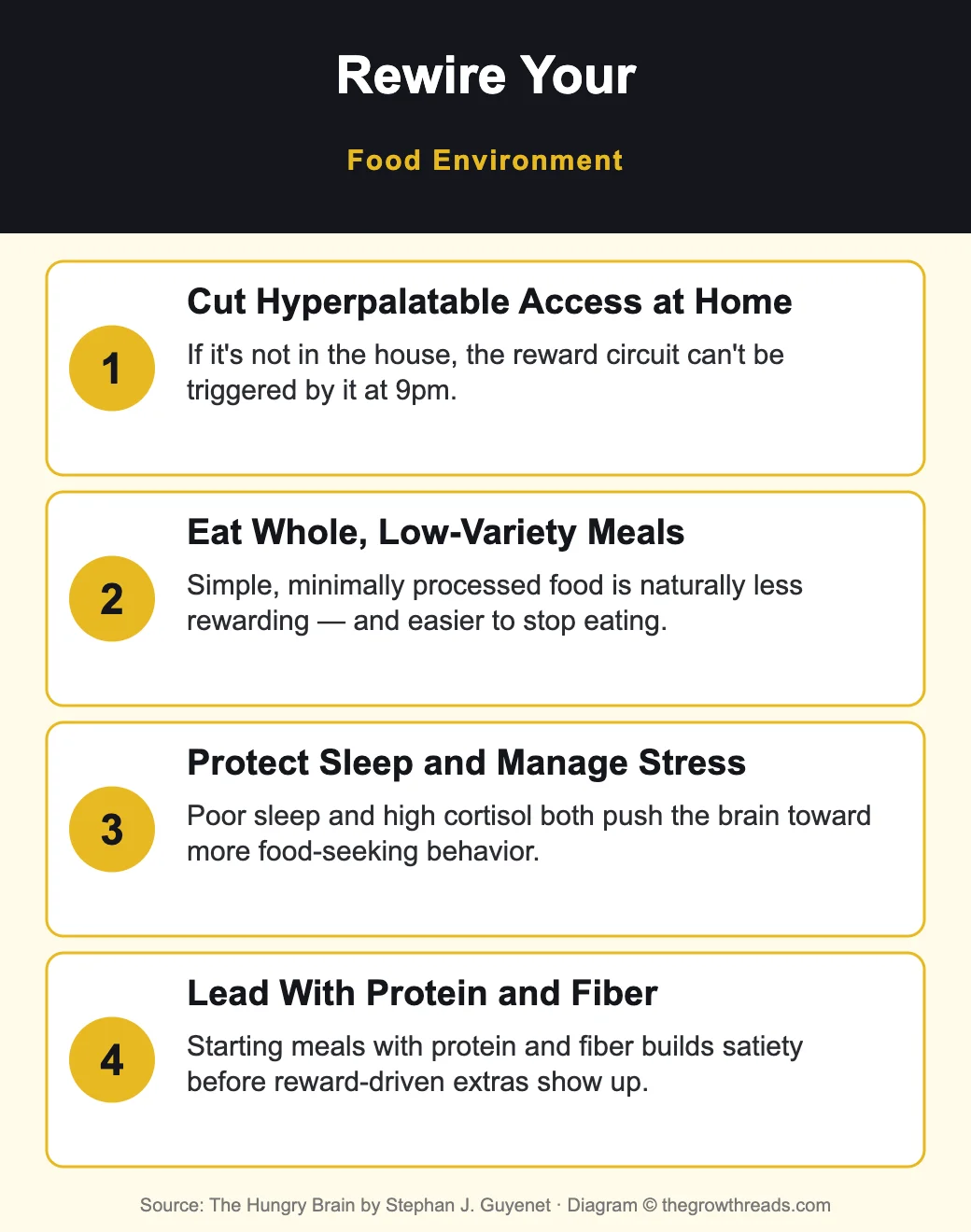
The final section turns the neuroscience into a practical philosophy: since willpower is a limited, easily depleted resource, the more reliable lever is changing what you’re exposed to in the first place. Guyenet’s recommendations are deliberately unglamorous — reduce the presence of hyperpalatable food at home, favor simpler and less varied meals built around whole foods, and lead with protein and fiber, both of which produce stronger and more durable satiety signals than sugar or refined starch.
He also connects two often-overlooked levers back to the same reward circuitry: sleep deprivation and chronic stress both elevate cortisol and measurably increase food-seeking behavior, independent of actual caloric need. None of this requires eliminating enjoyment of food — Guyenet is explicit that occasional hyperpalatable treats aren’t the problem, constant low-level exposure is. The goal is an environment where the effortful choice and the healthy choice stop competing, because the environment itself has been redesigned.
Practically, this often means shifting effort from the moment of eating to the moment of grocery shopping — since decisions made once a week (what enters the house) are far easier to sustain than decisions made ten times a day (what to eat right now). Cooking more meals at home, where recipes rarely hit an industrial bliss point, does much of this work automatically. None of it requires treating dessert as forbidden; Guyenet’s point is about baseline exposure, not zero tolerance.
TGR Note: The environment-design principle mirrors James Clear’s Four Laws in Atomic Habits — making the desired behavior “obvious” and “easy” by redesigning your surroundings, applied here specifically to appetite and food cues.
Who is The Hungry Brain best for — and who should read something else first?
The Hungry Brain is best for readers who’ve already tried willpower-based dieting, felt it fail, and want to understand the actual mechanism instead of trying harder at the same approach. It rewards people comfortable with a bit of neuroscience explained in accessible terms.
If you want a more insulin-centric theory of fat gain, start with Why We Get Fat. If you want the food-industry side of hyperpalatability, start with Salt Sugar Fat. And if you want a pure habit-and-environment framework without the neuroscience detail, start with Atomic Habits.
Questions to reflect on
- Which foods in your kitchen are hardest to stop eating once you start?
- When do you eat past comfortable fullness — habit, stress, or genuine reward?
- What would your kitchen look like if the convenient option defaulted to whole foods?
- How does a poor night’s sleep change what you crave the next day?
- What’s one simple, repeatable meal you could eat often without missing variety?
🔥 Ready to understand your own appetite?
Get The Hungry Brain and see exactly how your brain decides what — and how much — you eat.
How to apply The Hungry Brain (7-day plan)
- Day 1 — Audit your kitchen: Identify the three most hyperpalatable foods within easy reach and move them out of sight, or out of the house.
- Day 2 — Lead with protein and fiber: Rebuild one meal so protein and fiber come first, before any refined carbohydrate.
- Day 3 — Track variety, not calories: Notice how many distinct flavors you eat in a day — awareness alone often reduces mindless variety-seeking.
- Day 4 — Protect a full night of sleep: Treat sleep as an appetite-regulation tool, not a luxury.
- Day 5 — Build a stress-reset habit: Add a short decompression routine before your highest-risk eating window.
- Day 6 — Pre-decide tomorrow’s meals: Plan ahead to reduce in-the-moment decisions driven by reward, not hunger.
- Day 7 — Review cravings, not just weight: Notice whether cravings and energy shifted — that’s the leading indicator the environment change is working.
Frequently asked questions
Is The Hungry Brain based on real science or pop psychology?
It’s grounded in peer-reviewed neuroscience. Stephan Guyenet holds a PhD and spent years researching hypothalamic appetite regulation before writing the book, and he cites primary studies throughout rather than relying on anecdote. That said, it’s written for a general audience, translating dense research into accessible explanations without requiring a science background to follow.
Does the book recommend a specific diet?
No. Guyenet deliberately avoids prescribing a single diet plan, arguing that the mechanism matters more than the label. His practical recommendations — reduce hyperpalatable food exposure, favor whole foods, lead with protein and fiber — are compatible with most reasonable eating patterns rather than tied to one branded approach.
How is this different from other diet-science books like Why We Get Fat?
Why We Get Fat centers on insulin as the primary driver of fat storage. The Hungry Brain takes a broader neuroscience view, treating insulin as one of many inputs the hypothalamus weighs alongside leptin, sensory cues, and reward signals. The two books are complementary rather than contradictory.
Can understanding brain science actually help you eat less?
Indirectly, yes. The book’s core argument is that understanding the mechanism shifts your strategy from relying on willpower to redesigning your environment — which the research suggests is more sustainable. Knowing why cravings hit doesn’t eliminate them, but it does make environment-based interventions feel less like deprivation and more like working with your biology.
Is The Hungry Brain hard to read for a non-scientist?
It’s more technical than a typical pop-science bestseller but still written for general readers. Guyenet explains hypothalamic circuitry and hormone signaling in plain terms with minimal jargon, though readers looking for a purely narrative, story-driven book may find some chapters more textbook-like in pacing.
Does the “set point” theory mean weight loss is impossible?
No — Guyenet is clear that set points can shift over time, particularly in response to sustained environmental change, and that some research on this remains actively debated among scientists. The practical takeaway isn’t that change is impossible, but that it’s harder to sustain through willpower alone than through consistent environment design.
What’s the single most useful change to make after reading this book?
Most readers point to reducing hyperpalatable food access at home as the highest-leverage change — it requires no daily willpower once done, unlike calorie tracking or portion control, which have to be actively maintained meal after meal.
Related summaries
- Why We Get Fat Summary & Review
- Salt Sugar Fat Summary & Review
- How Not to Diet Summary & Review
- Atomic Habits Summary & Review
Explore more on our Best Health Books pillar page.
Related Health Summaries
Genius Foods Summary & Review: Eat Your Way to a Sharper Brain
Ikigai Summary & Review: The Japanese Secret to a Long and Happy Life
Never Finished Summary & Review: Unshackle Your Mind and Win the War Within
The Energy Paradox Summary & Review: Why Your Gut Is Stealing Your Energy
Why We Get Fat Summary & Review: It’s the Carbs, Not the Calories