

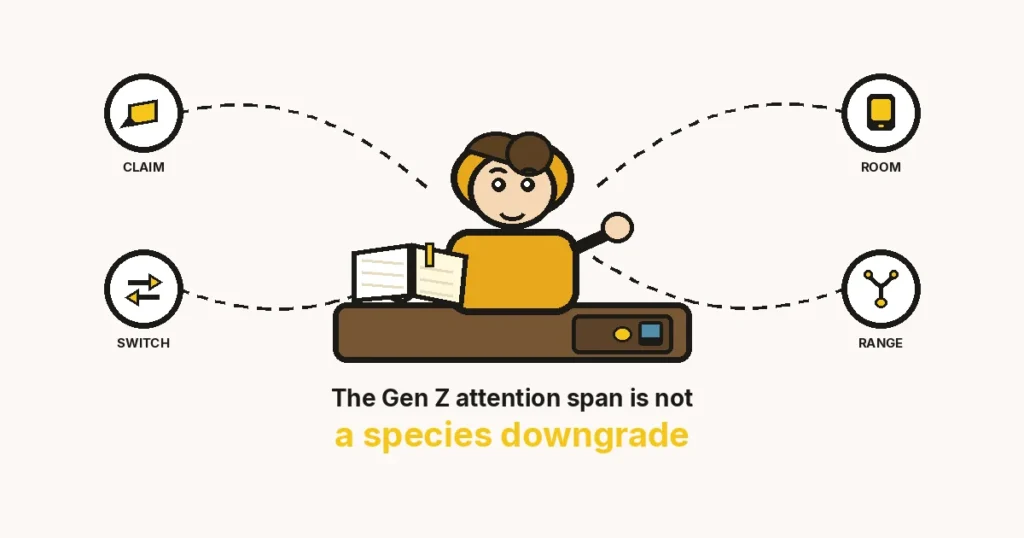
The Gen Z attention span is a cohort slogan, not a laboratory finding that a generation shrank to eight seconds. The goldfish number that travels with it is a myth. What the logs show is a faster hop in a noisier room — not a shorter species. Name a target and the hold still works.
Key takeaways
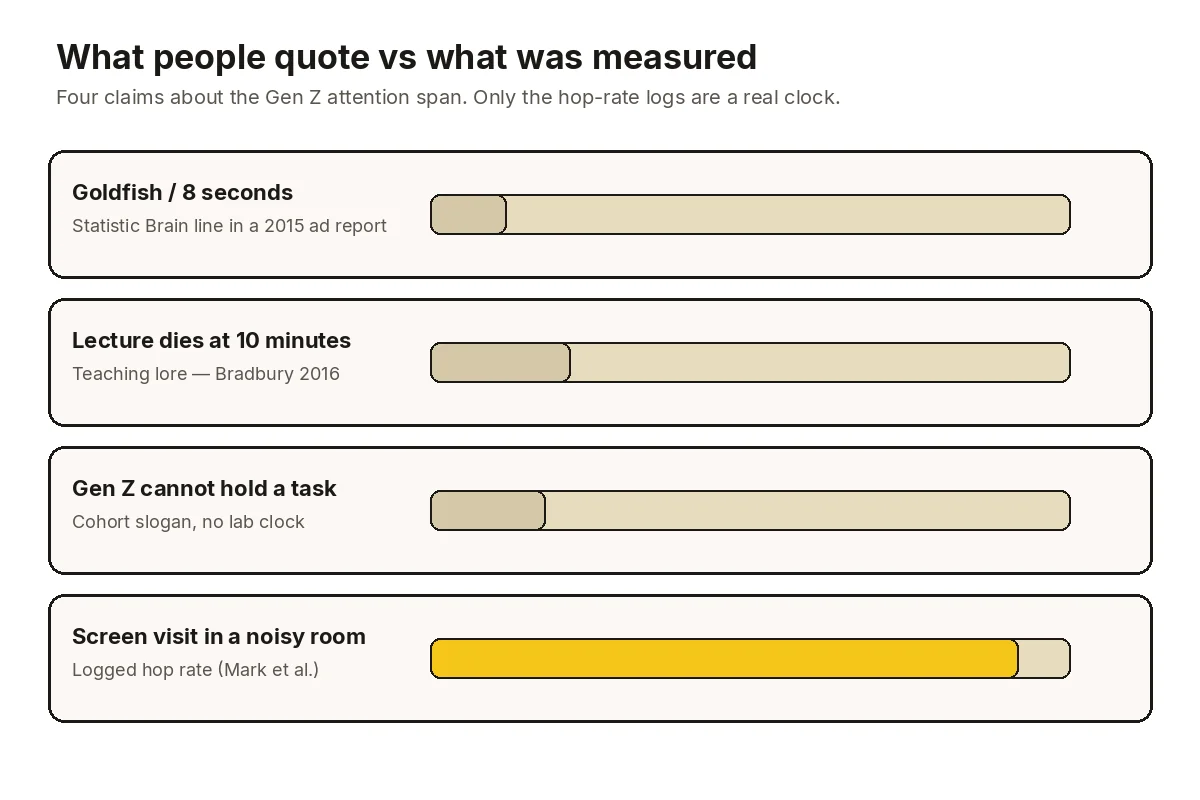
- The eight-second “goldfish” figure that gets pasted onto Gen Z is a 2015 consumer-insights line, not a laboratory clock on a named target (Microsoft Canada, 2015; Maybin, 2017).
- Bradbury (2016) showed the same pattern in teaching lore: a tidy seconds or minutes number, thin measurement, endless reprints — including the claim that a lecture dies at ten minutes.
- Workplace logs measure visit length, not a birth-year organ: information workers already spent about three minutes on a device before switching in 2005, before the cohort was in the labour market (Mark, Gonzalez and Harris, 2005).
- Media-multitasking research finds a filtering cost, not a generation verdict: heavy switchers filter irrelevance worse, and the finding is about habit, not a birth certificate (Ophir, Nass and Wagner, 2009; Uncapher and Wagner, 2018).
- Sampling many interests is not a broken clock — David Epstein’s Range treats breadth as how people find fit, which is why that unused review sits on this row rather than as a second how-to-focus guide.
What the Gen Z attention span actually is
The Gen Z attention span is a marketing slogan about a birth cohort, not a measured organ that shrank when the first iPhone shipped. Pew’s Michael Dimock (2019) is the usual cut: Generation Z starts around 1997. That is a census line. It is not a vigilance score. The sentence that travels with the line — “they have an eight-second attention span, shorter than a goldfish” — is the claim this URL has to check. It is not a definition of attention span. The live sister page on what attention span actually means already owns the word: duration of hold on a chosen target. Do not rewrite that page here. This page owns the cohort paste.
This is a Focus child. The parent how to focus better already owns the method: remove the switch, do not add willpower. Play slots drop the HowTo ladder, and this page will not invent one. The unused review this row was given is David Epstein’s Range — a book about sampling many fields, not a trial of TikTok. It earns the slot because “they hop between interests” is often range wearing a deficit’s name. The productivity library already holds the definition, the hop-rate page, and the focus parent. This article names the generation claim so those pages have a claims-checking child.
The useful unit is adult-legible. It applies to a hire, a student, a teammate, or anyone being told their birth year is a diagnosis. It is not a clinical page and not a parenting page. A hop on a Tuesday is a hop. A pattern across years and rooms is a different question, and not this URL.
Gen Z hop rate versus a shorter species
A hop rate is how often attention leaves a named target; a species claim is the idea that a birth year made the hold impossible. Keep them apart. Gloria Mark, Victor Gonzalez and Justin Harris (2005) logged information workers and found they spent about three minutes on a device before switching, with many working spheres cut even shorter. That is a visit length in a notification-rich room. It is not a Gen Z finding — most of those workers were not Gen Z — and it is not a goldfish. Later logging from the same research programme is widely reported around forty-seven seconds on a screen. That still describes an environment. It does not prove that people born after 1996 lost a biological minute.
The opposite of a useful cohort claim is the goldfish line used as a hook. The queue note for this row is blunt: the goldfish statistic is a myth, and that is the angle, not the sentence to reprint as if it were news. Microsoft Canada’s 2015 Attention Spans consumer-insights report is the usual source. Simon Maybin’s 2017 BBC investigation followed the citation to Statistic Brain and found no laboratory clock. Goldfish, as Felicity Huntingford told Maybin, are a model species for learning and memory. The joke is backwards. This page will say that once, then stop using the fish as bait.
Why the generation claim stuck
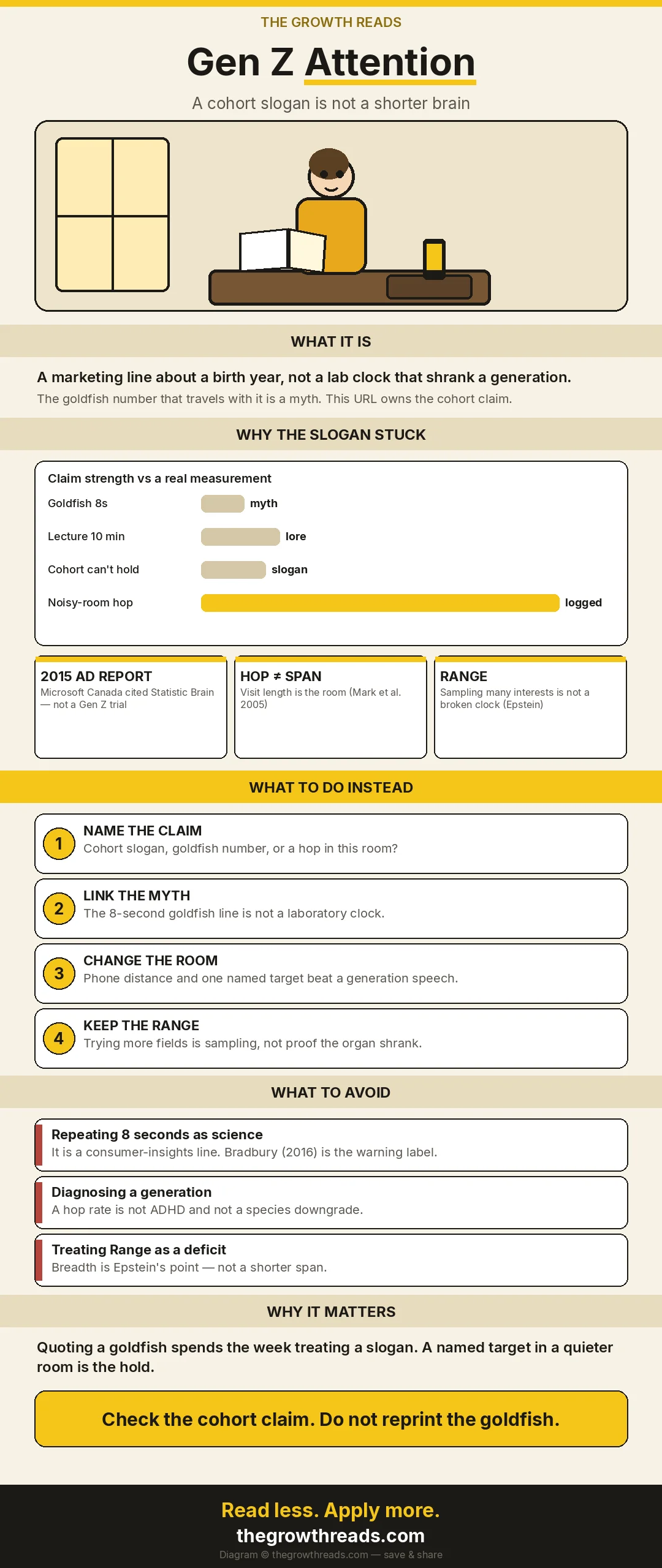
The generation claim stuck because a single number is cheaper than changing the room, and a birth year is a cheaper villain than a notification. Marketers needed a reason to cut the ad. Managers needed a reason the new hire checked a phone. Teachers needed a reason the lecture felt harder. An eight-second goldfish, pasted onto “Gen Z,” does all three jobs without a method.
Neil Bradbury (2016) took the classroom cousin — the claim that student attention dies at ten or fifteen minutes — and showed a tidy number being copied through handbooks with thin measurement underneath. Wilson and Korn (2007) had already warned teaching guides that the “ten-minute rule” was travelling without a clock. Students look away. That is not the same as a span expiring, and it is not the same as a generation expiring. A look-away can be a note, a blink, or a hop. If you do not say which, you have a vibe.
The digital-lifestyle half of the story is real and still not a species downgrade. Eyal Ophir, Clifford Nass and Anthony Wagner (2009) compared heavy and light media multitaskers and found the heavy group worse at filtering irrelevance, not better at switching. Melina Uncapher and Wagner (2018) reviewed the media-multitasking literature and kept the same grain: associations with attention and memory, lots of correlation, not a birth-year law. Henry Wilmer, Lauren Sherman and Jason Chein (2017) reviewed smartphone-cognition studies and found mostly mixed, correlational results. None of those papers measured “Gen Z attention span” as a construct. They measured habits and rooms.
Amy Orben and Andrew Przybylski (2019) then showed what happens when a generation-scale screen claim meets a specification check. In a large well-being dataset, the association between digital-technology use and adolescent well-being was small, and it moved when you changed the researcher’s choices. That paper is not an attention-span trial. It is the honest neighbour: “screens ruined a generation” is a shape of claim that shrinks when you look. The attention version of that shape is this page.
The four ingredients of the cohort myth
Four ingredients get folded into “the Gen Z attention span,” and only one of them is even a clock. Name the four and the slogan stops being a smear.
- The goldfish number. An eight-second / nine-second pair reproduced in a 2015 advertising report. Not a Gen Z sample. Not a named target. The sister definition page already took this apart. Link it; do not restage it.
- The lecture lore. Ten or fifteen minutes, copied through teaching guides (Wilson and Korn, 2007; Bradbury, 2016). A look-away is not a cohort diagnosis.
- The hop log. Short visits on a device in a noisy room (Mark, Gonzalez and Harris, 2005). Real, observational, and older than the generation being blamed for it.
- The range smear. Trying more fields, more apps, more drafts. Epstein’s book is the library’s name for why sampling is not a defect. A hop that never names a target is a short attention span — a different URL.
When someone says “Gen Z has no attention span,” ask which of the four they are holding. A number, a lecture, a log, or a smear. Collapsing them into a birth year hides the move.
Why the myth costs more than it feels like
A wrong generation story costs you the diagnosis, so you spend the week treating a slogan. If you think the span is a fixed score on a birth certificate, you shop for hacks and identity speeches (“they just can’t deep-work”). If you think it is a hop in a room, you name a target, close the last loop, and move the phone. Those are not the same afternoon. The parent how to focus better page already mapped the method. This page will not reprint it as a second system.
Adrian Ward, Kristen Duke, Ayelet Gneezy and Maarten Bos (2017) tested three phone locations with undergraduates: on the desk, nearby in a bag, and in another room. Available working memory and fluid intelligence dropped as the phone got closer, even when nobody touched it. Undergraduates are not “Gen Z” as a construct — they are people in a room with a phone. The finding is a distance effect. Using it as a generation verdict is how a lab task becomes a slur.
Mark, Daniela Gudith and Ulrich Klocke (2008) found that interrupted workers finished faster, with more stress, frustration and effort. A finished list can hide an expensive hop. That is why a manager can say “they delivered” and still feel the hold never happened. Single-tasking is the practice of refusing the extra open file so a duration can exist. Notification overload is the signal layer. Attention residue is the leftover from the last unfinished switch (Leroy, 2009). None of those pages is a generation page. Borrow the layer. Do not borrow a birth year.
Two honest caveats. Workplace logs are observational — they describe visit length, not a causal proof that phones shrank a cohort. Media-multitasking studies compare people who already differ in habit, so they cannot prove that hopping caused a weaker filter rather than a weaker filter drifting toward heavier hopping. Orben and Przybylski (2019) is a well-being specification check, not an attention-span experiment. None of that blesses an eight-second hire score. It still beats an unsourced “Gen Z can’t focus.”
The identity cost is the quiet one. Once “I have a short attention span” means “I was born after 1996,” people stop distinguishing a noisy room from a smaller brain. In our experience that is the sentence that arrives in the search bar. The honest answer is smaller: the goldfish number is a myth, the cohort is not a clock, and a named target in a quieter room is still a hold. David Epstein’s Range is not a trial of that sentence. It is the library’s closest book-length refusal of “they like too many things, therefore they cannot hold one.”
Nearby pages that are not this claim
Several neighbouring pages share an attention word with this one and answer a different question. Keep them linked, not merged. This URL is the claims-checking page: the generation slogan, and the goldfish myth that travels with it. Play slots do not emit a HowTo ladder, and this page will not invent one.
| Idea | What it actually is | What it is not |
|---|---|---|
| The Gen Z attention span | A cohort slogan plus a goldfish number that is not a lab clock | A measured organ, a clinical label, or a second definition of attention span |
| Attention span meaning | The sister: duration of hold on a chosen target | A generation verdict. Already live. Do not rewrite it here |
| Short attention span | A hop rate, usually set by the room | A birth-year nature |
| How to increase your attention span | The applied hold page | A claims check. Already live |
| How to focus better | The Focus parent: remove the switch | A second Gen Z recipe |
| Multitasking | The hop tax | A generation score |
| What deep work actually means | A protected block, not a personality | Proof that Gen Z cannot do one |
The live attention-span meaning page and the live short-attention-span page are different phrases and different jobs. This article does not restage either of them. A reader can use the definition, then come here for the cohort paste. The parent how-to remains the build. This URL is the claims-checking child.
Common mistakes
- Repeating the goldfish number as if it were a finding. It is a consumer-insights line. Maybin (2017) and Bradbury (2016) are the warning labels. The sister attention-span meaning page already said this about the word. This page says it about the generation paste.
- Treating a birth year as a diagnosis. A noisy Tuesday is a hop rate. A clinical pattern across years and rooms is a different question, and not this page. Do not collect symptoms from a workplace Slack log.
- Using a short video format as a brain scan. Average watch time is a product metric. It is not a vigilance score. Wilmer, Sherman and Chein (2017) did not measure TikTok as an organ.
- Calling range a deficit. Epstein’s Range is the unused review on this row because sampling many interests is how people find fit. A hop that never names a target is the hop-rate page, not this one.
- Adding grit to a buzzing desk and calling it a generation fix. Ward, Duke, Gneezy and Bos (2017) measured a tax from mere presence. The how to focus better page already owns the phone-distance finding. Borrow the distance. Do not borrow a new HowTo.
- Confusing a finished list with a hold. Mark, Gudith and Klocke (2008) already showed interrupted work can still finish. Finish is not hold. Staying on task is the applied cousin.
- Rewriting the sister definition or the hop-rate page. Different phrases, already published. This is the cohort-claim page, not a second goldfish explainer.
The evidence behind this
The claim on this page is modest: there is no laboratory clock that shrank Gen Z to eight seconds, and the goldfish number that travels with that sentence is a myth. The table is the working, not a highlight reel. Observational logs are marked as observational. The advertising report is left in as a document, not as a result.
| Study | Design and size | Finding | What we used it for |
|---|---|---|---|
| Microsoft Canada, 2015; Maybin, 2017 | Consumer-insights report (2,000 survey + 112 EEG); BBC citation chase | The eight-second / goldfish pair was reproduced from Statistic Brain, not measured as a Gen Z clock | The slogan is a document, not a result |
| Bradbury, 2016; Wilson and Korn, 2007 | Critical reviews of lecture-attention claims | The “ten-minute span” is recycled teaching lore with thin measurement | Why tidy seconds numbers keep travelling into classrooms |
| Mark, Gonzalez and Harris, 2005 | Field logging of information workers (CHI) | About three minutes on a device before a switch | Visit length is a hop rate, and it predates the cohort blame |
| Mark, Gudith and Klocke, 2008 | Lab experiment on interrupted work (CHI) | Interrupted people finished faster, with more stress, frustration, and effort | A finished list can hide an expensive hop |
| Ophir, Nass and Wagner, 2009 | Media-multitasking individual differences (PNAS) | Heavy multitaskers filtered irrelevance worse, not better | Habit, not a birth certificate |
| Uncapher and Wagner, 2018 | Review of media multitasking and memory/attention | Associations exist; causation is not settled | The hop literature is not a Gen Z trial |
| Wilmer, Sherman and Chein, 2017 | Narrative review of smartphone and cognition studies | Mostly correlational, mixed results | Phones changed the room; they did not publish a species downgrade |
| Ward, Duke, Gneezy and Bos, 2017 | Experiments on smartphone presence (JACR) | One’s own phone nearby reduced available working memory and fluid intelligence | A distance effect, not a generation verdict |
| Orben and Przybylski, 2019 | Specification-curve analysis of large adolescent well-being datasets | Technology–well-being associations were small and specification-sensitive | Generation-scale screen claims shrink when you look — a neighbour, not an attention clock |
Frequently asked questions
What is the Gen Z attention span?
The Gen Z attention span is a slogan about people born from the mid-1990s to the early 2010s, not a laboratory clock that shrank a generation. Pew’s Dimock (2019) is the usual cut for the cohort. The number that travels with the slogan — eight seconds, shorter than a goldfish — is a 2015 consumer-insights line, not a Gen Z trial. What the logs show is a faster hop in a noisier room. A hold on a named target is still a hold. This page checks the cohort claim. The sister page on attention-span meaning owns the word.
Do Gen Z really have an 8-second attention span?
No. The eight-second figure did not come from a Gen Z experiment. Microsoft Canada’s 2015 Attention Spans report reproduced a Statistic Brain graphic; Simon Maybin’s 2017 BBC investigation found no laboratory clock behind it. Bradbury (2016) is the academic warning on tidy seconds numbers. Workplace logs that show short screen visits describe a hop rate, not a birth-year organ. Treat “Gen Z has an 8-second attention span” as marketing folklore pasted onto a cohort.
Is the goldfish attention span statistic real?
No. Goldfish are a model species for learning and memory, which is the opposite of the joke. The nine-second goldfish figure has no method. The sister page on attention-span meaning already owns the definition and the eight-second story. This page only needs the next move: do not paste that myth onto a generation. A claims-checking page that reprints the goldfish as a hook has already lost. Say the statistic is a myth, then talk about the room.
Why do employers say Gen Z cannot focus?
Because a single number is cheaper than changing the room. Ophir, Nass and Wagner (2009) and Uncapher and Wagner (2018) describe media-multitasking habits and filtering, not a birth certificate. Ward, Duke, Gneezy and Bos (2017) measured a tax from a nearby phone in undergraduates — a room effect, not a generation verdict. If a hire hops, ask about notifications, unfinished loops, and the named target. The parent page on how to focus better owns the method. This page will not invent a HowTo for a slogan.
Did smartphones shrink Gen Z’s attention span?
They changed the room. Wilmer, Sherman and Chein (2017) reviewed smartphone-cognition work and found mostly correlational, mixed results — not a species downgrade. Orben and Przybylski (2019) showed that large “screens ruined well-being” claims shrink when you look at the specification. Mark, Gonzalez and Harris (2005) logged short device visits in information work before TikTok existed. A faster hop in a notification-rich room is real. A biologically shorter Gen Z span is not what those papers measured.
Is hopping between interests a short attention span?
Not by itself. David Epstein’s Range is the unused review this row was given because sampling many fields is how people find fit, not proof the organ shrank. A hop that never names a target is a different failure — that is the sister hop-rate page. Breadth plus a hold on the current page can travel together. Treat “they like too many things” as range until you have a named target that keeps dying in a noisy room.
How is this different from a short attention span?
A short attention span is a hop rate, usually set by the room — already live on its own URL. The Gen Z attention span is the claim that a birth cohort has that hop as a nature. One is a Tuesday log. The other is a stereotype. Keep them linked, not merged. If the hold is short, change the room and name the target. If the sentence starts with “Gen Z can’t,” you are on this page. Play slots do not emit a HowTo ladder either way.
What should you do instead of quoting the goldfish number?
Name the layer. If you mean a hop, say hop and look at the phone and the last open loop — attention residue and notification overload already live. If you mean the word, use the attention-span meaning page. If you mean a generation, stop. There is no lab clock that shrank a cohort to eight seconds. Then do the unglamorous work the focus parent already mapped: one named output, phone out of reach, one hold. This page will not invent a HowTo ladder for that work.
Sources
- Microsoft Canada. (2015). Attention spans (consumer insights). Cited as the usual source of the eight-second / goldfish pair — not as a laboratory result and not as a Gen Z trial.
- Maybin, S. (2017, March 10). Busting the attention span myth. BBC World Service. https://www.bbc.com/news/health-38896790
- Bradbury, N. A. (2016). Attention span during lectures: 8 seconds, 10 minutes, or more? Advances in Physiology Education, 40(4), 509–513. doi:10.1152/advan.00109.2016
- Wilson, K., & Korn, J. H. (2007). Attention during lectures: Beyond ten minutes. Teaching of Psychology, 34(2), 85–89. doi:10.1080/00986280701291291
- Mark, G., Gonzalez, V. M., & Harris, J. (2005). No task left behind? Examining the nature of fragmented work. Proceedings of CHI 2005, 321–330. doi:10.1145/1054972.1055017
- Mark, G., Gudith, D., & Klocke, U. (2008). The cost of interrupted work: More speed and stress. Proceedings of CHI 2008, 107–110. doi:10.1145/1357054.1357072
- Ophir, E., Nass, C., & Wagner, A. D. (2009). Cognitive control in media multitaskers. Proceedings of the National Academy of Sciences, 106(37), 15583–15587. doi:10.1073/pnas.0903620106
- Uncapher, M. R., & Wagner, A. D. (2018). Minds and brains of media multitaskers: Current findings and future directions. Proceedings of the National Academy of Sciences, 115(40), 9889–9896. doi:10.1073/pnas.1611612114
- Wilmer, H. H., Sherman, L. E., & Chein, J. M. (2017). Smartphones and cognition: A review of research exploring the links between mobile technology habits and cognitive functioning. Frontiers in Psychology, 8, 605. doi:10.3389/fpsyg.2017.00605
- Ward, A. F., Duke, K., Gneezy, A., & Bos, M. W. (2017). Brain drain: The mere presence of one’s own smartphone reduces available cognitive capacity. Journal of the Association for Consumer Research, 2(2), 140–154. doi:10.1086/691462
- Orben, A., & Przybylski, A. K. (2019). The association between adolescent well-being and digital technology use. Nature Human Behaviour, 3, 173–182. doi:10.1038/s41562-018-0506-1
- Dimock, M. (2019, January 17). Defining generations: Where Millennials end and Generation Z begins. Pew Research Center. https://www.pewresearch.org/short-reads/2019/01/17/where-millennials-end-and-generation-z-begins/
- Leroy, S. (2009). Why is it so hard to do my work? The challenge of attention residue when switching between work tasks. Organizational Behavior and Human Decision Processes, 109(2), 168–181. doi:10.1016/j.obhdp.2009.04.002
- Epstein, D. (2019). Range: Why generalists triumph in a specialized world. Riverhead Books. Library page: Range summary.
Related reading on The Growth Reads
The book this page draws on
- Range summary & review — sampling many fields is not a shorter clock; breadth is how people find fit
Related articles
- How to focus better — the Focus parent this claims-check sits under
- Attention span: what it actually means — the sister definition; different phrase from this cohort page
- Short attention span — the hop-rate page, not a birth year
- How to increase your attention span — the applied hold page
- Notification overload — the signal layer, not a generation
Go deeper
How this article was researched
The Growth Reads editorial team writes from primary sources: the books themselves, the authors’ published essays and interviews, and the peer-reviewed literature behind the claims. Every study cited above was read in the original publication or its published abstract, and every figure is quoted with its design, sample and effect so you can judge its weight rather than take ours. Where a finding is a consumer-insights report, a journalism citation chase, an observational log, a correlational review, or a well-being specification check rather than a randomised trial of “Gen Z attention,” we say so directly in the text rather than in a footnote.
This article contains no medical advice and no diagnosis. A hop on a Tuesday is a hop. Persistent difficulty holding attention across years, rooms and tasks is worth discussing with a qualified professional rather than treated as a missing generation score. The goldfish statistic is named as a myth because that is the angle this row was given — not as a hook to reprint.
How we work: every article on The Growth Reads is built from the books in our library plus the research they rest on, and is reviewed and date-stamped when the evidence changes. Read our full methodology.