

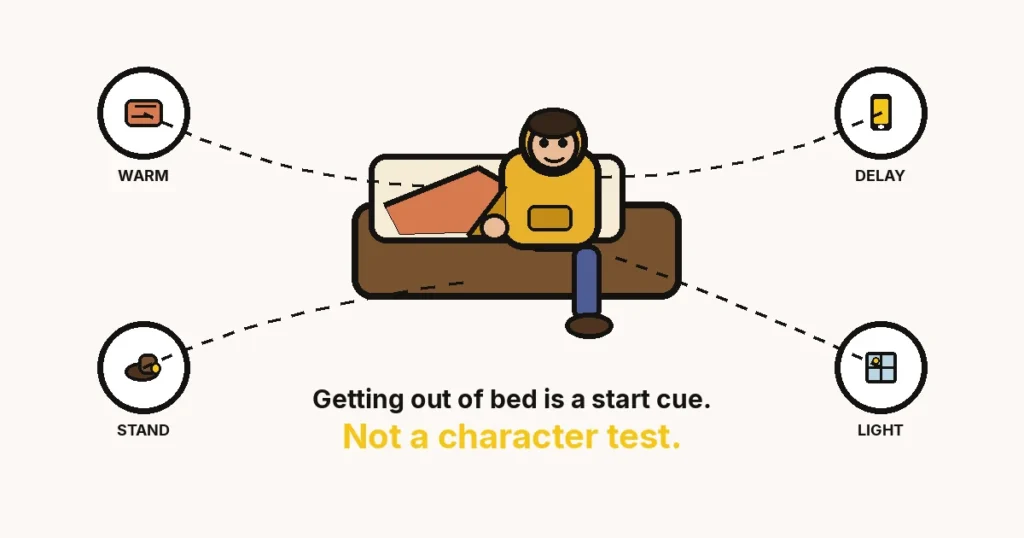
Why it is so hard to get out of bed is a start-cue problem, not a laziness verdict. The warm bed is a competing cue, the phone is a competing first task, and the first minutes after waking are a poor moment to hold that debate. The first stand is a written if–then, not a character test.
Key takeaways
- Why it is so hard to get out of bed is a cue race: the duvet and the phone are already loaded, and the floor is not until it is named the night before.
- New everyday actions reached automaticity at a median of 66 days in 96 adults, with a range of 18–254 days, and simpler behaviours moved faster (Lally, van Jaarsveld, Potts & Wardle, 2010).
- A written if–then — exact cue plus exact action — raised follow-through across 94 tests with a medium effect (Gollwitzer, 1999; Gollwitzer & Sheeran, 2006).
- Cognitive throughput in the first minutes after waking was worse than after 26 hours awake, then recovered over about two hours — a bad window to negotiate with the bed (Wertz, Ronda, Czeisler & Wright, 2006).
- James Allen’s As a Man Thinketh treats the next act as the thought you carry, not the mood you wait to feel — the first stand is written last night.
What “hard to get out of bed” actually is
Why it is so hard to get out of bed is the first work of the day losing a cue race, not a verdict on character. The duvet is already a loaded context. The phone is already a first task. The floor is a new action until you name it the night before. Wendy Wood and David Neal’s 2007 review of the habit–goal interface is the mechanism underneath: goals can launch a behaviour, but context carries it. A warm bed is context. A written “after the alarm, feet on the floor” is a goal trying to install a new context. Until that if–then is specific, the old context wins without a speech.
This is a Morning-cluster page. The parent is how to build a morning routine — a short sequence in a stable order, not a 5 a.m. identity. The first stand is the unglamorous first link in that sequence. It is not the whole morning, and it is not a personality. People who work well after lunch still need a first stand on work days. The question this URL owns is the bed-to-floor gap, not the hour you prefer to think.
The honest opposite of “I cannot get up” is not “I am disciplined.” It is “the first action is already chosen.” That is closer to an implementation intention than to a grit speech. Peter Gollwitzer’s 1999 review of implementation intentions — and the later 94-test meta-analysis with Paschal Sheeran — is why a vague hope (“I will get up on time”) underperforms an exact pair: cue plus action, written when you still have a clear head.
How this differs from laziness, depletion, and a late night
Hard to leave the bed is a first-move problem; laziness is a label; depletion is what is left after a long work block; a late night is yesterday writing today’s window. Those four get fused in the same groan, and the fusion is why the advice fails. Burnout vs laziness is motivation versus depletion at work — whether the tank is empty after the day. This page is earlier than that: whether the first stand happens at all. An empty tank after a hard week and a duvet that won a two-minute cue race can look identical from the hallway. They are not the same lever.
A late bedtime is a different sister. How to wake up early if you sleep late is a schedule shift, not a shorter night. If last night closed at 1 a.m. and the alarm is at 6, the bed is not “lazy.” The window was written yesterday. Stealing sleep to fake an early morning is the sleep-cut that page refuses. Floor-first still helps on a shifted schedule. It does not replace the shift.
Last night’s stall has its own URL. Bedtime procrastination is the delay of the close — Floor Kroese, Denise de Ridder, Catharine Evers and Marieke Adriaanse introduced that label in 2014 as putting off bedtime despite expecting to be worse for it. That is an evening cue. This page is the morning stand. Fixing one does not automatically fix the other, and treating both as one “I am lazy” story hides the two clocks.
Why the first stand fails
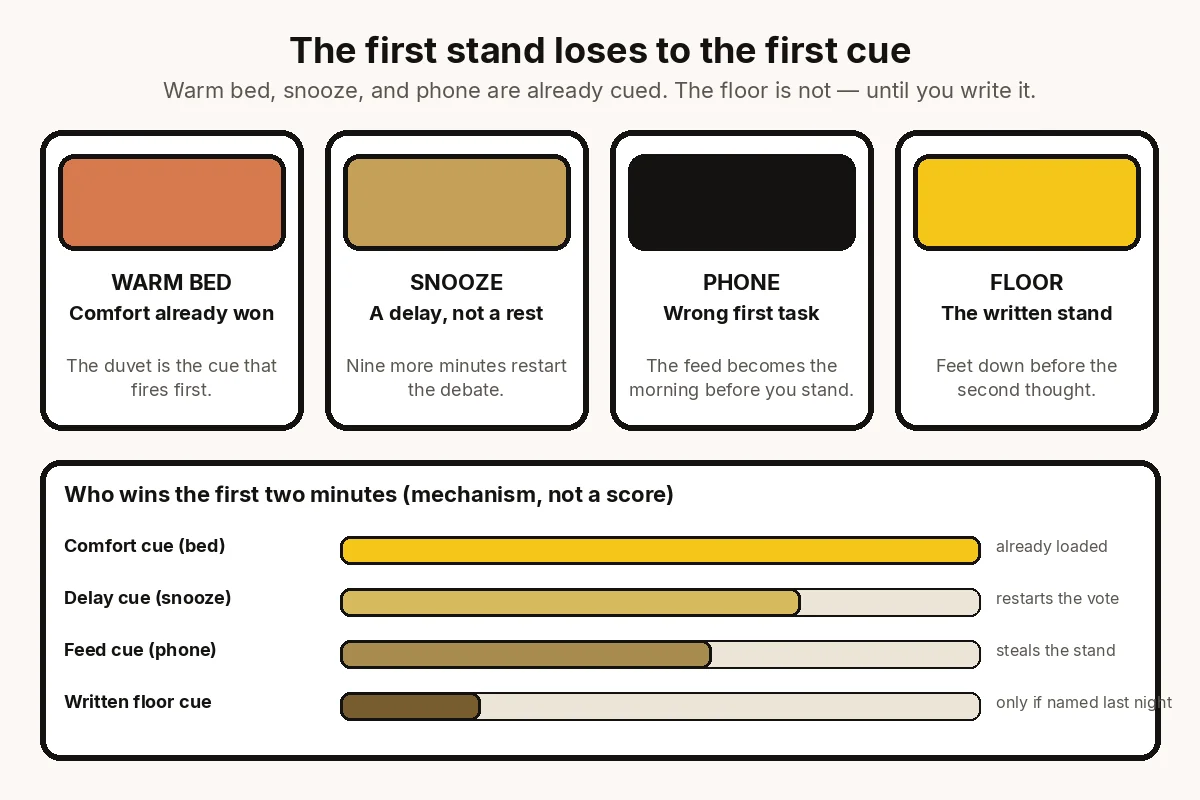
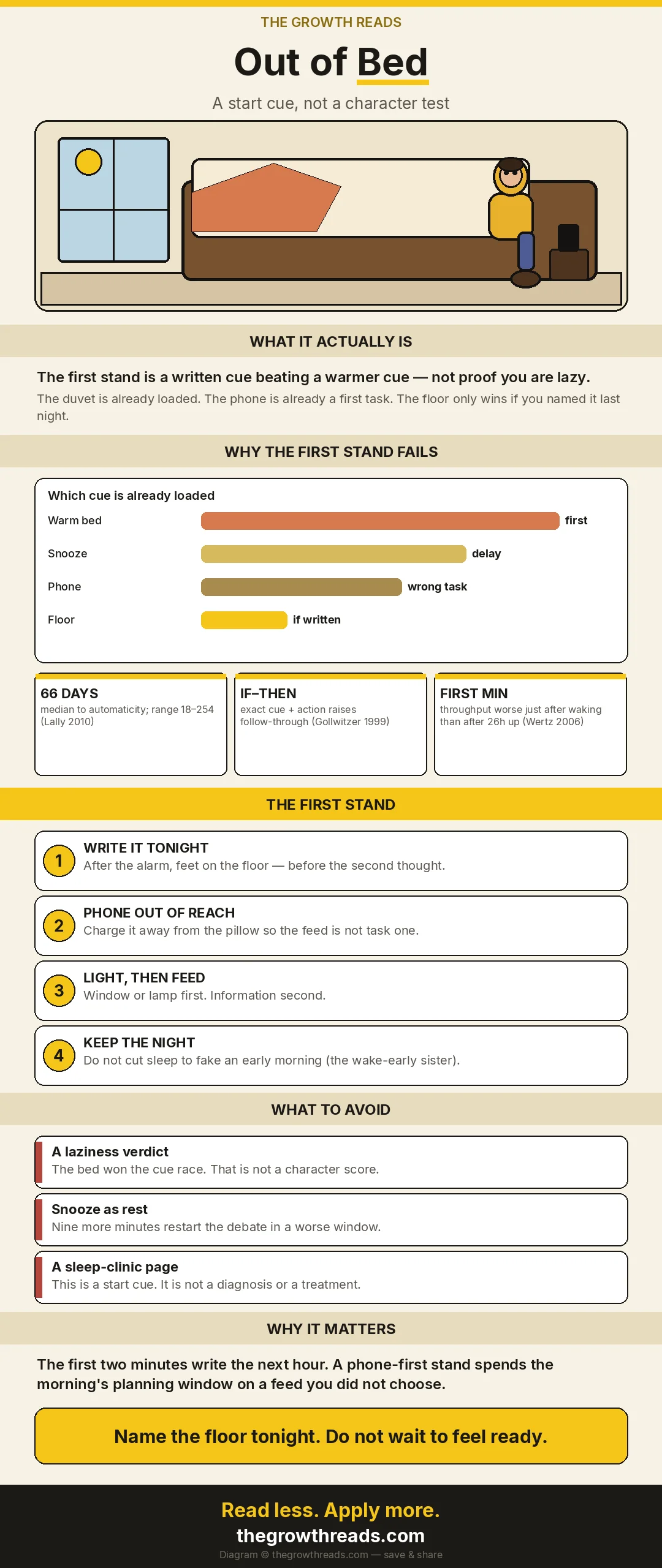
The first stand fails because a warmer, louder, or nearer cue is already installed, and the first minutes after waking are a poor moment to hold a debate with that cue. This is the reframe. It is not “try harder in a worse window.” It is “do not hold the vote in that window.”
Two research lines sit under that sentence, and they do different jobs. The habit line says context beats a hoped-for identity. Lally, van Jaarsveld, Potts and Wardle followed 96 adults who picked one new everyday behaviour and modelled the rise toward automaticity: median 66 days, range 18–254, simpler actions faster, and a single missed day did not wreck the curve. Getting out of bed is a simple motor action. It still needs a stable cue if you want it to stop feeling like a daily negotiation. The second line is narrower and easier to over-read: Adam Wertz, Joseph Ronda, Charles Czeisler and Kenneth Wright Jr reported in 2006 that cognitive throughput right after waking was worse than after 26 hours awake, then recovered over about two hours. That is a laboratory timing result, not a workplace law, and it is not a diagnosis. The use we make of it is modest: the first minutes are a bad committee meeting. Write the stand the night before, when the committee is not in session.
Patricia Tassi and Alain Muzet’s 2000 review of that first-minutes fog called the same window “sleep inertia” and summarised it as minutes to a couple of hours, depending on how and when you wake. We keep the mechanism and drop the clinic. This article does not treat, does not dose, and does not turn a groggy Tuesday into a disorder. It says: do not ask a foggy two minutes to invent a character you did not specify last night.
James Allen’s 1903 essay is the book on this page because it names the same split in older language. Purpose is a plan. Achievement is the daily act that proves the plan is not a mood. Waiting to “feel like getting up” is waiting for the mood to author the act. The As a Man Thinketh summary is the unused down-link for that claim — thought becoming the week’s circumstance — not a sleep manual and not a medical text.
The four competing first cues
Four first cues show up in an ordinary weekday, and only one of them is the stand. The other three are already good at winning.
- The comfort cue — the warm bed. Context is already loaded. Wood and Neal’s point is not poetic: a behaviour that has been paired with a place fires in that place. The duvet is the most rehearsed “stay” in the house.
- The delay cue — snooze. Nine more minutes feels like rest. It is a restart of the same vote in the same bad window. Each restart spends a slice of the morning’s first hour on renegotiation.
- The feed cue — the phone. If the alarm lives in your hand, the first task is whatever opened with the screen. That is a different article’s tax — phone distraction and the stimulus-order sister the low-dopamine morning routine — but it starts in the bed. Charge the phone out of reach and the feed cannot be task one.
- The written stand — feet on the floor. This is the only cue that is not already installed. It has to be named: after the alarm, before the second thought, feet down. That is Gollwitzer’s if–then in one motor act. It is also the first step of a morning sequence, not a 90-minute stack copied from a public morning.
What the evidence does not show. None of the papers below measured “days to become a morning person,” and none of them scored laziness. Lally’s 66-day median is time to felt automaticity for a chosen everyday action, not a get-out-of-bed cure. Wertz’s first-minutes result is one lab protocol. Treat both as mechanisms, not as a personal score.
Why the stall costs more than it feels like
A two-minute stall feels free because it is short; the bill is the next hour, which now opens on a feed or a second alarm instead of a first action. The cost is not a dramatic lost-lifetime number. It is a quiet rewrite of the morning’s planning window.
Sheina Milne, Sheina Orbell and Paschal Sheeran’s 2002 exercise study is the cleanest picture of what a written if–then does to a start that people already “intend.” Motivation alone left follow-through near two in five. Adding a written implementation intention — exact cue, exact action — reached nine in ten. Getting out of bed is not that exercise class. The transfer we are allowed to claim is smaller and still useful: intention without a specified first move is the state most people are in at 6:40 a.m. The written floor is the missing move. It will not make you love mornings. It will stop the first two minutes from becoming a committee.
There is a second, quieter cost when the “fix” is an earlier alarm on the same late bedtime. That is the sleep-cut the wake-early sister refuses. You do not buy a first stand by shortening the night. You buy a worse first hour and then call the fog a character problem. If the usable thinking time is after everyone else is offline, read why you are more productive at night before you steal the close of that night to look like a morning person.
Marc Wittmann, Jenny Dinich, Martha Merrow and Till Roenneberg’s 2006 social-jetlag paper is the third cost, and it is the one this page will not over-claim. A standing gap between the clock you keep for work and the clock your body keeps is a schedule mismatch, not a laziness score. We use that paper only as a boundary: if the stand is hard mainly on work days and easy on free days, look at the window before you look at your spine. That is still a productivity question — when the day starts — not a clinic.
The library view of the same cost is ordinary. A morning that opens on the feed spends the first block of the productivity library on other people’s sequences. A morning that opens on the floor still has a chance to run yours.
What a first stand actually looks like
A first stand is one written motor act after one stable cue — feet on the floor before the second thought — not a 5 a.m. identity and not a costume morning. The billionaire morning routine sister is the costume warning: a public stack is years of stacking, not a starter template. The first stand is smaller than a routine and stricter than a hope.
Write it tonight, in one sentence you can finish while half-asleep: “After the alarm, I put both feet on the floor.” That is the implementation intention. If you want a second link, add the next physical cue you already never skip — light at the window, water at the tap — the same way the morning-routine parent stacks after a habit you do not drop. Do not add a journal, a gym, and a cold shower on day one. Lally’s simpler-is-faster finding is the reason.
The comparison below is a label check, not a diagnostic of types. Play pages do not ship a “five types and the fix for each” ladder. They name the mix-up so you stop applying the wrong lever.
| What shows up | Wrong label | What is usually running | The first move |
|---|---|---|---|
| Warm bed, one more minute | Lazy | Comfort cue already loaded (Wood & Neal, 2007) | Feet down before the second thought |
| Snooze, then snooze | Need more rest | The vote restarts in a worse window (Wertz et al., 2006) | One alarm, stand on the first |
| Phone in the hand first | Just checking | The feed became task one | Phone charges out of reach |
| Hard on work days only | No discipline | Social clock vs body clock (Wittmann et al., 2006) | Shift the window; do not cut sleep |
| Late last night, early alarm | Broken mornings | Yesterday wrote today’s length | The wake-early sister: move bedtime with wake time |
If the stand is already stable and the next hour still dissolves, you have left this URL. That is the morning routine checklist or the low-dopamine sequence after you are up — not a louder alarm.
Common mistakes
Most failed first stands are a wrong lever, not a missing lecture. These are the ones that show up in ordinary weeks.
- Calling it laziness. A cue race is not a moral score. The duvet is better practised than the floor. See burnout vs laziness if the tank is empty after the day; do not import that page’s depletion frame into the first two minutes.
- Cutting the night to fake the morning. An earlier alarm on the same late bedtime is a sleep cut. The sister page is how to wake up early if you sleep late.
- Using snooze as rest. Snooze restarts the debate. It does not finish the stand.
- Keeping the alarm in your hand. The first object you touch becomes the first task. Move the phone before you move the identity.
- Installing a 90-minute stack on day one. The parent routine is a short sequence. The first stand is one link. Implementation intentions are one cue and one action, not a manifesto.
- Waiting to feel ready. Allen’s essay is blunt here: the act proves the plan. The mood is a late author.
- Turning a clock mismatch into a spine lecture. Hard on work days and easy on free days is often the window, not the will. Do not write a grit speech on top of a social-jetlag gap.
When the first stand is not the problem
A first-stand page is the wrong lever when the get-up is already stable, when the night is the thing that moved, or when the pattern is no longer a habit you can slide. This is a work-and-habits argument about the bed-to-floor gap. It is not a sleep-clinic page, not a diagnosis, and not a treatment list.
If the stand already happens and the first two hours still dissolve into phone and inbox, the constraint is the morning sequence. That is the checklist and the stimulus-order sisters, not a fiercer alarm. If last night is the only late thing, start with bedtime procrastination and the wake-early shift. If the only usable thinking time is after midnight, do not steal that night to look like a morning person on paper.
If getting up or staying up is unworkable across weeks, across contexts, and does not move when the cue and the window do, that is outside what a productivity article can honestly claim. See a qualified person. Do not turn that pattern into a laziness story, a grit score, or a tighter streak. Nothing on this page is medical advice. This article does not diagnose, does not treat, and does not list clinical symptoms.
The evidence behind this
The studies below support a start-cue reading of the first stand; they do not support a laziness score, a days-to-become-a-morning-person number, or a treatment plan. Observational and laboratory work is marked as such. Student and field samples are not universal laws.
| Study | Design and size | Finding | What we used it for |
|---|---|---|---|
| Lally, van Jaarsveld, Potts & Wardle, 2010 | 96 adults; new everyday behaviour modelled over 12 weeks | Median 66 days to automaticity; range 18–254; simpler faster; one miss did not wreck the curve | The stand is a simple action that still needs a stable cue; no invented “21-day” get-up score |
| Gollwitzer, 1999; Gollwitzer & Sheeran, 2006 | Review, then meta-analysis of 94 tests | If–then plans raised goal follow-through with a medium effect (d ≈ 0.65) | Write “after the alarm, feet on the floor,” not “I will be better in the morning” |
| Milne, Orbell & Sheeran, 2002 | Exercise field experiment; motivation vs motivation plus if–then | Motivation alone stayed near two in five; adding a written if–then reached nine in ten | Intention without a specified first move is the 6:40 a.m. state |
| Wood & Neal, 2007 | Theoretical review of habit–goal research | Goals can launch a behaviour; context carries it once the pairing is learned | The duvet is already context; the floor is not, until it is paired |
| Wertz, Ronda, Czeisler & Wright, 2006 | Laboratory cognition after waking vs after 26 hours awake | Throughput worse immediately after waking, recovering over ~2 hours | Do not hold the debate in the first minutes; this is not a diagnosis |
| Tassi & Muzet, 2000 | Review of the first-minutes fog literature | The window lasts minutes to a couple of hours, depending on how you wake | Mechanism only — no clinic, no treatment list |
| Kroese, De Ridder, Evers & Adriaanse, 2014 | Introduction of bedtime procrastination as a delay of the close | People delay bedtime despite expecting to be worse for it | Last night is a different URL from the first stand |
| Wittmann, Dinich, Merrow & Roenneberg, 2006 | Social jetlag: work clock vs body clock | A standing gap between social and biological time is a schedule mismatch | Hard-on-work-days is often the window, not a spine lecture |
| Allen, 1903 | Essay — not a trial | Repeated thought becomes character, then circumstance; achievement is the daily act | The stand is an act you write, not a mood you wait to feel |
Frequently asked questions
Why is it so hard to get out of bed even when I am not tired?
Because the first stand is a cue race, not a tiredness score. The warm bed is already a loaded context, and the phone is already a first task. Wood and Neal’s habit–goal review is why a hoped-for identity loses to a rehearsed place. Write the floor the night before — after the alarm, feet down — so the first minutes do not have to invent a plan. If the night was short, that is the wake-early sister, not a louder speech. This page does not diagnose tiredness.
Is being hard to get out of bed the same as laziness?
No. Laziness is a label people put on a lost cue race. The duvet is better practised than the floor. Burnout vs laziness is a different split: motivation versus depletion after work. This URL is earlier — whether the first stand happens. A written if–then is the lever. A character verdict is not. If the tank is empty after a long week, read that sister instead of importing its frame into the first two minutes of the morning.
Does hitting snooze make getting up easier?
Snooze restarts the same vote in a worse window. Wertz and colleagues found cognitive throughput right after waking was worse than after a long stretch awake, then recovered over about two hours. That is a lab timing result, not a rule about every bedroom, and it is not a reason to collect alarms. One alarm and a written stand beats a chain of nine-minute debates. If you need more sleep, move bedtime with wake time. Do not nick the night and call the fog a rest.
Should I put my phone across the room?
Yes, if the phone is the first object you touch. The alarm in your hand makes the feed task one before your feet have met the floor. Charge it out of reach so the stand cannot open a screen. That is the same stimulus-order idea as the low-dopamine morning sister, applied to the bed-to-floor gap. It is not a detox, not a dopamine treatment, and not a moral rule about phones. It is which cue you allow to fire first.
Is this the same problem as burnout?
No. Burnout vs laziness is motivation versus depletion at work — what is left in the tank after the day. Hard to get out of bed is whether the first stand happens before the day starts. The two can stack: an emptied week makes the duvet louder. They still want different first moves. Do not use this page as a burnout health article. It does not diagnose, it does not treat, and it does not list clinical signs.
What if I am just not a morning person?
Then do not turn a clock into a character test. Wittmann and Roenneberg’s social-jetlag work is a schedule mismatch, not a laziness score. A first stand is still useful on a later window: feet down after your actual alarm, not after someone else’s 5 a.m. The morning-routine parent is a fixed sequence, not a dawn identity. If nights are when the work is good, protect that close instead of stealing it to look early on paper.
How is this different from waking up early if I sleep late?
That sister is a schedule shift: keep the sleep length and move bedtime and wake time together. This page is the first motor act once the alarm you chose has gone. You can need both. An earlier alarm on the same late bedtime is a sleep cut, and it will make the stand feel harder for a mechanical reason. Read how to wake up early if you sleep late for the window. Use this URL for the bed-to-floor gap inside the window you actually have.
When is this not a habit problem?
When the get-up is already stable and the next hour is the thing that fails — that is the routine, not the stand. When last night is the only late thing — that is bedtime procrastination and the wake-early shift. When getting up or staying up is unworkable across weeks and contexts and does not move when the cue and the window do, stop asking this URL for a grit score. See a qualified person. This article is a start-cue page. It is not medical advice.
Sources
- Lally, P., van Jaarsveld, C. H. M., Potts, H. W. W., & Wardle, J. (2010). How are habits formed: Modelling habit formation in the real world. European Journal of Social Psychology, 40(6), 998–1009. https://doi.org/10.1002/ejsp.674
- Gollwitzer, P. M. (1999). Implementation intentions: Strong effects of simple plans. American Psychologist, 54(7), 493–503. https://doi.org/10.1037/0003-066X.54.7.493
- Gollwitzer, P. M., & Sheeran, P. (2006). Implementation intentions and goal achievement: A meta-analysis of effects and processes. Advances in Experimental Social Psychology, 38, 69–119. https://doi.org/10.1016/S0065-2601(06)38002-1
- Milne, S., Orbell, S., & Sheeran, P. (2002). Combining motivational and volitional interventions to promote exercise participation: Protection motivation theory and implementation intentions. British Journal of Health Psychology, 7(2), 163–184. https://doi.org/10.1348/135910702169420
- Wood, W., & Neal, D. T. (2007). A new look at habits and the habit-goal interface. Psychological Review, 114(4), 843–863. https://doi.org/10.1037/0033-295X.114.4.843
- Wertz, A. T., Ronda, J. M., Czeisler, C. A., & Wright, K. P., Jr. (2006). Effects of sleep inertia on cognition. JAMA, 295(2), 163–164. https://doi.org/10.1001/jama.295.2.163
- Tassi, P., & Muzet, A. (2000). Sleep inertia. Sleep Medicine Reviews, 4(4), 341–353. https://doi.org/10.1053/smrv.2000.0098
- Kroese, F. M., De Ridder, D. T. D., Evers, C., & Adriaanse, M. A. (2014). Bedtime procrastination: introducing a new area of procrastination. Frontiers in Psychology, 5, 611. https://doi.org/10.3389/fpsyg.2014.00611
- Wittmann, M., Dinich, J., Merrow, M., & Roenneberg, T. (2006). Social jetlag: misalignment of biological and social time. Chronobiology International, 23(1–2), 497–509. https://doi.org/10.1080/07420520500545979
- Allen, J. (1903). As a Man Thinketh. Public domain. TGR review: As a Man Thinketh summary.
Related reading on The Growth Reads
The books this page draws on
- As a Man Thinketh summary — the next act as the thought you carry, not the mood you wait to feel
Related articles
- How to build a morning routine — this cluster’s parent
- How to wake up early if you sleep late — the sister: schedule shift, not a sleep cut
- The morning routine checklist — the sequence after the stand
- The low-dopamine morning routine — stimulus order once you are up
- The billionaire morning routine — mechanism versus costume
- Bedtime procrastination — last night’s delay, not this morning’s stand
- Burnout vs laziness — motivation versus depletion at work, not the first stand
- Implementation intentions — the written if–then
Go deeper
How this article was researched
The Growth Reads editorial team writes from primary sources: the books themselves and the peer-reviewed literature behind the claims. Every study cited above was read in the original publication or its published abstract, and every figure is quoted with its design, sample and effect so you can judge its weight rather than take ours. Where a finding is a review, a meta-analysis, a laboratory protocol, a field sample, or an essay rather than a trial, we say so in the body rather than in a footnote. This page does not invent a days-to-become-a-morning-person score, because none of the cited papers measured one.
This article is a work-and-habits page. It is why it is so hard to get out of bed as a start-cue problem — not a burnout health page, not sleep medicine, not a diagnosis, and not a treatment plan. A pattern that is harming sleep, safety, or relationships is outside this URL.
How we work: every article on The Growth Reads is built from the books in our library plus the research they rest on, and is reviewed and date-stamped when the evidence changes. Read our full methodology.