

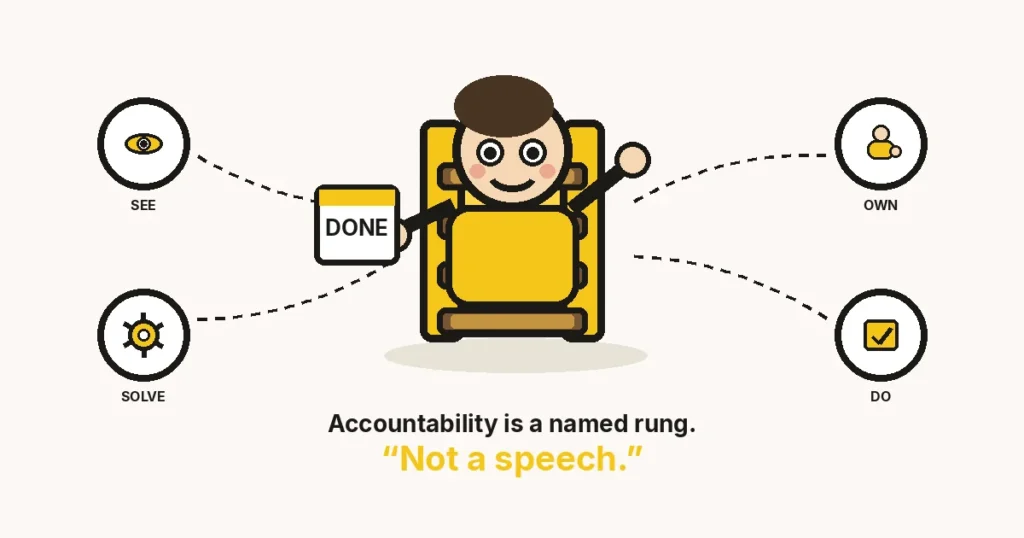
The accountability ladder is a map of where stalled work is sitting — below the line in blame, excuses and wait-and-hope, or above it in see, own, solve and do. It is a workplace teaching tool, not a personality test. Name the rung out loud. Then take the next one. A speech about being accountable is not a climb.
Key takeaways
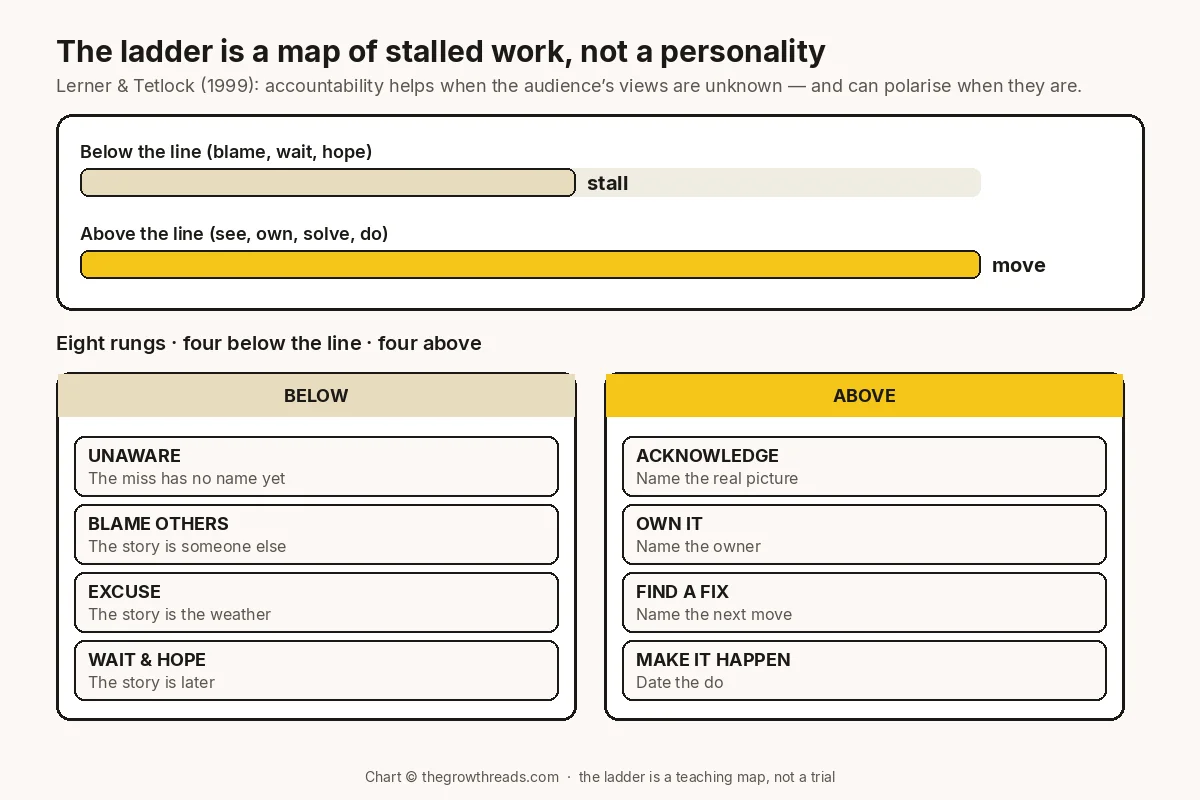
- Roger Connors, Tom Smith and Craig Hickman taught the accountability ladder in 1994 as a workplace map: four rungs below the line (unaware, blame, excuse, wait) and four above it (acknowledge, own, solve, do) — a teaching poster, not a lab instrument.
- Jennifer Lerner and Philip Tetlock (1999) reviewed decades of accountability experiments and found the effect is not uniformly good: an unknown audience can make thought more careful, and a known partisan audience can polarise it.
- Philip Tetlock (1983, 1985) showed that knowing you will have to explain a judgment can raise the complexity of thought and check the rush to blame a person instead of a situation — useful next to the “blame others” rung, not a proof that eight rungs exist in the brain.
- Edwin Locke and Gary Latham (2002) summarised goal-setting evidence: specific, hard goals beat vague “do your best” intentions, which is why “make it happen” on the ladder has to be a dated do, not a values speech.
- Seth Godin’s Linchpin is the named unused review on this URL: shipping the work instead of waiting for a permission slip is the top rung in book form, not another accountability slogan.
What the accountability ladder actually is
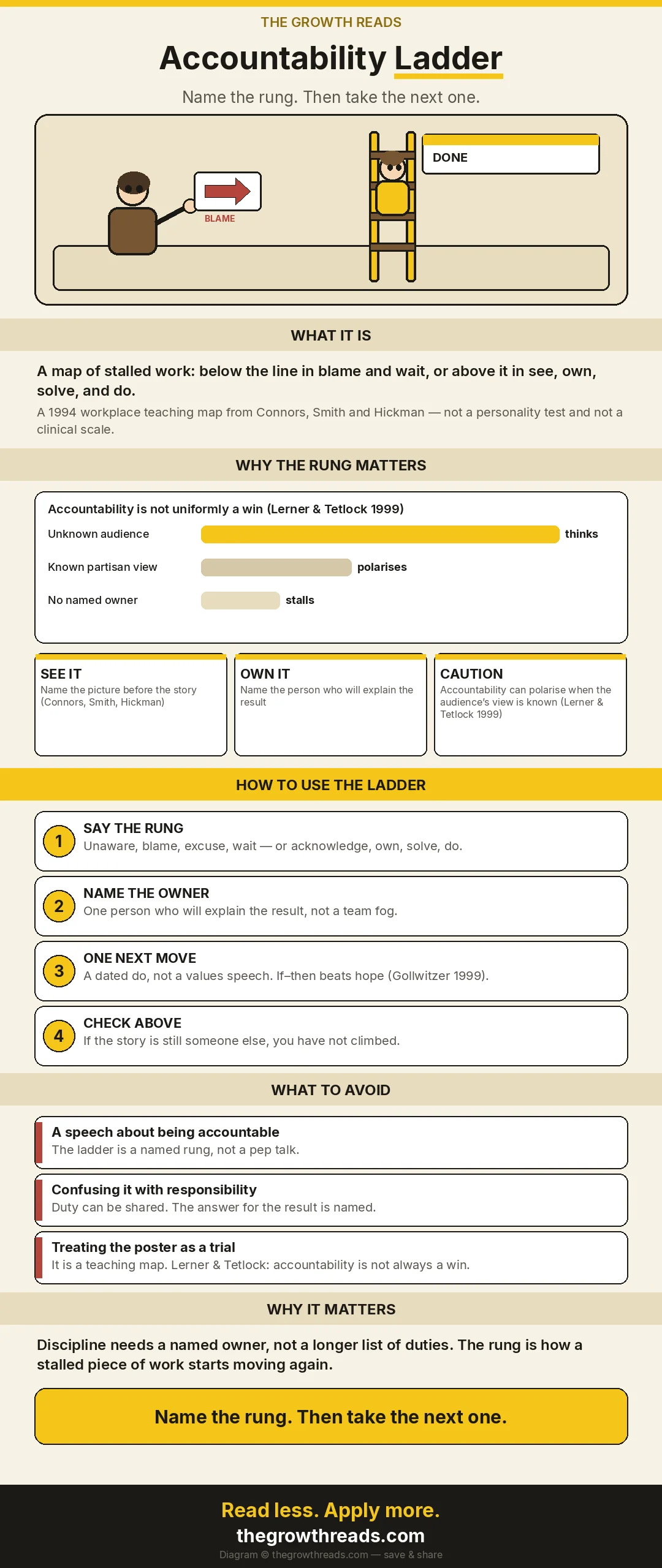
The accountability ladder is a map of stalled work: below the line the story still lives in someone else, the weather, or later; above the line someone can see the picture, own the result, name a fix, and date a do. It is not a personality, not a moral score, and not a clinical scale. If you cannot point at the rung in a sentence a stranger could check, you do not have a ladder. You have a poster.
Connors, Smith and Hickman put that map into workplace language in 1994. The useful object is blunt. Teams already know how to give a speech about ownership. They are worse at noticing that a task is still sitting on “wait and hope” while the slide says “we take accountability.” The ladder’s job is to make that mismatch expensive to ignore. It is a Discipline child, which is why this spoke links up to live how to build discipline rather than minting a new parent. Habits-cluster articles on this site still climb to live keystone habits. This URL is not that parent and does not replace it.
The research this page will stand on is adjacent, and we will say so. There is no randomised trial of eight named rungs. There is a large literature on what happens when people expect to explain a judgment, what happens when a goal is specific instead of a vibe, and how blame stories form. Use those. Do not pretend a 1994 teaching poster is a neuron.
How is this different from responsibility, blame, and a pep talk?
Responsibility can be a duty on a shared list. Blame is a story with a villain. A pep talk is heat without a dated do. The accountability ladder is the named rung plus a named owner.
A team can split a duty into twelve boxes and still have no one who will explain the result on Friday. That split is the point of accountability versus responsibility when that page is the vocabulary job. This URL is the map you open after the words are clear. Sister page how to take accountability is the practice of picking the owner-role up. Personal accountability is what that owner-role is called when it is a person, not a department. Keep the lanes. If you came here for a method, stay on the rungs. If you came here to redefine a word, those sisters are cleaner.
Why work sits on a rung
Work sits on a rung because a cheap story is cheaper than a dated do — until the bill shows up as a week of “we are waiting.” That is the mechanism, not “people are lazy,” and not a character flaw you diagnose from a slide.
Bernard Weiner’s 1985 attributional model is the cleanest research cousin of the lower rungs. People explain failure with causes that are internal or external, stable or unstable, controllable or not. “They dropped it” (external) and “the vendor is always like this” (stable, external) are ladders that never need a next move. “I missed the date, and I can send the file by Thursday” is a different attribution: internal enough to own, controllable enough to fix. Weiner’s paper is not the eight-rung poster. It is why blame and excuse feel like thinking. They are stories that locate the cause where your calendar does not have to change.
Philip Tetlock’s 1983 and 1985 experiments add the social check. When people knew they would have to explain a judgment to an audience whose views they did not know, their thinking got more complex, and they were less quick to pin a person’s behaviour on the person’s character. That is the honest use of “accountability” as a research word: an expected explanation, not a branding value. It is also the limit. An expected explanation can improve a judgment. It can also, as Lerner and Tetlock later summarised, make people perform the views they think the audience already holds.
Counter-case. Accountability is not uniformly a win. Lerner and Tetlock (1999) are explicit: pre-decisional accountability to an unknown audience can improve thought; accountability to a known partisan audience can polarise it. The ladder fails as a tool when it is used as a public shaming, when the “owner” has no authority to change the work, or when the stall is not a missing rung but a missing resource. If you cannot name the picture, the owner, and a do the owner can actually run, stop drawing rungs.
The eight rungs
Name the rungs by the story they tell, then compress the top four to see, own, solve, do when you need a short map. You do not need three posters. You need one sentence that survives a hostile read.
| Rung | The story | The tell | The next move |
|---|---|---|---|
| Unaware | Nothing is wrong, or nothing has a name yet | Surprise when the date was already missed | Write the picture in one sentence before defending it |
| Blame others | The stall has a villain | A name, a team, a vendor — and no dated do of yours | Keep the fact; drop the villain as the whole explanation (Tetlock, 1985) |
| Excuse | The stall has weather | “Once X,” “because of Y,” still no owner | Separate the constraint you cannot move from the move you still have |
| Wait and hope | The stall has a later | A calendar with no name on the send | Put a person and a time on the next visible action |
| Acknowledge | The picture is nameable | You can say what is true without a villain or a later | See it: one sentence of reality, dated |
| Own it | The result has a person | Someone will explain Friday’s outcome | Name the owner out loud, not in a shared fog |
| Find a fix | The stall has a next move | Options, not a values speech | Solve it: one option you will actually try |
| Make it happen | The stall has a dated do | A file, a send, a decision with a clock | Do it: specific and dated (Locke & Latham, 2002) |
See, own, solve, do is the short version of the top four. It is easier to say in a standup. It is also easier to fake. “We own this” with no name is still wait-and-hope in a nicer jacket. The hub at the productivity library is full of methods that fail the same way when they become collections rather than a next visible action. Temptation bundling and monk mode are other Discipline children. They are not this map. Do not borrow their motifs and do not borrow their jobs.
The top rung is why this spoke down-links to Linchpin rather than to another accountability slogan. Seth Godin’s book is about becoming the person who ships, not the person who waits for a permission slip. That is “make it happen” in trade language. The book stays on the review. This page keeps the rungs. You do not need Godin’s whole argument to date a send. You do need to stop treating “we take accountability” as the send.
See, own, solve, do is a compression, not extra science
The four-verb version is a shorter poster of the top half. It does not add a trial, and it does not delete the lower rungs. If you skip “see it,” own-it becomes a confession contest. If you skip “own it,” solve-it becomes a brainstorm with no sender. If you skip “solve it,” do-it is busywork. If you skip “do it,” you have a values offsite. Albert Bandura’s 1977 self-efficacy paper is the adjacent claim for the last two verbs: people take on actions they believe they can run. A dated do that the named owner cannot actually run is a decorative rung. Shrink the do until it fits the authority they have, or change the owner. Do not shout efficacy at a blocked calendar.
Why a stall costs more than it feels like
A stall feels cheap because each meeting is short. The bill is a week spent narrating the villain while the file does not move.
Locke and Latham’s 2002 summary is the cost sheet for the top of the ladder. Specific, hard goals beat vague “do your best” intentions across a large evidence base they review. Translate that onto a stalled project and you get the miss: “we need to be more accountable” is a do-your-best goal wearing a values badge. “Send the spec, owner Maya, Thursday 16:00” is a goal the literature would actually recognise. That is not a claim that writing eight rungs on a whiteboard raised anyone’s output. It is a claim that the top rung has to look like a goal, not like a mood.
The lower rungs have a cost that does not show up as a missed goal, because no goal was ever dated. Blame others spends the hour on a character study. Excuse spends it on weather. Wait and hope spends it on a shared document that nobody opens. Tetlock’s 1985 paper — accountability as a check on the fundamental attribution error — is the research warning inside that hour: without an expected explanation, it is easy to over-weight a person’s character and under-weight the situation. With a badly designed audience, you just perform the character study they wanted. Either way the file can sit.
So the honest claim is smaller than the diagram. Naming the rung can stop you donating a week to a story. It does not prove the next week shipped. Judge a climb by whether the dated do happened, not by whether people used the word accountability in the recap. Self discipline examples are what a climb looks like in a day. They are not this URL. This URL is the map of the stall those examples climb out of.
How to use the accountability ladder
Say the rung, name the owner, date one do, and check tomorrow whether the story is still someone else. This is a selection pass, not a numbered how-to product. There is no HowTo schema on this page because the slot is a spoke.
Start with one stalled piece of work, not a culture programme. If you need the habit of picking the owner-role up as a person, that practice lives on how to take accountability. If you need the parent skill of staying on a hard thing when the story gets loud, that is how to build discipline. Then say the current rung in a sentence a stranger could verify: “This launch is on wait-and-hope because the send has no name.” If the sentence needs a feeling, it is not a rung yet.
Name one owner. Not a channel. Not “the team.” The person who will explain Friday’s result. Write one next move as an if-then so it does not need a speech tomorrow: after standup, in the spec doc, I will paste the open questions and send them by 16:00. Gollwitzer (1999) is the if-then literature for that sentence — specified behaviours, not identities. “Be more accountable” is an identity. “Send the questions” is a behaviour. Locke and Latham would recognise the second. Bandura would ask whether the owner can actually run it. If they cannot, you named a mascot, not an owner.
Check the story the next working day. If it is still a villain, a weather report, or a later, you have not climbed, however complete the poster on the wall. Implementation intentions are the written form of the dated do. The 1-3-5 rule is one way to stop a day collecting twelve owner-less duties. Neither replaces saying which rung today’s stall is on.
Common mistakes that turn the ladder into a poster
- Giving a speech about being accountable. Heat without a dated do is still wait-and-hope. The rung is a sentence, not a tone.
- Naming a team as the owner. A channel cannot explain Friday. A person can. See personal accountability.
- Collapsing duty and answer into one word. Responsibility can be shared. The answer for the result is named. Keep accountability versus responsibility in its lane.
- Using the ladder as a shaming tool. Lerner and Tetlock (1999): a known partisan audience can polarise thought. A public dunk is not a climb.
- Skipping “see it.” Own-it without a named picture is a confession contest. Write the reality in one sentence first.
- Dating a do the owner cannot run. Bandura (1977): people take on what they believe they can do. Shrink the do or change the owner.
- Quoting the poster as a trial. Eight rungs are a teaching map. The evidence is adjacent (accountability, goals, attribution), not a randomised ladder. A mental discipline page that stays put is a cousin; it is not proof that your whiteboard worked.
When it is more than a work habit
The accountability ladder is for stalled work you can attach to a named owner and a dated do. It is not a diagnosis, a trauma plan, or a substitute for help when starting anything is broken across every context. This is a productivity method page. It does not treat, and it does not list clinical symptoms. If the stall is “I cannot begin, anywhere, for weeks,” that is not a missing rung. That is a different problem, and a clinician is the right next step — not a prettier ladder. Sleep, pain, and mood belong with people qualified to handle them. You can still name today’s owner while that other work happens. The diagram cannot hold “fix my life,” and it cannot hold a workplace where the named owner has no authority and no resource. In that case the honest rung is a constraint, not a character.
The evidence behind this
The literature supports a real effect of expected explanation on judgment, a real benefit of specific hard goals over vague intentions, and a real pattern in how people locate blame. It does not support eight rungs as a validated scale or a randomised win for a workplace poster.
| Study | Design and size | Finding we used | Limit |
|---|---|---|---|
| Lerner & Tetlock, 1999 | Psychological Bulletin review of accountability experiments | Accountability to an unknown audience can improve thought; a known partisan audience can polarise it | A review, not a new trial of eight rungs; effects depend on how accountability is designed |
| Tetlock, 1983 | Laboratory studies of accountable versus unaccountable judges | Expecting to explain a judgment raised integrative complexity of thought | Lab judgments, not a product launch; not the ladder poster |
| Tetlock, 1985 | Laboratory check on the fundamental attribution error under accountability | An expected explanation reduced the rush to blame character over situation | One bias, one design family; not knowledge-work field data |
| Locke & Latham, 2002 | American Psychologist summary of goal-setting evidence | Specific, hard goals beat vague “do your best” intentions | A summary of a programme, not a trial of “make it happen” as a slogan |
| Gollwitzer, 1999 | Review of implementation-intention experiments | If-then plans bind a cue to a specified action | Not an accountability-ladder trial; effects are for named behaviours, not identities |
| Bandura, 1977 | Psychological Review theory of self-efficacy | People take on actions they believe they can run | A framework paper; used here as a limit on decorative owners |
| Weiner, 1985 | Psychological Review attributional theory of motivation and emotion | Failure explanations vary by locus, stability, and controllability — the shape of blame and excuse | A theory paper, not a workplace ethnography of eight rungs |
| Connors, Smith & Hickman, 1994 | Workplace teaching map (trade book) | Below-the-line versus above-the-line language; see, own, solve, do as a compression | Not a trial; this page treats it as a map and borrows evidence from the rows above |
Frequently asked questions
What is the accountability ladder?
The accountability ladder is a workplace map of stalled work. Below the line sit unaware, blame others, excuse, and wait-and-hope. Above the line sit acknowledge, own it, find a fix, and make it happen — often compressed as see, own, solve, do. Roger Connors, Tom Smith and Craig Hickman taught that map in 1994. It is not a personality test and not a clinical scale. Name the rung out loud. Then take the next one. A speech about being accountable is not a climb, and a team fog is not an owner.
What are the rungs of the accountability ladder?
Eight rungs, four below the line and four above. Below: unaware, blame others, excuse, wait and hope. Above: acknowledge reality, own it, find a solution, make it happen. The above-the-line four compress to see, own, solve, do. You do not need to memorise every poster synonym. You need a sentence a stranger could check: which rung is this task on, and who will explain the result on Friday. If that sentence still names a villain or a later, you are still below the line.
How is the accountability ladder different from responsibility?
Responsibility can be a duty on a list. Accountability is the named person who will explain the result. A team can share a duty and still have no owner, which is how a stall hides in a shared document. Sister page how to take accountability is the practice of picking up that owner-role. Accountability versus responsibility is the vocabulary split. This URL is the map you use once the words are clear: where is the work sitting, and what is the next rung, not a longer list of jobs.
Does accountability always improve work?
No. Jennifer Lerner and Philip Tetlock’s 1999 Psychological Bulletin review is the counter-case this page will not bury. Accountability to an audience whose views you do not know can make thought more careful. Accountability to a known partisan view can increase conformity and polarise the story. So “hold people accountable” is not a universal win. The ladder is a teaching map for naming a stall. It is not a licence to run a public shaming, and it is not evidence that a poster raised output.
How do you climb the accountability ladder at work?
Say the current rung in a sentence someone else could verify. Name one owner who will explain the result. Write one dated next move — after this meeting, in this doc, I will send X by Friday. Peter Gollwitzer’s 1999 implementation-intention work is the if-then form of that do, for a specified action, not for “be more accountable.” Check again tomorrow: if the story is still someone else, you have not climbed. This page is a spoke, not a numbered how-to product, so there is no step schema here.
Is the accountability ladder a scientific model?
It is a teaching map from a 1994 workplace book, not a validated psychometric instrument and not a randomised trial of eight rungs. The research this page stands on is adjacent: Lerner and Tetlock on when accountability helps or polarises, Philip Tetlock’s earlier work on accountable judgment, Edwin Locke and Gary Latham on specific hard goals, Albert Bandura on self-efficacy, and Bernard Weiner on how blame stories form. Use the ladder to name a stall. Do not quote it as a lab finding.
What does “below the line” mean on the accountability ladder?
Below the line means the story of the stall still lives in someone else, the weather, or later. Unaware has no name yet. Blame others has a villain. Excuse has a circumstance. Wait and hope has a calendar with no owner. None of those are moral scores. They are cheap stories that keep the work from moving. Above the line starts when you can describe the picture, name who will explain the result, and date a next move. If you cannot point at those three, you are still below, however passionate the speech.
What should I read after this page?
Start with how to build discipline, the Discipline parent this spoke climbs toward. How to take accountability is the sister practice. Personal accountability is the vocabulary of the owner-role. Accountability versus responsibility keeps the duty and the answer from collapsing into one word. Temptation bundling and monk mode are other Discipline children; they are not this map. Linchpin is the named book: shipping the work instead of waiting for a permission slip. The productivity library holds the rest of the silo.
Sources
- Lerner, J. S., & Tetlock, P. E. (1999). Accounting for the effects of accountability. Psychological Bulletin, 125(2), 255–275. https://doi.org/10.1037/0033-2909.125.2.255
- Tetlock, P. E. (1983). Accountability and the complexity of thought. Journal of Personality and Social Psychology, 45(1), 74–83. https://doi.org/10.1037/0022-3514.45.1.74
- Tetlock, P. E. (1985). Accountability: A social check on the fundamental attribution error. Social Psychology Quarterly, 48(3), 227–236. https://doi.org/10.2307/3033683
- Locke, E. A., & Latham, G. P. (2002). Building a practically useful theory of goal setting and task motivation. American Psychologist, 57(9), 705–717. https://doi.org/10.1037/0003-066X.57.9.705
- Gollwitzer, P. M. (1999). Implementation intentions: Strong effects of simple plans. American Psychologist, 54(7), 493–503. https://doi.org/10.1037/0003-066X.54.7.493
- Bandura, A. (1977). Self-efficacy: Toward a unifying theory of behavioral change. Psychological Review, 84(2), 191–215. https://doi.org/10.1037/0033-295X.84.2.191
- Weiner, B. (1985). An attributional theory of achievement motivation and emotion. Psychological Review, 92(4), 548–573. https://doi.org/10.1037/0033-295X.92.4.548
- Godin, S. (2010). Linchpin: Are you indispensable? Portfolio. TGR review: Linchpin summary.
Related reading on The Growth Reads
The books this method draws on
- Linchpin summary & review — the named unused review; shipping instead of waiting for a permission slip
Related articles
- How to build discipline — the Discipline parent this spoke climbs toward
- How to take accountability — the sister practice of picking up the owner-role
- What is personal accountability — the owner-role as a person, not a department
- Accountability vs responsibility — duty can be shared; the answer is named
- Temptation bundling — another Discipline child, not this map
- Monk mode — another Discipline child, not this map
- Implementation intentions — the written if-then for the dated do
- Self discipline examples — what a climb looks like in a day
- Mental discipline — staying put, not a speech
- The 1-3-5 rule — stop a day collecting owner-less duties
Go deeper
How this article was researched
The Growth Reads editorial team writes from primary sources: the books themselves, the authors’ published essays, and the peer-reviewed literature behind the claims. Every study cited above was read in the original publication or its published abstract, and every figure is quoted with its design and limit so you can judge its weight rather than take ours. Where a finding is a review of accountability designs, a lab judgment task, a goal-setting summary, an if-then literature, a self-efficacy framework, an attribution theory, or a 1994 teaching map rather than a randomised test of eight rungs, we say so in the body rather than in a footnote.
This page is a productivity method, not a book review of any single title, and not medical or clinical advice. Persistent inability to start work across contexts belongs with a clinician, not with a prettier ladder. Discipline-cluster articles on this site link up to live how to build discipline. Habits-cluster articles still link up to live keystone habits. This URL does not mint a new habits parent.
How we work: every article on The Growth Reads is built from the books in our library plus the research they rest on, and is reviewed and date-stamped when the evidence changes. Read our full methodology.