

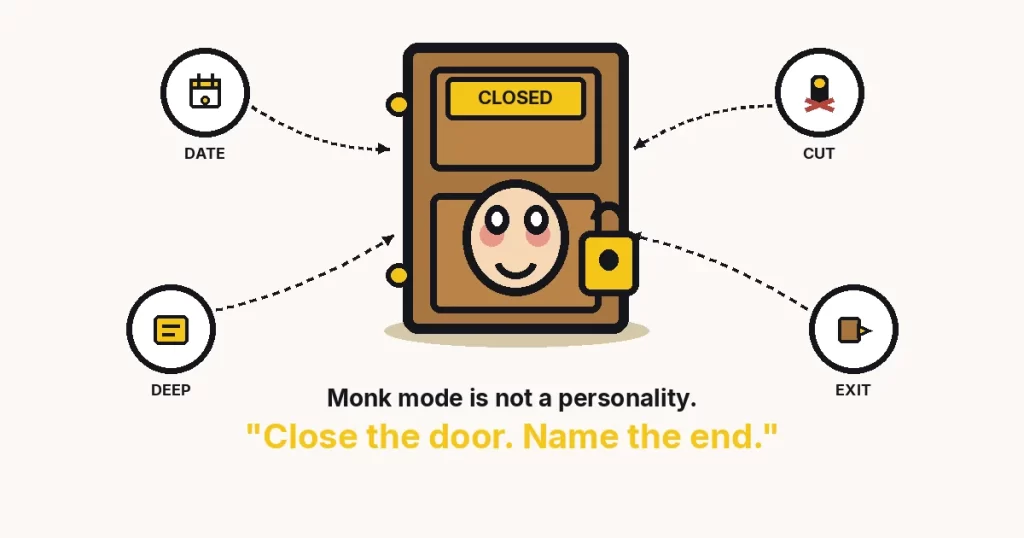
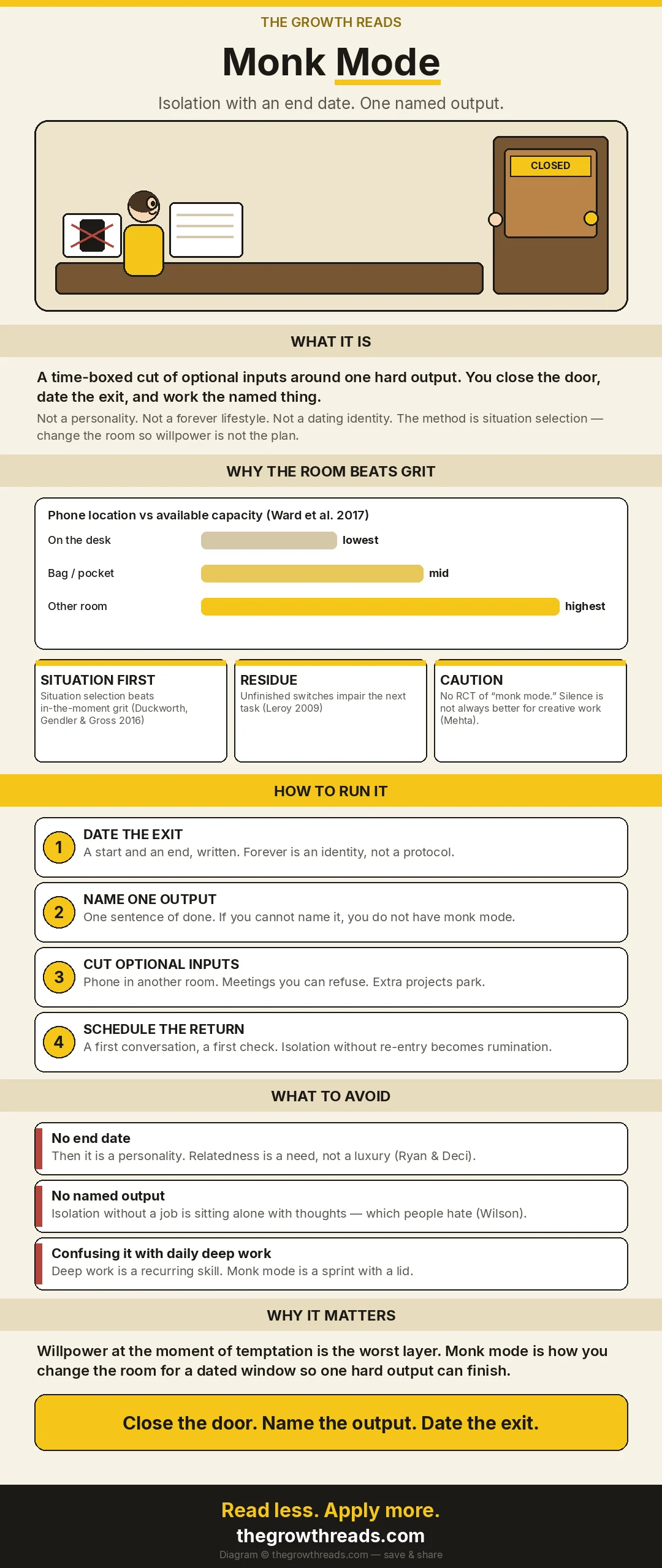
Monk mode is a time-boxed isolation protocol: you cut optional inputs for a named window so one hard output can finish. It is not a personality and not a forever identity. The method is situation selection — change the room so willpower is not the plan. Undated isolation is rumination wearing a robe.
Key takeaways
- Monk mode is a dated cut of optional inputs around one named output; it is not a personality, not a forever lifestyle, and not a dating identity (practitioner method; there is no randomised trial of “monk mode”).
- Situation selection and situation modification outperform in-the-moment willpower as self-control strategies (Duckworth, Gendler and Gross, 2016).
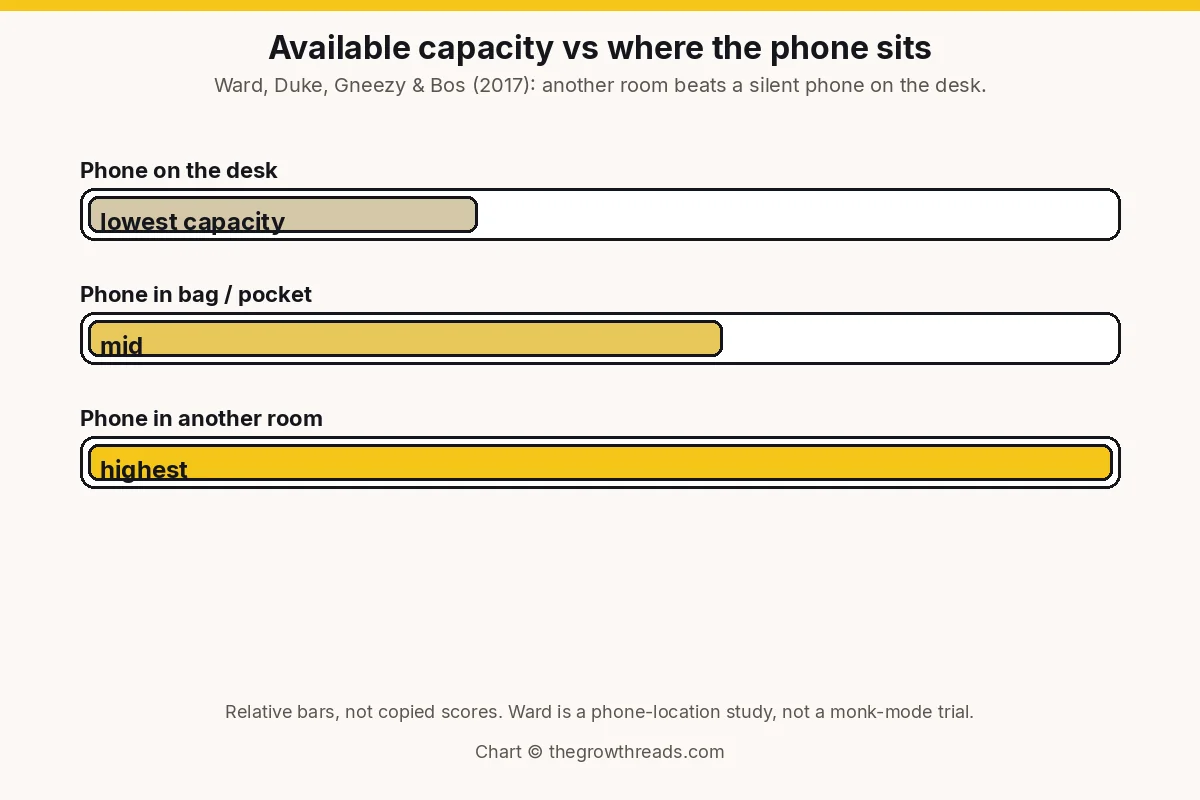
- A silent smartphone on the desk still reduces available working memory and fluid intelligence compared with leaving it in another room (Ward, Duke, Gneezy and Bos, 2017).
- Ordinary people find sitting alone with their thoughts aversive; some even choose mild electric shocks over undirected solitude (Wilson et al., 2014) — which is why an undated monk mode fails.
- Relatedness is a basic psychological need, not a luxury you can delete forever (Ryan and Deci, 2000). The exit date is part of the method.
What is monk mode?
Monk mode is a time-boxed isolation protocol: you cut optional inputs — social media, meetings you can refuse, extra projects, entertainment on tap — for a named window so one hard output can finish. The window has a start and an end, written down. The output is a sentence of “done,” not a vibe. If you cannot name the output, you do not have monk mode. You have a mood.
This page hangs off how to build discipline, the Discipline cluster page. Discipline is the daily skill of staying put when you want to leave. Monk mode is not that skill. It is a temporary room you build around one job so the daily skill has less to fight. The sister in this cluster is temptation bundling — pairing a want with a should instead of cutting the want. Both are situation design. They point opposite ways. Pairing is how you keep a gym habit when you also want a show. Cutting is how you finish a draft that cannot share the room with a feed.
There is no randomised trial that assigned people “go monk for thirty days” and measured shipped work. Be honest about that up front. What we do have is a research family on situational self-control: changing the environment so the hard thing is the default, rather than waiting to feel like a monk at 9 p.m. Angela Duckworth, Tamar Gendler and James Gross’s 2016 paper in Perspectives on Psychological Science is the map. Earlier stages — picking the situation, then modifying it — beat grit in the moment. Monk mode is situation selection at the scale of a week or a month. Ryan Holiday’s Discipline Is Destiny is the named review for choosing the hard thing as a practice, not a costume. The book stays on the review. This URL is the method: close the door, name the output, date the exit.
How is monk mode different from deep work, a digital detox, or temptation bundling?
Deep work is a recurring skill of undistracted concentration; a digital detox cuts screens without naming an output; temptation bundling pairs a want with a should; monk mode is a dated cut around one job. Productivity posts mash these together because they all involve saying no. They are not the same object.
| Practice | What is cut or paired | End date? | What it is not |
|---|---|---|---|
| Monk mode | Optional inputs around one named output | Required, written | Not a personality, not celibacy, not a worldview |
| Deep work | Distraction during a bout | Recurring; not a sprint | Not a social freeze. Live cousin: what deep work actually means |
| Digital detox | Screens, often vaguely | Often missing | A cut without a job. Isolation is not the point |
| Temptation bundling | Nothing cut; a want is paired with a should | Ongoing pairing | The opposite shape. Pair, don’t vanish |
| Mental discipline | The urge to leave the desk | Daily | Staying put. Isolation is not required |
The last two rows matter for later pages. What deep work actually means is the daily-skill page. You can run deep-work bouts inside a monk-mode window, and you can run them without ever going monk. Mental discipline is staying put when the room is ordinary. If your only way to work is to disappear, you do not yet have that skill — you have a sprint. The productivity library already has those cousins doing their jobs. This URL owns the dated isolation.
Why do people reach for monk mode?
People reach for monk mode because willpower at the moment of temptation is the worst layer, and the modern default room is built to lose. Duckworth, Gendler and Gross (2016) put that in order. Their process model of self-control runs from situation selection, through situation modification, attentional deployment, and cognitive change, down to response modulation — the grit you try to summon when the feed is already open. Later stages are more effortful and less reliable. Earlier stages change what you have to resist. A phone in another room is situation modification. A two-week calendar with no optional meetings is situation selection. The discipline is in the setup, not in a speech at 11 p.m.
Adrian Ward, Kristen Duke, Ayelet Gneezy and Maarten Bos’s 2017 paper in the Journal of the Association for Consumer Research is the phone finding everyone should quote instead of a folklore “willpower battery.” Across two experiments, people who left their smartphone in another room had more available working memory and fluid intelligence than people who kept it on the desk — even when the phone was face-down and silent. Nearby still taxes you. Face-down is not enough. Monk mode’s CUT move is that finding at the scale of a project: the device is not in the work room, and neither are the optional inputs that behave like a phone even when they are a tab.
Sophie Leroy’s 2009 experiments add the residue. Switching away from unfinished Task A leaves attention attached to A, and that residue measurably drags Task B. A feed you “just check” is not a free glance. It is a new A. Monk mode is how you stop manufacturing unfinished A’s for a dated window. Cary Stothart, Ainsley Mitchum and Courtney Yehnert found in 2015 that merely receiving a cell-phone notification — without looking or touching — disrupted performance on an attention-demanding task by roughly the same magnitude as actually answering. Silence on the desk is still a channel. The protocol is not “be stronger than the ping.” It is “do not leave a ping in the room.”
The four moves that make it a protocol
- Date the exit. Write a start and an end. Fourteen days, four weeks, the Friday the draft is due. Forever is an identity. Edward Deci and Richard Ryan’s 2000 statement of self-determination theory in American Psychologist is why the date exists: relatedness is a basic psychological need, alongside autonomy and competence. You can park optional social inputs for a window. You cannot delete belonging as a personality and call it productivity. If there is no end date, you are not in monk mode. You are rehearsing a disappearance.
- Name one output. One sentence of done: “the chapter is submitted,” “the prototype is in front of three users,” “the course is recorded.” If the output is “become focused” or “become a monk,” you have a slogan. How to focus better is the daily-trigger page. This page is the sprint. Peter Gollwitzer and Paschal Sheeran’s 2006 meta-analysis (94 tests, d = 0.65) is why the output gets an if–then, not a vibe: “On weekdays from 8:30 to 12:00, at the desk, with the phone in the kitchen, I work the named output.”
- Cut optional inputs. Phone in another room. Meetings you can refuse, refused. Extra projects parked with a return date, not secretly kept in a second tab. This is situation selection, not a character upgrade. You are not becoming someone who never wants a feed. You are removing the feed from the window in which the output has to exist. Notification overload is the live cousin for the ping itself. Single tasking is the bout-level refusal to switch once the door is closed.
- Schedule the return. The first conversation, the first check, the first optional meeting you will take when the window ends. Isolation without a re-entry plan is how a protocol becomes rumination. Timothy Wilson and colleagues’ 2014 Science paper is the warning, not a joke: people left alone with their thoughts often found the sitting unpleasant, and in one experiment a substantial share of participants chose to give themselves a mild electric shock rather than continue undirected solitude. Monk mode is not “sit with your thoughts.” It is work in a quieter room. The return is how you prove that.
None of those four is a personality. They are a shape you can run when one output cannot share the week with optional noise. Temptation bundling remains available on the other side of the door — pair the gym with the show on the days you are not in the window. Monk mode is the window. Bundling is the rest of the year.
Why does undated isolation cost more than it feels like?
Undated isolation costs you the output you never quite finish, because a protocol without a lid becomes an identity, and identities do not ship. Wilson et al. (2014) is the solitude finding people quote as a party trick. Use it as a limit. Their participants were not in monk mode. They were asked to sit and think. Many disliked it. Some shocked themselves to feel something. That is not evidence that isolation produces work. It is evidence that isolation without a job is aversive for ordinary minds. A monk-mode window that has no named output is that sitting, stretched to a month, with better branding.
Ryan and Deci (2000) is the other half of the bill. If relatedness is a need, then a forever cut is not an advanced form of discipline. It is a starved need wearing a productivity hat. You can date a cut. You cannot replace other people with a closed door and expect competence and autonomy to carry the whole load. Holiday’s Discipline Is Destiny review is useful here because the book’s subject is virtue as a practice you return to in ordinary life, not a disappearance you perform once. The down-link is that practice. This page is the sprint you sometimes put around one hard job.
Ravi Mehta, Rui (Juliet) Zhu and Amar Cheema’s 2012 paper in the Journal of Consumer Research is the creative caveat. Moderate ambient noise (around 70 dB in their studies) can help creative cognition relative to both silence and loud noise. Monk mode’s CUT move is about optional inputs you choose, not a vow of sensory deprivation. A café with a laptop and no phone can be a monk-mode room. A silent cell with no job is not a better version of the same thing. Quote it as a limit: silence is not a creative sacrament. The method is the dated cut of optional inputs, not the aesthetic of a cave.
Two honest caveats. There is no randomised trial of monk mode. Ward (2017) is a phone-location study. Duckworth, Gendler and Gross (2016) is a theoretical review of situational strategies, not a thirty-day isolation protocol. Wilson (2014) is undirected solitude, not a work sprint. Mehta, Zhu and Cheema (2012) is ambient noise and creativity in the lab. Use those papers to explain why a dated, job-shaped room can help. Do not quote them as a certificate that disappearing for a month is the scientifically correct duration.
How does monk mode actually run?
Write the window, name one output, cut the optional inputs that would steal it, then work the bouts and take the scheduled return. The mistake is treating monk mode as a personality you announce. The method is a container you rebuild when one job cannot share the week.
Name the sitting the way you would name a calendar block: “Monday 15 September to Friday 3 October, chapter two submitted, phone in the kitchen, no optional calls before 4 p.m.” If monk mode is “be more disciplined,” you do not have monk mode. You have a slogan. How to build discipline is the parent for that stall: you are still comparing identities instead of dating a room. A window whose first line is a self-help sentence is a mood board.
Protect the output with the cuts, then stop adding cuts. If a meeting is required, it stays. If a person is your life, they stay. Optional is the word doing the work. A protocol that cuts sleep, meals, or required work is not monk mode. It is a crash. How to focus better still applies inside the window: name the bout’s output, phone in another room, close the loop before you switch. What flow state actually is is a possible by-product of a quiet room plus a challenge that matches skill. It is not the goal. Flow is a state. Monk mode is a calendar.
At the return, leftovers get a trial. If the output shipped, the window did its job — even if you still want a feed. If the output did not ship, the information is in the cuts you did not actually make, or in an output that was never a sentence of done. Do not extend the window as a punishment. Re-date it, or drop it. A forever extension is how a protocol becomes a costume. The productivity hub is the shelf this sprint sits on, next to the daily skills that have to work when the door is open again.
What are the common mistakes?
- No end date. Then it is a personality. Relatedness is a need (Ryan and Deci, 2000). Write the Friday you come back.
- No named output. Isolation without a job is Wilson’s sitting, not a work protocol. “Become focused” is not done.
- Confusing it with daily deep work. What deep work actually means is a recurring skill. Monk mode is a sprint with a lid. You can have one without the other.
- Copying an influencer’s thirty-day aesthetic. Robes, 4 a.m., and a public vow are theatre. The method is the dated cut and the sentence of done.
- Using the same two words as a dating identity. Some corners of the internet mean a withdrawal from other people as a worldview. That is not this page. This URL is a work protocol under discipline.
- Treating a noisy job as a character verdict. A shift you do not control, a floor that forbids a quiet block, or a life that cannot take a two-week freeze is a different layer. This page will not turn that into a verdict.
When is it more than a protocol?
If a honest window still cannot start — a shift you do not control, sleep debt, or a freeze that is not yours to begin — you are on a different layer than a closed door. Monk mode assumes you can refuse some inputs. It will not open a calendar that is already full of other people’s meetings, a job that forbids a quiet block, or a body that cannot take the bout. Do not turn a folk sprint into a verdict. This page is not an evaluation, a symptom list, or a treatment.
A second miss is rumination dressed as isolation. Closing every door and then sitting with the same three fears, with no named output and no return date, is not offloading. It is rehearsal. Wilson et al. (2014) is why that sitting is aversive for ordinary people. A clinician is the right next step if the loops are not work loops. This article will not diagnose, and it will not list clinical signs. It will say: if the window is never about a chapter, a prototype, or a submitted file, you are not on this method.
A third miss is using isolation to avoid the daily skill. If the only way you can work is to disappear, how to build discipline is still the parent page. Monk mode is a tool that parent can use. It is not a replacement for staying put in an ordinary room. Temptation bundling is the other tool: pair the want instead of cutting it, on the weeks you are not in a window.
What does the evidence actually show?
Every figure above traces to a specific published study or review. Here is the short version of what each one found — and, honestly, what it does not prove. None of them is a randomised test of a folk “monk mode” month.
| Study | Design & size | What it found | Used here for |
|---|---|---|---|
| Duckworth, Gendler & Gross (2016), Perspectives on Psychological Science | Theoretical review of self-control strategies | Earlier stages (situation selection / modification) are more effective than grit in the moment | Why monk mode is a room, not a speech |
| Ward, Duke, Gneezy & Bos (2017), Journal of the Association for Consumer Research | Lab experiments; phone on desk vs bag vs another room | Another room left more working memory and fluid intelligence available, even vs a silent desk phone | The CUT move: nearby still taxes you |
| Leroy (2009), Organizational Behavior and Human Decision Processes | Lab experiments on switching from unfinished work | Attention residue from Task A impairs Task B | Why optional switches are not free during the window |
| Stothart, Mitchum & Yehnert (2015), Journal of Experimental Psychology: Human Perception and Performance | Lab attention task; notifications without looking | Receiving a notification disrupted performance comparably to answering | Why silence on the desk is still a channel |
| Wilson et al. (2014), Science | Lab studies of sitting alone with thoughts; one shock-optional condition | People often disliked undirected solitude; some chose mild shocks over continuing | Why isolation without a job fails — a limit, not a selling point |
| Ryan & Deci (2000), American Psychologist | Statement of self-determination theory | Autonomy, competence, and relatedness are basic psychological needs | Why the exit date is part of the method |
| Gollwitzer & Sheeran (2006), Advances in Experimental Social Psychology | Meta-analysis, 94 tests of implementation intentions | Medium-to-large effect on goal achievement (d = 0.65) | Why the window is a written if–then, not a mood |
| Mehta, Zhu & Cheema (2012), Journal of Consumer Research | Lab studies of ambient noise and creative cognition | Moderate noise (~70 dB) can help creativity vs silence or loud noise | Limit: the method is cutting optional inputs, not a vow of silence |
Frequently asked questions
What is monk mode in simple terms?
Monk mode is a time-boxed isolation protocol: you cut optional inputs for a named window so one hard output can finish. You write a start and an end. You name a sentence of done. You take the phone out of the room and park extra projects. Then you work the bouts and take a scheduled return. There is no trial of a thirty-day monk. The method is situation selection, which sits under how to build discipline as a way to change the room. If you cannot name the output or the exit, you have a mood, not a protocol.
Is monk mode the same as deep work?
No. Deep work is a recurring skill of undistracted concentration you can run on an ordinary Tuesday. Monk mode is a sprint: a dated cut of optional inputs around one job. You can do deep-work bouts inside a monk-mode window, and you can run deep work forever without ever going monk. This site’s page on what deep work actually means owns the daily skill. This URL owns the window. Mixing them is how a two-week protocol turns into a personality you cannot exit, or how a useful bout gets sold as a disappearance.
How long should monk mode last?
Long enough to finish the named output, short enough that relatedness is parked rather than deleted. Two weeks is a working lid for a chapter or a prototype. A quarter is a lot. Forever is not monk mode. Ryan and Deci (2000) is why: belonging is a need. Wilson et al. (2014) is why undirected solitude is aversive. Neither paper names a correct number of days. The date exists so the sitting cannot become an identity. If you are extending the window as punishment for not shipping, you are not in a protocol. You are in a costume. Re-date or drop it.
Does monk mode actually work?
There is no randomised trial of “go monk for thirty days.” The literature supports situational self-control, not the folk robe. Duckworth, Gendler and Gross (2016) argue that changing the situation beats grit in the moment. Ward et al. (2017) showed another room leaves more cognitive capacity than a silent phone on the desk. Leroy (2009) showed unfinished switches leave residue. Stothart (2015) showed a notification you do not answer still costs. Wilson (2014) and Ryan and Deci (2000) are the limits. Run the window as a device. Do not quote those papers as a certificate that disappearing is the correct duration.
What should I cut during monk mode?
Optional inputs that would steal the named output. Phone in another room is the smallest version of the CUT move — Ward et al. (2017) is why nearby still taxes you. Meetings you can refuse, refused. Extra projects parked with a return date. Sleep, meals, required work, and people who are your life are not optional. Cutting those is a crash, not a protocol. Mehta, Zhu and Cheema (2012) is why you should not treat silence as a sacrament: moderate noise can help creative work. Cut the feed. Do not vow to live in a cave. Optional is the word doing the work.
Is monk mode a dating thing?
Not on this page. Some corners of the internet use the same two words for a withdrawal from other people as a worldview. That is not a productivity method, and it is not what this URL owns. This article is a work protocol under discipline: a dated cut of optional inputs around one named output, with a scheduled return. If your window has no job and no exit, you are not on this method. How to build discipline is the parent. Temptation bundling is the sister that pairs a want instead of cutting it. Neither is a dating identity.
What do I do when the window ends?
Take the scheduled return: the first conversation, the first optional meeting, the first check. If the output shipped, the window did its job even if you still want a feed. If it did not ship, look at the cuts you did not actually make, or at an output that was never a sentence of done. Do not extend as punishment. Re-date it, or drop it. Then use the daily skills again: how to focus better, single tasking, temptation bundling on the weeks you are not in a sprint. The door opens. That is the point of dating it.
What should I read after this page?
Start with how to build discipline, the Discipline parent this sprint sits inside, if the stall is staying put on ordinary days. Read temptation bundling if pairing a want with a should is the shape you actually need. Discipline Is Destiny is the named book on choosing the hard thing as a practice, not a costume. Then what deep work actually means for the daily skill, and how to focus better for the triggers inside a bout. Flow state is a possible by-product, not the goal. None of those replace writing this window’s output, dating the Friday, and taking the return.
Sources
- Duckworth, A. L., Gendler, T. S., & Gross, J. J. (2016). Situational strategies for self-control. Perspectives on Psychological Science, 11(1), 35–55. https://doi.org/10.1177/1745691615623247
- Ward, A. F., Duke, K., Gneezy, A., & Bos, M. W. (2017). Brain drain: The mere presence of one’s own smartphone reduces available cognitive capacity. Journal of the Association for Consumer Research, 2(2), 140–154. https://doi.org/10.1086/691462
- Leroy, S. (2009). Why is it so hard to do my work? The challenge of attention residue when switching between work tasks. Organizational Behavior and Human Decision Processes, 109(2), 168–181. https://doi.org/10.1016/j.obhdp.2009.04.002
- Stothart, C., Mitchum, A., & Yehnert, C. (2015). The attentional cost of receiving a cell phone notification. Journal of Experimental Psychology: Human Perception and Performance, 41(4), 893–897. https://doi.org/10.1037/xhp0000100
- Wilson, T. D., Reinhard, D. A., Westgate, E. C., Gilbert, D. T., Ellerbeck, N., Hahn, C., Brown, C. L., & Shaked, A. (2014). Just think: The challenges of the disengaged mind. Science, 345(6192), 75–77. https://doi.org/10.1126/science.1250830
- Ryan, R. M., & Deci, E. L. (2000). Self-determination theory and the facilitation of intrinsic motivation, social development, and well-being. American Psychologist, 55(1), 68–78. https://doi.org/10.1037/0003-066X.55.1.68
- Gollwitzer, P. M., & Sheeran, P. (2006). Implementation intentions and goal achievement: A meta-analysis of effects and processes. Advances in Experimental Social Psychology, 38, 69–119. https://doi.org/10.1016/S0065-2601(06)38002-1
- Mehta, R., Zhu, R., & Cheema, A. (2012). Is noise always bad? Exploring the effects of ambient noise on creative cognition. Journal of Consumer Research, 39(4), 784–799. https://doi.org/10.1086/665048
Related reading on The Growth Reads
The books this method draws on
- Discipline Is Destiny summary & review — the named unused review; choosing the hard thing as a practice, not a costume
Related articles
- How to build discipline — the Discipline parent; the daily skill this sprint sits inside
- Temptation bundling — the sister; pair a want with a should instead of cutting the want
- Mental discipline — staying put in an ordinary room; isolation is not required
- What deep work actually means — the daily skill; not a social freeze
- How to focus better — the triggers inside a bout
- Single tasking — the bout-level refusal to switch once the door is closed
- What flow state actually is — a possible by-product, not the goal
Go deeper
How this article was researched
The Growth Reads editorial team writes from primary sources: the books themselves, the authors’ published essays, and the peer-reviewed literature behind the claims. Every study cited above was read in the original publication or its published abstract, and every figure is quoted with its design and limit so you can judge its weight rather than take ours. Where a finding is a theoretical review of self-control strategies, a phone-location experiment, a notification study, undirected solitude, a statement of self-determination theory, or a noise-and-creativity task rather than a randomised test of a folk monk-mode month, we say so in the body rather than in a footnote.
This page is a productivity method, not a book review of any single title, not a dating guide, and not medical or clinical advice. Persistent inability to start work across contexts belongs with a clinician, not with a closed door. Habits-cluster articles on this site still link up to live keystone habits; this URL is a Discipline child and does not mint a new habits parent.
How we work: every article on The Growth Reads is built from the books in our library plus the research they rest on, and is reviewed and date-stamped when the evidence changes. Read our full methodology.