

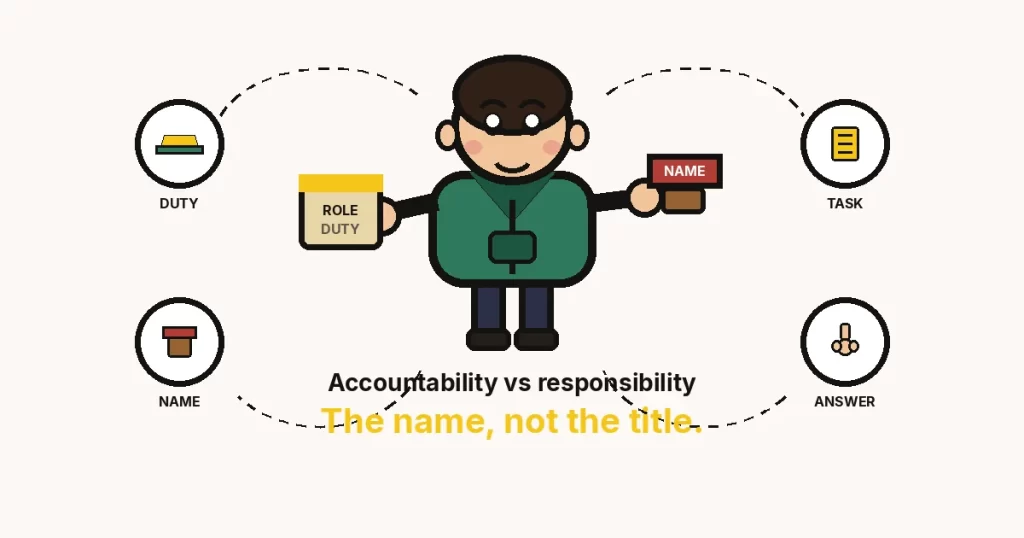
Accountability vs responsibility is the split between who answers for the result and who does the work. Responsibility is the duty on a role — shareable, delegable, listed. Accountability is the name that must explain the outcome to a forum that can judge it. Mixing the words keeps the task and loses the owner.
Key takeaways
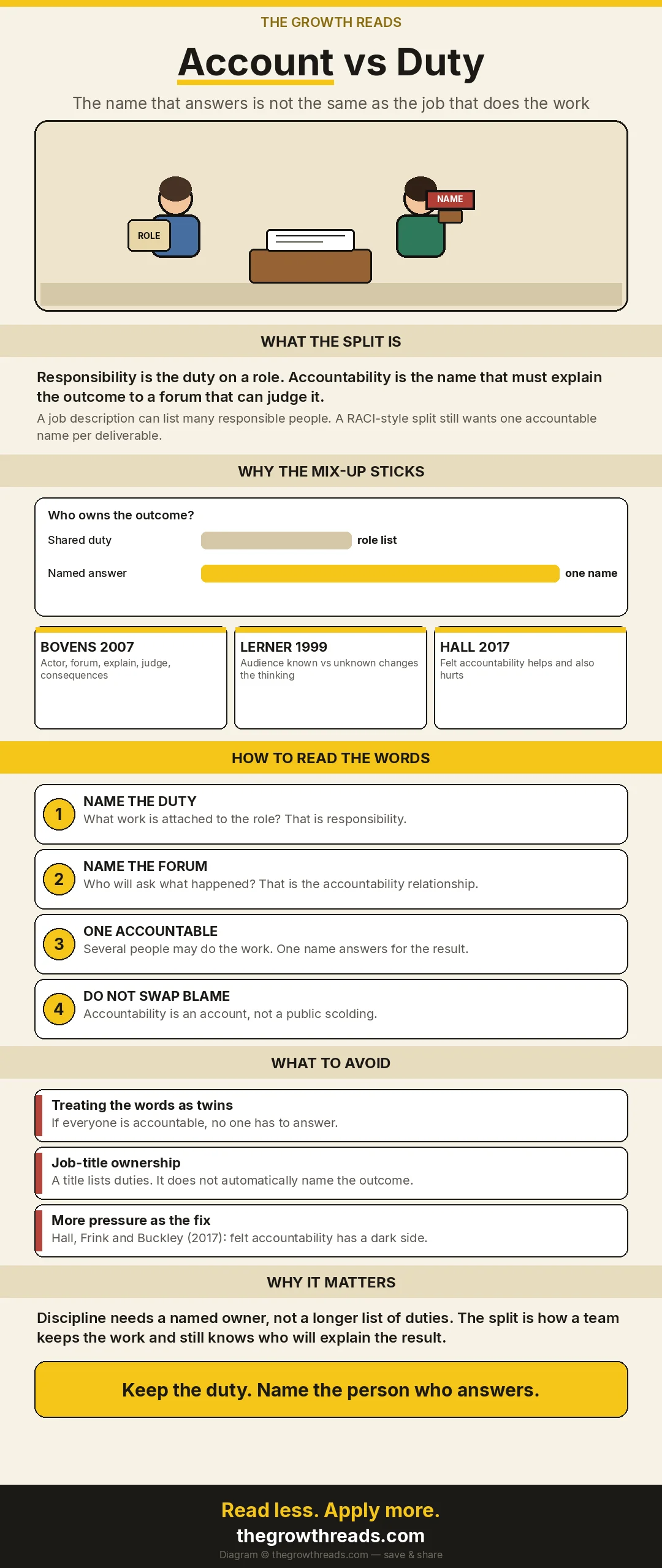
- Responsibility is the duty that attaches a person to a task through a role; Schlenker, Britt, Pennington, Murphy, and Doherty (1994) modelled that attachment as three links — prescription, identity, and event.
- Accountability is an actor–forum relationship: the actor must explain conduct, the forum can judge, and consequences can follow (Bovens, 2007).
- Lerner and Tetlock (1999) showed accountability is not one switch — a known versus unknown audience, and pre- versus post-decisional timing, change whether people think harder or just defend.
- Felt accountability has both useful and costly effects; Hall, Frink, and Buckley (2017) reviewed mixed results and warned that moderators matter.
- A job description can name many people as responsible; a RACI-style split still wants one accountable name per deliverable (Project Management Institute, 2017).
What accountability vs responsibility actually is
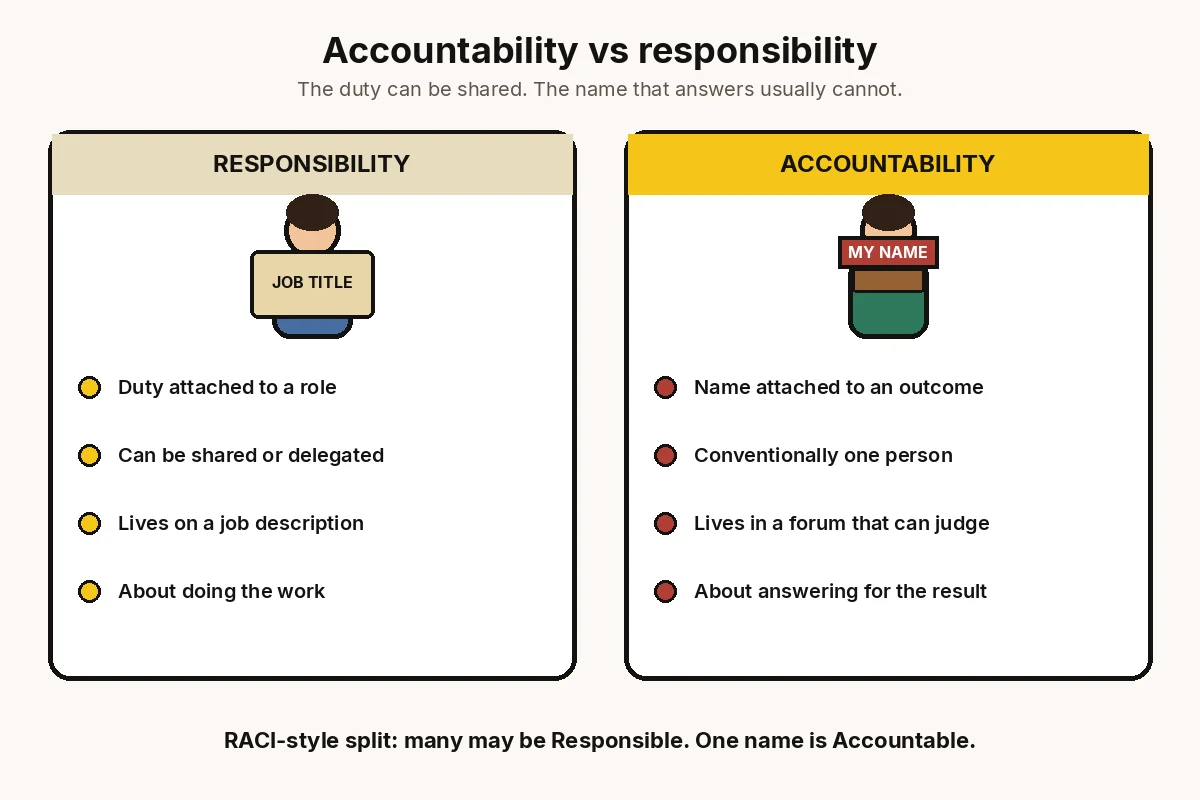
Accountability vs responsibility is a two-object split: responsibility is the duty attached to a role, and accountability is the name that has to explain the outcome. Everyday English treats the words as twins. Workplace English, project English, and the research literature do not. A job description can list five people as responsible for a launch. A forum — a manager, a client, a board, a public — still wants one name when the launch slips. That name is the accountable party. The five people may have done the work. Only one of them has to give the account.
This page hangs off the Discipline parent how to build discipline. Discipline is the habit of staying put once a standard is set. Accountability vs responsibility is the naming problem underneath that habit: if the standard has no owner, staying put has nowhere to sit. The parent is the system. This page is the recognition page — what the two words actually pick out, why they get collapsed, and which nearby pages already own the how.
The sister is already live. What is personal accountability is the definition of owning your own conduct. The method page how to take accountability is the scorecard that replaces excuses. This URL does not repeat that ladder. Play slots drop the HowTo step list on purpose. If you came here for a six-step system, that page already exists. If you came here because the search box said “accountability vs responsibility,” stay. The comparison is a different keyword from the how.
Mark Bovens (2007) gave the narrow definition this page uses for the second word. Accountability is a relationship between an actor and a forum. The actor has an obligation to explain and justify conduct. The forum can ask questions and pass judgement. The actor may face consequences. That is not a mood and not a slogan. It is a structure. Responsibility, in the psychological literature, is a different structure. Schlenker, Britt, Pennington, Murphy, and Doherty (1994) treated it as a triangle: a prescription that applies to an event, an identity bound by that prescription, and an actor connected to the event — especially by appearing to have control. Duty lives in that triangle. The account lives in Bovens’s forum. Mixing them is how a team keeps a task list and loses the person who will answer.
Jack Canfield and Janet Switzer’s The Success Principles opens with “Take 100% Responsibility for Your Life.” That sentence uses responsibility for what this page calls outcome ownership — the name on the result. The vocabulary clash is real and we name it. Canfield is not wrong about the move. He is using the everyday word for the accountability object. This page keeps the split because the search keyword is the split, and because project English already spends the two words differently. On the productivity hub, that is an ordinary Tuesday, not a character verdict.
Can you be responsible without being accountable?
Yes — and that is the whole point of the split. You can be responsible for writing the spec, booking the room, and sending the recap, and still not be the name that answers when the decision was late. The Project Management Institute’s RACI notation (PMBOK Guide, 6th ed., 2017) encodes exactly that: several roles may be Responsible — they do the work — while one role is Accountable — that role is ultimately answerable for correct completion and typically signs off. A person can hold both letters on a small task. A person can hold only R on a large one. The failure mode is not “too many helpers.” The failure mode is two A’s, or zero A’s, while the R column looks full.
The opposite of accountability is not irresponsibility. A team can be busy, skilled, and listed on every duty, and still have no forum that can ask “what happened?” of a single name. That is not laziness. It is an unnamed owner. Mental discipline is staying put once the owner is named. This page is the naming.
Why the two words collapse
The two words collapse because English uses both for “someone should have done something,” and because job titles quietly pretend a duty list is an owner. In a one-person shop the collapse is harmless: the same name does the work and answers for it. In a five-person launch the collapse is expensive. Everyone can point at the title. No one has to give the account. The title is a responsibility object. The account is an accountability object. They only look like the same sentence.
Lerner and Tetlock (1999) reviewed decades of laboratory work and refused the slogan version. Accountability is not a dimmer switch you turn up to get better thinking. Effects depend on whether the audience’s views are known in advance, whether the person expects to explain before or after the decision, and whether the forum will judge the process or only the outcome. Tetlock (1983) found that people who expected to justify a view to an audience whose position they did not know produced more integratively complex thoughts — they actually considered more than one side. Tetlock, Skitka, and Boettger (1989) showed the other face: when the audience’s views are known, the same pressure can produce conformity and defensive bolstering. More “accountability” in the hallway sense can make people defend a pick they already made, not think harder about the next one.
That is why this is a Discipline page and not a blame page. Self-discipline examples show the work of staying put. Accountability vs responsibility shows the label on the work. If the label is only a duty, the stay-put habit has no address. If the label is only a scolding, the duty never gets done because people hide. Hall, Frink, and Buckley (2017) called the individual-level version felt accountability — the perception that one will have to answer — and they were explicit that the literature shows constructive and deleterious consequences. The dark side is not a footnote. It is why “hold people more accountable” is not a strategy.
The four places the mix-up shows up
The mix-up shows up in four ordinary rooms: the job description, the group project, the calendar invite, and the post-mortem.
The job description. A title lists duties. Duties are responsibility. A title does not automatically name the outcome the holder will explain. “Owns the newsletter” is a duty until someone asks who will explain why the last three issues slipped, and only one person raises a hand.
The group project. Five names on a slide look like coverage. Coverage is shared responsibility. Coverage without a single A is how a deadline becomes a weather event. Nobody weather-reports a name.
The calendar invite. “Let’s all stay close to this” feels like care. It is a Consulted/Informed blur. The RACI letters exist because “stay close” is not a role. Someone still has to do the work, and someone still has to answer.
The post-mortem. A room that asks “who dropped this?” is hunting a blame object. A room that asks “who was the accountable name, and what did the responsible people actually hold?” is hunting the split. The first room produces silence. The second room produces a rewrite of the next RACI.
None of those four rooms require a personality defect. They require a word that was doing two jobs. Is discipline a skill already argued that staying put is trainable. This page adds the prior step: you cannot train a stay-put habit onto a duty that has no name.
Why the mix-up costs more than it feels like
The mix-up costs a delayed decision, a diluted standard, and a meeting that feels like work because nobody can close it. A full R column looks like progress. An empty A column is why the same launch is still “with the team” three Fridays later. The cost is not dramatic. It is a week of polite motion.
Bovens’s forum is the expensive part. If no forum can ask, the actor never has to prepare an account, and the work can stay in a state of almost-done forever. If the forum is a mob, Hall and colleagues’ dark side shows up: people manage the feeling of being watched instead of the work. Lerner and Tetlock’s boundary conditions are the practical warning. Process accountability to an unknown audience, before the pick, can raise the quality of thought (Tetlock, 1983). Outcome accountability after the pick, to an audience whose views you already know, can raise the quality of the speech (Tetlock, Skitka, and Boettger, 1989). Those are not the same meeting.
Canfield’s first principle still belongs here, with the vocabulary flag on. “Take 100% responsibility” is a personal move: stop waiting for the role to invent an owner. On a team, the same move is “name the A.” The Success Principles review is the unused down-link for that personal move. This page will not turn into a second scorecard. The scorecard already lives on how to take accountability.
Discipline without the split produces a longer duty list. How to build discipline is the parent because the stay-put habit needs an address. A duty list is not an address. A name that will explain the result is.
| Question | Responsibility | Accountability |
|---|---|---|
| What is attached? | A duty, via a role or prescription (Schlenker et al., 1994) | A name, via a forum that can judge (Bovens, 2007) |
| Can it be shared? | Yes — several people may do the work | Conventionally no — one A per deliverable (PMI, 2017) |
| Where does it live? | Job description, RACI “R”, task list | Sign-off, review, the person who must explain |
| What does “more” do? | More hands on the work | Not automatically better thinking (Lerner & Tetlock, 1999; Hall et al., 2017) |
| Failure mode | Unclear duty — nobody knows the task | Unclear name — everybody has a task and nobody answers |
Nearby ideas that are not this split
Several live pages sit next to this keyword and own a different object. Do not collapse them into one article.
Personal accountability is the inward version: you own your conduct even when no job description listed the hour. That is a definition page. This page is the comparison with responsibility. You can have a clean personal standard and still sit on a team with two A’s and a foggy R.
How to take accountability is the scorecard. Play slots do not reprint that ladder. If you want the moves — name the miss, write the next physical action, date the review — go there. Stay here for the words.
Accountability partner is a shared-progress device. A partner is a forum you chose. That is Bovens’s structure on purpose: someone will ask. It is not a second job title, and it is not this comparison.
Analysis paralysis is a Decisions stall: you will not pick because you keep comparing. An unnamed A can produce a stall that looks like analysis. The objects are still different. The parent of that page is a stopping rule. The parent of this page is a stay-put habit that needs an address.
How to prioritise tasks ranks the work. Ranking a list of duties without an A just produces a prettier list that still has no owner. Use that page for the ranking. Use this page for the name.
Intrinsic vs extrinsic motivation is why you start. Accountability vs responsibility is who answers after you started. A person can be intrinsically pulled toward the work and still not be the A. A person can be the A and still be doing it for a forum, not for the craft. Do not treat the motivation split as a synonym for this one.
Common mistakes
The common mistakes are vocabulary errors that look like management.
- Treating the words as twins. If everyone is “accountable,” Bovens’s forum has no actor. The word has been spent as a mood. Keep the duty. Name the person who answers.
- Job-title ownership. “That’s the Head of X’s job” is a responsibility sentence. It becomes an accountability sentence only when one name will explain the result. Titles do not automatically do that.
- Two A’s on one deliverable. PMI’s convention is one Accountable per task. Two names who “share accountability” are two people who can each point at the other.
- Zero A’s and a full R column. The work has hands. The outcome has weather. That is the Friday-still-with-the-team meeting.
- More pressure as the fix. Hall, Frink, and Buckley (2017) documented a dark side of felt accountability. Turning up the watch can produce hiding, not an account. Lerner and Tetlock (1999) already showed that the wrong forum produces defence, not thought.
- Swapping blame for an account. “Who dropped this?” hunts a villain. “Who was the A, and what did each R actually hold?” hunts the split. The first room goes quiet. The second room can rewrite the next chart.
- Using Canfield’s sentence as a team org chart. “Take 100% responsibility” is a personal move in The Success Principles. On a team, translate it: name the A. Do not ask five people to each take 100% of the same outcome.
The evidence behind this
The split is a conceptual finding with experimental edges, not a single field trial of every org chart. We say that in the open. Schlenker’s triangle and Bovens’s forum are models. Tetlock’s studies are laboratory accountability manipulations. Hall’s review is a synthesis of mixed organisational results. PMI’s RACI is a professional convention, not a randomised trial. Canfield is a practice book. Each row below says what we used the source for, and what it does not prove.
| Study | Design and size | Finding | What we used it for |
|---|---|---|---|
| Tetlock (1983), Journal of Personality and Social Psychology | Laboratory accountability manipulation; thought-listing protocols | Expecting to justify a view to an unknown audience raised integrative complexity | Pre-decisional accountability to an unknown forum can improve thinking — not a slogan |
| Tetlock, Skitka & Boettger (1989), JPSP | Laboratory; known vs unknown audience | Known-audience accountability produced conformity and defensive bolstering | The dark twin of “hold them accountable”: people manage the speech |
| Schlenker, Britt, Pennington, Murphy & Doherty (1994), Psychological Review | Theoretical model plus two supporting studies | Responsibility is three links: prescription–event, prescription–identity, identity–event | The duty object — why a role can hold work without holding the account |
| Lerner & Tetlock (1999), Psychological Bulletin | Narrative review of the accountability literature | Effects depend on known vs unknown views, pre- vs post-decisional timing, process vs outcome | Accountability is not one switch; the forum’s rules change the thinking |
| Bovens (2007), European Law Journal | Conceptual framework (governance) | Accountability = actor, forum, obligation to explain, judgement, possible consequences | The narrow definition this page uses for the second word |
| Hall, Frink & Buckley (2017), Journal of Organizational Behavior | Review and synthesis of felt-accountability research | Constructive and deleterious consequences; mixed results; moderators matter | The counter-case: more felt accountability is not automatically better work |
| Project Management Institute (2017), PMBOK Guide 6th ed. | Professional standard; RACI as a responsibility assignment matrix | Responsible = does the work; Accountable = ultimately answerable; typically one A | The workplace notation for the split — convention, not a trial |
What the evidence does not show: that printing the words on a wall changes a launch; that one RACI template fits every culture; that “100% responsibility” is a causal finding rather than a practice claim; or that felt accountability is monotonically good. Hall and colleagues said the last one in the open. We keep it in the open.
Frequently asked questions
What is the difference between accountability and responsibility?
Responsibility is the duty attached to a role — the work you are supposed to do. Accountability is the name that must explain the outcome to a forum that can judge it (Bovens, 2007). Several people may be responsible for parts of a launch. A RACI-style split still wants one accountable name per deliverable (PMI, 2017). The duty can be shared. The account usually cannot. If a sentence uses the words as twins, ask which object it is pointing at: the task, or the person who will answer when the task slips.
Can you be responsible without being accountable?
Yes. You can write the spec, book the room, and send the recap — all responsible work — and still not be the name that answers when the decision was late. That is why the RACI letters exist as two letters instead of one. A person can hold both on a small task. A person can hold only R on a large one. The failure is not too many helpers. The failure is two A’s, or zero A’s, while the R column looks full. The sister page on personal accountability is the inward version of owning conduct. This page is the team split.
Can accountability be shared?
In hallway English, people say yes. In the notation this page uses, no — not for the same deliverable. PMI’s convention is one Accountable role per task. Two names who “share accountability” can each point at the other, which is how a Friday meeting becomes weather. Responsibility is the shareable object. If the work is large, split the deliverable into two named outcomes and give each one A. Do not give one outcome two A’s and call it collaboration. Collaboration lives in the R, C, and I letters.
Is accountability the same as blame?
No. Blame hunts a villain after the fact. Accountability, in Bovens’s narrow sense, is a relationship set up so an actor expects to explain, a forum can judge, and consequences are possible. Lerner and Tetlock (1999) showed that the timing and the audience change whether that relationship produces better thinking or a better defence. Hall, Frink, and Buckley (2017) documented a dark side of felt accountability — more watching is not automatically better work. A post-mortem that asks “who dropped this?” is blame. A post-mortem that asks “who was the A?” is the split.
Why do people use accountability and responsibility interchangeably?
Because everyday English uses both for “someone should have done something,” and because a job title quietly pretends a duty list is an owner. In a one-person shop the collapse is harmless: the same name does the work and answers for it. In a five-person launch the collapse is expensive. Canfield’s first principle in The Success Principles uses “responsibility” for outcome ownership, which is the accountability object on this page. We name that clash instead of pretending the language is settled. The keyword you typed is the split. The book uses the everyday word for the harder object.
What is a RACI matrix in this split?
RACI is a responsibility assignment matrix: Responsible, Accountable, Consulted, Informed. It is the most common notation for a broader class of chart in the PMBOK Guide (PMI, 2017). R is who does the work. A is who answers for correct completion and typically signs off. C is asked before. I is told after. The matrix is a convention, not a field trial. We use it because it spends the two words this page owns. We do not claim that printing a RACI on a wall changes a launch. The value is the forced choice: one A, or the chart is lying.
Does more accountability always improve work?
No. That is the counter-case this page is required to state. Tetlock (1983) found better, more complex thought when people expected to justify a view to an unknown audience before deciding. Tetlock, Skitka, and Boettger (1989) found conformity and bolstering when the audience’s views were already known. Lerner and Tetlock (1999) made those boundary conditions the point of the review. Hall, Frink, and Buckley (2017) then showed felt accountability in organisations has constructive and deleterious results. “Hold people more accountable” is not a strategy until you name the forum, the timing, and the one A.
How is this different from personal accountability?
Personal accountability is you owning your own conduct — the inward page already live on this site. Accountability vs responsibility is the comparison with duty: who does the work versus who answers for the result. You can have a clean personal standard and still sit on a team with two A’s and a foggy R. You can be the A and still skip the personal move Canfield describes. The method sister, how to take accountability, is the scorecard. This play slot will not reprint that ladder. Use the sister for the how. Use this URL for the words.
Sources
- Tetlock, P. E. (1983). Accountability and complexity of thought. Journal of Personality and Social Psychology, 45(1), 74–83. https://doi.org/10.1037/0022-3514.45.1.74
- Tetlock, P. E., Skitka, L., & Boettger, R. (1989). Social and cognitive strategies for coping with accountability: Conformity, complexity, and bolstering. Journal of Personality and Social Psychology, 57(4), 632–640. https://doi.org/10.1037/0022-3514.57.4.632
- Schlenker, B. R., Britt, T. W., Pennington, J., Murphy, R., & Doherty, K. (1994). The triangle model of responsibility. Psychological Review, 101(4), 632–652. https://doi.org/10.1037/0033-295X.101.4.632
- Lerner, J. S., & Tetlock, P. E. (1999). Accounting for the effects of accountability. Psychological Bulletin, 125(2), 255–275. https://doi.org/10.1037/0033-2909.125.2.255
- Bovens, M. (2007). Analysing and assessing accountability: A conceptual framework. European Law Journal, 13(4), 447–468. https://doi.org/10.1111/j.1468-0386.2007.00378.x
- Hall, A. T., Frink, D. D., & Buckley, M. R. (2017). An accountability account: A review and synthesis of the theoretical and empirical research on felt accountability. Journal of Organizational Behavior, 38(2), 204–224. https://doi.org/10.1002/job.2052
- Project Management Institute. (2017). A guide to the project management body of knowledge (PMBOK guide) (6th ed.). Project Management Institute.
- Canfield, J., & Switzer, J. (2004). The success principles: How to get from where you are to where you want to be. HarperCollins. Summary: The Success Principles on The Growth Reads.
Related reading on The Growth Reads
Books
- The Success Principles summary — Canfield’s “100% responsibility” is the personal move; this page keeps the team split.
Related articles
- How to build discipline — the Discipline parent. The stay-put habit needs an address.
- What is personal accountability — the inward sister. Own your conduct; this page names the duty versus the account.
- How to take accountability — the scorecard. Do not reprint it here.
- Accountability partner — a forum you chose, not a second job title.
- Mental discipline — staying put once the owner is named.
- Self-discipline examples — what staying put looks like day to day.
Go deeper
How this article was researched
The Growth Reads editorial team read the primary papers and the framework behind the split — Tetlock (1983); Tetlock, Skitka and Boettger (1989); Schlenker, Britt, Pennington, Murphy and Doherty (1994); Lerner and Tetlock (1999); Bovens (2007); and Hall, Frink and Buckley (2017) — plus the Project Management Institute’s RACI notation in the PMBOK Guide (2017) and Canfield and Switzer’s The Success Principles as the named unused review. Numbers and boundary conditions in the takeaways and the evidence table come from those sources, not from listicles. This is a comparison page, not a second how-to and not a blame guide.
Limits. Bovens is a conceptual framework from governance, not a field trial of product teams. Schlenker’s triangle is a model of responsibility judgements, not a causal proof that rewriting a job description changes a launch. Tetlock’s studies are laboratory accountability manipulations. Hall’s review is explicit that felt-accountability results are mixed and moderated. PMI’s one-A convention is a professional standard, not a randomised trial. Canfield uses “responsibility” for outcome ownership; we flag that vocabulary clash instead of pretending the language is settled. We did not invent percentages. We did not treat accountability as a clinical trait. We did not name books that do not have a Growth Reads review except as already-live sister articles.
Method: primary papers, one professional standard, and one named unused review. Last checked 15 September 2026. Play slot — no HowTo schema.