

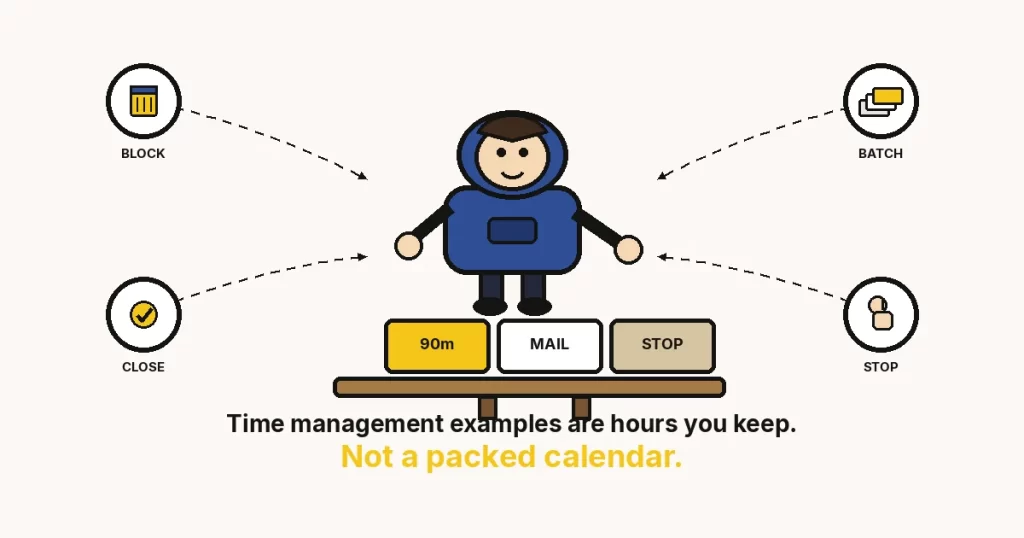
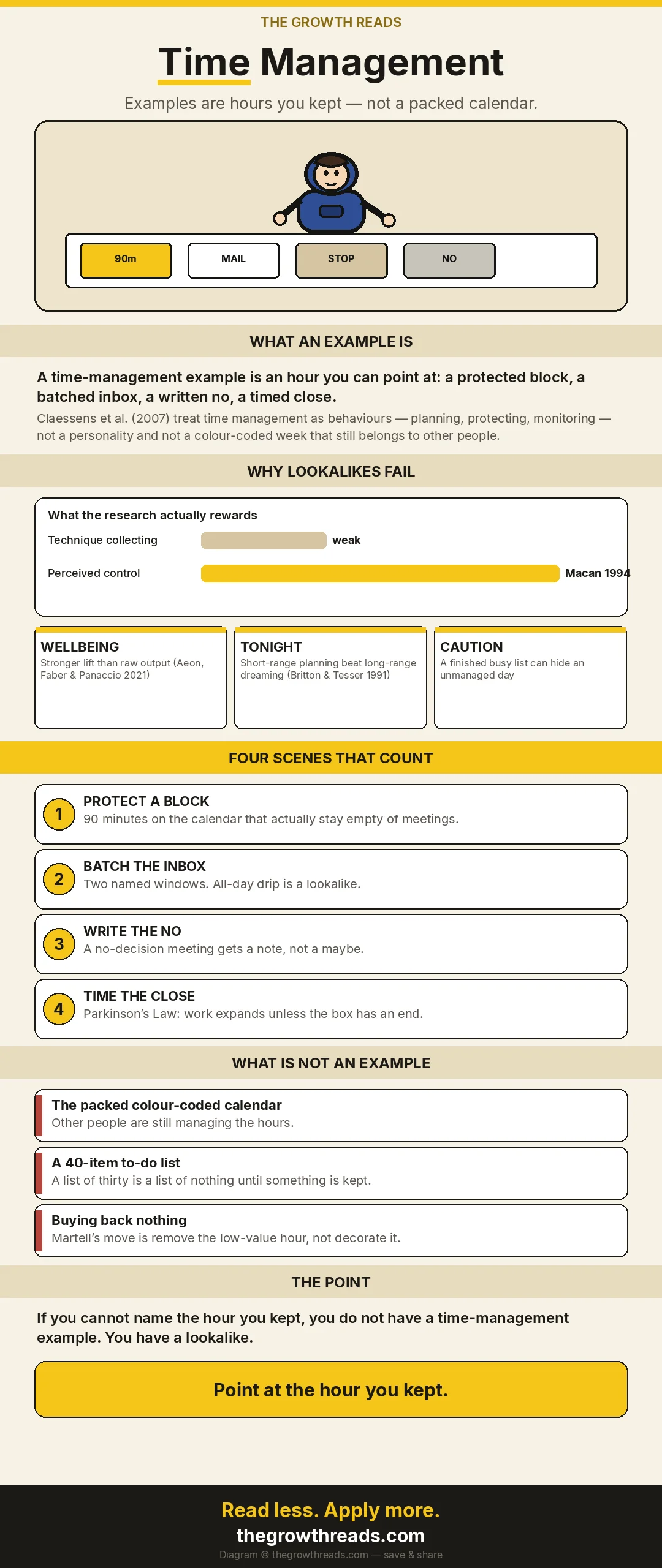
Time management examples are hours you can point at — a protected block, a batched inbox, a written no, a timed close. They are not a packed colour-coded calendar. Research treats time management as behaviours you can see: planning, protecting, and monitoring. This page shows those scenes. It is not a second how-to-manage-your-time guide.
Key takeaways
- Time management examples are observable hours you kept — a protected block, a batched inbox, a written no — not a colour-coded calendar that still belongs to other people (Claessens, van Eerde, Rutte and Roe, 2007).
- Perceived control of time, not the number of techniques you collect, is what links time-management behaviour to lower strain and higher satisfaction (Macan, 1994).
- A 2021 meta-analysis found time-management practices help job performance and academic results, with a stronger lift on wellbeing than on raw output (Aeon, Faber and Panaccio, 2021).
- Short-range planning — deciding tomorrow tonight — predicted student grades; long-range dreaming did not (Britton and Tesser, 1991).
- Buying back a recurring low-value hour is a time-management example in Dan Martell’s Buy Back Your Time: you remove the hour, you do not decorate it.
What time management examples actually are
Time management examples are hours you can point at after the day is over — a block that stayed empty of meetings, an inbox that opened twice, a no that got written, a report that closed on time. Claessens, van Eerde, Rutte and Roe (2007) defined time management as behaviours that aim at an effective use of time while doing goal-directed work. The useful word in that sentence is behaviours. An example is a behaviour made visible. A personality (“I’m organised”) is not an example. A colour-coded week that is still full of other people’s work is not an example either.
That is why this page hangs off the Decisions parent, not off a second how-to. The stall that looks like “I should manage time better” is often the same stall as analysis paralysis: more comparing, no kept hour. The sister page on why time management is important already owns the why. This page owns the pictures — what a kept hour looks like on a Tuesday, and what a lookalike looks like next to it.
The research is blunt about which pictures count. Macan (1994) tested a process model: time-management behaviours (goals and priorities, mechanics, a preference for organisation) feed a perception of control over time, and that perception — not the technique count — is what tracks lower job tension and higher satisfaction. Job performance did not ride the same path. Training, in that study, was not the lever popular books promised. So a drawer of unused planners is not a set of examples. A person who can name the hour they kept is closer to Macan’s mechanism, even if their calendar looks plain.
Aeon, Faber and Panaccio (2021) later pooled the literature. Time-management practices were related to job performance and to academic results, and more strongly to wellbeing; they also tracked lower distress. That is permission to treat a quiet close-of-day as a real example, not as a soft extra. It is also a limit: the associations are moderate, not magic, and they do not prove that any one app caused the lift. In our experience, people who ask for “time management examples” already have a full calendar. They want to know which of those hours were theirs.
Dan Martell’s Buy Back Your Time is the unused review on this row because it names a specific example: a recurring low-value hour you delete, transfer, or systemise. The book is not a second Eisenhower lecture. The move is removal. If the hour is still on your calendar with a prettier label, you decorated it. You did not buy it back.
Working definition. A time-management example = an hour you kept on purpose. Not a packed calendar. Not a personality. Not a technique you own but did not run.
Time management vs being busy
Busy is occupancy. Time management is a decision about which occupancy you will protect, batch, close, or stop. A day can be full and unmanaged. A day can look light and still be managed if the two hard hours were kept and the rest was refused. The time management matrix is the sort that makes that split visible — urgent is not the same as important — and it is a method page, not this one. Here the test is simpler: can you point at the hour?
Britton and Tesser (1991) measured time-management practices in ninety undergraduates. Short-range planning and time attitudes predicted grade-point average. Long-range planning did not. The student example that counts is tonight’s list for tomorrow’s three hours, not a five-year colour code. The work example that counts is the same shape: a near window you actually keep. The productivity hub collects the method pages; this page only has to stop you pointing at occupancy and calling it an example.
Parkinson’s 1955 observation still explains the other half of busy: work expands to fill the time available. A report given “the afternoon” will use the afternoon. A report given forty-five minutes and a close time is a different scene. The live page on Parkinson’s Law owns the mechanism. The example, on this page, is the timed close you can show a colleague.
Why lookalikes get mistaken for examples
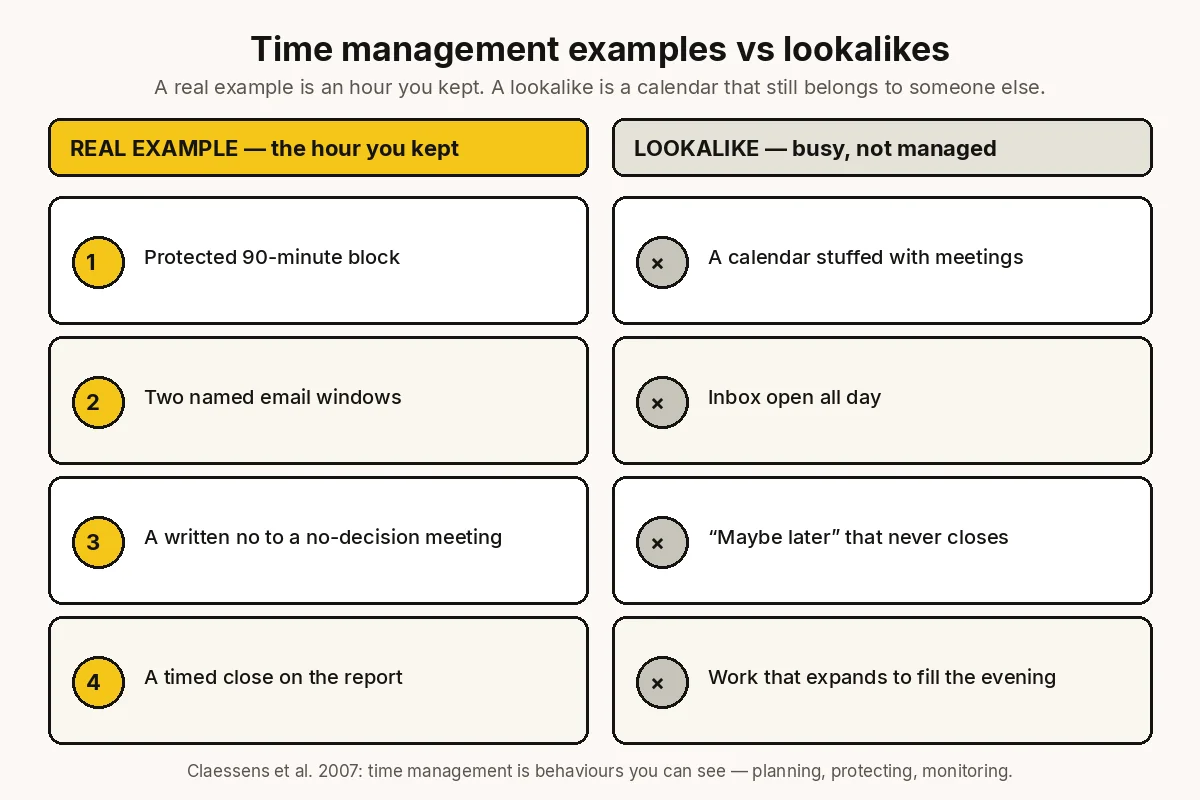
Lookalikes get mistaken for examples because they are visible, shareable, and they flattered the afternoon you already survived. A packed colour-coded calendar photographs well. A 40-item list feels like control while you write it. An all-day inbox looks like responsiveness. None of those is a kept hour. Macan’s path is the reason: the behaviour has to produce a sense that you allocated the time. If the allocation still belongs to whoever booked you, the colour is decoration.
Buehler, Griffin and Ross (1994) documented the planning fallacy: people underestimate how long their own tasks will take, even when they know similar tasks ran long. A lookalike calendar is often that underestimate drawn in ink — six “quick” meetings and a “light” report stacked into the same morning. When the morning blows, the story becomes “I need better time management,” which usually means “I need a new system.” The missing example was a smaller box and a written no, not a prettier grid.
Aeon and Aguinis (2017) argued that time management is also a temporal perspective — how you relate to past, present, and future — not only a toolkit. That is useful here and easy to abuse. It does not mean a vibe is an example. It means a person who only ever plans the distant future, and never tonight, will collect lookalikes. Britton and Tesser already showed the near window is the one that predicted grades. The far window is where lookalikes live.
Four scenes people misread
People fold four different Tuesdays into “I managed my time,” and only some of them are examples. Name the four and the word stops being a smear.
- The protected block. Ninety minutes on the calendar that actually stay empty of meetings. The lookalike is a calendar so full it looks “in demand.” The live 1-3-5 rule is one way to choose what the block is for. The example is the emptiness that held.
- The batched inbox. Two named windows. The lookalike is a badge count you clear in public all day. That is occupancy. It is also how a morning of real work becomes a morning of other people’s leftovers.
- The written no. A meeting with no decision gets a note, not a maybe. The lookalike is “let me see” that stays on the calendar as a ghost. How to prioritise tasks is the method cousin. The example is the sentence that freed the hour.
- The timed close. The report has an end. Parkinson’s Law is why an open afternoon is not a plan. The lookalike is “I’ll finish it this evening,” which is how evenings become a second unpaid shift. Energy management vs time management is the adjacent check: a timed close that sits on an empty tank is still a close, and it will cost more.
Martell’s buy-back is a fifth scene that belongs next to these four: a recurring low-value hour that leaves your week. If you cannot name which hour left, you do not have that example yet.
Why the mix-up costs more than it feels like
Calling a lookalike an example costs you the diagnosis, so you spend the week buying another planner. If the packed calendar is “proof I manage time,” you will not protect a block — you will add a colour. If the all-day inbox is “proof I am responsive,” you will not batch — you will buy a badge app. Macan (1994) is the warning label: the techniques did not, in that study, buy performance, and training was not the lever. Perceived control was. A drawer of unused systems is the expensive version of no control at all.
Aeon, Faber and Panaccio (2021) give the other half of the cost. The stronger association in the pooled studies was wellbeing, not output. A day of lookalikes can still finish the list — Mark’s interruption work, on the focus side of this site, already showed finished work can be expensive in the body. Time-management lookalikes do the same job on the calendar: the boxes get ticked, the day still was not yours. That is why a “productive” week can leave you feeling unmanaged. The examples were missing. The occupancy was not.
There is a limit worth saying out loud. Observational and correlational studies do not prove that one protected block caused a promotion, and Macan’s performance path was the weak one. Do not sell a 90-minute tile as a career system. Sell it as what it is: an hour you kept. The how to track productivity page is where measurement lives. This page only needs you to stop photographing a full week and calling the photo an example.
Nearby ideas that are not examples
Most phrases that sit next to “time management examples” in a search bar are neighbouring jobs, not synonyms. The table is a map, not a diagnostic of types-and-fixes — those method pages already exist.
| Phrase | What people think it is | What it actually is | Wrong next move |
|---|---|---|---|
| Time management example | Any busy, colour-coded day | An hour you kept on purpose | Screenshotting a packed calendar |
| Being busy | Proof you manage time | Occupancy — often other people’s | Adding a meeting to look in demand |
| Time blocking | The whole of time management | One way to protect a block | Filling every square so nothing can move |
| To-do list | A plan | A menu, until something is kept | Writing forty items and calling it a system |
| The matrix / ABCDE / 1-3-5 | The example itself | A sort. See the ABCDE method, the matrix, and 1-3-5 | Collecting sorts and running none |
| Buying back time | A nicer label on the same hour | Removing a low-value recurring hour (Martell) | Delegating the label and keeping the work |
Poor time management has its own later row. This page will not steal it. If the week has no kept hour, you do not yet have an example to study — you have a lookalike to stop praising.
Common mistakes
The common mistakes are all category errors — treating occupancy, tools, or personality as if they were a kept hour.
- Pointing at a packed calendar. Occupancy is visible. A kept hour is quieter. If you cannot name the block that stayed empty of other people, you are showing a lookalike.
- Collecting techniques and skipping Macan’s path. Goals, mechanics, and organisation only count if they produce perceived control (Macan, 1994). A drawer of unused planners is not a library of examples.
- Writing a 40-item list and calling it a plan. Britton and Tesser’s useful layer was short-range planning, not an infinite menu. Three kept hours beat thirty named ones.
- Leaving every box open so Parkinson can fill it. An afternoon without a close time will use the afternoon. The timed close is the example. “I’ll finish tonight” is how the evening becomes a second shift.
- Treating buy-back as a slogan. Martell’s move is removal. If the low-value hour is still on your week with a prettier name, you decorated it.
- Confusing energy with a missing example. A well-chosen hour on an empty tank still costs. Check energy versus time before you decide the calendar is the only broken layer.
- Waiting for a how-to mood before you will name a scene. This play page is the pictures. The method pages are already live. Name one kept hour from last Tuesday before you buy another system.
The evidence behind this
The evidence supports time management as visible behaviours that track control, wellbeing, and — more modestly — performance; it does not support a packed calendar as proof. The table below is what we actually used. Correlational and path-model work is marked as such. No invented percentages.
| Study | Design and size | Finding | What we used it for |
|---|---|---|---|
| Claessens, van Eerde, Rutte and Roe, 2007 | Narrative review of the time-management literature | Time management is behaviours aimed at using time effectively while doing goal-directed work — time assessment, planning, monitoring | The definition: an example is a behaviour you can see |
| Macan, 1994 | Process model; employees plus supervisor ratings | Time-management behaviours linked to perceived control of time; control linked to satisfaction and lower tension, not to performance; training was not the lever | Why a technique drawer is not a set of examples |
| Aeon, Faber and Panaccio, 2021 | Meta-analysis of time-management studies (PLOS ONE) | Time management related to job performance and academic achievement, more strongly to wellbeing, and to lower distress | Why a quiet close counts, and why we do not over-claim output |
| Britton and Tesser, 1991 | 90 undergraduates; time-management scales and GPA | Short-range planning and time attitudes predicted grades; long-range planning did not | The student example is tonight-for-tomorrow, not a five-year grid |
| Buehler, Griffin and Ross, 1994 | Planning-fallacy experiments | People underestimate their own task durations even when they know similar tasks ran long | Why a stuffed morning is a lookalike, not a plan |
| Aeon and Aguinis, 2017 | Academy of Management Perspectives review | Time management is also a temporal perspective, not only a toolkit | Why far-future colour codes collect lookalikes |
| Häfner and Stock, 2010 | Training study on perceived control of time at work | Training can raise perceived control of time in a work sample | A counterweight to Macan on training — still about control, not a prettier calendar |
| Parkinson, 1955 | Essay in The Economist | Work expands to fill the time available | The timed close as an example, not a vibe |
Frequently asked questions
What are some examples of time management?
Point at hours you kept: a ninety-minute block that stayed empty of meetings, two named email windows, a written no to a meeting with no decision, a report that closed on a timer, and a recurring low-value hour you removed. Claessens and colleagues (2007) treat time management as behaviours you can see — planning, protecting, monitoring — so an example has to be visible after the day. A packed colour-coded calendar is occupancy. A personality (“I’m organised”) is not an example either. If you cannot name the hour, you do not have one yet.
What is a good time management example at work?
The cleanest work example is a protected block that actually held, plus one written no. Macan (1994) found the useful mechanism was perceived control of time, not the number of techniques on the desk. A morning that still belongs to whoever booked you will not produce that control, however pretty the grid. Batching the inbox into two windows is a second work example because it returns the hours between the windows. Buying back a recurring admin hour, in Martell’s sense, is a third — the hour leaves the week.
Is a packed calendar an example of time management?
No. A packed calendar is occupancy, and often other people’s occupancy. Time management examples are hours you allocated on purpose and then kept. The time-management matrix exists to sort urgent from important; a full week can still be all urgent and none kept. Buehler, Griffin and Ross (1994) showed people stack underestimated tasks into the same morning. That stuffed morning photographs like a plan. It is a lookalike. Screenshot it if you want a record of the problem. Do not file it as an example.
What is the difference between time management and being busy?
Busy is how full the day was. Time management is which fullness you chose and protected. A light-looking day can be managed if the two hard hours were kept and the rest was refused. A heavy-looking day can be unmanaged if every box belonged to someone else. Aeon, Faber and Panaccio (2021) found time-management practices track wellbeing more strongly than raw output — which is why a “productive” busy week can still feel unmanaged. Occupancy finished. The kept hours did not exist.
Do time management techniques actually work?
They work as behaviours that raise perceived control and, in the pooled studies, wellbeing and (more modestly) performance — not as a drawer of unused apps. Macan (1994) did not find a performance path, and training in that study was not the promised lever. Aeon, Faber and Panaccio (2021) later found moderate associations with job performance and academic results, and a stronger one with wellbeing. Häfner and Stock (2010) found training can raise perceived control in a work sample. The honest read: run a kept hour, then measure control. Do not buy a seventh planner.
What is a time management example for students?
Tonight’s short-range plan for tomorrow’s three hours. Britton and Tesser (1991) found short-range planning and time attitudes predicted grade-point average in ninety undergraduates; long-range planning did not. So a five-year colour code is not the student example. A two-hour revision block that actually stays closed, an inbox window after the seminar, and a timed close on the essay are. The 1-3-5 rule is one way to choose the three hours. The example is that they were kept, not that they were named.
How is buying back your time an example of time management?
Dan Martell’s move is to remove a recurring low-value hour — delete it, transfer it, or turn it into a system — so the hour leaves your week. That is a kept decision you can point at next Tuesday: the hour is gone. Relabelling the same hour “strategy” is a lookalike. The Growth Reads review of Buy Back Your Time is the down-link on this row because it is the book that names removal, not another urgent-important lecture. If you cannot say which hour left, you have not bought anything back yet.
Is time blocking the same as time management?
No. Time blocking is one way to protect a block — a useful example when the block actually holds. Time management, in the research Claessens reviewed, also includes assessing time, planning the near window, and monitoring what happened. A calendar with every square filled so nothing can move is often a lookalike: the blocks are there, the control is not. Parkinson’s Law still applies inside a block with no close. Use blocking as one picture on this page, not as the whole subject, and do not restack a second how-to on top of it.
Sources
- Claessens, B. J. C., van Eerde, W., Rutte, C. G., & Roe, R. A. (2007). A review of the time management literature. Personnel Review, 36(2), 255–276. https://doi.org/10.1108/00483480710726136
- Macan, T. H. (1994). Time management: Test of a process model. Journal of Applied Psychology, 79(3), 381–391. https://doi.org/10.1037/0021-9010.79.3.381
- Aeon, B., Faber, A., & Panaccio, A. (2021). Does time management work? A meta-analysis. PLOS ONE, 16(1), e0245066. https://doi.org/10.1371/journal.pone.0245066
- Britton, B. K., & Tesser, A. (1991). Effects of time-management practices on college grades. Journal of Educational Psychology, 83(3), 405–410. https://doi.org/10.1037/0022-0663.83.3.405
- Buehler, R., Griffin, D., & Ross, M. (1994). Exploring the “planning fallacy”: Why people underestimate their task completion times. Journal of Personality and Social Psychology, 67(3), 366–381. https://doi.org/10.1037/0022-3514.67.3.366
- Aeon, B., & Aguinis, H. (2017). It’s about time: New perspectives and insights on time management. Academy of Management Perspectives, 31(4), 309–330. https://doi.org/10.5465/amp.2016.0166
- Häfner, A., & Stock, A. (2010). Time management training and perceived control of time at work. The Journal of Psychology, 144(5), 429–447. https://doi.org/10.1080/00223980.2010.496647
- Parkinson, C. N. (1955, November 19). Parkinson’s Law. The Economist.
- Martell, D. (2023). Buy Back Your Time. Portfolio. Review: Buy Back Your Time summary.
Related reading on The Growth Reads
Books
- Buy Back Your Time summary — remove the low-value hour; do not decorate it.
Related articles
- Analysis paralysis — parent: the stall that looks like more planning.
- Why is time management important — sister: the why, not the pictures.
- The time management matrix — urgent is not important.
- The 1-3-5 rule — one way to choose what a kept hour is for.
- How to prioritise tasks — the method cousin, not this page.
- Parkinson’s Law — why an open afternoon is not a plan.
- Energy management vs time management — a timed close on an empty tank still costs.
Hub and pillar
How this article was researched
The Growth Reads editorial team read the time-management review (Claessens, van Eerde, Rutte and Roe, 2007), Macan’s 1994 process model, the 2021 PLOS ONE meta-analysis (Aeon, Faber and Panaccio), Britton and Tesser (1991) on short-range planning, Buehler, Griffin and Ross (1994) on the planning fallacy, Aeon and Aguinis (2017) on temporal perspective, Häfner and Stock (2010) on training and control, and Parkinson’s 1955 essay. Dan Martell’s Buy Back Your Time is the named unused review for this queue row — a removal example, not a second how-to-manage-your-time guide.
Limits: Macan’s performance path was weak, and that study did not find training effective. Aeon, Faber and Panaccio report moderate associations, not proof that one protected block caused a promotion. This page does not replace the why sister, the matrix, or a later poor-time-management row.
Methodology: examples page on the locked v3 play template (no HowTo node). Primary sources are peer-reviewed papers plus one named book review. No invented percentages. Last checked 17 September 2026.