

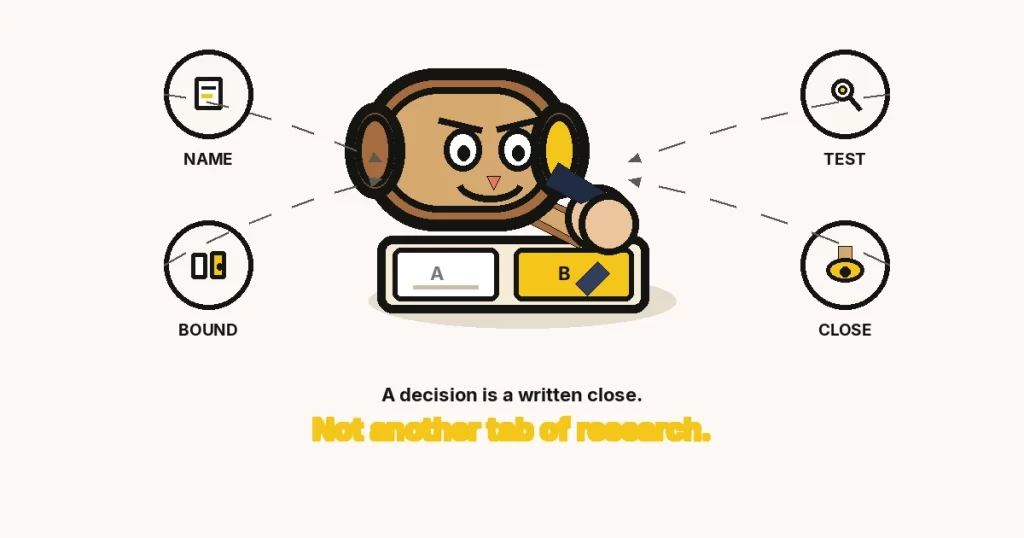
How to make a decision is to name the call in one sentence, bound the stakes and the close time, run one disconfirming test, then write the choice and the first action. Simon (1955) called that satisficing: stop at good enough, not at perfect information.
Key takeaways
- Simon (1955) described satisficing: organisms search until they find an option that meets an aspiration level, rather than comparing the whole universe of alternatives.
- Iyengar and Lepper (2000) found shoppers facing 24 jams were less likely to buy than shoppers facing 6 — more options can stall the close, not improve it.
- Wilson and Schooler (1991) found that introspecting on reasons can reduce the quality of preferences, so a longer pro/con list is not automatically a better call.
- Klein (2007) described the project premortem: imagine the call has already failed, and write why, before you spend more time defending it.
- The sister page owns the map of stages. This URL owns one written close, plus the reopen rule that only new facts get another vote.
What making a decision actually is (and what it isn’t)
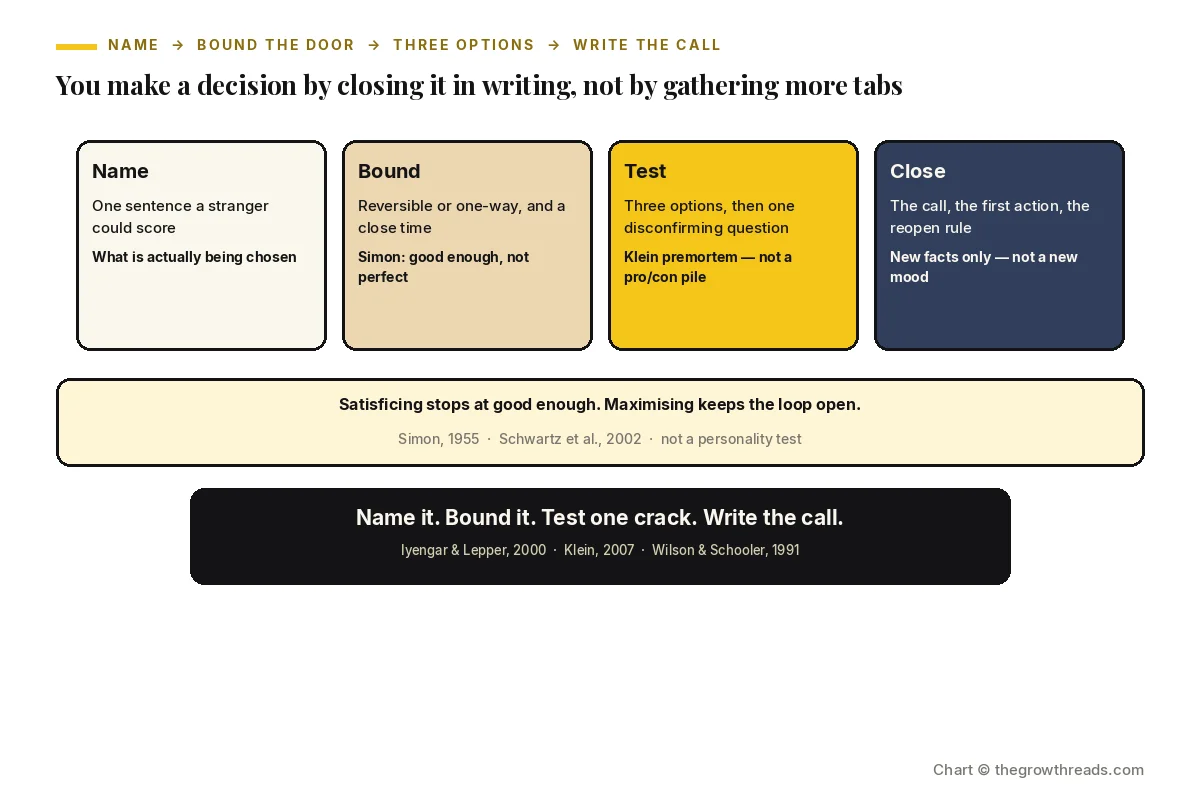
How to make a decision, on this page, is a work method: name the call in one sentence, bound whether it is reversible, set a close time, generate three options, run one disconfirming test, then write the choice and the first action. It is not a personality transplant. It is not a promise that the option you pick is globally optimal. It is not a medical, legal, or clinical protocol. Simon (1955) already named the lever: stop at an option that meets the bar you set, rather than searching until every alternative has been compared.
That job is narrower than “have a process.” The sister page, the decision-making process, owns the map of stages — what a cascade looks like, and where the textbook version stalls. This URL is the close of one live call: hire or not, tool A or tool B, ship Friday or slip the date. The parent, analysis paralysis, is the stall that looks like more research. Donella Meadows’ Thinking in Systems is the book for the other half of the picture: a decision is an intervention in a system of stocks and feedback, not a mood you wait to feel. Related reading on productivity systems and summaries sits under the same roof. This page ends when the call is written and the first action has a time.
How is this different from the process map, the freeze, or the loop?
This page closes one call; the decision-making process owns the stages; decision paralysis is the freeze before a start; how to stop overthinking is the loop that will not park. Four jobs. Four pages. If you are ranking a day of tasks rather than closing one call, that is the ABCDE method or the 1-3-5 rule. If you already closed and now keep picking it apart, that is how to stop second-guessing yourself. This page ends at the written call. The system Meadows described will still push back. That is expected. It is not a reason to reopen from a new feeling.
Why the call still will not close
The call still will not close because the bar is set at perfect information, the option list keeps growing, and a longer reasons-list can make the preference worse rather than clearer. Simon (1955) is the first motor: a chooser with limited time cannot maximise over the whole set. Aspiration levels, not exhaustive comparison, are what stop the search. If you have not written the bar, the search has no off switch. That is why this page starts with a sentence, not with another tab.
The second motor is the size of the set. Iyengar and Lepper (2000) set up a grocery display with 6 jams or 24. More people stopped at the larger display; far fewer bought. A limited-choice condition produced more purchases. That is one field experiment in one store, not a law about every software comparison. It is still why Step 4 caps the list at three, then stops adding. A fourth option that would not change the close is how analysis paralysis gets a second hour.
The third motor is the reasons you write. Wilson and Schooler (1991) found that people asked to analyse why they liked jams produced preferences that lined up less well with expert ratings than people who were not asked to introspect. Thinking about reasons can shift you onto attributes that are easy to name and off the ones that actually drive the call. A two-page pro/con sheet is not automatically more accurate. It can be a more articulate stall. If the stall is a missing picture of where the hours go, a time audit is the cousin page. This page is only the close.
The four triggers, in the order you can actually pull them
- Unnamed call. “I need to figure this out” is not a decision. Step 1 writes one sentence a stranger could score.
- Unbounded door. A reversible pick is being treated like a one-way door, or the reverse. Step 2 names which. Schwartz, Ward, Monterosso, Lyubomirsky, White and Lehman (2002) is why maximising — the hunt for the best — tracks with more regret in their surveys. That is correlational, not a trial of your Tuesday. It is still why the bar is good enough.
- Open set. Options keep arriving. Iyengar and Lepper (2000). Step 4 generates three, then stops.
- Undefended call. You have a favourite and no test that could kill it. Klein (2007) is the premortem. Step 5 is one page of “it already failed; why?” Tversky and Kahneman (1974) is why an unaided gut still uses availability, representativeness, and anchoring. A premortem is one cheap counter, not a cure for bias.
Why an unclosed call costs more than it feels like
An unclosed call feels like prudence, and it is often a second job: the same comparison running in the background while the work that needed the call sits still. Iyengar and Lepper (2000) is why the bill is not “I am being thorough.” Extra jam flavours reduced purchases. Wilson and Schooler (1991) is why a more detailed reasons-list can be a worse preference, not a better one. Milkman, Chugh and Bazerman (2009) reviewed ways decision making can be improved — consider the opposite, use an outsider view, bind the future self — and treated the unaided mind as a system that needs a procedure, not a pep talk. That paper is a review, not a trial of this sequence. Treat it as the map.
Gigerenzer and Goldstein (1996) modelled “take-the-best,” a fast-and-frugal rule that looks up cues in order and stops when one discriminates. In their simulations it matched or beat more information-greedy algorithms on some inference tasks. That is a model of bounded inference, not a licence to flip a coin on a one-way door. It is why Step 4 does not require a weighted score for every attribute you can name. Related reading on productivity systems and summaries helps because no single close owns every kind of work. This page is the written call, then the first action.
The honest limit: there is no randomised trial of this exact six-step sequence. Simon 1955 is a theory paper. Iyengar 2000 is jam in a grocery. Wilson 1991 is undergraduates and jam ratings. Klein 2007 is a practitioner method in a magazine. Schwartz 2002 is mostly surveys of maximising. Meadows is why the system will answer the intervention with its own feedback. Write the call anyway, then watch the system — Step 6’s reopen rule.
The four doors — and the fix for each
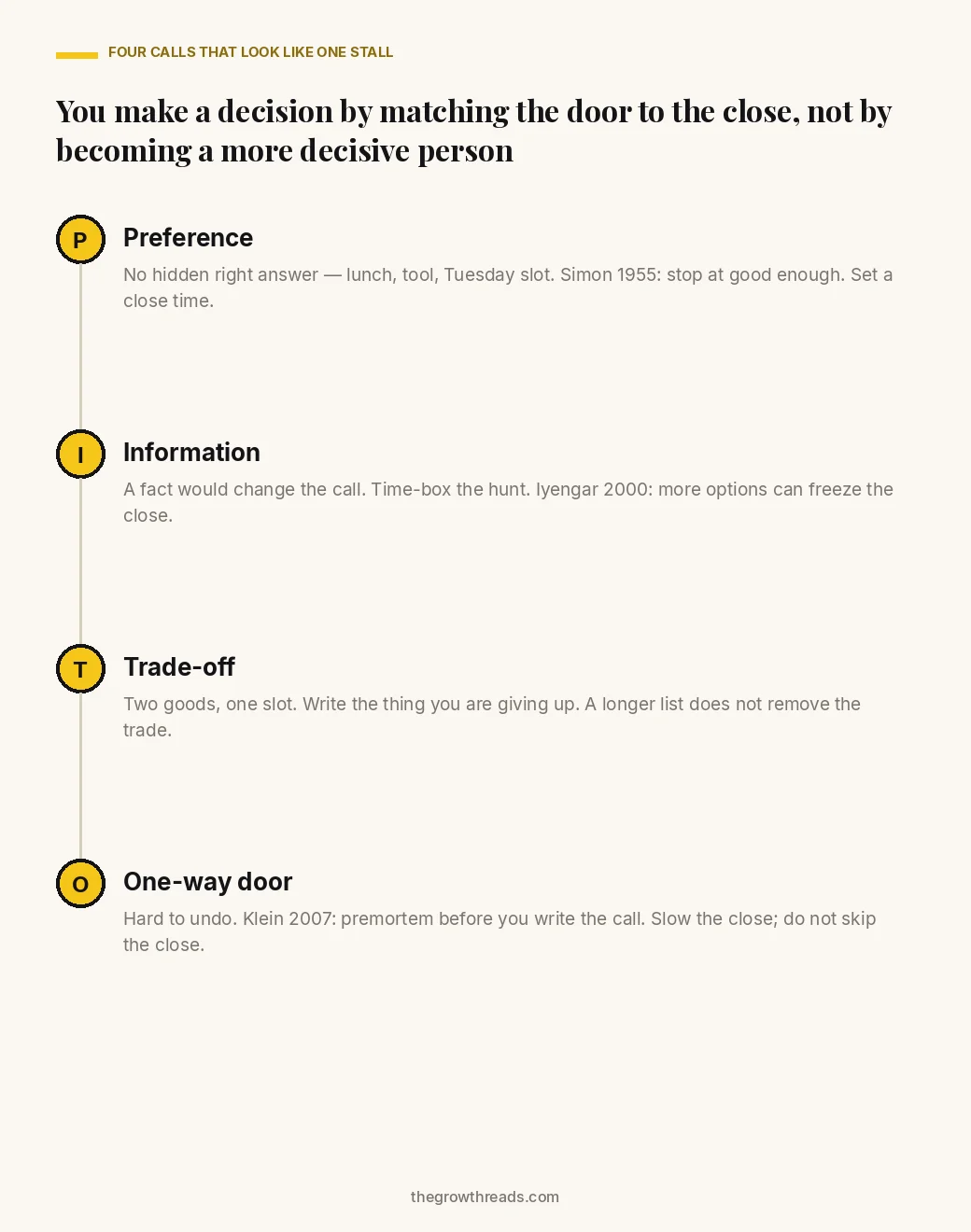
Most “just decide” speeches fail because they pull the wrong lever. Match the door to the close that fits, then pull that one.
| Door | What it looks like | The trigger that is winning | The fix that works |
|---|---|---|---|
| Preference | Lunch, tool, Tuesday slot — no hidden right answer, only a pick | Search with no aspiration level — Simon (1955) | Write a good-enough bar and a close time (Steps 1 and 3) |
| Information | A fact would actually change the call, and you have not got it yet | Open set, more looking — Iyengar & Lepper (2000) | Time-box the hunt. Three options, then stop adding (Step 4) |
| Trade-off | Two goods, one slot; a longer list will not make the loss disappear | Reasons that are easy to name — Wilson & Schooler (1991) | Write the thing you are giving up. Then close (Steps 1 and 6) |
| One-way door | Hard to undo: a hire, a public ship, a contract you cannot cheaply reverse | Favourite with no kill-test — Klein (2007) | Premortem first (Step 5). Slow the close. Do not skip the close |
How to make a decision: the 6-step system
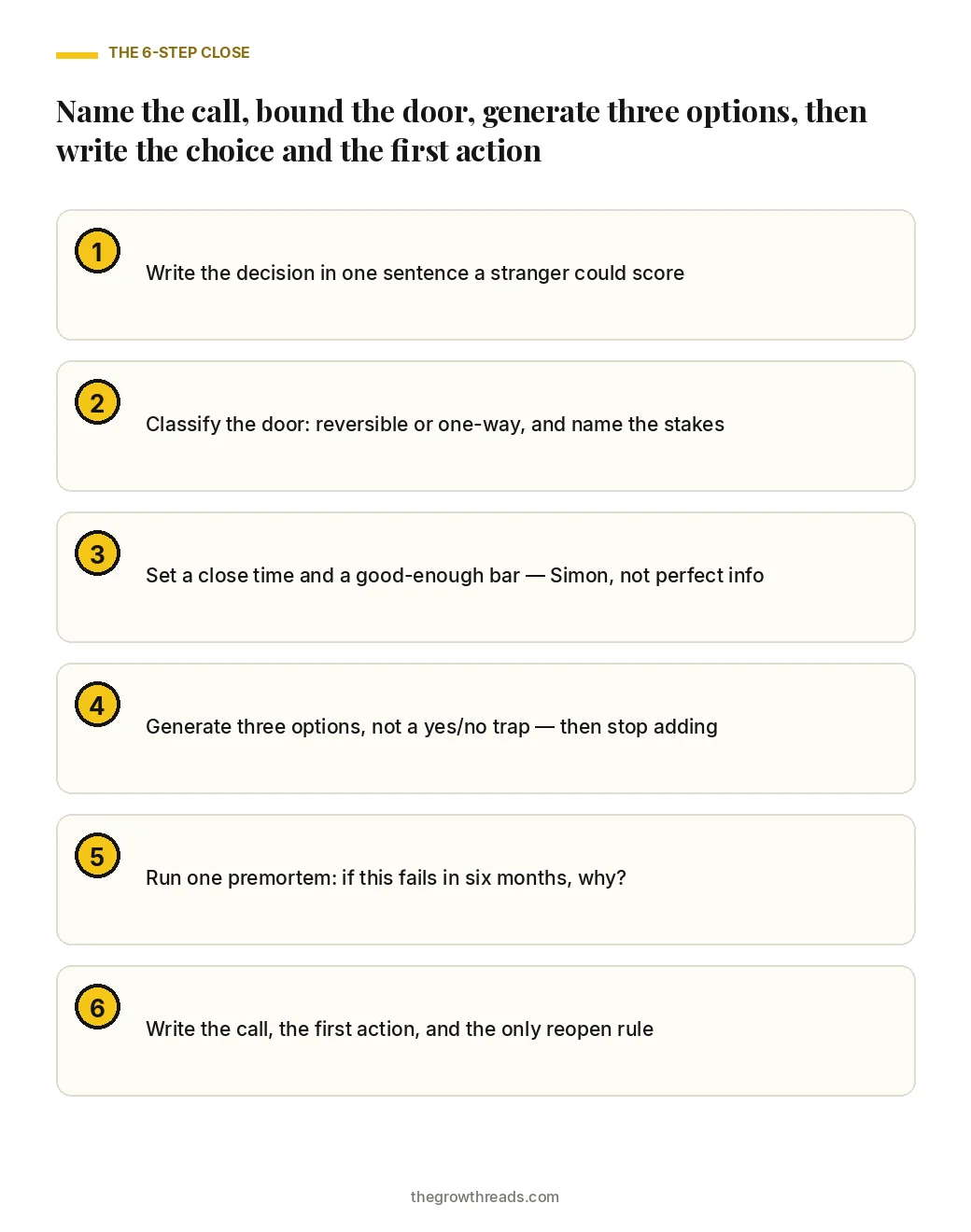
Make a decision by naming the call, classifying the door, setting a close time and a good-enough bar, generating three options, running one premortem, then writing the choice, the first action, and the only reopen rule. Do not start by becoming a more decisive person. Do not wait for a week with no other work. Do not mash this with the decision-making process as if the map of stages were the close, or with how to stop overthinking as if parking a loop were the same as picking. Those pages still apply when you need the cascade, or when the thoughts will not stop. This sequence is for when one live call is still open.
Step 1 — Write the decision in one sentence a stranger could score
On paper, write the call a stranger could tick: “Ship the draft Friday or slip to Tuesday,” “Keep tool A or switch to tool B this quarter,” “Hire the specialist or keep the contractor through October,” not “I need to figure out my direction.” If the sentence still sounds like a mood, you have not named the decision. Simon (1955) is the test: what option-set is actually being searched? The parent page, analysis paralysis, is what happens when that sentence never gets written and research stands in for it. This step is one line, dated. If ranking a whole day of tasks is the real job, stop and use how to prioritise tasks instead of collecting another insight. One sentence. Then the door.
Step 2 — Classify the door: reversible or one-way, and name the stakes
Leave the sentence. Mark the door. A reversible call can be undone with a cheap reversal: a trial, a two-week tool, a meeting you can recast. A one-way call is expensive to undo: a public ship, a hire, a contract. Milkman, Chugh and Bazerman (2009) is why this split matters: different procedures fit different errors, and an unaided mind will use the same thoroughness on both. Treat a two-way door with Simon’s bar and a close time. Treat a one-way door with Step 5’s premortem and a slower clock, not with endless extra options. If you cannot name which door it is, you are still arguing with the feeling. Sit on Step 2 until the label is boring and physical. Meadows’ Thinking in Systems is the reminder that even a small lever moves a stock; the door type is how expensive a wrong lever is to pull back.
Step 3 — Set a close time and a good-enough bar — Simon, not perfect information
Write when the call closes, and what “good enough” means in one line: “By 16:00 Thursday, any option that ships this week and keeps support under four hours,” not “when I feel sure.” Simon (1955) called the stop rule an aspiration level. Schwartz et al. (2002) found that people who reported maximising — hunting for the best — also reported more regret and less satisfaction with their picks in their surveys. That is not a diagnosis and not a personality test this page will score. It is why the bar is written before the options, so the search has an off switch. A time audit is how you see whether the hunt is actually using the afternoon. The close time is the whole step.
Step 4 — Generate three options, not a yes/no trap — then stop adding
Write three: the current default, one serious alternative, and one option that would look foolish only if you are already committed to the favourite. A yes/no frame hides the third. Iyengar and Lepper (2000) is why you then stop: the 24-jam table did not produce more buys. Gigerenzer and Goldstein (1996) is why you do not need a weighted score for every attribute you can invent — a stopping rule that uses a few cues is sometimes enough, in their models, and this is work, not their inference task. If a fourth option would not change the close, park it. If the stall is generating the list at all, decision paralysis is the freeze page. Three lines. Then the kill-test.
Step 5 — Run one premortem: if this fails in six months, why?
Pick the current leader. Write the date six months out. The call has already failed. Why? Klein (2007) described that as a project premortem: people who have not yet committed can still name cracks they will not name once they are defending the choice. Tversky and Kahneman (1974) is why you need the prompt: unaided judgment leans on what is available, what is representative, and what you anchored on. A premortem is one structured opposite, not a purge of bias. Wilson and Schooler (1991) is the honest limit: more reasons can make the preference worse, so this is one page, not a memoir. If accountability for the written call is the missing piece, how to take accountability is the scorecard. One page. Then write the call.
Step 6 — Write the call, the first action, and the only reopen rule
Write: the choice, the first action with a time, and the only condition that gets another vote — a new fact, not a new mood. “We ship Friday. First action: freeze the copy at 10:00. Reopen only if legal flags a blocker.” Milkman, Chugh and Bazerman (2009) treated binding the future self as one of the few levers that actually changes what happens next. This step is that bind, on paper. How to stop second-guessing yourself is the cousin page once the call is made and the loop starts after it. Do not found a new identity from one close. Meadows is why you then watch the system: stocks move slowly, feedback arrives late, and that delay is not a reason to reopen at 23:00. If the thoughts will not park, that is already on how to stop overthinking.
What to do when the decision is already overdue
When the call is already late, do not restart from a blank personality: pick the current leader, write why in four lines, take the first action in the next hour, and keep tomorrow’s reopen rule as written. A new comparison at 23:00 is how an overdue call gets a second week. You are allowed to be annoyed. You are not required to found a new system.
If you have not named the decision at all, do Step 1 tonight and skip the poetry. If the stall is a ritual you cannot choose to skip, that is the next section, not a close time. This page’s job that evening is only: the sentence on paper, the current leader, and the first action in the morning. Simon’s bar still applies when you are late. Especially then.
Common mistakes
- Calling the stall a character flaw. Simon (1955) put the lever in the aspiration level. Name the bar, not the verdict.
- Treating a two-way door like a one-way door. Milkman, Chugh and Bazerman (2009) is why thoroughness is not free. Reversible picks need a close time, not a premortem novel.
- Adding a twenty-fifth option. Iyengar and Lepper (2000) is why the larger set can reduce the close. Three, then stop.
- Writing a longer reasons-list as the work. Wilson and Schooler (1991) is why introspection can worsen preference. One premortem page, then Step 6.
- Mashing this with the process map. The decision-making process owns the stages. This page owns one written call.
- Reopening from a feeling. If more comparison would not change the first action, that is how to stop overthinking. Park it. Then do the action.
When it is more than a work call
A six-step close will not fix a medical choice, a legal exposure, or a night that is standing in for a conversation about the job — those are different problems, and this page is the wrong tool for them. If you cannot choose even when you want to, that is outside a productivity how-to. We will not list signs, name a disorder, or walk a clinical scale. Talk to a clinician or the relevant professional rather than adding an eighth step. Schwartz’s maximising surveys are cited only as a regret correlate, not as a test you should take at 1 a.m. A close time on a tool choice is the work version. A quiz you found after midnight is not a system, and it is not ours to interpret.
The evidence behind this system
The studies below are the satisficing, choice-overload, introspection, bias, premortem, and improvement literature that makes a named bar plus a written close a reasonable method. None of them is a trial of this exact six-step sequence.
| Study | Design & size | Finding | What we used it for |
|---|---|---|---|
| Simon (1955), Quarterly Journal of Economics | Theory paper on rational choice under limited computational capacity | Choosers satisfice: they search until an option meets an aspiration level, rather than maximising over the full set | Steps 1 and 3: the sentence and the bar; not a lab trial |
| Iyengar & Lepper (2000), Journal of Personality and Social Psychology | Field experiment in a grocery; 6 vs 24 jams, plus follow-up essay/choice studies | More people stopped at 24 jams; more people bought from 6 | Step 4’s cap; one store, not every software comparison |
| Wilson & Schooler (1991), Journal of Personality and Social Psychology | Lab studies; analysing reasons for jam and course preferences vs not analysing | Introspecting on reasons reduced agreement with expert ratings of those preferences | Why a longer pro/con is not automatically better; Step 5 stays one page |
| Tversky & Kahneman (1974), Science | Programmatic review of judgment under uncertainty, with experimental illustrations | Availability, representativeness, and anchoring describe systematic departures from statistical norms | Why Step 5 needs a prompt; not a claim this sequence removes bias |
| Klein (2007), Harvard Business Review | Practitioner method piece on the project premortem (not a new experiment) | Imagining a future failure before commitment surfaces cracks people will not name once they are defending the plan | Step 5; magazine method, not an RCT of this how-to |
| Schwartz, Ward, Monterosso, Lyubomirsky, White & Lehman (2002), Journal of Personality and Social Psychology | Scale development plus surveys relating maximising to regret and satisfaction | Higher maximising scores tracked with more regret and less satisfaction with choices | Step 3’s good-enough bar; correlational, not a personality diagnosis |
| Gigerenzer & Goldstein (1996), Psychological Review | Computational models of “take-the-best” vs more information-greedy algorithms | A fast-and-frugal stopping rule matched or beat greedier algorithms on some inference tasks | Step 4: you do not need every attribute scored; a model, not your hire |
| Milkman, Chugh & Bazerman (2009), Perspectives on Psychological Science | Review of interventions that can improve decision making | Procedures (consider the opposite, outsider view, bind the future self) beat unaided pep talks | Steps 2, 5, 6 as a procedure; a review, not a trial of this sequence |
Frequently asked questions
How do you make a decision this week?
Write the call in one sentence a stranger could score. Mark whether it is reversible or one-way. Set a close time and a good-enough bar. Generate three options, then stop adding. Run a one-page premortem on the current leader. Write the choice, the first action, and the only reopen rule. Simon described satisficing as stopping at an option that meets the bar. A pep talk is not a system. A written close is. Do it on one live call this week, not as a new personality, and do not wait for a morning when nothing else is due.
Is this the same as the decision-making process?
No. The decision-making process page owns the map of stages: what a cascade looks like, and where the textbook version stalls. This page closes one live call. You can need both in one month. You should not mash them into one speech. If you are designing how a team moves from frame to option to pick, use the process page. If a hire, a ship date, or a tool is still open on your desk, stay here, write the sentence, and close it. The test is whether one choice still has no time on it. A map that leaves the call open is a second article, not a close.
How many options should I generate?
Three, then stop. The current default, one serious alternative, and one option that would look foolish only if you are already committed to the favourite. Iyengar and Lepper found shoppers facing 24 jams were less likely to buy than shoppers facing 6. That is one grocery display, not a law about every comparison. It is still why this how-to caps the list. A yes/no frame hides the third option. A fourteenth tab that would not change the close is analysis paralysis wearing a research hat. Write three lines. Run the premortem on the leader. Then Step 6.
Should I list every pro and con?
No. Write one premortem page, not a memoir. Wilson and Schooler found that introspecting on reasons can reduce the quality of preferences relative to people who were not asked to analyse them. Tversky and Kahneman described the shortcuts an unaided gut still uses, which is why Klein’s premortem is a structured opposite rather than a longer list of the same reasons. A two-page sheet can be a more articulate stall. This page’s Step 5 is: the call has already failed; why? Then write the choice. If the thoughts will not park after that, that is the overthinking page, not another column of cons.
What if I keep reopening the call?
Then you are missing Step 6’s reopen rule, not a new personality. Write the only condition that gets another vote: a new fact, not a new mood. Milkman, Chugh and Bazerman treated binding the future self as a procedure, not a pep talk. How to stop second-guessing yourself is the cousin page once the call is made. How to stop overthinking is the loop that will not park. This page’s job is the written close. If you reopen at 23:00 because the feeling changed, that is a second vote the rule was meant to block. Keep tomorrow’s first action as written.
Is a fast decision always a bad one?
No. Simon’s point was that a limited chooser cannot maximise over the whole set, so a stop rule is rational, not lazy. Gigerenzer and Goldstein modelled a fast-and-frugal rule that looked up a few cues and stopped, and in their simulations it sometimes matched greedier algorithms. That is a model of inference, not a licence to flip a coin on a one-way door. Classify the door in Step 2. A reversible pick can close at 16:00. A one-way door still closes, with the premortem and a slower clock. Speed without a bar is a guess. A bar without a close time is a stall.
Is this for high-stakes medical or legal calls?
No. This is a productivity how-to for everyday work calls: the ship date, the tool, the hire, the Tuesday slot. It is not a diagnosis, not a symptom list, and not a clinical or legal protocol. Klein’s premortem is a project method from a magazine. Schwartz’s maximising work is a survey correlate, not a test you should take. If the call is medical, legal, or something you cannot choose even when you want to, this page is the wrong tool — talk to the relevant professional rather than adding an eighth step. We will not list signs. A close time on a tool choice is the work version.
Will this six-step system make the right decision?
No, and the evidence does not say it will. The studies on this page map satisficing, one grocery choice-overload experiment, an introspection finding, a bias review, a practitioner premortem, a maximising survey, a computational heuristic, and a review of improvement tactics. They are not a trial of this sequence. Simon is theory. Klein is a magazine method. An unclosed call is a bout. Next week needs the same sentence, or a new one if the facts changed. Use it for the next live call. Do not use it as a promise you will never pick wrong, and do not use it as a medical or legal protocol.
Related reading on The Growth Reads
The book behind the close
- Thinking in Systems summary & review — Donella Meadows on stocks, feedback, and leverage; the book cousin of a written intervention, not a personality manual
Related articles
- Analysis paralysis
- The decision-making process
- Decision paralysis
- How to stop overthinking
- How to stop second-guessing yourself
- The ABCDE method
- The 1-3-5 rule
- How to prioritise tasks
- How to run a time audit
- How to take accountability
Go deeper
How this article was researched
The Growth Reads editorial team writes from primary sources: the books, and the peer-reviewed literature behind the claims. Every study cited above was read in the original publication or its published abstract, and every figure is quoted with its design, sample and effect so you can judge its weight. Where a finding is limited — a theory paper, a grocery field experiment, an undergraduate lab, a magazine method, a survey correlate, or a six-step close with no trial of its own — we say so.
How we work: every article on The Growth Reads is built from the books in our library plus the research they rest on, and is reviewed and date-stamped when the evidence changes. Read our full methodology.
Sources
- Simon, H. A. (1955). A behavioral model of rational choice. The Quarterly Journal of Economics, 69(1), 99–118. doi:10.2307/1884854
- Iyengar, S. S., & Lepper, M. R. (2000). When choice is demotivating: Can one desire too much of a good thing? Journal of Personality and Social Psychology, 79(6), 995–1006. doi:10.1037/0022-3514.79.6.995
- Wilson, T. D., & Schooler, J. W. (1991). Thinking too much: Introspection can reduce the quality of preferences and decisions. Journal of Personality and Social Psychology, 60(2), 181–192. doi:10.1037/0022-3514.60.2.181
- Tversky, A., & Kahneman, D. (1974). Judgment under uncertainty: Heuristics and biases. Science, 185(4157), 1124–1131. doi:10.1126/science.185.4157.1124
- Klein, G. (2007). Performing a project premortem. Harvard Business Review, 85(9), 18–19. hbr.org/2007/09/performing-a-project-premortem
- Schwartz, B., Ward, A., Monterosso, J., Lyubomirsky, S., White, K., & Lehman, D. R. (2002). Maximizing versus satisficing: Happiness is a matter of choice. Journal of Personality and Social Psychology, 83(5), 1178–1197. doi:10.1037/0022-3514.83.5.1178
- Gigerenzer, G., & Goldstein, D. G. (1996). Reasoning the fast and frugal way: Models of bounded rationality. Psychological Review, 103(4), 650–669. doi:10.1037/0033-295X.103.4.650
- Milkman, K. L., Chugh, D., & Bazerman, M. H. (2009). How can decision making be improved? Perspectives on Psychological Science, 4(4), 379–383. doi:10.1111/j.1745-6924.2009.01142.x