

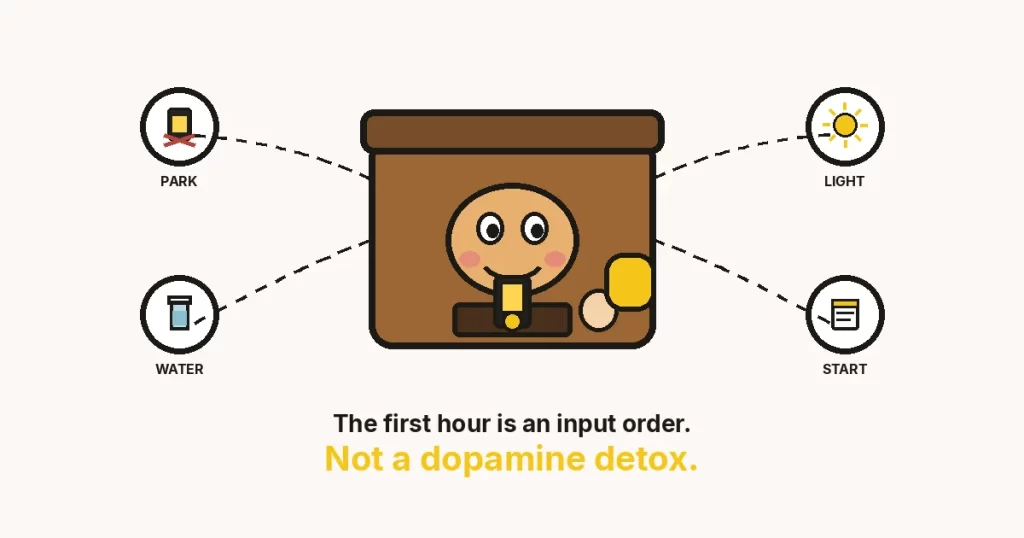
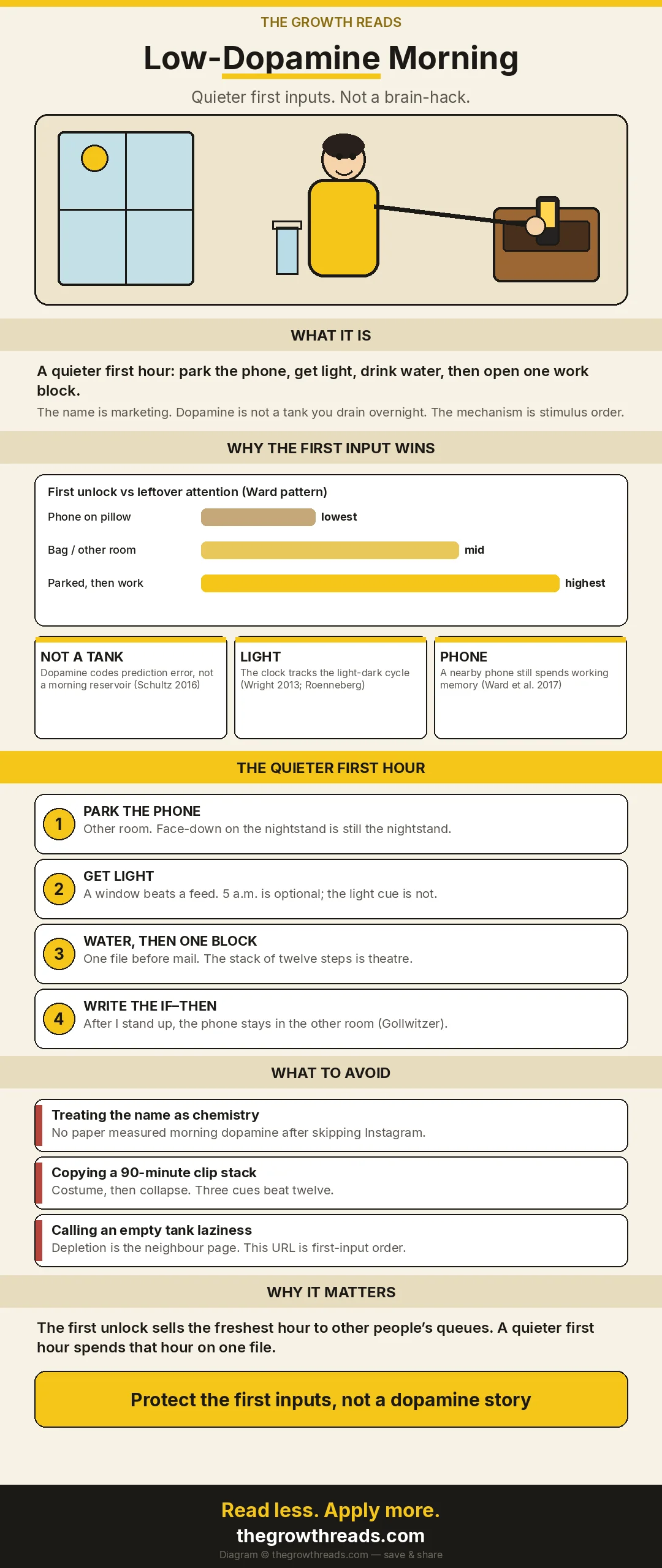
A low-dopamine morning routine is a quieter first hour: delay unlock, news, email, and short video until after light, water, and one work block. The name is marketing. Dopamine is not a tank you drain overnight. The usable mechanism is stimulus order — not a detox, not a diagnosis, and not a treatment list.
Key takeaways
- A low-dopamine morning routine is a name for delaying high-stimulation inputs until after light, water, and one work block — not a lab assay of morning dopamine, which none of the papers below measured.
- Dopamine neurons encode a reward-prediction error, not a pleasure reservoir you empty overnight and refill by skipping Instagram (Schultz, 2016).
- A smartphone on the desk still reduces available working memory and fluid intelligence even when it stays silent and untouched; the drop shrinks as the phone moves farther away (Ward, Duke, Gneezy & Bos, 2017).
- The human circadian clock tracks the light–dark cycle; a window is a clock cue, and a 5 a.m. identity is not the mechanism (Wright et al., 2013; Roenneberg, Wirz-Justice & Merrow, 2003).
- A short written if–then — “After I stand up, the phone stays in the other room” — is how a quieter first hour becomes a sequence rather than a mood (Gollwitzer, 1999), the same simpler-morning argument in Sharma’s The Monk Who Sold His Ferrari.
What a low-dopamine morning routine actually is
A low-dopamine morning routine is a quieter first hour: you delay high-stimulation inputs until after light, water, and one work block. The everyday search wants a chemistry story. The useful version is an order story. Unlock, news, email, and short video are loud first inputs. They sell the freshest hour to other people’s queues. A window, a glass of water, and one named file are quiet first inputs. They spend that hour on work you already chose.
That is why this page sits under Morning, next to the cluster’s live parent how to build a morning routine, rather than under a health silo or a brain-hack silo. A morning routine on this site is a short sequence in the same order, at roughly the same time, until the sequence itself becomes the next cue. The low-dopamine label is a trend name for one version of that sequence: park the loud inputs until after the first block. The sister costume page is the billionaire morning routine, minus the theatre. Same cluster. Different file. That URL owns the public-figure stack. This URL owns first-input order.
This is a work-and-habits page on the productivity library. It is not a burnout health page, not a dopamine-deficiency page, not a diagnosis, and not a treatment list. It does not score your chemistry. It does not tell you that a loud first hour means you have a disorder. The question is narrower: what is allowed to reach you before the first file opens.
A one-off quiet morning with no repeatable cue is a pleasant Saturday. Repeat the same park–light–water–block order in the same room and it starts to become a habit in Wood and Neal’s (2007) sense: a context that starts the next action without a speech. That is also the join to keystone habits and to what consistency actually is. Do not paste a chemistry story onto a leftover unlock. Do not paste an empty-tank story onto a phone that is still on the pillow. Burnout vs laziness is motivation versus depletion at work. This page is stimulus order.
Low-dopamine morning vs a dopamine detox
A dopamine detox is a branded fast from stimulating inputs; a low-dopamine morning routine is a one-hour input order before work. The detox name sounds like a cleanse. The morning name sounds like a lab finding. Neither paper trail measured how much dopamine you have at 7:14 after skipping a feed. Schultz (2016) reviewed how dopamine neurons report a reward-prediction error — a burst when an outcome is better than expected, a dip when it is worse. That is a teaching signal, not a tank. Berridge and Robinson (2016) then separated wanting from liking. Dopamine tracks incentive more than pleasure. Those papers are neuroscience. They are not a morning-routine trial, and they are not a reason to diagnose anyone from a nightstand.
The screen-time cousin is how to reduce screen time. That page owns hours on glass. This page owns the first hour’s order. You can have a low-screen day that still opens on a feed, and a high-screen day that still starts with a window and one file. Do not treat a location-and-order problem as a weekly minutes target. The phone-during-the-block cousin is phone distraction: presence, ping, and reach after you have already sat down. This URL is the hour before that sit-down, when the first unlock still gets to set the day.
The named unused review on this row is Robin Sharma’s The Monk Who Sold His Ferrari. The book is a parable, not a trial. Sivana’s morning is simpler than a clip stack: stillness, a body that is already up, work that is already chosen. Use it as the down-link for a quieter first hour, not as a second study and not as a celebrity costume. The live checklist version of the same cluster is the morning routine checklist.
Why the first input wins
The first input wins because a loud cue is cheaper than an expensive intention, and a phone on the pillow is already a cue. Intention says “I will start the important file.” The nightstand says “I am still here.” The badge says “something happened overnight.” Wood and Neal (2007) described habits as context–action links. The context does not care that you wrote a better plan at 11 p.m. If the first object in the hand is the same object that trained last month’s unlock, the speech loses.
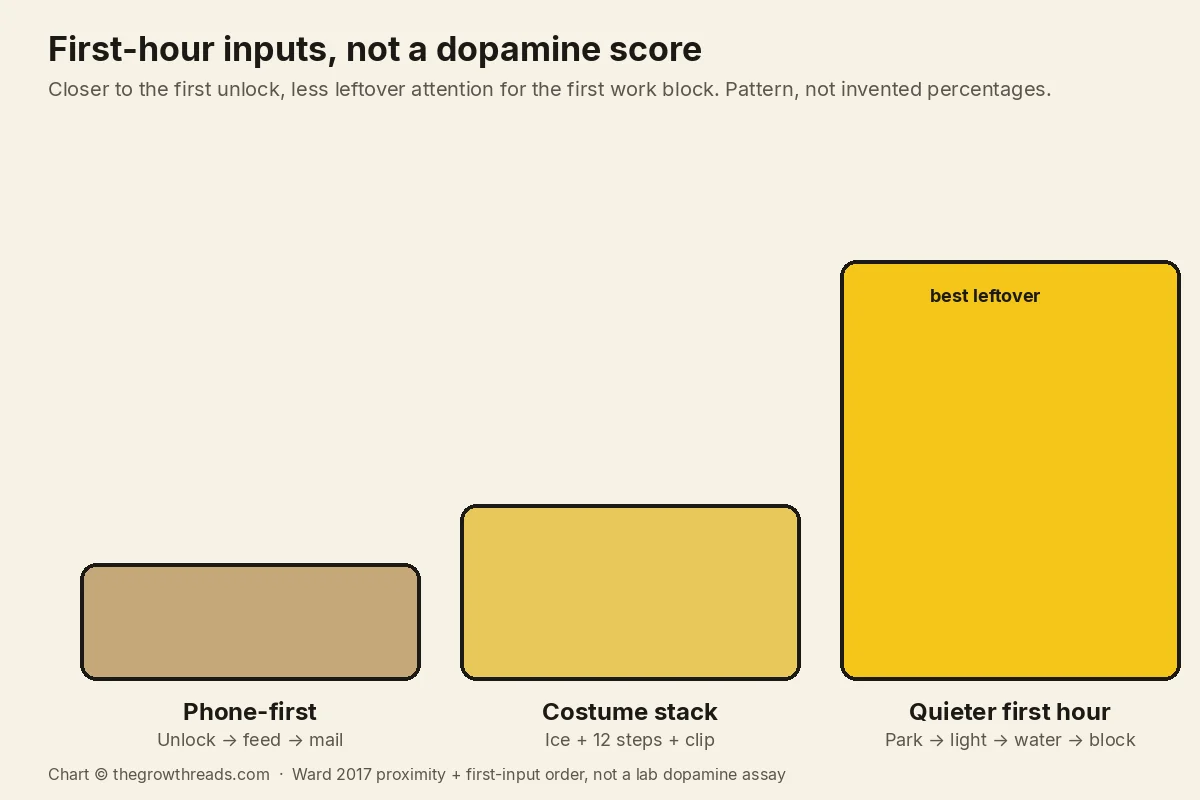
Ward, Duke, Gneezy and Bos (2017) measured the quieter version of that tax later in the day: a phone that is merely nearby still spends working memory and fluid intelligence. People did not have to touch it. Silent still counted. Face-down still counted. A pillow phone is the morning version of their desk condition. Stothart, Mitchum and Yehnert (2015) then showed that a notification you never answer can still disrupt a sustained-attention task. The first-hour version is the overnight badge you “just check.” The switch starts at the signal. The file you meant to open is already the second file.
Light is the other cheap cue, and it is not a 5 a.m. personality. Wright, McHill, Birks, Griffin, Rusterholz and Chinoy (2013) took eight people camping and watched their clocks move toward the sun’s schedule. That is a small field study, not a productivity trial, and not medical advice. The usable scrap is that the clock tracks light, not a brand of alarm. Roenneberg, Wirz-Justice and Merrow (2003) mapped chronotypes: people already differ in when their clocks want to rise. What makes someone a morning person owns that timing match. Why am I more productive at night owns the other end. This page does not ask you to become a morning person. It asks what reaches you once you are already up. The benefits of waking up early is the neighbour that owns the quieter hour you get by shifting the clock — not a moral win, and not this URL’s input-order file.
The four first-hour cues
- Park. The phone in another room is the cheap move Ward’s proximity line already pointed at. A bag beats the pillow. Another room beats a bag. Face-down on the nightstand is still the nightstand. Charge it in the kitchen if the walk is what makes the unlock expensive. That is the same reason how to wake up early if you sleep late keeps the alarm from being the first unlock.
- Light. A window is a clock cue (Wright et al., 2013). A feed is a queue cue. You do not need a sunrise identity and you do not need a 90-minute outdoor protocol copied from a clip. Open the curtain. Stand up. If your chronotype is late, this is still a light cue, not a demand that you become a different person (Roenneberg et al., 2003).
- Water. Not because a glass changes a neurotransmitter on a timer. Because it is a body cue that is already in the room, the way a kettle is a cue on the parent page. Drink, then start. The glass is a placeholder for “something that is not a screen.”
- Start. One named file before mail. Mail is other people’s ranking. A twelve-step stack is theatre — the miss on the billionaire morning routine. Lally, van Jaarsveld, Potts and Wardle (2010) found that simpler behaviours reached automaticity faster, with a median of 66 days and a range of 18–254. That paper measured new automaticity, not a dopamine curve. Use it as a warning against overbuilding day one, not as a promise that the morning “locks in” on a calendar date.
Why it costs more than it feels like
A first unlock feels free because it is fast; the bill is a morning that never quite enters one file, plus a residue hangover into the second hour. The glance is not the whole cost. The cost is starting the day inside someone else’s ranking, then trying to climb back into your own. Implementation intentions help when the walk is written as a sentence rather than hoped for as a mood (Gollwitzer, 1999). “After I stand up, the phone stays in the other room” is the join to implementation intentions. The sentence is cheap. The speech is expensive.
Energy is a neighbour, not a synonym. Energy management vs time management owns the hour-of-day match. A loud first hour can waste a high-energy window on a feed even when the clock time was “good.” A quiet first hour can still be a low-energy window if you forced a 5 a.m. identity onto a late chronotype. Do not treat this page as a sleep-shift article. Do not treat a depleted week as a louder-rules problem. If the tank is empty, that is the burnout-versus-laziness split — motivation versus depletion — and a different URL. This page does not diagnose depletion and does not treat it.
| First-hour pattern | What it actually is | What it costs | The cheaper move |
|---|---|---|---|
| Phone-first | Unlock before feet, then feed / mail / video | Ward’s nearest-phone condition at the loudest hour of the day | Other room. Face-down is still the pillow |
| Costume stack | A copied 8–12 step protocol from a clip | Theatre, then collapse by Wednesday (Lally: simple behaviours automatize faster) | Park, light, water, one block |
| Quieter first hour | Delay high-stimulation inputs until after one named file | Feels boring. Then the file exists | Write the if–then tonight (Gollwitzer) |
| Empty tank, any order | Motivation versus depletion — the neighbour page | A longer morning-rules list on a week that is already spent | Do not use this URL as a grit speech. See burnout vs laziness |
Two honest caveats. No paper in the table measured “morning dopamine” after a quieter first hour. Schultz and Berridge are used only to retire the tank story. Wright’s camping sample is eight people; it is a clock finding, not a proof that your output doubles if you open a curtain. Ward’s sample is undergraduates in a lab, not a month of your job. The linear proximity pattern is the usable scrap. This page does not invent a percentage for “how much more productive you get in the kitchen.”
Sharma’s parable is the organisational-feeling version of the same cheap layer: a morning that is already chosen, rather than a morning that waits for a feed to tell it what matters. That is not peer-reviewed. Pair it with the parent sequence on how to build a morning routine and with work-life balance if the “first hour” is the only hour you still own. A quieter first hour is not a personality upgrade. It is an input filter.
Common mistakes
- Treating the name as chemistry. Schultz (2016) is a prediction-error review. It is not a morning assay. If a clip promised a dopamine number, that clip invented the number.
- Copying a 90-minute public-figure stack. That is the miss on the billionaire morning routine. Costume, then collapse. Three cues beat twelve.
- Calling a nightstand phone “off” because it is face-down. Ward’s worst location was the nearest one. Orientation was not the fix. Distance was.
- Forcing a 5 a.m. identity onto a late clock. Roenneberg’s chronotypes already differ. Morning person owns the timing match. This page owns the inputs after you are up.
- Pasting an empty-tank story onto a loud first hour. Burnout vs laziness is motivation versus depletion. Do not diagnose depletion. Do not treat it. Do not add a longer morning-rules list to an empty week.
- Treating every screen problem as this page. Screen time owns hours. Phone distraction owns the device during a block. This URL is first-hour order.
- Waiting to “feel ready” before the walk. The walk is the intervention. Write it as an if–then on implementation intentions. Mood is a poor cue (Wood & Neal, 2007).
When it is more than a habit
A workplace morning that still starts from a pillow phone is a routine question; a pattern that takes over sleep, money, or safety is a different conversation and this page is not that conversation. The low-dopamine-morning frame is for ordinary first hours: the unlock before feet, the feed before a file, the costume stack that collapses by Wednesday. It is not a diagnosis, not a treatment list, and not a stand-in for help with compulsive use or anything that is harming health or relationships.
If the phone is on the pillow and a two-minute walk is available, this page applies. If mornings stay impossible after the inputs change, stop asking this URL for a laziness test, a dopamine score, or a grit plan. The honest next step is a qualified person, not a tighter streak and not a longer rules list. This article does not diagnose, does not treat, and does not list clinical symptoms.
The evidence behind this
The usable evidence is a prediction-error account of dopamine, a proximity drop for a nearby phone, a clock that tracks light, and a written if–then — not a morning dopamine score.
| Study | Design and size | Finding | What we used it for |
|---|---|---|---|
| Schultz (2016) | Review of dopamine reward-prediction-error signalling | Dopamine neurons report a two-component prediction-error signal, not a standing pleasure reservoir | Retire the “drain overnight, refill by skipping Instagram” story. Not a morning-routine trial |
| Berridge & Robinson (2016) | Review of wanting versus liking; incentive-sensitization theory | Dopamine tracks incentive salience (“wanting”) more than pleasure (“liking”) | Why a loud first input can pull the hand without being “more fun.” Not an addiction page and not a diagnosis |
| Ward, Duke, Gneezy & Bos (2017) | 520 undergraduates; working-memory and fluid-intelligence tasks; own phone in another room, bag/pocket, or on the desk | Available capacity dropped as the phone got closer, including when it stayed silent and untouched | A pillow phone is the morning version of the desk condition. Distance is the cheap fix |
| Stothart, Mitchum & Yehnert (2015) | 221 undergraduates; sustained-attention task; notification vs call/text vs control | A notification people did not answer disrupted attention on the order of actually responding | The overnight badge is already a switch. Silence belongs in the first hour too |
| Wright, McHill, Birks, Griffin, Rusterholz & Chinoy (2013) | Field; 8 adults camping; circadian markers vs the natural light–dark cycle | Clocks moved toward sun time when electric light was removed | A window is a clock cue. Small n. Not a productivity RCT and not sleep medicine |
| Roenneberg, Wirz-Justice & Merrow (2003) | Chronotype survey and daily timing patterns | People already differ in when their clocks want to rise | 5 a.m. is not the mechanism. Timing match lives on the morning-person page |
| Lally, van Jaarsveld, Potts & Wardle (2010) | 96 adults; daily self-report of a new everyday behaviour; automaticity over time | Median 66 days to a plateau; range 18–254; simpler behaviours automatized faster | Do not overbuild day one. This is new automaticity, not a days-to-break-dopamine number |
| Gollwitzer (1999) | Review of implementation-intention experiments | A written if–then (exact cue + exact action) raises follow-through versus a vague goal | “After I stand up, the phone stays in the other room.” Mood is a poor cue |
Frequently asked questions
What is a low-dopamine morning routine?
A low-dopamine morning routine is a quieter first hour: you delay unlock, news, email, and short video until after light, water, and one work block. The name is marketing. Dopamine is not a tank you drain overnight (Schultz, 2016). The usable mechanism is stimulus order. This is a work-and-habits page on the Morning cluster, next to how to build a morning routine. It is not a detox, not a diagnosis, and not a treatment list. Name the first input before you give the morning a chemistry speech.
Does a low-dopamine morning actually lower dopamine?
No paper cited here measured morning dopamine after skipping Instagram. Schultz (2016) reviewed prediction-error signalling: a burst when an outcome is better than expected, a dip when it is worse. That is a teaching signal, not a reservoir. Berridge and Robinson (2016) separated wanting from liking. Those findings retire the tank story. They do not give you a home assay and they do not justify a diagnosis from a nightstand. Use the phrase as a nickname for quieter first inputs. Do not use it as a lab result you do not have.
Is a low-dopamine morning the same as a dopamine detox?
No. A dopamine detox is a branded fast from stimulating inputs, usually sold as a cleanse. A low-dopamine morning routine is a one-hour input order before work: park the phone, get light, drink water, open one file. The screen-time page owns hours on glass. The phone-distraction page owns the device during a later block. This URL owns the first hour’s order. Do not paste a week-long fast onto a morning that only needed a walk to the kitchen. Do not treat either name as a measured change in a neurotransmitter.
What should you do in the first hour instead of checking your phone?
Park the phone in another room, open a window, drink water, and start one named file before mail. Ward, Duke, Gneezy and Bos (2017) found available capacity dropped as the phone got closer, even when it stayed silent. Wright and colleagues (2013) showed the clock tracks light. Gollwitzer (1999) is the sentence that makes the walk automatic: after I stand up, the phone stays in the other room. Skip the twelve-step costume. Lally’s group found simpler behaviours reached automaticity faster. Three cues beat a clip stack.
Is this the same as a billionaire morning routine?
No. The billionaire morning routine page owns the public-figure stack: ice, journals, 90-minute theatre copied from a clip. This page owns first-input order under the same Morning parent. Both are trend-shaped keywords. Both are mechanism pages, not celebrity listicles, and neither names private people to shame them. If your morning has twelve steps and no first file, you are on the costume URL. If your morning opens on a feed, you are on this one. The cheaper shared move is a short sequence, not a costume.
Is skipping the phone in the morning the same as laziness or burnout?
No. Laziness is a motive story told after the unlock. Burnout versus laziness is motivation versus depletion at work — a different URL, and not a health page. A low-dopamine morning is an input-order problem: the pillow, the badge, the first feed. If the tank is empty, a longer morning-rules list is the wrong layer. This page does not score laziness, does not diagnose depletion, and does not treat either. Name which file you actually have before you add another rule.
How long does a low-dopamine morning take to stick?
Lally, van Jaarsveld, Potts and Wardle (2010) tracked new everyday behaviours in 96 adults. Automaticity reached a plateau at a median of 66 days, with a range of 18 to 254, and simpler actions moved faster. That is new automaticity, not a days-to-change-dopamine number, and not a promise that your morning “locks in” on day 21. Write one if–then (Gollwitzer, 1999). Keep the sequence short. A twelve-step stack is how the routine is gone by day four. Context starts the next action (Wood and Neal, 2007), not a streak app.
Do you have to wake up at 5 a.m. for this to work?
No. Roenneberg, Wirz-Justice and Merrow (2003) mapped chronotypes: people already differ in when their clocks want to rise. Wright’s camping study is about light, not about a brand of alarm. A late chronotype can still park the phone and open a curtain at the hour they actually wake. The morning-person page owns the timing match. How to wake up early if you sleep late owns a schedule shift. This page owns the first inputs after you are already up. 5 a.m. is optional. The first-file-before-mail rule is not.
Sources
- Schultz, W. (2016). Dopamine reward prediction-error signalling: a two-component response. Nature Reviews Neuroscience, 17(3), 183–195. doi:10.1038/nrn.2015.26
- Berridge, K. C., & Robinson, T. E. (2016). Liking, wanting, and the incentive-sensitization theory of addiction. American Psychologist, 71(8), 670–679. doi:10.1037/amp0000059
- Ward, A. F., Duke, K., Gneezy, A., & Bos, M. W. (2017). Brain Drain: The Mere Presence of One’s Own Smartphone Reduces Available Cognitive Capacity. Journal of the Association for Consumer Research, 2(2), 140–154. doi:10.1086/691462
- Stothart, C., Mitchum, A., & Yehnert, C. (2015). The attentional cost of receiving a cell phone notification. Journal of Experimental Psychology: Human Perception and Performance, 41(4), 893–897. doi:10.1037/xhp0000100
- Wright, K. P., Jr., McHill, A. W., Birks, B. R., Griffin, B. R., Rusterholz, T., & Chinoy, E. D. (2013). Entrainment of the human circadian clock to the natural light-dark cycle. Current Biology, 23(16), 1554–1558. doi:10.1016/j.cub.2013.06.039
- Roenneberg, T., Wirz-Justice, A., & Merrow, M. (2003). Life between clocks: daily temporal patterns of human chronotypes. Journal of Biological Rhythms, 18(1), 80–90. doi:10.1177/0748730402239679
- Lally, P., van Jaarsveld, C. H. M., Potts, H. W. W., & Wardle, J. (2010). How are habits formed: Modelling habit formation in the real world. European Journal of Social Psychology, 40(6), 998–1009. doi:10.1002/ejsp.674
- Gollwitzer, P. M. (1999). Implementation intentions: Strong effects of simple plans. American Psychologist, 54(7), 493–503. doi:10.1037/0003-066X.54.7.493
- Wood, W., & Neal, D. T. (2007). A new look at habits and the habit-goal interface. Psychological Review, 114(4), 843–863. doi:10.1037/0033-295X.114.4.843
Related reading on The Growth Reads
The books this page draws on
- The Monk Who Sold His Ferrari summary — a simpler morning already chosen, not a clip-stack costume
Related articles
- How to build a morning routine — this cluster’s parent: a fixed cue, not a 5 a.m. identity
- The billionaire morning routine, minus the theatre — the sister: costume versus mechanism
- The morning routine checklist — the short sequence on paper
- The benefits of waking up early — a quieter hour from a clock shift, not this URL’s input order
- Phone distraction — the device during a later block, not the first unlock
- How to reduce screen time — hours on glass, not first-hour order
- Burnout vs laziness — motivation versus depletion, not a pillow phone
Go deeper
How this article was researched
The Growth Reads editorial team writes from primary sources: the books themselves and the peer-reviewed literature behind the claims. Every study cited above was read in the original publication or its published abstract, and every figure is quoted with its design, sample and effect so you can judge its weight rather than take ours. Where a finding is a review, a small field sample, a student lab, or correlational, we say so in the body rather than in a footnote. This page does not invent a morning dopamine score, because none of the cited papers measured one.
This article is a work-and-habits page. It is a low-dopamine morning routine as first-input order — not a burnout health page, not medical advice, not a diagnosis, and not a treatment plan. A pattern that is harming sleep, money, safety, or relationships is outside this URL.
How we work: every article on The Growth Reads is built from the books in our library plus the research they rest on, and is reviewed and date-stamped when the evidence changes. Read our full methodology.