

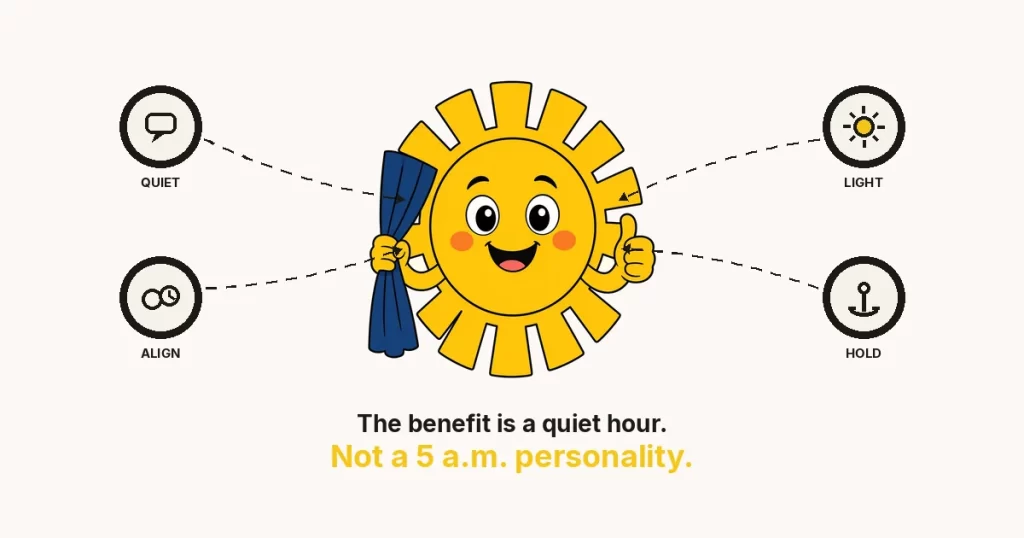
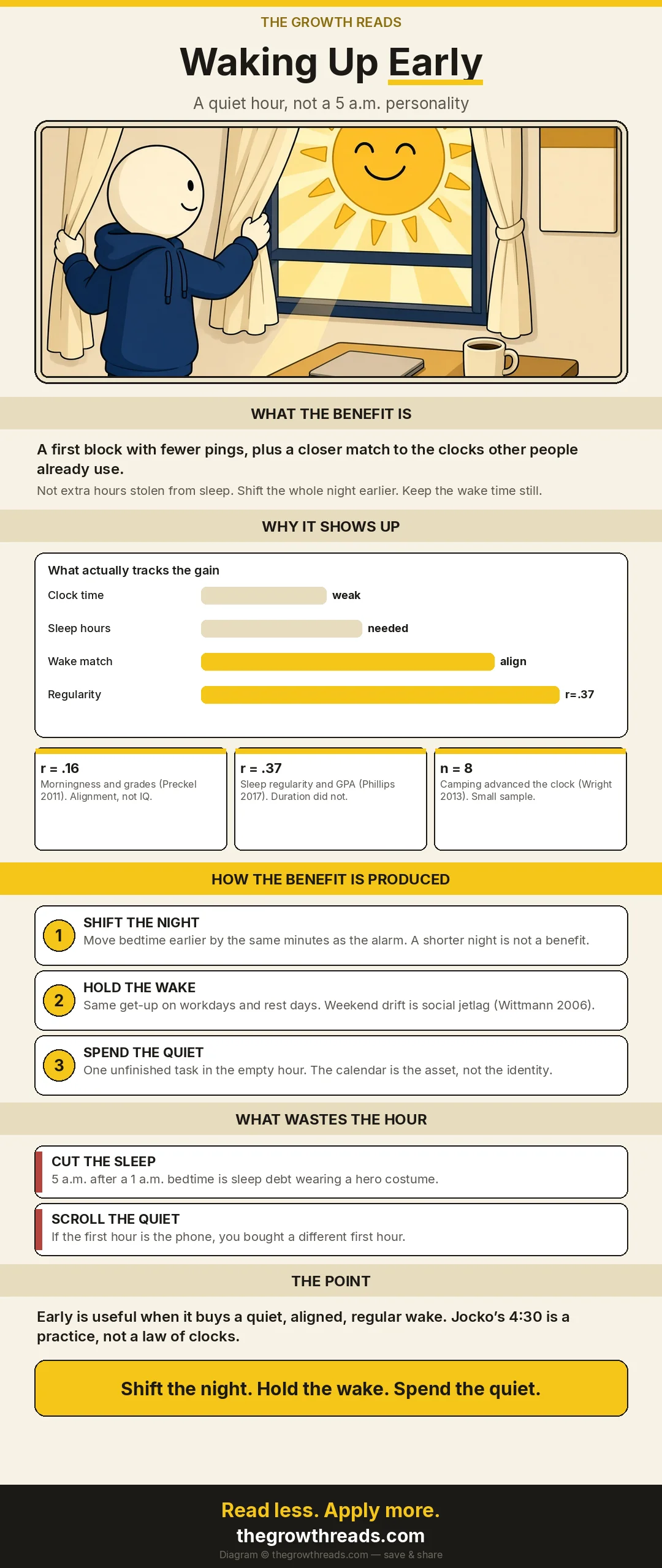
The benefits of waking up early are a quiet, interruption-light first block and a closer match to the clocks other people already use — not extra hours stolen from sleep, and not a 4:30 personality. Shift the whole night earlier and keep the wake time stable. Cut the night to hit 5 a.m. and those benefits reverse.
Key takeaways
- Morningness correlates with better grades (r = .16, N = 3,220) while eveningness correlates with slightly higher cognitive-test scores (r = .08) — so the school advantage is a match to early bells, not a smarter brain (Preckel, Lipnevich, Schneider & Roberts, 2011).
- In 61 undergraduates tracked for 30 days, sleep regularity predicted GPA (r = .37, n = 59) and sleep duration did not; a 10-point rise on the Sleep Regularity Index associated with about 0.10 GPA (Phillips et al., 2017).
- Interrupted knowledge workers often finish the original task faster, with no drop in quality, by paying in stress, frustration, time pressure and effort (Mark, Gudith & Klocke, 2008) — the empty first hour is valuable because the pings have not started.
- Late chronotypes accumulate the largest gap between work-day and free-day sleep, the pattern Wittmann, Dinich, Merrow and Roenneberg named social jetlag in 2006 (n = 501) — forcing a 5 a.m. alarm onto a late clock recreates that gap.
- A week of camping with only natural light advanced circadian timing and pulled later chronotypes toward solar time, but the sample was eight adults (Wright, McHill, Birks, Griffin, Rusterholz & Chinoy, 2013) — morning light is a cue, not a guarantee.
What the benefits of waking up early actually are
The benefits of waking up early are a first block with fewer interruptions, a closer match to the clocks institutions already run, a more regular wake time, and a stronger morning light cue — not more hours invented by sleeping less, and not a moral upgrade. That is the whole page. The search phrase sounds like a personality contest. The useful version is a timing match plus an empty calendar.
This URL sits under the live Morning parent, how to build a morning routine. The parent owns the cue-and-sequence. This child owns the why of an earlier get-up. The method for moving a late bedtime is already live at how to wake up early if you sleep late. Do not collapse those three pages. One is a sequence, one is a shift, one is the benefit list.
Jocko Willink’s Discipline Equals Freedom is the book this row points at: 4:30 a.m. as a practice he chose, not as a law of clocks. Keep the practice if it fits. Do not import the clock time as the mechanism.
What the benefits are not
They are not proof that early people are better, and they are not extra hours stolen from the night. Preckel’s 2011 meta-analysis is the sentence that should kill the moral version: morningness tracks academic indicators (r = .16) while eveningness tracks cognitive ability slightly the other way (r = .08). If larks were simply smarter, both correlations would point the same direction. They do not. Schools and offices start early. People whose biology already points that way look “disciplined” on a grade sheet. People whose biology points later look “undisciplined” on the same sheet. Goldin, Sigman, Braier, Golombek and Leone (2020) then showed the match is the lever: 753 Argentinian students randomly assigned to 07:45, 12:40 or 17:20 starts. Early chronotypes beat late chronotypes in the morning shift, especially in maths; the gap vanished in the afternoon; late chronotypes gained from evening classes. Move the building’s clock and the “benefit of being early” moves with it.
The sister page what makes someone a morning person is the timing-match definition. Why am I more productive at night is the honest counter-case for people whose peak sits after dinner. This page does not argue them out of that peak. It asks whether an earlier wake still buys something else — usually the quiet hour — without cutting sleep.
Why those benefits show up
The benefits show up because most workplaces and schools still run on an early social clock, and because the first hour of a weekday is still the hour with the fewest other people in your inbox. That is a calendar fact before it is a character fact. Roenneberg, Wirz-Justice and Merrow (2003) documented the spread of human chronotypes on 500 questionnaires: extreme larks are getting up when extreme owls are going to bed, and late types run up sleep debt across the workweek, then repay it on free days. The workweek is not a neutral backdrop. It is already biased early.
Once that bias is in the building, an earlier wake can buy three further things that are easy to confuse with “being a morning person.”
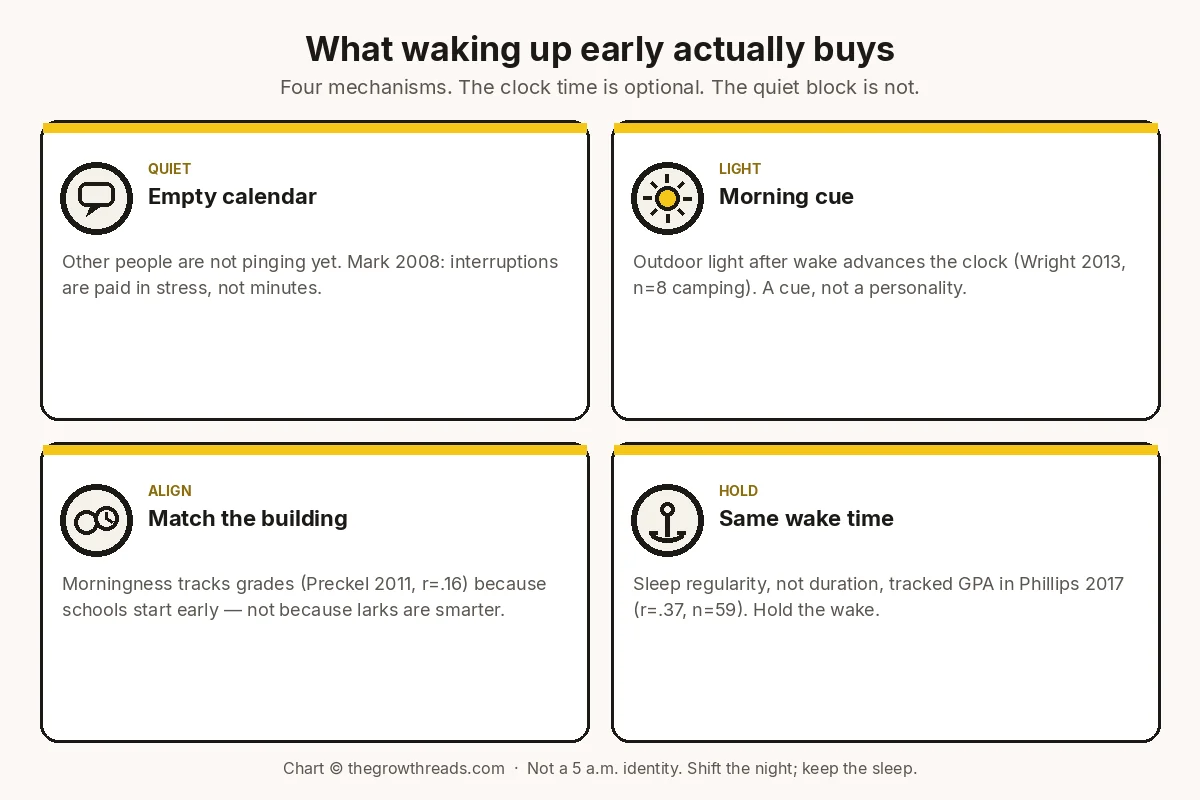
The four mechanisms, not the 5 a.m. identity
- Quiet. Gloria Mark, Daniela Gudith and Ulrich Klocke (CHI 2008) interrupted people during an email task and found they often finished faster, with no quality drop, by working harder — more stress, frustration, time pressure and effort. The first hour before Slack opens is not magic biochemistry. It is an hour in which that tax has not started. Sophie Leroy’s 2009 attention-residue experiments add the other half: leaving Task A unfinished keeps a piece of working memory attached to A, and Task B suffers. An empty morning is a chance to close one loop before the residue machine starts. If the first hour is the phone, you bought a different first hour. That is the same leak as how to focus better, just scheduled earlier.
- Light. Wright and colleagues (2013) took eight adults from a week of ordinary electrical lighting into a week of Rocky Mountain camping with only sunlight and campfires. Circadian timing advanced toward solar time; later chronotypes moved the most. After the camping week, the internal biological night ended before wake, just after sunrise. The sample is small and midsummer-Colorado-specific — say that out loud. The mechanism still matters for a desk job: outdoor light in the first hours after waking is a phase-advance cue. A dark bedroom plus a bright phone is the opposite cue. This is a timing tool, not a medical protocol, and not a substitute for the sleep-schedule work on how to fix your sleep schedule.
- Align. Preckel 2011 and Goldin 2020 are the alignment evidence. Grades move with the match between chronotype and start time. Haraszti and colleagues (2014) measured social jetlag with the Munich ChronoType Questionnaire in 753 Hungarian undergraduates and then looked at grades for 247 of them: social jetlag tracked worse weekly test averages during the lecture term (p = .028) and the association disappeared in the exam period, when students set their own hours. Late sleepers also did worse on morning tests (p = .017) with the reverse tendency in the afternoon. The “benefit of waking up early” on a campus is often “I am no longer sitting a morning exam on a late clock.”
- Hold. Phillips and colleagues (2017) tracked 61 Harvard undergraduates for 30 days and built a Sleep Regularity Index: the chance you are in the same sleep/wake state 24 hours later, scaled 0–100. SRI ranged 38–86. Sleep duration (mean 7.4 hours) did not correlate with SRI (r = .05). SRI did correlate with GPA (r = .37). Duration did not (r = .12, n.s.). Irregular sleepers’ dim-light melatonin onset sat 2.2 hours later than regular sleepers’ — about two to three time zones west — with the same total sleep, because the irregular group napped the difference. The benefit hiding inside “wake up early” is often “wake up at the same time.” Weekend drift is the hole in that bucket. Wittmann named that hole social jetlag in 2006.
The counter-case, stated once: none of this shows that 5:00 a.m. outperforms 7:30 a.m. for a person whose free-day midpoint already sits at 7:30. Preckel’s cognitive-ability correlations even lean slightly toward eveningness. Phillips cannot prove regularity causes grades — conscientious people may both sleep on a rail and file work on time. Wright’s camping week is eight people. Goldin’s school-timing study is the closest thing to a natural experiment, and it says match the clock, do not worship the morning. If your job is a night shift, “wake up early” is the wrong sentence. If your current 5 a.m. is a shortened night, you are not collecting the benefit. You are collecting sleep debt and calling it discipline.
Why the 5 a.m. costume costs more than it feels like
The costume costs more than it feels like because the identity is cheap to put on and the sleep is expensive to cut. Setting an earlier alarm takes four seconds. Moving bedtime the same number of minutes takes an evening. Most failed “from now on I am a 5 a.m. person” projects skip the evening and keep the alarm, which is how a benefits page turns into a sleep-debt page. The live method article already says this: waking earlier is a schedule shift, not a shorter night. This page will not re-teach that shift. It will say what you lose when you skip it.
Roenneberg’s 2003 sample is the picture. Late types already run a sleep debt across Monday to Friday and repay it on Saturday. Add a heroic weekday alarm on top of an unchanged 1 a.m. bedtime and you have invented a second debt. Wittmann’s 2006 volunteers (n = 501) filled in the Munich ChronoType Questionnaire plus wellbeing and stimulant questions: the work-versus-free-day gap, not the chronotype label alone, was the pattern that tracked the costs they measured. Forcing an early social clock onto a late biological clock is the definition they gave social jetlag. An Instagram 4:30 is that force with better lighting.
There is a second, quieter cost: you spend the hour you bought. Mark’s interrupted workers still finished. They paid in stress. A 5 a.m. that becomes an hour of feeds is not a failed moral test. It is a failed purchase. You paid with bedtime and bought the same switch-tax the rest of the day already sells. The billionaire morning routine page is the costume version of that purchase — a kettle with a crown. This page is the receipt: quiet, light, align, hold. If the hour does not produce at least one of those, the alarm is a prop.
Energy management versus time management is the neighbouring Morning idea that stops this from turning into “more hours in the day.” Hours are equal. Energy is not. An early wake that dumps you into a 2 p.m. crash has not added a benefit. It has moved the slump. Hold the sleep. Then spend the quiet on one unfinished task, the same way morning pages spends the first block on paper instead of on the inbox.
Nearby ideas that are not this one
Several neighbouring phrases share a SERP with the benefits of waking up early and answer a different question. Mixing them is how this page would steal a method URL, a chronotype URL, or a sleep-medicine URL, none of which it is allowed to be.
| Phrase | What it actually is | Not this page |
|---|---|---|
| Benefits of waking up early | Quiet hour, institutional match, regular wake, morning light cue | This URL |
| How to wake up early | A bedtime-and-light shift | Live as how to wake up early if you sleep late. The bare slug 301s there. |
| Morning person | A timing match, not a moral win | Sister: morning person |
| Morning routine | A fixed cue and a short sequence | Parent: how to build a morning routine; checklist at morning routine checklist |
| Sleep schedule | Two anchors: a held wake and a dim evening | How to fix your sleep schedule — routine, not sleep medicine |
| Productive at night | A late peak that is often real | Why am I more productive at night |
A C-tier keyword on a hard SERP still has to tell the truth about its own neighbours. The honest sentence is not “everyone should wake at 5.” It is “an earlier wake is useful when it buys quiet, alignment, regularity and light, and expensive when it only buys a shorter night.”
What actually produces the benefit
The benefit is produced by shifting the whole sleep episode earlier, holding the wake time on workdays and rest days, taking morning light, and spending the empty hour on one unfinished task — not by collecting 5 a.m. as an identity. This is a play-slot page, so there is no numbered step ladder. The method URL already exists. What follows is the receipt for the purchase, so you can tell whether you collected the thing the search query named.
Shift the night by the same minutes as the alarm. If the new get-up is 60 minutes earlier, bedtime moves 60 minutes earlier. Phillips’s irregular sleepers got the same total sleep as regular sleepers by napping. Most jobs do not pay you to nap. A shortened night with no nap is not the Phillips pattern. It is sleep debt. Willink’s field manual is useful here only as a reminder that the evening is part of the practice: freedom in his title is the result of a constraint you chose the night before, not of an alarm you set in a burst of midnight optimism.
Hold the wake. The Sleep Regularity Index is a day-to-day sameness score. A 10-point move associated with about a tenth of a GPA point in that undergraduate sample. That is not a law you can take to a performance review. It is a reason not to treat Saturday as a different species of morning. Social jetlag is the weekend lie-in plus the Monday alarm. If the early weekday is precious, the rest-day wake cannot slide two hours.
Spend the quiet. Mark’s cost is the interruption. Leroy’s cost is the unfinished loop. The empty hour is wasted on a third cost: opening a loop on purpose. One task, written before you sit down, is enough. A morning routine checklist can hold the sequence. It should not hold twelve new identities. Outdoor light in the first two hours after waking is the Wright cue; a walk to a window beats a brighter phone. Then the rest of the day can look like everyone else’s day. The benefit was the block, not a costume you wear until lunch.
Common mistakes
Most failed early-wake projects buy the alarm and skip the night, the regularity, or the quiet.
- Cutting sleep to collect 5 a.m. That is the opposite of the benefit. The method page is the fix; this page is the reason the fix exists.
- Scrolling the hour you bought. If the first block is the phone, Mark’s tax started before the office did. You paid bedtime for a worse version of the rest of the day.
- Weekend drift of two hours. Wittmann’s social jetlag is that gap. Phillips’s regularity score is the same idea with a different ruler. Hold the wake or stop calling the weekday “early.”
- Copying a 4:30 identity from a book or a feed. Willink chose a practice. Billionaire morning routine is theatre. Neither is a chronotype.
- Treating a late peak as a character flaw. Preckel’s cognitive-ability correlations lean slightly toward eveningness. Night productivity is a real pattern. Steal the quiet hour if you want it. Do not steal a personality.
- Confusing this page with a morning routine. A routine is a cue and a sequence. An early wake is a clock. You can have one without the other. The parent how to build a morning routine is the sequence.
- Using an early alarm as a sleep-disorder test. This is a work-and-habits page. Persistent inability to sleep, stay asleep, or wake is a different professional. We do not diagnose it here.
When the early alarm is the wrong tool
The early alarm is the wrong tool when it shortens the night, when the job runs at night, or when the only thing you wanted was a personality. Goldin’s randomly assigned school times are the cleanest picture we have: performance followed the match, not the morning. A night-shift nurse, a baker who already starts at 3, and a writer whose best pages arrive at 11 p.m. are not failing a 5 a.m. test. They have different buildings.
It is also the wrong tool when the actual problem is an evening that will not close. If the leak is a 1 a.m. feed, an earlier alarm adds a second injury. Close the evening first — dim light, a held shutdown, the same work as how to fix your sleep schedule — then decide whether an earlier wake still has a job to do. And if the early get-up is a way to outrun a life that does not fit, the alarm will not fix the life. Energy versus time is the neighbouring page for that mismatch. This page stops at the clock.
The evidence behind this
| Study | Design and size | Finding we used | What we used it for |
|---|---|---|---|
| Preckel, Lipnevich, Schneider & Roberts 2011 | Four meta-analyses; academic morningness N = 3,220; eveningness N = 700; cognitive morningness N = 2,177; eveningness N = 1,519 | Morningness–grades r = .16; eveningness–grades r = −.14; eveningness–ability r = .08; morningness–ability r = −.04 | Alignment, not a smarter lark |
| Goldin, Sigman, Braier, Golombek & Leone 2020 | 753 Argentinian students randomly assigned to 07:45 / 12:40 / 17:20 school starts | Early chronotypes outperform late ones in the morning shift (largest in maths); gap vanishes in the afternoon; late types gain in the evening | The closest causal picture of “match the clock” |
| Haraszti et al. 2014 | MCTQ n = 753; grades n = 247 Hungarian undergraduates | Social jetlag tracked worse weekly grades in term (p = .028), not in the exam period; late sleepers worse on morning tests (p = .017) | The early-building penalty is schedule-shaped |
| Phillips et al. 2017 | 61 undergraduates, 30-day diaries; SRI; DLMO in extreme quintiles (n = 12 + 12) | SRI–GPA r = .37; duration–GPA n.s.; irregular DLMO 2.2 h later; same total sleep via naps | Hold the wake; do not confuse with more hours |
| Wittmann, Dinich, Merrow & Roenneberg 2006 | MCTQ plus wellbeing and stimulant questionnaires, n = 501 | Named social jetlag: work-day versus free-day sleep gap, largest in late types | Why a 5 a.m. identity on a late clock is a forced gap |
| Roenneberg, Wirz-Justice & Merrow 2003 | 500 MCTQ-style questionnaires, work versus free days | Extreme larks rise when extreme owls sleep; late types bank workweek sleep debt | Chronotype is a distribution, not a virtue |
| Wright et al. 2013 | 8 adults; one week electrical lighting, one week camping, natural light only | Circadian timing advanced toward solar time; later chronotypes moved more; biological night ended before wake after camping | Morning light as a cue; small-n limit named |
| Mark, Gudith & Klocke 2008 | CHI experiment on interrupted email work | Interrupted people finished faster at higher stress, frustration, time pressure and effort | Why an empty first hour is an attention asset |
| Leroy 2009 | Two experiments on unfinished-task switches | Attention residue from Task A impairs Task B | Spend the quiet on one closed loop |
Frequently asked questions
What are the benefits of waking up early?
The useful benefits are a first block with fewer interruptions, a closer match to the early clocks schools and offices already run, a more regular wake time, and a stronger morning light cue. They are not extra hours invented by sleeping less, and they are not proof that early people are better. Preckel’s 2011 meta-analysis found morningness tracks grades while eveningness tracks cognitive-test scores slightly the other way. Goldin’s 2020 school-timing study found performance followed the match between chronotype and start time. Buy the quiet hour. Do not buy a personality.
Does waking up at 5 a.m. make you more productive?
Not by itself. Five a.m. is a clock time. Productivity in the studies we used tracks alignment, regularity and uninterrupted work, not a heroic number on an alarm. Mark, Gudith and Klocke (2008) showed interrupted people often finish faster by paying in stress. An empty 5 a.m. hour can dodge that tax. A 5 a.m. hour of feeds cannot. Phillips (2017) found sleep regularity tracked GPA and sleep duration did not. If 5 a.m. is a shortened night, you collected debt, not a benefit. Shift bedtime the same number of minutes, or leave the alarm alone.
Is waking up early better than being a night owl?
Not as a brain. Preckel, Lipnevich, Schneider and Roberts (2011) found eveningness slightly positively related to cognitive ability (r = .08) and negatively related to grades (r = −.14). Morningness ran the opposite way. The grade gap is a building that starts early, which Goldin and colleagues (2020) showed by randomly assigning 753 students to morning, afternoon or evening school. Late chronotypes were not worse in the afternoon. If your peak is at night, that peak is allowed to exist. Steal a quiet hour only if you also keep the sleep.
Do the benefits still count if I sleep less?
No. The benefits we can defend assume the night moved with the alarm. Phillips and colleagues (2017) found irregular sleepers got the same total sleep as regular sleepers by napping, and still showed later circadian timing and a weaker GPA link when the groups were split on the full 30 days. Most jobs will not pay for the nap. Cutting sleep to hit 5 a.m. is the failure mode the method page already names: a schedule shift, not a shorter night. Keep the hours. Move the window.
Why do morning people get better grades?
Because many tests and classes sit in the morning, not because larks have a better brain. Preckel’s academic correlation (r = .16, N = 3,220) is the association. Goldin’s random assignment of school start times is the mechanism test: the morning-shift advantage for early chronotypes vanished in the afternoon. Haraszti and colleagues (2014) found social jetlag tracked worse weekly grades during the lecture term and disappeared in the exam period, when students chose their hours. Match the clock the building already uses, or change the building’s clock. Do not moralise the grade sheet.
How is this different from a morning routine?
A morning routine is a short sequence tied to a stable cue — kettle, shower, desk — which is what the parent page how to build a morning routine owns. Waking up early is a clock time. You can run a strong routine at 8:30. You can also wake at 5:00 and spend the hour on a phone, which is an early wake with no routine and no quiet. This page owns the benefits of the clock time: quiet, alignment, regularity, light. Use the checklist page for the sequence. Use how to wake up early if you sleep late if the problem is the shift itself.
Does Jocko Willink prove that 4:30 a.m. works?
No. Discipline Equals Freedom is one operator’s field manual, and the 4:30 get-up is a practice he chose, not a trial with a control group. We point at that review because the queue assigned it, and because the useful idea in the book is constraint you pick the night before, not the digits on the clock. Wright’s camping study (n = 8) is actual circadian evidence for morning light, and it is still a tiny sample. If 4:30 fits a sleep episode you already shifted, keep it. If it is a costume on a 1 a.m. bedtime, it is social jetlag with better branding.
Should I wake up at the same time on weekends?
If you want the regularity benefit, yes, within a tight window. Phillips’s Sleep Regularity Index is literally the chance you are in the same sleep/wake state 24 hours later. Wittmann, Dinich, Merrow and Roenneberg (2006) named the work-versus-free-day gap social jetlag and found it largest in late chronotypes. A two-hour Saturday lie-in is a weekly time-zone trip. That does not make rest illegal. It means a “weekday early” that dies every Friday was never a held wake. Protect a slightly later shared wake, or stop counting the weekend as a different species of morning.
Sources
- Franzis Preckel, Anastasiya A. Lipnevich, Sandra Schneider and Richard D. Roberts, “Chronotype, cognitive abilities, and academic achievement: A meta-analytic investigation,” Learning and Individual Differences 21(5), 2011, 483–492. doi:10.1016/j.lindif.2011.07.003
- Andrea P. Goldin, Mariano Sigman, Gisela Braier, Diego A. Golombek and María J. Leone, “Interplay of chronotype and school timing predicts school performance,” Nature Human Behaviour 4, 2020, 387–396. doi:10.1038/s41562-020-0820-2
- Réka Ágnes Haraszti et al., “Social jetlag negatively correlates with academic performance in undergraduates,” Chronobiology International, 2014. doi:10.3109/07420528.2013.879164
- Andrew J. K. Phillips et al., “Irregular sleep/wake patterns are associated with poorer academic performance and delayed circadian and sleep/wake timing,” Scientific Reports 7, 1466, 2017. doi:10.1038/s41598-017-03171-4
- Marc Wittmann, Jenny Dinich, Martha Merrow and Till Roenneberg, “Social jetlag: misalignment of biological and social time,” Chronobiology International 23(1–2), 2006, 497–509. doi:10.1080/07420520500545979
- Till Roenneberg, Anna Wirz-Justice and Martha Merrow, “Life between clocks: daily temporal patterns of human chronotypes,” Journal of Biological Rhythms 18(1), 2003, 80–90. doi:10.1177/0748730402239679
- Kenneth P. Wright Jr., Andrew W. McHill, Brian R. Birks, Brandon R. Griffin, Thomas Rusterholz and Evan D. Chinoy, “Entrainment of the human circadian clock to the natural light-dark cycle,” Current Biology 23(16), 2013, 1554–1558. doi:10.1016/j.cub.2013.06.039
- Gloria Mark, Daniela Gudith and Ulrich Klocke, “The cost of interrupted work: more speed and stress,” CHI 2008, 107–110. doi:10.1145/1357054.1357072
- Sophie Leroy, “Why is it so hard to do my work? The challenge of attention residue when switching between work tasks,” Organizational Behavior and Human Decision Processes 109(2), 2009, 168–181. doi:10.1016/j.obhdp.2009.04.002
- Jocko Willink, Discipline Equals Freedom: Field Manual, 2017. TGR review: Discipline Equals Freedom summary.
Related reading on The Growth Reads
Books. Discipline Equals Freedom — the assigned down-link: a chosen constraint, not a 4:30 law.
Articles. How to build a morning routine is the Morning parent. What makes someone a morning person is the sister timing-match page. How to wake up early if you sleep late is the shift. Why am I more productive at night is the counter-case. Nearby: morning routine checklist, how to fix your sleep schedule, energy versus time, billionaire morning routine, morning pages, how to focus better.
Hub. All of this sits on the productivity pillar.
How this article was researched
Chronotype, grades and social jetlag figures were taken from the peer-reviewed papers listed above. Each title, year, venue and DOI was checked before use. Preckel 2011 is a meta-analysis, not a new sample; Goldin 2020 is a random assignment of school start times, not a lab trial of 5 a.m. alarms; Phillips 2017 is 61 Harvard undergraduates, not working adults; Wright 2013 is eight campers in a Colorado summer. Mark 2008 and Leroy 2009 are the interruption and residue mechanisms for the “quiet hour,” not studies of alarm clocks. Discipline Equals Freedom is one operator’s manual, cited as a practice, not as evidence.
Limits: academic samples dominate; none of these papers prove that a 5 a.m. identity causes productivity in knowledge work; Phillips cannot establish causality between regularity and GPA; Wright’s n is 8; Preckel’s grade correlation is small. This is a work-and-habits page. It is not sleep medicine, not a diagnosis, and not a children’s school-start campaign.
Method: open papers with dates, samples and DOIs, then applied to an earlier weekday wake without cutting sleep. No original survey. Last reviewed 16 September 2026.