

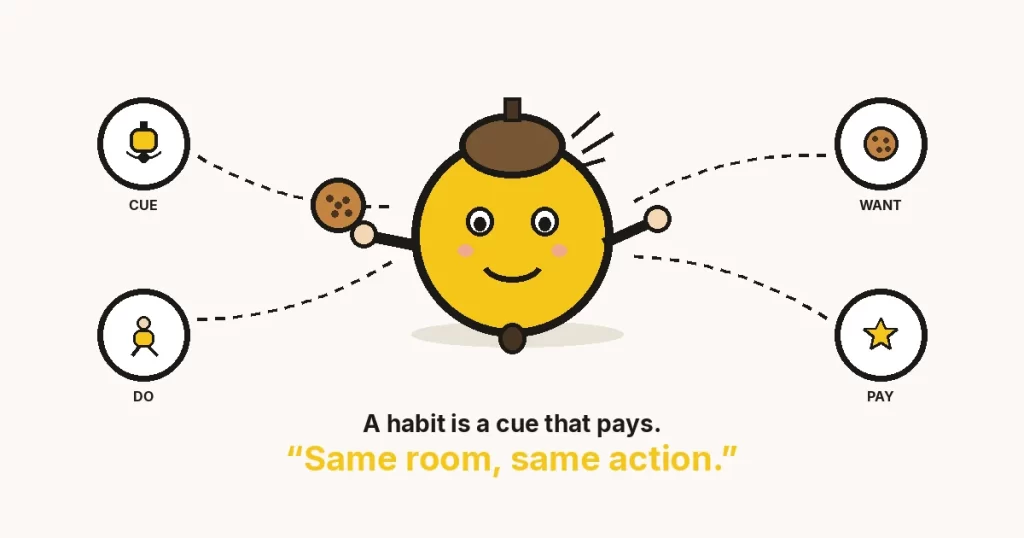
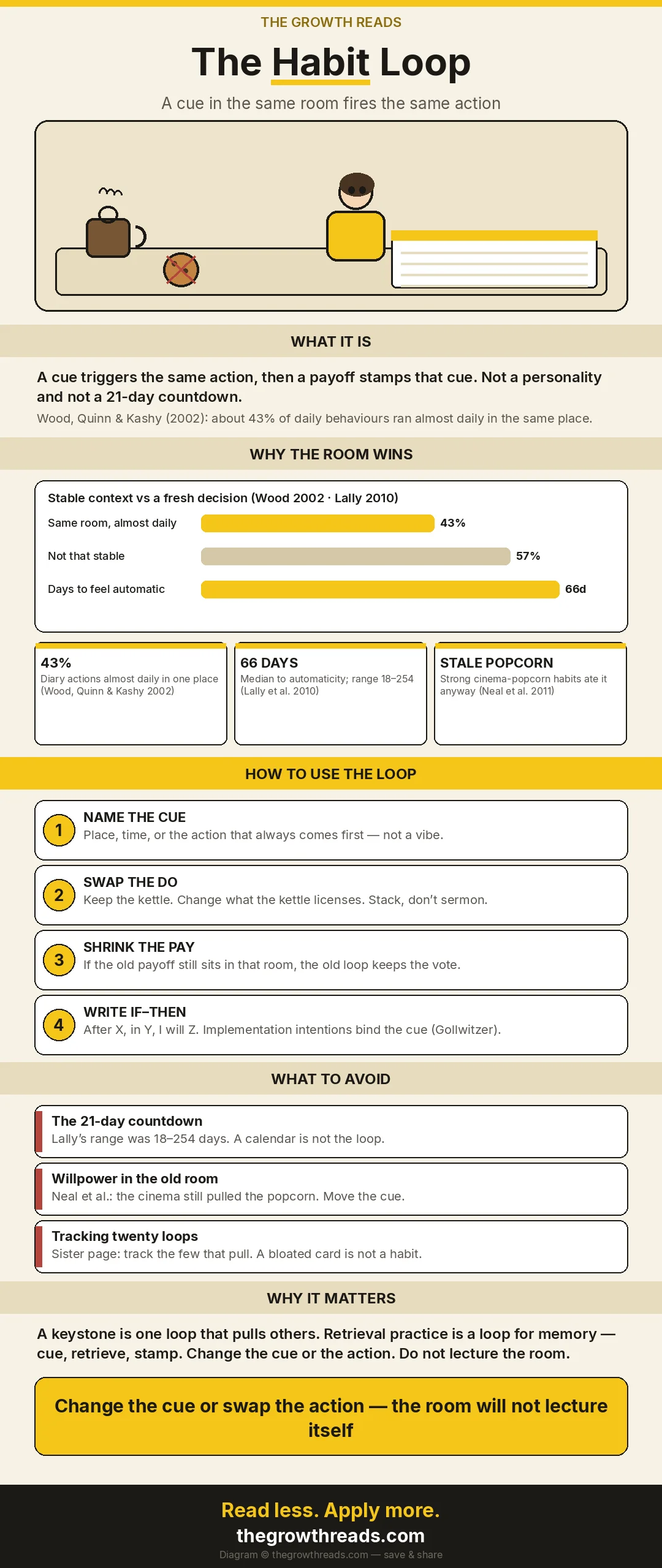
The habit loop is a cue that fires the same action, then a payoff that stamps that cue for next time. It is not willpower, not a 21-day countdown, and not a personality. Name the cue, swap the action that follows it, and stop chasing the old payoff in the same room.
Key takeaways
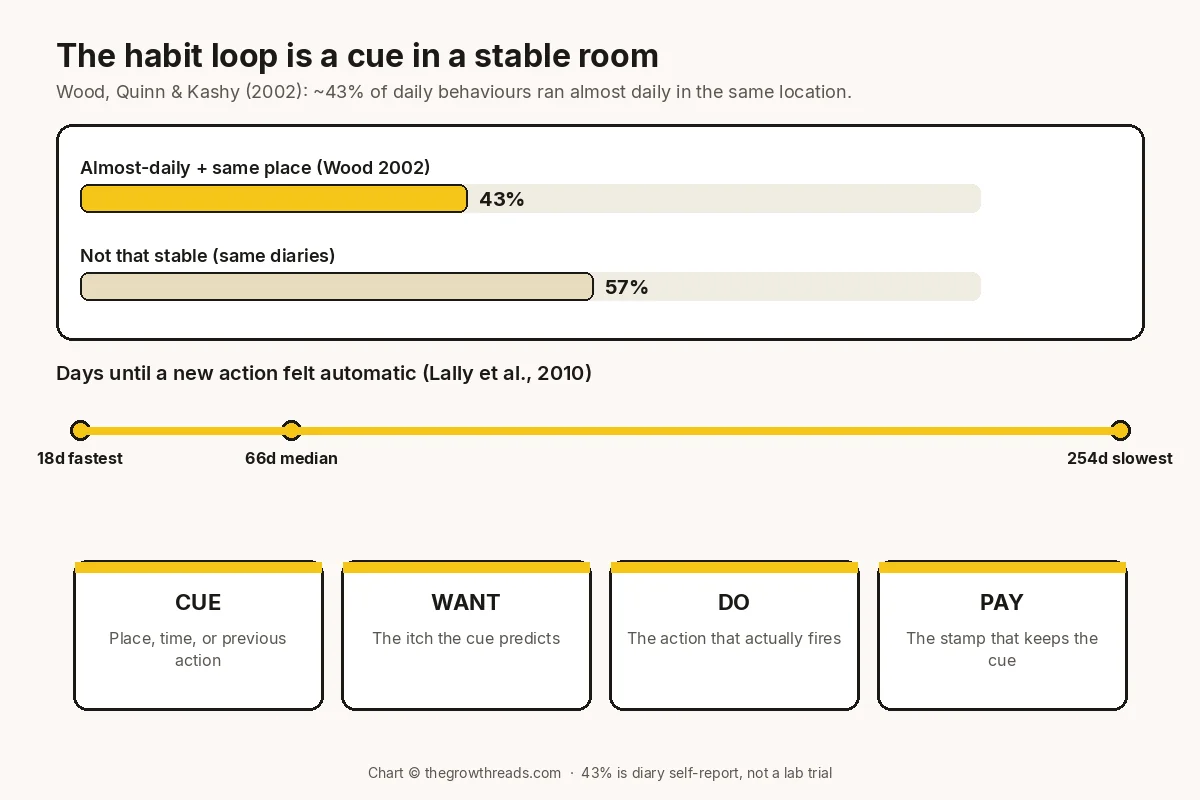
- Wendy Wood, Jeffrey Quinn and Deborah Kashy (2002) found that about 43% of behaviours in everyday diaries were ones people performed almost daily and usually in the same location — a habit loop is a room that keeps voting, not a speech you give yourself.
- Phillippa Lally, Cornelia van Jaarsveld, Henry Potts and Jane Wardle (2010) watched new everyday actions for twelve weeks: self-reported automaticity rose toward a plateau at a median of 66 days, with a range from 18 to 254, so a circled “day 21” is not the loop.
- David Neal, Wendy Wood, Mengju Wu and David Kurlander (2011) served stale popcorn: people with a strong cinema-popcorn habit still ate it in a cinema, and ate much less of the same popcorn in a meeting room — the cue carried the loop after liking had left.
- Wendy Wood and David Neal (2007) treat habits as context-response associations: goals matter most while the link is being learned; once it is stamped, the context can run the action even when the goal has moved.
- Henry Roediger and Jeffrey Karpicke (2006) showed that retrieving a memory beats restudying it for later recall — the down-link in Make It Stick is the same shape as a habit loop: a cue, a do, a stamp.
What the habit loop actually is
The habit loop is a cue in a stable context that fires the same action, then a payoff that stamps that cue so the next pass is cheaper. It is not a personality, not a moral score, and not a 21-day kitchen timer. If you cannot name the cue — the kettle, the chair, the unlock, the last action in a sequence — you do not have a loop. You have a wish with a diagram on it.
Wood, Quinn and Kashy asked people to diary what they were doing, thinking, and feeling as they went about ordinary days. In the Journal of Personality and Social Psychology in 2002 they reported that an average of about 43% of those behaviours were performed almost daily and usually in the same location. That is the boring, useful fact under every pretty loop poster: a large slice of a day is the room repeating itself. The popular three-step sketch (cue, routine, reward) and the four-step teaching version (cue, craving, response, reward) are maps of that repetition. They are not a scan of your basal ganglia, and this page does not pretend they are.
The useful job of the loop is to stop a pile. People who want “better habits” often collect twenty new actions and then wonder why none of them fire. That is the opposite of a keystone habit — one loop that pulls other loops with it. This URL is narrower than that parent. It owns the mechanism: a cue that pays. It does not mint a new habits parent. Later Habits articles on this site still link up to keystone habits. If you cannot name which loop would pull the rest, you are decorating, not installing.
How is this different from a routine, a streak, or a 21-day countdown?
A routine is a sequence you can still decide. A streak is a scoreboard. A countdown is folklore. The habit loop is the sequence that fires when the room fires.
A written morning list can be a routine you still negotiate. The loop starts when the kettle is enough and the negotiation is gone. A streak app will happily score a loop you ran in the wrong room, or miss a loop that fired without a tap. Lally and colleagues (2010) found a median of 66 days for a new action to feel automatic, with a spread from 18 to 254. That range is why sister page how long does it take to break a habit refuses a 21-day timer: replacement is a new loop in a cue, not a circled date. Which habits to track is the sister for this URL: only a few loops earn a row. Tracking twenty loops is how a card becomes a hobby.
Why the loop runs without a decision
The loop runs without a decision because a stable context can trigger the action after the original goal has left — sometimes after you have stopped liking the payoff. That is the mechanism, not “people are lazy,” and not a craving you are required to feel on every pass.
Wood and Neal’s 2007 review in Psychological Review is the cleanest statement of that claim. They treat habits as context-response associations. Goals matter while you are learning the link. Once the link is stamped, the context can run the response even when the goal has moved on. That is why you can sit down “to write” and open the same three apps before a sentence exists. The chair was the cue. The apps were the do. The tiny relief was the pay. The intention was a spectator.
Ann Graybiel’s 2008 review in the Annual Review of Neuroscience is the brain-side cousin, used here with a hard limit. In animals, the basal ganglia can chunk a sequence so that a start cue runs a learned package. That is a reason a loop can feel like one move instead of four decisions. It is not a licence to diagnose a reader, and it is not proof that a four-bubble poster is a neural map. The poster is a teaching device. The diary and the popcorn are the human evidence this page will stand on.
Counter-case. Not every repeated action is a habit loop. A surgeon’s checklist is repeated on purpose. A legal filing has a real window. Wood’s 43% is diary self-report in ordinary days, not a lab assay of automaticity, and it is not 43% of your Tuesday. The loop fails as an explanation when the action still needs a fresh decision every time, or when the “cue” is a mood you cannot point at in the room. If you cannot name the kettle, the chair, or the previous step, stop drawing arrows.
The four parts
Name the parts by what you do with them: cue, want, do, pay. The three-step sketch drops want. Wood’s language drops the poster and keeps the context-response link. Use whichever map lets you name the room. Do not collect all three as homework.
| Map | Parts | What it is good for | Where it lies |
|---|---|---|---|
| Context-response | Stable place or previous action → the do | Explains why the chair opens the apps after the goal has left (Wood & Neal, 2007) | Quiet on “want.” You still have to name what stamps the cue while you are learning |
| Three-step sketch | Cue, routine, reward | A short teaching loop people can say out loud | Makes “routine” sound like a chosen sequence. The interesting case is when it is not |
| Four-step sketch | Cue, craving, response, reward | Names the itch between cue and do | Craving is not required on every pass — stale popcorn still went down in the cinema |
| This page’s verbs | Cue, want, do, pay | Forces a next move: change the cue or swap the do | A map, not a trial. If the CUT equivalent — a do you will not run — is empty, you do not have a loop, you have a list |
Cue is a place, a clock, or the action that always comes first. “After I put the kettle on” is a cue. “When I feel motivated” is not. Want is optional as a felt itch and useful as a prediction: the kettle predicts a scroll, or it predicts a sentence. Do is the physical action. Pay is whatever makes the next pass cheaper — taste, relief, a tick, a retrieved answer. The hub at the productivity library is full of methods that fail the same way when they become collections rather than a cue you can point at.
That last pay is why this spoke down-links to Make It Stick rather than to another habit slogan. Peter Brown, Henry Roediger and Mark McDaniel’s book is about learning, not morning routines. Retrieval practice is still a loop: a question is the cue, retrieving the answer is the do, and being right (or being corrected) is the stamp. Roediger and Karpicke (2006) showed that a test beat restudy for later recall. If you want a loop that pays in memory rather than in sugar, that is the shape. The book stays on the review. This page keeps the mechanism.
Craving is a teacher, not a requirement
You do not have to feel a craving on every pass for the loop to be a loop. Neal, Wood, Wu and Kurlander (2011) took people with a strong cinema-popcorn habit, gave them stale popcorn, and sat them in a cinema or a meeting room. In the cinema the habit still pulled eating. In the meeting room, much less. Liking was not doing the work. The room was. Use “want” when you are installing a new loop and need a payoff worth repeating. Do not wait to “feel it” before you will admit the old loop is running.
Why a stuck loop costs more than it feels like
A stuck loop feels cheap because each pass is short. The bill is a day spent running yesterday’s action in today’s chair, then calling the familiarity discipline.
The popcorn paper is the cost sheet for a loop that outlived its payoff. People still ate food they did not like because the cinema said so. Translate that into knowledge work and you get inbox-first mornings, unlock-and-scroll commutes, and “I’ll just check” that is no longer a check. None of that requires a villain. It requires a cue that still pays in relief even when it no longer pays in work.
Lally’s range is the other half of the cost, and it is a limit on this page’s promises. A new loop can start to feel automatic in 18 days or still be effortful past 200. Missing one day did not wipe the curve in that study, which is a relief. It is also not a promise that your gym loop will feel like blinking by day 66. Automaticity was self-reported. The actions were eating, drinking, or exercise that people chose. This is not a randomised trial of a four-bubble poster, and it is not a certificate that drawing the loop made anyone kinder to a future self.
So the honest claim is smaller than the diagram. Naming the cue can stop you donating the first hour to an old do. It does not prove output rose. Judge a loop by whether the action you wanted actually fired when the kettle fired. Do not judge it by whether the arrows look complete. Consistency is showing up next to the same cue. It is not a personality, and it is not this URL — this URL is the loop those consistent passes run inside. Why consistency is important is the why. Keep them in their lanes.
How to use the habit loop
Name the cue, swap the do, shrink the old payoff in that room, and write the if-then so the next pass does not need a speech. This is a selection pass, not a numbered how-to product. There is no HowTo schema on this page because the slot is a spoke.
Pick one loop, not a lifestyle. If you need the loop that would pull others, that choice lives on keystone habits. If you already have a pile of candidate loops, which habits to track is the filter. Then say the cue out loud in a sentence a stranger could verify: after the kettle, at the counter, before the phone. If the sentence needs a feeling, it is not a cue yet.
Swap the do without pretending you swapped the room. Habit stacking is the attachment move: the existing loop is the cue for a new, smaller do. The two-minute rule is how you shrink that do until it can actually follow the kettle. Implementation intentions (Gollwitzer, 1999) are the written form: after X, in Y, I will Z. That paper is about if-then plans, not a habit-loop poster, and the effect sizes are for specific, named actions — not “be a morning person.”
Move or starve the old pay. If the cookie still sits next to the kettle, the old loop still has a vote. If the phone is the first object in the chair, the chair will keep opening it. Wood, Tam and Guerrero Witt (2005) found that when university students changed cities, old habits were easier to disrupt — a real context shift, not a motivational speech. You do not need to move house. You do need to stop serving the old payoff on the same square of counter. Review once a week, not all day: which cue still fires the old do? Which new do never found a kettle? How to start a reading habit is one worked example of a do that needs a cue (the chair, the train, the kettle) rather than a identity announcement.
Common mistakes that turn the loop into a poster
- Drawing four arrows and changing nothing in the room. A loop with the same kettle, the same phone, and a new slogan is the old loop.
- Installing twenty loops. A bloated card is not a habit. See which habits to track.
- Treating day 21 as a finish line. Lally et al. (2010): 18 to 254 days. Sister page how long does it take to break a habit is replacement, not a timer.
- Waiting to feel a craving. Neal et al. (2011): the cinema still pulled stale popcorn. The room can run the do after liking has left.
- Writing a mood as the cue. “When I feel ready” is not a cue. After the kettle, at the counter, is.
- Leaving the old payoff on the counter. The cookie next to the kettle is a vote for the old do. Starve it or move it.
- Using the diagram as proof you worked. The test is whether the new action fired when the cue fired. Pretty arrows are not a loop. A second brain that captures every intention and never attaches one to a kettle is the same miss in a nicer notebook.
When it is more than a loop
The habit loop is for actions you can attach to a cue you can point at. It is not a diagnosis, a trauma plan, or a substitute for help when starting anything is broken across every context. This is a productivity method page. It does not treat, and it does not list clinical symptoms. If the stall is “I cannot begin, anywhere, for weeks,” that is not a missing bubble. That is a different problem, and a clinician is the right next step — not a prettier loop. Sleep, pain, and mood belong with people qualified to handle them. You can still name today’s kettle while that other work happens. The diagram cannot hold “fix my life.”
The evidence behind this
The literature supports a large slice of ordinary behaviour running in stable contexts, a wide range of days until a new action feels automatic, and a leftover pull from old cues after liking has left. It does not support a 21-day law or a four-bubble poster as a neural map.
| Study | Design and size | Finding we used | Limit |
|---|---|---|---|
| Wood, Quinn & Kashy, 2002 | Experience-sampling diaries of everyday behaviour | ~43% of listed behaviours were almost daily and usually in the same location | Self-report diaries, not a lab assay of automaticity; not your Tuesday |
| Lally, van Jaarsveld, Potts & Wardle, 2010 | 12-week field study of self-chosen eating, drinking, or exercise actions | Automaticity plateau median 66 days; range 18–254; a missed day did not reset the curve | Self-reported automaticity; not a trial of a loop poster; wide range |
| Neal, Wood, Wu & Kurlander, 2011 | Stale-popcorn eating in a cinema vs a meeting room | Strong cinema-popcorn habits ate stale popcorn in the cinema, much less in the meeting room | One food, one pair of contexts; not knowledge work |
| Wood & Neal, 2007 | Theoretical review in Psychological Review | Habits as context-response links; goals matter most during learning | A framework paper, not a new experiment |
| Graybiel, 2008 | Neuroscience review of habit and ritual in the basal ganglia | Sequences can chunk so a start cue runs a package | Mostly animal work; not a licence to map a four-bubble poster onto a reader |
| Gollwitzer, 1999 | Review of implementation-intention experiments | If-then plans bind a cue to a do for specific, named actions | Not a habit-loop trial; effects are for specified behaviours, not identities |
| Roediger & Karpicke, 2006 | Lab memory experiments: test vs restudy | Retrieving beat restudying for later recall — a cue, a do, a stamp in memory | Word lists and prose, not a morning routine; used here as the Make It Stick mechanism |
| Wood, Tam & Guerrero Witt, 2005 | University students transferring universities; exercising, newspaper, TV habits | A context shift made old habits easier to disrupt | A life move, not a kitchen experiment; you still have to change the local cue |
Frequently asked questions
What is the habit loop?
The habit loop is a cue in a stable context that fires the same action, then a payoff that stamps that cue for next time. It is a mechanism, not a personality and not a 21-day countdown. Wendy Wood, Jeffrey Quinn and Deborah Kashy (2002) found about 43% of everyday behaviours in diaries were ones people did almost daily, usually in the same location. Change the cue or swap the action that follows it. Keep chasing the old payoff in the old room and the old loop keeps the vote.
What are the four stages of the habit loop?
Call them by the verb: cue, want, do, pay. The cue is a place, a time, or the action that always comes first. Want is the itch the cue predicts — useful teaching, not a lab requirement. Do is the action that actually fires. Pay is whatever stamps the cue so the next pass is cheaper. A three-step sketch drops want and still names cue, routine, reward. Wendy Wood’s research language is blunter: a context-response link. The poster count is optional. The room and the action are the method.
Is the habit loop the same as cue, routine, reward?
Searchers use both phrases for the same object. Cue–routine–reward is the three-step teaching sketch. A later four-step version inserts craving between cue and action. This URL answers the object: a cue that fires the same action, then a stamp. It does not treat a book title as the science. The evidence this page uses is diary work on stable locations (Wood, Quinn and Kashy, 2002), a field study of automaticity (Lally and colleagues, 2010), and a cinema-popcorn test of context (Neal, Wood, Wu and Kurlander, 2011). The diagram is a map, not a neuron.
How long does a habit loop take to form?
There is no honest single number. Phillippa Lally, Cornelia van Jaarsveld, Henry Potts and Jane Wardle (2010) tracked new everyday actions for twelve weeks. Self-reported automaticity rose toward a plateau at a median of 66 days, with a range from 18 to 254. Missing one day did not reset the curve. A 21-day countdown is folklore next to that spread. Sister page how long does it take to break a habit covers replacement, not a kitchen timer. Judge a loop by whether the action fires when the cue fires — not by a circled date.
How do you break a habit loop?
You do not lecture it. You change the cue or swap the action that the cue licenses. Neal, Wood, Wu and Kurlander (2011) found people with a strong cinema-popcorn habit still ate stale popcorn in a cinema, and ate much less of the same popcorn in a meeting room. Willpower in the old room is the expensive move. Keep the kettle; change what the kettle licenses. Habit stacking attaches a new do to a cue you already never skip. If the old payoff still sits on the counter, the old loop keeps a vote.
What is the difference between a habit loop and a routine?
A routine can be a sequence you still decide. A habit loop is the sequence that fires when the room fires, with less of that decision left in the middle. Wood and Neal (2007) treat habits as context-response associations: goals matter most while the link is being learned; once it is stamped, the context can run the action even when the goal has moved. That is why a morning you “mean to change” still opens the same app in the same chair. A written routine without a cue is a wish.
Does the habit loop work without a reward?
The teaching diagram needs a payoff because that is what stamps the cue during learning. Once the link is strong, the cue can fire the action with very little liking left — that is the stale-popcorn finding (Neal and colleagues, 2011). So “no reward” is two different claims. If you are installing a new loop, the do has to pay enough that you repeat it next to that cue. If you are trying to kill an old loop, removing the payoff in that room helps, and moving the cue helps more. A loop you hate and still run is still a loop. Disgust is not a break.
What should I read after this page?
Start with keystone habits if you need one loop that pulls others rather than a pile of new loops. Which habits to track is the sister: only a few rows earn a card. Habit stacking is how you attach a new do to a cue you already never skip. How long does it take to break a habit is replacement, not a countdown. Make It Stick is the named book: retrieval practice is a memory loop — a question cues a retrieve, and the success stamps it. Implementation intentions write the if-then that binds a cue to a do. None of those replace naming today’s cue out loud.
Sources
- Wood, W., Quinn, J. M., & Kashy, D. A. (2002). Habits in everyday life: Thought, emotion, and action. Journal of Personality and Social Psychology, 83(6), 1281–1297. https://doi.org/10.1037/0022-3514.83.6.1281
- Lally, P., van Jaarsveld, C. H. M., Potts, H. W. W., & Wardle, J. (2010). How are habits formed: Modelling habit formation in the real world. European Journal of Social Psychology, 40(6), 998–1009. https://doi.org/10.1002/ejsp.674
- Neal, D. T., Wood, W., Wu, M., & Kurlander, D. (2011). The pull of the past: When do habits persist despite conflict with motives? Personality and Social Psychology Bulletin, 37(11), 1428–1437. https://doi.org/10.1177/0146167211419869
- Wood, W., & Neal, D. T. (2007). A new look at habits and the habit-goal interface. Psychological Review, 114(4), 843–863. https://doi.org/10.1037/0033-295X.114.4.843
- Graybiel, A. M. (2008). Habits, rituals, and the evaluative brain. Annual Review of Neuroscience, 31, 359–387. https://doi.org/10.1146/annurev.neuro.29.051605.112851
- Gollwitzer, P. M. (1999). Implementation intentions: Strong effects of simple plans. American Psychologist, 54(7), 493–503. https://doi.org/10.1037/0003-066X.54.7.493
- Roediger, H. L., & Karpicke, J. D. (2006). Test-enhanced learning: Taking memory tests improves long-term retention. Psychological Science, 17(3), 249–255. https://doi.org/10.1111/j.1467-9280.2006.01693.x
- Wood, W., Tam, L., & Guerrero Witt, M. (2005). Changing circumstances, disrupting habits. Journal of Personality and Social Psychology, 88(6), 918–933. https://doi.org/10.1037/0022-3514.88.6.918
- Brown, P. C., Roediger, H. L., & McDaniel, M. A. (2014). Make it stick: The science of successful learning. Belknap Press. TGR review: Make It Stick summary.
Related reading on The Growth Reads
The books this method draws on
- Make It Stick summary & review — the named unused review; retrieval practice is a cue, a retrieve, a stamp
Related articles
- Keystone habits — the Habits parent; one loop that pulls others
- Which habits to track — the sister; only a few loops earn a row
- How to stack habits — attach a new do to a cue you already never skip
- How long does it take to break a habit — replacement, not a 21-day timer
- Implementation intentions — the written if-then that binds a cue to a do
- The two-minute rule — shrink the do until it can follow the kettle
- What is consistency — showing up next to the same cue
- Why consistency is important — the why, not the loop
- How to start a reading habit — a do that still needs a cue
- How to learn new skills — practice loops, not a talent story
Go deeper
How this article was researched
The Growth Reads editorial team writes from primary sources: the books themselves, the authors’ published essays, and the peer-reviewed literature behind the claims. Every study cited above was read in the original publication or its published abstract, and every figure is quoted with its design and limit so you can judge its weight rather than take ours. Where a finding is a diary percentage, a self-report automaticity curve, a popcorn-and-cinema test, a theoretical review, an animal neuroscience review, an if-then literature, a memory test, or a university-move study rather than a randomised test of a four-bubble poster, we say so in the body rather than in a footnote.
This page is a productivity method, not a book review of any single title, and not medical or clinical advice. Persistent inability to start work across contexts belongs with a clinician, not with a prettier loop. Habits-cluster articles on this site link up to live keystone habits. This URL is a Habits child and does not mint a new habits parent.
How we work: every article on The Growth Reads is built from the books in our library plus the research they rest on, and is reviewed and date-stamped when the evidence changes. Read our full methodology.