

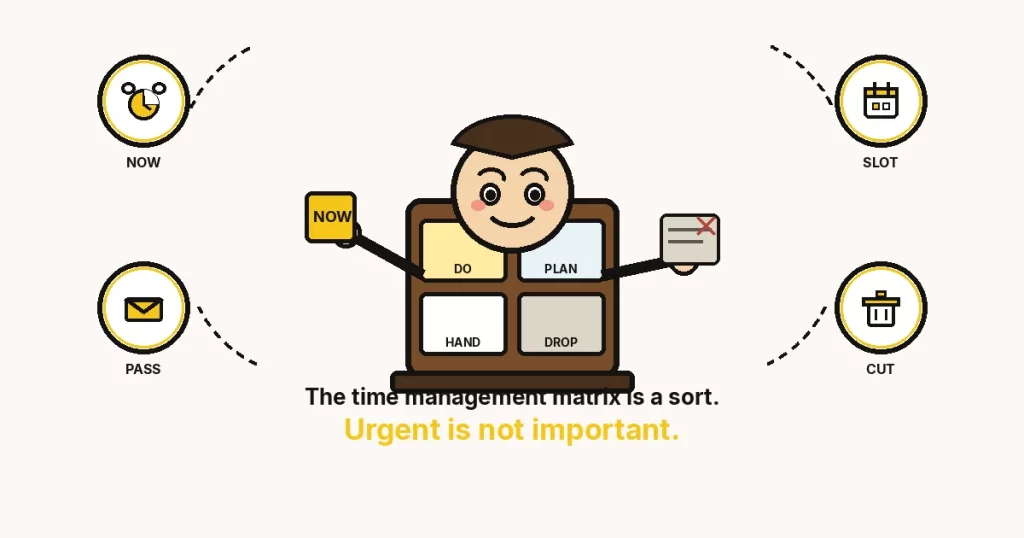
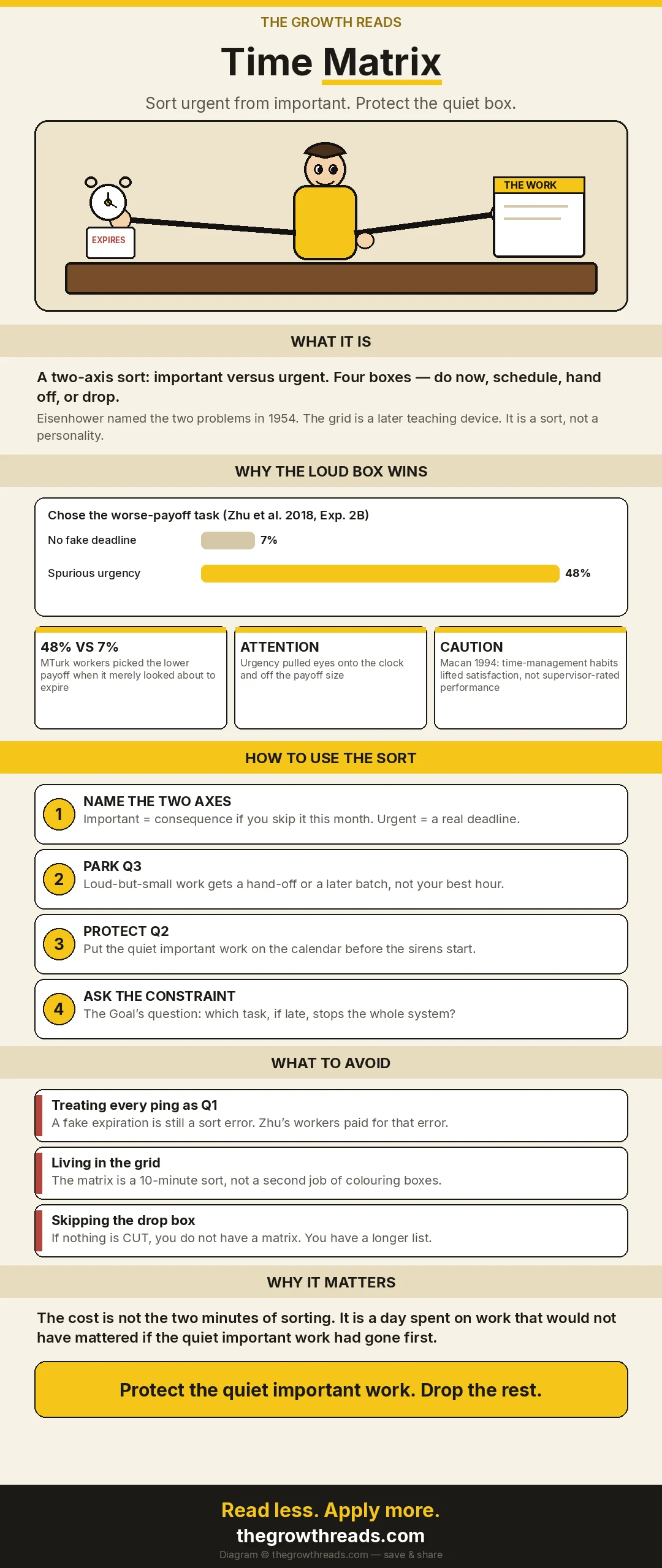
The time management matrix is a two-axis sort: important versus urgent. It exists so you stop treating the loudest task as the best one. Put each piece of work in one of four boxes — do now, schedule, hand off, or drop — then spend the protected hours on the important work that has no siren.
Key takeaways
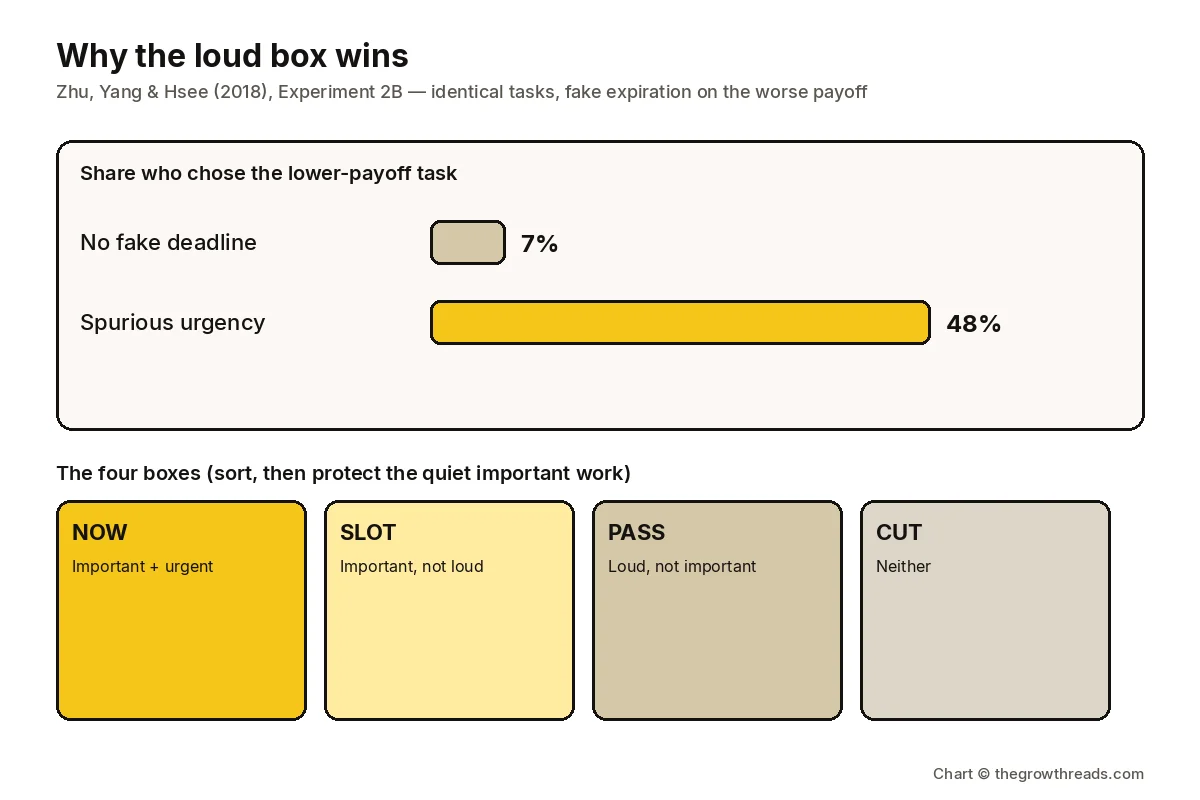
- Meng Zhu, Yang Yang and Christopher Hsee (2018) found a mere urgency effect: in Experiment 2B, 48.1% of workers chose an objectively worse-payoff task when it merely looked about to expire, against 7.3% with no fake deadline.
- The same experiment showed the clock stole attention from the payoff: people reported thinking more about expiration time and less about bonus size, and that shift mediated the worse choice.
- Therese Macan’s 1994 process model of time management found that goal-setting and scheduling were linked to a sense of control over time and to job satisfaction, but not to supervisor-rated job performance — so a neater grid is not proof the work got better.
- Dwight Eisenhower, speaking in Evanston in 1954, drew the two axes this page uses: “I have two kinds of problems, the urgent and the important. The urgent are not important, and the important are never urgent.”
- Gloria Mark, Daniela Gudith and Ulrich Klocke (2008) found interrupted knowledge workers finished in comparable time by going faster — and paid for it in stress, frustration and effort. That is the bill for living in the loud boxes.
What the time management matrix actually is
The time management matrix is a sort that splits work on two independent questions: will this matter if you skip it, and does it have a real deadline now? The first axis is importance — the size of the consequence. The second is urgency — the shortness of the completion window. Cross them and you get four boxes, not a personality, not a moral score, and not a second to-do list in a prettier shape.
On 19 August 1954, Eisenhower told the Second Assembly of the World Council of Churches in Evanston, Illinois, that he had two kinds of problems: the urgent and the important. He credited the line to a former college president. The four-box grid that later got sold as a productivity poster is a teaching device built on that distinction. This page owns the sort. It does not pretend Eisenhower ran a 2×2 workshop, and it does not turn the quote into a personality test.
The useful job of the matrix is to stop a freeze. When every item on the list feels equally loud, you are one step from analysis paralysis — more comparison after the comparison has stopped changing the call. Putting a piece of work in a box is a stopping rule: this is a now, a slot, a hand-off, or a drop. You are not ranking thirty things against each other. You are refusing to treat “it pinged” as the same fact as “it matters.”
How is this different from a to-do list, the 1-3-5 rule, or ABCDE?
A to-do list is an inventory. The time management matrix is a sort of that inventory on importance and urgency. Sister methods cap the day or letter-rank the list; they do not draw these two axes.
How to prioritise tasks is the Decisions sister for picking among options. This URL is narrower: given a pile, which items are important, which are merely loud, and which can leave the pile. The 1-3-5 rule caps the day at one big, three medium, five small. ABCDE letter-ranks. Those are capacity tools. The matrix is a classification tool. You can sort first, then feed the “now” and “slot” boxes into a 1-3-5 day. Mixing the jobs — colouring a 1-3-5 list as if colour were a plan — is how the grid becomes a hobby.
Why urgency wins even when it should not
Urgency wins because a short window pulls attention onto the clock and off the size of the outcome — even when the urgency is fake and the payoff is worse. That is the mechanism, not a character flaw and not “people like being busy.”
Zhu, Yang and Hsee published “The Mere Urgency Effect” in the Journal of Consumer Research in 2018. They defined importance as outcome magnitude and urgency as a short completion window, then asked people to choose between an important-but-not-urgent task and an unimportant-but-urgent one while holding difficulty, interdependence, supply, demand, and when the money arrived constant. They did not use real running-out-of-time. They used an illusion of expiration: the task still fitted inside the window. Participants were told they could do only one task, once. In Experiment 2B, 48.1% of MTurk workers chose the lower-payoff assignment when it merely looked about to expire, against 7.3% in the control (χ²(1) = 41.27, p < .001). Workers also reported paying more attention to expiration time and less to bonus amounts in the urgency condition, and that relative attentional focus mediated the choice.
Two honest limits sit on that finding. It is a laboratory and platform paradigm, not a month of knowledge work. The worse option was still a paid microtask, not “skip the strategy document for a Slack thread.” What it does support is rude and useful: a siren can make a dominated option feel worth taking. If your day is a sequence of sirens, the matrix is there to name the trick, not to decorate a notebook.
Counter-case. People sometimes pick the urgent task for good reasons: a real dependency, a legal deadline, a customer who will leave. Zhu et al. spent five experiments stripping those reasons out so they could show a leftover preference. On a real Tuesday you still have to ask whether the window is real. The matrix fails if you stamp everything Q1 “just in case.”
The four boxes
Name the boxes by what you do with them, not by a poster number: do now, schedule, hand off, or drop. The numbers I/II/III/IV are optional. The verbs are the method.
| Box | Axes | What it looks like | Move |
|---|---|---|---|
| NOW | Important + urgent | A real deadline on work that would hurt if skipped this month | Do it. Then ask why it became a fire |
| SLOT | Important, not loud | The draft, the constraint, the relationship, the system that would prevent the next fire | Put it on the calendar before the sirens start |
| PASS | Loud, not important | Someone else’s urgency, a meeting that could have been a note, a “quick” request | Hand off, batch, or delay on purpose |
| CUT | Neither | Low-stakes busywork with no real window | Drop it. If this box is empty, you do not have a matrix |
The NOW box is not a badge of honour. A week that is all NOW is a week whose SLOT work was skipped last month. The SLOT box is where Eliyahu Goldratt’s question from The Goal earns its keep: which task, if late, stops the whole system? That is importance with a factory’s bluntness. A matrix that never asks the constraint question will fill SLOT with “nice work” and leave the bottleneck starving.
PASS is where most knowledge-work days leak. A request can be urgent for the sender and still be small for the system. Batch it, delegate it, or answer it in a later window. CUT is the honesty test. If you cannot name three things you will not do this week, you are using the matrix as a longer list. The hub at the productivity library is full of methods that fail the same way when they become collections rather than a few moves you can name aloud.
What “important” has to mean or the sort is fake
Important means: if this is late or skipped, a consequence you care about actually moves. Not “it would be good.” Not “a serious person would.” If you cannot finish that sentence, the item is PASS or CUT until you can. Goldratt’s constraint is one version of the test. A weaker but usable version is: would you still do this if nobody pinged you about it this week? If the answer is no, it is not SLOT. It is someone else’s NOW wearing your calendar.
Why the loud boxes cost more than they feel like
A siren feels cheap because it is short. The bill is a day spent going faster on the wrong work, then calling the exhaustion productivity.
Mark, Gudith and Klocke’s 2008 CHI paper on interrupted knowledge work is the cost sheet for the PASS and NOW boxes when they run the day. Interrupted people often finished in comparable or even shorter time by speeding up. The hidden invoice was significantly higher stress, frustration, time pressure and effort. The work still shipped. The person doing it paid in a currency no completion-time metric captures. That is not an argument against every interruption. It is why a day of Q3 pings can look “busy and done” while the SLOT work — the constraint, the draft, the system — did not move.
Macan (1994) is the other half of the cost, and it is a limit on this page’s promises. In Journal of Applied Psychology she tested a process model: time-management training was supposed to raise three behaviour clusters (goals and priorities, mechanics such as lists, preference for organisation), which would raise perceived control of time, which would then improve tension, satisfaction, and performance. In a sample of 353 employed part-time students, perceived control of time mediated links to satisfaction and tension. It did not mediate performance. Training was not found to be effective. Brigitte Claessens, Wendelien van Eerde, Christel Rutte and Robert Roe’s 2007 review in Personnel Review put the same pattern in a wider literature: time-management behaviours show up more reliably next to perceived control, satisfaction, and health than next to a clean performance lift.
So the honest claim for the matrix is smaller than the poster. Sorting can raise the feeling that you chose the day. It is not a certificate that output rose. Use it to stop donating the best hours to a fake expiration. Do not use it as a story that coloured boxes made you better at the job.
How to use the time management matrix
Dump the pile, stamp each item with two questions, protect one SLOT block, and drop something on purpose. This is a selection pass, not a numbered how-to product. There is no HowTo schema on this page because the slot is a spoke.
Write the pile out of your head first if the list is a fog — a brain dump is the cousin for getting items onto paper. Then, for each line, ask only: if I skip this for a month, what happens? And: is there a real window, or a feeling of a window? Real window plus real consequence is NOW. Consequence without a window is SLOT. Window without consequence is PASS. Neither is CUT. Do the sort in ten minutes. If it takes an hour, you are decorating, which is how you slide back into analysis paralysis.
Protect SLOT on the calendar the way you would protect a meeting you cannot move. That is the only “system” this page needs. The Goal’s focusing steps are the check on whether SLOT is actually the constraint or a pile of virtuous busywork. If the bottleneck is waiting, SLOT is whatever feeds the bottleneck. If you are the bottleneck, SLOT is the deep block, not the inbox.
Review once, not all day. A Friday look: what became a fire that should have been SLOT last week? What sat in PASS because you were being helpful? What did you refuse to CUT? SMART goals can hold the outcome those SLOT hours are for. They are not a substitute for the sort. A well-written goal with a week of Q3 pings is still a week of Q3.
Common mistakes that turn the matrix into a longer list
- Stamping everything NOW. If everything is a fire, you have not sorted. You have panicked with extra ink.
- Treating a ping as a deadline. Zhu et al. (2018): a fake expiration was enough. Ask whether the window is real.
- Never using CUT. A matrix with no drops is a to-do list with four colours. The honesty is in the bin.
- Colouring the list all day. The sort is a ten-minute pass. Recolouring is a stall. See analysis paralysis.
- Putting outcomes in the boxes. “Be strategic” is not a task. “Write the one-page constraint note” is. Outcomes belong with how to track productivity or with SMART goals, not in a quadrant.
- Confusing SLOT with ‘someday’. Unscheduled important work is a wish. If it has no calendar block, it will lose to the next siren.
- Using the grid as proof you worked. Macan (1994): time-management habits were not a performance lift. The test is whether the constraint moved, not whether the poster is pretty.
When it is more than a matrix
The matrix is for work you can classify. It is not a diagnosis, a trauma plan, or a substitute for help when starting anything is broken across every context. This is a productivity method page. It does not treat, and it does not list clinical symptoms. If the stall is “I cannot begin, anywhere, for weeks,” that is not a missing quadrant. That is a different problem, and a clinician is the right next step — not a prettier 2×2. Sleep, pain, and mood belong with people qualified to handle them. You can still sort today’s pile while that other work happens. The grid cannot hold “fix my life.”
The evidence behind this
The literature supports a leftover pull toward urgency, and a modest, mostly attitudinal benefit from time-management behaviours. It does not support the poster’s claim that a 2×2 raises job performance.
| Study | Design and size | Finding we used | Limit |
|---|---|---|---|
| Zhu, Yang & Hsee, 2018 | Five experiments; Exp. 2B MTurk workers, χ²(1) = 41.27 | 48.1% vs 7.3% chose the worse-payoff task under spurious urgency; attention to time vs payoff mediated | Microtasks with fake expirations, not a field month of knowledge work |
| Macan, 1994 | Process model; 353 employed part-time students; supervisor ratings | Goals/priorities and mechanics linked to perceived control and satisfaction, not to job performance; training not effective | Self-report behaviours; one sample; 1990s training, not a matrix trial |
| Claessens, van Eerde, Rutte & Roe, 2007 | Narrative review of the time-management literature | TM behaviours associate more cleanly with perceived control, satisfaction, and health than with performance | A review, not a new experiment; mixed measures of “time management” |
| Mark, Gudith & Klocke, 2008 | CHI field experiment on interrupted knowledge work | Interrupted people finished by working faster, with more stress, frustration and effort | Not a test of the four boxes; used here as the cost of a siren-run day |
| Aeon & Aguinis, 2017 | Conceptual review in Academy of Management Perspectives | Time management as planning, monitoring, and evaluating time use — a process, not a poster | Framework paper, not a randomised matrix study |
| Eisenhower, 1954 | Public speech, Evanston, 19 August 1954 | Urgent vs important as two kinds of problems; he attributes the line | A quotation, not a trial; the four boxes are later teaching |
| Goldratt & Cox, The Goal | Practice book (novel), not a trial | Find the constraint; a SLOT hour that does not feed the bottleneck is decoration | A factory story, not a knowledge-work RCT |
Frequently asked questions
What is the time management matrix?
The time management matrix is a two-axis sort. One axis is importance: the size of the consequence if you skip the work. The other is urgency: whether there is a real, short completion window. Crossing them gives four boxes you can act on — do now, schedule, hand off, or drop. It is a classification of a pile, not a personality and not a second to-do list. Eisenhower named the two problems in 1954. The grid is a later teaching device. Use it to stop treating the loudest task as the best one, then spend protected time on the important work that has no siren.
What are the four quadrants of the time management matrix?
Call them by the verb. NOW is important and urgent: a real deadline on work that would hurt if skipped. SLOT is important and not loud: the constraint, the draft, the system that prevents the next fire — it needs a calendar block. PASS is loud but not important: someone else’s urgency, a meeting that could be a note, a “quick” request you can batch or hand off. CUT is neither: drop it. If the CUT box is empty every week, you do not have a matrix. You have a longer list with extra colours. The poster numbers I–IV are optional. The verbs are the method.
Is the Eisenhower matrix the same as the time management matrix?
People use the names as synonyms. The distinction this page cares about is older than the poster. In 1954 Eisenhower said he had two kinds of problems, the urgent and the important, and that the urgent are not important while the important are never urgent. He credited a former college president. Later teaching drew a 2×2. Searchers type “time management matrix” and “Eisenhower matrix” for the same object. This URL answers that object: a sort on those two axes. It does not claim Eisenhower invented a workshop grid, and it does not use the quote as a personality test.
How is the time management matrix different from a to-do list?
A to-do list is an inventory of work you might do. The matrix is a sort of that inventory on importance and urgency. A list can grow forever. A sort has to put some items in PASS and CUT or it is not a sort. Sister tools on this site cap the day or letter-rank the pile — the 1-3-5 rule, ABCDE, how to prioritise tasks. Those are useful after the sort, not instead of it. If you only colour the same thirty lines each morning, you are doing analysis with markers. Dump, stamp, protect one SLOT block, drop something. Then close the poster.
Does the time management matrix actually improve performance?
Do not promise that. Macan (1994) found time-management behaviours linked to perceived control of time and to job satisfaction, not to supervisor-rated performance, and she did not find training effective. Claessens, van Eerde, Rutte and Roe (2007) reviewed a wider literature and saw the same tilt: attitudes and strain more than a clean output lift. What the matrix can do is stop a documented error: Zhu, Yang and Hsee (2018) showed people will take a worse-payoff task when it merely looks urgent. Use the sort to protect SLOT hours. Judge it by whether the constraint moved, not by how complete the grid looks.
What should I put in the important-not-urgent box?
Work that would still matter if nobody pinged you this week, and that feeds the constraint of the system you are in. Goldratt’s question in The Goal is the blunt version: which task, if late, stops everything else? A SLOT item without a calendar block is a wish; it will lose to the next siren. Do not put moods, identities, or quarterly outcomes in the box. Put the next physical action that would move the constraint — a page, a decision, a fix. If you cannot name the consequence of skipping it, it is not SLOT yet. It is PASS or CUT until you can.
What do I do with urgent but unimportant work?
PASS it: hand it off, batch it, or answer it in a later window on purpose. Urgent-but-unimportant is the mere-urgency trap. Zhu et al. (2018) showed a fake expiration was enough to make people take the worse option. A real ping from a colleague can be the same shape. Ask whether the window is real and whether the consequence is yours. If it is real for them and small for the system, it does not get your best hour. A standing hour for PASS work is still a sort. Doing PASS all morning because it feels like helping is how SLOT starves.
What should I read after this page?
Start with analysis paralysis if the stall is more comparison after the call has stopped changing. How to prioritise tasks is the sister for picking among options after you have sorted. The 1-3-5 rule is a daily cap once NOW and SLOT are named. The Goal is the named book: find the constraint so SLOT is not a pile of virtuous busywork. Why is time management important covers the “why bother” question; this URL stays on the sort. None of those replace dumping today’s pile, stamping four verbs, and dropping one item before the first siren.
Sources
- Zhu, M., Yang, Y., & Hsee, C. K. (2018). The mere urgency effect. Journal of Consumer Research, 45(3), 673–690. https://doi.org/10.1093/jcr/ucy008
- Macan, T. H. (1994). Time management: Test of a process model. Journal of Applied Psychology, 79(3), 381–391. https://doi.org/10.1037/0021-9010.79.3.381
- Claessens, B. J. C., van Eerde, W., Rutte, C. G., & Roe, R. A. (2007). A review of the time management literature. Personnel Review, 36(2), 255–276. https://doi.org/10.1108/00483480710726136
- Mark, G., Gudith, D., & Klocke, U. (2008). The cost of interrupted work: More speed and stress. In Proceedings of the SIGCHI Conference on Human Factors in Computing Systems (pp. 107–110). https://doi.org/10.1145/1357054.1357074
- Aeon, B., & Aguinis, H. (2017). It’s about time: New perspectives and insights on time management. Academy of Management Perspectives, 31(4), 309–330. https://doi.org/10.5465/amp.2016.0166
- Eisenhower, D. D. (1954, August 19). Address at the Second Assembly of the World Council of Churches, Evanston, Illinois. Public Papers of the Presidents. UCSB American Presidency Project
- Goldratt, E. M., & Cox, J. (2004). The Goal: A process of ongoing improvement (3rd rev. ed.). North River Press. TGR review: The Goal summary.
- Claessens, B. J. C., van Eerde, W., Rutte, C. G., & Roe, R. A. (2004). Planning behavior and perceived control of time at work. Journal of Organizational Behavior, 25(8), 937–950. https://doi.org/10.1002/job.292
Related reading on The Growth Reads
The books this method draws on
- The Goal summary & review — the named unused review; find the constraint so SLOT is not decoration
Related articles
- Analysis paralysis — the Decisions parent; a stopping rule when comparison will not stop
- How to prioritise tasks — the sister; picking among options after the sort
- The 1-3-5 rule — a daily cap once NOW and SLOT are named
- The ABCDE method — letter-rank the pile
- The brain dump — get the pile onto paper before you stamp it
- SMART goals — the outcome those SLOT hours are for
- Why is time management important — the why, not the sort
- How to track productivity — outputs, not quadrants
Go deeper
How this article was researched
The Growth Reads editorial team writes from primary sources: the books themselves, the authors’ published essays, and the peer-reviewed literature behind the claims. Every study cited above was read in the original publication or its published abstract, and every figure is quoted with its design and limit so you can judge its weight rather than take ours. Where a finding is a microtask urgency experiment, a 1994 process model that did not lift performance, a narrative review, a CHI interruption study, a 1954 speech, or a factory novel rather than a randomised test of a four-box poster, we say so in the body rather than in a footnote.
This page is a productivity method, not a book review of any single title, and not medical or clinical advice. Persistent inability to start work across contexts belongs with a clinician, not with a prettier 2×2. Decisions-cluster articles on this site link up to live analysis paralysis. Habits-cluster articles link up to live keystone habits; this URL is a Decisions child and does not mint a habits parent.
How we work: every article on The Growth Reads is built from the books in our library plus the research they rest on, and is reviewed and date-stamped when the evidence changes. Read our full methodology.