

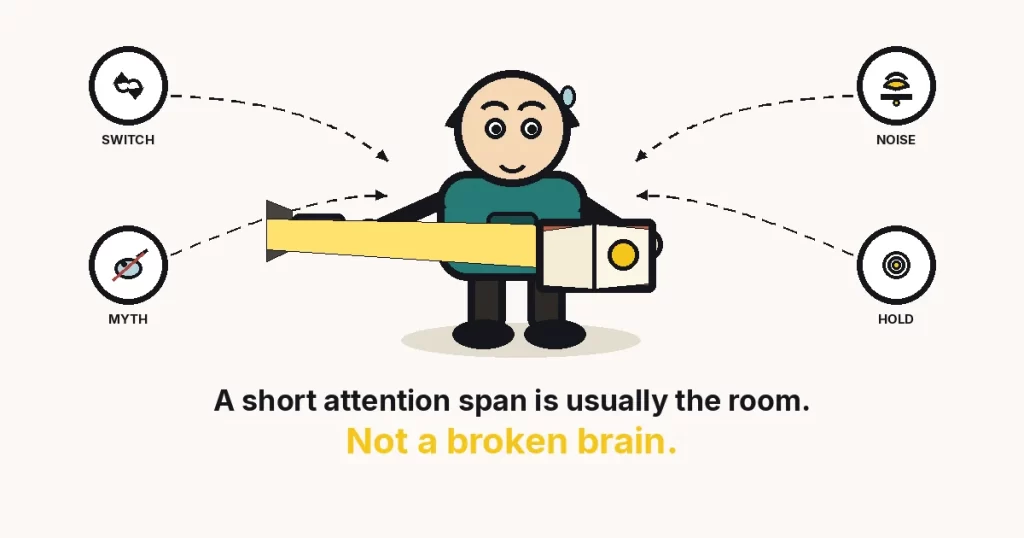
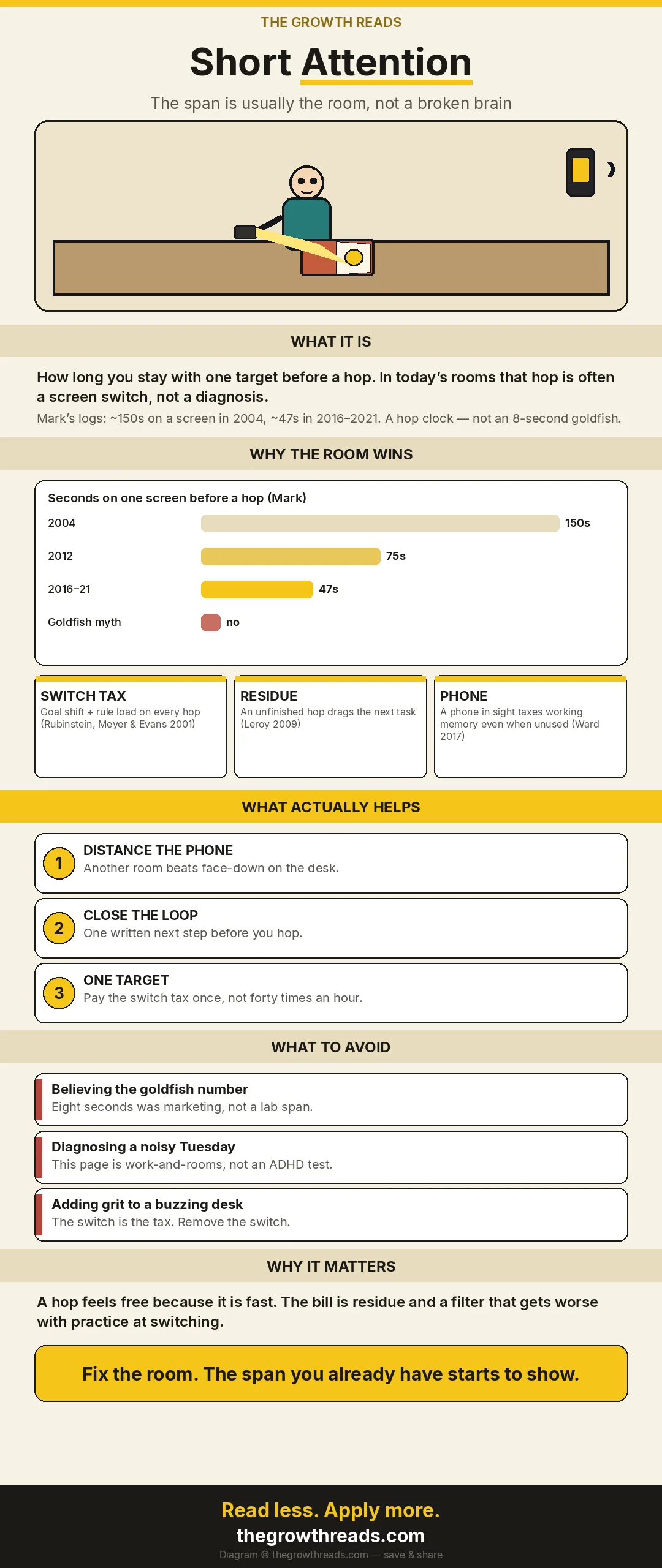
A short attention span is usually the room switching you, not a broken brain. Gloria Mark’s workplace logs show people now stay on one screen about 47 seconds before hopping, down from two and a half minutes in 2004. The eight-second goldfish number is a marketing myth. Change the room; the span you already have starts to show.
Key takeaways
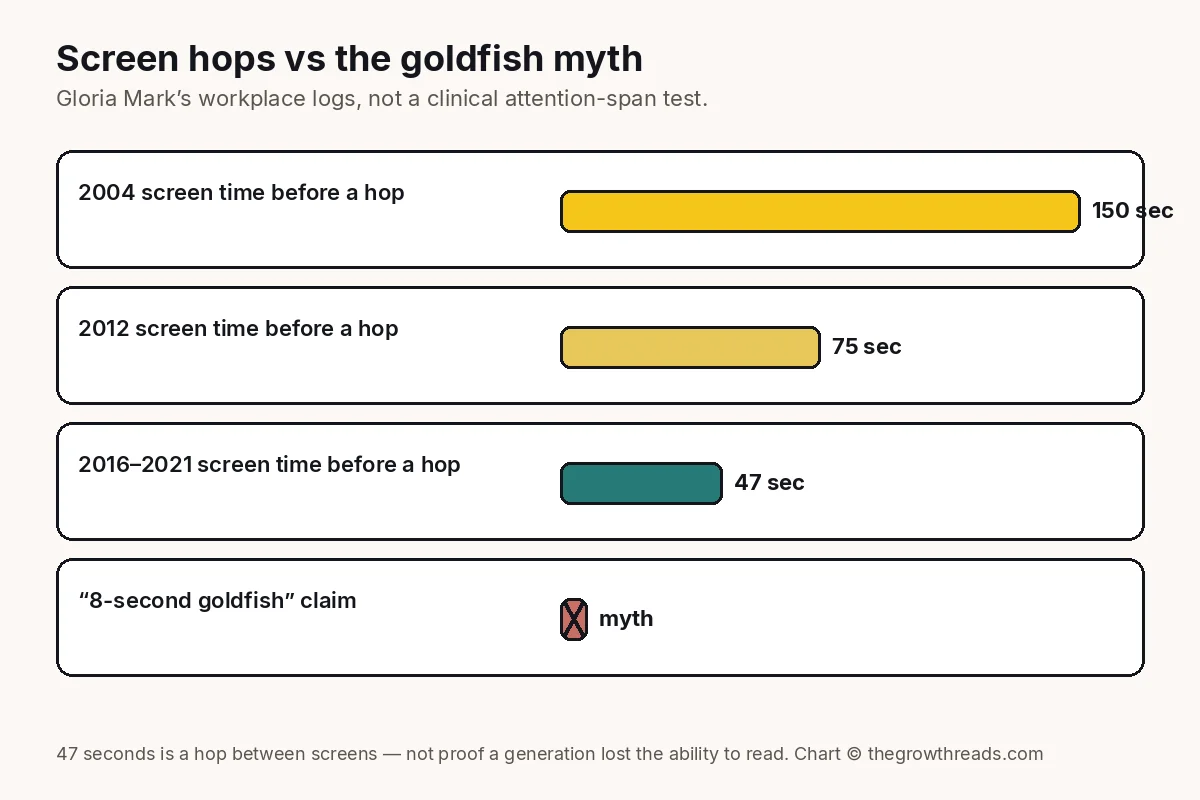
- Gloria Mark’s observational logs of knowledge work show average time on one screen before a hop falling from about 150 seconds in 2004 to about 75 seconds in 2012 and about 47 seconds in 2016–2021 — a hop clock, not a clinical attention-span test.
- Every hop still charges two executive-control stages: goal shifting, then rule activation, and the tax grows when the new task is complex (Rubinstein, Meyer & Evans, 2001).
- Switching away before a task is finished leaves attention residue that measurably drags the next task (Leroy, 2009).
- A smartphone in sight reduces available working memory and fluid intelligence even when it stays unused; distance beats “silent, face-down” (Ward, Duke, Gneezy & Bos, 2017).
- Joshua Foer’s Moonwalking with Einstein treats memory as encoding: what you never attended to cannot be recalled later — a short span is often a failed encode, not a missing filing cabinet.
What a short attention span actually is
A short attention span is how briefly you stay with one target before a hop — and in today’s rooms that hop is usually a screen switch, not proof the brain forgot how to read. The everyday complaint (“I cannot stay with anything”) mixes three different clocks. One clock is sustained attention: holding a chosen target while competitors keep nominating themselves. One clock is screen duration: how long a window stays in front before another window wins. One clock is a clinical story about attention that has been short across years and rooms. This page owns the first two. It does not diagnose the third.
That is why this article hangs off the Focus parent how to focus better. Focus is the near-total absence of task-switching. A short attention span is what the switching looks like from the inside: you sat down to write, and four minutes later you are in a thread you did not open on purpose. The parent page is the system for removing switches. This page is the recognition page — what the short span is, what actually causes it, and which “fixes” are aimed at the wrong clock.
Gloria Mark’s group at UC Irvine has spent two decades watching knowledge workers rather than asking them how long they think they can concentrate. The tidy series she reports from those logs is blunt: about two and a half minutes on a screen before a hop in 2004, about 75 seconds in 2012, about 47 seconds in the 2016–2021 windows. That is observational workplace data. It is not a random sample of humanity, and it is not a lab test of how long a person can read when the room is quiet. It is still the best public picture we have of what a modern work span looks like when the room is allowed to keep offering the next tab.
The number most people bring to this page is eight seconds. That figure did not come from a psychology lab. It came from a 2015 Microsoft Canada consumer-insights report that compared digital consumption trends and then sat next to a goldfish cartoon in a thousand slideshows. Goldfish were never timed in a comparable test. The report measured how people moved through media, not how long a human can hold a sentence. Treat “eight seconds” as branding. Treat 47 seconds as a hop clock from real desks. Neither number is a diagnosis.
What a short attention span is not
The opposite of a short attention span is not a saintly two-hour trance. Most useful work happens in protected stretches of ten to forty minutes, paid for once with a single switch into the task. Flow state is a different object: a match between challenge and skill, not a longer stopwatch. You can have an ordinary, healthy span and still never enter flow. You can also sit in flow for ninety minutes on Saturday and still hop every 47 seconds on a noisy Tuesday. The span is the hop rate. Flow is a state that sometimes rides on top of a protected span.
It is also not a memory defect. Joshua Foer’s Moonwalking with Einstein is this row’s unused review for a reason. The memory-championship story is an encoding story. You do not retrieve what you never attended to. A Tuesday that feels like “I cannot remember anything I just read” is often a Tuesday that never encoded, because the eyes moved and the target did not. That is a span problem wearing a memory costume. The filing cabinet is fine. The intake desk was closed.
And it is not an ADHD page. Lifelong, cross-context, impairing attention problems are a clinical conversation. A buzzing Slack bar is not. If the only room you cannot hold a page in is the one with a phone on the desk, start with the desk. We will say that again in the limits note, because the SERP around this keyword keeps offering a diagnosis the keyword does not earn.
What causes a short attention span
A short attention span is caused by hops, and hops are caused by four cheap triggers: a signal, an open loop, a visible phone, and the habit of checking when a task gets briefly uncomfortable. None of those require a personality flaw. They require a badge, a half-finished paragraph, a rectangle in reach, or a boring twenty seconds. That is an ordinary afternoon on the productivity hub, not a character verdict.
Joshua Rubinstein, David Meyer and Jeffrey Evans modelled the hop itself in 2001. Executive control does two jobs in sequence: it shifts the goal (“I am doing this now”), then it loads the rules the new job needs. Both stages take time. Both get more expensive when the new job is unfamiliar or complex. What feels like “I just glanced” is a full reload. Do that forty times an hour and the afternoon is mostly reloads.
Sophie Leroy’s 2009 paper added the part the stopwatch misses. When people left Task A unfinished, a residue of attention stayed attached to A and dragged performance on B. Finishing A helped — and even then, only when people also had a reason to disengage. A hop you did not close is still running in the background. The live sister page attention residue is the mechanism write-up. Here it is the reason a “short span” often feels like fog rather than like a clean cut.
The room then keeps offering hops. Cary Stothart, Ainsley Mitchum and Courtney Yehnert (2015) found that merely receiving a phone notification — without looking, without touching — disrupted an attention-demanding task by roughly the same magnitude as actually answering. Adrian Ward, Kristen Duke, Ayelet Gneezy and Maarten Bos (2017) then showed that a phone sitting in sight, unused and silent, still reduced available working memory and fluid intelligence, with the largest hit in people who felt most dependent on the phone. “I did not pick it up” is not the same as “it cost nothing.”
The four hops that shrink the span
- The signal. A badge, a banner, a buzz. Stothart’s result is the unwelcome one: the signal is the disruption. Silence-and-leave-it-on-the-desk solves a different problem than the one the study measured. Notification overload is the cluster page for that pile-up.
- The open loop. You “moved on” and the last paragraph is still holding a chair in working memory (Leroy, 2009). Write the next physical step before you hop. That is a fifteen-second close, not a new system.
- The rectangle in reach. Ward’s location line — desk, bag, other room — is the cheapest distance experiment most desks have never run. Face-down is still nearby.
- The escape check. The task got briefly uncomfortable, so the hand opened a thread. Eyal Ophir, Clifford Nass and Anthony Wagner (2009) found that habitual heavy media-multitaskers were worse at filtering irrelevant information, including in a quiet lab with no phone. Practising the hop does not appear to build a hop-resistance muscle. It appears to train the filter to stay open. That is the cost unpacked on what multitasking actually costs.
Sleep debt, illness, and a day that started in fragments will also shrink the span. Those are real. They are not the default story for a Tuesday that only falls apart when the laptop and the phone share a square foot. Start with the square foot. If the span is short in a quiet room, on a full night’s sleep, across years, that is a different conversation — and not one this page is allowed to finish.
Why it costs more than it feels like
A single hop feels free because it is fast; the bill is a stack of smaller taxes that never print as one dramatic number. Rubinstein, Meyer and Evans priced the reload. Leroy priced the residue that outlasts the reload. Gloria Mark, Daniela Gudith and Ulrich Klocke (2008) priced the human cost when interrupted workers still finished on time: they compensated by working faster, and they reported more stress, frustration, time pressure and effort. The work got done. The person doing it paid in a currency no completion-time metric captures.
Ophir, Nass and Wagner add a slower bill. Heavy media-multitaskers in their sample were not just interrupted more often. They performed worse on filtering and switching tests administered in a quiet lab. The study is correlational — it compared people who already differed in media habits, so it cannot prove that hopping causes a worse filter rather than a leaky filter drifting toward more hops. That limit matters. It is still a warning against treating “I am good at juggling” as a skill the data supports. The heaviest jugglers were the worst at the thing they claimed as a talent.
Foer’s encoding point is the quietest cost, and the one that shows up as “I read the page and nothing stuck.” If attention never landed, retrieval has nothing to fetch. A short span does not only steal the next ten minutes. It steals the memory of the last ten. That is why how to stay on task and single tasking keep showing up as sisters: they are the refusal to pay the hop tax forty times before lunch.
Two honest caveats. Mark’s 47-second figure is a synthesis of observational workplace logs, not a randomised trial of “attention span” as a trait. Ophir, Nass and Wagner cannot tell you that deleting Instagram will lengthen a clinical span. What both support is narrower and still useful: the modern room is engineered for hops, hops are expensive, and practising hops does not appear to make you better at ignoring them.
Put together, the honest cost of a short attention span is not “you only have eight seconds.” It is a reload tax (2001), a residue tax (2009), a stress tax that hides inside on-time delivery (2008), a presence tax from a phone you never touched (2017), and — for the heaviest hoppers — a filter that looks leakier even after the room goes quiet (2009). That is enough to take seriously. It is not enough to pathologise a Tuesday.
Nearby ideas that are not a short attention span
Most phrases that sit next to “short attention span” on a search page are different objects, and treating them as synonyms is how the wrong fix gets bought. The table is a boundary map, not a diagnostic of types-and-cures. Play pages do not run that ladder. They name the neighbours so this URL stays on its own keyword.
| Phrase | What people think it is | What it actually is | Wrong fix |
|---|---|---|---|
| Short attention span | A brain that can only hold eight seconds | A hop rate, usually set by the room | App-store “focus” themes; goldfish trivia |
| Poor focus | The same thing as a short span | The absence of a protected switch-off — the parent page | Adding willpower to a buzzing desk |
| Multitasking | A talent that offsets a short span | Rapid serial hopping; heaviest users filter worse | “I work better with three things open” |
| Bad memory | A filing-cabinet failure | Often a failed encode (Foer): nothing attended, nothing stored | A new notes app for unread pages |
| ADHD | What every hoppy Tuesday “probably is” | A clinical pattern across years and rooms — not this page | Self-diagnosis from a workplace log |
The parent how to focus better keeps the method. How to reduce screen time keeps the hours-on-glass problem. A later how-to in this queue will own “how to increase attention span” as a method URL. This page refuses to become that page early. Causes and boundaries first. The method URL can inherit them without this one growing a step ladder.
Common mistakes
- Repeating the goldfish number as if it were a finding. Eight seconds was a consumer-insights slide. Mark’s hop clock is the number that came from desks. Using the myth trains people to treat a normal paragraph as medically impossible.
- Silencing the phone and leaving it in the sightline. Ward, Duke, Gneezy and Bos’s location line says nearby still costs. Another room is the condition the study actually supports.
- Calling a noisy Tuesday ADHD. Lifelong, cross-context impairment is a clinician’s job. A badge on a laptop is a signal problem. Do not let a hop clock do medical work.
- Buying a new capture tool for a span problem. Foer’s point is intake, not storage. A prettier notebook will not encode a page you hopped off of. That is the shiny-object move with better paper.
- Treating multitasking as the workaround. Ophir, Nass and Wagner’s heavy hoppers were worse at the filter. Juggling is the cause wearing a skill badge. The sister write-up is multitasking.
- Waiting to feel focused before starting. The span lengthens after the first protected minutes, not before them. Name the output, remove one trigger, begin. Implementation intentions are the written version of that start.
- Protecting a calendar block and leaving every signal on. A hold on the calendar is a wish if the badge can still fire. Stothart’s notification result does not care that the invite said “deep work.”
The evidence behind this
The useful studies on a short attention span measure hops, residue, signals, and filters — not goldfish, and not a single “span score” you can buy a supplement for. What follows is the working set for this page, with design and limit in the same row as the finding.
| Study | Design and size | Finding | What we used it for |
|---|---|---|---|
| Rubinstein, Meyer & Evans (2001) | Four lab experiments on task switching; executive-control model | A hop has two stages — goal shift, then rule activation — and both take measurable time, more so when the new task is complex | Why a “glance” is a full reload |
| Mark, Gudith & Klocke (2008) | Field study of interrupted knowledge work | Interrupted workers finished as fast or faster by speeding up, at the cost of more stress, frustration, time pressure and effort | The hidden bill when the work still “gets done” |
| Leroy (2009) | Two experiments on switching before Task A is finished | Unfinished A leaves residue that impairs B; completion plus pressure to disengage clears more than completion alone | Why a short span feels like fog, not a clean cut |
| Ophir, Nass & Wagner (2009) | Lab comparisons of heavy vs light media-multitaskers (Media Multitasking Index) | Heavy multitaskers filtered irrelevant information worse, including on tests with no media present | Why “I am good at juggling” is a suspect claim |
| Stothart, Mitchum & Yehnert (2015) | Attention task with cell-phone notifications | Receiving a notification, without looking or answering, disrupted performance about as much as attending to the phone | Why the signal is the hop, not the reply |
| Ward, Duke, Gneezy & Bos (2017) | Phone location: desk vs bag vs other room | Available working memory and fluid intelligence fell as the phone got closer, even when unused; largest effect in high-dependence people | Why face-down on the desk is not “away” |
| Mark’s workplace logs (2004–2021; CHI 2016 and later synthesis) | Observational logs of knowledge-worker screen use | Average time on one screen before a hop: ~150s (2004), ~75s (2012), ~47s (2016–2021) | The hop clock this page uses instead of eight seconds |
| Microsoft Canada (2015), Attention Spans | Consumer-insights report, not a lab experiment | A digital-consumption slide that was later retold as “humans now have an 8-second span, worse than a goldfish” | Why the goldfish number is rejected, not repeated as fact |
Uncapher and Wagner’s 2018 PNAS review is the honest follow-up to Ophir: media-multitasking research is mixed, effects are often small, and causality is still the open wound. We keep Ophir because the filter finding is the one this SERP keeps denying (“some people can juggle”). We keep the review so we do not pretend the literature closed.
Frequently asked questions
What is a short attention span?
A short attention span is how briefly you stay with one chosen target before a hop. In a modern work room that hop is usually a screen switch — Mark’s logs put the average near 47 seconds — not an eight-second goldfish and not, by itself, a diagnosis. The useful question is which hop you are paying: a signal, an open loop, a phone in reach, or a check you run when the task gets briefly uncomfortable. Fix the hop you actually have. The span you already own is what remains when the hops slow down.
Is the eight-second goldfish attention span true?
No. The eight-second figure traces to a 2015 Microsoft Canada consumer-insights report about digital consumption, later retold next to a goldfish cartoon. Goldfish were not run through a matching lab test, and the report did not measure how long a person can hold a paragraph in a quiet room. Gloria Mark’s workplace logs are the better public number, and they describe screen hops (about 47 seconds in 2016–2021), not a species-wide collapse of the ability to read. Repeat the myth and you train people to pathologise a normal page.
Is a short attention span the same as ADHD?
No. ADHD is a clinical pattern: attention and regulation problems that show up across years and rooms and get in the way of life. A short span on a buzzing Tuesday is usually a hop rate set by badges, open loops, and a phone in reach. This page is a work-and-rooms article. It will not list symptoms, will not score you, and will not treat a 47-second screen hop as a diagnosis. If the span is short in quiet rooms, after sleep, across years, that is a different conversation with a clinician — not a job for a productivity URL.
Why can I not focus for more than a few minutes?
Because the room keeps selling hops cheaper than the task can hold you. A notification you do not answer still costs (Stothart, 2015). A phone you do not touch still taxes working memory if it stays in sight (Ward, 2017). An unfinished paragraph still occupies a chair after you “moved on” (Leroy, 2009). A few minutes is often the gap between two of those events, not the size of your capacity. Remove one trigger and time the next stretch. Most people discover a longer span was already there, waiting on a quieter desk.
Does multitasking shrink your attention span?
It trains hops. Ophir, Nass and Wagner (2009) found that people who already lived in several media streams at once were worse at filtering irrelevant information — including on quiet-lab tests with no phone. That study cannot prove that multitasking caused the leaky filter. It can retire the boast that heavy juggling is a talent. Rapid serial switching is what people call multitasking. Each switch reloads goals and rules (Rubinstein, Meyer & Evans, 2001). Practise that all day and a “short span” is the predictable indoor weather. The sister page is the cost write-up, not a second how-to.
How do you fix a short attention span without a ten-step system?
Change the room before you change your character. Put the phone in another room. Close the last loop with one written next step before you hop. Kill the badge, not just the volume. Pay the switch tax once by naming a single output for the next block. Those are conditions, not a numbered method ladder — this play slot does not own the method URL. If you want the full focus system, use the parent page. If you want the encoding story behind “I read it and nothing stuck,” use the Moonwalking with Einstein review.
Is attention span getting shorter every generation?
Workplace screen hops have gotten shorter in Mark’s logs. That is not the same claim as “Gen Z has a shorter biological span than their parents.” Screen duration is a room measurement. A generation-wide trait would need a different design than office logging. We will not launder a hop clock into a cohort insult. A later page in this queue is reserved for the Gen Z attention-span claim and the goldfish myth in that costume. This page stops at the desk in front of you.
What is the difference between attention span and focus?
Attention span is how long you stay. Focus is whether you are staying on purpose, on one target, while competitors lose. You can have a long span on the wrong thing — a thread, a reel, a worry. You can have short, clean focus in a twenty-minute block that earns the day. The parent page treats focus as the absence of switching. This page treats a short span as the hop rate that switching produces. Lengthen the span by removing hops. Do not wait for a mood called “focused” to walk in first.
Sources
- Rubinstein, J. S., Meyer, D. E., & Evans, J. E. (2001). Executive control of cognitive processes in task switching. Journal of Experimental Psychology: Human Perception and Performance, 27(4), 763–797. https://doi.org/10.1037/0096-1523.27.4.763
- Mark, G., Gudith, D., & Klocke, U. (2008). The cost of interrupted work: More speed and stress. Proceedings of the SIGCHI Conference on Human Factors in Computing Systems, 107–110. https://doi.org/10.1145/1357054.1357072
- Leroy, S. (2009). Why is it so hard to do my work? The challenge of attention residue when switching between work tasks. Organizational Behavior and Human Decision Processes, 109(2), 168–181. https://doi.org/10.1016/j.obhdp.2009.04.002
- Ophir, E., Nass, C., & Wagner, A. D. (2009). Cognitive control in media multitaskers. Proceedings of the National Academy of Sciences, 106(37), 15583–15587. https://doi.org/10.1073/pnas.0903620106
- Stothart, C., Mitchum, A., & Yehnert, C. (2015). The attentional cost of receiving a cell phone notification. Journal of Experimental Psychology: Human Perception and Performance, 41(4), 893–897. https://doi.org/10.1037/xhp0000100
- Mark, G., Iqbal, S. T., Czerwinski, M., Johns, P., & Sano, A. (2016). Focused, aroused, but so distractible: Temporal perspectives on multitasking and communications. Proceedings of the 19th ACM Conference on Computer-Supported Cooperative Work & Social Computing, 21–32. https://doi.org/10.1145/2818048.2819973 — plus Mark’s later observational synthesis of screen-hop times (≈150s / 75s / 47s).
- Ward, A. F., Duke, K., Gneezy, A., & Bos, M. W. (2017). Brain drain: The mere presence of one’s own smartphone reduces available cognitive capacity. Journal of the Association for Consumer Research, 2(2), 140–154. https://doi.org/10.1086/691462
- Uncapher, M. R., & Wagner, A. D. (2018). Minds and brains of media multitaskers: Current findings and future directions. Proceedings of the National Academy of Sciences, 115(40), 9889–9896. https://doi.org/10.1073/pnas.1611612115
- Microsoft Canada. (2015). Attention Spans (Consumer Insights). Marketing report — source of the later “8-second / goldfish” retelling, not a lab attention-span test.
- Foer, J. (2011). Moonwalking with Einstein: The Art and Science of Remembering Everything. Penguin. Growth Reads review: moonwalking-with-einstein-summary.
Related reading on The Growth Reads
The books behind this
- Moonwalking with Einstein summary — Foer’s encoding story: what you never attended to cannot be recalled. This row’s unused down-link.
Related articles
- How to focus better — the Focus parent: remove the switches
- Multitasking — the sister: the hop wearing a skill badge
- Attention residue — the leftover from an unfinished hop
- Single tasking — paying the switch tax once
- How to stay on task — holding the target after the start
- Notification overload — the signal pile-up
- How to reduce screen time — hours on glass, not hop rate
- What flow state actually is — a match, not a longer stopwatch
Go deeper
How this article was researched
The Growth Reads editorial team read the primary papers behind the hop-rate claim — Rubinstein, Meyer and Evans (2001); Mark, Gudith and Klocke (2008); Leroy (2009); Ophir, Nass and Wagner (2009); Stothart, Mitchum and Yehnert (2015); Mark, Iqbal, Czerwinski, Johns and Sano (2016); Ward, Duke, Gneezy and Bos (2017); and Uncapher and Wagner (2018) — plus Microsoft Canada’s 2015 consumer-insights report as the source of the goldfish retelling, and Foer’s Moonwalking with Einstein as the named unused review. Numbers in the takeaways and the evidence table are taken from those papers and from Mark’s later observational synthesis of screen-hop times, not from secondary listicles. This is a causes-and-boundaries page, not a second how-to-focus-better guide and not a clinical article.
Limits. The 47-second figure is observational workplace logging, not a trait test. Ophir, Nass and Wagner are correlational. Uncapher and Wagner (2018) warn that media-multitasking effects are mixed and often small. The Microsoft report is marketing research. We state those limits in the body. We did not invent percentages. We did not diagnose ADHD. We did not treat “short attention span” as a book title, and we did not name books that do not have a Growth Reads review except as already-live sister articles.
Method: primary papers, one marketing report (as a rejected myth), and one named unused review. Last checked 13 September 2026. Play slot — no HowTo schema.