

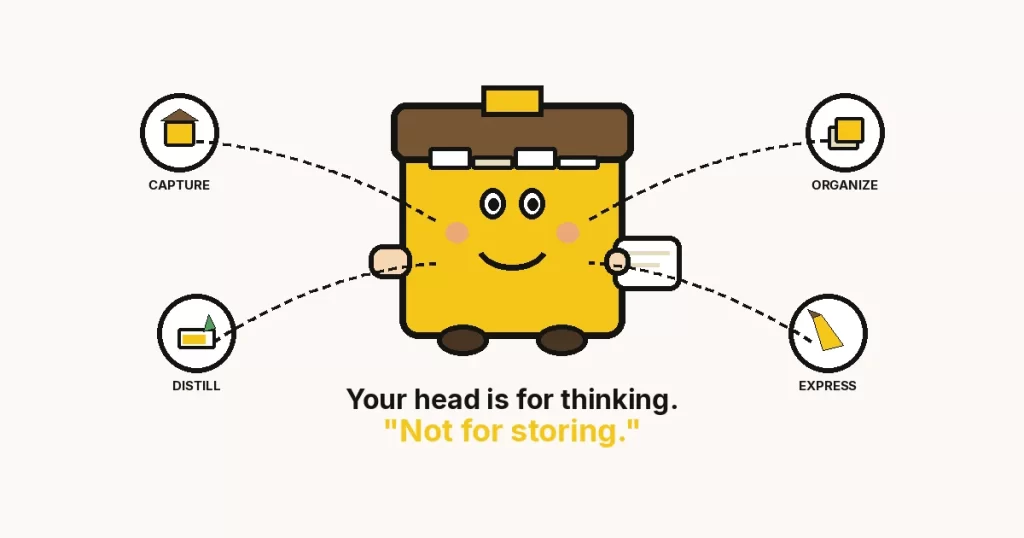
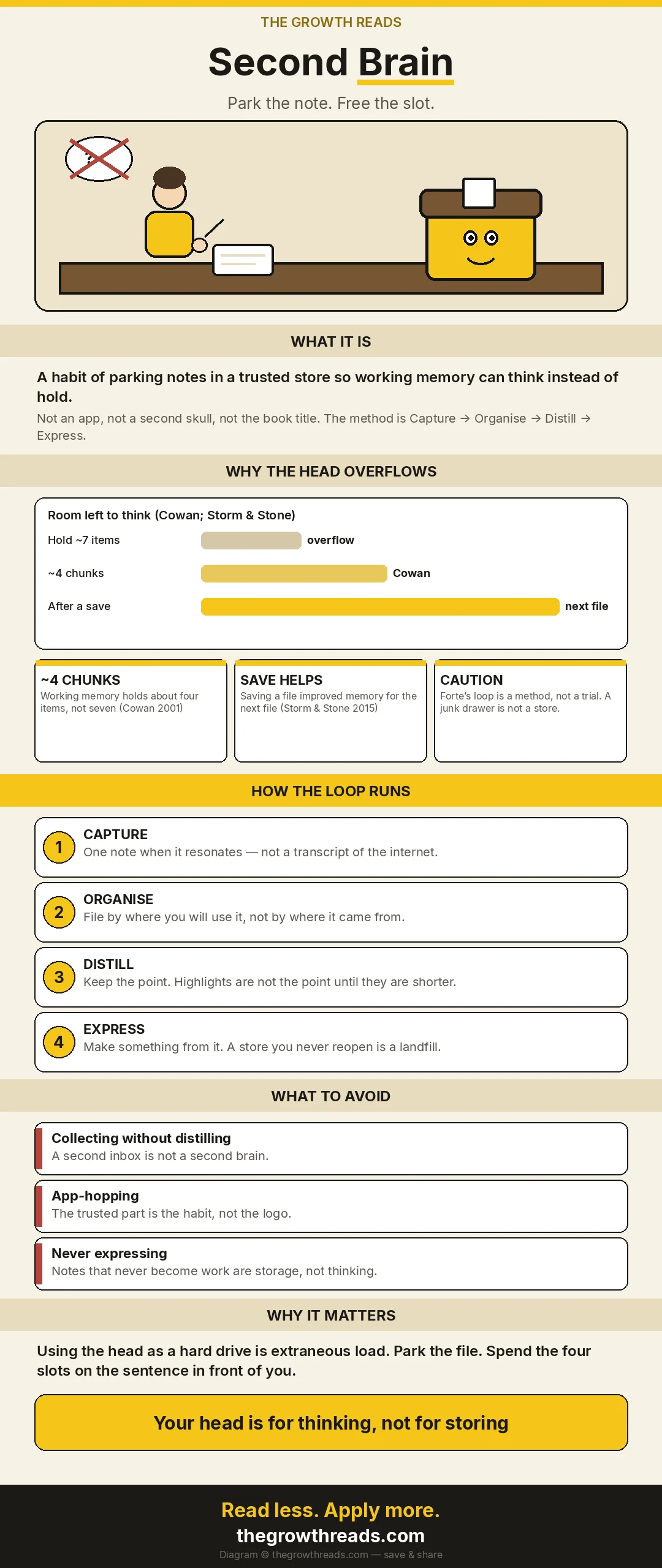
The second brain method is a habit of parking notes in a trusted external store so working memory can think instead of hold. You capture what resonates, organize it by use, distill it, then express it in work. The method is that loop — not an app, and not a bigger memory (Cowan, 2001; Forte, 2022).
Key takeaways
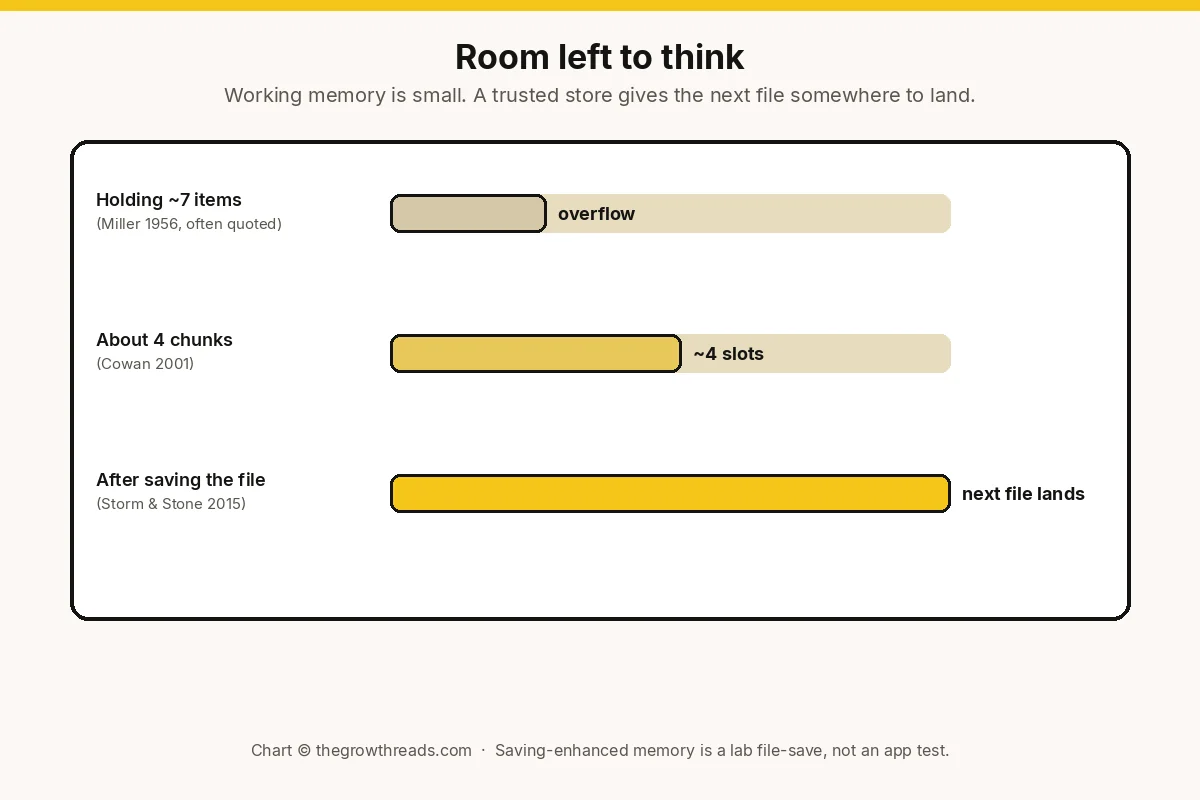
- Working memory holds about four chunks at once, not the seven-plus-or-minus-two figure still quoted from 1956 (Cowan, 2001; Miller, 1956).
- Saving one file can improve memory for the next file — offloading is not only a filing trick (Storm and Stone, 2015).
- When people expect to have later access, they remember where the information lives more than what it said (Sparrow, Liu and Wegner, 2011).
- Using the head as a hard drive is extraneous cognitive load: the slots spent holding yesterday’s quote are slots not spent on the sentence in front of you (Sweller, 1988; Baddeley, 2000).
- Tiago Forte’s CODE loop — Capture, Organize, Distill, Express — is a practitioner method, not a randomised trial. A junk drawer of highlights is not a second brain (Forte, 2022; Risko and Gilbert, 2016).
What is the second brain method?
The second brain method is the habit of moving useful information out of working memory into a trusted external store, then coming back to it when you make something — not a second skull, and not the title of a book used as a page. The search phrase names a method. The book that popularised the phrase stays on the review. This spoke is the loop you can run without buying a new app: capture what resonated, file it where future-you will look, shorten it to the point, then spend it in work.
Working memory is the scratchpad, not the archive. Alan Baddeley’s model treats it as a limited workspace with a phonological loop, a visuospatial sketchpad, and a central executive that decides what gets in. In 2000 he added an episodic buffer to bind those pieces into a scene. The buffer is still small. Nelson Cowan’s 2001 review put the practical capacity at about four chunks in many conditions, not George Miller’s famous seven plus or minus two from 1956. Miller was measuring something real. He was not handing you a hard-drive spec. Four is the number that survives later work. Seven is the number that still shows up in productivity posts.
This page hangs off keystone habits, the Habits cluster page every later habits article links up to. A capture habit can become load-bearing if it changes the rest of the day’s thinking — you stop rehearsing the quote because you already parked it. That cascade is not guaranteed. It is the same honesty the parent page already makes about exercise-as-magic. The sister in this cluster is what consistency actually is: the same small capture, repeated, until the store is trusted. A second brain you open twice a year is a forgotten drawer.
How is this different from a notes dump, a better memory, or a task list?
A notes dump is capture without the rest of the loop. A memory palace is still using the head as the store. A task list is next actions, not ideas you might reuse. The method fails in three common disguises, and each one looks like work.
| Practice | What is stored | What you are doing | What it is not |
|---|---|---|---|
| Second brain method | Notes you will reuse | Capture → organize → distill → express | Not an app, not a second skull |
| Notes dump | Everything that passed by | Capture only | A second inbox. Search will not save you if you never shortened it |
| Trying to remember harder | The same items, still in the head | Rehearsal | Working-memory training dressed as productivity |
| Task list | Next physical actions | Closing open loops of work | Useful. Different job. Ideas are not tasks |
| Study encoding | Material you must recall without the file | Retrieval practice | The opposite bet: you do want it in the head |
The last row matters. If the job is to sit a test, offloading the fact can cost you the later recall. Evan Risko and Sam Gilbert’s 2016 review of cognitive offloading is blunt about the trade: people store externally when the internal cost is high, and that can be rational — and it can also leave you with a weaker internal trace of the stored item. The second brain method is for work you will look up. It is a bad study plan. How to learn new skills is the encoding sister. Do not run both bets on the same sentence.
Why does the head try to be a hard drive?
The head tries to be a hard drive because unfinished information feels like an open loop, and an open loop occupies the same small workspace you need for the next sentence. You do not decide to rehearse the quote. The quote stays warm because you do not trust that it lives anywhere else. Trust is the mechanism. Without it, capture never happens, or it happens into a pile you will not reopen, which is the same as not capturing.
Betsy Sparrow, Jenny Liu and Daniel Wegner (2011) showed one version of that trust in the lab. When people expected to have later access to information, they were worse at remembering the information itself and better at remembering where it could be found. That paper is usually summarised as “Google is making us stupid.” That is not what the design showed. It showed transactive memory with a machine: we remember the location of the file when we believe the file will still be there. The second brain method is the same bet, made on purpose. It only pays if the store is actually trusted. A notes app you abandoned in March is not a location. It is a rumour.
Benjamin Storm and Sean Stone (2015) then showed a cleaner benefit. Participants who saved a file on a computer remembered more of a subsequent file than people who did not save the first one. Offloading did not only empty a slot. It protected the next encoding. That is the opposite of the folk fear that “if I write it down I will forget it.” You may remember the parked item less. You remember the next item more. For knowledge work, that is the trade you want: yesterday’s clipping should not tax today’s draft.
John Sweller’s 1988 cognitive-load work names the cost when the trade is refused. Extraneous load is effort spent on the way the information is held rather than on the problem. Rehearsing a URL, a quote, a half-formed outline, and the name of the PDF you meant to reopen is extraneous load wearing a halo of diligence. The four chunks Cowan described are then full of filing. The sentence in front of you gets whatever is left.
The four moves that make it a method
Forte’s CODE loop is four moves, not four apps: capture, organize, distill, express. Skip one and you have a different practice with the same branding.
- Capture. A note when something resonates — a line, a fact, a metaphor — not a transcript of the internet. The two-minute rule is the size check: if parking it takes less than two minutes, park it now. If turning it into an essay would take an hour, that is express, later. Capture is small on purpose.
- Organize. File by where you will use it, not by where it came from. A clipping from a podcast about hiring belongs with hiring, not with “podcasts.” Forte’s PARA labels — Projects, Areas, Resources, Archives — are one organize scheme. They are not this whole page. A later how-to will cover setting PARA up. This spoke only needs the rule: future-you must know which door to open.
- Distill. Shorten until the point is visible without rereading the original. Highlights are raw material. A two-line restatement is a note. If you cannot say what you would use it for, you captured a souvenir.
- Express. Make something from the store — a paragraph, a deck, a decision, a reply. A store you never reopen is a landfill with tags. Expression is how you find out whether the filing was honest.
None of those four is a personality. They are a weekly shape. The weekly review is the hour that runs organize, distill, and a first pass at express. Capture happens in the gaps. If the review never happens, you are back to a dump.
Why does keeping it in your head cost more than it feels like?
Rehearsing a note feels free because it is silent, but the bill is the same small workspace paying rent to yesterday. The honest cost is not a dramatic IQ drop. It is a quieter one: slower starts, repeated searches, and a draft that keeps breaking to ask “where did I see that.”
Hermann Ebbinghaus mapped how quickly unused traces fade. Jaap Murre and Joeri Dros (2015) replicated the classic forgetting curve with modern methods and found the same shape: a steep early drop, then a slower tail. If the information is not in a trusted store and not being practised, the head is a leaky bucket you are paying to watch. The second brain method does not stop forgetting. It stops you betting the week on a leaky bucket.
Sparrow’s location-memory finding has a matching cost when the location is a lie. You remember “it’s in Notion.” Notion does not have it. You then pay a search tax on top of the original load. Trust that is not maintained is more expensive than not capturing, because you stopped rehearsing and you cannot find the file. That is why the sister page on consistency belongs here. A capture habit with no reopen habit is an expensive superstition.
Storm and Stone’s saving result is the other side of the same coin. The people who saved the first file had more room for the second. The people who kept the first file “in mind” paid for it on the next encoding. Knowledge work is a sequence of files. The method is a claim about the sequence, not about a single clipping.
Two honest caveats. Forte’s CODE loop has not been run as a randomised trial of “second brain users vs notes-dumpers.” Treat it as a practitioner packing of older findings, not as a clinical result. And Sparrow, Liu and Wegner studied expected access to information in a lab, not a year of personal knowledge management. The direction — we remember the location when we trust the store — is what transfers. The exact percentages will not.
The named book for this page is Tiago Forte’s Building a Second Brain. The book stays on the review. This spoke is the method phrase: the loop, the load, the trust. Do not retarget the head term “second brain” as if it were a different article. That search is a broader, harder SERP. Do not title the page after the book. The productivity library already has the review doing that job.
How does the loop run in a real week?
The loop runs as a small capture in the moment, a weekly pass that files and shortens, and one piece of work that spends a note — conditions, not a new identity, and not a numbered product. This is not a step recipe. It is the same evidence at the size of a Tuesday.
Capture in the gap, not in a ceremony. One line, one source, one “I might use this for.” If you cannot name a use, skip it. Reading is not a failure to capture. How to start a reading habit is allowed to be reading. The second brain method starts when a line is likely to earn its keep later. A highlight on every paragraph is a dump with better lighting.
Put the capture next to a cue you already keep. After the meeting, after the chapter, after the walk. That is the habits parent talking: a keystone is a load-bearing cue, not a prettier app. If capture only happens when you “feel organised,” it will not happen. Why consistency matters is the same claim at cluster scale. The store becomes trusted because it is boringly there, not because the onboarding was beautiful.
Once a week, reopen the inbox of captures. File each note where future-you will look. Distill anything still in highlight form. Pick one note to spend in actual work — a paragraph, a decision, a message. That hour is the weekly review wearing knowledge-management clothes. If the pile is a hundred notes, distill ten. Perfection is how the dump returns.
Express on a live job, not as a separate “content calendar of my notes.” The point of the store is the sentence you are already writing. Search the project folder. Spend two notes. Close the folder. That is expression. A public newsletter of evergreens is optional and not the method.
What are the common mistakes?
The mistakes are practices that keep the head full, or that fill a store you will not trust, while calling the pile a second brain.
- Capturing everything. A second inbox is not a second brain. Resonance plus a use is the filter. The rest can stay in the original.
- Never distilling. Search does not replace a point. If you must reread the source to know why you saved it, you saved a bookmark.
- App-hopping. The trusted part is the reopen habit, not the logo. A new notes tool delivers the same short-term relief as the distraction it was meant to fix. That pattern has its own page: the shiny object tax.
- Filing by source instead of use. “Podcasts,” “Twitter,” “PDFs” are where it came from. Future-you will search for the job, not the medium.
- Using it as a study plan. Offloading can weaken the internal trace of the stored item (Risko and Gilbert, 2016). If you must recall it without the file, practise retrieval, do not file and pray.
- Never expressing. Notes that never become work are storage. Expression is the audit. If a folder has not been spent in a quarter, archive it or delete it. Archives are allowed. Pretend-projects are not.
- Treating the book title as the method. The review covers Forte. This page covers the loop. Buying the hardcover does not park Tuesday’s quote.
When is it more than a notes habit?
If the problem is that you cannot hold a thought even with a trusted store and a closed extra channel, you are not missing a notes app — you are on a different layer than filing. Sleep debt, a depleted week, or persistent cross-context difficulty with attention are not solved by PARA labels. This page is a work-and-habits method. It is not an evaluation, a symptom list, or a treatment.
A second, more common miss is encoding. Students and new practitioners often want the information in the head. The second brain method will feel like cheating and then fail the test. Switch pages. Learn the skill as a skill. Use the store for the parts you are allowed to look up.
A third miss is anxiety dressed as capture. Saving every article because something terrible might happen if you miss it is not CODE. It is a mood. Distill less. Capture less. The store should get lighter as you use it, not heavier as you soothe yourself.
What does the evidence actually show?
Every figure above traces to a specific published study. Here is the short version of what each one found — and, honestly, what it does not prove.
| Study | Design & size | What it found | Used here for |
|---|---|---|---|
| Miller (1956), Psychological Review | Review of span experiments available at the time | Immediate memory often clusters near seven plus or minus two items | The number people still quote — and the one later work revised |
| Cowan (2001), Behavioral and Brain Sciences | Review and re-analysis of working-memory capacity | In many conditions the focus of attention is about four chunks | Why the scratchpad is smaller than the slogan |
| Baddeley (2000), Trends in Cognitive Sciences | Theoretical update to the working-memory model | An episodic buffer binds visual, verbal and long-term pieces in a still-limited workspace | Why “just remember it” competes with the sentence you are writing |
| Sweller (1988), Cognitive Science | Problem-solving experiments plus cognitive-load theory | Load spent on how information is held can crowd out learning the problem | Rehearsing files as extraneous load |
| Storm & Stone (2015), Psychological Science | Lab experiments on saving computer files | Saving the first file improved memory for a subsequent file | Why parking yesterday’s note helps today’s encoding |
| Sparrow, Liu & Wegner (2011), Science | Lab experiments on expected future access to information | People remembered locations better, and contents worse, when they expected access | Why trust in the store changes what the head keeps |
| Risko & Gilbert (2016), Trends in Cognitive Sciences | Review of cognitive offloading | People offload when internal costs are high; offloading can reduce internal encoding of the stored item | The trade, and why this is a bad study plan |
| Murre & Dros (2015), PLOS ONE | Replication of Ebbinghaus’s forgetting curve | The classic steep-then-slow fade still shows up with modern methods | Why an unrehearsed, unfiled trace is a leaky bet |
Frequently asked questions
What is the second brain method in simple terms?
The second brain method is a habit of parking notes in a trusted store so working memory can think instead of hold. You capture what resonated, file it where you will use it, shorten it to the point, then spend it in work. It is not an app, not a second skull, and not the book title used as a page. Working memory is a small scratchpad — about four chunks in much of the later research — and rehearsal of files is load you could spend on the sentence in front of you.
Is a notes app enough to have a second brain?
No. An app is a location. The method is a loop you reopen. If the file is not trusted, the head keeps rehearsing, which is the problem you started with. Sparrow, Liu and Wegner showed that expected access changes what we remember. Expected access to a graveyard of highlights is not access. Pick one store. Capture small. Reopen it weekly. Express something. The logo on the folder is the least important part of that sentence.
How is this different from just taking notes?
Taking notes can be a dump: capture with no organize, no distill, no express. The second brain method is the rest of the loop. A highlight you cannot summarise is a bookmark. A folder named after the podcast is a source pile. A note you never spend in work is storage. Notes become a method when future-you can find the point and use it without rereading the original. That is slower in the chair and cheaper across the month.
Do I have to use PARA to run this method?
No. PARA — Projects, Areas, Resources, Archives — is one organize scheme from the same practitioner tradition. The rule you actually need is: file by where you will use it, not by where it came from. If a simpler set of project folders gets you to express, that is the method. A later page can cover PARA as a setup. This page is the loop. Do not wait for a perfect taxonomy before you park Tuesday’s quote.
Will writing it down make me remember less?
You may remember the parked item less. That can be the point. Risko and Gilbert’s review of offloading notes that storing externally can weaken the internal trace of the stored item. Storm and Stone found that saving a file improved memory for the next file. For work you will look up, take the trade. For a test you must sit without the file, do not. Encoding and offloading are opposite bets. Pick the bet that matches the job.
What should I actually capture?
Lines that resonated and that you can name a use for — a fact, a metaphor, a decision rule, a quote you would spend in a live job. Not a transcript of the internet, not every highlight, not articles saved because missing them might feel dangerous. Capture is small on purpose. If parking it takes more than a couple of minutes, you are already distilling or expressing. Leave those for the weekly pass. Reading without capturing is still reading.
How is this different from a task-list system?
A task list stores next physical actions so work loops can close. The second brain method stores ideas you might reuse. Mixing them in one undifferentiated inbox is how a note about hiring becomes a ghost task, and a task about invoicing becomes a forgotten essay. Keep actions in the action list. Keep reusable thinking in the store. They can point at each other. They should not be the same object. Ideas are not tasks, and tasks are not clippings.
What should I read after this page?
Start with the Habits parent, keystone habits, if you need the load-bearing cue that makes capture stick. Read what consistency is if the store dies between bursts of enthusiasm. Then the named review: Tiago Forte’s Building a Second Brain, for the practitioner loop this page compressed. How to learn new skills is the encoding sister when you must hold the material without the file. None of those replace parking one note from this afternoon’s reading.
Sources
- Miller, G. A. (1956). The magical number seven, plus or minus two: Some limits on our capacity for processing information. Psychological Review, 63(2), 81–97. https://doi.org/10.1037/h0043158
- Cowan, N. (2001). The magical number 4 in short-term memory: A reconsideration of mental storage capacity. Behavioral and Brain Sciences, 24(1), 87–114. https://doi.org/10.1017/S0140525X01003922
- Baddeley, A. (2000). The episodic buffer: A new component of working memory? Trends in Cognitive Sciences, 4(11), 417–423. https://doi.org/10.1016/S1364-6613(00)01538-2
- Sweller, J. (1988). Cognitive load during problem solving: Effects on learning. Cognitive Science, 12(2), 257–285. https://doi.org/10.1207/s15516709cog1202_4
- Storm, B. C., & Stone, S. M. (2015). Saving-enhanced memory: The benefits of saving on the learning and remembering of new information. Psychological Science, 26(2), 182–188. https://doi.org/10.1177/0956797614542274
- Sparrow, B., Liu, J., & Wegner, D. M. (2011). Google effects on memory: Cognitive consequences of having information at our fingertips. Science, 333(6043), 776–778. https://doi.org/10.1126/science.1207745
- Risko, E. F., & Gilbert, S. J. (2016). Cognitive offloading. Trends in Cognitive Sciences, 20(9), 676–688. https://doi.org/10.1016/j.tics.2016.07.002
- Murre, J. M. J., & Dros, J. (2015). Replication and analysis of Ebbinghaus’ forgetting curve. PLOS ONE, 10(7), e0120644. https://doi.org/10.1371/journal.pone.0120644
Related reading on The Growth Reads
The books this method draws on
- Building a Second Brain summary & review — the named unused review; the practitioner loop this page compressed
Related articles
- Keystone habits — the Habits parent; the load-bearing cue this capture habit can hang on
- What is consistency — the sister; a store you do not reopen is not trusted
- Why consistency is important — the same claim at cluster scale
- The two-minute rule — the size check on capture
- The weekly review — the hour that files, shortens, and spends
- How to learn new skills — the encoding sister when you must hold it without the file
- How to start a reading habit — reading is allowed to be reading
- The shiny object tax — a new notes app is not a trusted store
Go deeper
How this article was researched
The Growth Reads editorial team writes from primary sources: the books themselves, the authors’ published essays, and the peer-reviewed literature behind the claims. Every study cited above was read in the original publication or its published abstract, and every figure is quoted with its design and limit so you can judge its weight rather than take ours. Where a finding is a lab file-save, a transactive-memory task, or a practitioner loop rather than a trial of “second brain apps,” we say so in the body rather than in a footnote.
This page is a productivity method, not a book review of any single title, and not medical or clinical advice. Cross-context attention difficulty belongs with a clinician, not with a notes taxonomy.
How we work: every article on The Growth Reads is built from the books in our library plus the research they rest on, and is reviewed and date-stamped when the evidence changes. Read our full methodology.