

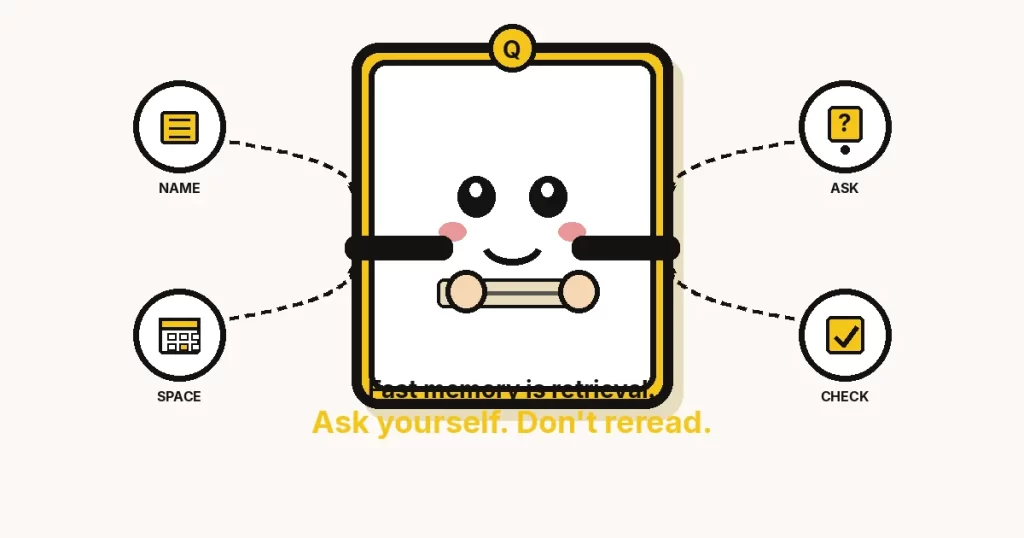
How to memorize something fast is to retrieve the item from a blank page, then space those retrieves — not to reread the same notes at speed. Fluency is a feeling. A closed-book ask is the store. Massed rereading wins an immediate quiz and loses the next day (Roediger and Karpicke, 2006).
Key takeaways
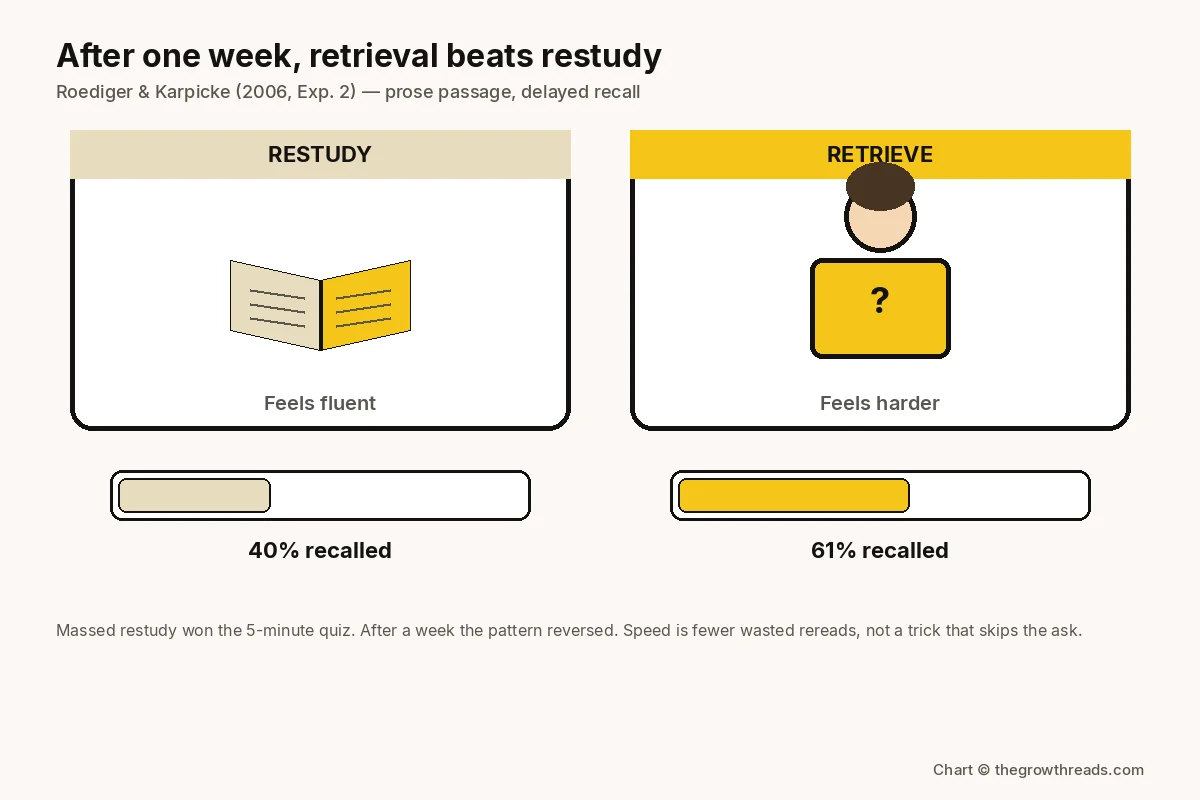
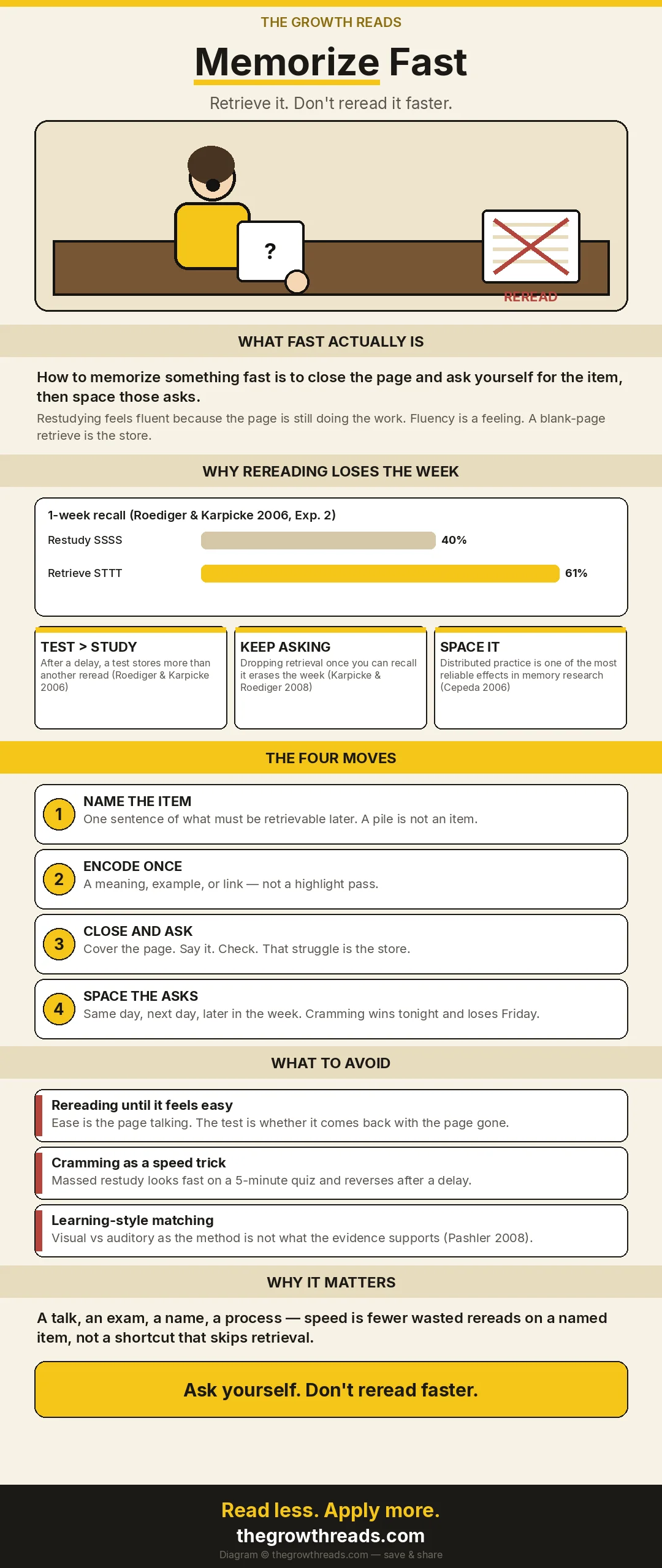
- After a delay, students who had been tested on a prose passage recalled more than students who had restudied it: in Experiment 2, repeated study left about 40% a week later and repeated testing left about 61% (Roediger and Karpicke, 2006).
- Once an item can be recalled, extra restudy does little for a one-week test; extra retrieval is what holds the file. Dropping the ask after the first success is how a “known” list disappears (Karpicke and Roediger, 2008).
- Across classroom techniques, practice testing and distributed practice sit in the high-utility tier; highlighting and rereading sit in the low-utility tier even though they feel like work (Dunlosky, Rawson, Marsh, Nathan and Willingham, 2013).
- Spacing the same retrieve across time beats cramming the same minutes into one sitting. How large the gap should be depends on how long you need the item, not on a single magic interval (Cepeda, Pashler, Vul, Wixted and Rohrer, 2006).
- Anders Ericsson and Robert Pool’s Peak treats a fast, usable memory as a better mental representation — built by practice you can fail at — not as a talent you either have or lack.
What does it mean to memorize something fast?
To memorize something fast is to make a named item retrievable later with as little wasted restudy as possible — not to finish a highlight pass in record time. The search phrase sounds like a trick. The research treats it as a scheduling problem: the minutes you already have should go to retrieval and spacing, because those are the conditions that still work after a delay.
An “item” is one thing you would be embarrassed not to have: the opening of a talk, a formula, a client’s name, a five-step process, a quote you plan to use. A chapter, a folder, or “the whole exam” is not an item. If you cannot name the thing in a sentence, you are still in the stall covered by how to focus better: attention never landed on a target, so there is nothing to store.
Fast, on this page, is relative to rereading. Roediger and Karpicke’s 2006 students who restudied a passage looked better five minutes later. A week later the testers had pulled ahead by about twenty percentage points in the repeated-testing condition. The method that feels slower in the chair is the one that is faster across the week, because you stop paying for the same page again.
How is this different from “why does my memory suck”?
A “bad memory” is usually a leak in the everyday sequence — look, store, sleep, ask. That complaint has its own page: why does my memory suck. This page assumes you already have an item you want on purpose, and asks how to get it in with fewer wasted minutes. Same research family. Different job. The leak page is diagnosis. This one is the encoding method for a named target.
If names vanish in meetings because you never looked up, fix the look first. If you looked, wrote nothing, and hope the reread will do the rest, you are on this page.
Why does rereading feel fast and still fail?
Rereading feels fast because the page is still doing the work, so the mind reads fluency as knowledge. Jeffrey Karpicke and Henry Roediger made the split brutal in a 2008 Science experiment with Swahili–English word pairs. Once students could recall a pair, extra restudy of that pair added almost nothing to a one-week test. Extra retrieval of the same pair is what held the file. Dropping the ask after the first success is how a list that felt “done” is gone by Friday.
Nate Kornell and Robert Bjork (2007) watched people choose their own study. Learners preferred restudying items they already knew, and they underused testing. The feeling in the chair points at the weaker method. That is not a character flaw. Fluency is a vivid signal. A blank page is an awkward one. The awkward signal is the one that predicts later recall.
John Dunlosky, Katherine Rawson, Elizabeth Marsh, Mitchell Nathan and Daniel Willingham’s 2013 review of learning techniques put numbers on the same pattern for classroom work: practice testing and distributed practice ranked high; highlighting, rereading, and summarization ranked low. The low-utility methods are popular because they look like studying. They are also the ones that finish a stack of pages without ever asking whether the item will come back.
The four moves that actually store an item
The store is four moves on one named item: name it, encode it once with meaning, close the page and ask, then space the next ask. None of these is a personality. They are conditions.
- Name. Write one sentence of what must be retrievable later. “The three objections in the deck” is an item. “The whole deck” is a pile.
- Encode once. Attach a meaning, an example, or a link — a sentence in your words, a tiny sketch, a “this is like.” A yellow stripe over the author’s sentence is not encoding. It is a flag that you were there.
- Ask. Cover the page. Say the item. Then check. The stumble is the mechanism, not a sign you should go back to highlighting. That is the test-enhanced learning effect from Roediger and Karpicke (2006).
- Space. Ask again the same day, the next day, and later in the week. Massed practice — the same minutes in one sitting — wins a quiz you take now and loses the one that matters. Cepeda, Pashler, Vul, John Wixted and Doug Rohrer’s 2006 synthesis of verbal-recall spacing is one of the most reliable effects in this literature. The useful gap scales with how long you need the item. A talk tomorrow wants a same-day retrieve. A process you need in two weeks wants days between asks, not a midnight stack.
Katherine Rawson and John Dunlosky (2011) treated “how much is enough” as a scheduling question of its own. In their successive-relearning work, three successful retrievals in an initial session, then spaced sessions, beat a single pass that stops at the first success. You do not need their exact classroom protocol. You need the idea: one lucky recall is not the store.
Why wasted rereads cost more than they feel like
A reread feels cheap because it is quiet, but the bill is the item that is missing when you need it — plus the hour you will spend restudying the same page. The honest cost is not a dramatic number. It is a repeated tax: fluency tonight, a blank tomorrow, another highlight pass, still no retrieve.
That tax also sits on attention. If you “study” with a second channel open, you are not encoding the item. You are switching. Sophie Leroy’s attention residue is the sister mechanism: the last task still runs after you leave it, and the new one gets a smaller slot. The encoding method on this page assumes a single target for a short block. If the block is a switch-fest, go back to attention residue and to how to stay on task before you buy another pack of cards.
Cal Newport’s Deep Work is useful here as a container, not as a brand: the undistracted block is where an ask can happen. A reread with Slack open is not a retrieval session. It is a highlight with company. The productivity library is full of systems that fail this way — more apparatus, same missing retrieve.
Two honest caveats. Roediger and Karpicke tested prose passages in a lab. Karpicke and Roediger 2008 used paired associates. Neither is your Tuesday standup. The direction — retrieval beats restudy after a delay — has been replicated across materials; the exact percentages will not transfer to your talk. And Cepeda’s spacing synthesis is about verbal recall. It does not say “always wait three days.” The gap that helps depends on the retention interval you actually have.
How do you memorize something fast without cramming?
You memorize something fast without cramming by running the four moves on one item inside a short, protected block, then leaving a gap before the next ask. This is not a numbered product. It is the same evidence run at the size of a real afternoon.
Pick the item before you open the notes. If you cannot name it, you are still choosing, which is a different stall. Then encode once — a sentence, an example, a link — and close the source. Ask out loud or on paper. Check. Mark whether it came back. Do that three times in the first sitting if the item is stubborn (Rawson and Dunlosky’s “enough” is a useful ceiling, not a religion). Put the next ask on a calendar you already keep: tonight, tomorrow, later in the week.
If-then plans help the session start. Peter Gollwitzer’s implementation intentions are the cousin page: “After I shut the laptop lid, I will ask for the three objections.” The plan is for the retrieve, not for another reread.
Ericsson’s deliberate-practice research — the spine of Peak — is easy to misuse on a “fast” query. Ten thousand hours is not this page. The useful piece is smaller: a mental representation improves when practice can fail. A covered card can fail. A reread cannot. Josh Waitzkin’s Art of Learning makes the same point from the other side of the table: numbers you can still retrieve under pressure are the ones you trained as retrieves, not the ones you highlighted in a quiet room.
Cramming still has a job: the five-minute quiz before you walk in. Roediger and Karpicke’s restudy condition won that delay. Use a last-minute reread as a warm-up if you already stored the item. Do not use it as the store. If the only session you have is tonight and the test is tomorrow morning, still spend most of the minutes asking, not highlighting. The 5-minute win for restudy is real and narrow. Most “I need this fast” moments are actually “I need this on Thursday.”
What are the common mistakes when you try to memorize something fast?
The mistakes are methods that produce fluency without a retrieve, or a retrieve you drop the moment it works once.
- Rereading until it feels easy. Ease is the page talking. The test is whether the item comes back with the page gone (Roediger and Karpicke, 2006; Kornell and Bjork, 2007).
- Cramming as a speed trick. Massed restudy looks fast on an immediate quiz and reverses after a delay. Spacing is the speed method for anything you need later (Cepeda et al., 2006).
- Highlighting as the whole method. Dunlosky’s review puts highlighting in the low-utility tier. A stripe is a flag. It is not a store.
- Matching a “learning style.” Harold Pashler, Mark McDaniel, Doug Rohrer and Robert Bjork (2008) reviewed the meshing hypothesis — teach visual learners visually, and so on — and found the evidence did not support it as a method. Dual coding (a sketch plus a sentence) can still help as extra encoding. “I am a visual learner, so I only watch videos” is not the same claim, and it is not what that paper supports.
- Stopping after the first success. Karpicke and Roediger (2008) is the warning label: once you can recall it, restudy is a weak extra; retrieval is the extra that holds the week.
- Buying a new app instead of covering the page. That is the shiny object tax in study clothes. A stack of index cards already does the ask. A tool that cannot hide the answer is a reread machine.
- Trying to encode while switching. A retrieve needs a target. If the block is notifications, you are back on the Focus parent, not on a memory trick.
When is it more than a study trick?
This page is a method for a named item at work or in study. It is not a clinical memory page, and it is not a diagnosis. Sudden collapse of everyday function, safety-critical forgetting, or a change that is new and frightening is a different question than “how do I get this talk into my head by Thursday.” Do not treat a technique article as that conversation. For the everyday leak — names, meeting points, the sense that nothing sticks — start with the sister page on why memory feels broken, then come back here when you have an item to store on purpose.
Harold Pashler’s learning-styles paper is also the counter-case inside the method: if a page promises that matching your style is the speed trick, it is selling a hypothesis that review did not support. Retrieval and spacing do not require you to sort yourself into a type.
What does the evidence actually show?
The evidence shows that retrieval after a delay beats restudy, that dropping retrieval once an item is recallable erases the week, that spacing beats massing for later tests, and that popular study rituals sit in a weaker utility tier — with the limit that most of this is lab or classroom material, not your job.
| Study | Design and size | Finding | What we used it for |
|---|---|---|---|
| Roediger and Karpicke, 2006, Exp. 2 | Undergraduates; prose passages; SSSS vs STTT; 5-minute vs 1-week delay | Restudy ~81% at 5 minutes vs testing ~75%; at 1 week restudy ~40% vs testing ~61% | The reversal that makes “fast” mean fewer wasted rereads, not a 5-minute highlight win |
| Karpicke and Roediger, 2008 | Swahili–English pairs; conditions that dropped study or dropped test after items were recallable; 1-week test | Further testing of recallable items preserved recall; further study of them did not | Why one success is not the store; keep asking |
| Cepeda, Pashler, Vul, Wixted and Rohrer, 2006 | Quantitative synthesis of distributed-practice effects in verbal recall | Spacing improves later recall; optimal gap scales with retention interval | Why cramming is a bad speed trick for anything you need after today |
| Dunlosky, Rawson, Marsh, Nathan and Willingham, 2013 | Review of ten learning techniques against classroom evidence | Practice testing and distributed practice: high utility. Highlighting and rereading: low | Why the popular rituals feel like work and still underperform the ask |
| Kornell and Bjork, 2007 | Learners chose what to restudy vs test | People prefer restudying known items and underuse testing | Why the feeling in the chair points at the weaker method |
| Rawson and Dunlosky, 2011 | Successive relearning; how many successful retrievals, then spaced sessions | Three successful retrievals in an initial session was a strong practical dose | A ceiling for “enough” in the first sitting — not a single lucky recall |
| Pashler, McDaniel, Rohrer and Bjork, 2008 | Review of the learning-styles meshing hypothesis | Evidence did not support matching instruction to a preferred style as the method | The counter-case: style-matching is not the speed trick |
| Ericsson, Krampe and Tesch-Römer, 1993 | Deliberate-practice framework (violinists and other expert groups) | Practice that can fail, with feedback, builds the representation experts retrieve | Peak’s spine: a usable memory is a built structure, not a reread count |
Frequently asked questions
How do you memorize something fast in simple terms?
Name one item, encode it once with meaning, close the page, and ask yourself for it. Then space the next asks — same day, next day, later in the week. That is how to memorize something fast without a trick. Rereading until it feels fluent is the slow method dressed as speed. Roediger and Karpicke (2006) found restudy won a 5-minute quiz and lost a one-week test to retrieval. A covered card is the store. A highlight pass is a visit.
Is rereading ever useful?
Yes, as a check after a retrieve, and as a 5-minute warm-up if the item is already stored. Roediger and Karpicke’s restudy condition really did win the immediate delay. Use that fact. Do not use it as the whole method for anything you need tomorrow or next week. A last look at a card you already failed and then recalled is a check. A third highlight pass on a chapter you have never asked yourself for is the low-utility ritual Dunlosky’s review is pointing at.
How many times should I retrieve an item?
More than once, and not only in one sitting. Karpicke and Roediger (2008) showed that dropping retrieval after the first success is how a “known” pair is gone a week later. Rawson and Dunlosky (2011) found three successful retrievals in an initial session, then spaced sessions, a strong practical dose. You do not need a lab protocol. You need a rule you will keep: ask until it comes back cleanly, then ask again tomorrow. One lucky recall is a sample, not a file.
What is the best spacing gap?
A gap that matches how long you need the item, not a single magic number. Cepeda and colleagues (2006) found distributed practice beats massing for later recall, and that the useful gap scales with the retention interval. A talk tomorrow: retrieve later today. A process you need in two weeks: leave days between asks. If you only have tonight, still spend the minutes asking rather than restudying the same page five times. Massing is the emergency warm-up, not the store.
Do I need flashcards or an app?
No. You need a way to hide the answer and a way to mark whether it came back. Index cards, a folded page, a colleague who asks you the three points — all of those are retrieves. An app is fine if it actually hides the answer and if you will open it on the spaced loop. If the app becomes a weekly project, it has failed. Paper is allowed to be the whole stack. The shiny-object version of this method is a new system with the page still visible.
Does this work for names and talks, or only for exams?
The mechanism is the same: a named item, an ask, a gap. Lab studies used passages and word pairs, not your client list, so the percentages will not copy over. The direction still applies. A name you never retrieve is a name you reread on the badge. A talk you only rehearse with the slides open is a reread. Cover the slide. Say the beat. Check. That is the same move as a closed book, at the size of a meeting.
What about learning styles — visual vs auditory?
Do not pick a method by sorting yourself into a type. Pashler, McDaniel, Rohrer and Bjork (2008) reviewed the claim that instruction should mesh with a preferred learning style and found the evidence did not support it. A sketch plus a sentence can still help as extra encoding. “I only watch videos because I am visual” is not that claim, and it is not a substitute for retrieval. The speed method on this page is the ask, spaced, on a named item.
What should I read after this page?
Start with the Focus parent, how to focus better, if the block is still a switch-fest — you cannot encode what you never attended to. Then why does my memory suck for the everyday leak this method is not trying to diagnose. For the book that treats usable memory as a built representation, read the Peak summary. Deep Work is the container for the undistracted ask. The Art of Learning is pressure-tested retrieve. The productivity library collects the rest.
Sources
- Roediger, H. L., III, & Karpicke, J. D. (2006). Test-enhanced learning: Taking memory tests improves long-term retention. Psychological Science, 17(3), 249–255. https://doi.org/10.1111/j.1467-9280.2006.01693.x
- Karpicke, J. D., & Roediger, H. L., III. (2008). The critical importance of retrieval for learning. Science, 319(5865), 966–968. https://doi.org/10.1126/science.1152408
- Cepeda, N. J., Pashler, H., Vul, E., Wixted, J. T., & Rohrer, D. (2006). Distributed practice in verbal recall tasks: A review and quantitative synthesis. Psychological Bulletin, 132(3), 354–380. https://doi.org/10.1037/0033-2909.132.3.354
- Dunlosky, J., Rawson, K. A., Marsh, E. J., Nathan, M. J., & Willingham, D. T. (2013). Improving students’ learning with effective learning techniques: Promising directions from cognitive and educational psychology. Psychological Science in the Public Interest, 14(1), 4–58. https://doi.org/10.1177/1529100612453266
- Kornell, N., & Bjork, R. A. (2007). The promise and perils of self-regulated study. Psychonomic Bulletin & Review, 14(2), 219–224. https://doi.org/10.3758/BF03194055
- Rawson, K. A., & Dunlosky, J. (2011). Optimizing schedules of retrieval practice for durable and efficient learning: How much is enough? Journal of Experimental Psychology: General, 140(3), 283–302. https://doi.org/10.1037/a0023956
- Pashler, H., McDaniel, M., Rohrer, D., & Bjork, R. (2008). Learning styles: Concepts and evidence. Psychological Science in the Public Interest, 9(3), 105–119. https://doi.org/10.1111/j.1539-6053.2009.01038.x
- Ericsson, K. A., Krampe, R. T., & Tesch-Römer, C. (1993). The role of deliberate practice in the acquisition of expert performance. Psychological Review, 100(3), 363–406. https://doi.org/10.1037/0033-295X.100.3.363
Related reading on The Growth Reads
The books this method draws on
- Peak summary & review — usable memory as a built representation; the named unused review for this page
- Deep Work summary & review — the undistracted block where an ask can happen
- The Art of Learning summary & review — retrieves that still hold under pressure
Related articles
- How to focus better — the Focus parent; attention has to land before anything stores
- Why does my memory suck — the sister leak page; this spoke is the encoding method
- Attention residue — the last task still running when you try to encode
- How to stay on task — remaining with the item long enough to ask
- Implementation intentions — the if-then that starts the retrieve
- The shiny object tax — a new app is not a covered page
Go deeper
How this article was researched
The Growth Reads editorial team writes from primary sources: the books themselves, the authors’ published essays, and the peer-reviewed literature behind the claims. Every study cited above was read in the original publication or its published abstract, and every figure is quoted with its design and limit so you can judge its weight rather than take ours. Where a finding is a prose-passage lab, paired-associate list, or classroom technique review rather than your talk, we say so in the body rather than in a footnote.
This page is a productivity method, not a book review of any single title, and not medical or clinical advice. Everyday memory complaints belong on the sister leak page. Sudden or safety-critical forgetting is a different conversation than a study trick.
How we work: every article on The Growth Reads is built from the books in our library plus the research they rest on, and is reviewed and date-stamped when the evidence changes. Read our full methodology.