

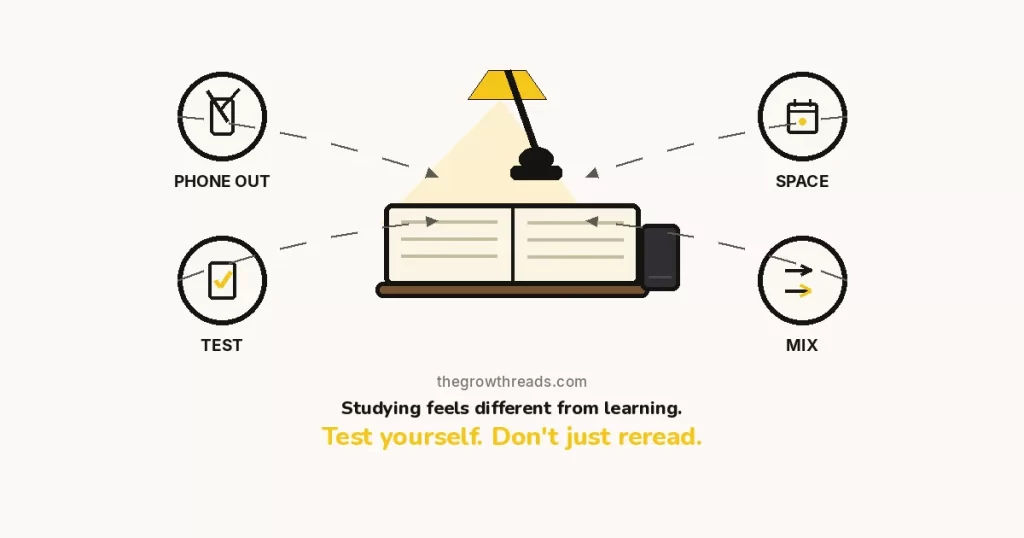
To focus while studying, stop rereading and start testing yourself, put the phone in another room instead of on silent, and spread sessions across days instead of one long sitting. Focus during study fails less often from a discipline gap than from techniques that feel productive — highlighting, rereading, cramming — but don’t build retrieval. Swap them for retrieval practice, spacing, and true phone distance, and concentration during study improves without any extra willpower.
Key takeaways
- Students who took a practice test after reading a passage remembered significantly more a week later than students who reread the same passage four times, even though the rereaders felt more confident right after studying (Roediger & Karpicke, 2006).
- A smartphone left face-down and silenced on the same desk still measurably reduced available cognitive capacity compared with leaving it in another room, even when participants never touched it (Ward, Duke, Gneezy & Bos, 2017).
- A meta-analysis of 254 studies found spacing study sessions across days instead of massing them into one produced better long-term recall than cramming in the vast majority of comparisons, across ages and materials (Cepeda, Pashler, Vul, Wixted & Rohrer, 2006).
- College students practicing mixed problem types in one session scored roughly double on a later test compared with students who practiced one problem type at a time, despite feeling like they were learning more slowly during the mixed session (Rohrer & Taylor, 2007).
- An unanswered phone notification alone was enough to significantly increase attention lapses on a demanding task compared with no notification at all — the phone did not need to be touched, seen, or heard to interrupt (Stothart, Mitchum & Yehnert, 2015).
What focus while studying actually is (and why it isn’t the same as focus at work)
Focus while studying is the ability to hold attention on material long enough to encode it for later retrieval, not simply to feel absorbed while looking at it. That distinction matters because studying has a built-in trap that most work tasks don’t: it is entirely possible to sit still, stay on the page, and feel deeply focused for an hour while building almost no durable memory of what was read.
That is also why cutting distractions and learning to focus better solve overlapping but distinct problems. General focus protects attention once you’ve decided what to do with it; focus while studying has the extra job of choosing techniques that convert attention into retrievable memory, because attention spent on the wrong technique — rereading a highlighted paragraph for the fourth time — can feel identical to attention spent on a technique that actually works.
Is feeling focused the same as learning?
No — the two are reliably mismatched, and the gap is the single most-replicated finding in study-skills research. Henry Roediger and Jeffrey Karpicke had students either reread a science passage four times or read it once and then take a practice test on it. Immediately after studying, the rereaders predicted they would remember more. A week later, the group that had tested themselves once outperformed the rereaders by a wide margin. Feeling fluent with material and being able to retrieve it later are two different mental events, and study time spent optimizing for the first one is often wasted.
What causes focus to break down while studying? The retrieval-illusion mechanism
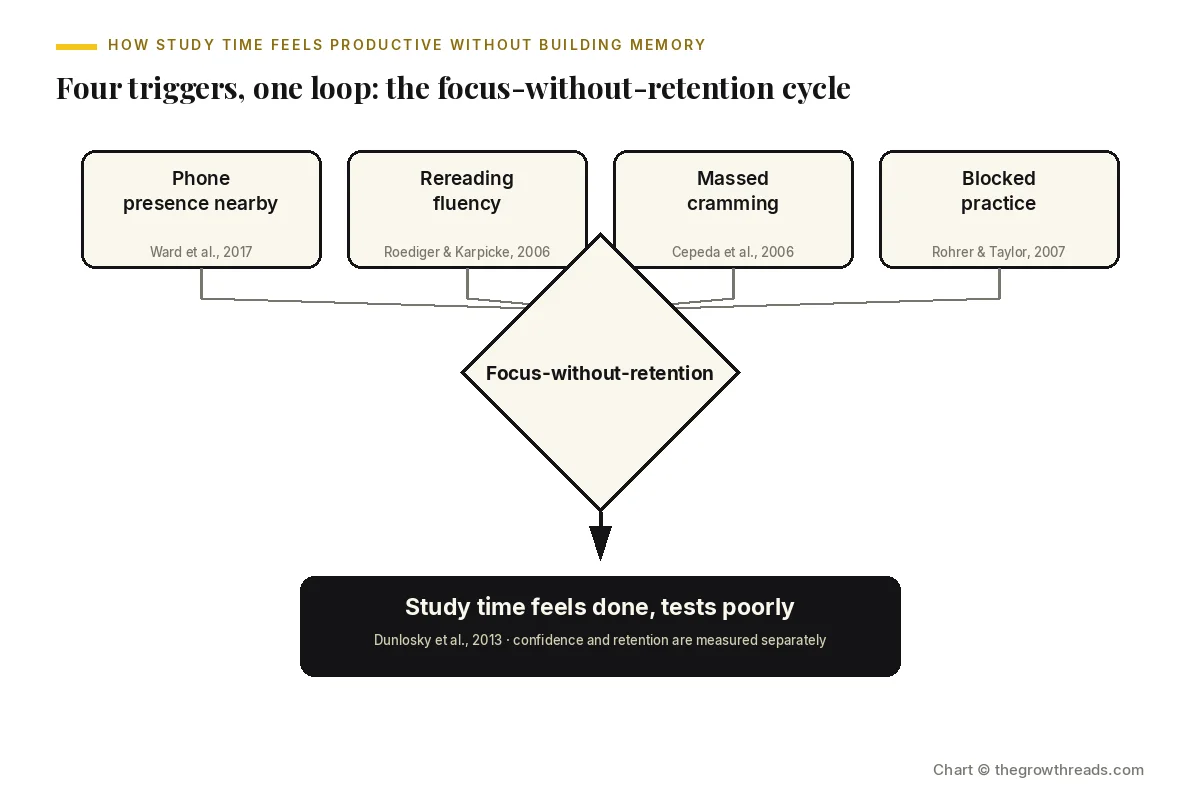
Focus breaks down during study for two separate reasons that get treated as one problem: the environment keeps interrupting attention, and the techniques being used don’t build the kind of memory that survives a test. Neither requires more willpower to fix. One requires distance from the phone; the other requires swapping rereading for retrieval.
The environmental half is well understood. The technique half is less intuitive, because the techniques that feel worst while studying — testing yourself before you feel ready, mixing problem types instead of mastering one before moving on — are consistently the ones the evidence favors, and the techniques that feel best — rereading, highlighting, blocking one topic at a time — are consistently the weaker performers. A large review by John Dunlosky and colleagues rated rereading and highlighting as low-utility techniques and practice testing and distributed practice as high-utility techniques, based on how well each one actually transfers to test performance rather than how confident it makes a student feel.
The four things that make study focus unproductive
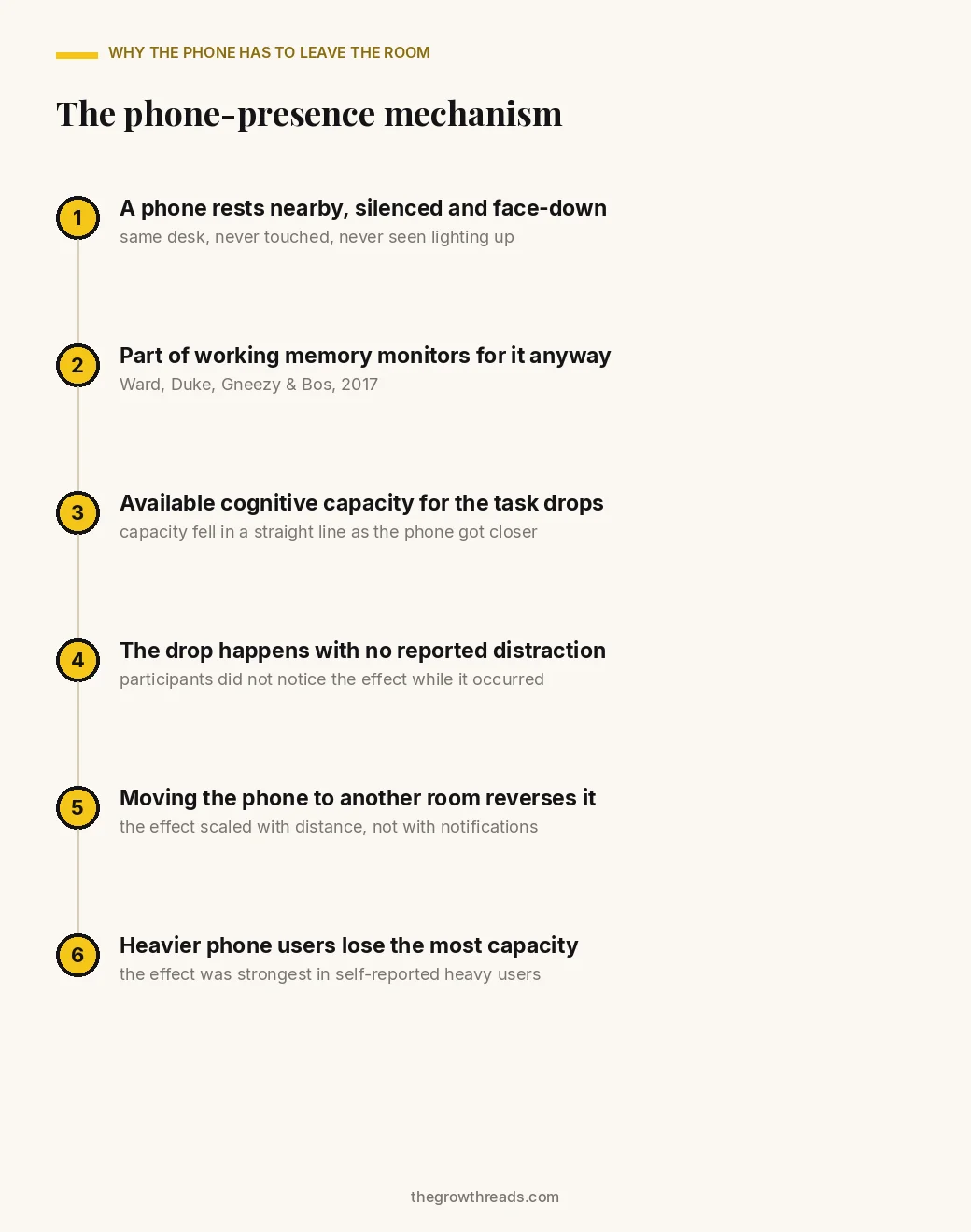
- Phone presence, not phone use. Adrian Ward and colleagues found that a smartphone merely resting on the desk — face-down, silenced, never touched — measurably reduced the cognitive capacity available for a demanding task compared with leaving the same phone in another room, and the effect was strongest in people who reported relying on their phone most.
- Rereading fluency. Passages become easier to read each time they’re reread, and that growing ease gets misread as growing understanding — the exact confusion Roediger and Karpicke’s 2006 study measured directly.
- Massed cramming. Cepeda and colleagues’ 2006 meta-analysis of 254 studies found spacing sessions across days beat massing them into one sitting in the large majority of comparisons, meaning the single overnight cram session is fighting the format of memory itself, not just fatigue.
- Blocked practice. Doran Rohrer and Kelli Taylor found students who practiced one problem type at a time (blocked) felt they were learning faster than students who mixed problem types (interleaved) — and then scored roughly half as well on a later test, because blocking lets you solve by pattern-matching to the last problem rather than by identifying which method actually applies.
Why it costs more than it feels like
A study session that feels smooth and confident is, on its own, no evidence that anything was learned — and the gap between felt progress and actual retention tends to surface at the worst possible moment: the test. Robert Bjork named this pattern “desirable difficulty” — the techniques that create the most durable learning are the ones that feel hardest and slowest while they’re happening, which is precisely why students underuse them and overuse the techniques that feel easiest.
The cost compounds because the easy-feeling techniques don’t just underperform, they actively displace time that could go to the techniques that work. Rajiv Junco and Shelia Cotten surveyed and tracked over 1,800 college students and found that time spent using a phone or messaging apps while doing schoolwork was significantly associated with lower GPA, independent of total study time reported — the problem wasn’t how long students studied, it was what the study session actually consisted of.
An honest caveat. Junco and Cotten’s survey design is correlational, not experimental — it cannot fully rule out that students already prone to lower academic performance are also more likely to multitask on a phone while studying, rather than the phone use causing the lower grades. The mechanism studies above (Ward et al., 2017; Stothart et al., 2015) are the stronger causal evidence for why phone presence specifically degrades a study session, and they were both controlled experiments rather than surveys.
The five patterns of unfocused studying — and the fix for each
Because the trigger determines the fix, generic advice (“just concentrate harder”) fails differently depending on which of these five is actually running. Diagnose the pattern before reaching for a technique.
| Pattern | What it looks like | The trigger underneath | The fix that works |
|---|---|---|---|
| The Highlighter Illusion | Notes come out in three colors, the textbook looks well-loved, and none of it comes back to mind without the page in front of you | Highlighting and rereading are rated low-utility because they build familiarity, not retrieval strength (Dunlosky et al., 2013) | Close the book and write down everything you remember before rereading a single line |
| The Phone-in-Sight Drain | The phone is face-down, silenced, and never touched — and focus still feels thinner than it should | Mere presence of a personal phone reduces available cognitive capacity, whether or not it’s used (Ward, Duke, Gneezy & Bos, 2017) | Put the phone in a different room, not just face-down on the same desk |
| The Marathon Cram | One long session the night before, running on the belief that more consecutive hours means more retained material | Massed practice underperforms spaced practice for long-term recall in the large majority of studies reviewed (Cepeda et al., 2006) | Split the same total hours across four or five shorter sessions on different days |
| The Block Practice Trap | All the practice problems of one type get solved before moving to the next type, and the session feels smooth and confident throughout | Blocked practice lets pattern-matching substitute for actually identifying which method applies (Rohrer & Taylor, 2007) | Shuffle problem types within the same session, even though it feels slower and harder at first |
| The Notification Twitch | A single buzz derails the next several minutes even when the phone is never picked up | An unanswered notification alone measurably increases attention lapses on a demanding task (Stothart, Mitchum & Yehnert, 2015) | Turn the phone fully off, or leave it in airplane mode in another room, for the length of the session |
Most students run two or three of these at once — the Highlighter Illusion on reading-heavy subjects, the Marathon Cram the night before a test, the Phone-in-Sight Drain on every session regardless of subject.
How to focus while studying: the 6-step system
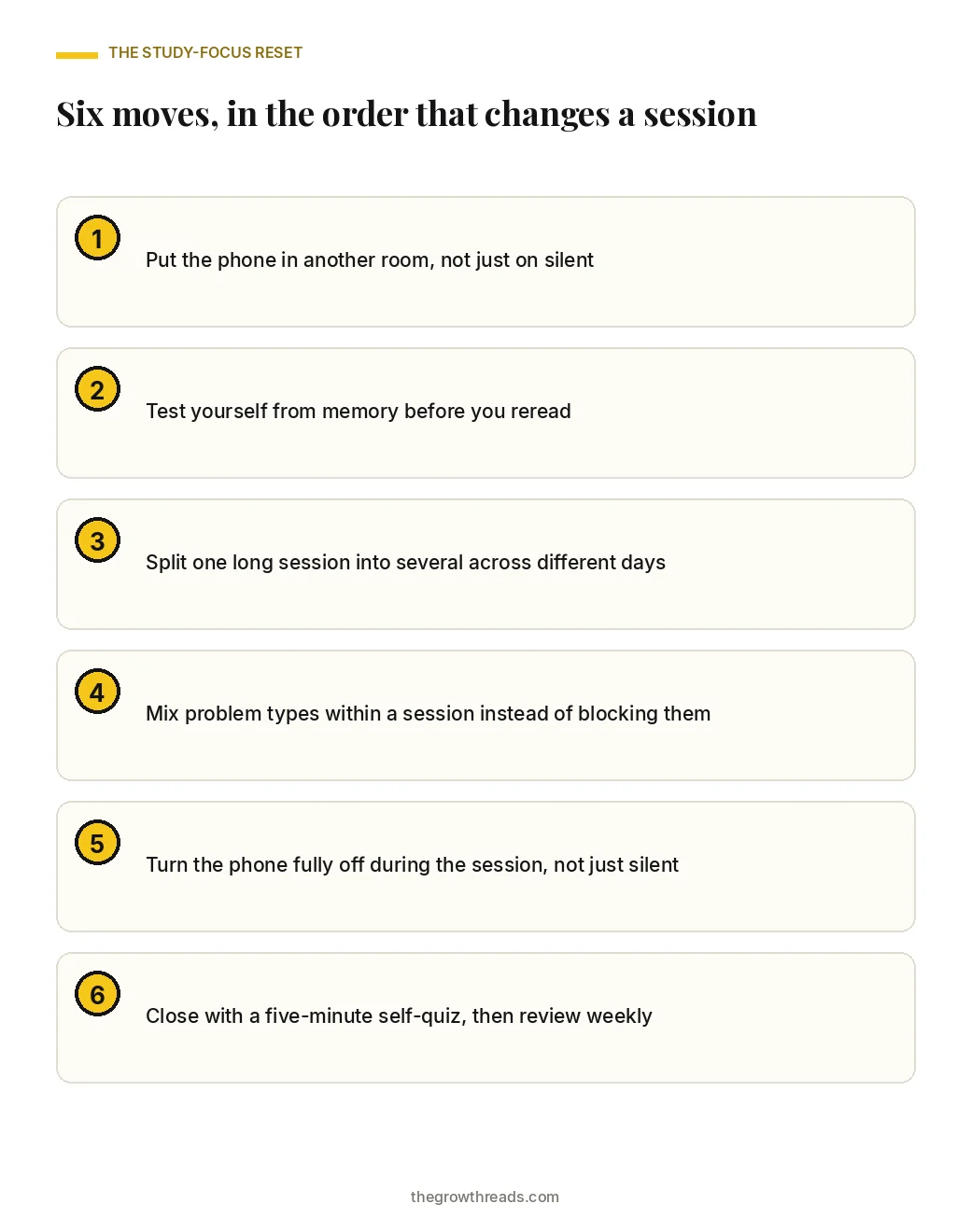
To focus while studying, remove the environmental drains first, then replace the techniques that feel productive with the ones that actually build retrieval. The first two steps take effect the moment you apply them. The last four change what a study session is actually made of.
Step 1 — Put the phone in another room, not just on silent
Leave the phone in a different room, a bag in another area, or with someone else for the length of the session — face-down on the same desk is not far enough. Ward, Duke, Gneezy and Bos ran participants through demanding cognitive tasks with their own phone either in another room, in a pocket or bag, or face-up on the desk, and found available cognitive capacity dropped in a straight line as the phone got closer, even though every participant reported not being distracted by it. Distance, not willpower or notification settings, is what actually frees the capacity back up.
Step 2 — Test yourself before you reread
After a first read of the material, close the book and write or say everything you can remember before checking the source again. Roediger and Karpicke’s 2006 study found this single swap — testing instead of a second and third read — produced significantly better recall a week later, despite feeling harder and less confident in the moment than simply rereading the same page. The test doesn’t just measure what you know; taking it is what builds the memory.
Step 3 — Split one long session into several shorter ones across different days
Take the total hours planned for a topic and spread them across four or five sessions on different days instead of one sitting. Cepeda and colleagues’ 2006 meta-analysis of 254 studies found spaced practice outperformed massed practice for long-term recall across ages, materials and retention intervals, and Sean Kang’s 2016 review of the same literature notes the effect holds even when the total study time is identical between the spaced and massed groups — the schedule, not the hours, is doing the work.
Step 4 — Mix problem types within a session instead of blocking them
Instead of solving every problem of one type before moving to the next type, shuffle the order so different problem types are interleaved throughout the session. Rohrer and Taylor’s study found students who interleaved scored roughly double on a later test compared with students who blocked practice by type, even though the interleaved group rated the session as harder and felt they were progressing more slowly while it was happening. That discomfort is the desirable-difficulty signal, not a sign the method is failing.
Step 5 — Turn the phone fully off, not just to silent, during the session
Power the phone down or switch on airplane mode for the length of the block, rather than relying on silent or do-not-disturb. Stothart, Mitchum and Yehnert found that an unanswered notification — visible or audible, never touched — was enough to significantly raise attention lapses on a sustained-attention task compared with no notification at all, meaning silent mode still leaves the interruption channel open exactly where step 1 already closed the presence channel.
Step 6 — End every session with a five-minute self-quiz, then review weekly
Close the last five minutes of every session by writing down, from memory, the two or three things the session was supposed to teach. Dunlosky and colleagues’ 2013 review ranks practice testing among the highest-utility learning techniques studied, ahead of rereading, highlighting, and summarizing, precisely because it forces the same retrieval step step 2 introduced mid-session — but done as a closing habit, it also flags what to revisit in the next spaced session rather than leaving that to guesswork.
What to do the week before an exam
Most of this system assumes weeks of runway. Exam week rarely offers that, and cramming under real time pressure needs its own adjustments rather than being abandoned outright.
Compress the spacing, don’t eliminate it. Cepeda and colleagues’ data still favors two or three shorter sessions across the remaining days over one long session the night before, even when the total available time is small — the gap between sessions matters more than its absolute length.
Prioritize self-testing over reading anything new. With limited hours left, a practice test on material already covered produces more retained score than a first read of material not yet covered, because the marginal hour spent testing what you know is more reliably retained than the marginal hour spent skimming what you don’t.
Protect one distance rule even under pressure. If nothing else from this system survives exam week, keep the phone in another room during the sessions that remain — it is the single change that costs nothing and returns capacity immediately, per Ward and colleagues’ findings. An evening routine that protects sleep the night before a test matters more, not less, under exam-week pressure — the temptation to trade sleep for one more spaced session is exactly backwards. Browse more of our productivity guides for other ways to protect a high-pressure week.
Common mistakes that undo focused studying
- Trusting how confident a session felt. Roediger and Karpicke’s rereaders were more confident and less correct — confidence and retention are measured separately for a reason.
- Leaving the phone face-down instead of out of the room. The same drain that shows up mid-task also shows up mid-focus generally — see the screen-time checking loop that keeps a nearby phone pulling at attention even unopened.
- Treating a full study weekend as equivalent to the same hours spread across a month. Cepeda and colleagues’ spacing effect means the schedule changes the outcome even when the hour count on both sides is identical.
- Blocking practice because it feels more organized. Rohrer and Taylor’s interleaving result means the study method that feels tidiest is often the one leaving the least behind.
- Switching between the textbook tab and a messaging app “during breaks.” Junco and Cotten’s survey found phone use interspersed through study time tracked with lower GPA independent of total hours studied — the same false-progress pattern covered at length in the shiny object tax.
- Blaming a bad memory instead of the technique. This is the same mistake covered in how to build discipline: a system that removes the wrong triggers and swaps in the right techniques beats a system that asks for more effort at the same techniques, every time the two are tested against each other.
When it’s more than a study habit
If attention breaks down the same way across schoolwork, reading for pleasure, conversations and unrelated tasks — not just during study sessions specifically — that pattern points past a study-technique problem and is worth naming honestly rather than treated as a discipline gap. The system in this article is built for ordinary study-session focus, the kind almost every student struggles with regardless of ability.
Two situations are worth flagging rather than pushing through. If focus during study is consistently and dramatically worse than focus on equally demanding non-academic tasks the same person handles fine, that gap is more informative than either alone and worth discussing with a school counselor or clinician. And if every technique in this system has been tried consistently for several weeks with no change at all, that is a signal to get an outside read on the situation rather than a signal to try harder at the same six steps.
The evidence behind this system
Every figure above traces to a specific published study. Here is what each one actually found — and what it doesn’t prove.
| Study | Design & size | What it found | Used here for |
|---|---|---|---|
| Roediger & Karpicke (2006), Psychological Science | Controlled lab experiment, university students | Practice testing after one read produced significantly better one-week recall than rereading four times, despite rereaders feeling more confident | The Highlighter Illusion pattern and Step 2 |
| Ward, Duke, Gneezy & Bos (2017), J. Association for Consumer Research | Two lab experiments, n≈800 total | Available cognitive capacity dropped as the participant’s own phone moved closer (other room > pocket/bag > desk), independent of reported distraction | The Phone-in-Sight Drain pattern and Step 1 |
| Cepeda, Pashler, Vul, Wixted & Rohrer (2006), Psychological Bulletin | Meta-analysis, 254 studies | Spaced practice outperformed massed practice for long-term recall in the large majority of comparisons, across ages and materials | The Marathon Cram pattern and Step 3 |
| Rohrer & Taylor (2007), Instructional Science | Controlled experiment, college students, math problems | Interleaved practice roughly doubled test performance versus blocked practice, despite feeling slower during study | The Block Practice Trap pattern and Step 4 |
| Stothart, Mitchum & Yehnert (2015), J. Experimental Psychology: HPP | Controlled lab experiment, sustained-attention task | An unanswered phone notification alone significantly increased attention lapses versus no notification, without the phone being touched | The Notification Twitch pattern and Step 5 |
| Dunlosky, Rawson, Marsh, Nathan & Willingham (2013), Psych. Science in the Public Interest | Systematic review, 10 learning techniques | Practice testing and distributed practice rated high-utility; rereading and highlighting rated low-utility, based on transfer to real test performance | The overall technique argument and Step 6 |
| Kang (2016), Policy Insights from Behavioral and Brain Sciences | Narrative review of the spacing-effect literature | Spacing benefits hold even when total study time is matched between spaced and massed groups | Reinforces Step 3’s schedule-over-hours claim |
| Junco & Cotten (2012), Computers & Education | Survey, n=1,839 college students | Phone and messaging use while doing schoolwork was associated with lower GPA, independent of total study time reported | The “why it costs more” section, with the correlational caveat stated explicitly |
Frequently asked questions
Does turning my phone to silent fix the distraction problem?
Only partly. Stothart, Mitchum and Yehnert’s 2015 study found an unanswered notification alone raised attention lapses even when the phone was never touched, and Ward and colleagues’ 2017 study found the phone’s mere physical presence on the desk reduced available cognitive capacity regardless of whether it made a sound. Silent mode blocks the sound; it doesn’t move the phone, and both channels turn out to matter separately.
Is rereading notes really a bad way to study?
It’s a low-yield way, not a useless one. Dunlosky and colleagues’ 2013 review rated rereading as low-utility specifically because it builds familiarity with the text rather than the ability to retrieve it without the text in front of you, which is exactly what Roediger and Karpicke’s 2006 study measured directly: rereaders felt more confident and remembered less a week later than students who tested themselves once instead.
How long should a focused study session be?
The research behind this article speaks more clearly to schedule than to session length: Cepeda and colleagues’ 2006 meta-analysis found spacing sessions across days beats massing the same hours into one sitting, regardless of exactly how long each individual session runs. A session that ends when attention genuinely starts to fade, rather than one stretched to a fixed round number, tends to leave more usable capacity for the next spaced session.
Does listening to music help or hurt focus while studying?
This article doesn’t cover music directly because the strongest available evidence here is about phone presence and study technique, not background audio, and the research on music and studying is genuinely mixed depending on the task and the listener. What the phone-presence findings do suggest is that a phone playing music still counts as a phone in reach — a dedicated speaker or a device with notifications fully disabled avoids reintroducing the Phone-in-Sight Drain through the back door.
Is cramming ever actually fine?
Sometimes it’s the only option, and the “what to do the week before an exam” section above covers how to compress rather than abandon the system when time is short. But Cepeda and colleagues’ data is clear that a single long session before a test produces weaker long-term recall than the same hours spread across even two or three sessions, so cramming should be treated as a fallback for genuine time constraints, not a strategy chosen by default.
Should I interleave subjects even if it feels harder?
Yes — the difficulty is the mechanism, not a side effect to tolerate. Rohrer and Taylor’s 2007 study found the interleaved group felt they were progressing more slowly during the session and still roughly doubled the blocked group’s score on a later test. Robert Bjork’s “desirable difficulty” concept describes exactly this pattern: techniques that feel harder while studying are often the ones building the memory that survives past the study session.
Why do I feel like I studied but can’t remember anything on the test?
This is the exact gap Roediger and Karpicke’s 2006 study measured: rereading and highlighting build a fluent, familiar feeling toward the material that doesn’t correspond to the ability to retrieve it without the page in front of you. The fix isn’t studying longer with the same techniques — it’s swapping in the retrieval-based techniques (self-testing, spacing, interleaving) that the feeling of fluency was standing in for.
What if I have trouble focusing no matter what I try?
If focus problems show up identically across schoolwork and unrelated tasks, or persist after several honest weeks of the system above with no change at all, that’s a signal worth raising with a school counselor or clinician rather than a sign to keep pushing the same six steps harder. This system is built for the ordinary study-focus gap most students experience, not as a diagnostic tool for attention difficulties that show up everywhere, not just at the desk.
Related reading on The Growth Reads
The books this system draws on
- Peak Mind summary & review — Amishi Jha’s research on training attention deliberately rather than assuming it takes care of itself
- Peak Performance summary & review — Brad Stulberg and Steve Magness on why deliberate stress plus deliberate rest, not more raw hours, is what builds capacity
Related articles
- How to focus better: the 6-step system for a distracted brain
- How to reduce screen time: the 6-step system that actually works
- Attention residue: why the last task still runs after you switch
- Task batching: grouping similar work so switching costs less
- Evening routine: close the workday so tomorrow starts clean
Go deeper
How this article was researched
The Growth Reads editorial team writes from primary sources: the books themselves, the authors’ published essays and interviews, and the peer-reviewed literature behind the claims. Every study cited above was read in the original publication or its published abstract, and every figure is quoted with its design, sample and effect so you can judge its weight rather than take ours. Where a finding is correlational rather than causal, or where a claim (like Bjork’s “desirable difficulty”) is a well-established theoretical framework rather than a single dated study, we say so directly in the text rather than in a footnote.
This article contains no medical advice. Attention difficulty that shows up identically across academic and non-academic tasks, or that doesn’t respond to consistent structural change, is worth discussing with a school counselor or clinician rather than treated as a study-habits problem.
How we work: every article on The Growth Reads is built from the books in our library plus the research they rest on, and is reviewed and date-stamped when the evidence changes. Read our full methodology.
Sources
- Roediger, H. L., & Karpicke, J. D. (2006). Test-enhanced learning: Taking memory tests improves long-term retention. Psychological Science, 17(3), 249–255. doi:10.1111/j.1467-9280.2006.01693.x
- Ward, A. F., Duke, K., Gneezy, A., & Bos, M. W. (2017). Brain drain: The mere presence of one’s own smartphone reduces available cognitive capacity. Journal of the Association for Consumer Research, 2(2), 140–154. doi:10.1086/691462
- Cepeda, N. J., Pashler, H., Vul, E., Wixted, J. T., & Rohrer, D. (2006). Distributed practice in verbal recall tasks: A review and quantitative synthesis. Psychological Bulletin, 132(3), 354–380. doi:10.1037/0033-2909.132.3.354
- Rohrer, D., & Taylor, K. (2007). The shuffling of mathematics problems improves learning. Instructional Science, 35(6), 481–498. doi:10.1007/s11251-007-9015-8
- Stothart, C., Mitchum, A., & Yehnert, C. (2015). The attentional cost of receiving a cell phone notification. Journal of Experimental Psychology: Human Perception and Performance, 41(4), 893–897. doi:10.1037/xhp0000100
- Dunlosky, J., Rawson, K. A., Marsh, E. J., Nathan, M. J., & Willingham, D. T. (2013). Improving students’ learning with effective learning techniques. Psychological Science in the Public Interest, 14(1), 4–58. doi:10.1177/1529100612453266
- Kang, S. H. K. (2016). Spaced repetition promotes efficient and effective learning. Policy Insights from the Behavioral and Brain Sciences, 3(1), 12–19. doi:10.1177/2372732215624708
- Junco, R., & Cotten, S. R. (2012). No A 4 U: The relationship between multitasking and academic performance. Computers & Education, 59(2), 505–514. doi:10.1016/j.compedu.2011.12.023