

★★★★☆ 4.5/5 — A sharply observed, unsparing memoir of four Silicon Valley jobs, essential for anyone who has ever fallen for a mission statement.
Best for: Anyone working in or around tech, especially women in male-dominated teams, and readers who want a literary, insider account of startup culture rather than a business-advice book.
Reading time: ~5 hours (288 pages) · Summary read time: ~13 minutes
Difficulty to apply: Low — this is a reflective, observational book, not a how-to; its value is in the lens it hands you, not a checklist.
Uncanny Valley in one minute
Anna Wiener left a stagnant career in New York publishing for Silicon Valley — and found herself inside the very machine she’d later spend a book unwinding. Over four jobs across the 2010s — an e-book analytics startup, a beloved open-source tool, and a fast-growing customer-data unicorn — she watched utopian rhetoric about “changing the world” curdle into something closer to surveillance, extraction, and quiet exhaustion. Uncanny Valley is not a takedown from the outside. It is a memoir written by someone who was in the room, cashed the equity, believed some of it, and left with her eyes open. The book never names the companies outright — Wiener writes about “the analytics startup,” “the open source startup,” “the social network no one likes” — a deliberate choice that turns specific companies into something more universal: a pattern anyone who has worked in tech will recognize.
Key takeaways
- Mission statements are marketing, not ethics: “Changing the world” was a recruiting pitch long before it was a plan, and it rarely survived contact with a cap table.
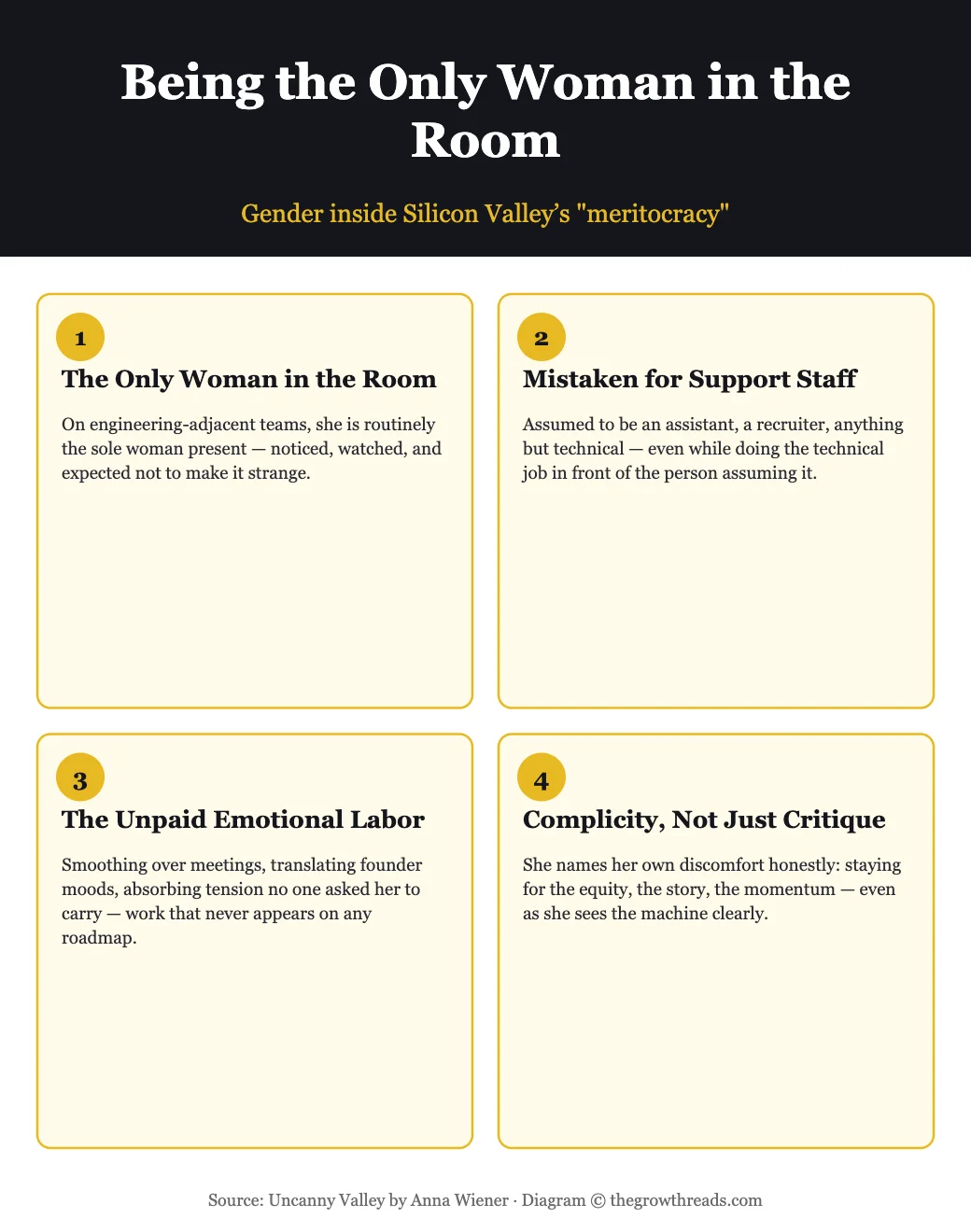
- Being the only woman in the room is its own job: Wiener spent unpaid hours managing perceptions, translating tone, and absorbing friction no one else was tracking.
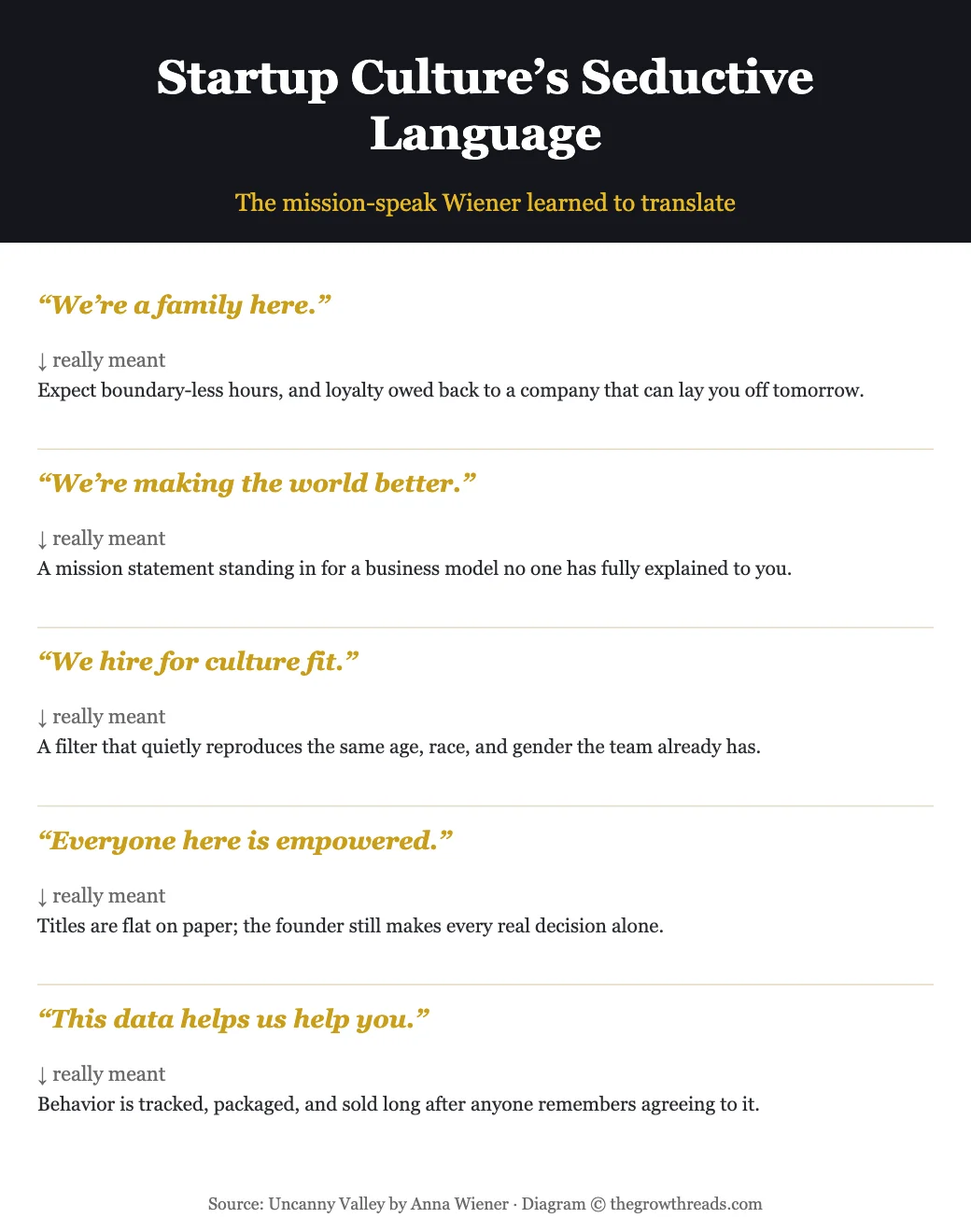
- “Family” language obscures at-will employment: Startups borrowed the vocabulary of kinship to justify the demands of a company that could lay her off without warning.
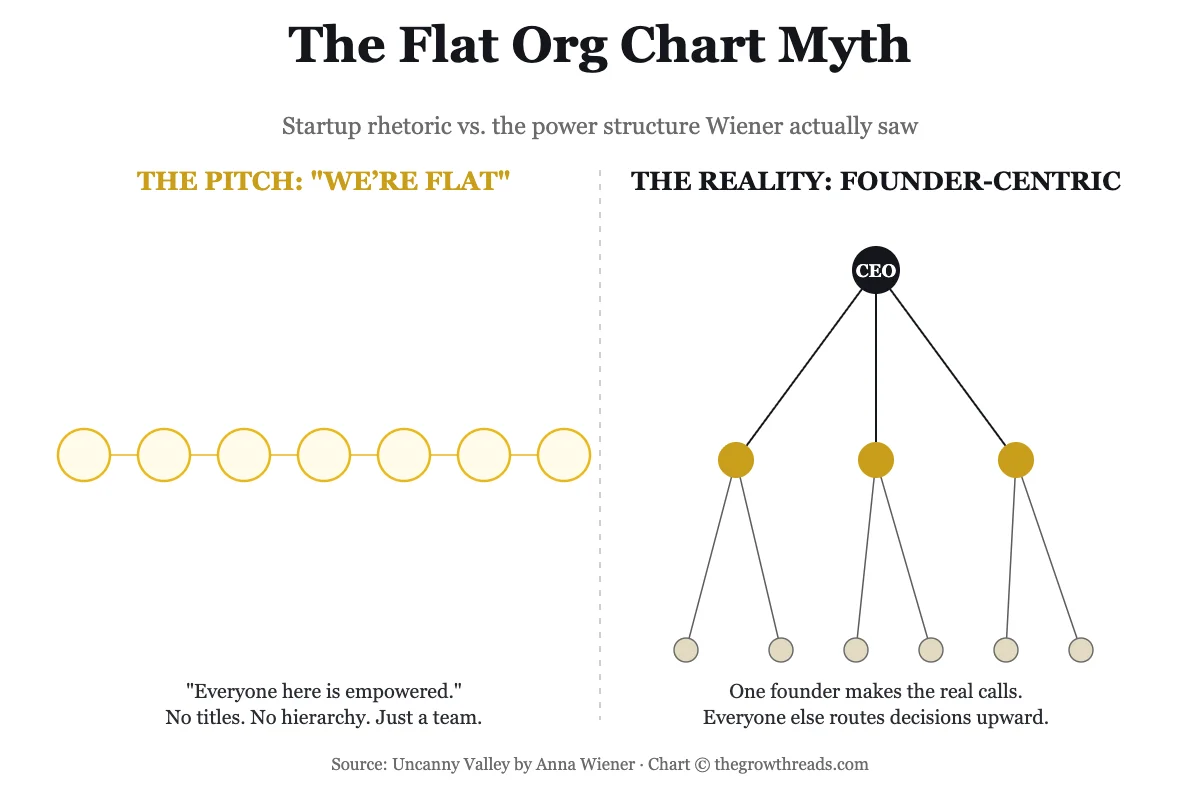
- Flat hierarchies are rarely flat: Titles disappeared on org charts; founder power did not.
- Data work is rarely neutral: Working inside an analytics company taught her how casually user behavior gets tracked, packaged, and monetized.
- Enthusiasm is a resource companies extract: Free snacks and open floor plans made overwork feel like belonging rather than labor.
- Self-awareness doesn’t equal escape: Wiener names her own complicity honestly — she stayed for the equity and the story even as she saw the pattern clearly.
- Outsider status sharpens observation: Coming from publishing, not engineering, let her see cultural absurdities insiders had stopped noticing.
- Anonymizing companies universalizes the critique: By refusing brand names, the book argues the problem is structural, not one bad employer.
- Leaving is itself a form of clarity: Only once she quit could she write the account she’d been unable to see clearly from inside.

What is Uncanny Valley about?
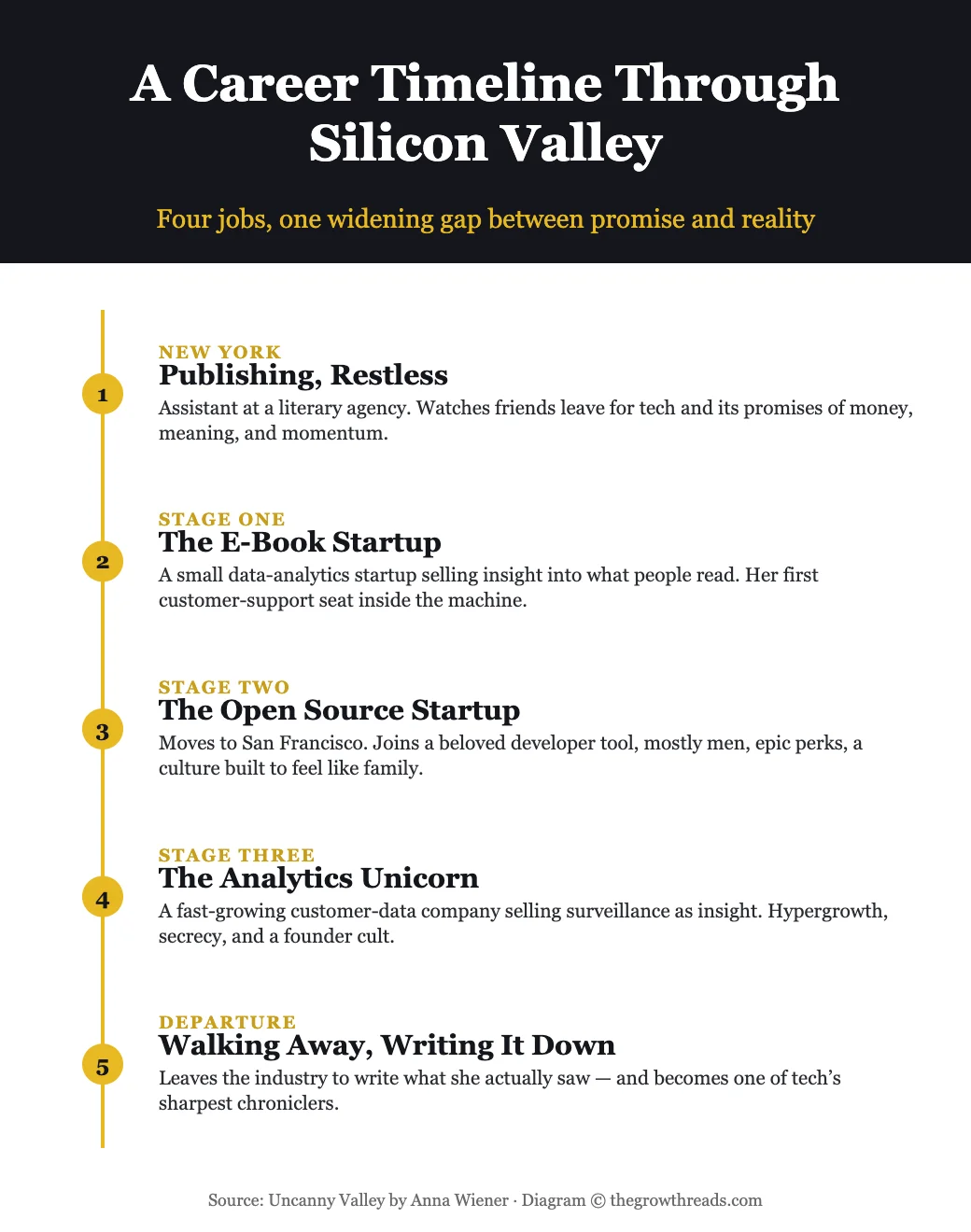
Uncanny Valley is Anna Wiener’s memoir of working inside Silicon Valley startups in the 2010s — moving from New York publishing to an e-book analytics startup, an open-source company, and a data-analytics unicorn — and watching the industry’s utopian promises collide with its everyday reality of surveillance, hierarchy, and burnout.
About the author
Anna Wiener worked in publishing in New York before moving to San Francisco in the early 2010s to join the tech industry, first at a small e-book data-analytics startup, then at a widely used open-source developer tool, and finally at a fast-growing customer-analytics company. Uncanny Valley, published in 2020, drew on those years and became a New York Times bestseller and one of the era’s defining tech memoirs. Wiener now writes as a staff writer and tech correspondent for The New Yorker, where she has continued reporting on the industry from the outside — the vantage point her memoir first made her name writing from. Explore all Anna Wiener book summaries →
Key concepts at a glance
| Concept | What it means | Use it when |
|---|---|---|
| Techno-utopianism | The belief that technology and market growth inherently make the world better | You hear a company describe its product primarily in moral terms |
| Founder cult | Concentrated trust and authority in a single charismatic leader, often unchecked | Every major decision seems to trace back to one person, regardless of title |
| “Family” framing | Kinship language used to justify long hours and blurred boundaries | A workplace asks for loyalty it would not reciprocate in a downturn |
| Culture fit | A hiring filter that quietly favors people who resemble the existing team | You notice a team that looks remarkably similar despite “diverse” hiring goals |
| Hypergrowth | Prioritizing rapid scale over process, oversight, or sustainable pace | Headcount or user numbers are the main metric discussed in all-hands meetings |
| Surveillance capitalism (lived) | The everyday, unglamorous mechanics of collecting and monetizing user data | You want to understand data practices from someone who built the dashboards |
| Emotional labor of tokenism | The uncompensated work of being the visible “only one” on a team | You’re evaluating diversity efforts that stop at hiring, not culture |
| Complicity narrative | Self-implicating storytelling that resists easy hero/villain framing | You want honest reflection rather than a clean outsider’s takedown |
Part 1: New York, and the Pull West
Wiener opens in her mid-twenties, an underpaid assistant at a small literary agency in New York, watching friends leave publishing for tech and come back with stories of free lunches, stock options, and a sense that they were building something that mattered. Publishing felt static; tech felt like the future being written in real time. She takes a job at a small startup that analyzes reading data from e-books — a data-analytics company serving publishers, built on tracking exactly how readers move through a book: where they pause, where they quit, what they highlight. The irony is not lost on her even then: she has left a dying industry to help a new one extract value from the intimate act of reading.
The job is her introduction to startup logic. Perks stand in for job security. A small, close-knit team stands in for a career plan. She is one of the only women on staff who isn’t in a purely administrative role, and she begins to notice patterns she doesn’t yet have language for — being spoken over in meetings, being assumed to be junior regardless of her actual responsibilities, watching men with less experience receive more benefit of the doubt. The company is small enough that these patterns feel personal rather than structural. It will take two more jobs, and several more years, before she sees them as systemic.
By the end of this first chapter of her career, the pull toward San Francisco has become undeniable. The e-book startup is going nowhere fast, publishing is going nowhere slow, and the Bay Area promises both financial upside and, more seductively, membership in a story about the future. She packs up and moves west, uncertain exactly what she’s chasing but certain it’s not what she’s leaving.
TGR Note: Wiener’s realization that data about reading behavior is itself a product anticipates the argument Shoshana Zuboff makes at industrial scale in The Age of Surveillance Capitalism — behavioral data as raw material, extracted quietly, long before most users understand the trade they’ve made.
Part 2: The Open Source Startup — Belonging, Almost
In San Francisco, Wiener lands at a beloved open-source startup — the kind of company developers speak about with genuine affection, built on a tool that makes engineers’ lives easier and asks little in return beyond adoption. She joins in a support and solutions role, translating between customers and an engineering team that is almost entirely male. The office is playful, the perks are generous, and the culture insists, repeatedly, that everyone here is family.
It’s here that the book’s sharpest observations about gender begin to accumulate. She is regularly mistaken for someone’s assistant. She is asked, more than once, if she is technical enough to be in the room she is already working in. She becomes fluent in a kind of emotional translation — softening feedback, managing egos, absorbing tension between departments — labor that never appears in a job description and is never compensated as labor. Wiener is careful not to present herself as a passive victim of this environment; she names her own ambivalence, her own attraction to the culture’s warmth and inside jokes, even as she catalogs its costs.
The “family” language does real work here. It makes long hours feel like devotion rather than extraction. It makes disagreement feel like betrayal rather than feedback. And it papers over a hierarchy that, for all the company’s flat-org-chart branding, still runs through a small circle of founders and early engineers who hold the actual power. Wiener stays because she is, by her own account, seduced — by belonging, by the story, by the sense that she is finally inside something instead of watching from outside.
TGR Note: The gap between a startup’s stated flatness and its real, founder-centric power structure is the same gap explored more broadly in Team Human, where Douglas Rushkoff argues that networked institutions often concentrate power precisely while claiming to distribute it.
Part 3: The Analytics Unicorn — Inside the Surveillance Machine
Wiener’s third job is at a fast-growing, richly funded customer-analytics company — the kind of unicorn whose product exists to help other companies understand, in granular detail, what their users are doing. She moves into a customer-support-adjacent role again, this time watching hypergrowth up close: headcount doubling in months, secrecy around metrics, a founder whose moods set the emotional weather for hundreds of employees. It is here that the book’s critique of “surveillance capitalism” stops being an abstract term and becomes a description of her actual job — watching dashboards fill with behavioral data about people who never explicitly agreed to be tracked this closely, and helping customers extract more of it.
The chapters set here are the book’s most pointed. Wiener describes a culture that prizes growth metrics above almost everything else, where questions about ethics or long-term consequences read as naive or disloyal. She is not naive about her own position: she holds equity, she benefits from the company’s success, and she keeps working there even as her discomfort deepens. The book resists the temptation to cast her as an innocent bystander. Instead, it insists that most people inside these companies are simultaneously complicit and clear-eyed — two states that, in her account, coexist far more easily than outside critics assume.
What makes this section land is its specificity. Wiener doesn’t need to name the company, because she names the mechanics: the way growth targets reshape what gets built, the way “engagement” quietly becomes a euphemism for compulsion, the way founders who once described their mission in idealistic terms grow more guarded, more controlling, and less accountable as the stakes rise. The utopian rhetoric doesn’t disappear — it just stops matching what’s actually happening inside the building.
TGR Note: Wiener’s ground-level view of a data-analytics company’s incentives pairs naturally with Atlas of AI, where Kate Crawford maps the same extraction logic at planetary scale — and with Artificial Unintelligence, Meredith Broussard’s term “technochauvinism” for the reflexive belief that a tech solution is always the right one.
Part 4: Waking Up, Walking Away
The book’s final movement is quieter than its middle, and more devastating for it. Wiener describes a slow accumulation of small disillusionments — a colleague’s careless comment, a founder’s evasive answer, a metric celebrated at an all-hands that she knows, from her own dashboard access, means something less flattering than it’s being presented as. No single event triggers her departure. It is closer to a threshold finally being crossed after years of small deposits.
When she finally leaves the industry, she doesn’t leave with a manifesto. She leaves with material — years of specific, remembered detail that she begins, slowly, to shape into the book itself. Writing becomes the way she processes what she couldn’t fully see while she was inside it; the memoir’s clarity is a function of distance, not of having always known better. This is part of what makes Uncanny Valley land differently than outsider critiques of tech: it doesn’t claim superior judgment from the start. It shows the judgment being built, slowly, expensively, in real time.
The book ends without a tidy resolution about what should replace the industry she’s describing. What it offers instead is a way of seeing — a set of questions readers can carry into their own workplaces about language, power, and who benefits when growth becomes the only value anyone is allowed to name out loud.
TGR Note: Wiener’s account of hypergrowth culture and its human cost sits well alongside The Attention Merchants, Tim Wu’s history of how industries learn to monetize attention — and with Team Human for readers who want a more explicitly argued case for resisting extractive tech systems.
Who is Uncanny Valley best for — and who should read something else first?
This book is best for anyone currently working in tech, especially women in engineering-adjacent roles who want language for dynamics they’ve sensed but not yet named, and for readers who prefer literary, observational writing over prescriptive business advice. If you want a more systemic, data-driven account of surveillance capitalism, start with The Age of Surveillance Capitalism instead. If you want a sharper polemic against extractive tech culture, Team Human makes the argument more directly.
Questions to reflect on
- What language does your own workplace use to ask for more than a job description technically requires?
- Have you ever mistaken a mission statement for evidence of a company’s actual priorities?
- Where in your career have you been “the only one” — and what unpaid labor did that role require?
- What data have you generated at work that you never saw the full afterlife of?
- What would it take for you to notice disillusionment building before it becomes a crisis?
🔥 Ready to see Silicon Valley from the inside?
Get Anna Wiener’s sharp, unsparing memoir of the decade tech promised to change everything.
How to apply Uncanny Valley (7-day plan)
- Day 1: Notice your own mission-speak: Write down the phrases your workplace uses to describe its purpose. Ask which ones describe an actual business model, and which are recruiting language.
- Day 2: Map who holds real power: Sketch your team’s actual decision-making structure, not the official org chart. Who genuinely has to approve things, regardless of title?
- Day 3: Audit your unpaid labor: List the emotional or social work you do at work that isn’t in your job description — smoothing conflict, translating tone, managing morale.
- Day 4: Trace one piece of your own data: Pick a tool you use daily and find out what user behavior it actually tracks. Read the privacy policy once, honestly, start to finish.
- Day 5: Reread your company’s “family” language: Find where your workplace uses kinship or loyalty language. Ask what obligation it’s quietly asking you to accept in return.
- Day 6: Talk to someone outside your bubble: Describe your job to a friend in an unrelated field and notice which parts require translation — and which parts sound stranger out loud.
- Day 7: Write your own honest account: In a few paragraphs, describe one moment at work when idealism and self-interest were both true at once. Don’t resolve the tension — just name it.
\n
\n
\n
\n
\n
\n
Frequently asked questions
Is Uncanny Valley a business or self-help book?
No. It is a literary memoir, not a prescriptive business book. Anna Wiener reflects on her own experience in Silicon Valley rather than offering frameworks or advice, which is part of why it reads more like narrative journalism than a typical tech book.
\n
Which real companies does Uncanny Valley describe?
Wiener deliberately never names the companies she worked for, referring to them by description instead — “the analytics startup,” “the open source startup,” and so on. Many readers and reviewers have speculated about which real companies these are, but the anonymization is intentional and central to the book’s argument that the pattern is structural, not one company’s fault.
\n
Do I need to work in tech to enjoy this book?
No. While tech workers will recognize the most detail, the book’s core themes — gender dynamics at work, the seduction of mission-driven language, and the gap between rhetoric and reality in any fast-growing organization — apply well beyond Silicon Valley.
\n
How does Uncanny Valley compare to The Age of Surveillance Capitalism?
They’re complementary but different in scope and form. Shoshana Zuboff’s book is an academic, systemic analysis of how surveillance capitalism works as an economic model. Wiener’s book is a personal, ground-level memoir of what it felt like to work inside one small piece of that system, day to day.
\n
Is Anna Wiener critical of the people she worked with?
She is more self-implicating than accusatory. The book resists easy villains, including herself; Wiener is honest about her own complicity, ambition, and attraction to the culture she later critiques, which many readers find more persuasive than an outsider’s takedown would be.
\n
What happened to Anna Wiener after she left tech?
She became a writer, publishing essays before Uncanny Valley and later joining The New Yorker as a staff writer covering the technology industry — continuing to report on Silicon Valley, now from outside the companies rather than inside them.
\n
Is this a good pick for a workplace or book club discussion?
Yes. Its combination of personal narrative and structural critique tends to generate strong discussion, especially among readers with their own experience of mission-driven or high-growth workplaces, in tech or otherwise.
Related summaries
- The Age of Surveillance Capitalism by Shoshana Zuboff — the systemic, economic analysis behind the practices Wiener saw up close.
- Atlas of AI by Kate Crawford — the planetary-scale infrastructure and labor behind the systems Wiener helped build.
- Artificial Unintelligence by Meredith Broussard — a sharper diagnosis of the “technochauvinism” beneath tech’s utopian rhetoric.
- Team Human by Douglas Rushkoff — a more explicit argument for resisting extractive tech culture.
- Browse all Best AI & Technology Books
How we analyze books: our team reads each title in full, cross-references author interviews and reputable reviews, and builds original diagrams and application plans rather than reproducing the text. Read our full methodology.
Related Technology Summaries
Co-Intelligence Summary & Review: How to Actually Work With AI
Deep Medicine Summary & Review: How AI Could Give Doctors Back Their Time
The Ethical Algorithm Summary & Review: Building Fairness and Privacy Into Code, Not Policy
The Shallows Summary & Review: How the Internet Is Rewiring Your Brain
The Singularity Is Near Summary & Review: Why Kurzweil Thinks 2045 Changes Everything