

★★★★☆ (4.4/5) — Twenty-three of AI’s biggest names, one consistent set of questions, and zero agreement on where it all ends.
Best for: Readers who want the full range of expert opinion on AI’s future, not one author’s argued thesis.
Reading time: ~9 hrs for the full book · ~24 min for this guide.
Difficulty to apply: Easy — this is a book for updating your mental model, not building new habits.
Architects of Intelligence in one minute
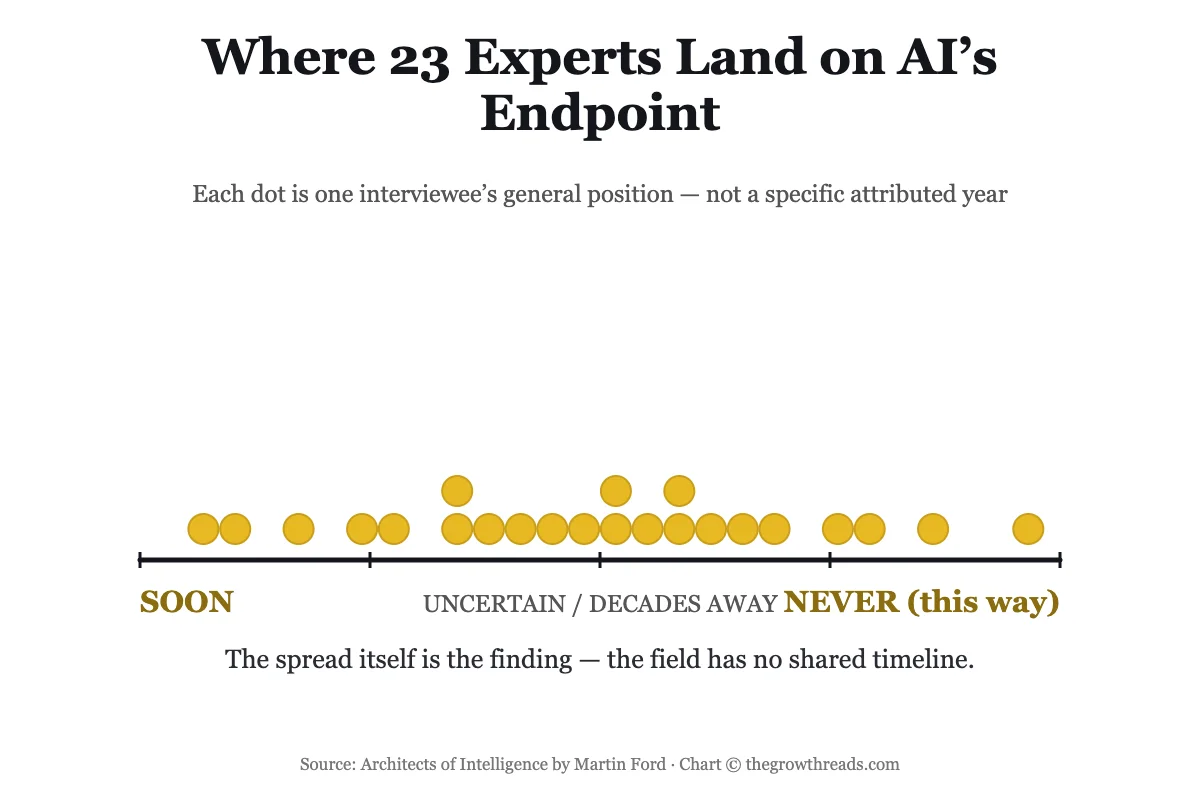
Nobody who actually builds AI agrees on when — or whether — it becomes generally intelligent. Martin Ford, the tech entrepreneur and futurist behind Rise of the Robots, spent months interviewing twenty-three of the field’s most prominent researchers and entrepreneurs — academics and industry leaders working across deep learning, robotics, cognitive science, and AI safety. He asked each of them a consistent set of questions: what deep learning can and can’t do, when human-level AI might arrive, and what we should actually be worried about. Architects of Intelligence doesn’t answer those questions. It shows you, in the builders’ own words, that the people closest to the technology don’t answer them the same way either — and that the disagreement itself is the most useful thing the book has to offer.
Key takeaways
- There is no expert consensus on AGI timelines. Across the twenty-three interviews, estimates for human-level AI range from within a decade to “not in our lifetimes” to genuine skepticism that it arrives in the form usually imagined.
- Deep learning’s limits are contested, not settled. Some interviewees see today’s pattern-matching approach as a real path toward general intelligence with enough scale; others argue a fundamentally different approach is required.
- Risk framing splits the field. Some researchers treat existential risk from advanced AI as a serious, near-term concern; others see that framing as a distraction from immediate harms like bias, job loss, and concentration of power.
- The interview format is the point. Ford asks the same questions of everyone, which turns the book into a genuine comparison of positions rather than a curated argument.
- Academia and industry answer differently, but not predictably. Incentive structures shape some answers, but plenty of industry researchers sound cautious and plenty of academics sound bullish.
- Diverse teams come up again and again. Interviewees across very different specialties independently raise the need for varied perspectives among the people building AI systems.
- Hype skepticism is a shared instinct. Even the most optimistic interviewees tend to push back on breathless coverage of what current systems can actually do.
- No single discipline owns the answers. Philosophy, neuroscience, economics, and ethics all get invoked as necessary partners to computer science.
- Ford’s own synthesis closes every chapter. His brief reactions after each interview keep the book from being a flat transcript dump — he’s actively reading the pattern across conversations.
- The book ages differently than most AI titles. Because it captures a range of positions rather than one forecast, its value holds up even as any single prediction in it inevitably proves wrong.
What is Architects of Intelligence about?
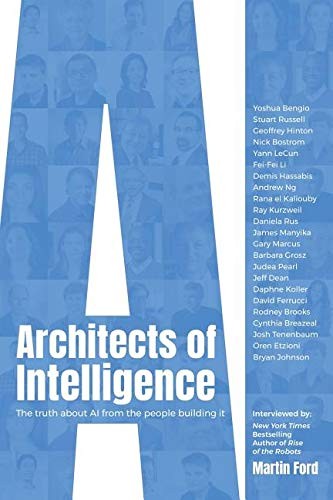
Architects of Intelligence is a collection of twenty-three in-depth interviews Martin Ford conducted with leading AI researchers and entrepreneurs, asking each the same core questions about deep learning’s real capabilities, timelines to human-level AI, and existential and societal risk — revealing a field with far less consensus than headlines suggest.
About the author
Martin Ford is a Silicon Valley entrepreneur and futurist who built his career founding and running a software development firm before turning to writing about automation’s economic consequences. His 2015 book, Rise of the Robots, won the Financial Times and McKinsey Business Book of the Year award and helped move AI and automation into mainstream debate years before generative AI made the conversation urgent. With Architects of Intelligence, published in 2018, Ford shifted from arguing his own thesis to a different project: getting two dozen of the field’s most consequential builders to answer the same hard questions, on the record, in their own words. He continues to write, speak, and interview leading voices in AI on where the technology is heading. Explore all Martin Ford book summaries →
Key concepts at a glance
| Concept | What it means | Use it when |
|---|---|---|
| AGI | Artificial general intelligence — a system with human-like, cross-domain reasoning, as opposed to narrow AI built for one task. | Evaluating any bold claim about “AI that thinks like a person.” |
| Deep learning | The pattern-matching, neural-network approach behind most recent AI progress, built on scaling data and compute. | Assessing whether a new AI capability is a genuine leap or a scaling story. |
| Existential risk framing | The view that sufficiently advanced AI could pose a threat to humanity’s long-term survival, not just to jobs or fairness. | Sorting a researcher’s public comments into “long-term risk” vs. “near-term harm” camps. |
| Near-term harms | Bias, job displacement, and concentration of power — the risks some interviewees argue deserve more attention than speculative superintelligence. | Weighing today’s AI policy debates against tomorrow’s hypothetical ones. |
| Interdisciplinary AI | The recurring argument that computer science alone can’t responsibly build AI — philosophy, ethics, and social science need a seat at the table. | Judging whether an AI team or project has the range of expertise a hard problem needs. |
| Interview-format nonfiction | A book built from structured conversations rather than one author’s argued case, trading a single thesis for breadth of firsthand perspective. | Choosing between a book that argues a position and one that surveys expert opinion. |
| Ford’s synthesis | The short reflection Ford adds after each interview, connecting that conversation to broader patterns across the book. | Looking for the throughline without re-reading all twenty-three interviews yourself. |
Part 1: Twenty-Three Conversations, One Set of Questions
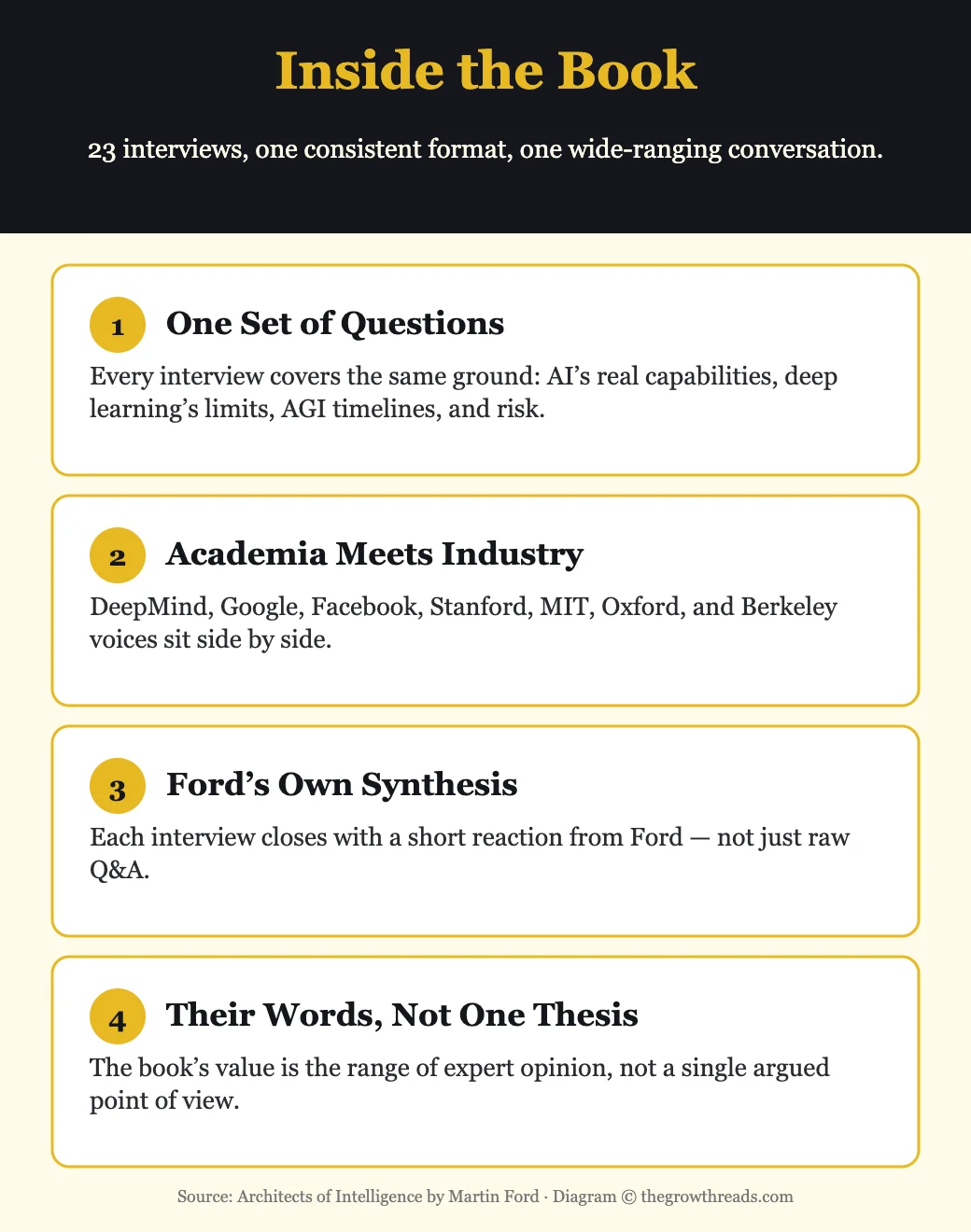
Ford’s structural choice is what makes Architects of Intelligence work as more than a collection of profiles. Rather than letting each interview wander, he asked a consistent core set of questions of nearly everyone: What is the current state of AI capability, really? What are the genuine limits of deep learning? When, if ever, do you expect human-level machine intelligence? And what should we actually worry about? That consistency turns two dozen separate conversations into something closer to a structured survey — you can read across interviews and see where comparable answers cluster and where they scatter.
The interviewees span a genuinely wide slice of the field circa 2018: researchers behind landmark deep learning breakthroughs, roboticists building physical systems, cognitive scientists studying how humans reason, and entrepreneurs commercializing AI at scale. Some work inside large technology companies; others are university researchers with no product to ship. Some have spent careers warning about long-term risk; others build systems that ship next quarter. Ford doesn’t flatten these differences — he lets them sit side by side and lets the reader notice the pattern, or its absence.
TGR Note: Ford’s own first book, Rise of the Robots, argues a specific thesis about automation and jobs. Architects of Intelligence is almost the opposite project — instead of building his own case, he steps back and lets two dozen other people make theirs, in their own words, on the record.
This format has a cost as well as a benefit. Because every interview follows a similar arc, the book can feel repetitive read start to finish — the same questions recur, just answered by a different person. But that repetition is also the source of its real value: it’s precisely what lets you compare answers instead of just admiring each one individually. Ford seems to have made that trade deliberately, favoring comparability over narrative variety.
Part 2: Where the Experts Actually Disagree
The single most striking pattern across the twenty-three interviews is how little consensus exists on AGI timelines. Some interviewees are comfortable naming a rough decade for human-level AI; others decline to estimate at all, arguing that too many unknowns remain to put a number on it; still others push back on the framing itself, suggesting that “AGI” as commonly imagined may not be the right target or may never arrive in that specific form. Read in sequence, the interviews don’t converge toward a middle answer — they stay genuinely spread across the whole range, from soon to never.
The same split shows up around deep learning’s ceiling. Several interviewees believe scaling current neural-network approaches — more data, more compute, larger models — remains a viable, if incomplete, path toward more general intelligence. Others argue just as confidently that pattern-matching at scale is the wrong kind of approach for genuine reasoning and common sense, and that a different paradigm entirely will be needed. Both camps include people with deep, hands-on experience building the systems in question — this isn’t a gap between insiders and outside skeptics, it’s a live disagreement among the insiders themselves.
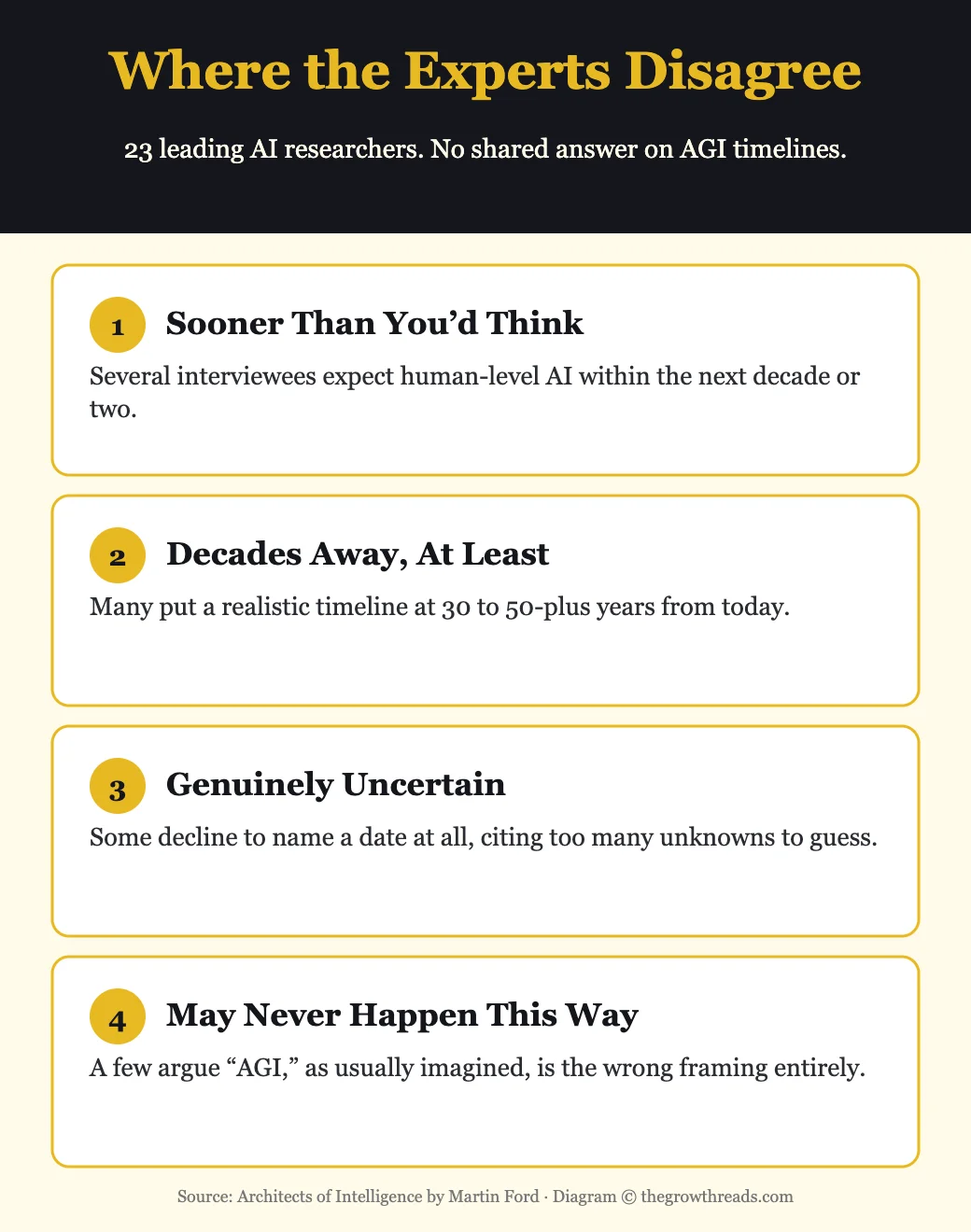
Risk framing splits the interviewees just as sharply. A meaningful subset treats long-term, existential risk from advanced AI as a serious concern worth active research attention now — the idea that sufficiently capable systems could become hard to control or align with human values. Others see that framing as, at best, premature and, at worst, a distraction from harms already measurable: biased decision systems, job displacement, and AI capability concentrated inside a small number of well-resourced organizations. Neither position reads as uninformed; both are argued by people who have thought carefully about the tradeoffs.
TGR Note: If the existential-risk side of this debate is the one you want to go deeper on, Superintelligence by Nick Bostrom — himself one of the twenty-three interviewees here — makes the fullest single-author case for taking the risk seriously. His chapter here, read alongside his own book, shows how a position sounds compressed into an interview versus argued at full length.
What’s notable is that this isn’t a simple two-camp split that maps neatly onto academia versus industry. Some of the most risk-focused voices work inside major AI labs; some of the most measured, near-term-focused voices are career academics. The disagreement runs through the middle of both groups, not between them — exactly why a single interview format works so well: Ford’s format lets the camps argue with each other across chapters, rather than picking a side itself.
Part 3: Industry Voices, Academic Voices, and the Incentives Behind Them
Reading the interviews with an eye on who works where adds another layer to the disagreement. Researchers inside large technology companies are, unsurprisingly, closer to the commercial pressure to ship products — some of their answers emphasize what current systems can already do well. University-based researchers, insulated from product deadlines, sometimes have more room to speculate about longer horizons or voice skepticism about applications without a rigorous foundation yet.
But the pattern is far from absolute, and the exceptions matter as much as the rule. Some industry researchers are notably cautious about overselling current capability, pushing back on hype even from within organizations that benefit commercially from optimism. Some academics sound just as bullish as any startup founder. Ford’s format doesn’t let you sort interviewees into tidy buckets by employer — you have to read each conversation to find out where that person actually lands, which is part of what makes the book worth reading in full rather than skimmed for one takeaway.
TGR Note: James Barrat’s Our Final Invention makes an argued, single-author case that AI safety work isn’t moving fast enough relative to capability progress. This book doesn’t argue that case directly, but its risk-focused interviewees are effectively making pieces of the same argument, just without one author tying it into a single narrative.
Part 4: What Holds the Book Together
For all the genuine disagreement across the twenty-three interviews, a handful of threads recur often enough to look less like coincidence and more like something close to consensus. The most frequent is a call for more diverse teams building AI — not an abstract fairness point, but a practical argument that homogeneous teams miss blind spots that end up baked into deployed systems. Interviewees who disagree on almost everything else tend to agree on this one.
A second thread is a shared instinct toward skepticism of AI hype. Even the most optimistic interviewees push back, specifically and pointedly, on coverage or marketing that overstates what current systems can actually do — genuine optimism paired with real irritation at overselling, often enough across different people that it reads as a professional norm rather than one person’s quirk.
A third thread is interdisciplinary humility: the recurring acknowledgment that computer science alone can’t responsibly build or govern advanced AI. Philosophy, neuroscience, economics, and ethics all get invoked as necessary partners, not decorative ones — a quieter but more universal point of agreement than anything about timelines or risk.
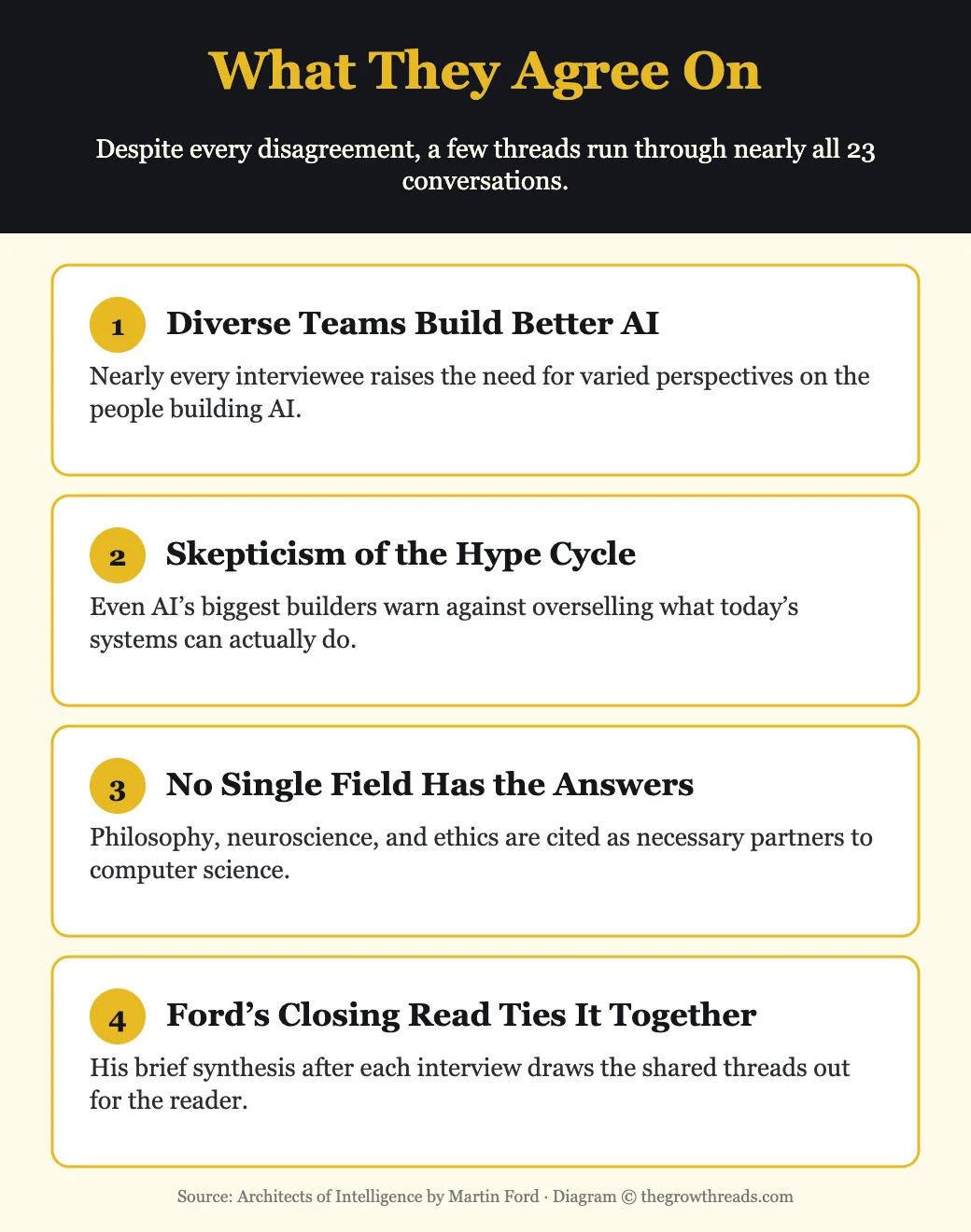
Ford’s closing synthesis, threaded through his brief reactions after each interview, pulls these recurring threads into view without requiring you to hold all twenty-three conversations in your head at once. He doesn’t force false agreement where none exists — the timeline and risk disagreements stay genuinely open — but he flags the places where the same idea keeps resurfacing from very different people.
TGR Note: Ford’s diagnosis in Rise of the Robots is about automation’s effect on jobs specifically. The near-term-harms camp here — concerned with bias, displacement, and concentration of power more than existential risk — is arguing a version of that same case from twenty-two additional, independent vantage points.
Who is Architects of Intelligence best for — and who should read something else first?
This book rewards readers who want the texture of genuine expert disagreement rather than a tidy single answer — people comfortable sitting with “the field doesn’t know” as a real, useful conclusion. It’s a strong fit if you’ve read one or two argued AI books and want to stress-test that single perspective against a wider set of firsthand voices. If you want Ford’s own argued position on automation and the economy, start with his more focused Rise of the Robots instead. For one author’s fully worked-out case on existential AI risk, Superintelligence or Our Final Invention will scratch that itch more directly.
Questions to reflect on
- Which camp do you naturally lean toward on AGI timelines — and how much of that is evidence versus intuition?
- Do you find the existential-risk framing or the near-term-harms framing more persuasive, and why?
- Where in your own work or reading do you rely on one expert’s opinion when a range of views might serve you better?
- What would change your mind about how far current AI approaches can scale?
- If you had Ford’s twenty-three interview slots, whose perspective would you add that isn’t represented here?
🔥 Ready to hear it straight from the people building AI?
Get the full set of twenty-three interviews and Ford’s synthesis in Architects of Intelligence.
How to apply Architects of Intelligence (7-day plan)
- Day 1: Read the intro and pick three interviewees whose backgrounds most differ from each other — one academic, one entrepreneur, one safety-focused researcher.
- Day 2: Read your first chosen interview. Write down, in one sentence each, their answers on timeline and on risk.
- Day 3: Read your second interview. Compare the two sets of answers side by side — where do they overlap, where do they split?
- Day 4: Read your third interview. Add it to your running comparison notes.
- Day 5: Pick one AI claim you’ve seen in the news recently. Check it against the range of views you’ve collected so far — does any interviewee’s position help you evaluate it?
- Day 6: Read two more interviews from people whose day jobs differ from your first three picks. Update your comparison notes.
- Day 7: Write a short personal position statement on AGI timelines and AI risk, explicitly noting which interviewees most shaped it and why.
Frequently asked questions
Who did Martin Ford interview for Architects of Intelligence?
Ford interviewed twenty-three prominent AI researchers and entrepreneurs spanning deep learning, robotics, and cognitive science, drawn from both major technology companies and universities. The roster includes figures known for landmark deep learning research, leaders of high-profile AI labs, roboticists, cognitive scientists, and AI safety researchers — deliberately spanning different institutional homes and specialties rather than clustering around one lab or subfield.
Does the book reach a conclusion about when AGI will arrive?
No, and that’s deliberate. The interviewees’ estimates span from within a decade to “not in our lifetimes,” with several declining to estimate at all and others questioning whether the usual framing of AGI is even the right target. Ford’s synthesis draws out recurring patterns in the disagreement but doesn’t try to average the answers into a single house prediction.
Is this book still relevant, since it was published in 2018?
Largely yes, though it predates the generative AI boom that followed ChatGPT’s release. Because the book’s value comes from the range and structure of expert disagreement rather than any single forecast, most of that holds up — the specific products discussed have moved on, but the debates about timelines, deep learning’s limits, and risk framing are largely the same ones the field is still having.
How is this different from Ford’s earlier book, Rise of the Robots?
Rise of the Robots is Ford’s own argued case about automation’s effect on jobs and the economy. Architects of Intelligence is a different kind of project entirely — instead of arguing his own thesis, Ford steps back and interviews two dozen other people, letting their answers, not his argument, carry the book.
Do the interviewees agree on anything?
Yes — despite sharp disagreement on timelines and risk, several threads recur across many interviews: the value of diverse teams building AI, skepticism toward AI hype even among optimists, and the view that computer science alone can’t responsibly govern AI without help from philosophy, ethics, and other fields.
Is this a good starting point for someone new to AI topics?
It works better as a second book than a first one. Because it presents a wide range of positions without much hand-holding on the basics, readers get more from it after some grounding in core AI concepts — from a primer or from Ford’s own Rise of the Robots — so they can place each interviewee’s answer relative to the mainstream.
What’s the best way to read a 550-page interview collection like this?
Most readers do better picking interviews strategically — mixing academics and entrepreneurs, optimists and skeptics — rather than reading start to finish, since the repeated question format can feel repetitive at length. The 7-day plan above is built around that selective approach.
Related summaries
- Rise of the Robots by Martin Ford
- Our Final Invention by James Barrat
- Superintelligence by Nick Bostrom
- Best AI Books
How we analyze books: we read the full text, cross-check factual claims, and focus our summaries on practical application rather than restating the book chapter by chapter. Read our full methodology.
Related Technology Summaries
Atlas of AI Summary & Review: The True Cost Behind Every Query
Genius Makers Summary & Review: The Human Story Behind the AI Boom
Human Compatible Summary & Review: Building AI That Stays on Our Side
Scary Smart Summary & Review: How to Shape What AI Learns From Us
Weapons of Math Destruction Summary & Review: How Algorithms Quietly Punish the Poor