

★★★★☆ (4.4/5) — A landmark early map of the AI age, still worth reading for its central idea alone.
Best for: Readers curious about where today’s AI boom came from, and anyone who wants a clear mental model for why technological change keeps outrunning expectations.
Reading time: ~7 hrs to read the full book; this guide takes about 14 minutes.
Difficulty to apply: Easy — the core idea is simple to grasp, even though the book’s later chapters get philosophically dense.
The Age of Spiritual Machines in one minute
Ray Kurzweil argued in 1999 that intelligent machines weren’t decades away in some vague science-fiction sense — they were on a predictable, exponential schedule, and most people would badly misjudge when they’d arrive. His core tool is what he calls the Law of Accelerating Returns: technological progress, especially computing power, doesn’t creep forward in a straight line — it compounds, so each advance shortens the time to the next one. Because human intuition is built for linear change, we chronically underestimate how fast exponential change actually moves. Kurzweil uses that engine to sketch a decade-by-decade path toward a century in which computers rival, then exceed, human intelligence — and he treats the philosophical fallout, including what happens to consciousness and spirituality, as a serious question rather than a plot device.
Key takeaways
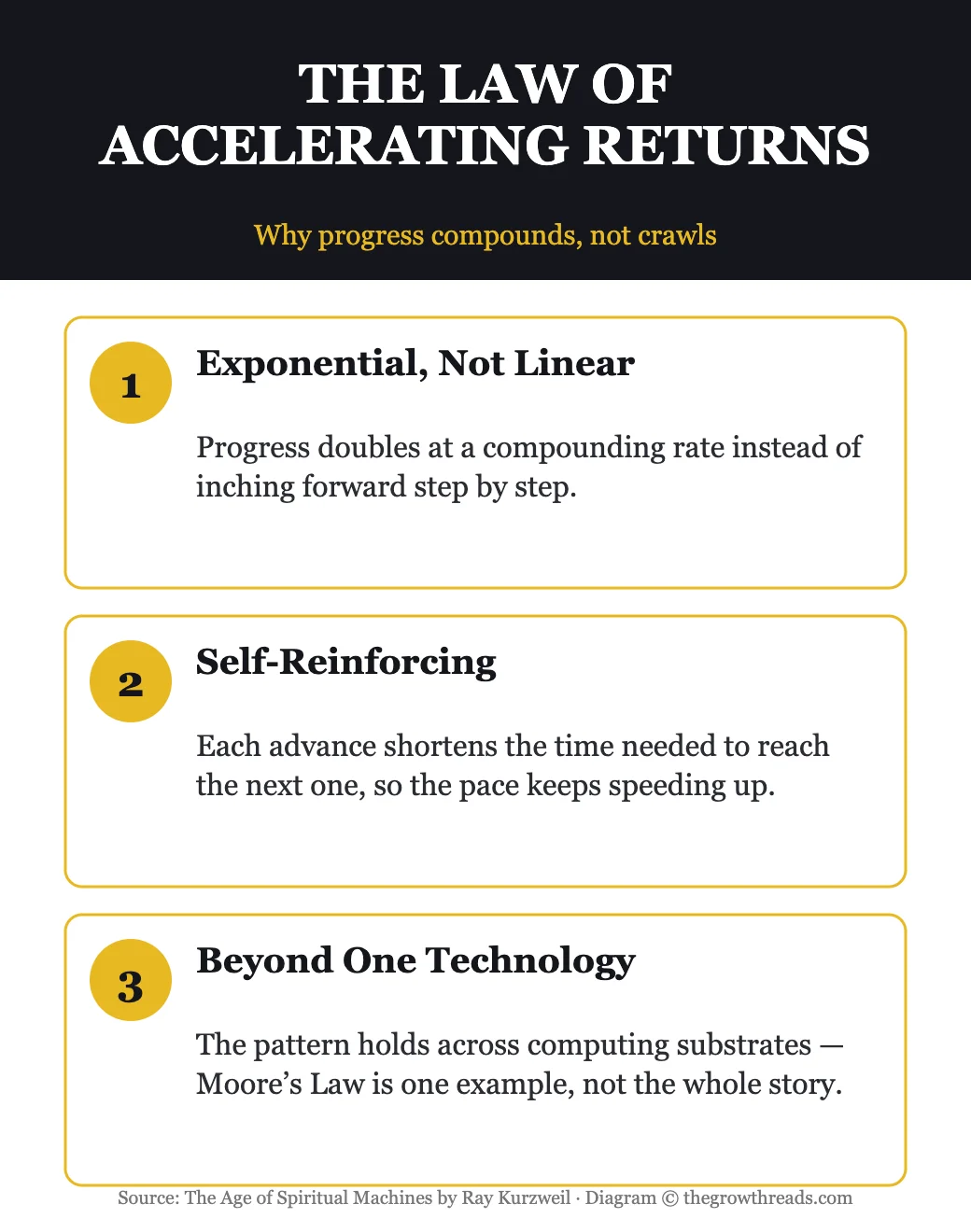
- The Law of Accelerating Returns is the book’s engine: technological progress compounds instead of creeping forward at a constant rate, so the pace of change itself keeps increasing.
- Exponential trends feel invisible until they suddenly don’t: for a long stretch, doubling growth looks almost flat — then it turns sharply upward, right around the point most people notice it.
- It’s broader than Moore’s Law: Kurzweil argues the exponential pattern shows up across computing substrates over time, not just in one chip-making technique.
- Human intuition is linear by default: we evolved to predict tomorrow from today, which makes compounding change genuinely hard to feel in your gut, even when you understand it on paper.
- Computing power and the human brain are on a collision course, in his telling: Kurzweil expected machine computation to approach and then surpass rough estimates of raw human brain capacity.
- The interface between people and machines keeps getting more direct: from keyboards to speech to (he predicted) increasingly seamless, even neural, connections.
- A meaningful Turing test is one waypoint, not the destination: Kurzweil treats convincing machine intelligence as a milestone on a much longer arc, not the finish line.
- The book takes “spiritual” questions seriously: what happens to consciousness, identity, and the soul in a world where the line between mind and machine blurs is treated as a real philosophical question.
- Uploading and merging human and machine intelligence is the long-horizon endpoint: Kurzweil frames the eventual blending of biological and artificial minds as the logical continuation of the trend, not a fringe idea.
- Some predictions landed close to schedule; others are still unfolding — a useful lesson in how hard it is to time exponential change precisely, even when the underlying trend is right.
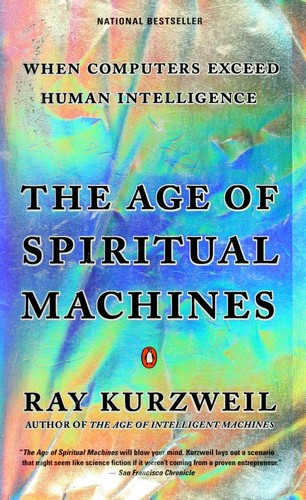
What is The Age of Spiritual Machines about?
Published in 1999, the book argues that computing power follows an exponential curve Kurzweil calls the Law of Accelerating Returns, and that this curve will drive machines to match and then exceed human intelligence far sooner than linear intuition suggests — with profound implications for identity, consciousness, and what it means to be human.
About the author
Ray Kurzweil is an inventor, computer scientist, and futurist known for a decades-long track record of technology predictions. He built pioneering systems in optical character recognition, text-to-speech synthesis, and music technology, earning a GRAMMY Award and induction into the National Inventors Hall of Fame, along with the U.S. National Medal of Technology. He later served as a Principal Researcher and AI Visionary at Google. Explore all Ray Kurzweil book summaries →
Written at the close of the 1990s, this book was Kurzweil’s attempt to formalize the intuition behind his lifelong pattern of successful inventions: that the pace of technological progress could be modeled, and that modeling it honestly led to conclusions most people found startling. It helped establish him as one of the most widely cited voices on AI’s trajectory, and its central framework would go on to anchor his later, better-known book, The Singularity Is Near.
Key concepts at a glance
| Concept | What it means | Use it when |
|---|---|---|
| Law of Accelerating Returns | Technological progress compounds rather than proceeding at a constant rate. | Forecasting how fast a technology trend will actually move. |
| Exponential vs. linear thinking | Human intuition predicts tomorrow from today; exponential change breaks that intuition. | Checking your own gut estimate of “how long until X” against the math. |
| Computing substrates | The exponential pattern outlives any single technology, including silicon chips. | Explaining why a slowdown in one specific technique rarely stops the broader trend. |
| The Six Epochs (framing device) | A big-picture arc from physics and chemistry through biology, brains, technology, and eventual human-machine merger. | Placing today’s AI progress inside a much longer historical pattern. |
| Human-machine interface | The channel between people and machines getting steadily more direct, from keyboards toward speech and beyond. | Thinking about why voice assistants and wearables keep gaining ground. |
| The Turing test as waypoint | Convincing machine intelligence is treated as one milestone among many, not an endpoint. | Evaluating claims that a chatbot has “passed” some threshold of intelligence. |
| Uploading / mind-machine merger | The long-horizon idea that human and machine intelligence eventually blend. | Engaging seriously with the book’s more speculative, philosophical chapters. |
Part 1: The Law of Accelerating Returns
Kurzweil opens with a claim that sounds almost too simple: progress in computing doesn’t move at a steady pace — it compounds. Each generation of a technology tends to make the next generation arrive faster, because better tools accelerate the tools that come after them. He traces the pattern back further than expected, running the curve through electromechanical calculators, vacuum tubes, and relays, all the way to the earliest mechanical computing devices. The point isn’t that any one technology is magic; it’s that the underlying curve of computational capability has held remarkably steady across several completely different physical substrates, one replacing the next as it hit its own limits.
That distinction matters more than it looks. A narrower claim — “chip density doubles every couple of years” — is fragile, since it lives or dies with silicon manufacturing. Kurzweil’s broader claim is that when one substrate nears its limits, the competitive pressure that drove its improvement routes itself into a new substrate, and the overall curve continues. That reframing is why the book holds up decades later even where its narrower, chip-specific numbers look dated: the argument was never really about one manufacturing technique.
TGR Note: This “trend outlives any single technology” argument is the same move Kevin Kelly makes in The Inevitable, framing AI progress as one of several unstoppable forces rather than one company’s roadmap — a useful pairing for separating “this trend might slow” from “the forces behind it find another channel.”
Part 2: Exponential Minds — Why We Keep Underestimating the Future
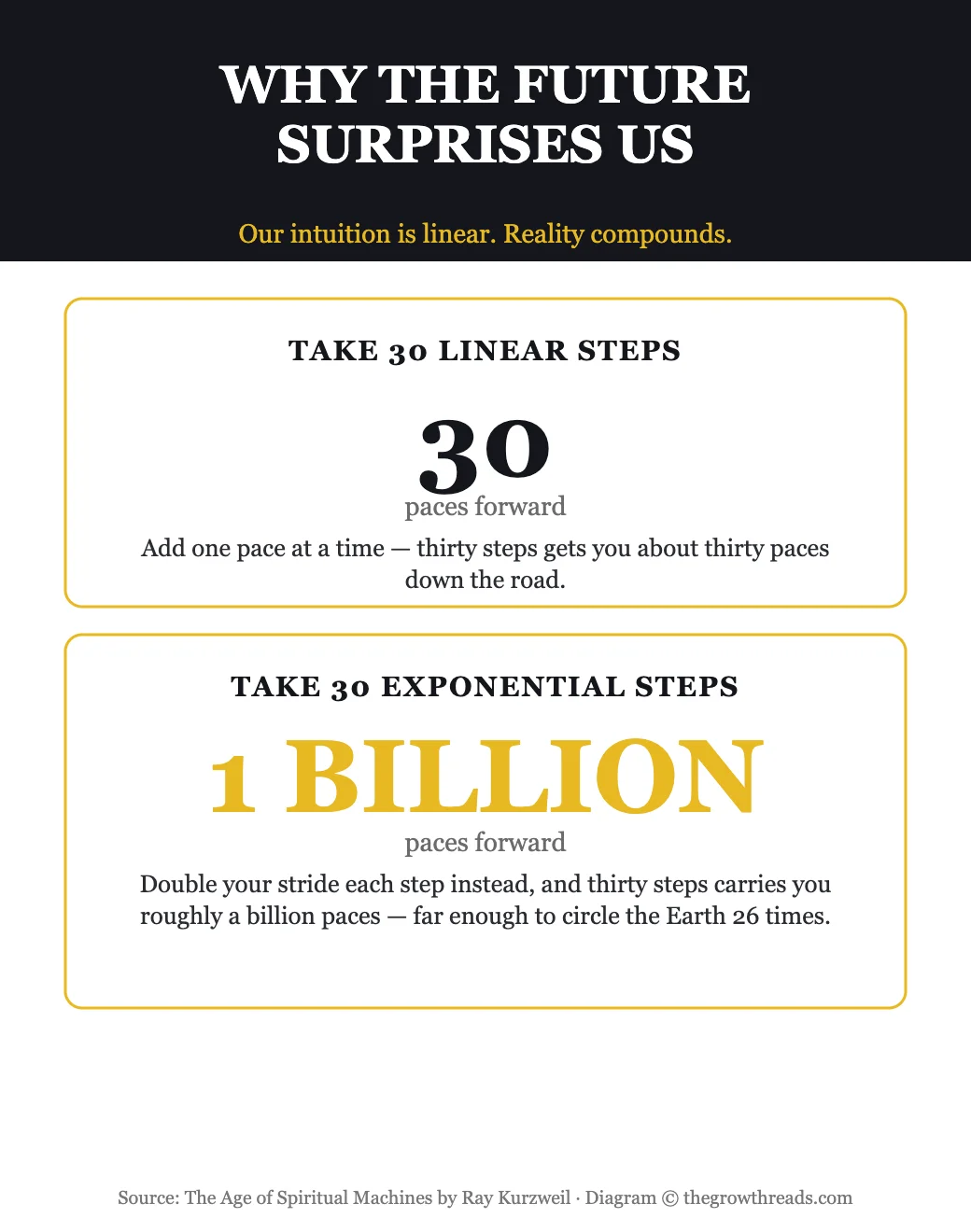
If the Law of Accelerating Returns is the book’s engine, this part is its warning label: the human brain is a poor instrument for feeling exponential change coming. We’re built to extrapolate from recent, roughly linear experience. That instinct works fine for most of daily life, but it fails badly for compounding trends, because early on, exponential growth looks almost identical to no growth at all — right up until the point it doesn’t.
Kurzweil illustrates this with a simple thought experiment about walking in steps. Take thirty ordinary steps forward and you’ve covered about thirty paces — a short, forgettable walk. Now take thirty steps where each one doubles the length of the last. The early steps look unremarkable, even smaller than the ordinary version. But doubling compounds fast: by the thirtieth step, you’ve covered roughly a billion paces, enough to circle the Earth dozens of times over. Nothing about the rule changed between step one and step thirty — what changed is that our linear intuition can’t feel the difference between “doubling” and “flat” until the curve has already turned sharply upward, and by then the surprising future has effectively already arrived.
This is why so many expert predictions about technology turn out to be too conservative rather than too wild. Experts are often excellent at reasoning about the next linear step and much weaker at internalizing what a decade of compounding does to a curve. The book’s practical advice is to treat your own gut sense of “that’s decades away” with real suspicion whenever the underlying trend is genuinely exponential.
TGR Note: The same blind spot shows up, in a very different tone, in Our Final Invention, where James Barrat argues underestimating self-improving AI’s speed is exactly what makes it risky to leave safety work for later — a useful pair to read back to back.
Part 3: Decade by Decade — Kurzweil’s Predicted Arc
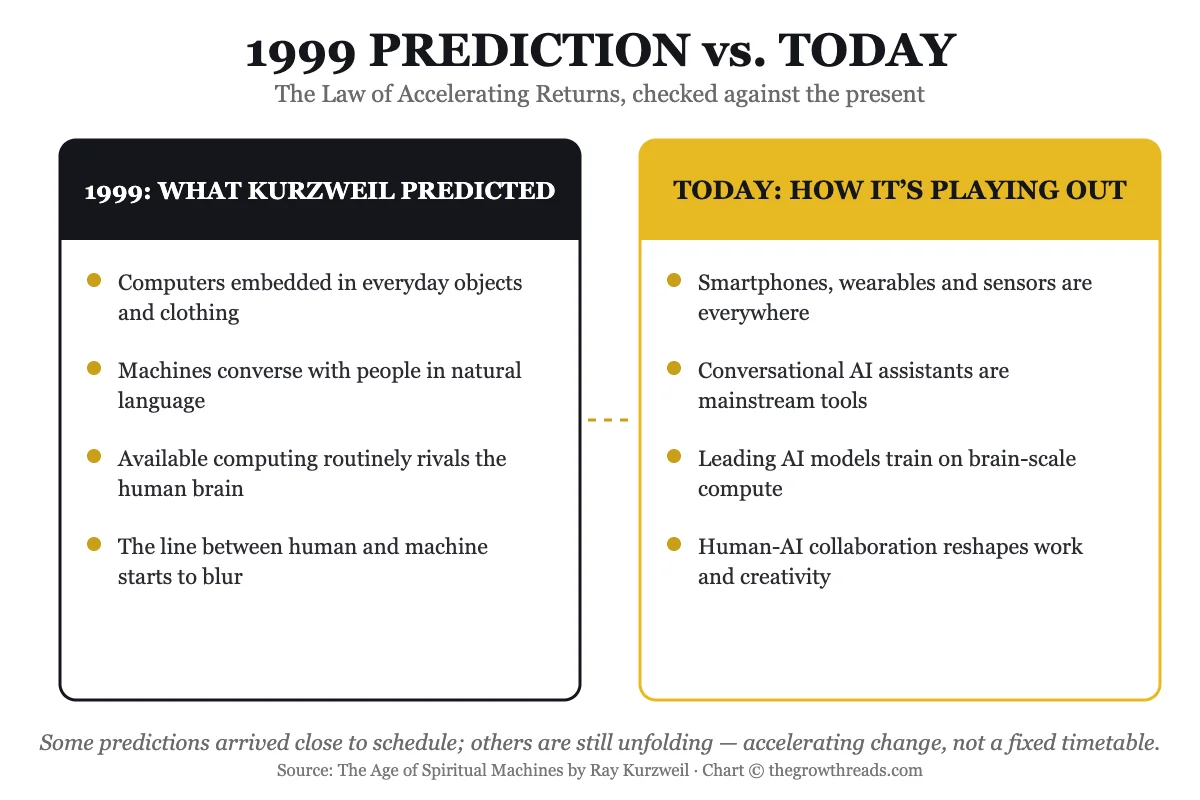
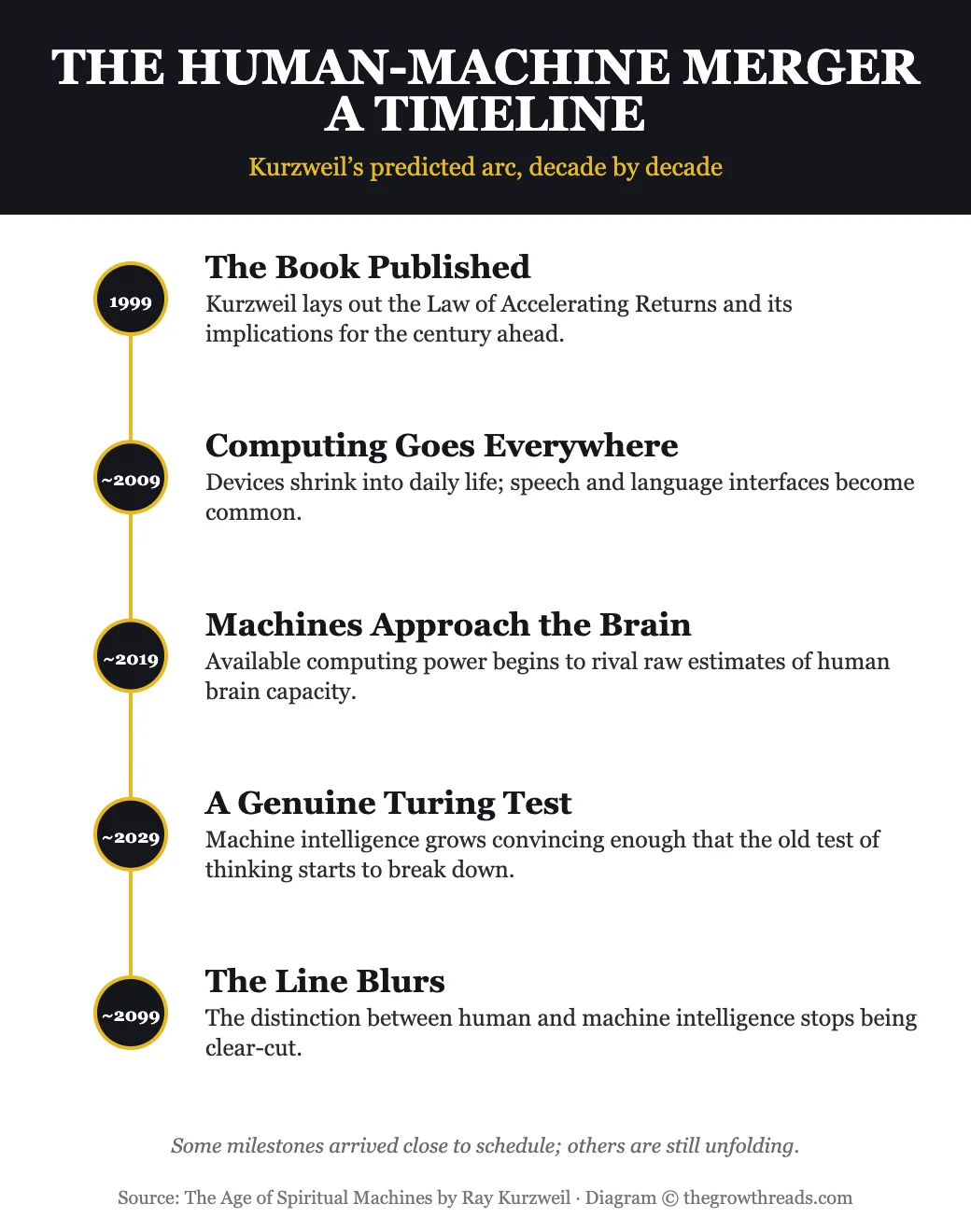
Having built the case for why change accelerates and why we tend to misjudge it, Kurzweil spends much of the book’s back half doing something few futurists were willing to do in 1999: putting specific, checkable predictions on the record, decade by decade, out to the end of the century. The broad shape of that arc runs from computing quietly disappearing into everyday objects and speech interfaces becoming commonplace, through computing power beginning to rival rough estimates of the human brain, toward machine intelligence eventually becoming convincing enough that older tests of “real” thinking start to look inadequate, and finally toward a horizon where the distinction between human and machine intelligence stops being clear-cut.
Read from 2026, that arc is a genuinely interesting case study in prediction under uncertainty. Some broad, structural bets — ubiquitous computing, mainstream speech interfaces, computing capacity climbing toward brain-scale territory, startlingly convincing conversational AI — have arrived roughly on the timeline he sketched, even where exact numbers differ. Other predictions, particularly the speculative long-horizon ones involving direct neural interfaces and nanotechnology-scale medicine, are still unfolding. That mixed record isn’t a knock against the book; it’s a fair test of the Law of Accelerating Returns itself, since the framework never claimed every date would land exactly — only that the overall curve of capability would keep bending upward faster than linear intuition expects.
What holds up best, arguably better than any single prediction, is the underlying discipline: state your assumptions, run the curve forward honestly, and be specific enough to later be checked. That’s a rarer habit among futurists than it should be, and a large part of why this book is still worth reading as a primary source.
TGR Note: For a book-length look at what happens once machine intelligence clearly exceeds human intelligence, see Superintelligence, where Nick Bostrom picks up almost where this book’s later chapters leave off, with a heavier focus on control and safety.
Part 4: Consciousness, Identity, and the Spiritual Questions Machines Raise
The book’s title is doing real work, and this is the part where it earns it. Kurzweil doesn’t treat “spiritual machines” as a marketing flourish. As machines become capable of behavior indistinguishable from human thought, he argues, we run headlong into questions philosophy has circled for centuries without needing to answer urgently: What is consciousness, actually? Does it require a biological substrate, or is it a pattern that could run on any sufficiently capable computational system? If a machine convincingly reports having subjective experience, on what grounds do we decide whether to believe it?
He pushes further into territory that’s genuinely uncomfortable to sit with: the eventual prospect of human consciousness merging with, or migrating onto, machine substrates. Kurzweil treats this not as a horror premise but as the logical continuation of a trend already underway — humans have augmented themselves with technology, from eyeglasses to pacemakers, for a very long time, and he sees no obvious place on that spectrum where “augmentation” turns into “replacement” in a way that breaks the continuity of identity. Whether or not a reader agrees, the book insists these are real philosophical questions worth taking seriously well before the technology to force the issue exists.
This is also where the book’s optimism is most evident. Kurzweil frames the blurring of human and machine intelligence as an expansion of what it means to be human, not an ending — a continuation of humanity’s oldest project of using tools to transcend biological limits.
TGR Note: Max Tegmark covers similar ground — identity, meaning, and values once intelligence isn’t exclusively biological — in Life 3.0, organized around concrete future scenarios rather than a decade-by-decade forecast, a natural next read once you’ve absorbed Kurzweil’s framework.
Who is The Age of Spiritual Machines best for — and who should read something else first?
This book rewards readers who want the origin story behind today’s AI conversation, and who are comfortable holding a rigorous technical argument alongside an openly speculative philosophical one. It’s an especially good fit if you’ve felt whiplash from how fast AI has moved recently and want a framework for why that feels the way it does.
If you’d rather start with the same author’s more expansive follow-up, The Singularity Is Near covers similar ground with a sharper focus on the 2045 “singularity” framing. If your interest is specifically AI safety rather than philosophy of mind, Human Compatible is a more targeted place to start.
Questions to reflect on
- Where in your own life or work have you underestimated something because you were reasoning about it linearly rather than exponentially?
- Which of Kurzweil’s decade-by-decade predictions feel closest to your own lived experience of the last twenty-five years — and which feel furthest off?
- Do you find the idea of human-machine merger optimistic, unsettling, or both — and why?
- If a machine convincingly claimed to be conscious, what evidence would actually change your mind either way?
- What’s one “impossible” claim in your own field today that a Law-of-Accelerating-Returns style argument might make look inevitable in ten years?
🔥 Ready to see where today’s AI age actually came from?
Grab a copy and read the argument that shaped decades of AI thinking, straight from the source.
How to apply The Age of Spiritual Machines (7-day plan)
- Day 1: Write down one trend in your field or life that you assume is “years away.” Just name it — don’t judge it yet.
- Day 2: Try the thirty-steps thought experiment on paper. Compare linear steps to doubling steps and notice how late the exponential curve visibly takes off.
- Day 3: Read Kurzweil’s predictions for one era close to today, and note which parts feel like they landed and which don’t.
- Day 4: Revisit the trend from Day 1. Ask honestly whether it’s linear, or exponential and you’re discounting it.
- Day 5: Discuss the human-machine merger idea with someone. Notice which parts of your reaction are reasoned and which are just discomfort.
- Day 6: Pick one interface you already rely on (voice assistant, predictive text, wearable) and trace how recently it would have felt like science fiction.
- Day 7: Write one prediction you’re willing to commit to about your field a decade out, and one checkable reason you believe it.
Frequently asked questions
What is the Law of Accelerating Returns in simple terms?
It’s Kurzweil’s argument that technological progress compounds rather than moving at a constant pace — each advance shortens the time needed to reach the next one. It’s broader than Moore’s Law alone, since the pattern holds across different computing substrates over time, not just one chip-making technique.
Is this the same as The Singularity Is Near?
No, though they’re closely related. This book (1999) lays out the Law of Accelerating Returns and Kurzweil’s early decade-by-decade predictions. The Singularity Is Near (2005) expands that framework into a more detailed argument centered on a projected “singularity” around 2045. Reading this book first gives useful context for the later one.
How accurate were Kurzweil’s predictions in this book?
Mixed, in an informative way. Broad, structural predictions — ubiquitous computing, mainstream speech interfaces, computing power climbing toward brain-scale territory, strikingly capable conversational AI — arrived roughly on the timeline he sketched, even where exact dates differ. More speculative long-horizon predictions around neural interfaces and nanotechnology-based medicine are still unfolding. That mix is a fair test of the underlying framework, not a mark against it.
Do I need a technical background to understand this book?
No. Kurzweil writes for a general audience and explains ideas like the Law of Accelerating Returns in plain language with concrete examples, such as the doubling-steps thought experiment. The book does get philosophically dense in its later chapters on consciousness and identity, but that density is conceptual rather than mathematical.
Why does the book talk about spirituality and consciousness?
Because Kurzweil treats the philosophical fallout of increasingly capable machines as a genuine question rather than a sci-fi flourish. If machine behavior becomes indistinguishable from human thought, questions about consciousness and identity stop being abstract — hence the title and its extended discussion of what he calls “spiritual machines.”
What’s the difference between this book and Our Final Invention or Superintelligence?
This is the earliest and most optimistic of the three, focused on building the case for accelerating change and mapping where it leads. Our Final Invention and Superintelligence both engage more directly with risk and control once machine intelligence clearly exceeds human intelligence.
Is the “human-machine merger” idea meant literally?
Yes, Kurzweil intends it as a serious long-term possibility, not a metaphor — though it sits at the most speculative end of the book’s arc, decades out from its nearer-term predictions. He frames it as a continuation of humanity’s long history of augmenting itself with tools, from eyeglasses to pacemakers, not a sudden break from anything already underway.
Related summaries
- The Singularity Is Near — Kurzweil’s own expanded follow-up, centered on the 2045 projection.
- Superintelligence — Nick Bostrom’s more cautious take on what happens once machines clearly exceed human intelligence.
- Life 3.0 — Max Tegmark on identity, meaning, and values in a world of advanced AI.
- The Inevitable — Kevin Kelly on the unstoppable technological forces reshaping the next thirty years.
See all the best AI and technology books on The Growth Reads →
How we analyze books: our team reads the full text, cross-checks claims against other reputable sources, and distills the arguments into practical, actionable takeaways. We never critique an author’s ideas here — our goal is to help you decide if a book is right for you and apply its lessons faster. Read our full methodology.
Related Technology Summaries
Deep Medicine Summary & Review: How AI Could Give Doctors Back Their Time
Human-Centered AI Summary & Review: Turn Up Automation AND Human Control
Machines of Loving Grace Summary & Review: The Hidden Fork Behind Every AI Debate
The Alignment Problem Summary & Review: Why AI Does What You Say, Not What You Meant
The Singularity Is Nearer Summary & Review: Kurzweil’s Case for 2029 and 2045