

★★★★☆ 4.4/5 — A clear-eyed, technically grounded corrective to AI hype, from a data journalist who builds the software she’s skeptical of.
Best for: Anyone building, buying, or being governed by algorithmic systems — plus any AI-curious reader tired of the hype cycle.
Reading time: ~7 hrs for the book · ~30 min for this guide
Difficulty to apply: Moderate — the ideas are simple, but building the habit of questioning “the computer said so” takes practice.
Artificial Unintelligence in one minute
Not every problem is a computer problem — and pretending otherwise is what gets people hurt. Meredith Broussard, a data journalist and former software developer, coins the term “technochauvinism” for the reflexive belief that a technological solution is always the best one, and that more computing power will eventually fix any problem, social ones included. Writing as an insider, not an outside critic, she walks through how computers actually work, where they stop working, and what happens when institutions deploy algorithms into hiring, policing, and education without asking whether a computer was ever the right tool. Her fix isn’t rejecting technology — it’s “algorithmic accountability”: auditing automated systems with the scrutiny applied to any other powerful decision-maker.
Key takeaways
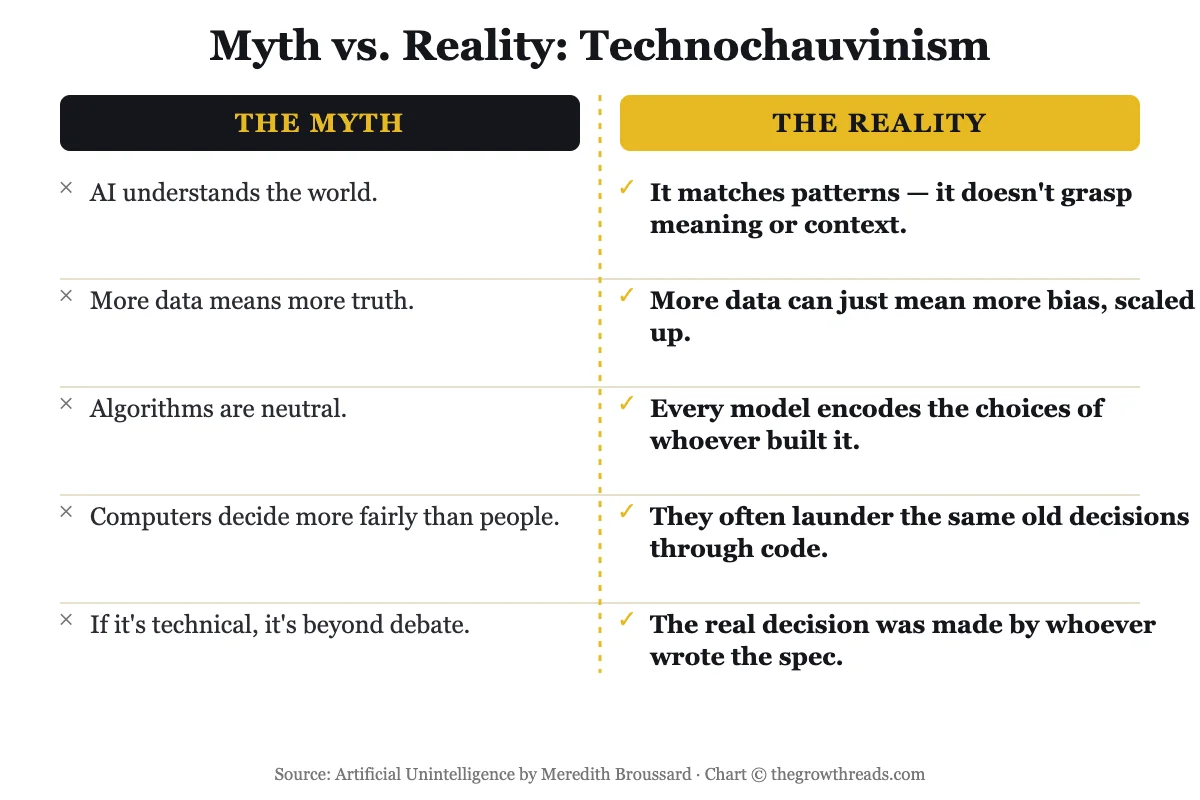
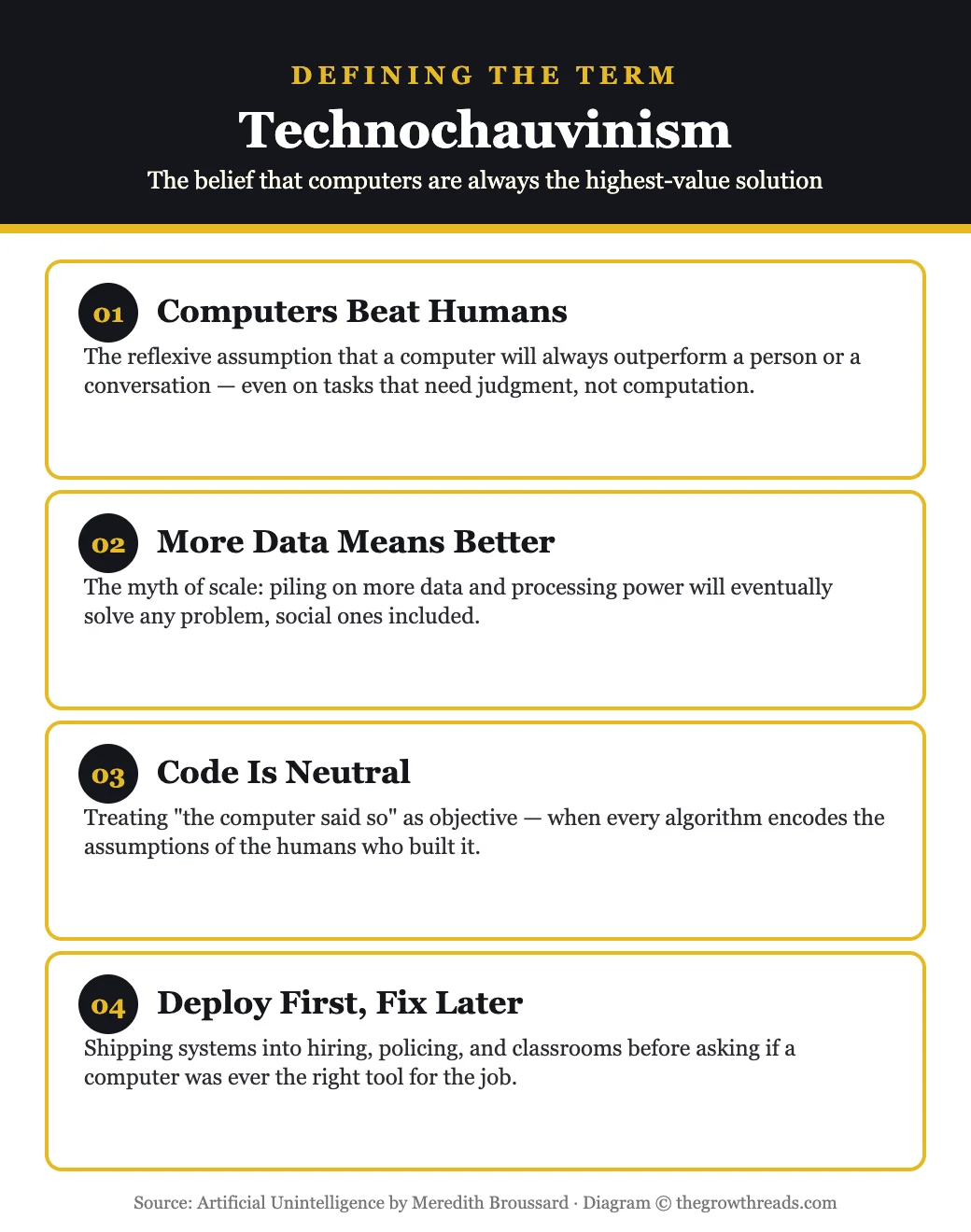
- Technochauvinism: the reflexive belief that a computer is always the highest-value solution, even for problems that are fundamentally social rather than computational.
- Computers are narrow specialists, not generalists: they excel at rule-bound tasks and still can’t replicate judgment, common sense, or social nuance.
- Self-driving cars hit a “long tail” problem: the ambiguous, split-second judgment calls of real streets resist being fully catalogued in any dataset.
- Facial recognition has historically been least accurate on the people most affected by it: error rates run far higher for women and darker-skinned people, since training sets skewed toward light-skinned men.
- Predictive policing can create feedback loops: a tool trained on historical arrests sends more patrols to already over-policed neighborhoods, producing more arrests the tool reads as confirmation.
- Hiring algorithms trained on past decisions tend to reproduce those decisions’ biases — and dress the repetition up as objective, data-driven screening.
- “The computer decided” is not a neutral statement. Every model encodes the assumptions and blind spots of the humans who built and trained it.
- Algorithmic accountability treats automated systems like any other powerful decision-maker: subject to audits, appeals, and public scrutiny, not exempted because they’re “technical.”
- Sometimes the right fix isn’t a better algorithm — it’s a policy change or funding for more people. Technochauvinism forecloses that option before anyone asks.
- Broussard writes as a practitioner, not a bystander: she builds software and teaches data journalism, which is why her skepticism carries weight.
What is Artificial Unintelligence about?
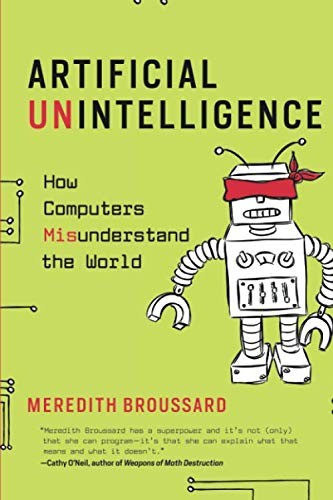
Artificial Unintelligence is data journalist Meredith Broussard’s case for healthy skepticism about computing, arguing that “technochauvinism” — the assumption that tech is always the best fix — leads institutions to deploy algorithms into hiring, policing, and education that quietly encode human bias while being presented as neutral and beyond debate.
About the author
Meredith Broussard is a data journalist, computer scientist, and associate professor at New York University’s Arthur L. Carter Journalism Institute, where she directs research examining how algorithms shape public life. Before moving into journalism and academia, she worked as a professional software developer, which gives her critique of the tech industry unusual authority: she isn’t arguing from outside a field she doesn’t understand — she’s a practitioner who built the kind of systems she now scrutinizes. Her work sits at the intersection of computer science, journalism, and public accountability, examining how automated decision-making touches everything from criminal justice to school admissions. She has become one of the most cited voices in algorithmic accountability reporting, training journalists to audit the software used to make consequential decisions about ordinary people’s lives. Explore all Meredith Broussard book summaries →
Key concepts at a glance
| Concept | What it means | Use it when |
|---|---|---|
| Technochauvinism | The reflexive belief that a tech solution is always the best solution, regardless of the problem | You reach for “there’s an app for that” before asking whether the problem needs one |
| Algorithmic accountability | Holding automated systems to the same scrutiny as any human decision-maker with real power | An algorithm affects someone’s job, loan, grade, or freedom |
| The objectivity myth | “The computer decided” sounds neutral, but reflects the choices of everyone who built and trained it | Someone cites a score as beyond question because it’s “just math” |
| Garbage in, garbage out | A model trained on biased historical data reproduces that bias, just faster and at greater scale | Evaluating whether a “data-driven” tool is actually fair, not just fast |
| Fairness-through-unawareness fallacy | Removing a category like race from a dataset doesn’t remove its effects, since correlated variables still carry the signal | A vendor claims their tool is unbiased because it doesn’t “see” a protected trait |
| The long tail of edge cases | Rare, ambiguous situations that resist being fully catalogued in any training dataset | Assessing claims a system is “basically solved” or “nearly there” |
| Public-interest technology | Building and auditing technology explicitly in service of the public good, not just speed | Evaluating whether a civic tech project actually served the people it claims to help |
Part 1: The Myth of Technochauvinism
Broussard opens by naming the belief system she spends the rest of the book dismantling: technochauvinism, the assumption — often unstated — that a technological solution is inherently superior to a human one, and that any problem, given enough data, is ultimately solvable by machine. It shows up in small ways (reaching for an app before asking whether the problem needs one) and consequential ones (replacing a caseworker’s judgment with a risk score). What makes the diagnosis land is where it comes from: Broussard isn’t a technology outsider recoiling at a field she doesn’t understand. She spent years as a working software developer before becoming a data journalist and professor, and her skepticism is hard-won — she knows exactly what code can and can’t do.
That insider vantage point reframes the argument. This isn’t a book arguing computers are bad, or programmers careless. It’s arguing that technochauvinism is a category error: treating computation as a universal solvent for problems that are, at bottom, about people, institutions, money, and power. A computer can sort, calculate, and pattern-match with superhuman speed. It cannot exercise judgment about a messy situation it has never encountered, or understand why a rule that works in 999 cases produces an absurd result in the thousandth. Broussard’s point isn’t that computers are worthless at these boundary cases — it’s that technochauvinism stops institutions from even asking where the boundary is.
TGR Note: Broussard’s diagnosis reads as a mirror image of Kevin Kelly’s optimism in The Inevitable. Where Kelly frames tech’s expansion as largely benign, Broussard asks the question he mostly skips: unstoppable for whom, at what cost? Reading them back to back is genuinely useful.
Part 2: How Computers Actually Work — and Where They Stop
Before explaining where computers fail, Broussard makes sure readers understand what a computer actually does, stripped of marketing language. At bottom, a computer executes explicit instructions using logic and arithmetic; a machine-learning model, however sophisticated, is a statistical pattern-matcher that finds correlations in training data and applies them to new inputs. Neither process involves anything resembling comprehension. A model can learn that certain pixel patterns correlate with “stop sign” with extraordinary reliability, without possessing any concept of what a stop sign means. That gap is where technochauvinism does its damage: institutions treat benchmark accuracy as equivalent to real-world comprehension, and deploy accordingly.
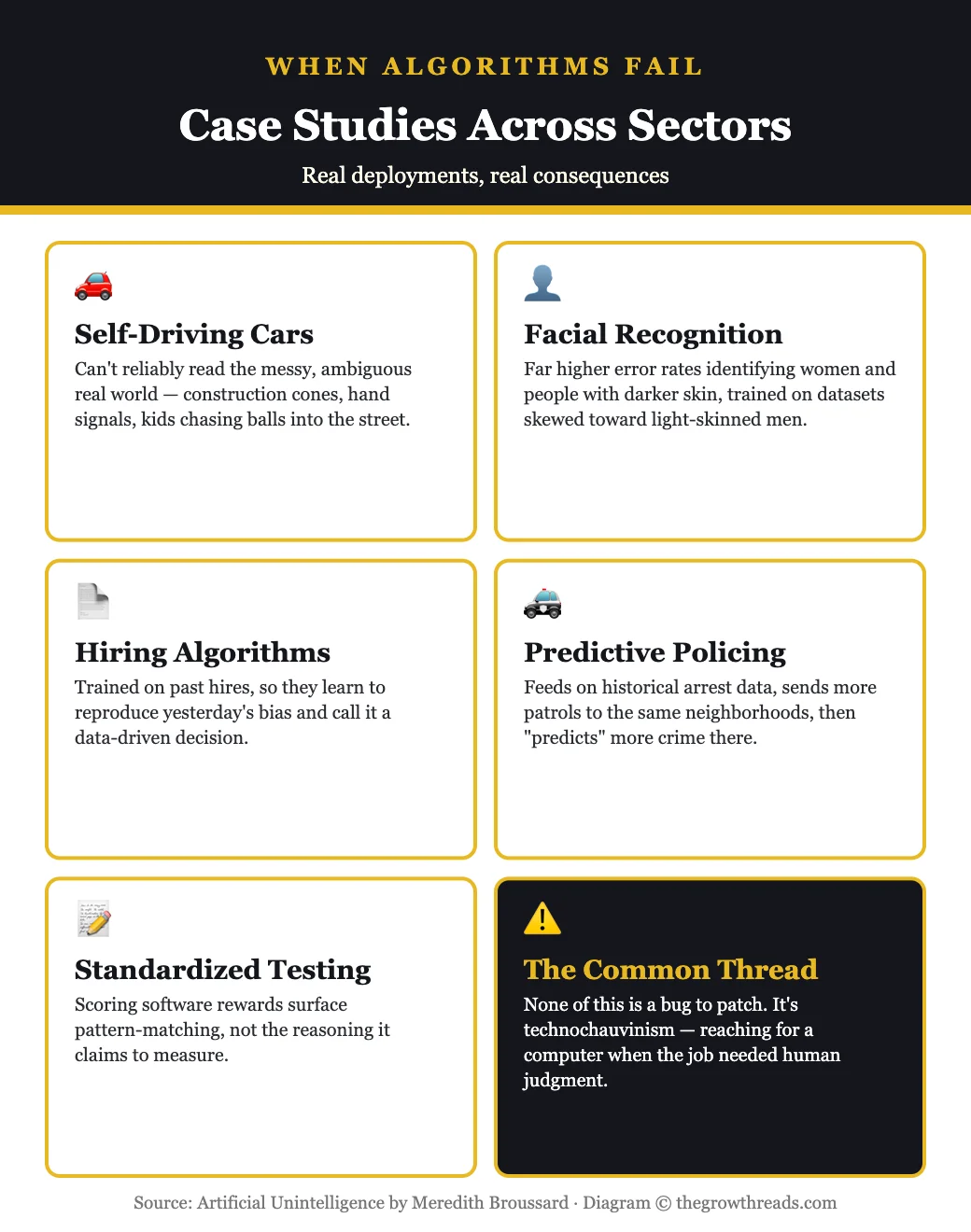
The self-driving car serves as her central case study. Autonomous vehicles perform remarkably well on the well-marked, rule-following majority of driving — precisely the situations easiest to represent in training data. What breaks them is the long tail: a police officer waving traffic through a red light, a construction zone with hand-drawn detour signs. Human drivers navigate these ambiguous, never-quite-the-same situations using common sense built from a lifetime of experience. No dataset, however large, fully catalogues the long tail, because it’s the set of things the system hasn’t seen before. Broussard’s point isn’t that self-driving cars are a bad idea forever — it’s that “full autonomy any year now” keeps underestimating how much of driving competence lives in exactly the situations hardest to train for.
This same structure — a computer confidently producing output that looks authoritative while quietly encoding a chain of human choices about what to measure and what counts as acceptable error — recurs throughout the systems institutions rely on. The infographic below traces that chain step by step, from the moment historical data is collected to the moment a decision is handed to a real person as though it came from nowhere in particular.
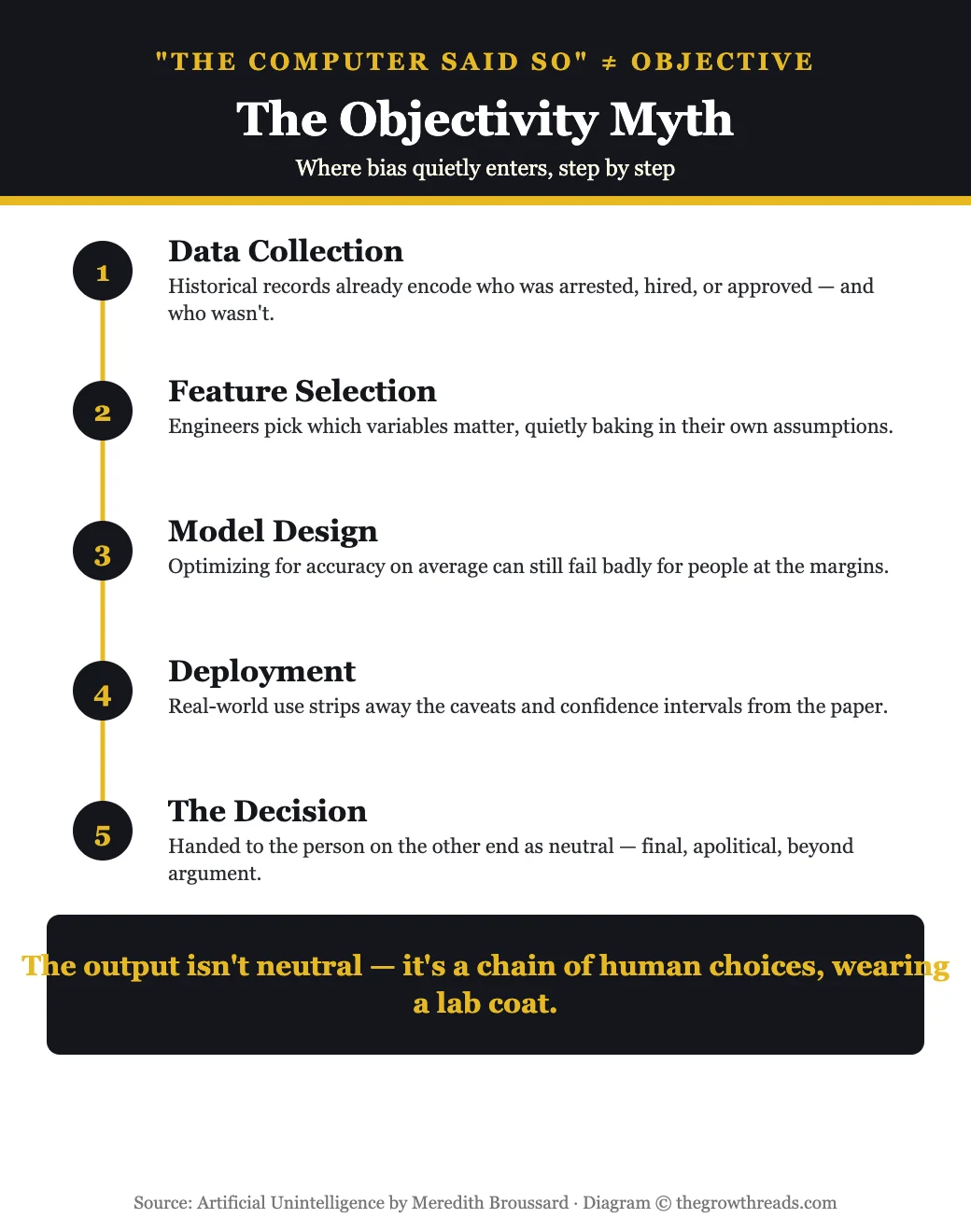
Once a reader can see that chain of choices, “the computer decided” stops sounding like the end of a conversation and starts sounding like the beginning of one.
Part 3: When Algorithms Fail — Real-World Case Studies
Broussard grounds her argument in specific, documented deployments where the stakes are not hypothetical. In criminal justice, predictive policing tools trained on historical arrest records send more patrols into neighborhoods that were already over-policed — producing more arrests there, which the system reads as confirmation, tightening a feedback loop about where police were already looking, not where crime is occurring. Facial recognition, evaluated across major vendors, has shown far higher error rates identifying women and darker-skinned people than light-skinned men — a direct consequence of skewed training data, deployed anyway into policing and identity verification.
In hiring, algorithms trained on a company’s past successful hires learn to favor candidates who resemble those hires, reproducing whatever demographic skew existed historically and calling it an objective screen because it’s “just pattern-matching.” In education, automated essay-scoring systems reward surface features — sentence length, vocabulary, transition phrases — without reliably measuring the reasoning they claim to assess, so students learn to write for the algorithm, not for understanding.
What unites these cases isn’t technical incompetence — the systems performed exactly as specified on their own accuracy metrics. What unites them is technochauvinism at the institutional level: a decision, made above the engineering team, that an algorithmic solution was worth deploying without asking whether the historical data was a fair foundation, or building in the audit that would catch a feedback loop before it calcified into policy.
TGR Note: These case studies sit right alongside Cathy O’Neil’s argument in Weapons of Math Destruction — O’Neil coined that term for exactly this pattern of opaque, self-reinforcing scoring systems. Reading both gives a fuller picture than either alone.
Part 4: Building Algorithmic Accountability
Broussard’s constructive answer to technochauvinism is algorithmic accountability: holding automated decision-making systems to the same scrutiny, transparency, and appeal rights as any other powerful institutional actor. Concretely, that means audits — someone outside the team that built a system checking its real-world error rates across different groups, not just aggregate accuracy. It means people affected by a score having a meaningful way to contest it, and journalists and regulators developing the literacy to interrogate these systems instead of taking a vendor’s claims at face value.
She’s careful to distinguish this from technophobia. The goal isn’t concluding algorithms should never be used — it’s insisting the decision to use one, and how it’s built and monitored, gets the same rigor as any other high-stakes institutional choice. Often, in the cases Broussard investigates, scrutiny reveals nobody had actually checked, and the “objective” system was quietly worse than the flawed process it replaced.
The book’s closing argument is a reframe, not a rejection: computers are one tool among many, good at some jobs and bad at others, and the discipline worth building — as an engineer, an institution, or a citizen encountering a score you didn’t ask for — is asking whether a problem is actually a computer problem before reaching for a computational fix.
TGR Note: For what it costs to build the AI systems Broussard audits — the mines, the labor, the footprint — pair this with Kate Crawford’s Atlas of AI. For a clearer technical picture of what AI can and can’t do, Melanie Mitchell’s Artificial Intelligence: A Guide for Thinking Humans is the natural next stop.
Who is Artificial Unintelligence best for — and who should read something else first?
This book is best for people who build, buy, deploy, or are subject to algorithmic systems: engineers and product managers who want a working vocabulary for the limits of what they’re shipping, journalists learning to interrogate a vendor’s accuracy claims, and policymakers deciding whether to adopt an automated tool. It’s equally valuable for the AI-curious general reader who wants a credible counterweight to hype-driven coverage — no engineering background required.
For the optimistic case on where computing is headed before the corrective, start with Kevin Kelly’s The Inevitable. For the deepest dive into algorithmic bias in criminal justice and hiring, go to Cathy O’Neil’s Weapons of Math Destruction. For AI’s economic infrastructure, Kate Crawford’s Atlas of AI is the better start.
Questions to reflect on
- Where in your own work or life have you reached for a technological fix before confirming the underlying problem was actually a computer problem?
- Think of a score or automated recommendation you’ve been shown recently — do you know what data trained it, or did you take “the algorithm decided” at face value?
- If an algorithmic system affecting you produced a decision you disagreed with, is there a real way to contest it — or does it function as a final answer?
- Which failure pattern in this summary (feedback loops, biased training data, surface pattern-matching) have you personally seen in a tool you use at work?
- What would “algorithmic accountability” thinking look like applied to a non-software decision process in your own organization?
🔥 Ready to build a healthier skepticism about tech?
Get the full book for the case studies, the technical detail, and Broussard’s complete argument for algorithmic accountability.
How to apply Artificial Unintelligence (7-day plan)
- Day 1: Write down one place you’ve reflexively reached for a tech solution. Ask honestly whether the problem was actually about people, process, or money instead.
- Day 2: Pick one algorithmic score you encounter regularly (a credit score, a spam filter, a content feed) and research what data likely trains it.
- Day 3: Read a product page claiming an AI tool is “unbiased,” and list every human decision hiding behind that claim.
- Day 4: If your workplace uses automated screening, ask whether there’s a documented appeal process for someone the system rejects incorrectly.
- Day 5: Practice explaining the difference between pattern-matching and understanding to someone else, using a concrete example like autocomplete or a spam filter.
- Day 6: Identify one decision in your organization that could reasonably be audited for fairness, and sketch what that audit would check.
- Day 7: Write a one-paragraph personal policy for when you will and won’t trust “the computer said so” going forward.
Frequently asked questions
What does “technochauvinism” mean in Artificial Unintelligence?
Technochauvinism is Meredith Broussard’s term for the reflexive belief that a technological solution is always the highest-value one, and that enough data and computing power can eventually solve any problem, including social ones. It’s less a reasoned argument than an unexamined default — the assumption that a computer’s answer is automatically more rigorous than a human one, even untested. Broussard traces how this default shapes decisions in hiring, policing, and education, often without anyone consciously choosing it.
Is Artificial Unintelligence anti-technology?
No — Broussard’s goal is using computing appropriately, not rejecting it. As a former professional developer, she writes from inside the field, not against it. Her target is technochauvinism: deploying algorithms into consequential decisions without checking whether a computer was the right tool, and without the audits that would catch failures early. Her proposal, algorithmic accountability, assumes technology keeps being used — just held to real scrutiny.
What real-world examples of algorithmic bias does the book cover?
Broussard walks through documented cases across sectors: facial recognition with higher error rates for women and darker-skinned people, predictive policing that creates feedback loops by over-patrolling already over-policed neighborhoods, hiring algorithms that reproduce past patterns, and automated scoring in education that rewards surface writing features over genuine comprehension. Some specifics have been debated as tools evolved since publication; the core mechanisms remain the book’s most durable contribution.
What is “algorithmic accountability,” and how is it different from just criticizing AI?
Algorithmic accountability is Broussard’s proposed practice, not just a critique: treating automated systems the way an institution treats any powerful actor, with independent audits of real-world error rates, a process for contesting an incorrect decision, and enough technical literacy among journalists and regulators to interrogate a vendor’s claims. It assumes algorithms will keep being deployed — the goal is making sure deployment survives real scrutiny.
Why do self-driving cars come up so often in this book?
Broussard uses self-driving cars as her clearest illustration of the gap between pattern-matching and genuine understanding. Autonomous vehicles handle the well-marked, rule-following majority of driving well, because that’s easiest to represent in training data. What breaks them is the “long tail” of ambiguous situations — a hand signal, an unusual obstacle — that resist being fully catalogued no matter how much data is collected. It’s a concrete example of a pattern that recurs throughout the book in less visible software systems.
Do I need a technical or programming background to understand this book?
No. Broussard writes for a general audience and explains the mechanics of computing and machine learning in plain language, using concrete examples rather than code or math. Her technical background keeps the explanations accurate, but they’re pitched at readers who want to ask good questions, not build a system themselves.
How does Artificial Unintelligence compare to Weapons of Math Destruction?
The two books pair naturally. O’Neil, a mathematician, focuses tightly on how opaque, high-stakes scoring systems in credit, insurance, and criminal justice cause harm at scale. Broussard, a technologist, casts a wider net across the culture of technochauvinism itself and spends more time on the technical mechanics of how these systems get built. Reading both gives a fuller picture than either alone.
Related summaries
- Weapons of Math Destruction by Cathy O’Neil — the deepest dive into algorithmic bias in credit, insurance, and criminal justice.
- Atlas of AI by Kate Crawford — the hidden labor, resource, and environmental costs behind every AI system.
- Artificial Intelligence: A Guide for Thinking Humans by Melanie Mitchell — a clear technical picture of what today’s AI can and cannot do.
- The Inevitable by Kevin Kelly — the optimistic counterpoint on where computing’s expansion is headed.
- See all Best AI & Technology Books →
How we analyze books: every TGR summary is built from a full read of the source material, cross-checked against the author’s published interviews and essays, and structured around practical application rather than just recap. Read our full methodology.
Related Technology Summaries
Rebooting AI Summary & Review: Why Deep Learning Alone Won’t Get Us to Trustworthy Machines
The Age of AI Summary & Review: A New Philosophical Rupture
The Alignment Problem Summary & Review: Why AI Does What You Say, Not What You Meant
The Book of Why Summary & Review: How to Think in Causes, Not Just Correlations
Weapons of Math Destruction Summary & Review: How Algorithms Quietly Punish the Poor