

★★★★★ 4.4/5 — A gripping, human-scale history of how a handful of stubborn researchers turned a discredited idea into the technology running the world’s biggest companies.
Best for: Readers who want the origin story behind today’s AI boom, told through the people who lived it.
Reading time: ~9 hours to read cover to cover · ~40 min for this guide
Difficulty to apply: Light — this is narrative history more than a how-to, but it reframes how you read AI news.
Genius Makers in one minute
For decades, almost nobody believed neural networks would work — except a small, stubborn group of researchers who kept at it anyway. New York Times reporter Cade Metz tells the story of how deep learning went from an academic backwater, dismissed by most of the AI field, to the technology at the center of Google, Facebook, and the broader tech industry.
It’s a character-driven history — Geoffrey Hinton, Yann LeCun, Yoshua Bengio, Demis Hassabis, and the researchers around them — that traces the field’s decades in the wilderness, its sudden vindication, the corporate acquisition wars that followed, and the ethical reckoning that began once these systems started shaping real people’s lives.
Metz is particularly good at capturing the social dynamics of academic rejection — the conference papers turned away, the funding proposals dismissed, the sense among true believers that they were pursuing something everyone else considered a dead end. That texture matters, because it explains why the eventual vindication landed with such force: this wasn’t a field that gradually gained acceptance, it was one that flipped almost overnight once the results became undeniable.
Key takeaways
- Neural networks spent decades out of favor: most of the AI field considered them a dead end for most of the 1970s-1990s.
- A small group kept the field alive: Hinton, LeCun, Bengio, and a handful of others kept publishing and teaching through the lean years.
- 2012’s ImageNet moment changed everything: a neural network’s dramatic performance jump stunned the computer vision world overnight.
- Acquisitions moved fast once belief shifted: Google acquired Hinton’s tiny startup within days of meeting him.
- Competition accelerated the field: Facebook built an AI research lab from scratch largely to avoid falling behind Google.
- AlphaGo was a cultural turning point: beating a Go world champion in 2016 made deep learning a mainstream story, not just a research one.
- Talent became the scarcest resource: a handful of researchers commanded enormous leverage and pay as companies raced to hire them.
- Success surfaced new problems fast: as these systems scaled, bias, misuse, and surveillance concerns followed closely behind.
- Some pioneers became the loudest critics: researchers who built the technology started warning about its risks.
- Power concentrated quickly: a small number of companies ended up controlling most of the field’s talent and resources.
What is Genius Makers about?
Genius Makers tells the human story of deep learning’s rise — from a discredited academic idea kept alive by a handful of researchers to the technology at the core of Google, Facebook, and the modern tech industry. Cade Metz traces the personalities, rivalries, and ethical reckonings behind AI’s transformation from obscurity to global influence.
About the author
Cade Metz is a technology journalist who spent over a decade covering AI and the tech industry, including years at Wired and The New York Times. He conducted hundreds of interviews with the researchers, executives, and engineers at the center of deep learning’s rise, giving Genius Makers a level of access and narrative detail rare in technology books. His reporting background shows in the book’s structure — it reads like investigative journalism woven into a decades-spanning character study, not a technical textbook. Explore all Cade Metz book summaries →
Key concepts at a glance
| Concept | What it means | Use it when |
|---|---|---|
| AI winter | A period when funding and interest in AI research collapsed | Understanding why neural networks were dismissed for decades |
| Backpropagation | The training algorithm that let neural networks actually learn | Understanding the technical breakthrough behind deep learning |
| ImageNet moment | The 2012 competition where a neural net’s performance stunned the field | Marking when deep learning became mainstream |
| Deep learning mafia | The small, tight-knit group of researchers who kept the field alive | Understanding how a niche idea survived institutional rejection |
| Talent war | Corporate competition to acquire AI researchers and their startups | Understanding how quickly incentives shifted once belief changed |
| AI ethics reckoning | The wave of concern over bias, misuse, and power once AI scaled | Evaluating a company’s AI deployment for hidden risks |
Part 1: The believers who wouldn’t quit
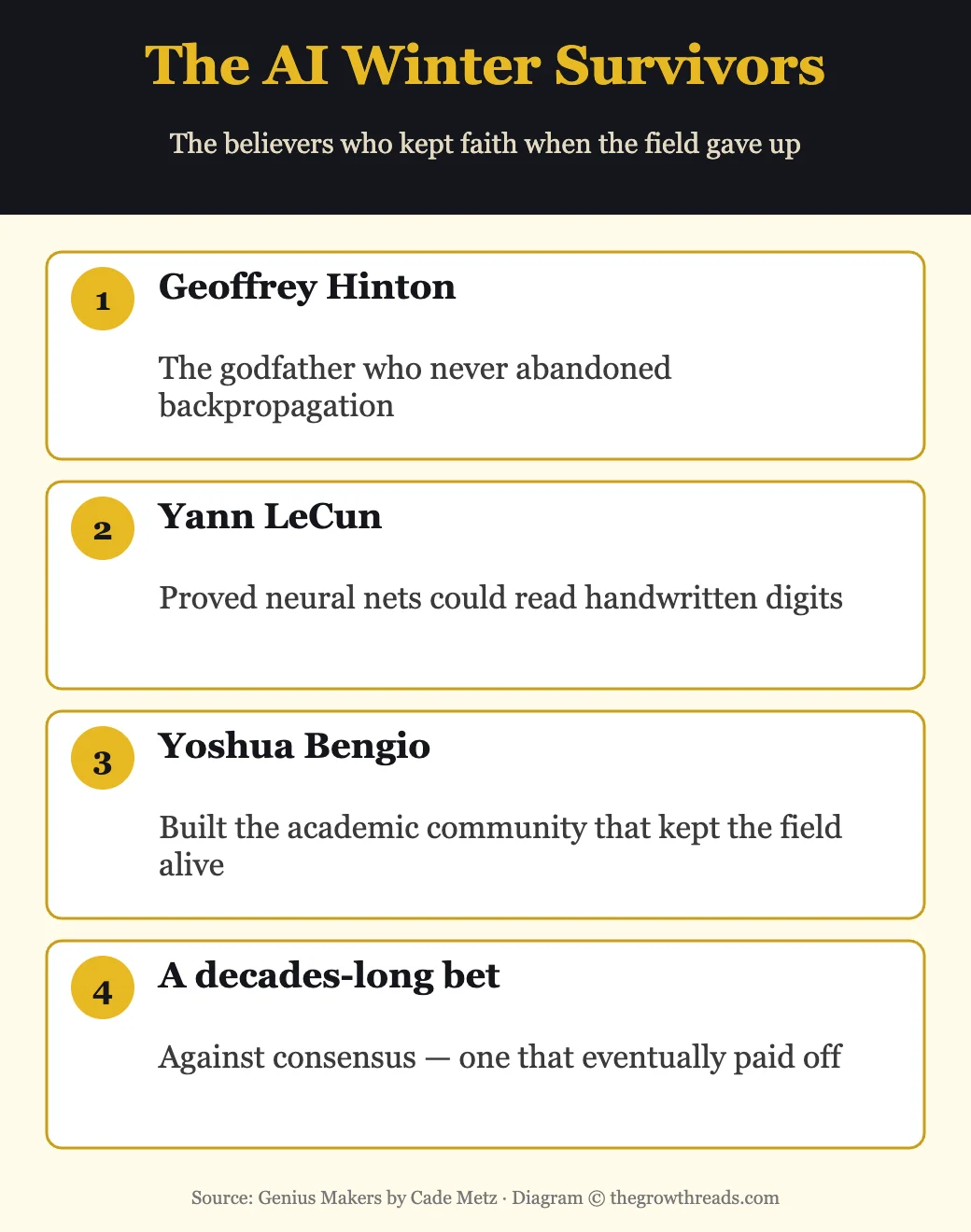
For most of the late twentieth century, neural networks were considered a scientific dead end. The dominant approach to AI relied on hand-coded rules and logic, and most researchers who tried the neural network approach — modeling learning loosely on the brain — hit walls that seemed insurmountable. Funding dried up. Careers stalled. Metz traces how a small group, centered on Geoffrey Hinton, refused to abandon the idea, publishing in relative obscurity for decades while the rest of the field moved on.
What kept them going wasn’t certainty that they were right — it was a stubborn intuition that the field had given up too early. Hinton, along with Yann LeCun and Yoshua Bengio, became known (half-affectionately) as part of a small circle keeping backpropagation and neural networks alive through what the field openly called an “AI winter.” Their persistence, chronicled here in granular, human detail, is the book’s emotional core: a bet against consensus that took over two decades to pay off.
One detail Metz returns to repeatedly is how personally disorienting this transition was for the researchers themselves. People who had built careers around being the outsiders, the ones defending an unpopular idea, suddenly found themselves running major corporate labs with enormous budgets and public expectations. That whiplash — from academic obscurity to being courted by the world’s most powerful companies within a few short years — is as much a part of the story as the technology itself.
Part 2: The overnight empire
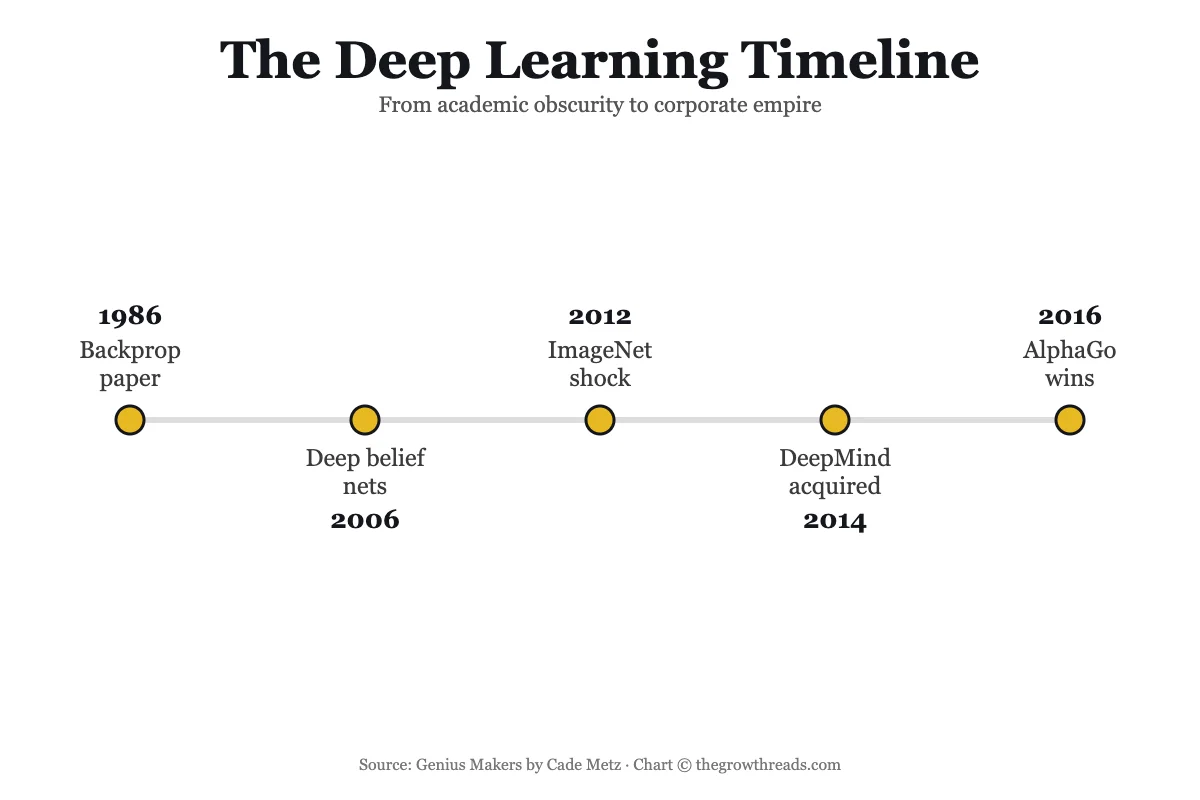
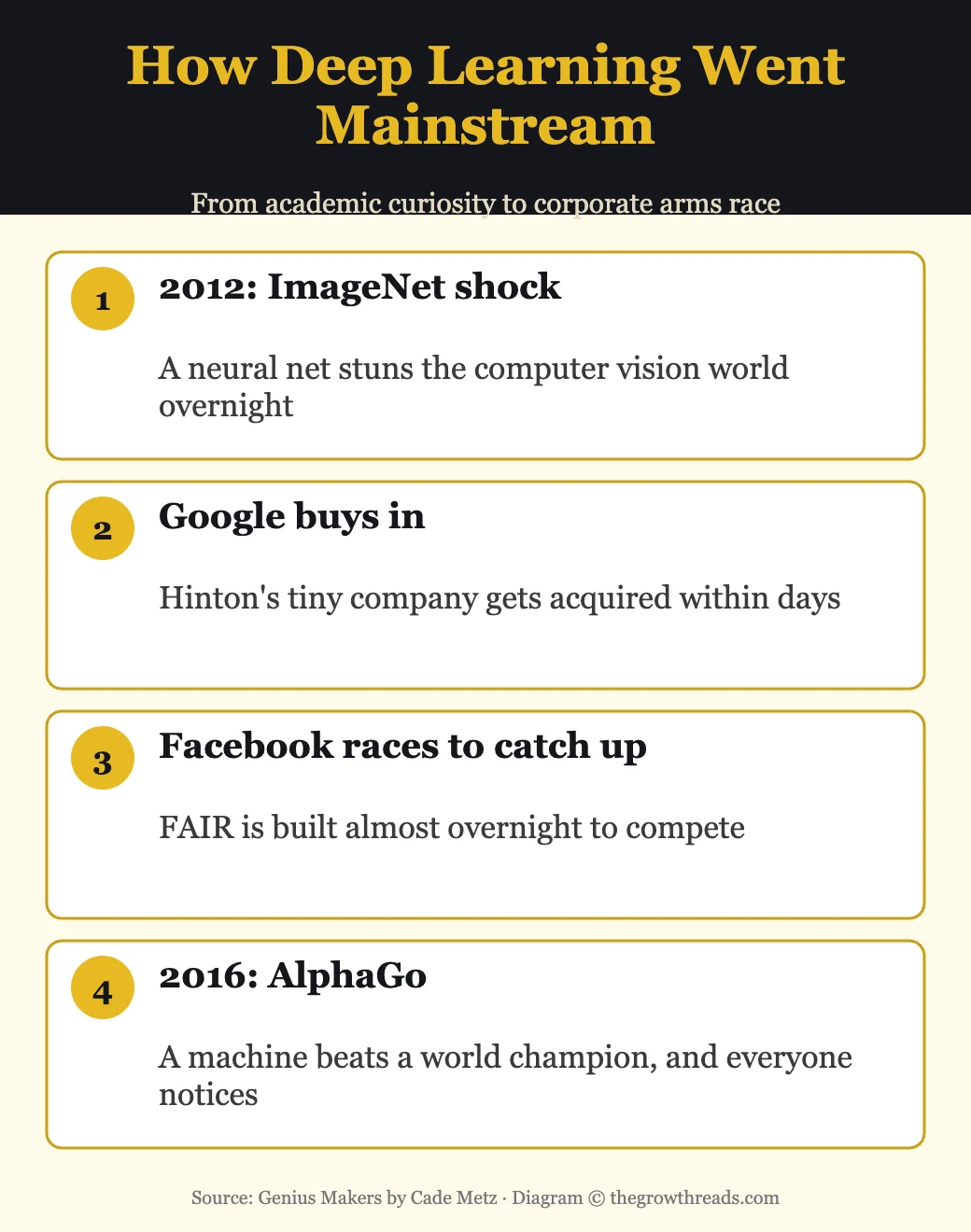
The 2012 ImageNet competition is the book’s pivot point. A neural network built by Hinton’s team outperformed every rival approach by such a wide margin that the entire computer vision field took notice within days. What followed was startlingly fast: Google acquired Hinton’s tiny company almost immediately, and a corporate arms race for AI talent kicked into gear. Facebook, worried about falling behind, built an entire AI research lab from a standing start specifically to compete.
Metz captures this transition vividly — researchers who had spent careers publishing to small, skeptical academic audiences suddenly found themselves the subject of bidding wars between the world’s richest companies. The 2016 AlphaGo match, where a DeepMind system beat a Go world champion, became the moment deep learning broke into mainstream public consciousness, transforming it from an industry story into a global one.
Part 3: The reckoning
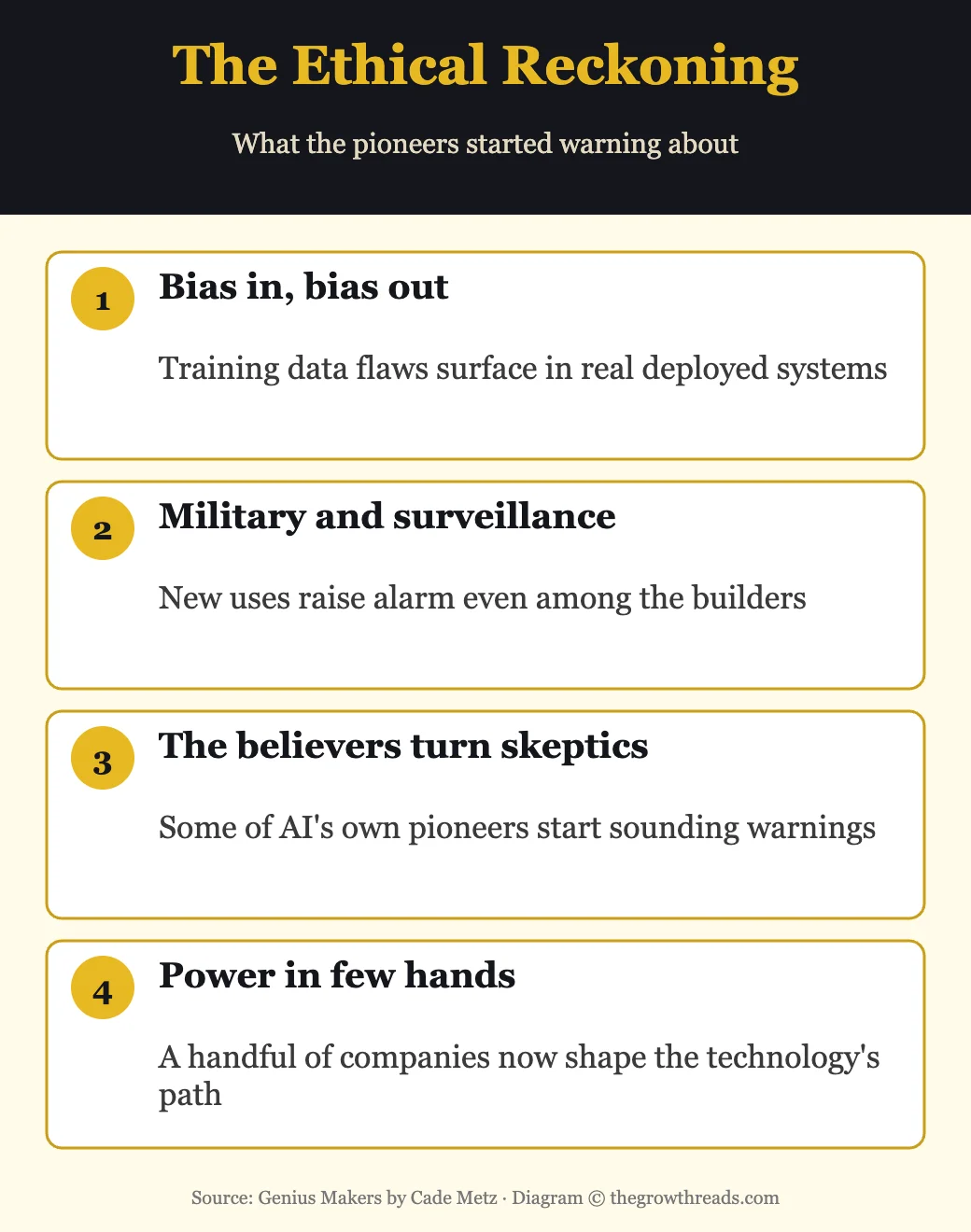
The book’s final act shifts tone. As deep learning systems moved from research labs into real products — facial recognition, content recommendation, hiring tools, surveillance systems — their flaws stopped being academic and started affecting real people. Metz documents how bias baked into training data surfaced in deployed systems, how military and surveillance applications raised alarm even among engineers who had built the underlying technology, and how some of the field’s own pioneers became its most prominent public critics.
This closing section resists easy resolution. Metz doesn’t argue that deep learning was a mistake, or that its pioneers were wrong to pursue it — the book’s own first two acts make clear how remarkable the achievement was. Instead, he shows a field grappling honestly, sometimes for the first time, with the fact that a technology built by a small, well-intentioned group had ended up concentrated in a handful of enormously powerful companies, with consequences none of the original researchers had fully anticipated.
Who is Genius Makers best for — and who should read something else first?
This book is the right choice if you want the human, narrative history behind today’s AI headlines — who built it, why, and what it cost them personally and professionally. It’s especially rewarding for readers who like character-driven nonfiction (in the vein of business or science journalism) rather than technical or how-to books.
If you want a more forward-looking, structural analysis of who controls AI today rather than the history of how we got here, read The Big Nine instead. If you’re more interested in the technical mechanics of how neural networks work and where they still fall short, start with Rebooting AI.
Questions to reflect on
- What’s an idea in your own field that most people dismissed for years before it turned out to be right — and what kept its believers going?
- How does knowing the messy, human, often accidental history behind deep learning change how you read confident claims about where AI is headed next?
- Where do you see the tension Metz describes — between remarkable technical achievement and its unintended consequences — playing out in a technology you use today?
- If you were one of the original AI winter researchers, how would you feel watching the technology you nursed through decades of rejection become this powerful this fast?
- What responsibility, if any, do you think today’s AI pioneers have for anticipating misuse of tools they build for good reasons?
🔥 Ready for the real story behind the AI boom?
Grab Genius Makers and meet the stubborn researchers who built deep learning before anyone believed in it.
How to apply Genius Makers (7-day plan)
- Day 1 — Map today’s AI landscape. List which companies you interact with daily that are direct descendants of the story this book tells.
- Day 2 — Study one pioneer. Read a short profile or interview with Geoffrey Hinton, Yann LeCun, or Yoshua Bengio to see how they talk about the field today.
- Day 3 — Trace a technology backward. Pick one AI feature you use and trace it back to the research lineage this book describes.
- Day 4 — Read one AI ethics story critically. Find a recent story about AI bias or misuse and connect it to the reckoning described in Part 3.
- Day 5 — Reflect on persistence. Journal about an idea you’ve stuck with despite skepticism from others, using the AI winter researchers as inspiration.
- Day 6 — Talk it through. Explain the ImageNet moment to a colleague or friend and why it mattered so much.
- Day 7 — Form your own view. Write a paragraph on whether you think today’s AI power concentration is a natural consequence of the technology or a choice that could have gone differently.
Frequently asked questions
Do I need a technical background to understand Genius Makers?
No. Cade Metz writes as a journalist for a general audience, and the book is structured around people and events rather than algorithms. Technical concepts are explained in accessible terms as they come up in the narrative.
Is this book more about the technology or the people?
Primarily the people. Genius Makers is character-driven narrative nonfiction — the technology matters, but the book’s core is the personalities, rivalries, and personal stakes of the researchers who built it.
Does the book cover recent developments like large language models?
The book focuses on deep learning’s rise through roughly 2020, centered on the ImageNet moment, corporate acquisitions, and AlphaGo. It predates the most recent wave of large language models, but the historical foundation it covers directly explains how that later wave became possible.
Is Genius Makers critical of the tech companies involved?
It’s balanced rather than one-sided. Metz documents genuine achievement and genuine concern side by side, letting readers see both the remarkable technical accomplishment and its complicated consequences without heavy editorializing.
How is this different from other AI history books?
Its access is unusual — Metz interviewed hundreds of the actual researchers and executives involved, giving the book first-hand detail and direct quotes rather than secondhand summary. That reporting depth is what sets it apart.
Who are the main people featured in the book?
Geoffrey Hinton, Yann LeCun, and Yoshua Bengio anchor the early chapters, with Demis Hassabis and the DeepMind story featuring heavily in the middle sections, alongside executives and researchers from Google, Facebook, and other major labs.
How long does it take to read Genius Makers?
Most readers finish it in about nine hours of straight reading. Its narrative structure makes it easy to read in longer sessions, as each chapter tends to follow a compelling story arc.
Related summaries
- The Big Nine — the structural analysis of who controls AI today, following on from this book’s history.
- The Alignment Problem — a deeper technical look at the bias and fairness issues this book raises.
- Rebooting AI — the technical mechanics behind the neural networks this book’s pioneers built.
- More Technology book summaries
Related Technology Summaries
Hooked Summary & Review: The Habit Model Behind Every App You Can’t Put Down
Talking to Robots by David Ewing Duncan Summary & Review
The Algorithmic Leader Summary & Review
The Fourth Industrial Revolution Summary & Review: How Every Industry Is Converging
The New Breed Summary & Review: What Animals Teach Us About Living with Robots