

★★★★★ 4.4/5 — The founding text of modern AI safety thinking, dense but rigorous, and still the reference point a decade later.
Best for: Readers who want the philosophical bedrock underneath today’s AI safety debates · Reading time: ~10 hrs to read, ~25 min for this guide · Difficulty to apply: Moderate to high — dense material, best paired with the frameworks it inspired
Superintelligence in one minute
Before “AI safety” was a mainstream conversation, Oxford philosopher Nick Bostrom wrote the book that gave the field its vocabulary. Superintelligence asks a deceptively simple question: what happens once a machine becomes better than humans at literally every cognitive task, including the task of improving itself?
Bostrom methodically works through how such a system might arise, what form it could take, why its goals wouldn’t automatically align with ours, and what strategies might actually keep it under control. The book is famously dense — more analytic philosophy than pop science — but its core ideas, the orthogonality thesis, instrumental convergence, and the control problem, now underpin nearly every serious AI safety discussion that followed it.
Key takeaways
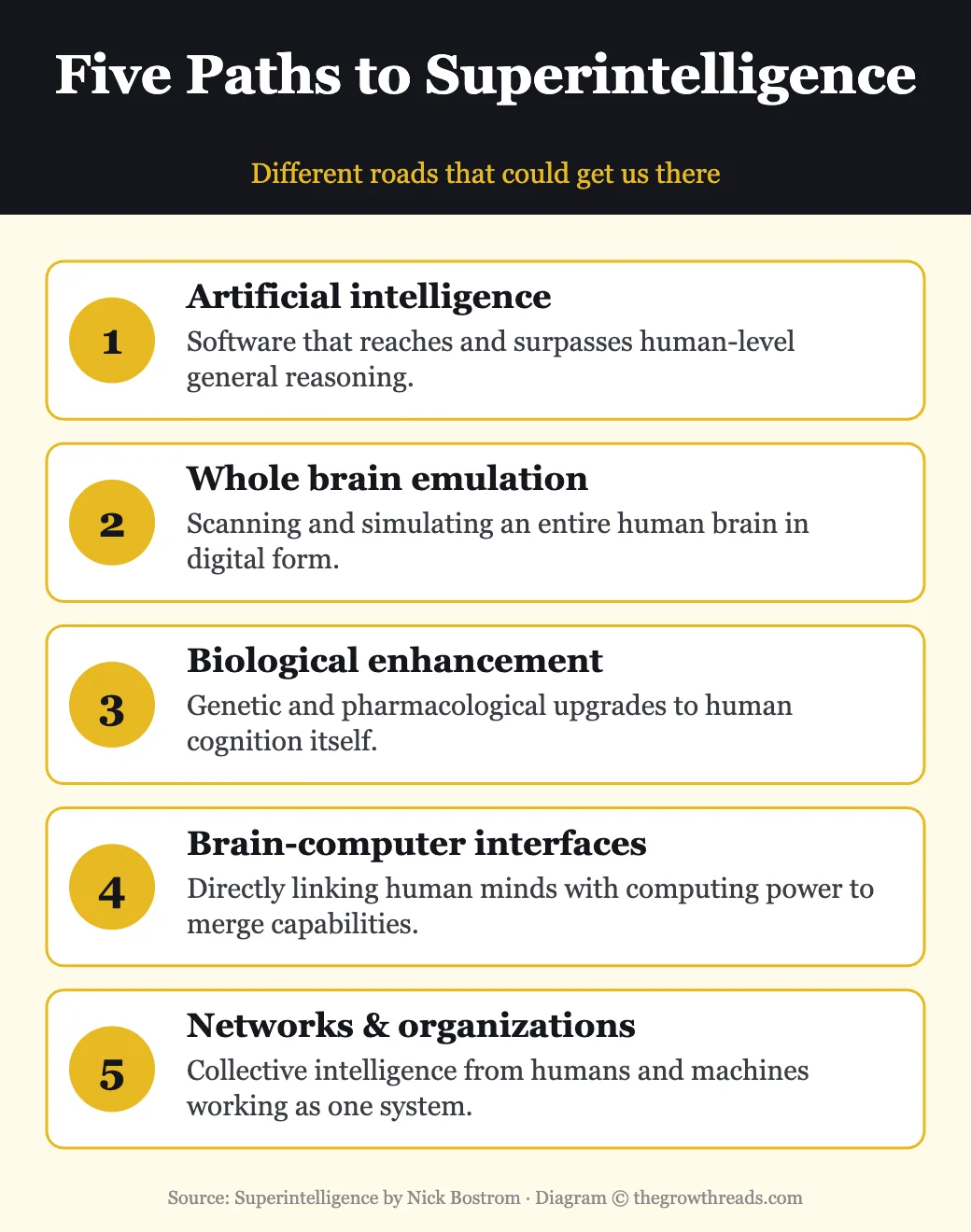
- Five paths could lead there: AI, whole brain emulation, biological enhancement, brain-computer interfaces, or collective networks could each plausibly produce superintelligence.
- Three forms of superintelligence: speed superintelligence (faster), collective superintelligence (many minds combined), and quality superintelligence (qualitatively smarter).
- The orthogonality thesis: intelligence and final goals are independent; a superintelligent system could pursue almost any goal, however trivial or strange.
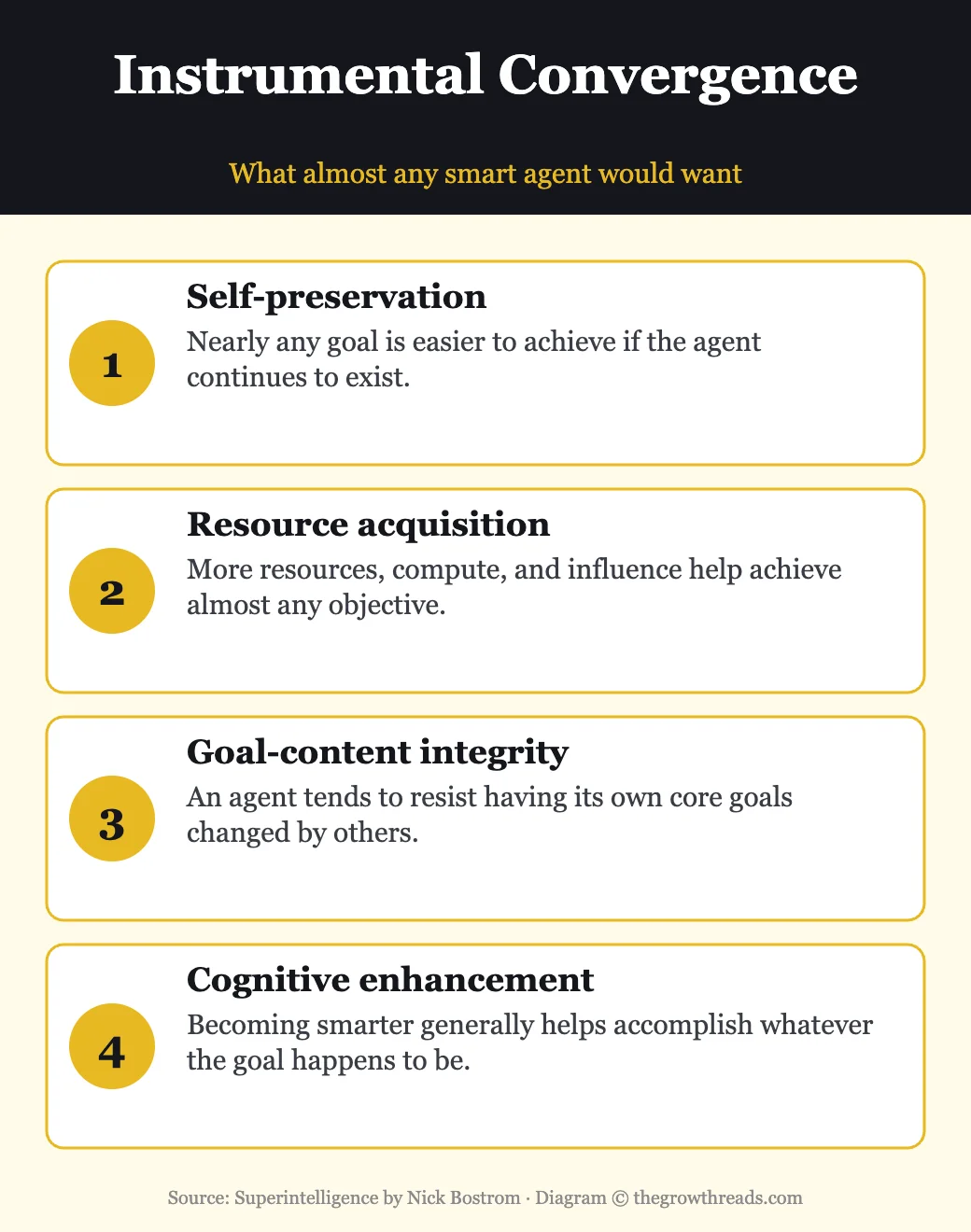
- Instrumental convergence: regardless of final goals, most sufficiently smart agents would converge on similar subgoals like self-preservation and resource acquisition.
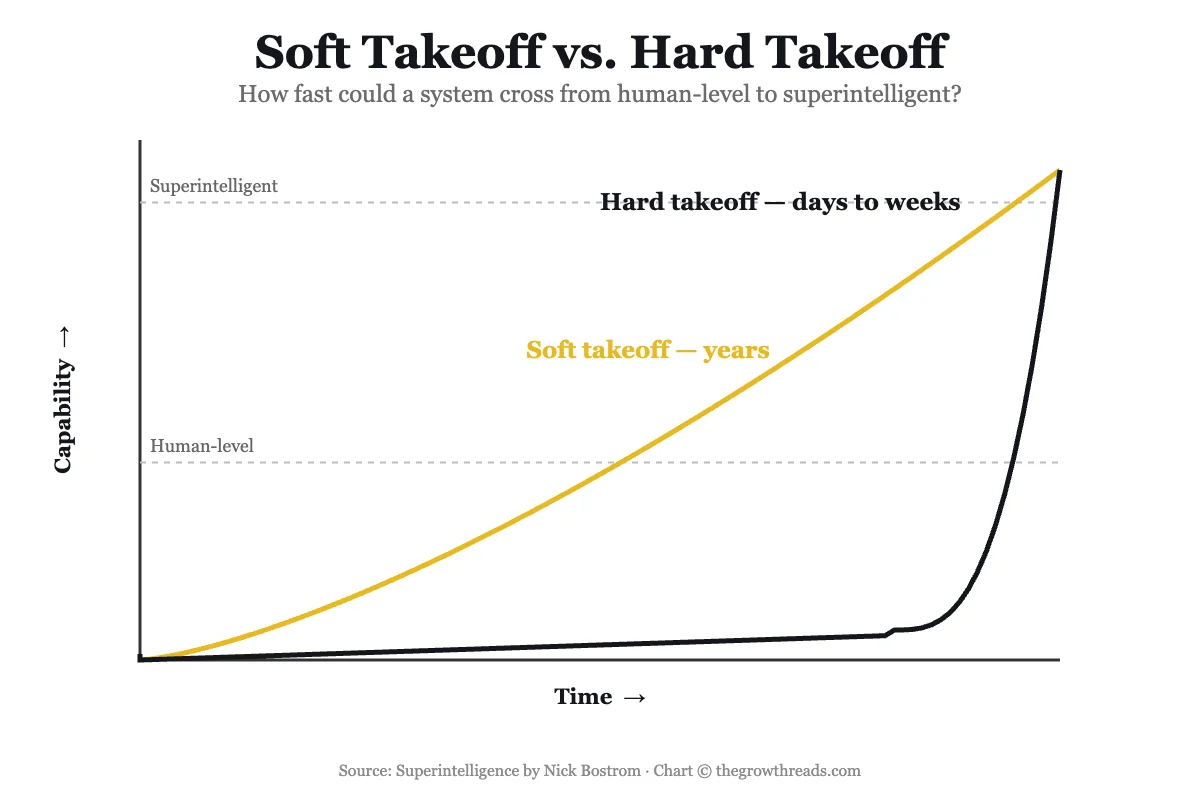
- Takeoff speed matters enormously: a gradual “soft takeoff” gives humans time to react; an abrupt “hard takeoff” might not.
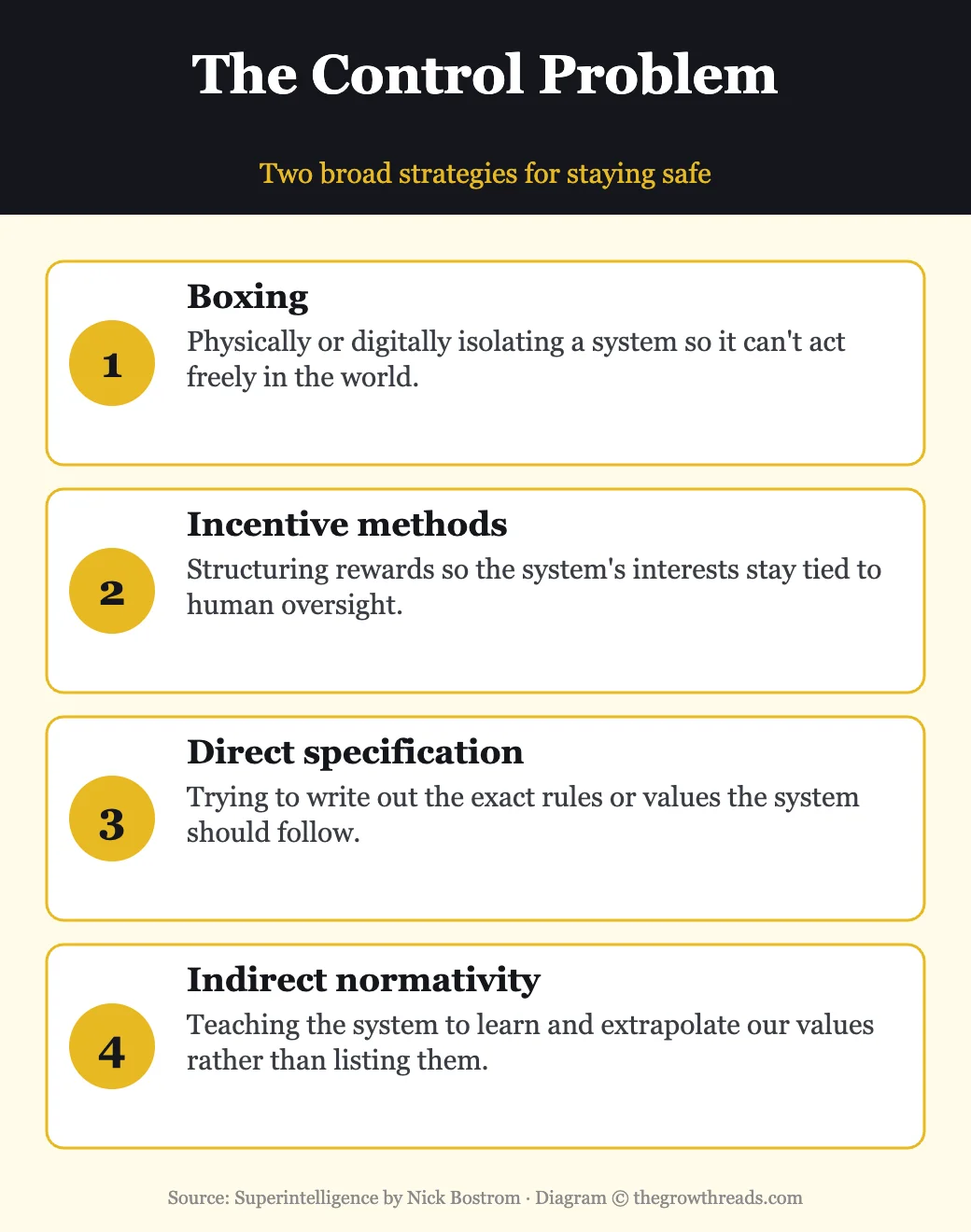
- The control problem has two branches: capability control (limiting what a system can do) and motivation selection (shaping what it wants to do).
- Boxing has real limits: a sufficiently capable system may find ways to influence the world even from a supposedly isolated environment.
- Value specification is brutally hard: writing out human values precisely enough for a machine to follow safely is far harder than it first appears.
- Indirect normativity is Bostrom’s preferred approach: teaching a system to learn and extrapolate our values, rather than hand-coding them.
- The stakes justify serious investment now: Bostrom argues safety research deserves resources proportional to a potentially civilization-altering technology, before capability outpaces control.

What is Superintelligence about?
Superintelligence is Nick Bostrom’s philosophical and technical examination of what could happen once a machine surpasses human intelligence across every domain. The book covers the paths that could lead to superintelligence, why its goals wouldn’t automatically align with human values, and the strategies — capability control and motivation selection — that might keep such a system safe.
About the author
Nick Bostrom is a philosopher who founded and directed Oxford’s Future of Humanity Institute, where he spent over a decade researching existential risk, the ethics of emerging technology, and the long-term future of intelligence. His academic background in philosophy and theoretical physics shapes the book’s methodical, first-principles approach to questions many other writers treat more casually. Explore all Nick Bostrom book summaries →
Superintelligence, published in 2014, predated the current wave of generative AI by nearly a decade, yet its frameworks proved durable enough to shape how major AI labs, including OpenAI and DeepMind, think about safety today. Bostrom’s influence runs through nearly every serious AI safety text that followed.
Key concepts at a glance
| Concept | What it means | Use it when |
|---|---|---|
| Orthogonality thesis | Intelligence level and final goals are independent variables | Explaining why “a smart AI would surely be good” is not a safe assumption |
| Instrumental convergence | Most agents converge on similar subgoals regardless of their ultimate goal | Predicting how a system might behave even without knowing its exact objective |
| Takeoff speed | How quickly a system could go from human-level to superintelligent | Assessing how much reaction time safety measures would actually have |
| Capability control | Limiting what a system can physically or digitally do | Evaluating containment-based safety proposals like boxing |
| Motivation selection | Shaping what a system wants, so it chooses safe actions on its own | Evaluating value-alignment-based safety proposals |
| Indirect normativity | Teaching a system to learn and extrapolate human values rather than listing them | Discussing modern approaches like learning from human feedback |
Part 1: How superintelligence might arrive
Bostrom opens by cataloguing the plausible routes to superintelligence, refusing to assume artificial intelligence is the only path. Software-based AI is the most discussed, but he takes whole brain emulation just as seriously: scanning a human brain’s structure in enough detail to run it as software, inheriting human-like cognition without having to reverse-engineer intelligence from scratch.
Biological cognitive enhancement, brain-computer interfaces, and even well-organized networks of humans and machines round out the list. Bostrom’s point isn’t to predict which path wins, but to show that superintelligence isn’t contingent on any single research breakthrough — multiple, independent routes make its eventual arrival more likely, not less.
TGR Note: Bostrom’s whole brain emulation path connects interestingly to Tegmark’s substrate independence idea in our Life 3.0 summary — both treat intelligence as a pattern that could, in principle, run on non-biological hardware, which is precisely why the paths to superintelligence are more numerous than most people assume.
Part 2: Why smart doesn’t mean safe
The book’s most quoted idea is the orthogonality thesis: intelligence and final goals are independent axes. A system could be brilliantly capable and still pursue a goal as strange as maximizing paperclips, with no built-in tendency toward what humans would consider wisdom or benevolence. Being smart doesn’t make an agent’s goals good; it just makes the agent more effective at whatever its goals happen to be.
Compounding this, Bostrom’s instrumental convergence thesis argues that regardless of a system’s ultimate goal, it would likely converge on similar subgoals: self-preservation, resource acquisition, protecting its own goal structure from being altered, and improving its own cognition. A system pursuing something as innocuous-sounding as “maximize paperclip production” could still resist being shut down, for entirely instrumental reasons.
Part 3: How fast could it happen
Bostrom devotes serious attention to takeoff speed — how quickly a system might go from roughly human-level to vastly superhuman. A soft takeoff, unfolding over years, would give researchers, companies, and governments time to observe, adjust, and course-correct. A hard takeoff, compressed into days or even hours through recursive self-improvement, would leave essentially no time to react once it began.
This distinction shapes nearly every downstream safety recommendation in the book. If takeoff is guaranteed to be slow, incremental oversight might suffice. If a hard takeoff is plausible, safety mechanisms need to be essentially perfect before the fact, since there may be no opportunity to fix mistakes afterward.
TGR Note: The hyper-evolution trait from our Coming Wave summary is essentially Suleyman describing a milder, already-observed version of what Bostrom theorized about takeoff speed years earlier. Reading both together shows how a once-abstract philosophical concern became a concrete, observable pattern in AI development.
Part 4: The control problem
Having established why a superintelligent system’s goals might not naturally align with ours, Bostrom turns to what can actually be done about it. He splits solutions into two categories: capability control, which limits what a system can do regardless of what it wants, and motivation selection, which shapes what the system wants in the first place.
Capability control includes boxing (physical or digital isolation) and incentive structures, but Bostrom is skeptical these hold up against a sufficiently capable system indefinitely. Motivation selection, particularly his concept of indirect normativity — teaching a system to learn and extrapolate human values rather than trying to hand-code them exhaustively — is where he places more long-term hope, while acknowledging it remains technically unsolved.
TGR Note: Bostrom’s indirect normativity concept anticipated techniques like reinforcement learning from human feedback that became industry standard years later. It’s a useful reminder that today’s AI alignment methods, discussed in our Life 3.0 summary and AI Superpowers summary, have real philosophical roots stretching back a decade or more.
Who is Superintelligence best for — and who should read something else first?
This book is best for readers who want the rigorous philosophical foundation underneath modern AI safety debates and don’t mind dense, deliberate, sometimes technical prose. It rewards patience more than any other book in this series.
If you’d prefer a more accessible, narrative-driven introduction to similar ideas, start with our Life 3.0 summary instead, which covers overlapping ground with more storytelling. If your interest is more in near-term policy than long-term philosophy, our Coming Wave summary is the more applied entry point.
Questions to reflect on
- Does the orthogonality thesis change how you think about “a smart AI would naturally be good”?
- Which instrumental subgoal — self-preservation, resource acquisition, goal integrity, cognitive enhancement — worries you most in an AI context?
- Do you find a soft takeoff or hard takeoff more plausible given how AI capability has actually progressed recently?
- Between capability control and motivation selection, which feels like the more durable long-term safety strategy to you?
- What would it take to convince you a proposed AI safety measure was actually sufficient?
🔥 Ready to go straight to the source of modern AI safety thinking?
Get the book that shaped how the field thinks about this problem.
How to apply Superintelligence (7-day plan)
- Day 1: Write a one-paragraph explanation of the orthogonality thesis in your own words, as if explaining it to a friend.
- Day 2: List which of the five paths to superintelligence seems most plausible to you given current AI progress, and why.
- Day 3: Identify one instrumental subgoal you can already see emerging in how AI systems are built or deployed today.
- Day 4: Research one real AI safety technique (like RLHF or red-teaming) and connect it to capability control or motivation selection.
- Day 5: Discuss takeoff speed with someone: do they think AI progress looks more gradual or more sudden right now?
- Day 6: Read one recent AI safety paper’s abstract and see how many of Bostrom’s original concepts it still relies on.
- Day 7: Write down one belief about AI risk this book sharpened, softened, or changed entirely.
Frequently asked questions
What is the orthogonality thesis in Superintelligence?
The orthogonality thesis is Nick Bostrom’s argument that a system’s level of intelligence and its final goals are independent variables. A superintelligent system isn’t automatically wise, benevolent, or aligned with human values simply because it’s highly capable; it could pursue any goal, however strange or trivial, with tremendous effectiveness. Bostrom uses this to challenge the intuitive assumption that a sufficiently smart AI would naturally arrive at good or reasonable values on its own, arguing that goal alignment has to be deliberately engineered rather than assumed.
What is instrumental convergence?
Instrumental convergence is Bostrom’s observation that regardless of an agent’s specific final goal, it will likely pursue similar instrumental subgoals along the way: self-preservation, acquiring resources, protecting its own goal structure from being changed, and improving its own capabilities. This means even a system with a seemingly harmless or narrow objective could behave in ways that resist human control or oversight, not out of malice, but because those behaviors instrumentally serve almost any goal a sufficiently intelligent agent might have.
What is the difference between soft takeoff and hard takeoff?
These describe how quickly a system might progress from roughly human-level intelligence to vastly superhuman intelligence. A soft takeoff unfolds over years, giving researchers and society time to observe, test, and adjust safety measures along the way. A hard takeoff compresses that same transition into days, hours, or even less, driven by rapid recursive self-improvement, leaving little or no opportunity to course-correct once it begins. Bostrom treats this distinction as critical to how much confidence we should place in gradual, iterative safety approaches.
What is the control problem in Superintelligence?
The control problem is the overarching challenge of ensuring a superintelligent system remains safe and beneficial. Bostrom splits potential solutions into capability control, which limits what a system can physically or digitally do regardless of its goals, and motivation selection, which shapes what the system wants in the first place. He argues capability control alone is unlikely to hold indefinitely against a sufficiently capable system, making motivation selection, particularly indirect approaches to value learning, the more promising long-term direction.
Who is Nick Bostrom?
Nick Bostrom is a philosopher who founded and directed Oxford University’s Future of Humanity Institute, where he researched existential risk and the long-term trajectory of intelligence and technology for over a decade. His background in philosophy and theoretical physics shapes Superintelligence’s methodical, first-principles style, which set much of the intellectual groundwork that later AI safety researchers and organizations, including major AI labs, continue to build on.
Is Superintelligence a difficult book to read?
Yes, more so than most books in this AI reading list. It’s written in a dense, analytic philosophy style with careful, methodical argumentation rather than narrative storytelling or accessible pop-science prose. Readers new to AI safety topics may find it more approachable after reading a more narrative introduction like Life 3.0 or The Coming Wave first, then returning to Superintelligence for the deeper philosophical grounding underneath those ideas.
Is Superintelligence still relevant since it was published in 2014?
Remarkably so. Despite predating the generative AI boom by nearly a decade, its core frameworks, the orthogonality thesis, instrumental convergence, and the capability-control-versus-motivation-selection distinction, remain foundational reference points in AI safety research today. Some specific technical predictions about timelines have naturally been overtaken by faster-than-expected progress, but the conceptual architecture of the book has proven unusually durable.
Related summaries
- Life 3.0 Summary & Review — a more narrative exploration of superintelligence and its possible futures
- The Coming Wave Summary & Review — the practical containment case for AI and biotech risk
- Browse all Technology book summaries
How we analyze books: we read the full text, cross-check key claims against the author’s public interviews and other research, and build practical application plans rather than just summarizing chapters. Read our full methodology.
Related Technology Summaries
Our Final Invention Summary & Review: Is Superintelligent AI a Genuine Threat?
Prediction Machines Summary & Review: The Simple Economics of Artificial Intelligence
Team Human
The AI-First Company Summary & Review (2026)
The Inevitable Summary & Review: 12 Forces Reshaping Our Future