

★★★★☆ 4.4/5 — Neff’s research-backed case that treating yourself with the kindness you’d offer a friend is a measurable, learnable skill — and a far more stable foundation for wellbeing than self-esteem.
Best for: harsh self-critics, perfectionists, and anyone who’s ever assumed being hard on themselves is what keeps them motivated · Reading time: ~7 hrs (this guide: ~15 min) · Difficulty to apply: Moderate — the ideas are simple, unlearning years of self-criticism takes sustained practice
Self-Compassion in one minute
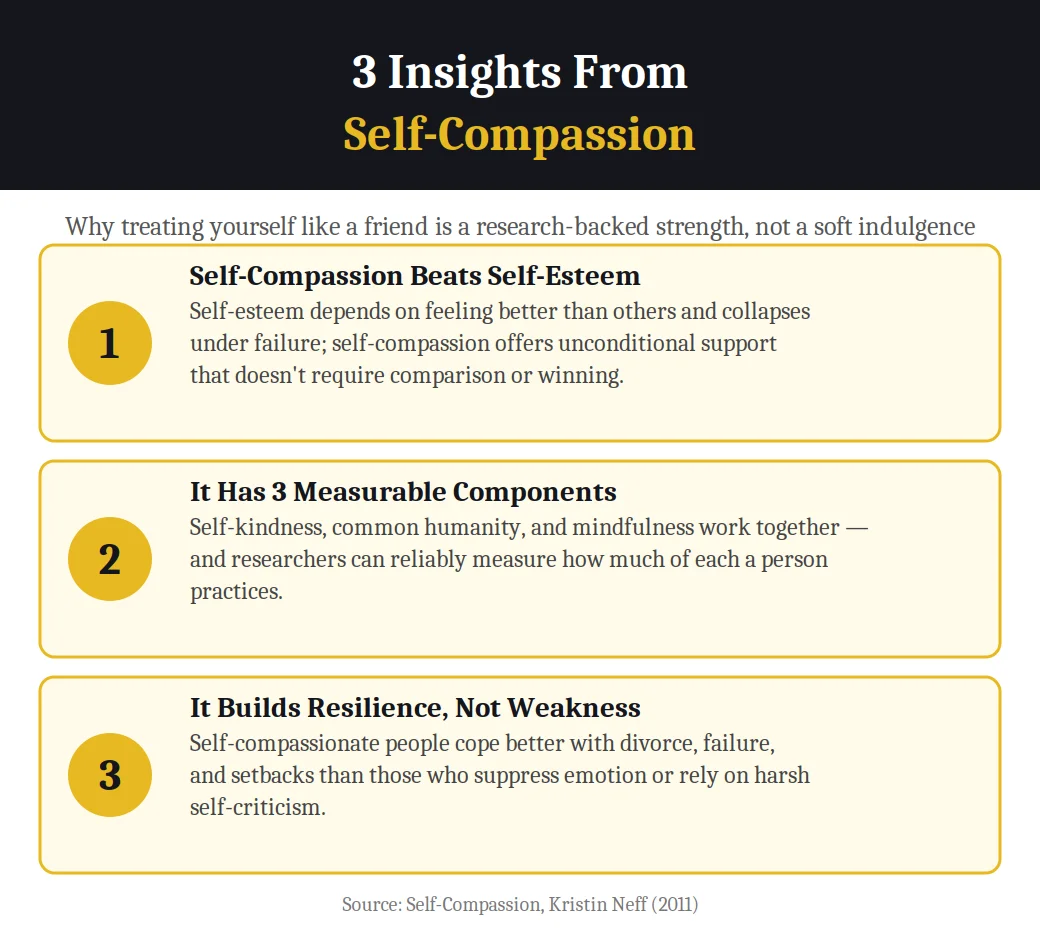
Treating yourself with the same kindness you’d offer a good friend isn’t self-indulgence — it’s one of the most powerful, well-researched sources of resilience available to us. Kristin Neff’s 2011 book draws on the research program she pioneered as a psychologist at the University of Texas at Austin, where she developed the first validated measure of self-compassion after finding no adequate tool existed. Neff argues that self-compassion rests on three components working together — self-kindness instead of self-judgment, common humanity instead of isolation, and mindfulness instead of over-identification with painful thoughts — and that this combination offers a healthier, more stable foundation for wellbeing than self-esteem, which depends on comparing favorably to others and collapses the moment you fail. Drawing on both her research and her own life, Neff systematically dismantles the common fears that self-compassion is weak, self-indulgent, or bad for motivation.
Key takeaways
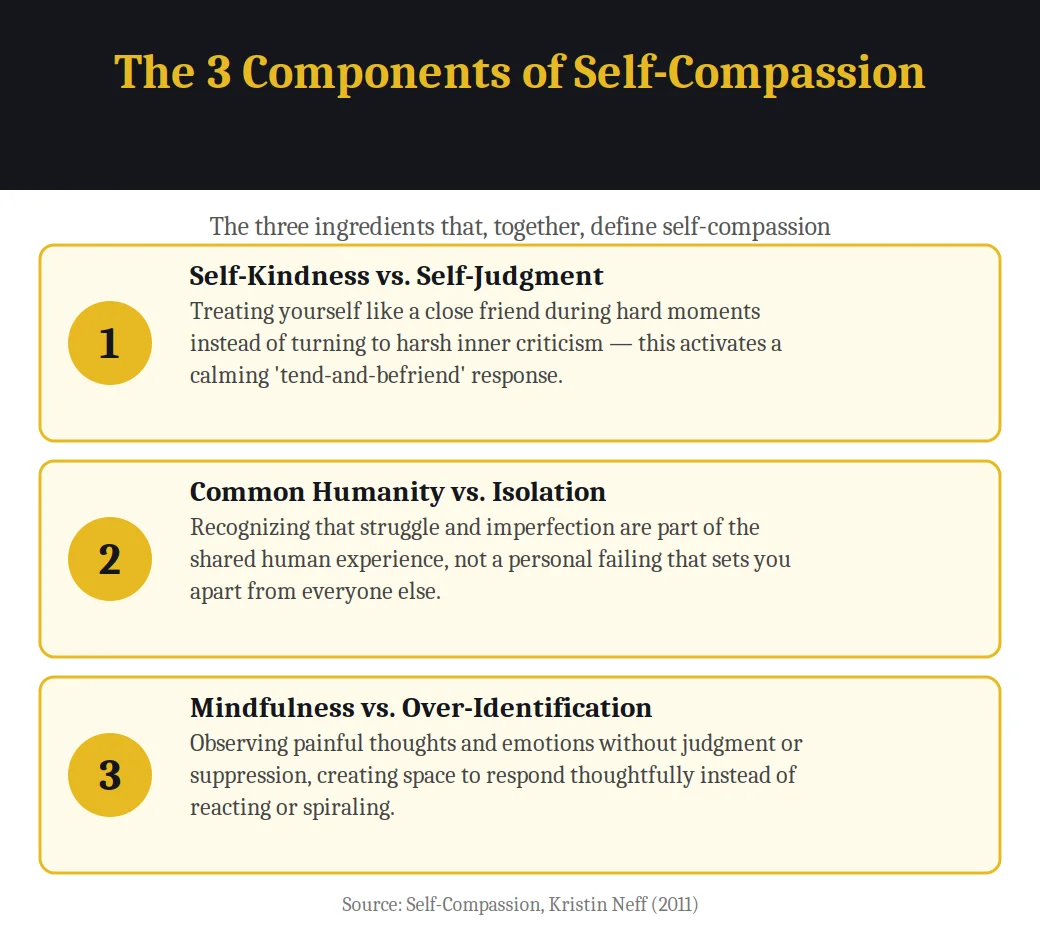
- Self-compassion has three measurable components: self-kindness, common humanity, and mindfulness combine to form a psychological stance researchers can reliably assess using Neff’s Self-Compassion Scale.
- Self-kindness activates a calming physiological response: treating yourself gently during hard moments engages a “tend-and-befriend” response associated with oxytocin release, rather than the threat response triggered by self-criticism.
- Common humanity turns shame into connection: recognizing that struggle and imperfection are part of being human, not evidence of personal failure, reduces the isolation that makes suffering worse.
- Mindfulness creates space to respond instead of react: observing painful emotions without suppressing or exaggerating them lets you choose a thoughtful response rather than spiraling into rumination.
- Self-esteem is conditional; self-compassion isn’t: self-esteem requires feeling better than others and is vulnerable to failure and comparison, while self-compassion remains available regardless of how you’re performing.
- Self-compassion isn’t self-pity: research shows self-compassionate people actually ruminate less and report fewer symptoms of anxiety and depression than people who feel sorry for themselves.
- Self-compassion isn’t weakness: studies of people going through divorce found that self-compassionate individuals coped and recovered better than those who suppressed their emotions.
- Self-compassion doesn’t undermine motivation: research by Breines and Chen found self-compassionate people showed greater accountability and commitment to behavioral change than harsh self-critics.
- Self-compassion isn’t selfish: because self-criticism consumes emotional bandwidth, self-kindness actually frees up more capacity to genuinely support other people.
What is Self-Compassion about?
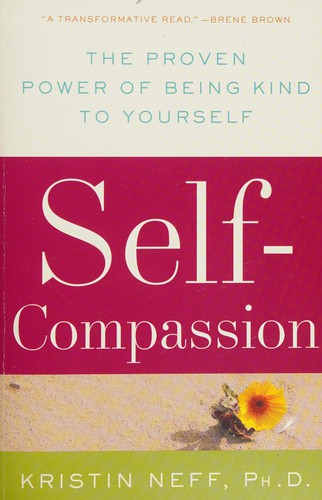
Self-Compassion is psychologist Kristin Neff’s argument that treating yourself with kindness during struggle is a measurable, learnable psychological skill — not a vague feel-good notion — and a healthier foundation for wellbeing than self-esteem. Drawing on the research program she pioneered, including the Self-Compassion Scale she developed to formally study the concept, Neff lays out three components that combine to form self-compassion: self-kindness, common humanity, and mindfulness. The book systematically addresses common fears about the concept, using research to show that self-compassion doesn’t produce self-pity, weakness, complacency, narcissism, or selfishness — it produces the opposite of each.
About the author
Kristin Neff is an associate professor of educational psychology at the University of Texas at Austin and one of the world’s foremost researchers on self-compassion. In the early 2000s, finding no existing psychological measure for the concept, she developed the Self-Compassion Scale, now the standard research tool used across hundreds of studies worldwide. Her 2011 book brought this research to a general audience, and she later co-founded the Mindful Self-Compassion program with Christopher Germer, an eight-week course now taught internationally, and co-authored The Mindful Self-Compassion Workbook. Explore all Kristin Neff book summaries →
Key concepts at a glance
| Concept | What it means | Use it when |
|---|---|---|
| Self-kindness | Treating yourself like a close friend during hard moments instead of turning to harsh self-criticism | You’ve made a mistake or are struggling and your instinct is to attack yourself |
| Common humanity | Recognizing that struggle and imperfection are part of the shared human experience | You feel isolated or singled out by a failure or hardship |
| Mindfulness | Observing painful thoughts and feelings without suppressing or over-identifying with them | You’re at risk of spiraling into rumination or reacting impulsively |
| Self-compassion vs. self-esteem | Self-compassion is unconditional; self-esteem depends on comparison and performance | You’re deciding what to base your sense of self-worth on |
| The Self-Compassion Scale | A validated research tool measuring self-kindness, common humanity, and mindfulness | You want an evidence-based way to assess your own level of self-compassion |
Part 1: Self-kindness versus self-judgment
Neff opens with the component most people associate with self-compassion: self-kindness, or treating yourself the way you’d treat a good friend going through a hard time. Most people extend far more warmth, patience, and understanding to others than to themselves, reserving a harsh inner critic for their own mistakes that they would never use on someone they cared about. Neff’s research shows that self-kindness engages a calming, affiliative physiological response — associated with oxytocin release — in contrast to the threat response triggered by self-criticism, which keeps the body in a state of chronic, low-grade stress.
TGR Note: This connects directly to Feeling Good‘s cognitive-behavioral techniques for catching and correcting harsh, distorted self-talk — both books treat the inner critic as something to actively counter rather than passively accept as accurate.
Part 2: Common humanity versus isolation
The second component reframes suffering itself. When something goes wrong, the instinctive feeling is often that you’re uniquely flawed or singled out — as if everyone else is managing fine while you alone are struggling. Neff argues this sense of isolation is what turns ordinary difficulty into shame. Common humanity replaces that isolating story with the recognition that imperfection, failure, and hardship are simply part of being human, shared by everyone, which transforms a private source of shame into a point of connection with other people rather than a wedge separating you from them.
TGR Note: Common humanity pairs naturally with Daring Greatly‘s argument that shame thrives on secrecy and silence — both books treat openly naming a shared struggle as the first step toward defusing it.
Part 3: Mindfulness versus over-identification
The third component is mindfulness: observing painful thoughts and emotions clearly, without either suppressing them or becoming completely consumed by them. Neff distinguishes this from both extremes — pretending you’re fine when you’re not, and spiraling so deeply into a difficult emotion that it becomes your entire identity in the moment. Mindfulness creates just enough space between you and the painful experience to respond to it thoughtfully, rather than reacting on autopilot or ruminating indefinitely.
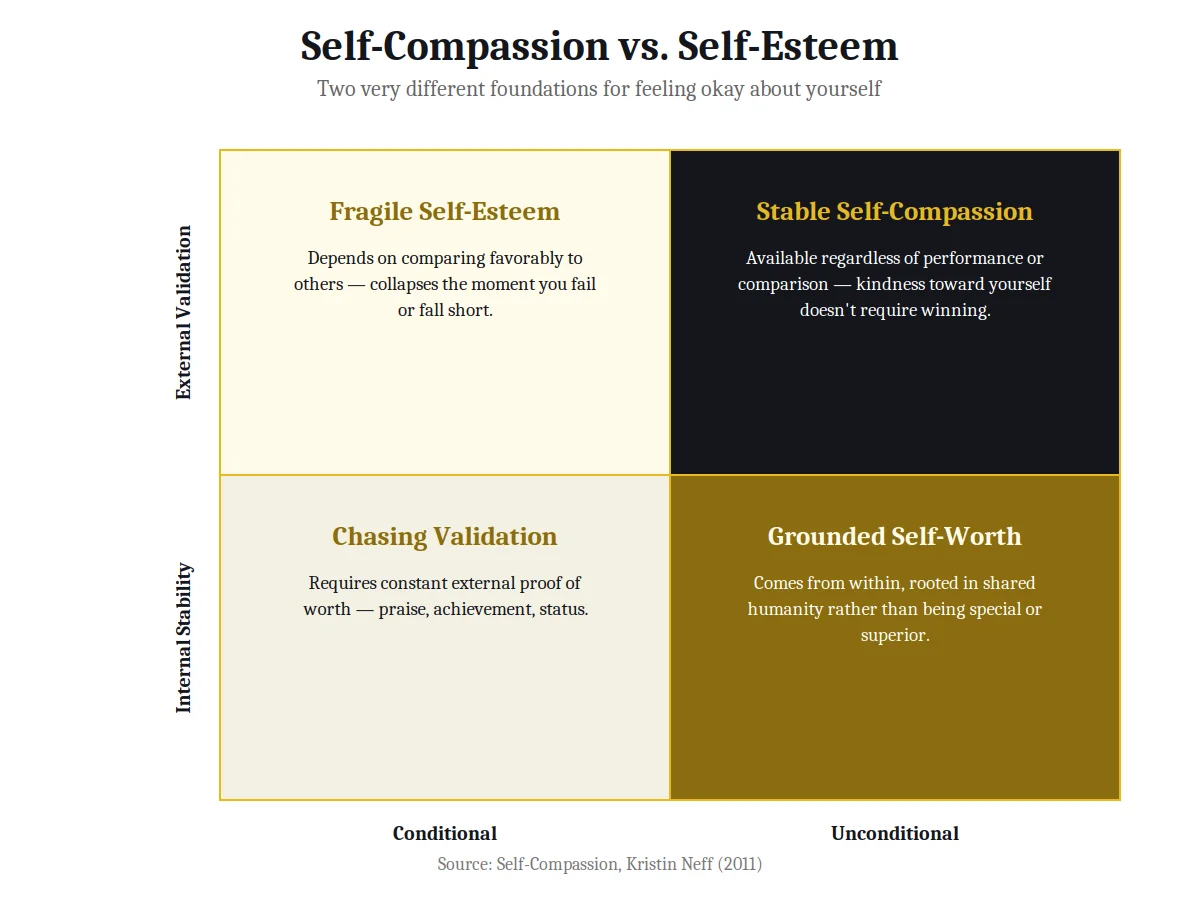
Together, the three components explain why Neff argues self-compassion is a more stable foundation for wellbeing than self-esteem. Self-esteem is inherently comparative — it requires feeling that you measure up well against others — which makes it fragile and vulnerable to collapse the moment you fail or fall short. Self-compassion asks for no such comparison: it’s available precisely in the moments when you’re struggling or falling short, which is exactly when self-esteem is least available.
TGR Note: This distinction connects to Mindset‘s case that a growth mindset, which treats setbacks as information rather than verdicts on your worth, produces more durable motivation than a fixed mindset focused on proving your ability.
Part 4: Dismantling the five myths
Neff devotes significant attention to common fears about self-compassion, addressing each with research evidence. Self-compassion is not self-pity — self-compassionate people actually ruminate less and report fewer symptoms of anxiety and depression than people who feel sorry for themselves. It is not weakness — studies of people going through divorce found self-compassionate individuals coped and recovered better than those who suppressed their emotions. It does not breed complacency — research shows self-compassionate people demonstrate greater accountability and commitment to change than harsh self-critics, because they’re not paralyzed by fear of self-judgment. It is not narcissism — where self-esteem requires feeling better than others, self-compassion requires only acknowledging shared human imperfection. And it is not selfish — because self-criticism consumes emotional bandwidth, self-kindness frees up capacity that makes people more, not less, available to genuinely support others.
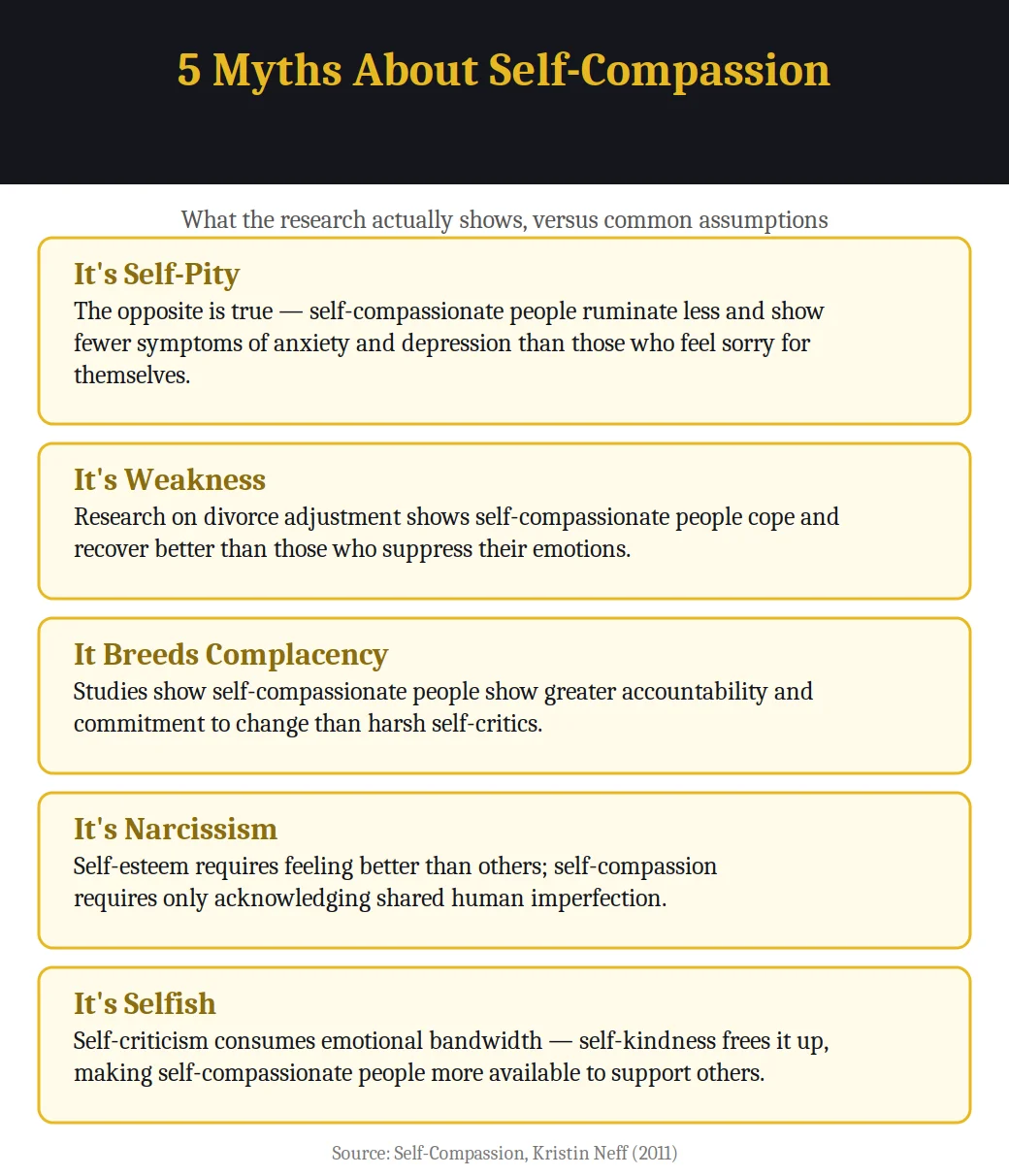
The book’s central message is that self-compassion isn’t something you need to earn through achievement or comparison — it’s available at any moment, especially the hardest ones, and practicing it consistently builds genuine resilience rather than eroding it.
Who is Self-Compassion best for — and who should read something else first?
This book is best for harsh self-critics, perfectionists, and anyone who has assumed that being hard on themselves is what keeps them disciplined or motivated. It rewards readers open to research-backed psychology paired with practical exercises over purely motivational self-help.
If your struggle is more specifically with shame and vulnerability in relationships and work, Daring Greatly and The Gifts of Imperfection both dig deeper into that adjacent territory. If your inner critic shows up mainly as distorted, repetitive negative thoughts, Feeling Good‘s cognitive techniques offer a more structured, thought-by-thought approach to the same underlying problem.
Questions to reflect on
- What would you say to a close friend in your exact situation right now — and how does that differ from what you’re saying to yourself?
- Is there a struggle you’re currently facing that feels isolating, but that’s actually a common part of the human experience?
- When painful emotions come up, do you tend to suppress them, get swept away by them, or observe them with some distance?
- How much of your sense of self-worth currently depends on comparing yourself to other people?
- Which of the five myths about self-compassion — pity, weakness, complacency, narcissism, or selfishness — has held you back the most from practicing it?
🔥 Ready to stop being your own harshest critic?
This guide covers the three components — the book gives you Neff’s full research, exercises, and the science behind each one.
How to apply Self-Compassion (7-day plan)
- Day 1: Notice one moment your inner critic speaks up, and write down what you’d say instead to a good friend in the same situation.
- Day 2: When you catch yourself struggling, silently remind yourself that imperfection and difficulty are part of being human, not a personal failing.
- Day 3: Practice observing a painful emotion for sixty seconds without suppressing it or being swept away by it.
- Day 4: Identify one place your self-worth depends on comparison, and imagine what unconditional self-kindness would look like there instead.
- Day 5: Try a short self-compassion break: acknowledge the difficulty, remind yourself it’s shared, then offer yourself a kind phrase.
- Day 6: Notice whether being kinder to yourself today made you more or less accountable for a mistake — compare it to your usual self-critical pattern.
- Day 7: Reflect on which of the five myths about self-compassion has been holding you back, and identify one small way to test it against your own experience.
Frequently asked questions
What is the main idea of Self-Compassion?
Self-Compassion argues that treating yourself with kindness during struggle — through self-kindness, common humanity, and mindfulness — is a measurable, learnable skill and a healthier foundation for wellbeing than self-esteem.
What are the three components of self-compassion?
Self-kindness (treating yourself like a friend instead of a harsh critic), common humanity (recognizing struggle as part of being human, not personal failure), and mindfulness (observing painful emotions without suppressing or over-identifying with them).
How is self-compassion different from self-esteem?
Self-esteem depends on comparing favorably to others and collapses under failure, while self-compassion is unconditional and remains available regardless of performance or comparison.
Is self-compassion the same as self-pity?
No — research shows self-compassionate people actually ruminate less and report fewer symptoms of anxiety and depression than people who engage in self-pity.
Does self-compassion make you less motivated?
No — research by Breines and Chen found self-compassionate people showed greater accountability and commitment to behavioral change than people who relied on harsh self-criticism.
What is the Self-Compassion Scale?
The Self-Compassion Scale is a validated research tool Kristin Neff developed to measure self-kindness, common humanity, and mindfulness, now used across hundreds of studies worldwide.
Is being self-compassionate selfish?
No — because self-criticism consumes emotional bandwidth, self-kindness frees up capacity, making self-compassionate people more available to genuinely support others, not less.
Related summaries
If Self-Compassion resonated, these dig further into related territory: Daring Greatly on shame and vulnerability, The Gifts of Imperfection on wholehearted living, and Feeling Good on correcting distorted self-critical thoughts. For more, see our best psychology books pillar page.
How we analyze books: We work from the full book — reconstructing its core arguments in our own words, adding commentary that connects it to related research and other books in our library, and pressure-testing the advice in a practical 7-day plan. Ratings weigh usefulness, readability, and evidence quality. Read our full methodology.
Related Psychology Summaries
Noise Summary & Review: The Hidden Flaw in Human Judgment
Superforecasting Summary and Review
The 48 Laws of Power Summary & Review: Reading the Hidden Game of Influence
The Chimp Paradox Summary & Review: How to Manage the Brain That Reacts Before You Think
The Confidence Gap Summary and Review