

⭐⭐⭐⭐½ 4.5/5 — a practical, science-flavored playbook for taming the emotional brain that hijacks your best decisions.
Best for: Anyone who reacts before they think, then regrets it · Reading time: ~6 hrs full book, ~14 min guide · Difficulty to apply: Moderate — the ideas are simple, the daily practice takes patience
The Chimp Paradox in one minute
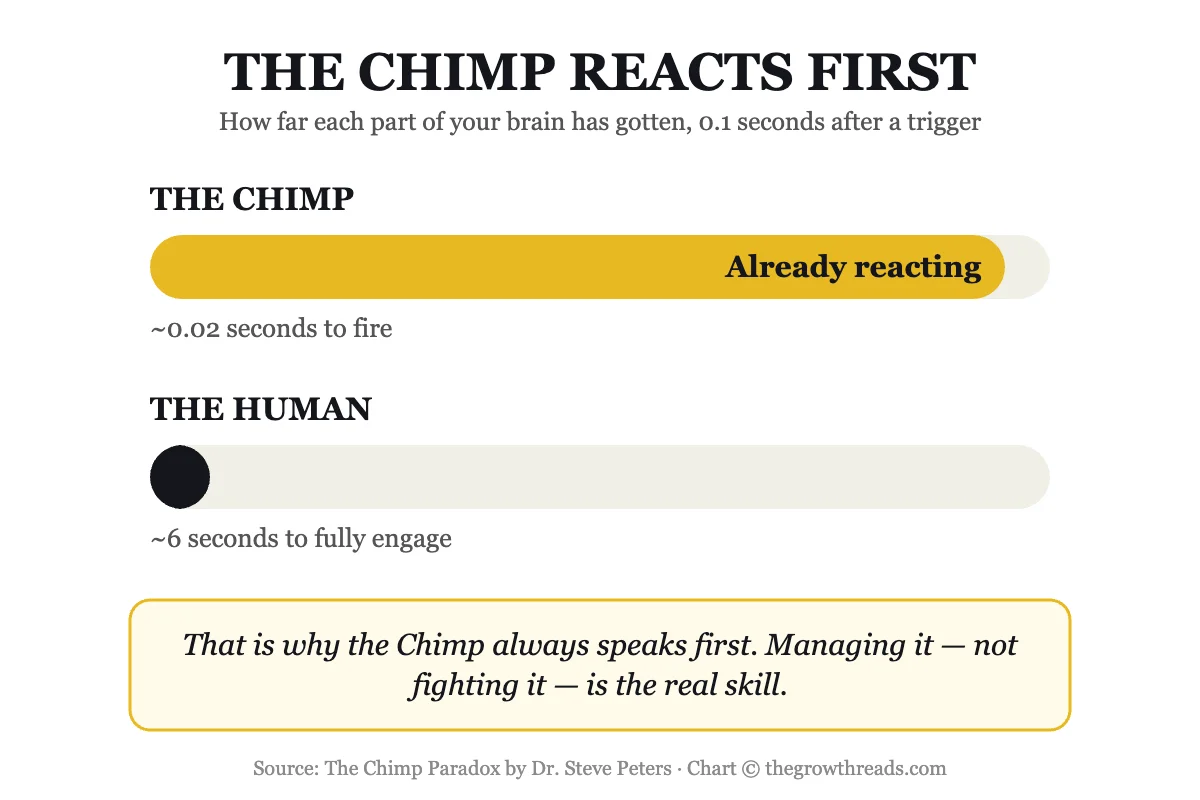
You are not your Chimp — but you are responsible for it. Dr. Steve Peters, the psychiatrist who helped British Cycling turn Olympic hopefuls into serial gold medalists, argues that every one of us is run by three competing systems: an emotional “Chimp” that reacts first and fastest, a rational “Human” that thinks things through, and a “Computer” that stores the habits and beliefs both of them rely on. The Chimp is not your enemy — it is a powerful, well-meaning animal wired for survival, five times faster than your rational mind, and it will hijack your mood, your words, and your decisions unless you learn to manage it. The Chimp Paradox is a field manual for exactly that: catching the hijack, calming the Chimp, and reprogramming the automatic habits that run your life on autopilot.
Key takeaways
- You have three brains, not one: the emotional Chimp, the rational Human, and the habit-storing Computer — and they do not always agree.
- The Chimp reacts about five times faster than you can think, which is why you say or feel things before you have consciously decided to.
- The Chimp is not bad — it is just built for survival, not for modern life, meetings, or relationships.
- You cannot suppress the Chimp, but you can manage it with a short set of repeatable techniques.
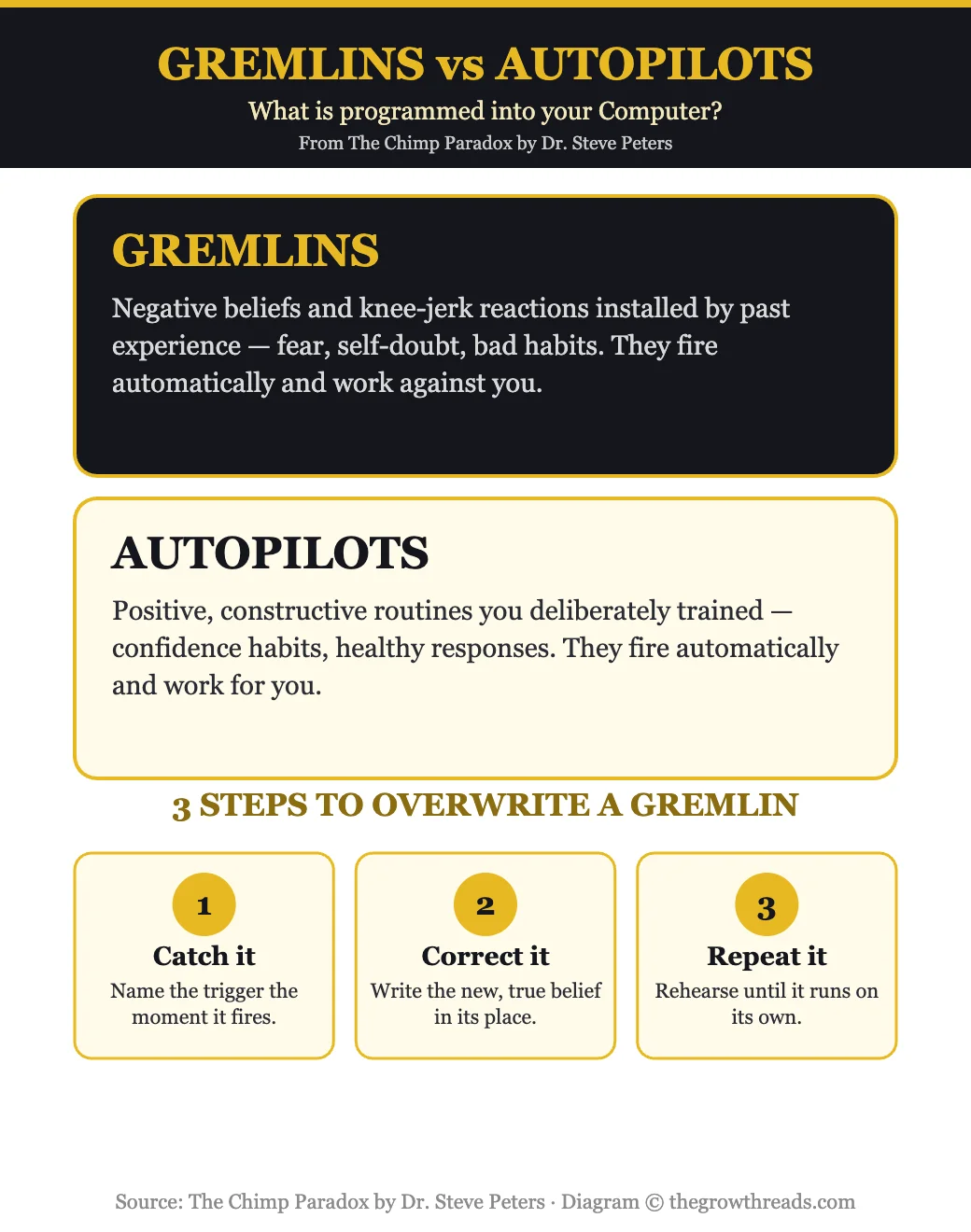
- Gremlins are negative automatic programs stored in your Computer that fire without your permission and work against you.
- Autopilots are positive automatic programs you deliberately install through repetition, and they work for you.
- Your “Troop” — how your Chimp reads other people — shapes far more of your social friction than logic does.
- Naming your core values (your “Stones of Life”) gives the Human something firm to stand on when the Chimp is loud.
- Emotional energy is a finite daily resource, not an unlimited one, and unmanaged Chimp reactions burn through it fast.
- Small, consistent practice — not willpower — is what rewires the Computer over weeks and months.
What is The Chimp Paradox about?
The Chimp Paradox is a mind-management model that explains human behavior through three competing systems — an emotional Chimp brain, a rational Human brain, and a habit-storing Computer — and teaches practical techniques to manage emotional hijacks, build confidence, and install better automatic habits.
About the author
Dr. Steve Peters is a British psychiatrist who spent decades treating patients and lecturing in psychiatry at the University of Sheffield before turning his “Chimp Model” into one of sport’s most quietly influential performance tools. Brought in to support British Cycling in the early 2000s, he worked closely with riders including Sir Chris Hoy, Victoria Pendleton, and Bradley Wiggins through a run of Olympic gold medals, and later advised snooker champion Ronnie O’Sullivan and Liverpool FC. The Chimp Paradox, published in 2012, distilled that clinical and elite-sport experience into a model anyone could use. He has since written two follow-up books, My Hidden Chimp and A Path Through the Jungle, extending the model to children and everyday decision-making. Explore all Dr. Steve Peters book summaries →
Key concepts at a glance
| Concept | What it means | Use it when |
|---|---|---|
| The Chimp | Your emotional, impulsive brain — reacts first | You feel a sudden urge to snap, flee, or shut down |
| The Human | Your rational, evidence-based brain | You need to plan, negotiate, or think long-term |
| The Computer | Stores your beliefs, habits, and automatic programs | You keep reacting the same way without meaning to |
| Gremlin | A negative automatic program working against you | You catch yourself in a self-sabotaging habit or belief |
| Autopilot | A positive automatic program working for you | You want a good habit to run without conscious effort |
| Troop | How your Chimp instinctively reads other people | You are navigating belonging, status, or conflict |
| Stone of Life | A core, non-negotiable personal value | You need a firm reference point before you decide or react |
| Banana | A small reassurance offered to calm the Chimp | You need to de-escalate an anxious or angry reaction fast |
Part 1: Meet Your Inner Chimp — The Three-Brain Model
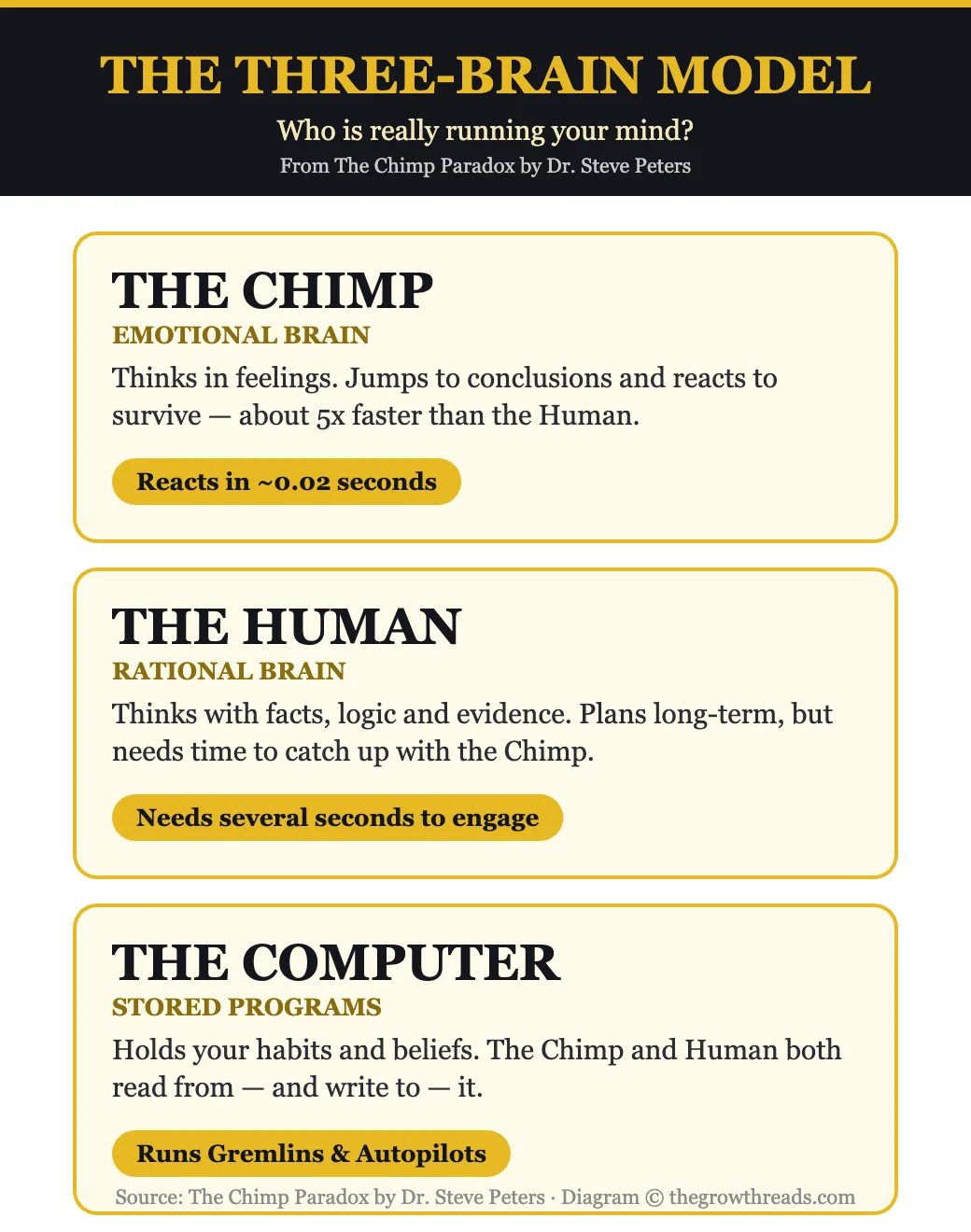
Peters’ starting point is disarmingly simple: you do not have one mind, you have three, and they were not designed to work together. The Chimp corresponds roughly to the emotional, limbic parts of the brain — it thinks in feelings and impressions, jumps straight to conclusions, and is built entirely around survival: staying safe, staying fed, staying accepted by the group. The Human corresponds to the rational, frontal parts of the brain — it weighs evidence, thinks in facts, and plans for consequences that are days, months, or years away. Sitting beneath both is the Computer, a vast storage system of beliefs, habits, and automatic responses that either brain can write to, and both brains constantly read from.
The catch is speed. The Chimp processes information roughly five times faster than the Human, because reacting first and asking questions later kept our ancestors alive. That means in almost every emotionally charged moment — a curt email, a raised eyebrow in a meeting, a rejection — the Chimp has already formed an opinion, and often already acted on it, before the Human has finished reading the situation. Peters is careful to frame this without judgment: the Chimp is not a flaw to be eliminated. It is a powerful ally when it is working with you, and a serious liability when it is left to run unmanaged.
Part 2: Why the Chimp Hijacks You
Because the Chimp filters the world emotionally before the Human ever sees it, it tends to think in extremes: safe or dangerous, friend or threat, success or catastrophe. Peters calls this “black-and-white” thinking, and it explains a huge amount of everyday overreaction — the sharp reply to a neutral text message, the spiral of self-doubt after one piece of critical feedback, the flash of road rage that feels completely disproportionate a minute later. None of these are failures of character. They are the predictable output of a fast, emotional system doing exactly what it evolved to do: protect you from perceived threats, right now, without waiting for permission.
The practical problem is that a hijacked Chimp does not stay contained. Words get said that cannot be unsaid, decisions get made under a false sense of urgency, and relationships absorb damage that a calmer response would have avoided entirely. Peters’ case for learning to manage the Chimp is not about becoming emotionless — it is about buying enough time for the Human to catch up before the Chimp’s reaction becomes the final answer.
Part 3: Managing the Chimp — Exercise, Box, Banana, Plan
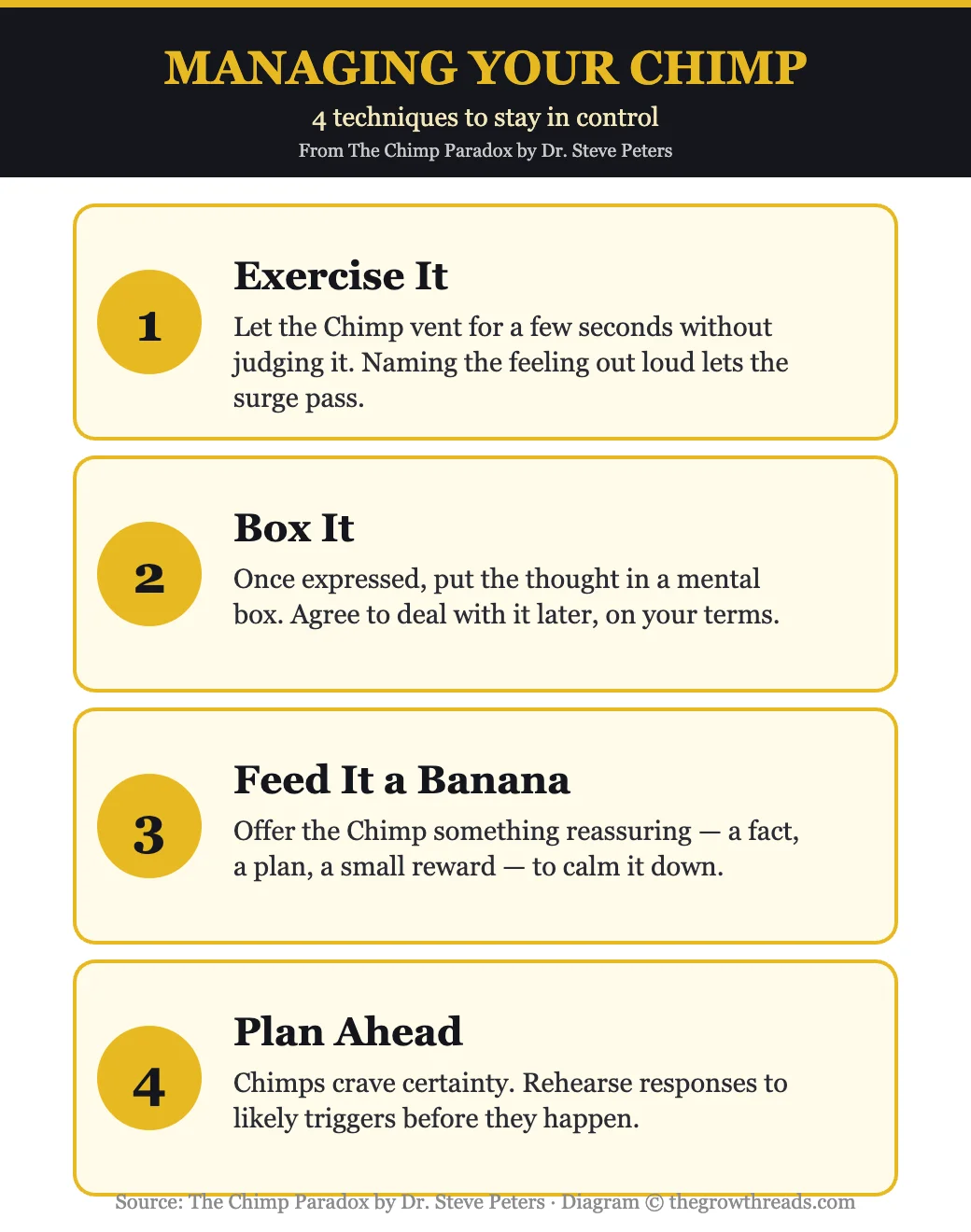
Peters resists the idea that you can simply out-argue an activated Chimp — you cannot reason with an animal mid-panic. Instead, The Chimp Paradox offers a small set of concrete moves you can use in the moment. First, exercise the Chimp: let the emotional surge be expressed — spoken aloud, written down, or simply acknowledged internally — rather than suppressed, because suppressed Chimp reactions tend to leak out later, usually at a worse time. Second, box the Chimp: once the initial reaction has had its say, consciously agree to park the thought and revisit it later, on your own terms, once the Human is back online. Third, feed it a banana: give the Chimp something concrete and reassuring — a fact, a plan, a small win — because it calms far faster with evidence of safety than with logic alone. Fourth, plan ahead: because the Chimp thrives on certainty, rehearsing your response to a predictable trigger before it happens means the Human, not the Chimp, gets to write the script.
Underneath all four techniques sits the Computer, and this is where lasting change actually happens. Every time you manage a Chimp reaction well, you are not just surviving one bad moment — you are writing a slightly better automatic program for next time. Do it enough times and a effortful, deliberate response becomes an Autopilot: something your Computer now runs by default. Peters is candid that this takes weeks of repetition, not a single read-through of the book, which is precisely why the model is built around small daily habits rather than one dramatic insight.
Part 4: Your Troop, Your Stones, and Living on Purpose
Two ideas in the second half of the book widen the model beyond moment-to-moment reactions. The first is the Troop — Peters’ term for how your Chimp instinctively categorizes the people around you as safe, threatening, or irrelevant, largely outside your conscious control. A huge share of workplace friction and family conflict, he argues, is really the Chimp defending Troop status rather than the Human disagreeing about facts. Recognizing when a disagreement is actually a Troop reaction — a fear of being excluded, outranked, or judged — often defuses it faster than trying to win the argument.
The second is the Stones of Life: a short list of core, non-negotiable personal values, written down in advance, that the Human can point to when the Chimp is loud and the right path is unclear. Peters pairs this with a simple but underrated observation about energy — that emotional and mental effort draw from the same finite daily reserve as physical energy, and an unmanaged Chimp burns through that reserve fast. Goals, in this model, work best when they satisfy both brains: a Human goal gives you a rational destination, while a Chimp goal gives the emotional system enough reassurance and reward along the way that it does not sabotage the plan.
Who is The Chimp Paradox best for — and who should read something else first?
This book earns its popularity with people who already know, intellectually, what they should do — stay calm, respond instead of react, follow through on a goal — but keep getting outrun by their own emotions in the moment. It is especially useful for people in high-pressure, high-visibility roles (managers, athletes, performers, parents) where one bad reaction is costly and public. If you are looking for a rigorous academic tour of affective neuroscience, Peters’ deliberately simplified animal metaphor may feel like a shortcut rather than a destination — in that case, our The Molecule of More summary goes deeper on the underlying brain chemistry. If your main struggle is self-criticism rather than reactivity, start with our Self-Compassion summary instead.
Questions to reflect on
- Think of the last time you reacted in a way you later regretted. Looking back, whose voice was that — the Chimp or the Human?
- Which people or situations most reliably trigger a Chimp hijack for you, and what pattern do they share?
- What is one Gremlin — a negative automatic reaction — that you can name specifically enough to start rewriting?
- What are your three to five “Stones of Life” — the values you want the Human to stand on when the Chimp is loud?
- Where in your week could you build in five minutes of “boxing” time to process reactions you have been carrying unspoken?
🔥 Ready to stop being run by your reactions?
Get The Chimp Paradox and start managing the voice that speaks before you do.
How to apply The Chimp Paradox (7-day plan)
- Day 1 — Name your Chimp. Notice one moment today where you reacted before you thought, and simply label it: “that was my Chimp.”
- Day 2 — Practice exercising it. The next time you feel a surge of frustration or anxiety, say or write it down in full before responding to anyone.
- Day 3 — Try boxing a thought. Pick one nagging worry and consciously schedule 10 minutes tomorrow to deal with it — then let it go for today.
- Day 4 — Find one banana. Identify a small, concrete reassurance (a fact, a checklist, a plan B) you can offer yourself before a stressful event.
- Day 5 — Plan for a known trigger. Pick a recurring trigger and rehearse, in advance, exactly how you want to respond next time.
- Day 6 — Write your Stones of Life. List three to five values you want to guide decisions when your Chimp is loudest.
- Day 7 — Review and reinforce. Look back on the week: which technique worked best, and how can you turn it into a daily Autopilot?
Frequently asked questions
What is the Chimp Paradox theory in simple terms?
The Chimp Paradox proposes that your mind runs on three systems: an emotional “Chimp” that reacts fast and thinks in feelings, a rational “Human” that thinks in facts and plans ahead, and a “Computer” that stores the habits and beliefs both systems use. Because the Chimp reacts roughly five times faster than the Human, it often speaks or acts first. The goal is not to suppress the Chimp but to manage it — buying time for the Human to weigh in before a reaction becomes the final word.
Who is Dr. Steve Peters and why did he write this book?
Dr. Steve Peters is a British psychiatrist who developed the Chimp Model over years of clinical work and lecturing at the University of Sheffield. He became widely known after using the model to help British Cycling’s Olympic team, including Sir Chris Hoy and Victoria Pendleton, manage pressure through multiple Games. He later advised snooker player Ronnie O’Sullivan and Liverpool FC, and wrote The Chimp Paradox in 2012 to make the model available beyond elite sport.
What is the difference between the Chimp and the Human in the model?
The Chimp is the emotional, impulsive part of the mind — it reacts to perceived threats or opportunities instantly, thinks in black-and-white terms, and is driven by survival instincts like safety and belonging. The Human is the rational, reflective part — it weighs evidence, considers consequences, and plans for the future, but engages more slowly. Neither is “better”; the skill Peters teaches is recognizing which one is currently in the driver’s seat and managing the handoff between them.
How do you stop your Chimp from taking over?
You cannot switch the Chimp off, but Peters offers four repeatable techniques: exercise it (let the reaction be expressed rather than suppressed), box it (agree to revisit the thought later instead of acting immediately), feed it a banana (offer a small, concrete reassurance to calm it), and plan ahead (rehearse your response to predictable triggers in advance, so the Human writes the script before the Chimp does).
What are Gremlins and Autopilots?
Gremlins and Autopilots are both automatic programs stored in what Peters calls the Computer — the part of the mind that runs habits and beliefs without conscious effort. Gremlins are negative programs, such as self-doubt or a defensive reflex, that fire automatically and work against you. Autopilots are positive programs — confident habits, calm responses — that you have deliberately trained through repetition. Managing the Chimp well and often is what gradually turns Gremlins into Autopilots.
Is the Chimp Paradox based on real neuroscience?
The model is a simplified, practitioner-friendly metaphor rather than a precise map of brain anatomy, and some neuroscientists note that real emotional and rational processing is more distributed and interconnected than a clean three-part split suggests. That said, the underlying observation — that fast, emotional processing frequently outpaces slower, deliberate reasoning — is well supported in psychology and behavioral science, which is likely why the model has proven so durable in practice.
How long does it take to see results from Chimp Management?
Peters is explicit that this is a practice, not a one-time read: most people notice they can catch a Chimp reaction in progress within the first few weeks, but turning a new response into a reliable Autopilot typically takes consistent repetition over one to three months. Progress usually shows up first as faster recovery after a hijack, and only later as fewer hijacks happening in the first place.
Related summaries
- Self-Compassion Summary & Review
- The Confidence Gap Summary & Review
- Radical Acceptance Summary & Review
- The Molecule of More Summary & Review
- See all Best Psychology Books →
Related Psychology Summaries
The Elephant in the Brain Summary and Review
The Gift of Fear Summary & Review: Why Your Instincts Are Your Best Protection
The Power of Now Summary & Review: A Guide to Spiritual Enlightenment
The Upside of Stress Summary & Review: Why Feeling Stressed Can Be Good for You
When the Body Says No Summary & Review: How Suppressed Emotion Makes You Sick