

★★★★★ 4.5/5 — A rigorously researched case that accurate prediction is a learnable discipline of precise probabilities, relentless updating, and intellectual humility, not a rare gift or a matter of credentials.
Best for: analysts, strategists, investors, and anyone who has to make consequential calls under uncertainty · Reading time: ~8 hrs (this guide: ~16 min) · Difficulty to apply: Moderate — the habits are simple to state but require real discipline to practice consistently
Superforecasting in one minute
Accurate forecasting isn’t a rare talent or a matter of credentials — it’s a learnable discipline built from precise probabilities, relentless small updates, and intellectual humility. Philip E. Tetlock and Dan Gardner’s 2015 book grows out of the Good Judgment Project, a multi-year forecasting tournament sponsored by the U.S. intelligence community, which pitted ordinary volunteers against government analysts — some with access to classified information — on real-world geopolitical and economic questions. The tournament identified a small group, roughly 2% of participants, whom Tetlock dubbed “superforecasters”: people who consistently beat both the analysts and prediction markets, not through insider knowledge or exceptional intelligence, but through specific, teachable habits of thought. Superforecasting lays out exactly what those habits are, from breaking big questions into smaller, checkable parts, to using fine-grained probabilities instead of vague hedges, to treating every forecast as a draft to be revised rather than a verdict to be defended.
Key takeaways
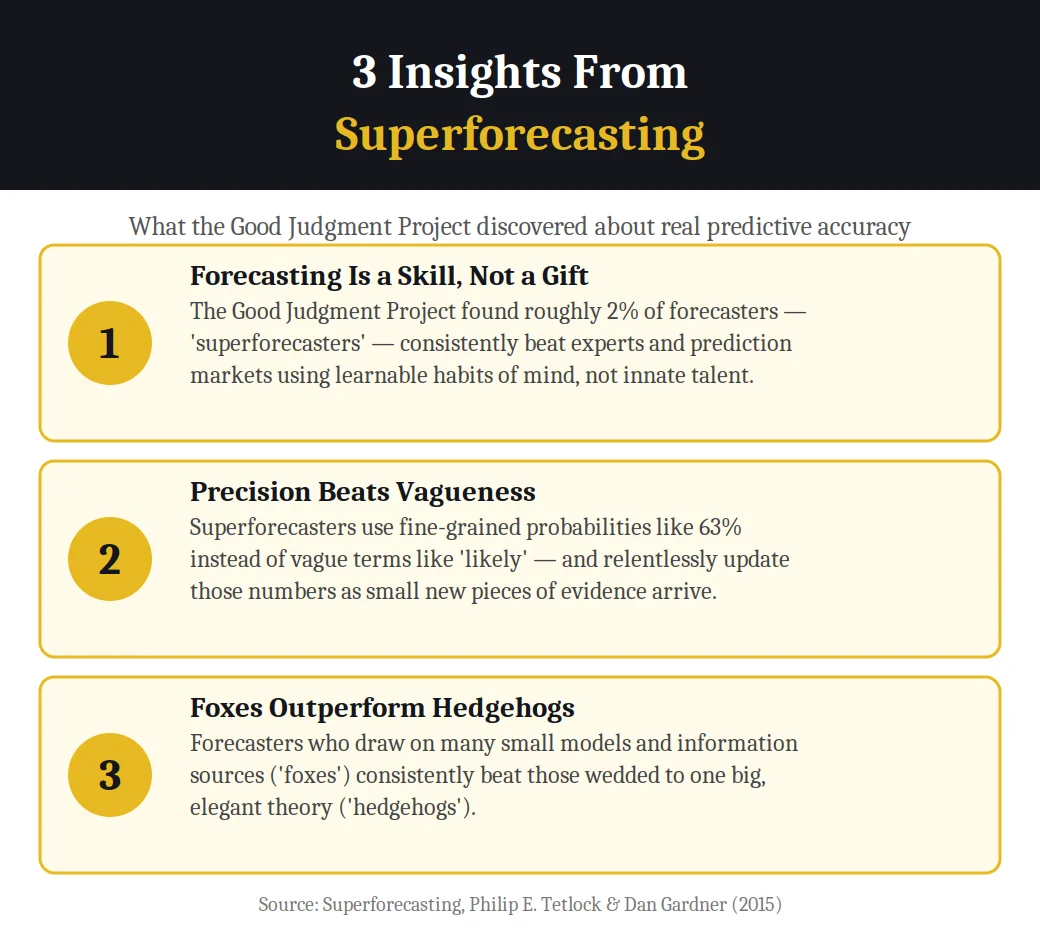
- Superforecasters are made, not born: the Good Judgment Project found that specific thinking habits, not IQ or subject-matter expertise alone, separated the top 2% of forecasters from everyone else.
- Foxes beat hedgehogs: forecasters who draw on many small models and sources of evidence consistently outperform those committed to one big, elegant theory — even though hedgehogs tend to sound more confident.
- Precision is not optional: saying “70%” instead of “probably” isn’t just a stylistic choice — it’s what makes a forecast falsifiable and scoreable in the first place.
- Brier scores keep forecasters honest: this scoring method measures the gap between a stated probability and the actual outcome, making it possible to compare forecasters’ accuracy over time rather than relying on anecdote or confidence.
- Good forecasts update in small steps: superforecasters nudge their estimates as new evidence arrives rather than swinging wildly between extremes, which produces more stable, better-calibrated tracks records.
- Break big questions into smaller, checkable ones: Fermi-style decomposition — building an estimate from known facts and sub-questions — consistently outperforms trying to intuit an answer to a complex question directly.
- Actively open-minded thinking is a superpower: superforecasters actively seek out information and arguments that contradict their current view, rather than settling comfortably into a position.
- Teams of forecasters can outperform even individual superforecasters: well-run teams that share information and challenge each other’s reasoning without descending into groupthink beat solo forecasters and, in the tournament, beat prediction markets too.
- Confidence and accuracy are different things: Tetlock’s research shows that the forecasters who sound most certain on television are, on average, no more accurate than those who openly express uncertainty.
What is Superforecasting about?
Superforecasting is Philip E. Tetlock and Dan Gardner’s account of the Good Judgment Project, a multi-year forecasting tournament that pitted ordinary volunteers against professional intelligence analysts on real-world geopolitical and economic questions. The tournament found that a small subset of participants, dubbed “superforecasters,” consistently and dramatically outperformed both trained analysts and prediction markets — not through special access to information, but through specific, learnable habits of thought. The book lays out those habits in detail: precise probabilistic thinking, incremental belief updating, breaking big questions into checkable pieces, and a distinctive blend of humility and decisiveness that lets superforecasters take a firm position without becoming attached to it.
About the author
Philip E. Tetlock is a professor at the University of Pennsylvania and one of the world’s foremost researchers on the accuracy of expert judgment. His earlier two-decade research project, published as Expert Political Judgment, found that the average pundit’s predictions were barely better than chance — work that led him to co-found the Good Judgment Project, a forecasting tournament sponsored by the U.S. intelligence research agency IARPA, in which the project’s top forecasters dramatically outperformed professional analysts. Dan Gardner is a journalist and author who specializes in translating research on risk, uncertainty, and decision-making for general audiences, including in his earlier book Future Babble. Together they turned the tournament’s findings into Superforecasting, published in 2015. Explore all Philip E. Tetlock & Dan Gardner book summaries →
Key concepts at a glance
| Concept | What it means | Use it when |
|---|---|---|
| Fox vs. hedgehog | Foxes draw on many small models and sources; hedgehogs commit to one big theory — foxes forecast more accurately | You’re evaluating whether your own thinking is too attached to a single explanation |
| Probability granularity | Using precise numbers (like 63%) instead of vague words (like “likely”) makes forecasts falsifiable and comparable | You’re making or evaluating a prediction and want it to be genuinely checkable later |
| Brier score | A scoring method measuring the gap between a stated probability and the actual outcome | You want to track and compare forecasting accuracy over time, not just anecdotally |
| Incremental updating | Nudging an estimate as new evidence arrives, rather than swinging between extremes | New information arrives that’s relevant but not conclusive on its own |
| Fermi-style decomposition | Breaking a big, hard-to-answer question into smaller, more knowable sub-questions | A question feels too big or uncertain to estimate directly |
Part 1: What the Good Judgment Project discovered
The book opens with the origin of its central claim: the Good Judgment Project, a multi-year tournament run in partnership with IARPA, the U.S. intelligence community’s research arm, in which thousands of volunteer forecasters predicted the outcomes of real geopolitical and economic questions — would a ceasefire hold, would a currency devalue, would an election go a certain way. The project’s standout finding was that a small group of participants, roughly 2%, consistently and substantially outperformed both professional intelligence analysts (some working with classified information) and prediction markets. Tetlock and Gardner spend much of the book unpacking exactly what these “superforecasters” did differently.
TGR Note: This finding echoes Thinking, Fast and Slow‘s broader theme that deliberate, effortful thinking (System 2) can reliably outperform confident intuition (System 1) — but only when it’s actually applied, which most people and even most experts fail to do consistently.
Part 2: Foxes, hedgehogs, and the discipline of precision
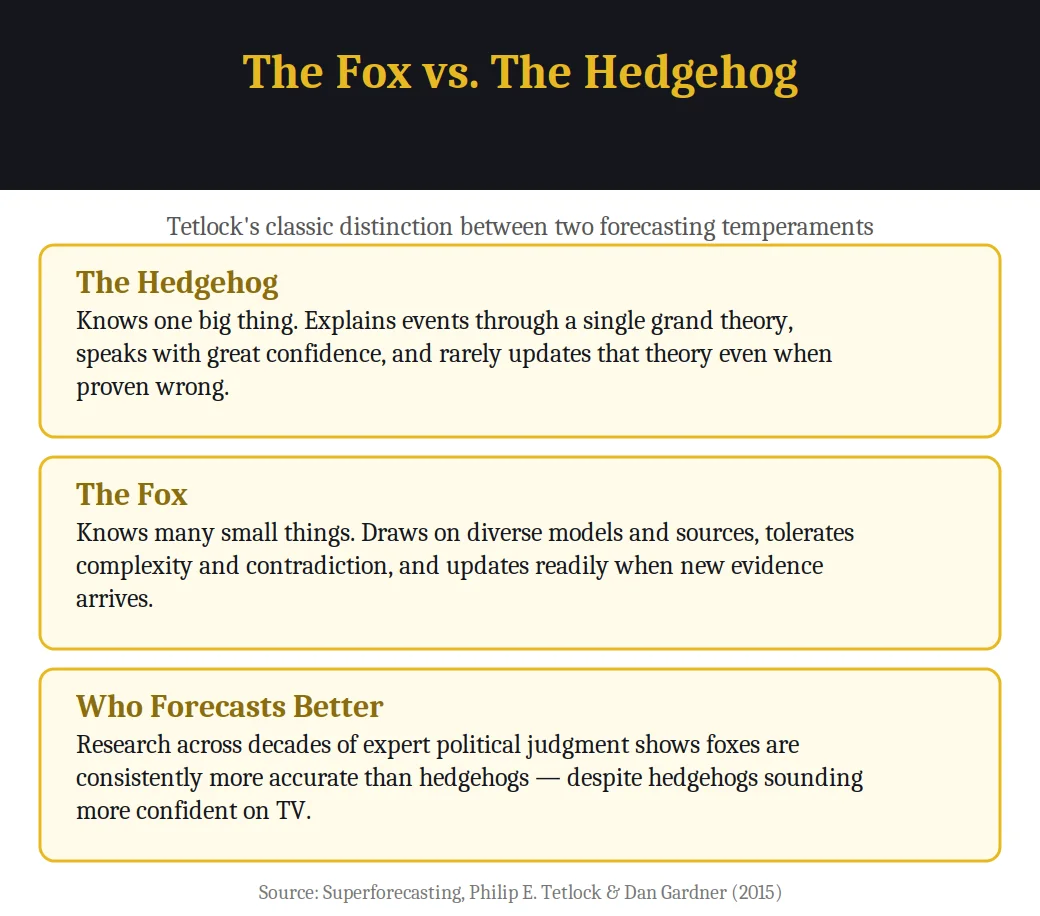
Building on Tetlock’s earlier research, the book revives his fox-versus-hedgehog distinction: hedgehogs know one big thing and interpret events through a single grand theory, speaking with great confidence and rarely revising that theory even when it’s proven wrong; foxes know many small things, draw on diverse models and sources, and readily update when new evidence arrives. Across decades of research, foxes consistently forecast more accurately than hedgehogs — despite hedgehogs’ confident, telegenic certainty making them more likely to be invited back onto television.
Alongside temperament, the authors emphasize precision. Vague language like “likely” or “possible” hides how confident a forecaster actually is and makes it impossible to score a prediction against what actually happens. Superforecasters instead commit to specific numbers — 63%, not “probably” — which is uncomfortable at first but is precisely what allows their track record to be measured using tools like the Brier score, which quantifies the gap between a stated probability and the eventual outcome across many forecasts.
TGR Note: The demand for precise, falsifiable probability estimates parallels Thinking in Bets‘s argument that decisions should be evaluated by the quality of the process and the honesty of the odds assigned, not simply by whether the outcome happened to turn out well.
Part 3: Calibration, resolution, and getting the balance right
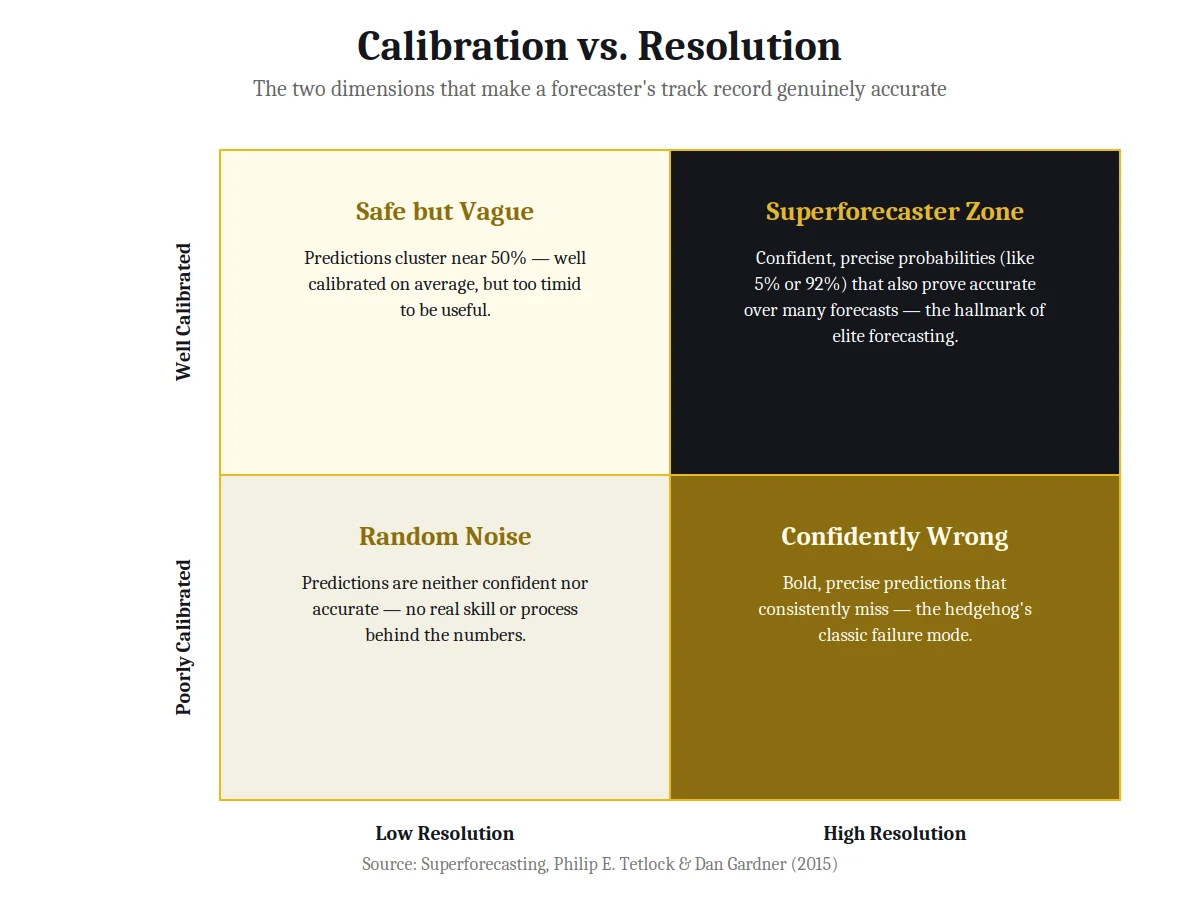
Tetlock and Gardner introduce two distinct dimensions of forecasting quality: calibration, meaning that when a forecaster says “70%,” that outcome should actually happen roughly 70% of the time across many such forecasts; and resolution, meaning the forecaster is willing to make confident, non-timid predictions rather than clustering everything near 50% to play it safe. A well-calibrated forecaster who’s too timid to ever commit to a confident number isn’t especially useful, and a bold forecaster who’s poorly calibrated is actively harmful — the superforecaster’s edge comes from being both confident and correct at the same time.
Achieving that balance requires what the authors call actively open-minded thinking — deliberately seeking out information and arguments that contradict your current view, rather than settling comfortably into a position and defending it. Superforecasters treat their own beliefs as hypotheses to be tested rather than positions to be defended, which is precisely what lets them update in small, frequent steps instead of clinging to an initial call or swinging wildly when new information arrives.
TGR Note: This mirrors The Scout Mindset‘s central case that seeing clearly requires wanting to know what’s true more than wanting to be right — both books treat updating your mind as a strength rather than a weakness.
Part 4: Ten Commandments and the power of teams
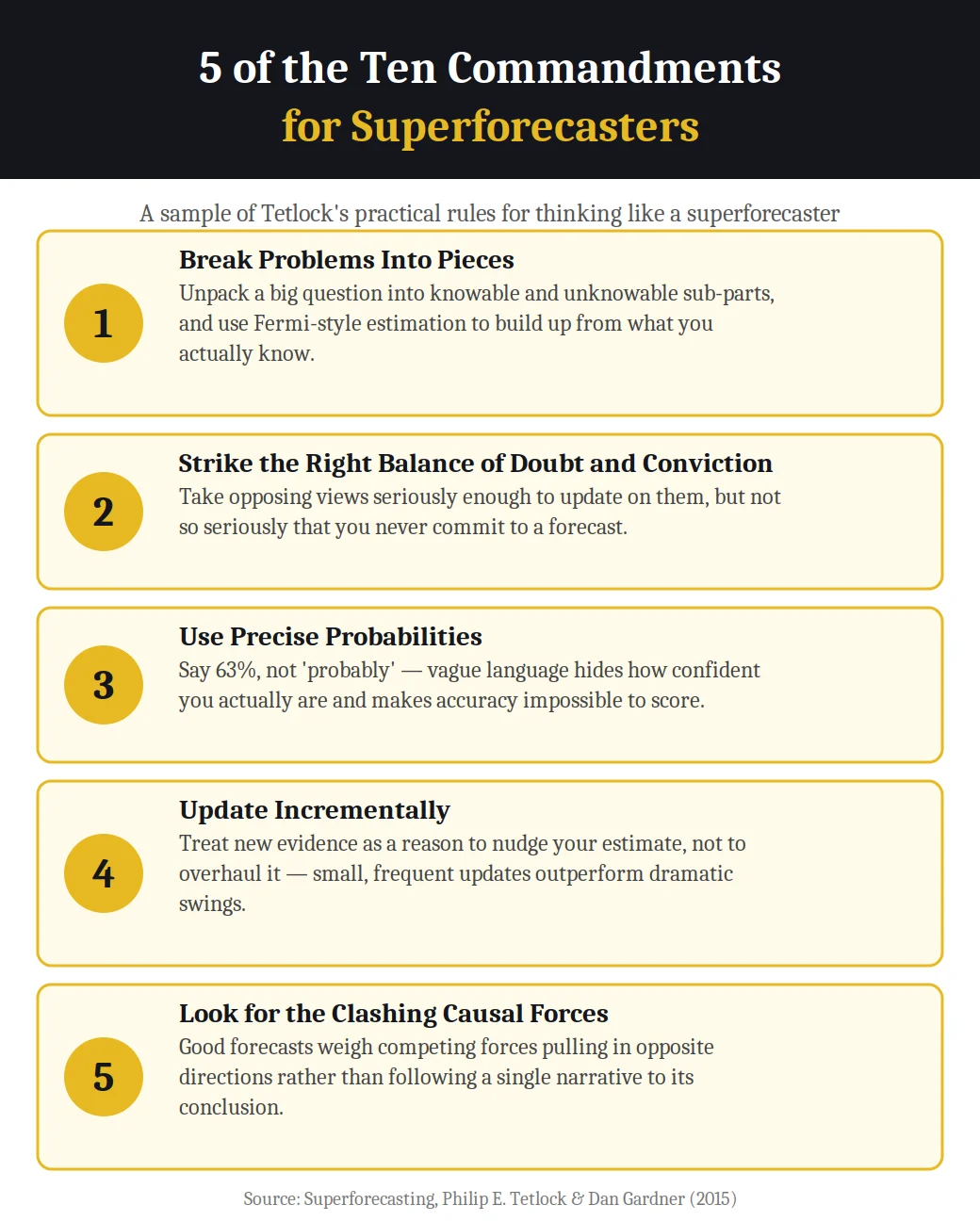
The book closes with Tetlock’s “Ten Commandments for Aspiring Superforecasters,” a practical set of rules distilled from the tournament data: break problems into knowable and unknowable pieces, strike the right balance of doubt and conviction, use precise probabilities, update incrementally, look for clashing causal forces rather than following one narrative, and treat forecasting as a skill to be deliberately practiced and reviewed like any other. Crucially, the authors also show that well-run teams — ones that share information and challenge each other’s reasoning without collapsing into groupthink — can outperform even individual superforecasters, and in the tournament, outperformed prediction markets as well.
The book’s larger argument is optimistic: good judgment under uncertainty isn’t a fixed trait reserved for a lucky few. It’s a discipline that ordinary people can learn, measure, and improve — as long as they’re willing to commit to precise, checkable predictions and treat being wrong as useful data rather than personal failure.
Who is Superforecasting best for — and who should read something else first?
This book is best for analysts, strategists, investors, and anyone whose job or life requires making consequential calls under real uncertainty. It rewards readers who want concrete, evidence-backed practices rather than motivational language about “trusting your gut.”
If your interest is more in the psychology of why our intuitive judgments go wrong in the first place, Thinking, Fast and Slow provides the deeper cognitive-science foundation this book builds on. If you want a more decision-focused, poker-inspired take on probabilistic thinking, Thinking in Bets covers similar ground with a sharper focus on individual decision-making. And if your interest is specifically in overcoming motivated reasoning to see situations more clearly, The Scout Mindset is a natural companion.
Questions to reflect on
- Think of a recent prediction you made — did you use a precise probability, or a vague hedge like “probably” or “maybe”?
- Are you more of a fox or a hedgehog in how you approach uncertain questions at work?
- When did you last change your mind meaningfully in response to new evidence, rather than defending your original position?
- Is there a big, intimidating question in your life or work you could break down into smaller, more knowable sub-questions?
- Do you have a way to track whether your past predictions actually came true — or are you relying on memory and impression instead?
🔥 Ready to forecast like the pros who beat the CIA?
This guide covers the core habits — the book gives you Tetlock and Gardner’s full research, case studies, and the complete Ten Commandments.
How to apply Superforecasting (7-day plan)
- Day 1: Pick one upcoming uncertain event relevant to your work or life, and assign it a precise percentage probability instead of a vague hedge.
- Day 2: Break that question into smaller, more knowable sub-questions using Fermi-style decomposition.
- Day 3: Actively seek out one piece of evidence or one perspective that contradicts your current estimate.
- Day 4: Update your probability incrementally based on what you found — resist the urge to swing to an extreme.
- Day 5: Write your forecast down with a date, so you can score yourself later using a simple Brier-style check.
- Day 6: Discuss the question with one other person and see whether their reasoning changes your estimate.
- Day 7: Reflect on whether you tend toward fox-like or hedgehog-like thinking, and pick one habit from the Ten Commandments to practice going forward.
Frequently asked questions
What is the main idea of Superforecasting?
Superforecasting argues that accurate prediction under uncertainty is a learnable discipline, not a rare gift, built from precise probabilistic thinking, incremental updating, and intellectual humility — as demonstrated by the Good Judgment Project tournament.
What is the Good Judgment Project?
The Good Judgment Project was a multi-year forecasting tournament sponsored by IARPA, the U.S. intelligence community’s research arm, in which volunteer forecasters predicted real-world events and a small subset, “superforecasters,” dramatically outperformed professional analysts and prediction markets.
What is the difference between a fox and a hedgehog in forecasting?
Hedgehogs interpret events through one big theory and rarely update it; foxes draw on many small models and sources and readily update when new evidence arrives. Foxes consistently forecast more accurately, despite hedgehogs sounding more confident.
What is a Brier score?
A Brier score measures the gap between a forecaster’s stated probability and the actual outcome, allowing forecasting accuracy to be tracked and compared objectively over many predictions rather than judged anecdotally.
Why do superforecasters use precise probabilities like 63%?
Precise numbers make a forecast falsifiable and scoreable against what actually happens, while vague language like “likely” hides how confident the forecaster really is and can’t be checked for accuracy later.
Can teams forecast better than individual superforecasters?
Yes — the book shows that well-run teams that share information and challenge each other’s reasoning without groupthink can outperform even individual superforecasters, and in the tournament outperformed prediction markets too.
How is Superforecasting different from Thinking, Fast and Slow?
Thinking, Fast and Slow explains the cognitive biases behind flawed intuitive judgment, while Superforecasting focuses specifically on the practical habits that make forecasts under uncertainty measurably more accurate.
Related summaries
If Superforecasting resonated, these dig further into related territory: Thinking, Fast and Slow on the cognitive biases behind flawed judgment, Thinking in Bets on probabilistic decision-making, and The Scout Mindset on seeing clearly instead of defending your position. For more, see our best psychology books pillar page.
How we analyze books: We work from the full book — reconstructing its core arguments in our own words, adding commentary that connects it to related research and other books in our library, and pressure-testing the advice in a practical 7-day plan. Ratings weigh usefulness, readability, and evidence quality. Read our full methodology.
Related Psychology Summaries
Meditations Summary & Review: Timeless Stoic Wisdom for Modern Life
Sapiens Summary & Review: How Shared Fictions Built the Modern World
The Elephant in the Brain Summary and Review
The Power of Your Subconscious Mind Summary & Review: Reprogram Your Thinking
The Scout Mindset Summary & Review: See Reality Clearly