

⭐⭐⭐⭐✦ 4.1 / 5
One-liner: A research-backed framework for diagnosing and upgrading the culture of any group — from toxic to world-changing — through five distinct tribal stages.
Best for: Leaders, managers, founders, and culture-builders who want to move their teams from individual competition to collective greatness.
Reading time: ~6 hours (304 pages)
Difficulty to apply: Moderate — requires patience to diagnose the current stage correctly and discipline to apply leverage points progressively.
Tribal Leadership in one minute
Every organization is a tribe of 20 to 150 people, and every tribe operates at one of five cultural stages. Dave Logan, John King, and Halee Fischer-Wright spent 10 years studying 24,000 people in two dozen organizations to map these stages. Most workplace tribes are stuck at Stage 3 — where individuals compete against each other with an “I’m great (and you’re not)” mentality. The breakthrough happens when leaders learn to upgrade their tribe to Stage 4, where shared values replace personal ambition and the mantra shifts to “we’re great.” The key mechanism is building triads — three-person relationships that create stability, accountability, and a culture bigger than any individual.
Key takeaways
- Culture is organized in five stages: From “life sucks” (Stage 1) to “life is great” (Stage 5), each stage has a distinct language pattern, relationship structure, and behavioral signature.
- Nearly half of all tribes are stuck at Stage 3: 49% of workplace tribes operate at “I’m great” — individual competition that looks productive but limits collective potential.
- You can only upgrade one stage at a time: A Stage 2 person cannot leap to Stage 4. Leaders must meet people where they are and use stage-specific leverage points.
- Language reveals the stage: Listen for the words people use — “I,” “me,” “my” signals Stage 3; “we,” “us,” “our” signals Stage 4. Language is both a diagnostic and an intervention.
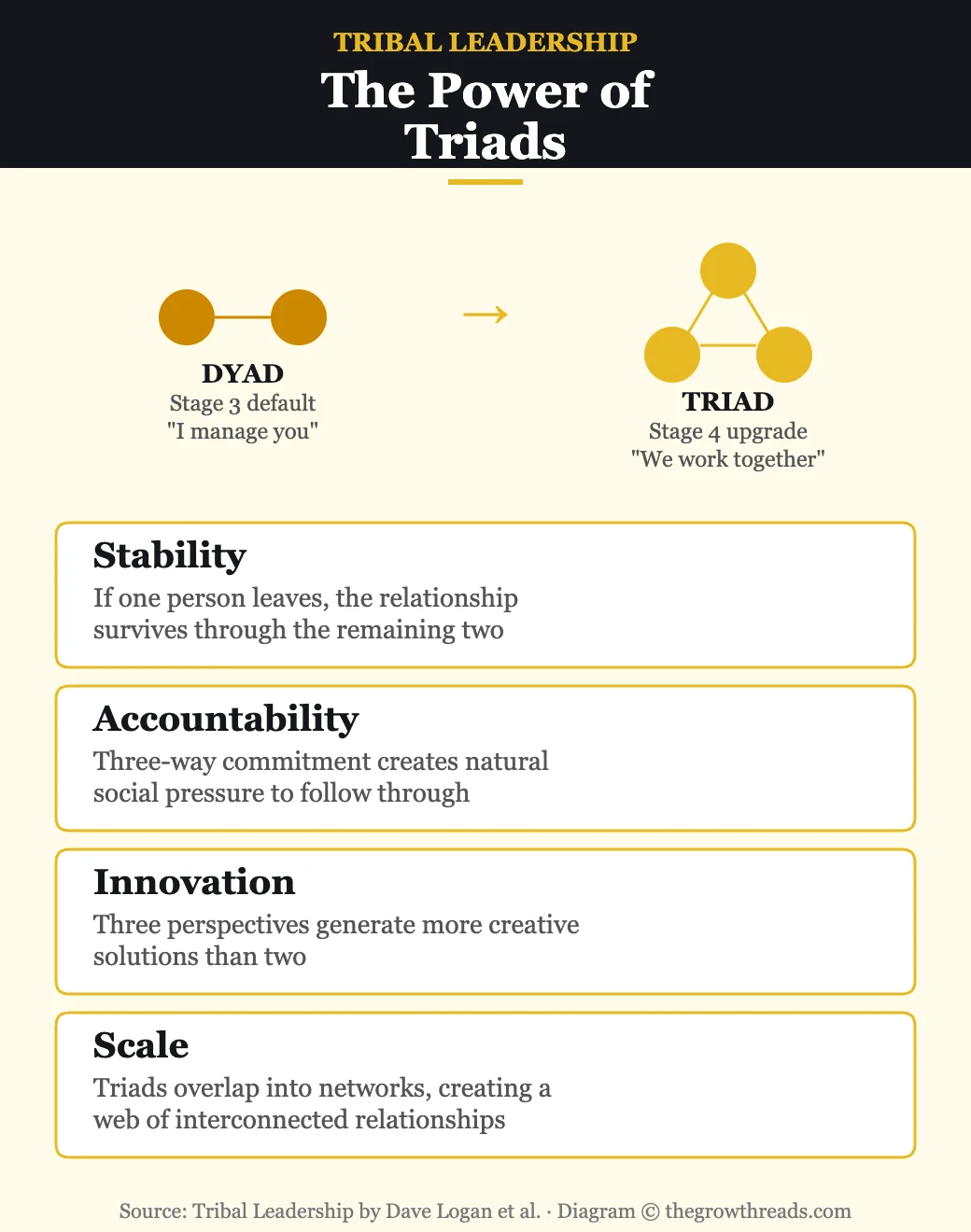
- Triads are the architecture of Stage 4: Two-person relationships (dyads) are Stage 3’s default. Building three-person relationships creates the structural stability needed for “we” culture.
- Values and a noble cause unite Stage 4 tribes: Shared values replace personal ambition as the organizing principle, and a noble cause (bigger than any individual) provides direction.
- Stage 5 is rare and temporary: Only about 2% of tribes reach Stage 5, where the focus shifts to making history-level impact. It emerges naturally from strong Stage 4 foundations.
- The leader’s role is upgrading the tribe: The most powerful thing a leader can do is not manage tasks but systematically move the tribe’s culture from one stage to the next.
- Stage 3 success is the biggest trap: High-performing individuals at Stage 3 often resist upgrading because personal achievement has worked for them — but it caps the team.
- Tribal culture is self-reinforcing: Once a stage is established, it attracts people who match it and repels those who do not, creating a self-sustaining cultural ecosystem.
What is Tribal Leadership about?
Tribal Leadership is a leadership and organizational culture book based on a 10-year study of 24,000 people across two dozen organizations. The authors identify five stages of tribal culture, from despairing to world-changing, and provide a practical framework for leaders to diagnose their tribe’s current stage and systematically upgrade it through specific language shifts, relationship structures, and values alignment.
About the author
Dave Logan is a faculty member at the USC Marshall School of Business and a management consultant who has worked with organizations ranging from startups to Fortune 500 companies. John King is a co-founder of CultureSync, a management consulting firm, and an expert in organizational design. Halee Fischer-Wright is a physician-turned-leadership-consultant who brings a healthcare perspective to organizational culture. Together, they conducted one of the largest studies of workplace culture ever attempted, observing and coding language patterns across industries to develop the tribal stages model. Explore all Logan Ury book summaries →
Key concepts at a glance
| Concept | What it means | Use it when |
|---|---|---|
| Tribal stages (1-5) | Five distinct cultural levels, each with signature language and behavior | You want to diagnose where your team’s culture currently sits |
| Stage 3 trap | Individual excellence that blocks collective greatness | Your team has talented people who compete more than collaborate |
| Triads | Three-person relationships that create stable, accountable culture | You want to structurally shift from “I” to “we” culture |
| Noble cause | A purpose bigger than any individual that unites the tribe | Your team lacks shared direction beyond hitting targets |
| Leverage points | Stage-specific interventions that move people to the next level | You want targeted actions, not generic motivation |
| Language as diagnostic | Listening for “I/me” vs “we/us” to identify the operating stage | You need a quick, reliable way to read team culture |
| Values alignment | Explicit shared values that replace personal ambition as the organizing force | You want to create a culture that self-selects for the right people |
Part 1: The five stages of tribal culture
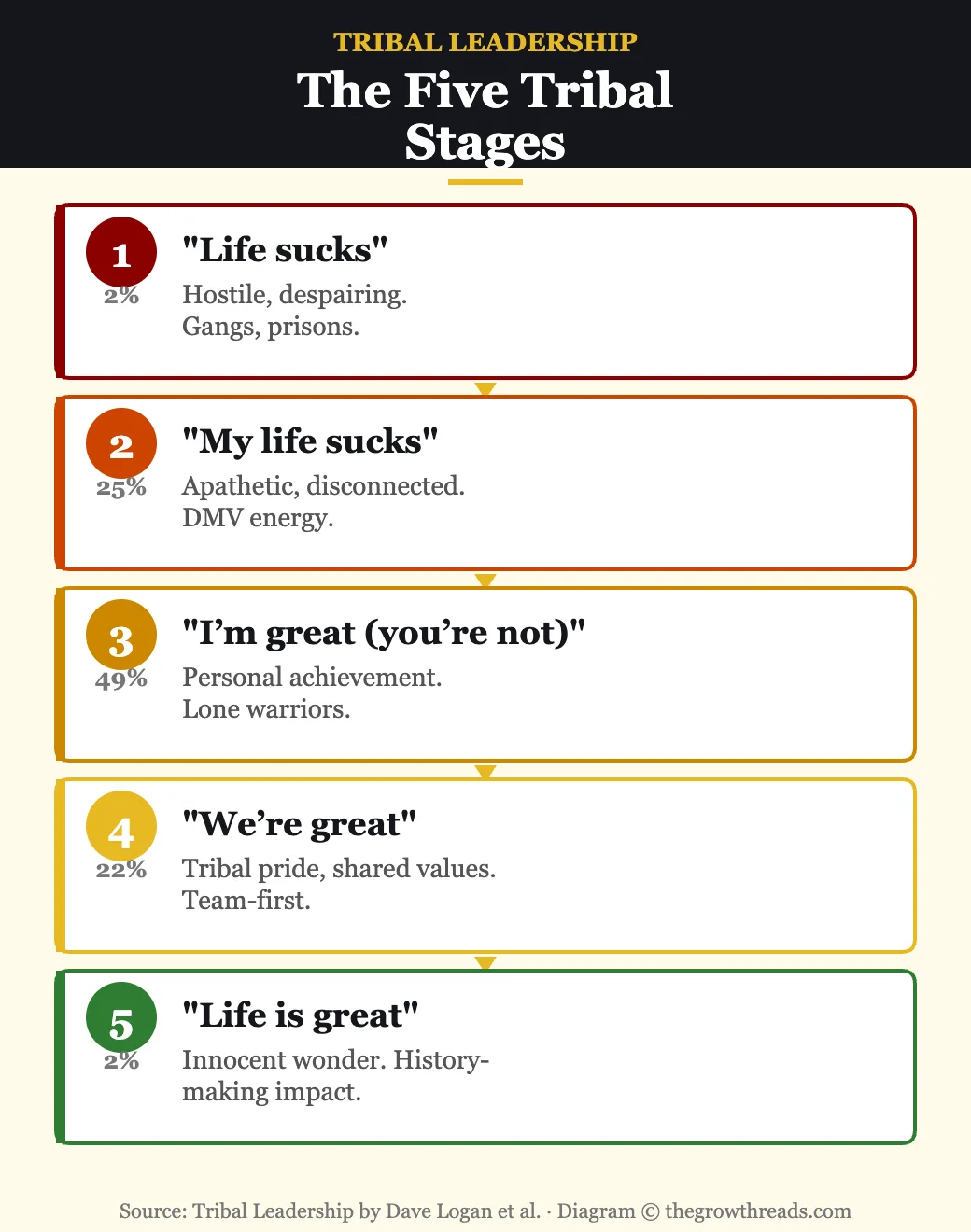
Logan and his co-authors define a tribe as a naturally occurring group of 20 to 150 people who know each other well enough to interact regularly. Every workplace contains multiple overlapping tribes, and each tribe operates at one of five cultural stages, identifiable by the language people use and the relationships they form.
Stage 1 (“Life sucks”) represents about 2% of workplace tribes. People at this stage feel that life itself is fundamentally unfair and hostile. The language is universally despairing, and the behavior is often destructive. Think of gang culture or the most dysfunctional corners of institutional life. Most leaders will never encounter Stage 1 in a typical workplace.
Stage 2 (“My life sucks”) represents about 25% of workplaces. The despair is personal rather than universal — people feel disconnected, apathetic, and victimized. They do the minimum required and disengage. The authors compare this to the stereotypical DMV experience: employees going through the motions without energy or ownership.
Stage 3 (“I’m great — and you’re not”) is the dominant stage, representing 49% of workplace tribes. This is the land of individual achievers who compete against their own colleagues. They hoard knowledge, build personal brands, and define success as personal wins. Stage 3 people are often very productive individually, which makes this stage particularly seductive — and particularly hard to leave.
Stage 4 (“We’re great”) represents about 22% of workplaces. Here, the tribe shares values, pursues a common cause, and competes against external opponents rather than each other. Knowledge is shared freely, relationships are triadic rather than dyadic, and the group’s identity supersedes individual identity. This is where sustained organizational excellence lives.
Stage 5 (“Life is great”) represents only about 2% of tribes and is almost always temporary. At this stage, tribes feel they are making history — changing the world, not just their market. Stage 5 teams include the original Macintosh team at Apple and select medical research groups. It cannot be engineered directly but emerges from a strong Stage 4 foundation confronting a transformative opportunity.
Part 2: The critical Stage 3 to Stage 4 upgrade
The book’s most actionable section focuses on the upgrade that matters most: moving from Stage 3 to Stage 4. This is where nearly half of all organizations are stuck, and where the greatest unlocked potential lies.
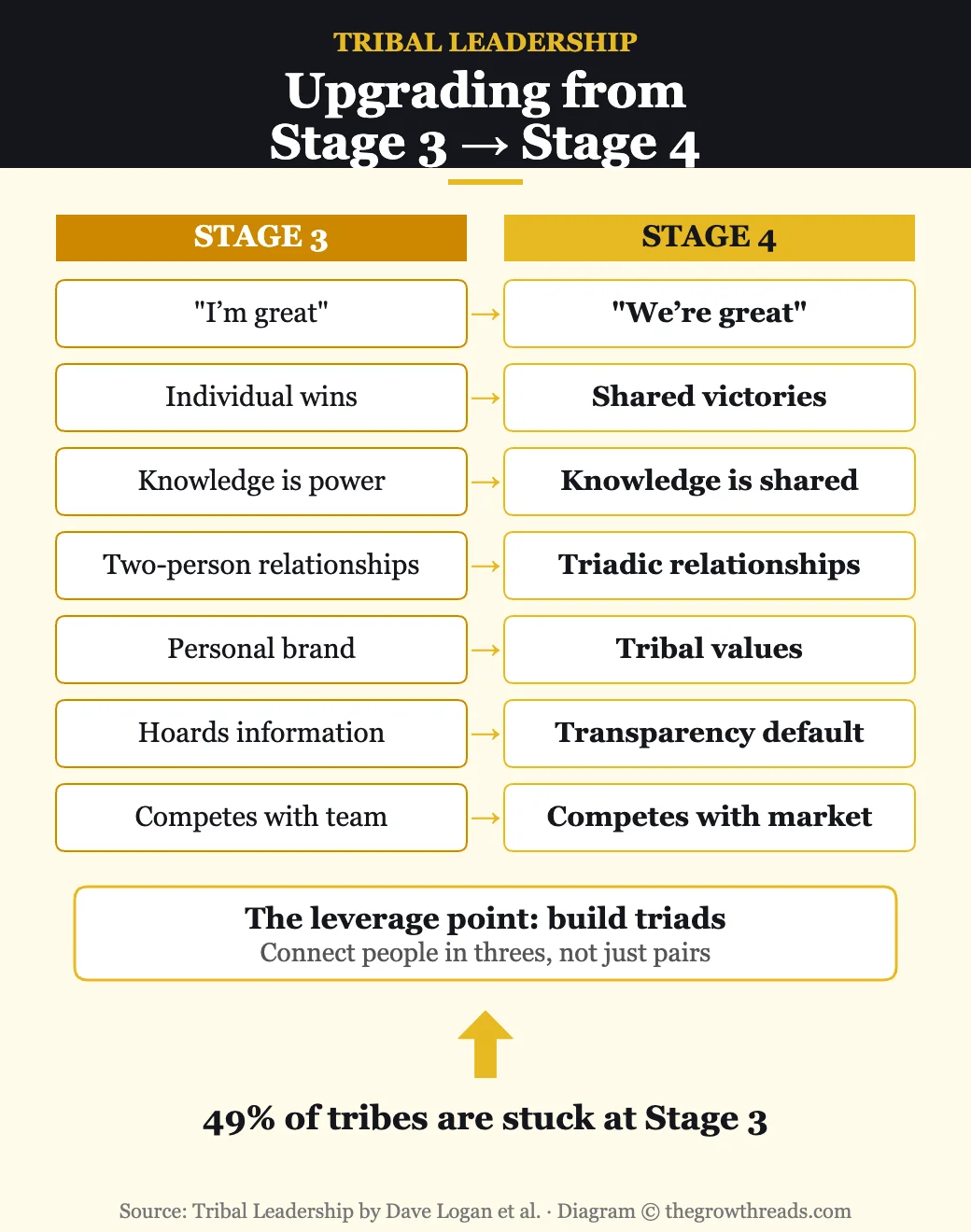
Stage 3 tribes are characterized by dyadic (two-person) relationships. The Stage 3 leader maintains individual connections with each team member, hoards information as a source of power, and positions themselves as the indispensable hub. It works — Stage 3 leaders are often the highest individual performers. But it creates a ceiling: the organization can never outperform the leader’s personal capacity.
The leverage point for upgrading is structural, not motivational. Giving Stage 3 people inspirational speeches about teamwork does not work because their relationship architecture does not support it. Instead, leaders must build triads — introducing people to each other and encouraging three-way working relationships where the leader is not the hub. When a leader connects two team members directly and steps back, the relationship outlives any single person’s involvement.
The authors identify specific language shifts that signal the upgrade is happening: “I did” becomes “we did.” “My project” becomes “our project.” “I need” becomes “the team needs.” Leaders can accelerate this by consistently using tribal language themselves, publicly celebrating team achievements over individual ones, and structuring work around shared goals rather than individual metrics.
They also emphasize the role of shared values. Stage 3 tribes have personal values (each person has their own). Stage 4 tribes have tribal values — explicit, shared principles that everyone references when making decisions. The process of articulating these values together is itself a powerful bonding exercise that shifts identity from “I” to “we.”
Part 3: The noble cause and Stage 4 sustainability
Stage 4 tribes do not just share values — they rally around a noble cause, a purpose bigger than any individual that gives the tribe’s work meaning beyond profit or personal advancement. The noble cause is not a mission statement written by consultants; it is an authentic expression of what the tribe believes it exists to accomplish in the world.
The authors provide examples from their research. A medical center tribe whose noble cause was “We will not let anyone die alone.” A software company whose tribe rallied around “Technology should be as intuitive as a conversation.” These are not corporate slogans — they are deeply felt commitments that guide daily decisions and attract people who share the same fire.
The noble cause serves three functions. First, it provides direction — when the tribe faces a decision, the noble cause acts as a compass. Second, it provides motivation — people work harder and more creatively when they believe their work matters beyond the quarterly report. Third, it provides selection pressure — people who do not share the cause eventually self-select out, while those who do are drawn in.
The authors also address tribal strategy at Stage 4. Unlike traditional strategy (developed by executives and pushed down), tribal strategy emerges from the intersection of the tribe’s values, its noble cause, and its assets (what it has and knows). Strategy sessions become collaborative exercises where the tribe maps its strengths against its purpose and identifies the actions that will have the most impact.
Part 4: Reaching Stage 5 and sustaining culture
Stage 5 is rare, temporary, and cannot be engineered directly. It happens when a strong Stage 4 tribe encounters a challenge or opportunity so significant that the focus shifts from “we’re great” to “life is great” — a sense that the tribe is making history. The original Macintosh team, breakthrough medical research groups, and certain social movements have reached this stage.
The authors caution against trying to skip to Stage 5. Teams that attempt to manufacture a “we’re changing the world” narrative without first building genuine Stage 4 infrastructure fall back quickly, usually to Stage 3. Stage 5 is an emergent property of Stage 4 maturity meeting the right conditions.
The book also addresses the challenge of sustainability. Tribal culture is not a one-time achievement but an ongoing practice. New hires enter at their own stage and must be brought along. External pressures can cause regression (a market downturn might push a Stage 4 tribe back to Stage 3 survival instincts). Leaders must continuously listen for language shifts, maintain triadic relationships, reinforce shared values, and reconnect the tribe to its noble cause.
Who is Tribal Leadership best for — and who should read something else first?
This book is ideal for leaders, managers, founders, and anyone responsible for team culture. It is especially powerful for leaders of Stage 3 organizations who sense that individual talent is high but collective performance is capped. HR professionals, organizational development consultants, and anyone who has ever said “we have great people but they don’t work well together” will find the framework immediately diagnostic.
If you are looking for a more personal leadership framework, start with Leaders Eat Last by Simon Sinek. If your challenge is team dysfunction rather than culture staging, The Five Dysfunctions of a Team by Patrick Lencioni is more targeted. And if you want to understand how to build culture during rapid growth, The Hard Thing About Hard Things by Ben Horowitz offers complementary war stories.
Questions to reflect on
- What stage is your current team or organization operating at — and what language patterns give you that diagnosis?
- If you are at Stage 3, who are two people you could introduce to each other to begin building a triad?
- Does your team have explicitly shared values that people actually reference when making decisions — or are the values just words on a wall?
- What would your tribe’s noble cause be if you articulated it honestly — not as a corporate slogan but as a genuine shared commitment?
- Are you personally operating as a Stage 3 “I’m great” leader, or have you genuinely shifted to “we’re great” thinking?
🔥 Ready to upgrade your tribe’s culture?
Learn the five-stage framework that has transformed organizations from competing individuals into unstoppable teams.
How to apply Tribal Leadership (7-day plan)
- Day 1 — Diagnose the stage: Listen to the language your team uses today. Count how many times you hear “I/me/my” versus “we/us/our.” This tells you whether you are at Stage 3 or Stage 4.
- Day 2 — Map your relationships: Draw your team’s relationship map. Are most connections dyadic (two-person, with you at the hub)? Identify two people you could introduce to each other directly.
- Day 3 — Build your first triad: Connect two team members on a shared project or problem. Step back and let them develop a direct relationship without you as intermediary.
- Day 4 — Shift your language: Consciously replace “I” with “we” in every work conversation. Instead of “I need this done,” say “the team needs this.” Notice how it changes the response.
- Day 5 — Surface shared values: Ask three team members individually: “What do you think this team stands for at its best?” Compare answers to find the overlapping values.
- Day 6 — Draft a noble cause: Based on the values you surfaced, write a one-sentence noble cause — what your team exists to accomplish beyond profit. Share it with one trusted colleague for feedback.
- Day 7 — Celebrate a “we” win: Identify a recent success that was genuinely collaborative. Publicly celebrate it as a team achievement, naming specific contributions from multiple people. Notice how this shifts the energy.
Frequently asked questions
What are the five stages of tribal leadership?
Stage 1 (“Life sucks”) is hostile and despairing, representing about 2% of workplaces. Stage 2 (“My life sucks”) is apathetic and disconnected, at 25%. Stage 3 (“I’m great, you’re not”) is individual competition, the dominant stage at 49%. Stage 4 (“We’re great”) is tribal pride and shared values, at 22%. Stage 5 (“Life is great”) is rare and temporary, where tribes feel they are making history, at about 2%.
What is a triad in Tribal Leadership?
A triad is a three-person relationship where all three people have direct connections to each other, as opposed to a dyad (two-person relationship) where a leader serves as the hub. Triads are the structural building block of Stage 4 culture because they create stability (if one person leaves, the relationship survives), natural accountability, and a “we” identity that transcends individual connections. Building triads is the primary leverage point for upgrading from Stage 3 to Stage 4.
How do you know what stage your team is at?
Listen to the language. Stage 2 people say “my life sucks” and express apathy. Stage 3 people say “I” frequently, talk about personal achievements, and hoard knowledge. Stage 4 people say “we,” reference shared values, and celebrate team wins. The words people use are the most reliable diagnostic — not what they say in meetings, but how they talk in hallways, emails, and casual conversations. The dominant language pattern reveals the operating stage.
Why is Stage 3 so common and hard to leave?
Stage 3 is seductive because it works at the individual level. High-performing individuals get promoted, recognized, and rewarded. The “I’m great” mindset produces visible personal results, which reinforces the behavior. Leaving Stage 3 means surrendering individual credit for collective impact — a trade that feels risky and counterintuitive, especially in organizations that reward individual metrics. The trap is that Stage 3 success creates a ceiling that only becomes visible when collective challenges exceed any individual’s capacity.
What is a noble cause?
A noble cause is a purpose bigger than any individual that gives the tribe’s work meaning beyond profit or personal advancement. It is not a corporate mission statement but an authentic expression of what the tribe believes it exists to accomplish. A noble cause provides direction for decisions, motivation beyond quarterly targets, and selection pressure that attracts aligned people and naturally repels misaligned ones. It is the organizing principle that sustains Stage 4 culture over time.
Can you skip stages?
No. The authors are emphatic that people and tribes can only move one stage at a time. A Stage 2 person cannot leap directly to Stage 4 because they lack the intermediate skills and identity shifts. Each stage provides the foundation for the next. A Stage 2 to Stage 3 upgrade requires finding personal competence. Stage 3 to Stage 4 requires surrendering individual glory for collective purpose. Attempting to skip stages produces superficial compliance without genuine cultural change.
How does Tribal Leadership compare to The Five Dysfunctions of a Team?
The Five Dysfunctions of a Team by Patrick Lencioni diagnoses specific team breakdowns — absence of trust, fear of conflict, lack of commitment, avoidance of accountability, and inattention to results. Tribal Leadership provides a broader cultural framework that explains why those dysfunctions occur (they are symptoms of Stage 3 culture) and offers a structural solution (triads, shared values, noble cause). Lencioni is more tactical; Logan is more architectural. Together they give leaders both the diagnosis and the cultural infrastructure to fix it.
Related summaries
- Start With Why by Simon Sinek — How purpose inspires followers, complementing the noble cause framework.
- Good to Great by Jim Collins — Level 5 Leadership as the individual counterpart to tribal culture stages.
- The Five Dysfunctions of a Team by Patrick Lencioni — Diagnosing and fixing the breakdowns that Stage 3 culture creates.
- Leaders Eat Last by Simon Sinek — Creating the safety and trust that enable Stage 4 tribal culture.
Explore more: 📚 Best Leadership Books