

★★★★½ 4.5/5 — “The playbook for the conversation you keep putting off because you don’t want to sound like a nag — or a pushover.”
Best for: managers, team leads, parents, and roommates who need to raise a broken promise without a blowup
Reading time: Book ~5.5 hrs · This guide ~14 min
Difficulty to apply: Moderate — the diagnosis takes discipline; the conversation itself is short
Crucial Accountability in one minute
Crucial Accountability is the companion volume to Crucial Conversations, built entirely around one recurring moment: someone broke a promise, missed a deadline, or behaved badly, and now you have to say something. Kerry Patterson, Joseph Grenny, Ron McMillan, and Al Switzler argue that most people botch this moment before they’ve said a single word, because they skip straight to the confrontation without diagnosing what actually happened. Was it a one-time slip or a pattern? Is trust itself now in question? And underneath all of that — is this really a “won’t” (they don’t want to) or a “can’t” (they’re not able to)? Get the diagnosis right, and the conversation that follows is almost always short, calm, and effective. Get it wrong, and even a well-intentioned conversation turns into either a fight or another swallowed resentment.
Key takeaways
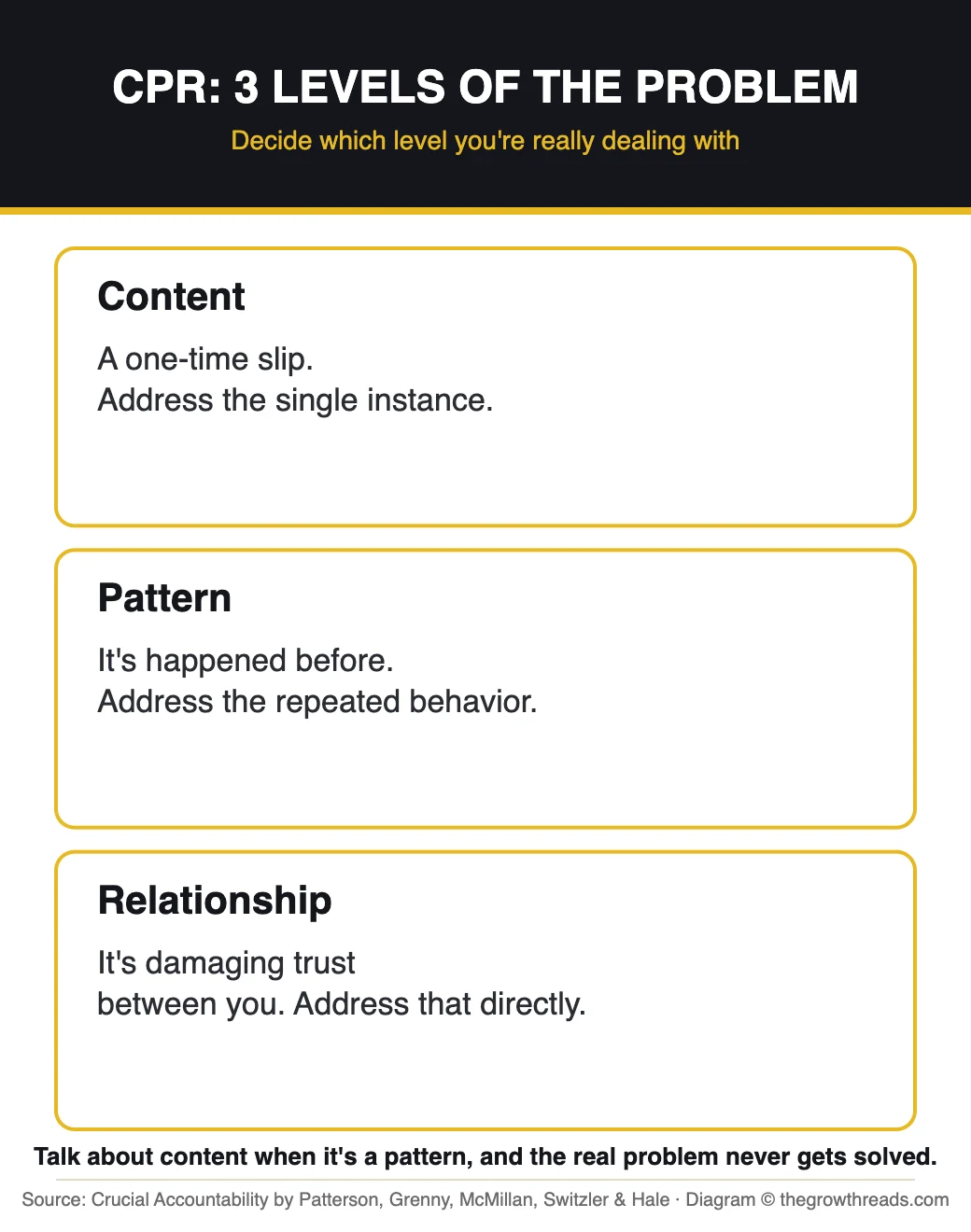
- Every broken promise sits at one of three levels — CPR: Content (a one-time slip), Pattern (it keeps happening), or Relationship (it’s damaging trust) — and the right level determines what you should actually say.
- Diagnose “won’t” versus “can’t” before you open your mouth: confronting a can’t problem as if it were a won’t problem guarantees the conversation fails.
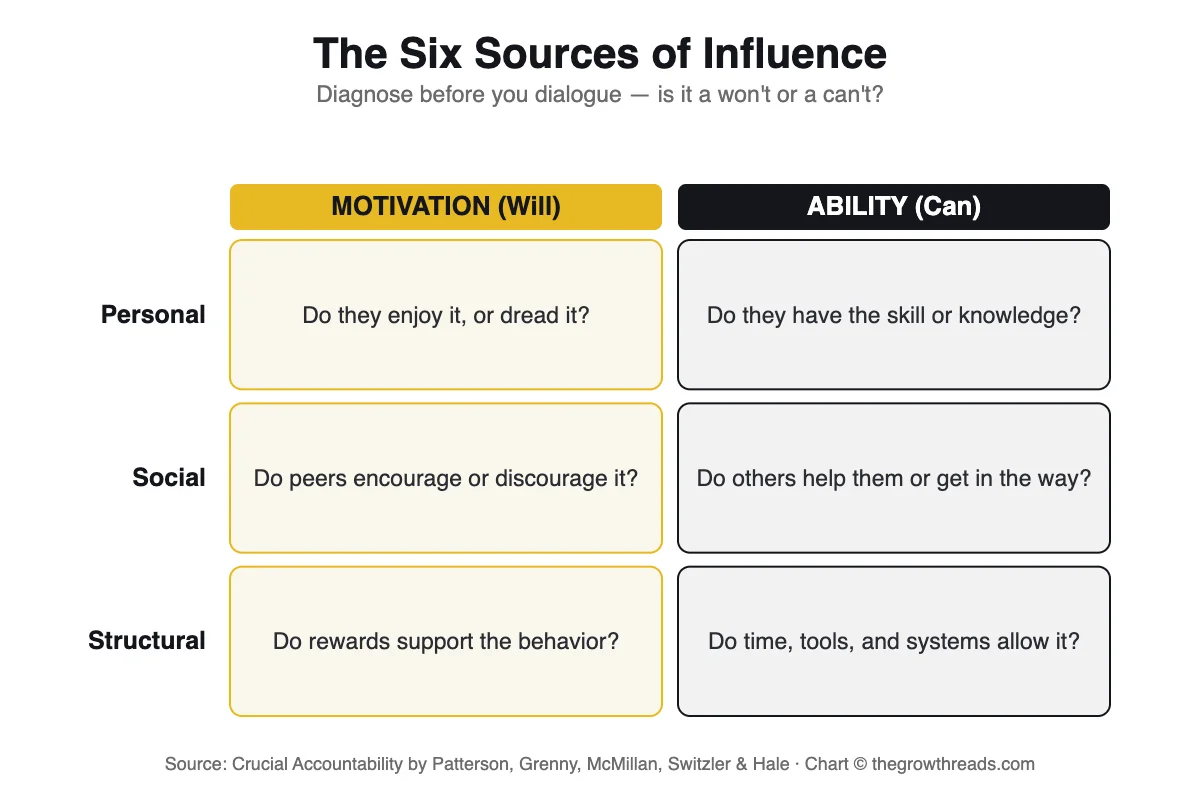
- The Six Sources of Influence crosses that motivation/ability question with three levels — Personal, Social, Structural — giving six possible root causes for any single broken promise.
- Most people default to “they just don’t care”: a Personal Motivation story is the simplest explanation, which is exactly why it’s reached for even when it’s rarely the true one.
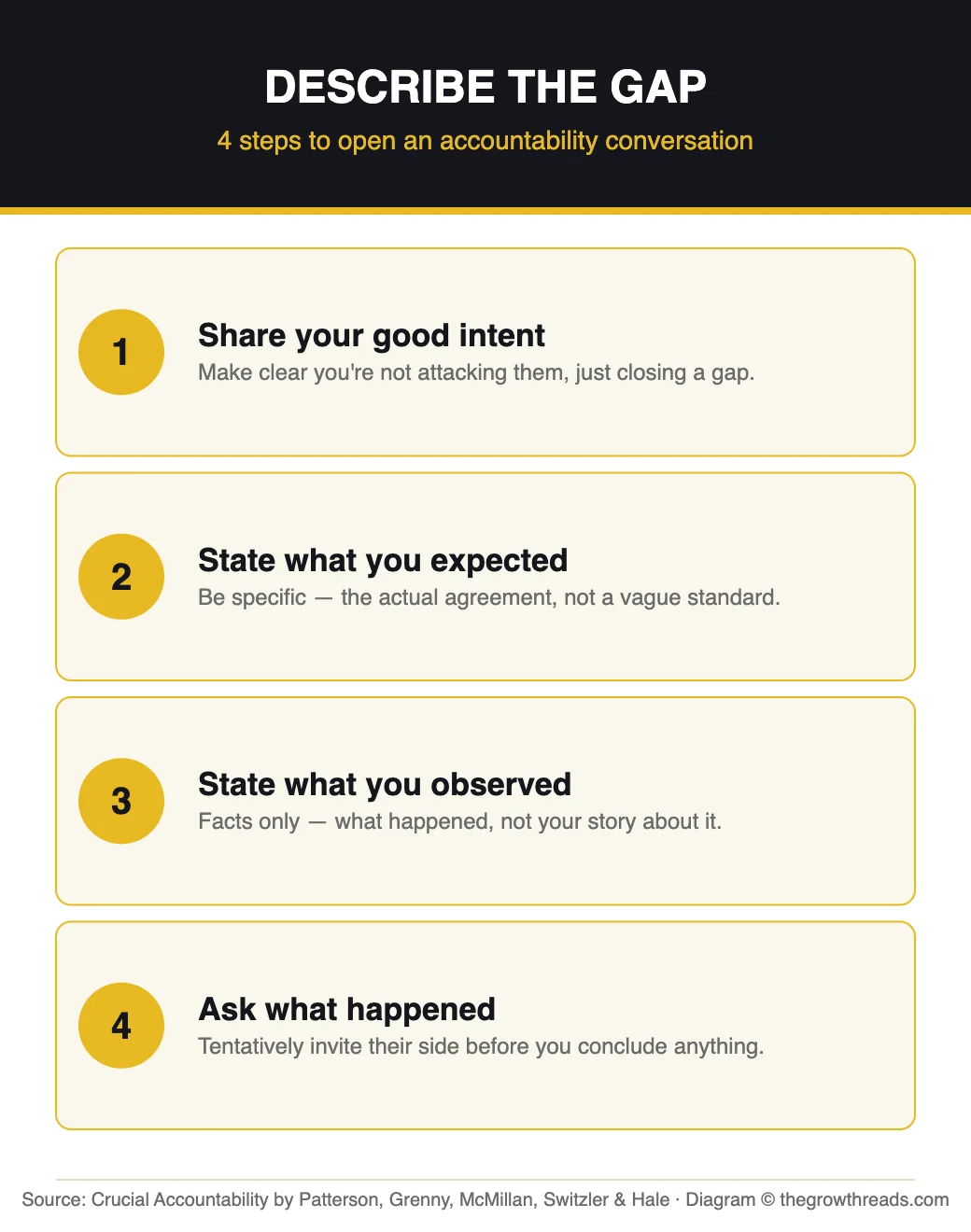
- Open the conversation by Describing the Gap: share your good intent, state what you expected, state what you observed, then ask what happened — all before any judgment.
- Keep the gap in facts, not conclusions: “the report was due Friday and it’s Wednesday,” not “you don’t respect my time.”
- CPR maps to timing: address Content immediately and briefly, elevate to Pattern once it’s recurring, and only escalate to Relationship once trust itself is genuinely in question.
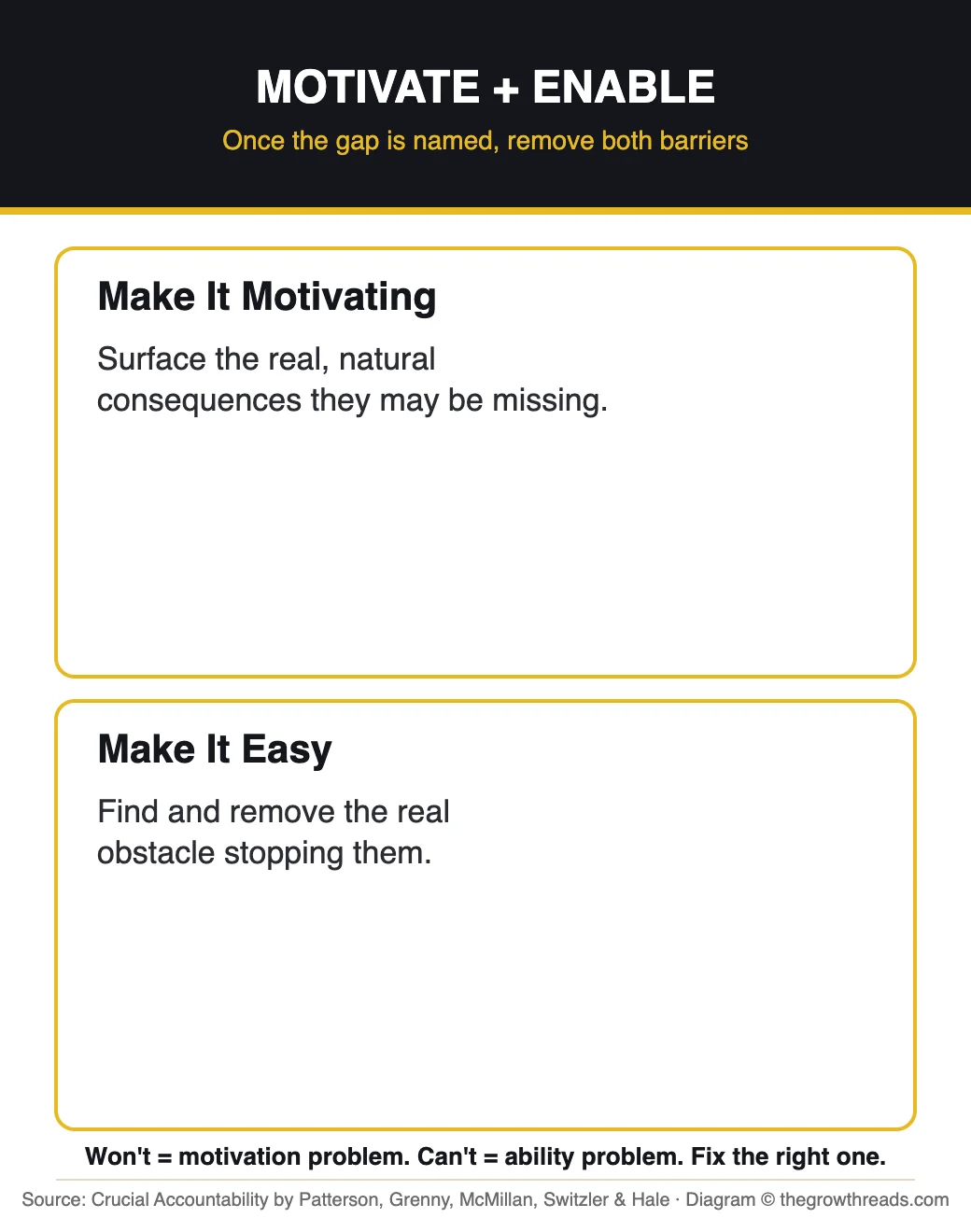
- Make It Motivating means surfacing real consequences the other person hasn’t connected to their own behavior — not manufacturing new threats.
- Make It Easy means removing the actual obstacle: willpower can’t fix a broken process, a missing tool, or an unclear instruction.
- The conversation isn’t finished until you agree on a follow-up date — without one, the same gap almost always reopens within weeks.
What is Crucial Accountability about?
Crucial Accountability is a framework by Kerry Patterson, Joseph Grenny, Ron McMillan, and Al Switzler for holding someone accountable — for a broken promise, a missed deadline, or bad behavior — by diagnosing why the gap happened before you say anything, then opening the conversation with facts instead of judgment.
About the authors
Kerry Patterson, Joseph Grenny, Ron McMillan, and Al Switzler are the same team behind Crucial Conversations, and co-founded what is now Crucial Learning (formerly VitalSmarts) around a single research question: why do some people hold others accountable without either avoiding the issue or turning it into a fight? The book began life in 2004 as Crucial Confrontations, built on the same years of observing real “influencers” that produced Crucial Conversations, then was substantially revised and retitled Crucial Accountability for its second edition, with David Maxfield joining as a co-author, and updated again for a third edition with Justin Hale. Where Crucial Conversations covers any high-stakes, emotional discussion, this book narrows the lens to one specific and universal moment — someone didn’t do what they said they’d do — and builds an entire diagnostic and conversational method around it.
Key concepts at a glance
| Concept | What it means | Use it when |
|---|---|---|
| CPR (Content, Pattern, Relationship) | The three levels a broken promise can sit at | Before you decide what to say |
| Won’t vs. Can’t | Is this a motivation problem or an ability problem? | The instant you notice a gap |
| Six Sources of Influence | Personal, Social, Structural causes, each split by motivation and ability | The obvious explanation doesn’t fit |
| Describe the Gap | Share intent, state expected, state observed, ask what happened | Opening any accountability conversation |
| Make It Motivating | Surfacing real consequences the other person is missing | The problem is genuinely a “won’t” |
| Make It Easy | Removing the real obstacle in their way | The problem is genuinely a “can’t” |
| Follow-up | A specific date to check whether the gap closed | The end of every accountability conversation |
Part 1: Why Most Accountability Conversations Fail Before They Start
The book opens with a claim that sounds almost too simple: most accountability conversations don’t fail because of how they’re delivered — they fail because the wrong conversation was chosen in the first place. Every broken promise sits at one of three levels, and the authors give this the shorthand CPR. Content is a one-time slip — someone missed a single deadline, showed up late once, or dropped one ball. Pattern is the same behavior recurring — this is the third time the report has been late, not the first. Relationship is the most serious level: the repeated pattern has started to damage trust itself, and the conversation is no longer really about deadlines at all, but about whether you can rely on this person going forward.
Choosing the wrong level backfires in both directions. Treat a Pattern as if it were a one-off Content issue — a quiet, isolated comment each time — and you train the other person to expect no real consequence, while your own frustration quietly compounds in the background until it eventually erupts disproportionately over what looks, to them, like a minor issue. Treat a single Content slip as if it were already a Relationship crisis — reacting to one late report as evidence the person “can’t be trusted” — and you damage a relationship that didn’t need damaging over what may genuinely have been a one-time, understandable event. The skill, the authors argue, starts before any words are spoken: correctly naming which of the three levels you’re actually dealing with.
TGR Note: The CPR framework is really a claim about timing — say the small thing early, before it becomes the big thing. That’s also the argument at the heart of our It’s Your Ship summary, where a Navy crew’s willingness to flag small problems immediately is what prevented them from ever becoming Relationship-level failures.
Part 2: Diagnose Before You Dialogue
The authors illustrate the grid with a deceptively ordinary example: a warehouse team that keeps missing shipping deadlines. The easy, Personal Motivation story is that the crew doesn’t care about deadlines anymore. But walking the Six Sources grid surfaces other possibilities that a rushed manager would otherwise skip past entirely — a Structural Ability issue (the scanning equipment is outdated and frequently fails), a Social Motivation issue (a senior team member openly jokes about deadlines being “corporate nonsense,” quietly giving everyone else permission to care less), and a Personal Ability issue (two newer hires were never actually trained on the priority-sorting system). None of these show up if the manager walks in assuming laziness, and each one requires a genuinely different conversation and a genuinely different fix.
Once you know which level you’re dealing with, the book’s second core skill is refusing to guess at why the gap happened. The master question is deceptively simple — is this a “won’t” or a “can’t”? — but the authors found that almost everyone skips it and jumps straight to “they just don’t care,” because it’s the easiest story available, not because it’s usually true. To force a more rigorous diagnosis, the book crosses that motivation/ability question against three levels of cause, producing six possible sources for any single broken promise: Personal (do they, individually, want to and know how to?), Social (do the people around them encourage or undermine the behavior?), and Structural (do the systems, incentives, and tools they work within support it or fight it?).
The value of the grid is that it forces you to rule out cheap explanations before you commit to an expensive conversation. A report that’s late every month might look like Personal Motivation — “they don’t care about deadlines” — but the Six Sources model asks you to check the other five boxes first: does anyone else on the team quietly reinforce lateness as normal (Social Motivation)? Is the report genuinely hard to produce with the tools and access they’ve been given (Structural Ability)? Do they simply not know the report is due monthly rather than quarterly (Personal Ability)? Skipping this diagnostic step is, according to the authors, the single most common reason accountability conversations misfire — you deliver a perfectly well-executed conversation aimed at entirely the wrong cause.
TGR Note: This diagnostic step assumes you already have the underlying dialogue skills — staying safe, watching for Silence and Violence, and reading your own stories accurately. If those terms are new to you, our Crucial Conversations summary covers the foundational skill this book builds on and applies specifically to broken promises.
Part 3: Describe the Gap
The authors also warn against a common shortcut: skipping straight to a solution before the other person has answered the “what happened” question at all. It’s tempting, once you’ve noticed a gap, to arrive with a fix already prepared — a new deadline, a new process, a stern warning — but doing so forecloses exactly the information Describe the Gap is designed to surface. A manager who assumes a missed deadline is laziness and responds with a stricter deadline will get the same result next month if the real problem was a dependency on another team that never delivered its input on time. The four-step sequence isn’t a script to recite mechanically; it’s a discipline for staying curious one full step longer than instinct wants you to.
With a diagnosis in hand, the book gives a short, repeatable structure for opening the actual conversation: Describe the Gap. First, share your good intent — a brief line making clear you’re raising this to solve a problem together, not to attack them. Second, state what you expected, specifically — the actual agreement or standard, not a vague sense that something felt off. Third, state what you observed, strictly as fact: what happened, when, and how you know, without any interpretation folded in. Fourth, ask what happened, tentatively and genuinely, inviting their account before you draw any conclusion.
The discipline here is keeping the “expected” and “observed” statements to pure facts rather than conclusions — “the report was due Friday and it arrived Wednesday of the following week” instead of “you don’t respect my time” or “you’re not committed to this team.” Facts are hard to argue with and rarely trigger defensiveness; conclusions about character almost always do, even when they happen to be accurate. The authors also note that the fourth step — asking what happened — is where most of the useful information in the entire conversation actually surfaces, and it frequently reveals that a problem assumed to be a “won’t” was, all along, a “can’t”: a tool that broke, an instruction that was genuinely ambiguous, a competing priority nobody had resolved.
Part 4: Make It Motivating, Make It Easy, and Follow Up
One nuance the book spends real time on is that most real gaps aren’t purely one or the other — a chronically late report might be 70 percent a structural problem (a data source that’s genuinely hard to access) and 30 percent a motivational one (the person has stopped believing anyone reads the report anyway). Treating it as entirely a motivation problem wastes the conversation on urgency and consequences the person already understands, while ignoring the access issue that’s been quietly making the deadline nearly impossible to hit. The authors recommend addressing the largest and most fixable source first, then checking whether the gap actually closes before assuming a second, smaller cause needs its own separate conversation.
Once the gap has been described and the real cause understood, the book splits the response into two paths that map directly back to the won’t/can’t diagnosis. If the problem is genuinely a motivation issue, Make It Motivating means surfacing consequences the other person hasn’t fully connected to their own behavior — not manufacturing new threats or punishments, but making the real, natural stakes visible: what actually happens to the team, the customer, or their own reputation if the pattern continues. If the problem is genuinely an ability issue, Make It Easy means identifying and removing the specific obstacle — a missing skill, a broken tool, an unclear process, or a competing demand on their time — because no amount of motivation talk fixes a problem that was never about willpower.
The final and, in the authors’ view, most frequently skipped step is agreeing on follow-up. A crucial accountability conversation that ends with mutual understanding but no specific date to check back in almost always reopens the same gap within weeks, because the accountability quietly evaporates the moment the conversation ends. The book’s guidance is blunt: name a specific time to follow up before the conversation is considered closed, and treat a second broken promise about the follow-up itself as a new, and often more serious, accountability conversation in its own right.
TGR Note: Consistent, fair follow-up on small commitments is exactly the kind of trust-building behavior described in our The 5 Levels of Leadership summary — Maxwell’s argument is that influence is earned level by level, and this book’s follow-up discipline is one of the concrete daily habits that earns it.
Who is Crucial Accountability best for — and who should read something else first?
This book is built for anyone who has to hold someone else accountable regularly: managers giving performance feedback, team leads chasing recurring missed deadlines, parents dealing with a teenager’s broken curfew, or roommates renegotiating chores for the third time. It assumes the issue is a specific, nameable gap between what was expected and what happened — its job is diagnosing why the gap happened and giving you the words to close it.
If your real challenge is a single high-stakes, emotionally loaded conversation rather than a recurring broken promise — a difficult negotiation, a painful piece of feedback, a conflict rooted in opposing values — start with our Crucial Conversations summary instead, which covers the broader dialogue skills this book assumes you already have.
Questions to reflect on
- Think of a broken promise you haven’t addressed yet. Is it really Content, Pattern, or Relationship — and have you been treating it as the wrong level?
- Before assuming “they don’t care,” which of the other five sources of influence haven’t you actually checked?
- When you picture raising this, are you leading with a fact (“the report was late”) or a conclusion (“you don’t care”)?
- Is this genuinely a “won’t” or a “can’t” — and what evidence do you have either way, beyond your first instinct?
- If you had this conversation well, what specific follow-up date would you set before considering it closed?
🔥 Ready to close the gap without the blowup?
Crucial Accountability gives you the diagnosis and the words — get the book and use the 7-day plan below to try it on one real gap this week.
How to apply Crucial Accountability (7-day plan)
- Day 1: Pick one broken promise you’ve been avoiding, and name whether it’s Content, Pattern, or Relationship.
- Day 2: Run it through the Six Sources grid — Personal, Social, Structural, each against motivation and ability — before settling on a cause.
- Day 3: Write out your Describe the Gap opening: good intent, expected, observed, and the question you’ll ask.
- Day 4: Strip every conclusion out of your “observed” statement, leaving only facts a video camera could have recorded.
- Day 5: Rehearse the conversation once, out loud or with a colleague, watching for judgment sneaking back into your language.
- Day 6: Have the actual conversation, ending with either Make It Motivating or Make It Easy, matched to your real diagnosis.
- Day 7: Set and calendar a specific follow-up date — the conversation isn’t done until this step is scheduled.
Frequently asked questions
What does CPR stand for in Crucial Accountability?
CPR stands for Content, Pattern, and Relationship — the three levels a broken promise can occupy. Content is a single, one-time slip. Pattern is the same behavior recurring over time. Relationship is the most serious level, where the repeated pattern has started to damage trust between the two people, and the conversation is no longer really about the specific incident but about reliability itself. The book argues that naming the correct level before speaking is what determines whether the conversation actually resolves anything.
What’s the difference between a “won’t” and a “can’t” problem?
A “won’t” problem is a motivation issue — the person is capable of doing what was expected but isn’t sufficiently motivated to do it. A “can’t” problem is an ability issue — the person wants to meet the expectation but lacks the skill, resources, or support to do so. Confronting a can’t problem with motivational pressure, or a won’t problem by simply removing obstacles, both fail, which is why the book insists on diagnosing which one you’re actually facing before choosing your response.
What are the Six Sources of Influence?
The Six Sources of Influence cross the won’t/can’t question against three levels of cause: Personal (the individual’s own desire and skill), Social (whether people around them encourage or undermine the behavior), and Structural (whether systems, incentives, and tools support or block it). Each level splits into a motivation and an ability question, producing six possible root causes for any single broken promise, and the model is designed to stop people from settling on the first, simplest explanation.
How do you “Describe the Gap” without sounding accusatory?
The book’s structure is to share your good intent first, then state what you expected and what you observed as pure, verifiable facts — not conclusions about the other person’s character or motives — before asking what happened. Saying “the report was due Friday and arrived Wednesday of the following week” states a fact; saying “you don’t respect deadlines” states a conclusion. Facts rarely trigger defensiveness on their own, while conclusions about character almost always do, even when they turn out to be accurate.
Is this the same book as Crucial Conversations?
No, though they’re companion volumes by the same authors and built on the same underlying research. Crucial Conversations covers any high-stakes, emotionally charged discussion where opinions differ. Crucial Accountability narrows the focus specifically to the moment someone has broken a promise, missed an expectation, or behaved badly, adding a diagnostic layer — CPR and the Six Sources of Influence — that Crucial Conversations doesn’t cover in the same depth.
Why does the book insist on scheduling a follow-up date?
The authors found that accountability conversations which end with mutual understanding but no specific follow-up date tend to quietly reopen the same gap within weeks, because the sense of accountability fades the moment the conversation ends. Naming a concrete date to check in keeps the agreement active rather than symbolic, and treating a second missed follow-up as its own accountability conversation prevents the pattern from being silently tolerated a second time.
Can this framework be used at home, not just at work?
Yes — the authors deliberately include examples involving family members, roommates, and friends alongside workplace scenarios, because broken promises and missed expectations follow the same CPR pattern at home as they do at the office. Many readers find the Describe the Gap structure particularly useful in personal relationships, where accusatory language (“you never help around here”) is common and the shift to stating expected versus observed facts changes the tone of the conversation immediately.
Related summaries
- Crucial Conversations Summary & Review
- The 5 Levels of Leadership Summary & Review
- It’s Your Ship Summary & Review
- Built to Last Summary & Review
- Best Leadership Books
How we analyze books: every TGR summary is built from a full read of the source material, cross-checked against the authors’ interviews and other research on the same topic, then structured around what you can actually apply — not just what the book says. Read our full methodology.
Related Leadership Summaries
High Output Management Summary & Review: Andy Grove’s Playbook for Multiplying Your Impact
The Coaching Habit Summary & Review: Say Less, Ask More, Lead Better
The Motive Summary & Review: Why You Lead Matters Most
The No Asshole Rule Summary and Review
Tribal Leadership Summary & Review: Upgrade Your Team from Stage 3 to Stage 4