

⭐⭐⭐⭐ 4.0/5 — The relationship framework that has helped 20 million couples understand each other.
Best for: Couples who feel disconnected despite trying hard — and anyone who wants to love in a way their partner actually feels.
Reading time: ~4 hrs
Difficulty to apply: Low — the framework is simple, but consistency requires ongoing attention to your partner’s needs.
The 5 Love Languages in one minute
You and your partner are probably speaking different love languages — and neither of you realizes it. Gary Chapman, a marriage counselor with over 40 years of experience, observed that relationship dissatisfaction almost always traces back to the same root cause: partners expressing love in ways the other person does not recognize as love. Chapman identified five distinct love languages — Words of Affirmation, Quality Time, Receiving Gifts, Acts of Service, and Physical Touch — and showed that each person has a primary language that fills their emotional “love tank.” When you express love in your own language rather than your partner’s, the effort goes unnoticed. When you learn to speak their language, even small gestures create deep connection. The book has sold over 20 million copies because the framework is simple, immediately applicable, and produces results that couples can feel within days.
Key takeaways
- Everyone has a primary love language: Just as people have a native spoken language, each person has a primary way they give and receive emotional love. Speaking that language fills their emotional tank; ignoring it leaves them feeling empty regardless of your intentions.
- Love is a choice, not just a feeling: Chapman distinguishes between the “in-love” experience (which is temporary and involuntary) and genuine love (which is a daily choice to meet your partner’s emotional needs). Lasting relationships are built on the latter.
- Your love language is usually different from your partner’s: This mismatch is the most common source of relationship frustration. You may be working overtime to show love through acts of service while your partner is starving for quality time.
- Words of Affirmation people need verbal recognition: Compliments, encouragement, gratitude, and kind words fill their tank. Criticism and harsh language empty it faster than anything else.
- Quality Time people need undivided attention: Being physically present is not enough — they need you to be emotionally present, engaged in conversation, and actively sharing experiences together. Distraction is their kryptonite.
- Receiving Gifts people value thoughtfulness: The gift itself matters less than the thought behind it. A handpicked wildflower can mean more than an expensive piece of jewelry if it shows you were thinking of them.
- Acts of Service people feel loved through action: Doing the dishes, running errands, fixing things around the house — these practical demonstrations say “I love you” louder than any words. Broken promises and laziness devastate them.
- Physical Touch people need physical connection: Holding hands, hugs, sitting close, and sexual intimacy are how they feel secure. Physical neglect or abuse is the ultimate betrayal of their love language.
- Your complaints reveal your love language: What you most frequently complain about in your relationship is usually a direct indicator of your unmet primary love language. Complaints are unmet needs in disguise.
- The love tank must be continuously filled: Love is not a one-time event. Like a car’s fuel tank, the emotional love tank depletes over time and must be regularly refilled through consistent acts in your partner’s primary language.

What is The 5 Love Languages about?
The 5 Love Languages identifies five distinct ways people express and receive emotional love: Words of Affirmation, Quality Time, Receiving Gifts, Acts of Service, and Physical Touch. Gary Chapman argues that relationship dissatisfaction usually stems from partners speaking different love languages, and provides a framework for identifying your own language and learning to speak your partner’s.
About the author
Gary Chapman is a pastor, speaker, and marriage counselor who has been working with couples for over four decades. He holds a PhD in adult education from Southwestern Baptist Theological Seminary and has served as a senior associate pastor at Calvary Baptist Church in Winston-Salem, North Carolina, where he continues to lead marriage enrichment seminars. The 5 Love Languages, first published in 1992, grew out of years of counseling sessions where Chapman noticed the same patterns of miscommunication recurring across thousands of couples. The book has since spawned an entire franchise, including editions for singles, children, teens, military families, and the workplace, and has been translated into 50 languages. Explore all Gary Chapman book summaries →
Key concepts at a glance
| Concept | What it means | Use it when |
|---|---|---|
| Love tank | An emotional reservoir that fills when you receive love in your primary language | Your partner seems distant, irritable, or dissatisfied despite your efforts |
| Primary love language | The one language that communicates love most deeply to you | You want to understand what your partner truly needs to feel loved |
| In-love experience | The temporary, euphoric phase of a new relationship (typically 2 years) | The initial excitement fades and you wonder if you married the right person |
| Love as a choice | After the in-love phase, love becomes a deliberate daily decision | You do not “feel” in love but want to build a lasting relationship |
| Dialects | Specific variations within each language (e.g., public vs. private words) | You know your partner’s language but want to fine-tune how you speak it |
| Bilingual lovers | Some people have two equally strong love languages | You cannot narrow down to a single primary language for yourself or your partner |
Part 1: Why love fades — and how to bring it back
Chapman opens with a distinction that many readers find immediately clarifying: the difference between the “in-love” experience and genuine love. The in-love experience — the butterflies, the obsessive thinking, the sense that this person is perfect — is a temporary, biologically driven state that typically lasts 18 to 24 months. It is involuntary, effortless, and ultimately unsustainable. When it fades, couples often conclude they have “fallen out of love” and begin looking for the exit.
Chapman argues this is a tragic misunderstanding. The end of the in-love phase is not the end of love — it is the beginning of real love. Real love is not a feeling; it is a choice to meet your partner’s emotional needs even when you do not feel like it. This requires knowing how your partner experiences love, which is where most couples go wrong. They assume their partner experiences love the same way they do, and when their efforts go unrecognized, both partners end up feeling unloved despite trying hard.
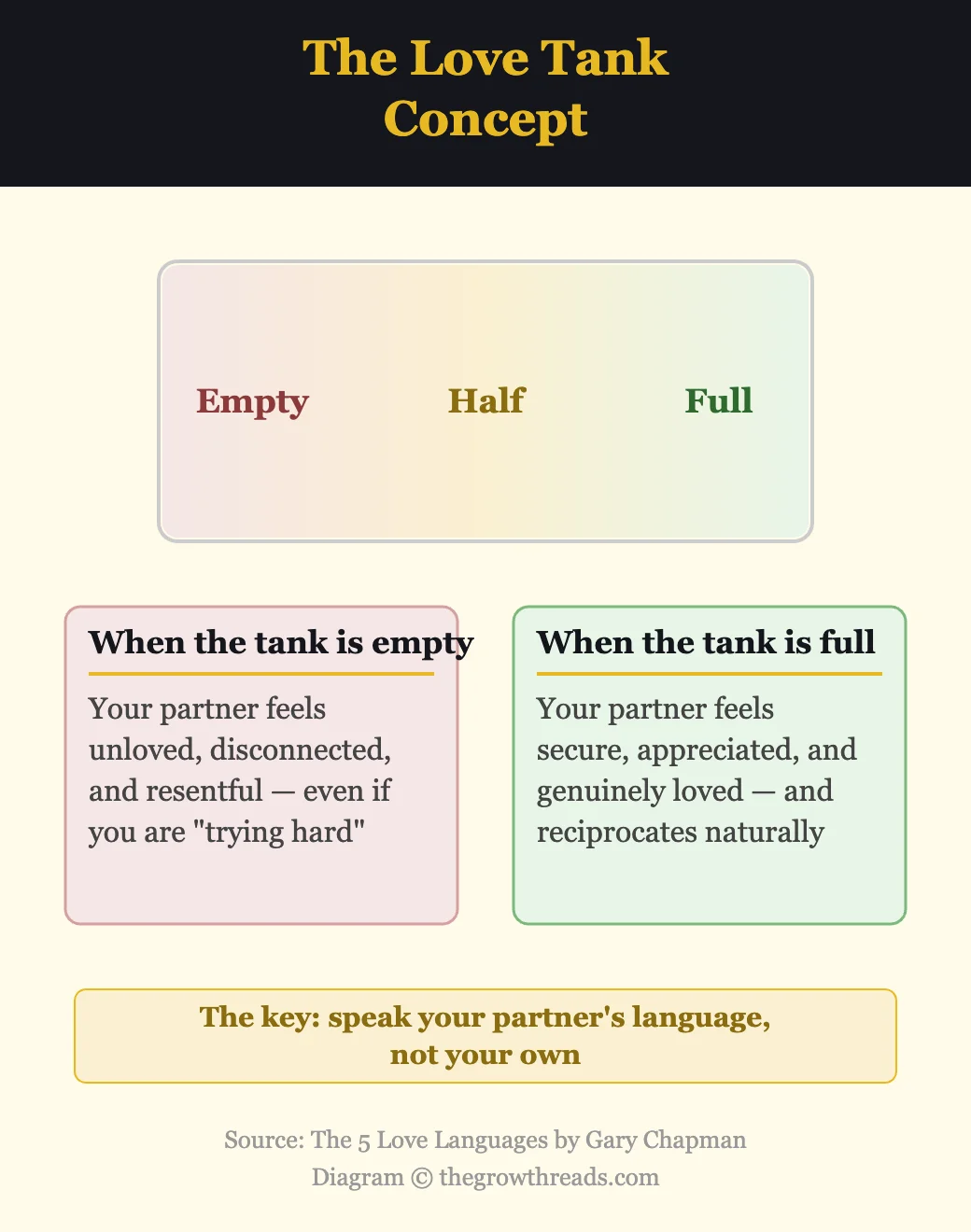
The “love tank” metaphor anchors the entire book. Chapman asks readers to imagine that every person carries an emotional fuel tank. When the tank is full — when they feel genuinely loved — they function well, relate warmly, and reciprocate generosity. When the tank is empty — when they feel unloved despite their partner’s efforts — they become withdrawn, critical, or resentful. The key insight is that the tank can only be filled by love expressed in the person’s primary language. Pouring love in the wrong language is like pouring water into a car’s gas tank — it is effort, but it does not fuel anything.
Part 2: The five languages explained
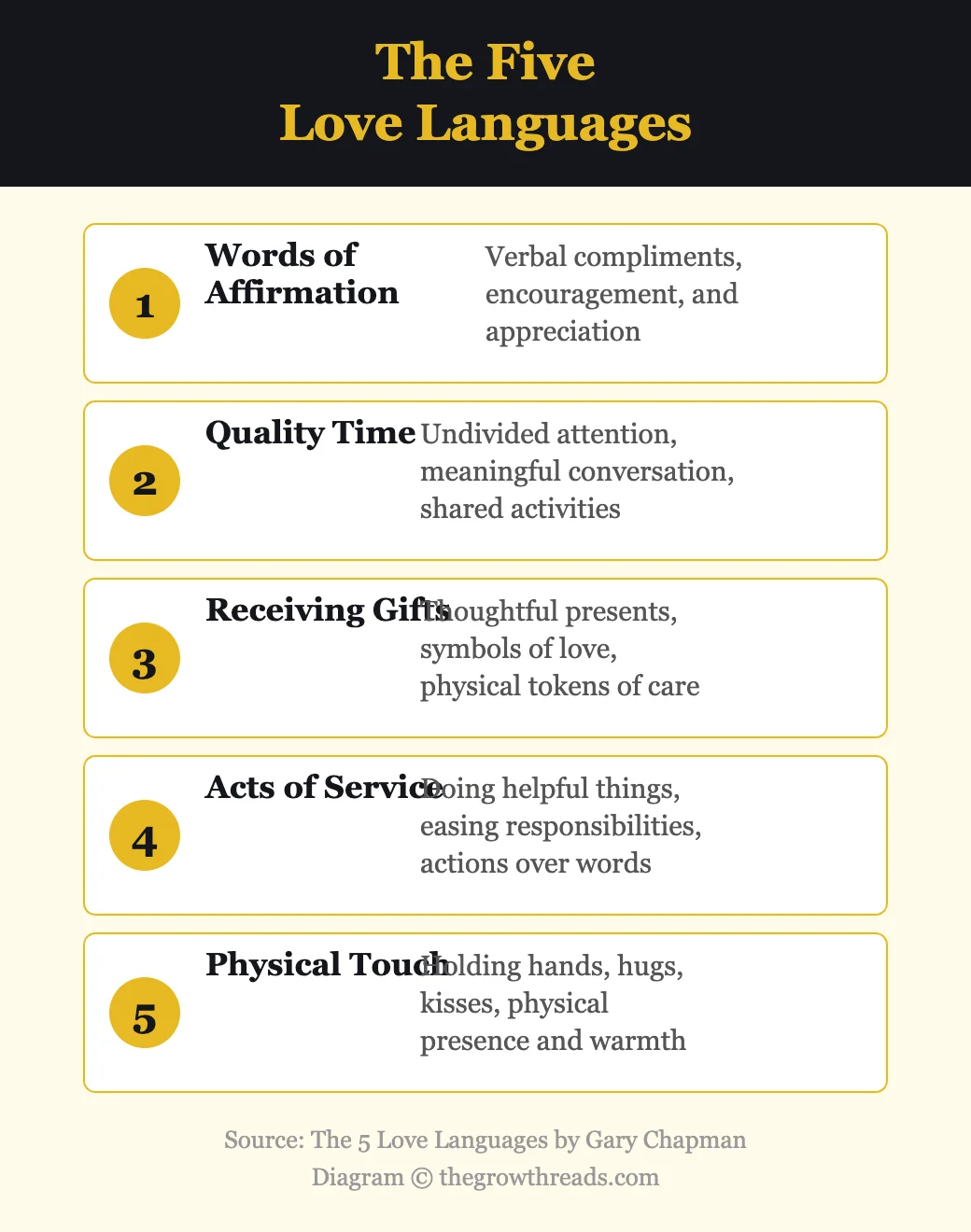
The core of the book walks through each love language with case studies from Chapman’s counseling practice. Words of Affirmation encompasses verbal compliments (“you look amazing in that”), words of encouragement (“I know you can do this”), kind words (tone matters as much as content), and humble requests rather than demands. Chapman notes that for people whose primary language is Words of Affirmation, a single cutting remark can drain their love tank faster than a week of compliments can fill it.
Quality Time means giving your partner your undivided attention — not sitting in the same room while scrolling your phone. Chapman distinguishes between quality conversation (sympathetic dialogue where both partners share openly) and quality activities (shared experiences that create memories and connection). The critical point is that quality time is about togetherness, and the primary enemy is distraction.
Receiving Gifts is the most visually demonstrable love language. Chapman emphasizes that the cost is irrelevant — what matters is the thought and effort. He introduces the concept of the “gift of self” — being physically present during moments of crisis — as a powerful expression for gift-language people. In many cultures, gift-giving at weddings and milestones is a deeply embedded love language that extends beyond romantic relationships.
Acts of Service means doing things you know your partner would like you to do — cooking a meal, washing the car, running errands, fixing a leaky faucet. Chapman stresses that these must be done willingly and cheerfully; service done with resentment or under coercion does not fill the love tank. He also notes that requests are not demands — learning to make requests rather than issue ultimatums is a critical skill for this language.
Physical Touch encompasses everything from sexual intimacy to holding hands, putting an arm around a shoulder, or touching a partner’s back as you walk past. Chapman notes that physical touch is the most primitive love language — infants who are not touched fail to develop normally. For adults whose primary language is Physical Touch, the absence of physical connection creates deep emotional insecurity.
Part 3: Discovering and applying the languages
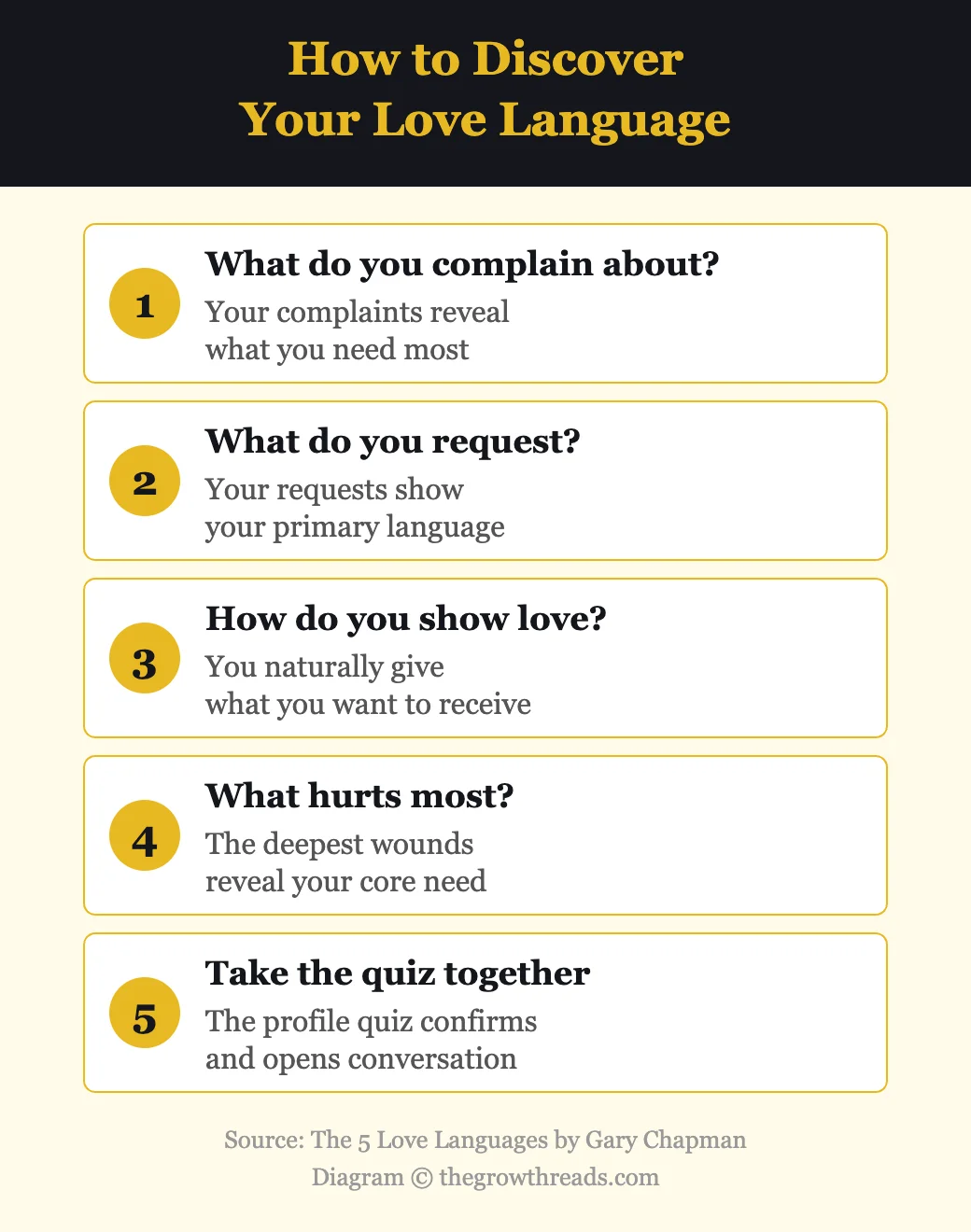
The final section provides practical tools for identifying your own love language and your partner’s. Chapman offers three methods: first, observe what you complain about most — your complaints are usually unmet needs in disguise. If you regularly say “we never spend time together,” your primary language is probably Quality Time. Second, notice how you naturally express love to others — you tend to give in the language you want to receive. Third, consider what hurts you most deeply — the opposite of your love language causes the greatest pain.
Chapman addresses common objections directly. “What if my partner’s love language is something I’m bad at?” His answer: love is a choice, and speaking a new language is a learnable skill. It will feel awkward at first, but with practice it becomes natural. “What if I have two equally strong languages?” Chapman acknowledges that some people are “bilingual” — they have two primary languages. Focus on both. “What if my partner refuses to learn my language?” Chapman’s advice is counterintuitive: fill their tank first, without expecting reciprocity. In the vast majority of cases, a partner whose tank is full begins naturally reciprocating.
The book closes with guidance on applying the framework beyond romantic relationships — to children (who also have primary love languages), friendships, and workplace relationships. Chapman notes that understanding love languages transforms not just marriages but entire families, because children whose love tanks are full are more cooperative, more emotionally secure, and better equipped to handle life’s challenges.
Who is The 5 Love Languages best for — and who should read something else first?
Best for: Couples in any stage of a relationship — newlyweds, long-term partners, and couples in crisis. Parents who want to understand their children’s emotional needs. Anyone who has ever felt “I’m trying so hard, but nothing I do seems to be enough.” The book is also valuable for people entering new relationships who want to build strong communication habits from the start.
Read something else first if: Your relationship involves deeper issues like attachment anxiety or avoidance — start with Attached. If you need help with conflict resolution specifically, Crucial Conversations is more tactical. And if you want a research-backed deep dive into what makes marriages succeed or fail, The Seven Principles for Making Marriage Work by John Gottman provides the empirical foundation that complements Chapman’s framework.
Questions to reflect on
- What do I most frequently complain about in my relationship — and what unmet love language does that complaint reveal?
- How do I naturally express love to my partner? Is that my own language or theirs?
- When was the last time I felt deeply loved by my partner — what did they do, and which language was it in?
- What has hurt me most deeply in a relationship? The opposite of that pain is likely my primary love language.
- Am I willing to learn to speak a love language that does not come naturally to me — and what would it look like to practice it this week?
🔥 Ready to transform how you love?
Discover the simple framework that has helped 20 million couples reconnect.
How to apply The 5 Love Languages (7-day plan)
- Day 1 — Identify your own love language: Take the free quiz at 5lovelanguages.com or use the three self-assessment methods from the book: what do you complain about, how do you naturally show love, and what hurts you most?
- Day 2 — Guess your partner’s language: Before asking them, observe their behavior. What do they complain about? What do they do for you most often? Write down your best guess.
- Day 3 — Share and compare: Have your partner take the quiz too. Compare results and discuss. Most couples experience an immediate moment of insight: “That’s why you never appreciated when I…”
- Day 4 — Speak their language once: Do one deliberate act in your partner’s primary love language. If it is Quality Time, put your phone away and have a 30-minute conversation. If it is Acts of Service, take care of a task they dislike. Notice their response.
- Day 5 — Ask for what you need: Tell your partner one specific thing they could do in your love language that would fill your tank. Make it concrete and achievable: “It would mean a lot if you told me something you appreciate about me today.”
- Day 6 — Double down: Speak their love language twice today. Morning and evening. Consistency is what makes the framework work — sporadic efforts do not build a habit.
- Day 7 — Set a recurring reminder: Create a daily phone reminder to do one thing in your partner’s love language. After 30 days of intentional practice, it will begin to feel natural rather than forced.
Frequently asked questions
Is The 5 Love Languages worth reading?
Yes — especially if you have ever felt like you and your partner are “speaking different languages” when it comes to showing affection. The framework is simple enough to apply immediately and has been validated by over 20 million readers across 50 languages. Even skeptics frequently report that the love language framework gave them their first real insight into why their partner felt unloved despite their best efforts.
Can your love language change over time?
Chapman says your primary love language typically remains stable throughout life, though its intensity may shift with life circumstances. A new parent might temporarily prioritize Acts of Service over Quality Time simply because of the demands of caring for an infant. During illness, Physical Touch might become more important. The core language usually stays the same, but the dialects — the specific ways you want it expressed — evolve as you and your relationship grow.
What if my partner refuses to read the book?
Chapman addresses this directly: start by filling your partner’s tank without expecting reciprocity. Observe their behavior to guess their primary language, then speak it consistently for 30 days. In the vast majority of cases, a partner whose emotional tank is full begins naturally reciprocating — and becomes curious about the framework that produced the change. Lead by example rather than by assignment.
Do love languages apply to children?
Absolutely — Chapman has written a separate book on this topic (The 5 Love Languages of Children). Children have primary love languages just like adults, and a child whose emotional tank is consistently full is more cooperative, emotionally secure, and resilient. Observing which type of attention your child seeks most and which withdrawal upsets them most reveals their primary language.
Is the love languages framework scientifically validated?
The framework is based on Chapman’s clinical observations from decades of marriage counseling rather than controlled experiments. Some academic studies have found correlations between love language alignment and relationship satisfaction, though the research base is not as extensive as frameworks like Gottman’s. Its enduring value lies in its practical utility — millions of couples report that it gives them a shared vocabulary for discussing emotional needs that they previously struggled to articulate.
How is this different from attachment theory?
Attachment theory (as described in Attached by Amir Levine) explains the deep psychological patterns that drive how you bond — anxious, avoidant, or secure. Love languages describe the specific behaviors through which you feel loved within those bonds. They operate at different levels: attachment style is about your fundamental approach to intimacy, while love languages are about the daily actions that make intimacy feel real. Both frameworks are useful and complementary.
What should I read after The 5 Love Languages?
For the research-backed science of what makes marriages work, read The Seven Principles for Making Marriage Work by John Gottman. For understanding the deeper attachment patterns beneath love language preferences, try Attached by Amir Levine. For difficult conversations within relationships, Nonviolent Communication by Marshall Rosenberg provides the communication skills. And for broader personal growth that strengthens all relationships, Daring Greatly by Brené Brown is essential.
Related summaries
If The 5 Love Languages resonated with you, explore these related summaries:
- The Seven Principles for Making Marriage Work — Gottman’s research-backed framework for lasting marriages
- Attached — Understanding your attachment style and how it shapes your relationships
- Nonviolent Communication — A powerful framework for compassionate, clear communication
- Daring Greatly — Brené Brown on vulnerability as the foundation of connection