

★★★★★ 4.8/5 — A field guide to naming what you feel so you can actually connect with people.
Best for: Anyone who struggles to put feelings into words, therapists and coaches, managers navigating hard conversations, and readers of Brown’s earlier work.
Reading time: ~7 hours to read the full book · ~25 minutes for this guide.
Difficulty to apply: Easy to start, ongoing to master — it’s a vocabulary you build over a lifetime.
Atlas of the Heart in one minute
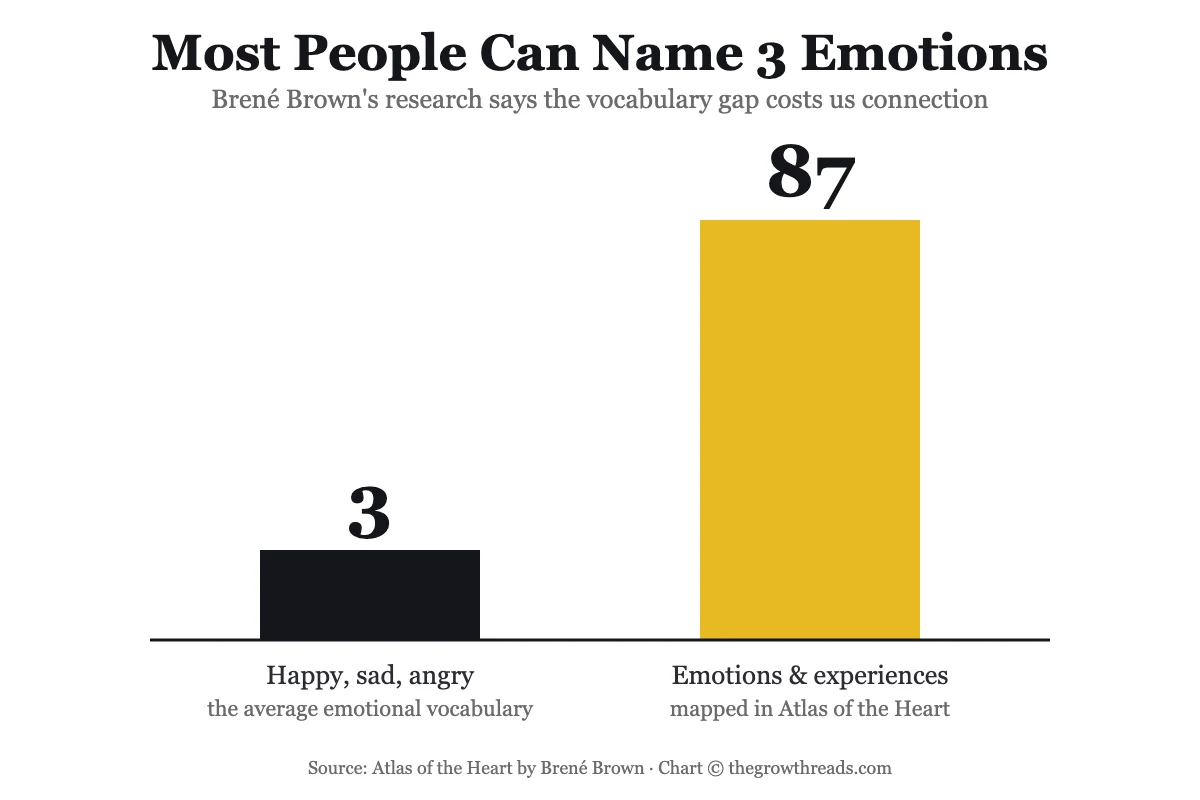
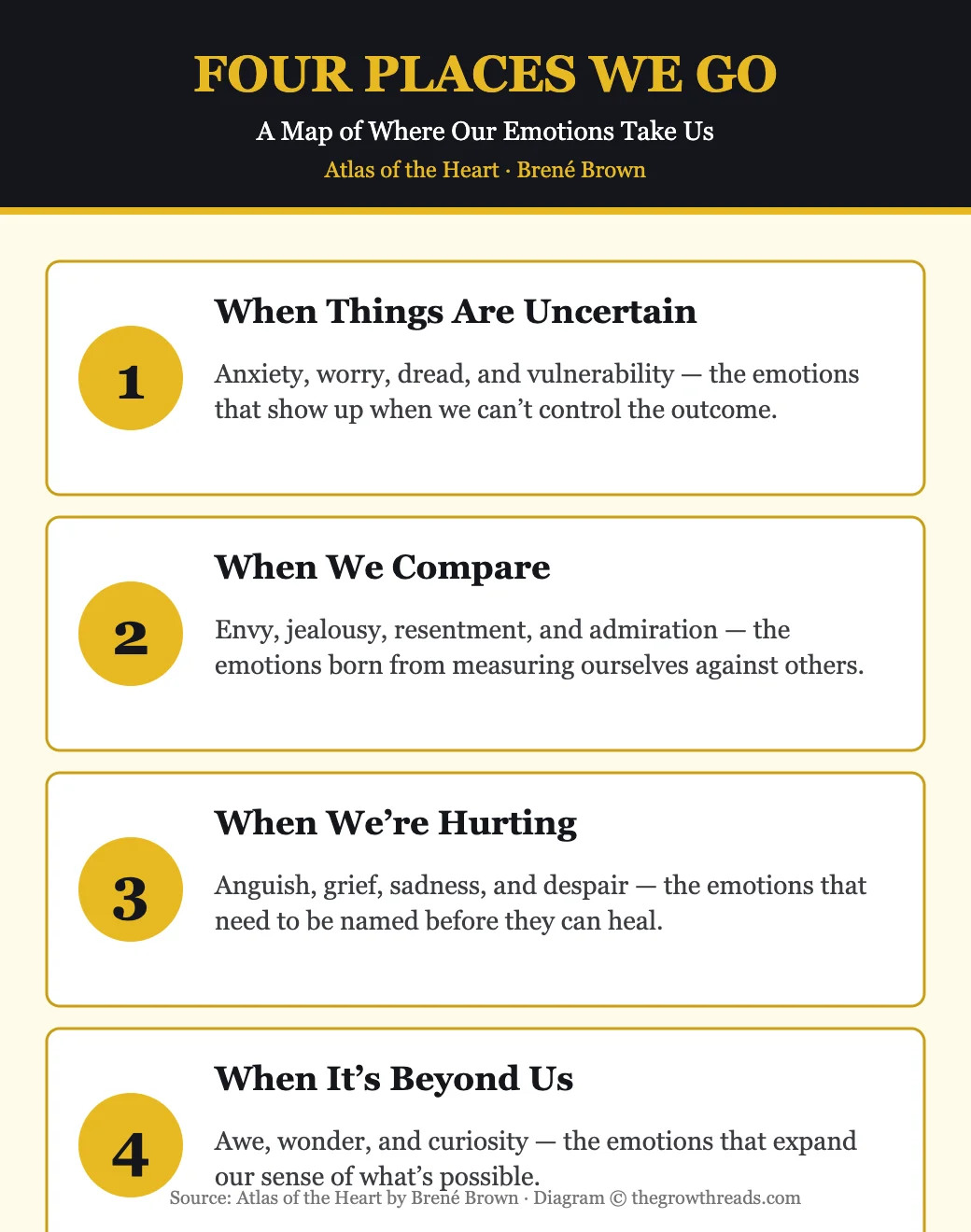
Most people can only name three emotions: happy, sad, and angry. Brené Brown’s Atlas of the Heart argues that this tiny vocabulary is a real problem — because you cannot process, communicate, or connect through a feeling you cannot name. Drawing on more than a decade of grounded-theory research interviewing tens of thousands of people, Brown maps and defines 87 emotions and experiences, organizing them into clusters — the “places we go” when we’re uncertain, when we compare ourselves to others, when we’re hurting, when things aren’t working, and when we’re moved by something bigger than ourselves. Each emotion gets a plain-language definition, a research-backed distinction from its near-neighbors (envy versus jealousy, guilt versus shame, worry versus anxiety), and a short reflection on how naming it precisely changes how we handle it. The book’s real thesis isn’t just “know more emotion words” — it’s that language is the bridge between what happens inside us and the connection we’re able to build with other people.
Key takeaways
- Language shapes experience: You cannot regulate, process, or communicate an emotion you don’t have a name for.
- Comparative suffering doesn’t work: Ranking whose pain is “worse” blocks empathy for both people involved.
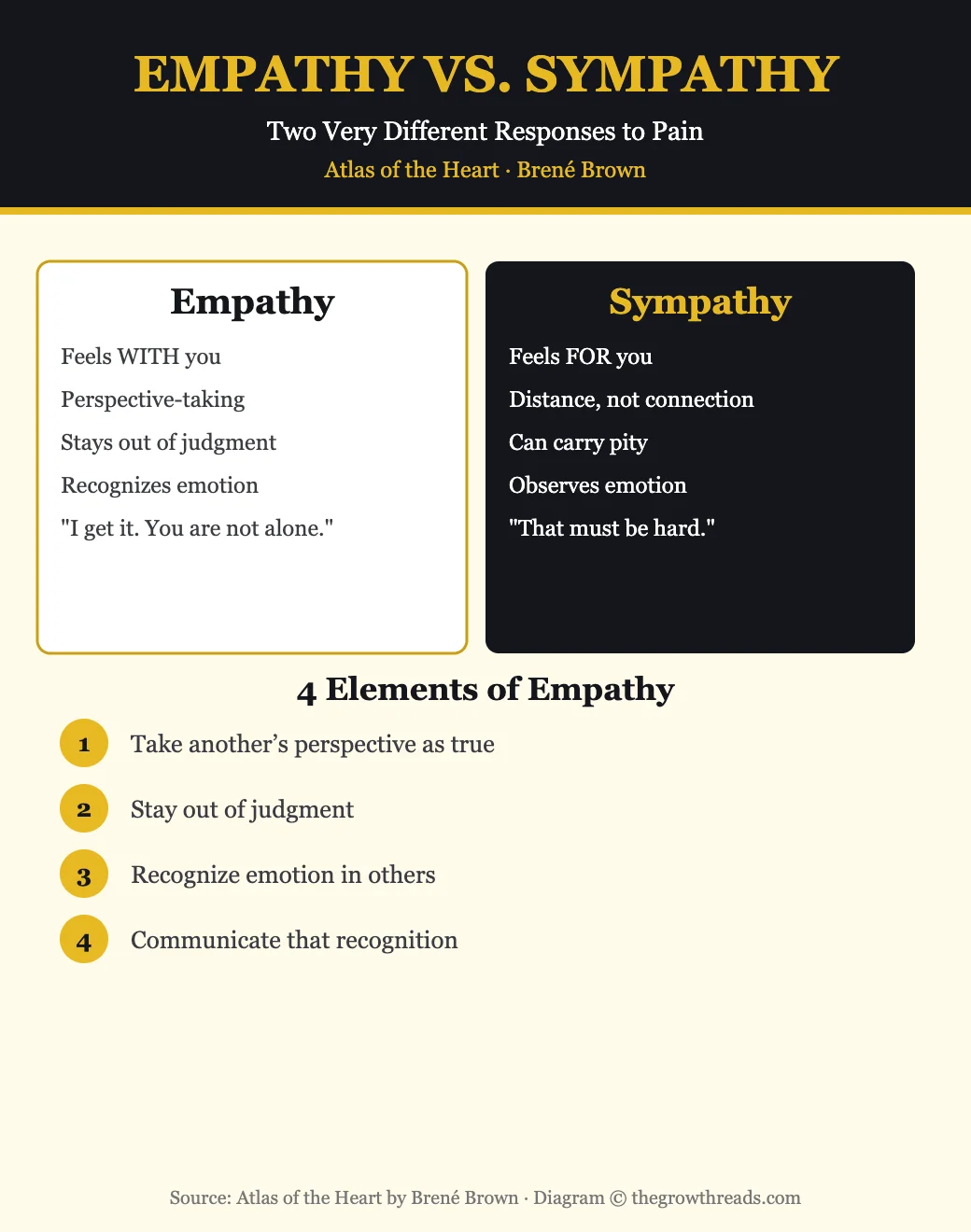
- Empathy is a skill, not a trait: It has four learnable components — perspective-taking, staying out of judgment, recognizing emotion, and communicating that recognition.
- Empathy and sympathy are different: Empathy feels with someone; sympathy feels for someone from a safe emotional distance.
- “The story I’m telling myself” is a tool: Naming your interpretation out loud separates the facts of a situation from the narrative you’ve built around it.
- Boundaries and compassion coexist: The most compassionate people Brown studied were also the most boundaried — the two are not in tension.
- Connection requires vulnerability: You cannot be truly seen by someone without risking being truly seen.
- Emotions cluster in families: Envy and jealousy, worry and anxiety, and guilt and shame are frequently confused but function very differently.
- Awe and wonder expand us: Experiences that make us feel small in a good way build resilience and perspective.
What is Atlas of the Heart about?
Atlas of the Heart is Brené Brown’s guide to 87 emotions and human experiences, organized into meaningful clusters. It argues that naming a feeling precisely — rather than defaulting to “fine” or “stressed” — is the first step toward processing it and connecting authentically with other people.
About the author
Brené Brown is a research professor at the University of Houston who has spent over two decades studying courage, vulnerability, shame, and empathy through grounded theory research involving tens of thousands of interviews. Her 2010 TEDx talk on vulnerability became one of the most-viewed TED talks of all time, launching a body of work that includes Daring Greatly, Rising Strong, The Gifts of Imperfection, and Dare to Lead. Atlas of the Heart, published in 2021, distills her research into a single reference for the emotional vocabulary that underlies all of her earlier books, and became the basis for an HBO Max documentary series of the same name. Explore all Brené Brown book summaries →
Key concepts at a glance
| Concept | What it means | Use it when |
|---|---|---|
| Comparative suffering | Ranking whose pain is worse, which blocks empathy for everyone involved. | You catch yourself thinking “others have it worse” to dismiss your own feelings. |
| The story I’m telling myself | Naming your interpretation of events separately from the facts. | You’re upset and not sure if it’s the situation or your assumptions about it. |
| Empathy vs. sympathy | Empathy connects by feeling with someone; sympathy observes from a distance. | Someone shares something painful and you want to respond well. |
| Envy vs. jealousy | Envy wants what someone else has; jealousy fears losing what you already have. | You’re trying to understand a difficult feeling about another person. |
| Guilt vs. shame | Guilt says “I did something bad”; shame says “I am bad.” | Processing a mistake without spiraling into self-attack. |
| Boundaries and compassion | The most compassionate people are also the most boundaried. | You’re struggling to say no without feeling unkind. |
| Awe and wonder | Experiences that make us feel small in a good, expansive way. | You want to build perspective and resilience. |
Part 1: Places We Go When Things Are Uncertain or Too Much
Brown opens with the emotions that show up when we lack control — stress, overwhelm, anxiety, worry, avoidance, excitement, dread, fear, and vulnerability. She draws sharp, research-backed lines between feelings that get lumped together in everyday speech: worry is the cognitive rehearsal of what might go wrong, while anxiety is a more diffuse, physical unease that often lacks a clear object. Stress, she notes, is about the mismatch between demands and our resources, while overwhelm is a total flooding that shuts down our ability to function at all — two states that require very different responses. The chapter’s throughline is that vulnerability isn’t a single emotion but the underlying condition beneath most of the others in this cluster: uncertainty, risk, and emotional exposure are simply the price of showing up.
This is also where Brown introduces “comparative suffering,” the reflex to measure our pain against someone else’s — telling ourselves we shouldn’t feel overwhelmed because someone else has it worse. She argues this move doesn’t create empathy for the other person; it just shuts down our own emotional honesty, which makes us less available to anyone, including ourselves.
Part 2: Places We Go When We Compare, and When Empathy Is Needed
The middle of the book tackles two of its most practically useful clusters: the emotions born from comparison, and the mechanics of empathy itself. On comparison, Brown distinguishes envy (wanting something someone else has) from jealousy (fearing the loss of something you already have), and introduces the more obscure but powerful concept of “freudenfreude” — the joy of witnessing someone else’s success — as the deliberate antidote to its better-known cousin, schadenfreude.
The empathy chapter is arguably the book’s most cited material. Building on nursing researcher Theresa Wiseman’s work, Brown breaks empathy into four learnable skills: taking another person’s perspective as true for them, staying out of judgment, recognizing the emotion someone else is experiencing, and communicating that recognition back to them. Critically, she distinguishes this from sympathy, which observes someone’s pain from a safe emotional distance rather than stepping into it. The line she returns to again and again: rarely can a response make something better; what makes something better is connection.
Part 3: The Story I’m Telling Myself
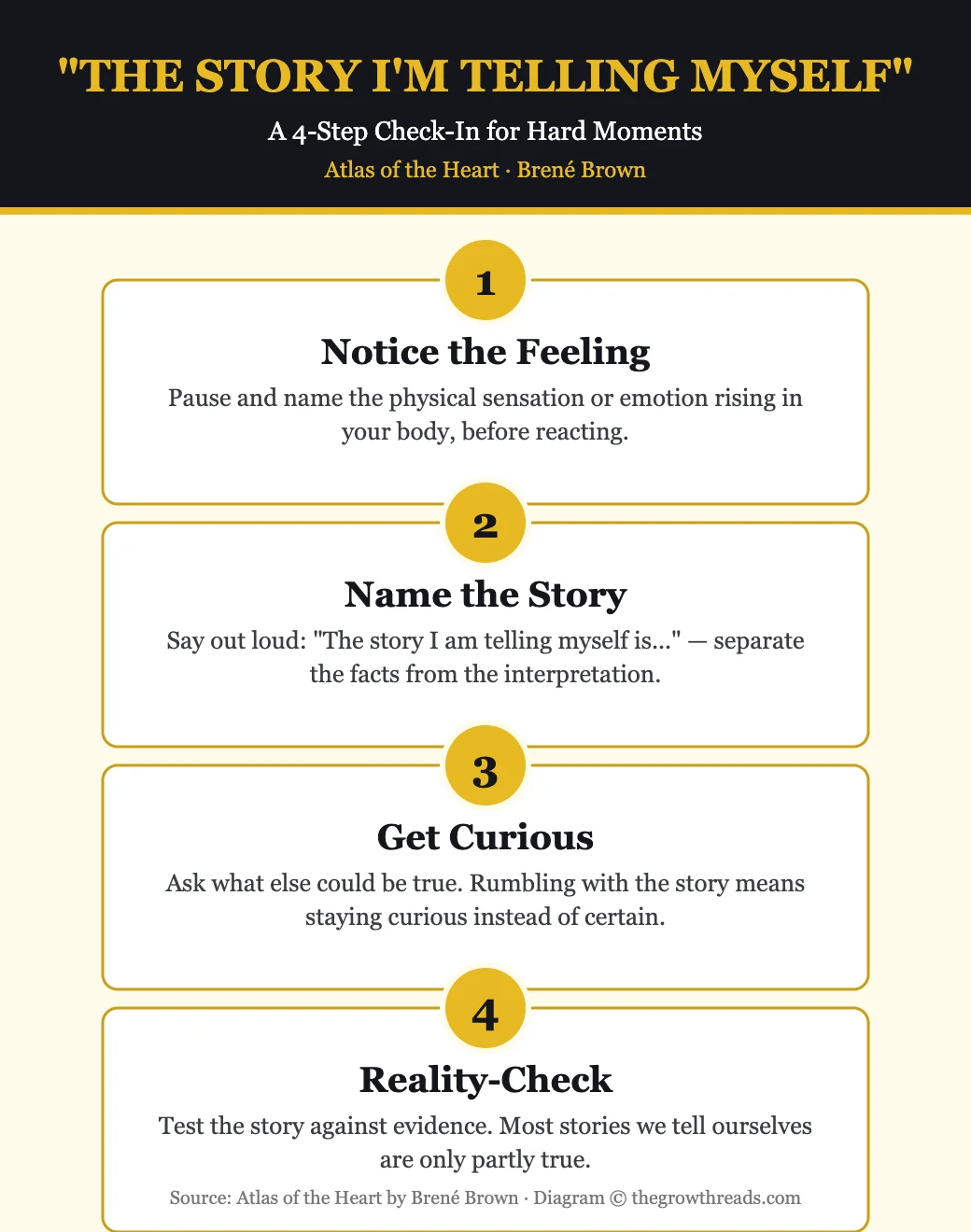
One of the book’s most quoted tools is the phrase “the story I’m telling myself” — a simple sentence stem for separating what actually happened from the interpretation we’ve layered on top of it. Brown calls the process of examining that story “the rumble”: staying curious about what else might be true instead of locking into the first, most emotionally charged interpretation. This isn’t about dismissing your feelings — it’s about testing the narrative attached to them before you act on it.
She pairs this with a close look at boundaries, built around a counterintuitive finding from her research: the most compassionate people she interviewed were also consistently the most boundaried. Being clear about what is and isn’t okay, she argues, is what makes genuine compassion sustainable — without boundaries, generosity curdles into resentment. This section also covers the difference between guilt (“I did something bad”) and shame (“I am bad”), a distinction that runs through all of Brown’s work and resurfaces constantly once you start applying the book’s vocabulary to your own life.
Part 4: Awe, Wonder, and the Case for a Bigger Vocabulary
Brown also spends time on the emotions that show up when things simply aren’t working — boredom, disengagement, resignation, ambivalence, and indifference. These are quieter than dramatic feelings like anger or grief, which is exactly why they’re dangerous: they rarely trigger the kind of urgent response that gets a problem fixed. Naming disengagement before it curdles into resignation, she argues, is one of the more underrated emotional skills covered in the book, both in relationships and at work.
The book closes on its most expansive emotional cluster — awe, wonder, curiosity, and the experiences that make us feel small in a good way. Brown argues these states aren’t just pleasant; they build resilience by putting our individual struggles into a larger perspective and correlate with lower stress and greater life satisfaction in her research. She also revisits confusion and interest as productive, generative states rather than problems to resolve quickly — sitting with “I don’t know yet” is itself a skill.
The final chapters make the book’s larger case explicit: emotional granularity — the ability to identify feelings precisely rather than lumping everything into “good” or “bad” — is strongly linked in psychological research to better emotion regulation, stronger relationships, and greater resilience under stress. The 87 entries aren’t trivia; they’re a practical vocabulary for noticing what’s actually happening inside you, moment to moment, so you can respond to it deliberately instead of being run by it.
Because the book is organized as a reference rather than a linear argument, it also works well as a shared vocabulary for couples, teams, and families — several readers report keeping it on hand specifically to look up a feeling mid-conversation, the way you’d reach for a dictionary.
Who is Atlas of the Heart best for — and who should read something else first?
Atlas of the Heart is best for readers who want language for feelings they’ve always sensed but never named, therapists and coaches who want a shared vocabulary with clients, managers navigating hard conversations, and anyone who has already read Brown’s other work and wants the reference book that underlies it.
If you’re brand new to Brown’s work and want a narrative introduction before the reference-book format, start with Daring Greatly instead. If your priority is recovering from a specific setback rather than building general emotional vocabulary, Rising Strong is the more targeted read.
Questions to reflect on
- What is one feeling I’ve had recently that I described as “fine” or “stressed” when a more precise word actually existed?
- Have I caught myself minimizing my own struggle because “someone else has it worse”? What did that cost me?
- The next time I’m upset, can I separate the facts of the situation from “the story I’m telling myself” about it?
- Am I responding to people in my life with empathy or with sympathy — and do they know the difference in how it feels?
- Where in my life could clearer boundaries actually make me more compassionate, not less?
🔥 Ready to build a bigger vocabulary for what you feel?
Get Brené Brown’s complete map of 87 emotions and experiences.
How to apply Atlas of the Heart (7-day plan)
- Day 1 — Audit your vocabulary. For 24 hours, notice every time you say “fine,” “stressed,” or “good” and try to name the more specific feeling underneath.
- Day 2 — Catch comparative suffering. Notice one moment you minimized your own feelings by comparing them to someone “worse off,” and let yourself feel it fully instead.
- Day 3 — Practice the story stem. In one hard moment, say out loud: “The story I’m telling myself is…” and separate fact from interpretation.
- Day 4 — Run the empathy checklist. In one conversation, deliberately practice all four empathy skills: perspective, non-judgment, recognition, and communication.
- Day 5 — Set one boundary. Say no to one thing, clearly and kindly, and notice whether it makes you more or less resentful afterward.
- Day 6 — Separate guilt from shame. Next time you make a mistake, practice saying “I did something bad” instead of “I am bad.”
- Day 7 — Seek awe. Spend 20 minutes somewhere or with something that makes you feel small in a good way, and write down what you notice.
Frequently asked questions
What is the main idea of Atlas of the Heart?
The main idea is that most people have a very limited emotional vocabulary — often just three words like happy, sad, and angry — and that this limits our ability to process feelings and connect with others. Brené Brown maps and defines 87 emotions and experiences, grouped into meaningful clusters, arguing that naming a feeling precisely is the first step toward understanding it and communicating it to someone else.
Who should read Atlas of the Heart?
Atlas of the Heart is best for readers who want more precise language for their inner experiences, therapists and coaches building a shared vocabulary with clients, managers navigating difficult conversations, and existing fans of Brené Brown’s work looking for the reference book that underlies her earlier titles. Readers brand new to her work may prefer to start with the more narrative Daring Greatly.
Is Atlas of the Heart based on research?
Yes. Brené Brown is a research professor who used grounded theory methodology — a qualitative research approach involving tens of thousands of interviews conducted over two decades — to identify and define the emotions in the book. Each entry draws on this data as well as existing psychological research, distinguishing closely related emotions like envy and jealousy, or guilt and shame, with academic precision.
What is the difference between empathy and sympathy in the book?
Empathy means feeling with someone — taking their perspective, staying out of judgment, recognizing their emotion, and communicating that recognition back to them. Sympathy means feeling for someone from a safe emotional distance, often without truly stepping into their experience. Brown argues empathy creates genuine connection, while sympathy, though well-intentioned, can leave the other person feeling more alone.
How long does it take to read Atlas of the Heart?
The full book runs about 336 pages and takes most readers roughly seven hours to read cover to cover. Because it’s organized as a reference — each emotion gets its own short entry — many readers dip in and out of it over time rather than reading straight through. This guide summarizes the core frameworks and clusters in about 25 minutes.
What does “the story I’m telling myself” mean?
It’s a phrase Brown recommends using to separate the facts of a situation from the interpretation or narrative you’ve built around it, especially when you’re upset. Saying “the story I’m telling myself is…” out loud creates space to question whether that interpretation is accurate before you act on it, which is central to the reflective process she calls “the rumble.”
Is Atlas of the Heart useful outside of personal relationships, like at work?
Yes. The empathy framework, the guilt-versus-shame distinction, and the boundaries-and-compassion research are all directly applicable to management and workplace communication. Many readers use the book’s vocabulary to navigate difficult feedback conversations, team conflict, and burnout — the emotional clusters apply wherever people are interacting under stress, not only in personal relationships.
Related summaries
- Daring Greatly Summary & Review
- Rising Strong Summary & Review
- Dare to Lead Summary & Review
- Best Relationship Books — Full Pillar Guide
Related Relationships Summaries
How to Know a Person Summary & Review: The Art of Truly Seeing Others
Never Split the Difference Summary & Review: FBI Negotiation Tactics for Everyday Life
Nonviolent Communication Summary & Review: Replace Blame With Connection
Passionate Marriage Summary and Review
Platonic Summary and Review