

★★★★☆ 4.3/5 — Modern Romance turns real sociological fieldwork into a sharp, funny field guide to dating in the smartphone era.
Best for: Anyone actively texting, swiping, or dating who wants to understand why it feels harder than it used to.
Reading time: ~6 hrs for the full book, ~14 min for this guide.
Difficulty to apply: Easy — most lessons are mindset shifts and messaging habits you can change today.
Modern Romance in one minute
Dating has never had more options — or made people more anxious. Aziz Ansari teamed up with sociologist Eric Klinenberg to run real focus groups in New York, Paris, Tokyo, Buenos Aires, and Doha, comparing how older generations found partners with how singles date today. The verdict: technology didn’t just change where we meet people, it rewired what we expect from them. Earlier generations often married the “good enough” option who lived nearby; today’s daters, armed with endless swipes and search filters, are hunting for a soul mate who checks every box — and burning out in the process. Modern Romance blends comic timing with real data to explain why texting creates so much anxiety, why “the spark” is an unreliable predictor of love, and why the culture you date in shapes the rules more than any app ever will.
Key takeaways
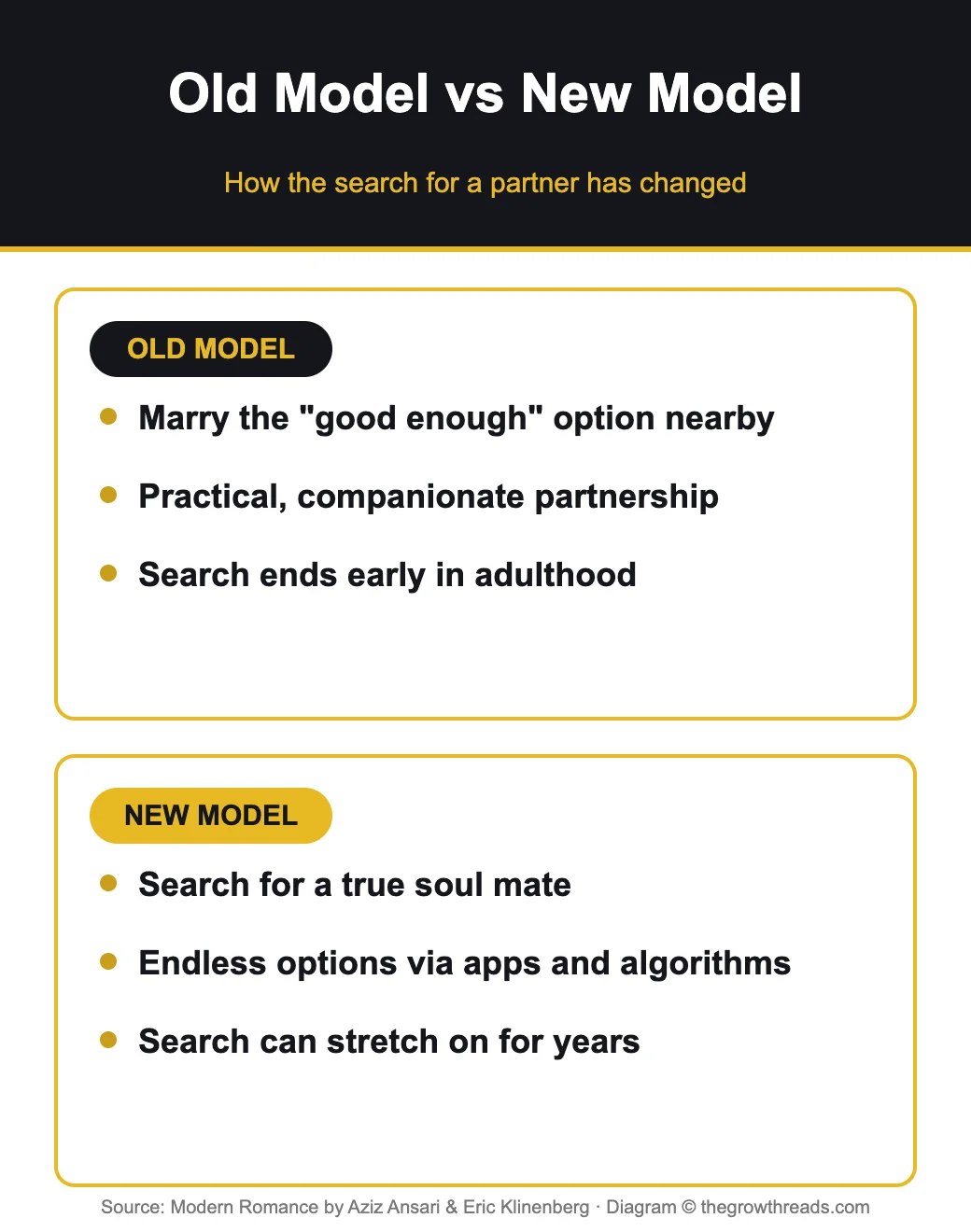
- The search for love has fundamentally changed: earlier generations chose a “good enough” partner nearby; today we search for a soul mate who satisfies every criterion.
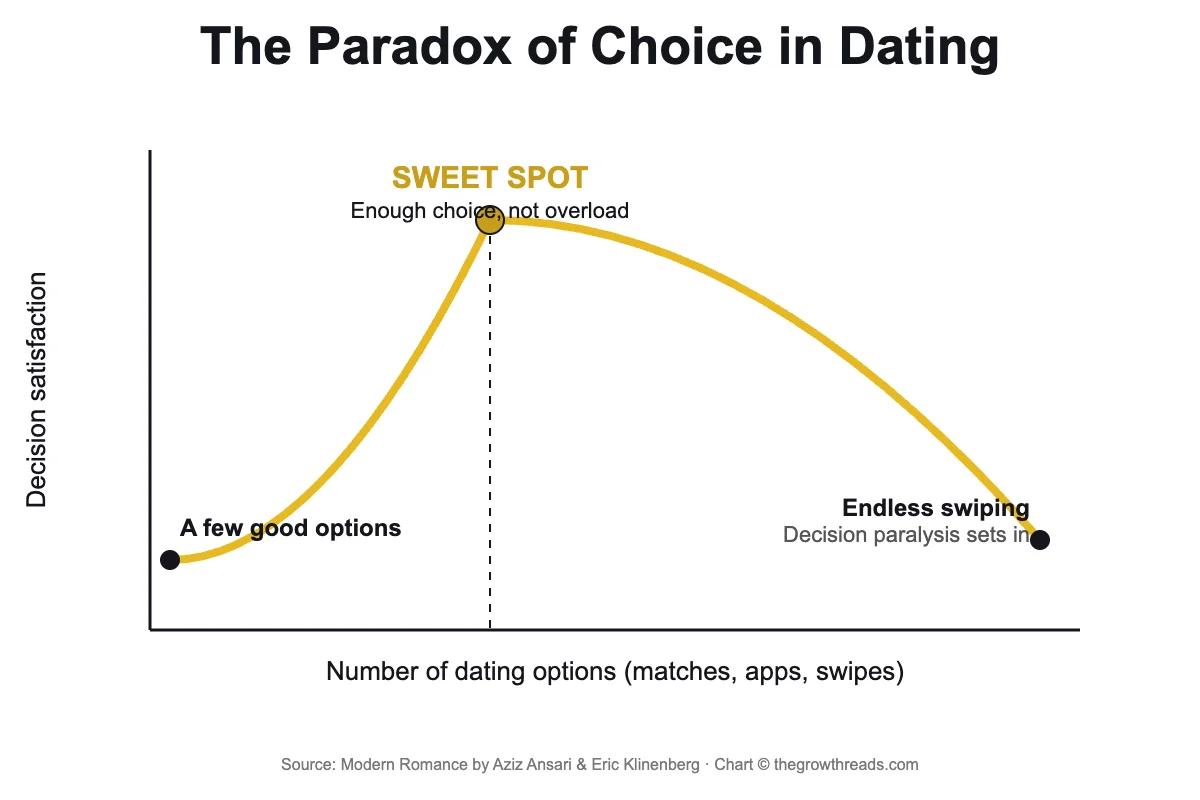
- More options can make dating harder: the paradox of choice means endless swiping often produces worse decisions and more regret, not better ones.
- Texting has its own hidden rules: response speed, punctuation, and message length all send signals — and most daters read into them more than intended.
- Ghosting thrives on distance: the more removed we feel from a person, the easier it becomes to vanish without explanation.
- Online profiles reward snap judgment: a handful of photos and a one-line bio compress a whole person into a few seconds of swiping.
- The “spark” is overrated: initial chemistry predicts less about long-term compatibility than the willingness to build a connection over time.
- Face-to-face still wins: voice and in-person interaction accelerate genuine connection far faster than an endless text thread.
- Culture shapes courtship: Tokyo’s low-touch dating culture, Buenos Aires’ expressive street flirting, Paris’ relaxed view of desire, and Doha’s blended arranged-and-love marriages all solve the same problem differently.
- Commitment is a decision, not just a feeling: lasting relationships are built by choosing to invest, not by waiting for permanent fireworks.
- Small dating habits compound: how you write a first message, how quickly you suggest meeting up, and how you handle a quiet stretch shape your results more than any app’s algorithm.
What is Modern Romance about?
Modern Romance is Aziz Ansari and sociologist Eric Klinenberg’s research-driven look at how technology and shifting cultural expectations have transformed dating worldwide. Drawing on focus groups from New York to Tokyo, Paris, Buenos Aires, and Doha, it explains why finding love feels more anxiety-inducing than ever — and what daters can actually do about it.
About the author
Modern Romance is a collaboration between comedian Aziz Ansari and sociologist Eric Klinenberg. Ansari is best known for playing Tom Haverford on Parks and Recreation and for creating the Peabody Award-winning Master of None, but he has long been fascinated by how people actually date and text in real life. Klinenberg, a professor at New York University and director of its Institute for Public Knowledge, is the author of Going Solo, Heat Wave, and Palaces for the People — books that examine how modern life reshapes human connection. Together they spent more than a year running focus groups and interviews across five countries, pairing Ansari’s ear for the absurd with Klinenberg’s rigorous research methods to produce a book that reads like equal parts comedy special and sociology text. Explore all Aziz Ansari book summaries →
Key concepts at a glance
| Concept | What it means | Use it when |
|---|---|---|
| Old Model of Marriage | Earlier generations often married the “good enough” option who lived nearby | Thinking about how previous generations approached partnership |
| New Model / Soul Mate Ideal | Modern daters search for a best-possible-fit partner who checks every box | Evaluating your own expectations for “the one” |
| Paradox of Choice | More dating options can lower satisfaction and decision quality, not raise it | App fatigue or endless swiping sets in |
| Texting Anxiety | Overanalyzing message timing, wording, and punctuation creates needless stress | Before overthinking a reply |
| Ghosting | Ending contact abruptly without explanation, enabled by low-stakes digital communication | A match goes silent, or you’re tempted to disappear |
| The Grass-Is-Greener Effect | The belief that a better match is always one more swipe away | You can’t commit to giving someone a real chance |
| The Spark Myth | Instant chemistry is a poor predictor of long-term compatibility | A promising match doesn’t ignite fireworks on date one |
| Face-to-Face Advantage | In-person or voice interaction builds real connection faster than text ever can | Deciding whether to keep texting or just ask someone out |
| Cultural Courtship Norms | Dating customs — arranged intros, public flirting, workplace romance — vary widely, each with trade-offs | Comparing your own dating culture to others |
Part 1: From “Good Enough” to “The One”
Ansari and Klinenberg open with a simple but striking contrast. They interviewed older residents of a New York retirement community about how they met their spouses decades ago, and the answers were almost always the same: someone lived on the same block, worked at the same office, or showed up at the same church social. Courtship was short, options were few, and “good enough” was frequently the entire criterion. Nobody expected a partner to be a best friend, a intellectual equal, a smoldering passion, and a co-parent all at once — that was a lot to ask of one relationship in a world with a handful of realistic candidates.
Compare that to a single twenty-something today, who can browse thousands of potential partners without leaving the couch. That shift, Klinenberg’s research shows, has quietly rewritten what people expect from a relationship. The soul mate ideal — the belief that there is one uniquely compatible partner who will satisfy every emotional, intellectual, and physical need — has replaced the old companionate model. It sounds like an upgrade. In practice, it creates a psychological trap: with so many options theoretically available, any option can feel like a compromise.
The book leans on the psychology of choice to explain why. Studies on decision-making (echoing the well-known jam-tasting experiments in consumer psychology) show that more options often produce less satisfaction, not more, because people become anxious about the paths not taken and second-guess decisions they’ve already made. Dating apps didn’t invent this dynamic, but they supercharged it — a single phone can surface more potential partners in an evening than a small town produced in a lifetime.
Part 2: The Text Message Minefield
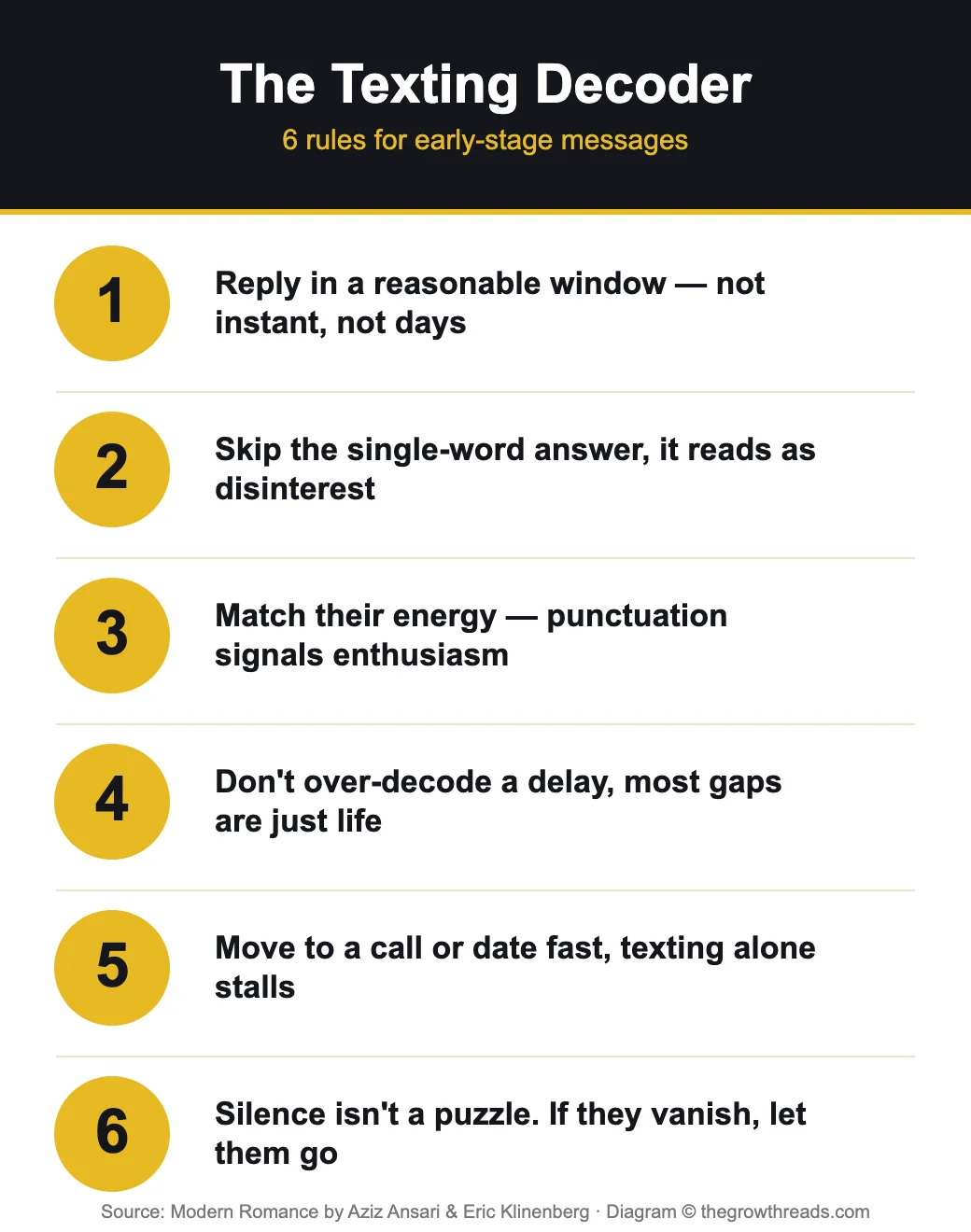
Nowhere does the book get funnier — or more useful — than its dissection of texting. Ansari’s stand-up sensibility shines here: he collects real screenshots from focus group participants and walks through, line by line, how a single exclamation point or a slow reply can spiral into hours of interpretation. The core finding is that texting strips away tone, timing, and body language, so people compensate by over-reading whatever signals remain: punctuation, response speed, capitalization, even whether someone uses “lol” or “haha.”
The authors also document the anxiety created by response-time norms that nobody agreed to but everyone somehow knows. Reply too fast and you can look overeager; reply too slow and you risk looking uninterested — even though, in reality, the other person was probably just busy, not sending a message. Klinenberg’s data suggests most delays are mundane, not meaningful, yet daters routinely assume the worst.
This is also where ghosting enters the book’s vocabulary in a serious way. Because texting removes the discomfort of a face-to-face conversation, it’s far easier to simply stop responding than to have an honest, if awkward, exit conversation. The book doesn’t excuse the behavior, but it explains the mechanism: distance and low stakes make disappearing feel consequence-free, even when it isn’t.
Part 3: Swipes, Snap Judgments, and the Algorithm
Online dating profiles compress an entire human being into a few photos and a short bio, and Ansari and Klinenberg show just how quickly people judge that compressed version. In their research, focus group participants swiped through profiles in seconds, often making decisions based on a single photo before reading a word of text. The book walks through what actually works in a profile: photos that show a real smile and a recognizable context (not group shots where a stranger has to guess which person is you), and a bio that gives a real conversation starter rather than a generic list of interests.
The algorithm side of the story is just as revealing. Early dating platforms tried to use compatibility scores and elaborate matching questionnaires to predict chemistry, but the data the authors reviewed suggested these scores didn’t reliably predict who actually clicked in person. That finding connects to the book’s most reassuring argument: the “spark” people wait for on a first date is a weak predictor of whether two people will build a lasting relationship. Psychologists cited in the book found that attraction and compatibility often develop after repeated interaction, not before it — meaning a lukewarm first date is not necessarily a rejection verdict.
The authors also describe a “grass is greener” trap that’s unique to app-based dating: because there is always another potential match one swipe away, it becomes easy to treat a promising person as disposable rather than investing the effort a real relationship requires. The abundance that makes modern dating feel efficient is the same abundance that makes it hard to commit.
Part 4: Romance Around the World — and What Actually Works
The most distinctive parts of Modern Romance come from its international focus groups, which show that “modern dating problems” are not universal — they’re shaped by local culture. In Tokyo, the authors describe a generation of young men and women, sometimes called “herbivores,” who are opting out of dating and marriage altogether, worn down by long work hours and a culture where texting has replaced in-person courtship almost entirely. In Buenos Aires, by contrast, public flirting (piropos) is an expected, almost theatrical part of daily life, and directness is rewarded rather than seen as forward.
Paris offers yet another model: French participants described a more relaxed, less anxious relationship to desire and jealousy, including a striking openness to dating outside a primary relationship that would read as scandalous in other cultures the authors studied. In Doha, the book documents a generation caught between tradition and modern expectations — young Qatari daters increasingly want a genuine love match, but still route it through parental introduction and approval, blending old and new models rather than discarding one for the other.
Back home, the book’s most touching material comes from interviews with older adults in New York who are dating again after decades of marriage, widowhood, or divorce. They approach romance with almost none of the anxiety younger daters describe — not because they have fewer options, but because they’ve learned that a slow start doesn’t predict how a relationship will unfold, and that face-to-face effort beats perfect texting every time.
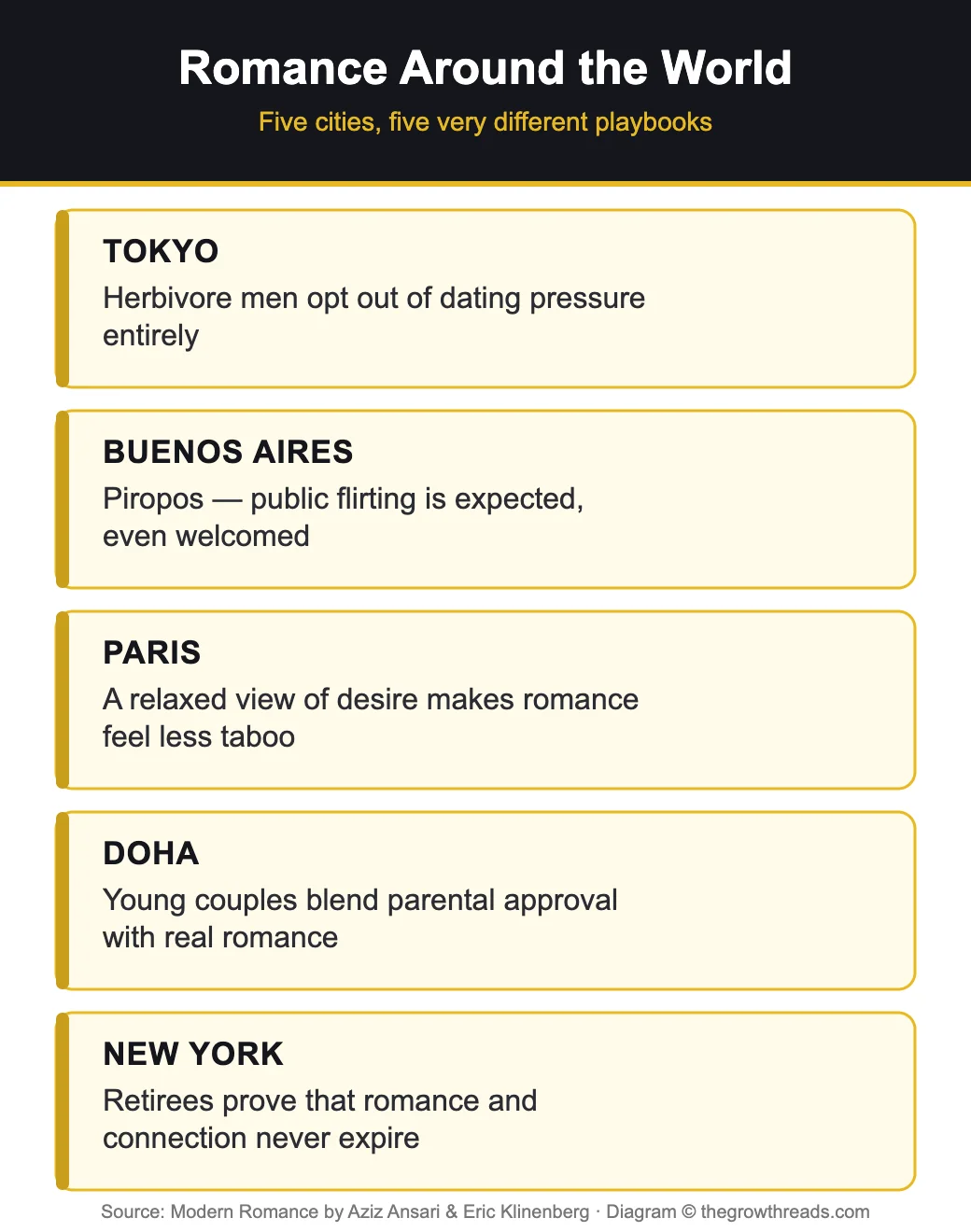
Stitched together, the cross-cultural chapters make the book’s real argument: technology is not destiny. The tools change the mechanics of meeting people, but the fundamentals of building a relationship — showing up, communicating honestly, and choosing to invest in someone even when a hundred other profiles are one swipe away — have not changed at all.
Who is Modern Romance best for — and who should read something else first?
Modern Romance is best for people actively dating with apps, texting matches, or trying to make sense of why swiping culture feels exhausting. Its blend of comedy and research makes it an easy, entertaining entry point into the psychology of modern courtship.
If you’re already in a committed relationship and want to deepen it rather than start one, Eight Dates is a more direct fit. If your dating struggles are less about apps and more about anxious or avoidant patterns that repeat across relationships, start with Attached instead. And if you want a more tactical, step-by-step dating strategy rather than sociological context, How to Not Die Alone picks up where this book leaves off.
Questions to reflect on
- Do you find yourself treating a promising match as disposable because “someone better” might be one swipe away?
- How much of your recent dating anxiety has come from over-analyzing a text message rather than an actual conversation?
- Have you ever written off a date because there was no instant “spark” — and could compatibility have grown with more time?
- What would change if you moved a conversation from texting to a call or an in-person meeting a day earlier than you normally would?
- Which “old model” habits — patience, giving someone a real chance, treating a first date as one data point — might be worth borrowing today?
🔥 Ready to decode your dating life?
Grab Modern Romance and see your texts, swipes, and dating apps differently.
How to apply Modern Romance (7-day plan)
- Day 1: Audit your dating apps. Delete or mute any profile you’re only keeping “just in case” — the paradox of choice gets worse the more open loops you keep.
- Day 2: Rewrite your bio to include one real, specific conversation starter instead of a generic list of interests.
- Day 3: Notice one moment today when you over-analyze a text (yours or theirs). Write down what you assumed, then what actually turned out to be true.
- Day 4: If a conversation has been purely text-based for more than three days, suggest a call or a specific date idea.
- Day 5: Give one “lukewarm” first date a real second chance instead of writing it off for lacking instant chemistry.
- Day 6: Practice a clean, honest exit instead of ghosting — send one message ending things kindly if you’ve been meaning to.
- Day 7: Reflect on which “old model” habit (patience, giving someone a real shot, treating dating as a process) you want to keep using going forward.
Frequently asked questions
What is the main argument of Modern Romance?
The book argues that technology and the “soul mate” ideal have changed dating more than most people realize. Earlier generations often married a “good enough” partner nearby; today’s daters, facing near-unlimited options through apps, search for a best-possible-fit soul mate — a shift that creates more anxiety and decision paralysis, not less. Aziz Ansari and sociologist Eric Klinenberg use real focus group research across five countries to show how this plays out in texting habits, ghosting, and swiping behavior, while also highlighting that the fundamentals of building connection haven’t actually changed.
Is Modern Romance based on real research?
Yes. Klinenberg, a professor of sociology at New York University, designed and ran focus groups and interviews in New York, Paris, Tokyo, Buenos Aires, and Doha, supplemented by data from dating platforms and academic studies on choice, attraction, and communication. Ansari brought a comedian’s eye for real-life detail, including screenshots of actual text exchanges submitted by participants. Some of the platform-specific statistics have aged since the book’s 2015 publication, but the underlying psychological findings still hold up well.
How is dating different now compared to a generation ago?
Previous generations typically chose from a small pool of realistic local options and settled relatively quickly on a “good enough” partner. Today’s daters can access thousands of potential matches through apps, which sounds like an advantage but often produces more second-guessing, comparison, and decision fatigue. The book frames this as a genuine trade-off: more choice, but often less satisfaction with the choice eventually made.
What does the book say about texting etiquette?
Modern Romance spends significant time decoding the unwritten rules of texting: replying too fast can look overeager, replying too slow can look uninterested, and small details like punctuation or a delayed “haha” get over-analyzed. The authors’ core advice is to worry less about performing the “right” response time and instead move a promising conversation toward a call or an in-person meeting sooner rather than later.
Why do people ghost, according to the book?
The authors explain ghosting as a byproduct of distance and low stakes: texting removes the discomfort of an in-person goodbye, making it psychologically easier to simply stop responding than to have an honest, if awkward, closing conversation. The book doesn’t defend the behavior, but it explains why it has become so common in app-based dating specifically.
Does Modern Romance offer any actionable dating advice?
Yes — alongside the research, the book offers practical suggestions: use profile photos and bios that invite a real conversation, don’t dismiss a date solely for lacking instant chemistry, move conversations off text quickly, and recognize the “grass is greener” trap that comes from having endless alternatives one swipe away.
Is Modern Romance still relevant given how much dating apps have changed since 2015?
Some specific platform references and screenshots feel dated, since apps like Tinder and Hinge have evolved considerably. That said, the psychological core of the book — the paradox of choice, the anxiety of digital communication, the overrated “spark,” and the value of cross-cultural perspective — remains just as relevant to dating today as it was at publication.
Related summaries
- Attached Summary & Review
- Hold Me Tight Summary & Review
- Eight Dates Summary & Review
- How to Not Die Alone Summary & Review
See more on our Best Relationship Books pillar page.
Related Relationships Summaries
Daring Greatly Summary & Review: Why Vulnerability Is the Ultimate Courage
Getting to Yes Summary & Review: Negotiate Agreement Without Giving In
Men Are from Mars, Women Are from Venus Summary & Review: Why You Keep Misunderstanding Each Other
The Course of Love Summary and Review
Why Won’t You Apologize Summary and Review