

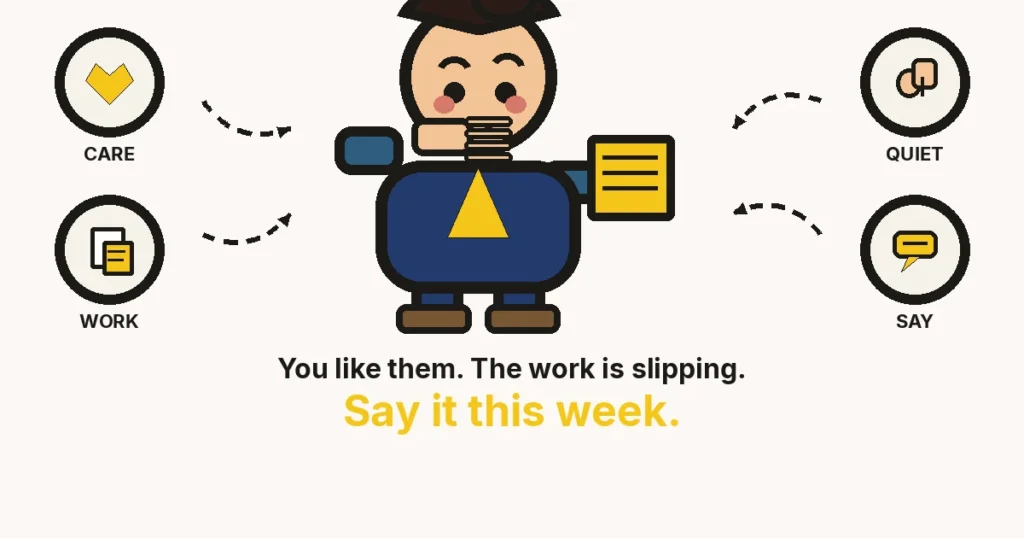
The hard sentence never gets said when you like the person, so a reassurance goes out and the behaviour stays unnamed. Kim Scott, in a 2015 essay, calls care without a challenge ruinous empathy. Name the behaviour, the impact on the work, and the ask, and send that note this week.
Key takeaways
- The hard sentence never gets said when you like the person and a reassurance goes out instead of the behaviour.
- Kim Scott, in the First Round Review essay dated 24 November 2015, says the vast majority of management mistakes happen in the quadrant she calls ruinous empathy.
- In that 2015 essay, Scott says she really liked Bob, that his work was terrible, and that she reassured him instead of criticizing him.
- Scott says that after sparing his feelings for 10 months she was firing him, and that he asked why she had not told him.
- The candor note is this page’s application for a solo founder or a new manager. The print book was not opened, and no sentence is taken from a numbered page.
What the hard sentence is
The hard sentence never gets said when you like them, the work is slipping, and the message you actually send is that they are doing fine. You are a solo founder. The contractor’s last two files missed the points you agreed. You rewrote both after dinner. Your reply was “looks great, tiny tweaks, no rush.” You like working with them. The client date moved, and the sentence that names the missing points is still in your drafts. You are a new manager. On the client call they talked over the buyer twice. You said “you were great in there” in the corridor, because last quarter you were peers and you do not want the new title to make you sharp. The buyer has started emailing you instead. The sentence about the interruption has no day on it.
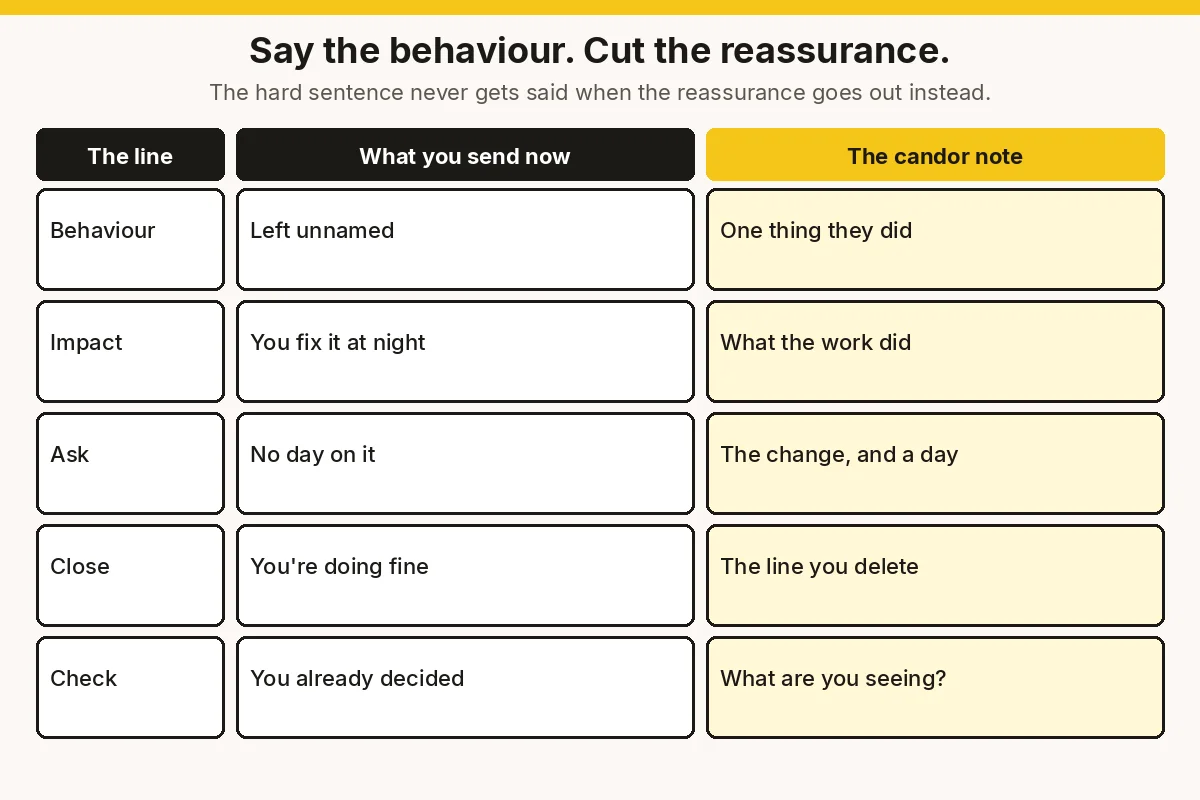
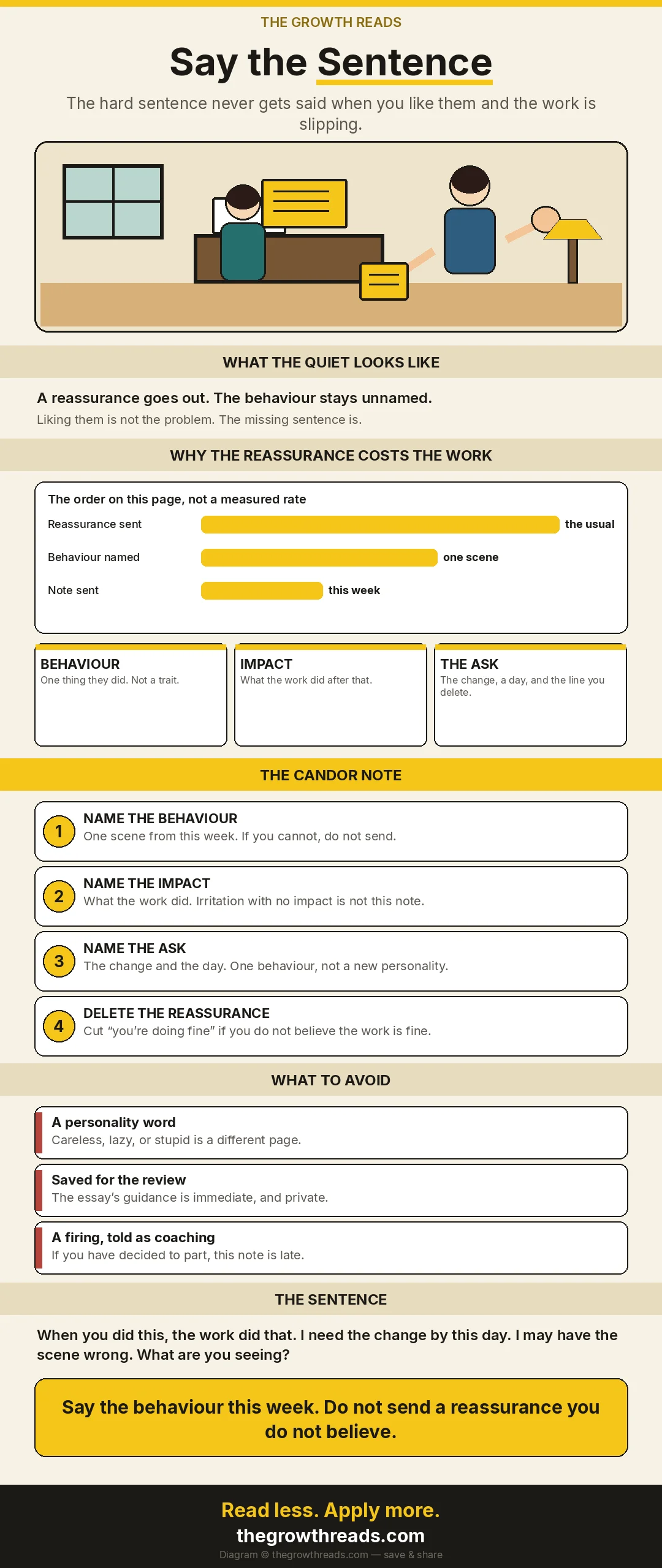
The liking is not the failure. Scott’s essay treats caring personally as half of the useful quadrant. The failure is the challenge that never leaves your mouth, replaced by a reassurance you do not believe. The behaviour is one scene from this week. The impact is what the work did after that scene. The ask is the change and the day. The reassurance is the line you delete.
This page starts before the sentence exists. Feedback turns into a personality comment is the sentence that names a character instead of a behaviour. Here the sentence has not gone out at all. You answer before they finish is the reply you give while they are still asking. Here they are not asking. You already know the scene, and you are filling the quiet with praise. You still speak like a peer is the role. The corridor compliment can come from that role. This page is the sentence the role still owes the work.
What the essay says
Kim Scott says the usual management mistake is care without a challenge, and she names that quadrant ruinous empathy. The copy checked is her essay “Radical Candor — The Surprising Secret to Being a Good Boss,” dated 24 November 2015 on First Round Review, read in full on 21 November 2026. She was describing a tool she had shared at First Round’s CEO Summit. The essay does not say it is a chapter of a book. Porchlight’s page for ISBN 9781250103505, read the same day, lists Radical Candor: Be a Kick-Ass Boss Without Losing Your Humanity, St. Martin’s Press, hardcover, 14 March 2017, 272 pages. That page describes the book as caring personally at the same time as challenging directly, and it uses the same three names for the other quadrants. The print book was not opened. Nothing below is a numbered page.
Scott draws two axes. The vertical one she calls the “give a damn” axis: caring personally. The horizontal one she calls the “willing to piss people off” axis: challenging directly. The upper right, both at once, is the quadrant she wants, and she names it radical candor. Challenge without care is the quadrant she calls obnoxious aggression. Neither is the quadrant she calls manipulative insincerity. Care without challenge is ruinous empathy. She says the vast majority of management mistakes happen there, and that the sneaky quadrant is actually pretty rare.
| What she separates | Her names | What this page will not borrow |
|---|---|---|
| Care and a direct challenge | Radical candor. She also gives the memory line HHIPP: humble, helpful, immediate, in person, and it does not personalize. Criticism is private. Praise is public. | A poster, a sticker chart, or a slogan in place of the sentence. |
| Challenge without care | Obnoxious aggression. She says that if you cannot offer radical candor, the second-best thing is to be an asshole, and in the next breath that she hates working with jerks and that you are not shooting for second best. | Permission to be harsh. Second best is still a miss. The personality-comment page owns the sentence that names a character. |
| Neither care nor challenge | Manipulative insincerity. Her example is a person who stopped challenging and started arranging conversations in secret. | A claim that your team is political. One story is not a diagnosis of your company. |
| Care without challenge | Ruinous empathy. She says this is where most of the mistakes are. Her account is a person she calls Bob. | Ten months as a rule. A firing as the tool on this page. Bob’s name, which she says she assigned. |
The Bob account is the one that matches the quiet in the opening. She says she really liked him, and that he was absolutely terrible at his job. When he worried about his performance, she reassured him. After nearly a year she could see the weak work hitting the rest of the team, and she was in danger of losing several people who were doing the work well. She says that trying to be nice to him had been unfair to them. Then the line she gives for the ending: she had never criticized him for 10 months, because she was trying to spare his feelings, and she was sitting in front of him firing him. She says he pushed his chair back and asked why she had not told him, and why no one had. She calls the praise a fake-out, a bunch of false reassurances. She says she never asked him what he thought, because she had written him off. She also says she had failed to build a place where other people would tell him, not to be mean, but to help him.
That is one manager’s story about one person. It is not a rate, and it is not a finding that kindness causes firings. The part this page uses is narrower. She could see the work. She sent reassurance instead. The first time he heard the criticism was the ending. A solo founder does not need her adjective “terrible.” You need a scene you can point at, and a reassurance you have actually sent.
She is also clear that the harsh quadrant is not the repair. She says she hates working with jerks, and that you are not shooting for second best. The essay’s example of a challenge that landed is her boss, after a presentation, saying that saying “um” every third word made Scott sound stupid. Scott’s point on that sentence is the last P in HHIPP: it did not personalize. Her boss did not say “you’re stupid.” She said the ums made her sound stupid. If the sentence you are about to send names the person, stop and use the personality-comment page. This page is for the sentence you have been too kind to send, and the kindness has to stay inside it.
The candor note
The candor note is four lines: the behaviour, the impact, the ask, and the reassurance you will not send. It is this page’s application. It is not a quotation from the essay, and it is not a page from the book. Scott’s story supplies the failure. The lines are how a founder or a new manager says the thing this week without turning it into a character judgment or a surprise firing.
1. The behaviour. One scene from this week, in words they could recognize. “The last two files left out the three points we listed on Monday.” “On Tuesday’s call you started speaking while the buyer was still on the price.” If the only words you have are “be more senior,” “raise the bar,” or “you know what I mean,” you do not have a behaviour yet. Do not send the note. A 1:1 that is only a status recital will not produce the scene either. The 1:1 is a status recital when the meeting never reaches a decision. The scene can come out of that meeting. The note is not a second status round.
2. The impact. What the work did. You rewrote the files, and the client date moved. The buyer now writes to you. Leave out your irritation if you cannot connect it to the work. A sentence whose only impact is that you felt annoyed is not this note. Scott’s account of the cost was the team, not her mood: the weak work was hitting people who were doing it well. Use a cost you have actually seen. Do not invent a team you do not have.
3. The ask, with a day. One change, and when you will look. “The Thursday file includes those three points. I will not rewrite it before then.” “On Thursday’s call, you let the buyer finish the price. If it happens again, I will say so on the call.” Scott says changing behaviour is hard, and that you cannot ask someone for a personality transplant out of one short meeting. One scene is the size of the ask. A new personality is the seat, or it is the harsh quadrant.
4. The line you delete. “Looks great.” “You were great in there.” “No rush.” “It’s fine.” Any of those can stay if you believe the work is fine and the note is about something else. They cannot stay as a wrapper around a criticism you mean. Scott calls that kind of praise a fake-out. The humble part, which is the H she puts first, is a question, not a compliment you do not mean: “I may have the scene wrong. What are you seeing?” She says she never asked Bob that, because she had already written him off. If you have written them off, you are not in this note. You are in the late case below.
The sentence you send
Send one scene, one impact, one ask, and the question. Delete the reassurance you do not believe. Say it in person if you can do that this week, and say it in private. The essay’s line is immediate, and in person, and private when it is criticism. A solo founder who will not see them until next month should not wait for the perfect walk. Send the note this week. Say that the walk would have been better, and do not add a paragraph of praise to make the email feel softer. A new manager who can catch them tomorrow should not put it in the team channel to prove they are direct.
Contractor, in the reply you almost sent.
The last two files left out the three points we listed on Monday. I rewrote both, and the client date moved. I need Thursday’s file to include those points. I will not rewrite it before then. I may have the scene wrong. What are you seeing?
Direct report, after the call.
On Tuesday you started speaking while the buyer was still on the price. The buyer has been emailing me since. On Thursday’s call, let them finish. If it happens again, I will say so on the call. I may have the scene wrong. What are you seeing?
Both sentences are this page’s application. Neither is in the essay. Change the nouns. Keep the scene, the impact, the day, and the question. A note that ends “but honestly you’re amazing and this is tiny” puts the fake-out back in the last line. Delete it before you hit send.
If they tell you the scene is wrong, believe the details you can check, and correct your line. Humble, in her memory word, means you might have the scene wrong. It does not mean you withdraw a scene you watched because the conversation got warm. Ask what they saw. Then decide whether the behaviour stands. Do not decide that in the same breath as a compliment.
When you are the only person
If you have no manager under you, you still send the note. You skip the parts of the essay that need a larger team. Scott’s later section is for a manager of managers. She describes a meeting with someone’s reports, notes she takes herself, and a short list of one or two things the boss could do differently. She says she would tell the manager what was said and not who said it. A founder with one contractor has nobody to gather that from. Do not invent a skip-level. Do not print the four quadrants and stick them on the wall instead of sending the sentence. She does suggest the poster and a pair of stickers, for a team that will mark where the last conversation landed. That is a team tool. Your tool this week is the note.
She also describes trying to carry a disagreement between two people. She says the shuttle created the political environment she was trying to avoid, and that she would have insisted they speak to each other first. She would have joined only if that failed, and only with both of them in the room. If your first hire and your contractor will not say the hard thing to each other, do not reassure each of them in private that the other is the problem. Put them in the same conversation, or stay out of it. Your own unsent sentence is a different item. Do not hide it inside their conflict.
One line in the essay is easy to steal for a different problem. She says you cannot care about other people if you do not care about yourself, and she talks about keeping a morning run during a bad stretch. That is capacity. It is not this note. If the week is gone because every file comes back to you, the sentence is still owed. A run does not name the missing points.
When the note is already late
If you have already decided to part, the candor note is the wrong tool, and Scott’s story is the warning rather than the script. She heard the question at the firing, after months of reassurance. Using that scene as a model would mean saving the truth for the ending. This page wants the opposite while the working relationship is still going. If you have decided the person is leaving, do not open with four lines of coaching about a file they will not own next week. The seat no longer fits is the conversation when the work of the seat and the person are the mismatch. Say that plainly, on that page’s terms. Do not dress an exit as a development note.
The note is also the wrong tool when you cannot name a behaviour, or when the work is fine and you are only irritated. Ruinous empathy, in her account, was care that refused a challenge the work needed. A challenge the work does not need is the other quadrant, the one she says is still a miss. “You have been quiet in stand-up and it bothers me” is not yet an impact. Find what the work did, or do not send it.
And do not send it as a performance. Her boss’s walk worked, in Scott’s telling, because the criticism was specific and because Scott already knew she was cared about, from a long list of ordinary acts: a book group, time off for a sick relative, the same care shown to the rest of the team. You cannot borrow that history with a warmer adjective in the first sentence. If you have not been straight with them, the question at the end is doing some of that work. It is not a substitute for a relationship you do not have. Send the scene anyway if the work is slipping. Do not pretend the adjective is the care.
Common mistakes
- Wrapping the scene in “you’re doing great.” Scott calls that praise a fake-out when you do not believe the work is fine.
- Waiting for a review, a quieter week, or a walk you will not have. Her word for the timing is immediate. This page’s clock is this week.
- Naming a character. “Careless,” “lazy,” or “stupid” as a noun for the person belongs on the personality-comment page. Her contrast was “you sounded stupid when you said um,” not “you’re stupid.”
- Using ten months, or the firing, as the method. Both are her account of one delay. They are not a schedule and not a script.
- Carrying the sentence between two other people. She says the shuttle made the politics worse. They talk to each other first.
- Printing the quadrants and skipping the note. The poster is her suggestion for a team that will mark conversations. It does not send Thursday’s file back.
- Challenging with no care, because a blunt essay line called that second best. She says she hates that option, and that you are not aiming at it.
- Asking them to become a different person by Friday. She says you cannot ask for a personality transplant out of one short meeting. One behaviour, one day.
What the source does and does not say
The essay gives one manager’s framework and one story. It does not give a rate, a sample, or a sentence you must memorize. The store page gives the book’s title, publisher, date, page count, and a description that uses the same quadrant names. It does not give the Bob story, and this page does not pretend to have read it there.
| Source | What it is | What we used | What we will not use |
|---|---|---|---|
| Kim Scott, First Round Review, 24 November 2015. Read in full on 21 November 2026. | An essay from a CEO Summit talk. Her axes, the four names, the Bob account, HHIPP, the shuttle, and the manager-of-managers meeting. | Ruinous empathy as the name for care without a challenge. The warning that reassurance can delay the truth until an ending. The boundary that a challenge should not name the person. Private, soon, and a question because she had skipped asking. | Mill’s sentences. The essay’s quotation marks around them do not close cleanly, so they are not reproduced. Any count of teams, revenue, or “how often” this happens. Ten months as a rule. The word she uses for second best as advice to be harsh. |
| Porchlight’s page for ISBN 9781250103505. Read on 21 November 2026. | A bookseller listing. St. Martin’s Press, hardcover, 14 March 2017, 272 pages. The description says a good boss cares personally and challenges directly, and it names the other three quadrants. | The book title, the author, the publisher, the date, the page count, and the ISBN, so the 11:00 review has a real edition to point at. Confirmation that a published book describes this framework. | Any sentence treated as printed on a page. The blurbs. Bestseller lines. The revised edition. That edition was not the page we opened, and its text was not read. |
| What was not opened | The print book. Any PDF of the book. A later revised edition. | Nothing from those objects. | Page numbers. A claim that the essay’s wording matches the hardcover. A claim that the essay says it became the book. It does not say that. |
Frequently asked questions
What does it mean that the hard sentence never gets said?
It means you like the person, the work is slipping, and the message you send is a reassurance. The behaviour has no name, and the ask has no day. Kim Scott, in the First Round Review essay of 24 November 2015, calls care without a direct challenge ruinous empathy. She says that is where the vast majority of management mistakes happen. This page is the note that names the behaviour, the impact on the work, and the ask, and that deletes the reassurance you do not believe.
What is ruinous empathy?
In that 2015 essay, Scott draws two axes. Caring personally is the axis she calls “give a damn.” Challenging directly is the axis she calls being willing to piss people off. Ruinous empathy is care without the challenge. Radical candor is both. Obnoxious aggression is the challenge without the care. Manipulative insincerity is neither. She says the harsh quadrant is bad, that she hates working with jerks, and that you are not shooting for second best. She also says most mistakes are the kind ones, where you spare someone.
What should I say instead of telling them they are doing fine?
Say one scene from this week, what the work did after it, the change you need, and the day you will look. Then ask what they are seeing. Scott says the praise she gave Bob was a fake-out, a bunch of false reassurances, and that she never asked him what he thought, because she had written him off. The script on this page is an application of that shape. It is not a quotation. If you cannot name one behaviour, do not send the note. “Be more senior” is not a behaviour.
Is this the same problem as feedback that becomes a personality comment?
No. That page is the sentence that names a character instead of a behaviour. This page is the sentence that never goes out, because you like them. The essay uses both ideas. Scott says her boss told her that saying “um” made her sound stupid, and did not say that she was stupid. That contrast belongs on the personality-comment page if your draft names the person. Use this page when the reassurance is what you have been sending. Use the other page when the draft you are about to send is about their character.
What if I have already decided they should leave?
Then this note is late. Scott says she had never criticized Bob for 10 months, because she was trying to spare his feelings, and that she was then firing him. He asked why she had not told him, and why no one had. That is a warning, not a script for the ending. If the seat no longer fits, use that page and say the mismatch plainly. Do not open a parting conversation with four lines of coaching about a behaviour you have already decided will not matter next week.
What if I am the only person, and they are a contractor?
You still send the note. The essay’s skip-level meeting is for a manager of managers. Scott says she would tell that manager what was said and not who said it. A solo founder has no one to gather that from, and a contractor has no skip level above you. You are the person who has been writing that the file looks great. Name the missing points, the rewrite, and the day the next file includes those points. If the work cannot be done inside the agreement, that is a scope or a fit conversation, not a softer version of this note.
What if two people will not say it to each other?
Do not carry it between them. Scott says she tried to be the diplomat for two reports who could not get along, and that the shuttle created the political mess she was trying to avoid. She says she would have insisted they speak to each other first, and that she would have joined only if that failed, and only with both of them there. Your note is for the behaviour you have been papering over with a reassurance. Their disagreement is a meeting with both of them, not a private compliment to each.
Did the essay prove that waiting months causes a firing?
No. Ten months is Scott’s account of one person she calls Bob, and she says that is not his name. She says she liked him, that the work was terrible, that she reassured him, and that the ending was a firing he did not see coming. That is one manager’s story in an essay. It is not a study, it has no comparison group, and it does not show that a kind delay of any length ends in a firing. If you can name the behaviour, and you have been sending a reassurance, say it this week. Do not borrow the firing as the tool.
Sources
- Kim Scott. “Radical Candor — The Surprising Secret to Being a Good Boss.” First Round Review, 24 November 2015. Read in full on 21 November 2026 from review.firstround.com/radical-candor-the-surprising-secret-to-being-a-good-boss/. The essay names the four quadrants, tells the Bob account, and gives HHIPP. It does not say it is a chapter of the book. The candor note is not in the essay.
- Porchlight Book Company. Listing for ISBN 9781250103505, Radical Candor: Be a Kick-Ass Boss Without Losing Your Humanity, by Kim Scott. Read on 21 November 2026 from porchlightbooks.com/products/radical-candor-kim-scott-9781250103505. The page lists St. Martin’s Press, hardcover, 14 March 2017, 272 pages, and describes the book as caring personally and challenging directly. It names obnoxious aggression, ruinous empathy, and manipulative insincerity. The print book was not opened. No sentence is taken from a numbered page.
Related reading on The Growth Reads
- Feedback turns into a personality comment — the sentence that names a character instead of a behaviour
- The seat no longer fits — when the mismatch is the seat, and a coaching note would be late
- You still speak like a peer — the role, when the corridor compliment is coming from the old one
- You answer before they finish — the reply you give while they are still asking
- The 1:1 is a status recital — when the meeting never reaches the scene
- Productivity — the cluster this article sits in
- How we review — what a checked essay is, and what an unread page is not
How this was checked
Who it is for. A solo founder or a new manager who likes the person, and who has been sending a reassurance while the work slips.
What was read. Kim Scott, “Radical Candor — The Surprising Secret to Being a Good Boss,” First Round Review, 24 November 2015, in full, on 21 November 2026. Porchlight’s listing for ISBN 9781250103505, the same day.
What was not read. The print edition of Radical Candor. No page number, because the book was not opened. The store’s 272 pages and the ISBN are the listing, not a copyright page. The essay does not say it is a chapter of the book. A revised edition was not the listing we opened, and its text was not read. John Stuart Mill’s sentences are not reproduced. The essay’s quotation marks around them do not close cleanly.
Limit. The candor note and the two sentences are our application. Bob is the name she says she assigned. Ten months, the team impact, and the firing are her account of one person, not a rate and not a method. The blunt name she gives the second-best quadrant is not advice to be harsh. She says she hates that option. A personality word, a seat that no longer fits, and a decision to part do not become this note because an essay about kindness is useful somewhere else.
How we work: every article on The Growth Reads is built from books we have read and from primary accounts we can check, and it is date-stamped when those sources change. Read our methodology.