

★★★★☆ 4/5 — Use it when loyalty is the reason an early person is still in a seat the work has outgrown. Name the mismatch, say it this week, and do not invent a quieter corner.
Best for: a solo founder or a new manager who can point to one early person and one seat.
Reading time: the old-timer chapter is one sitting on the official HTML edition. Open Library records the Stripe Press hardcover at 344 pages.
Difficulty to apply: moderate. The sentence is short. The debt is what makes you postpone it.
High Growth Handbook in one minute
Some early people grow with the company. Some should change roles, leave, or be managed out. Gil’s old-timer chapter is for a founder whose first people still hold the early trust. The ones who scale learn from newer specialists and accept a smaller say for a while. The ones who do not are often kept from loyalty, or parked where they will do little harm. He treats that parking as the sign to part with grace. The four lines later are this review’s application. They are not a form in the chapter.
Key takeaways
- Early can be the most valuable: some of the best long-term people join early, with the founders’ trust and the mission.
- Humility is the sign they scale: early employees who can learn from newer people can grow with the company.
- A smaller say, for a while: they accept less influence in the short term and expect the scope to return as they learn.
- Five shapes: they fight a needed change, want a role they cannot do, feel left out, keep an old title’s power, or lose hunger after a large cash-out.
- The debt is the delay: a founder hears the issues and defers them. He says that harms the early employee too.
- Say it this week: a frank talk sometimes turns the work around. A real mismatch may mean a smaller seat, and they may leave.
- A quieter corner is the test: a place where they will do little harm is, in his judgement, the reason to part with grace. The 99% is not a study.
- Filter it: his 17 July 2018 note says there is no good generic startup advice. Use the order on the company you have.

What is High Growth Handbook about?
High Growth Handbook is Elad Gil’s Stripe Press book for a company that is scaling. The chapter separates early employees who grow with the company from early employees who should change roles, leave, or be managed out. A founder names the mismatch, says it, and does not park the person in a quieter corner.
About the author
Elad Gil wrote High Growth Handbook. On 17 July 2018 he posted that it was on sale from Stripe Press, drawn from companies after product-market fit as they grew from a handful of people to hundreds or thousands. The footnote says he joined Google at about 1,500 people and left at 15,000, and sold MixerLabs to Twitter when Twitter was about 90 people, leaving at about 1,500. Those figures are his account. Explore all Elad Gil book summaries →
Stripe Press product data gives the subtitle Scaling Startups from 10 to 10,000 People, hardcover, 344 pages, ISBN 9781732265103. Open Library agrees on the publisher, 17 July 2018, the page count, and ISBN-10 1732265100. There is no Wikipedia page, so this review adds no photo. The print book was not opened.
Key concepts at a glance
| Concept | What it means | Use it when |
|---|---|---|
| Scales | Learns from people with more experience in the function. | They can take a smaller say and still do the work. |
| Should move | Change roles, leave, or be managed out. Loyalty is why they stay. | The work changed. The old shape of the job did not. |
| Does not evolve | They fight a change the company now needs. | The last two weeks include that block. |
| Cannot scale | The first person in a function may want a title they cannot do. | The title is larger than the work they finish. |
| Left out | The daily say disappears. They block work or go around the owner. | Decisions skip the person who holds the seat. |
| Old title | A title from an earlier size still moves people. | People follow a title the seat no longer owns. |
| Quieter corner | A seat whose purpose is that they do little harm. | You are designing it because it is less important. |
Early people who grow with the company
Gil writes that some of the most valuable long-term employees join early, with the founders’ trust and the mission. He points to an early Google hire who later led YouTube, and to Chris Cox, who the HTML edition says joined Facebook as an engineer in 2005 and is chief product officer in that text. The YouTube name is spelled unusually on the page. The claim does not depend on the spelling. People who scale carry that mindset into a team, know how the company runs, and can challenge a rule or explain it. Many lack deep functional experience. The CEO’s trust lets them hire people who have it.
The line the page sets off is his: “Early employees who are humble enough to realize they can learn from fresh blood can grow with the company and use it as a personal platform for their own learning and impact.” A common sign they will work out, he writes, is that they accept a smaller role and less influence for a while, and expect the scope to grow again as they learn. On a team of three, that learning may be a specialist you both respect, or a written standard. If they can learn, and they can accept a smaller say for a while, the seat stays theirs.
Early people who should change roles
Some early employees, he writes, overstay. The causes he names are getting too rich, failing to scale skill and mindset, or clinging to lunch with the CEO and a say in every decision. The moves are a different role, a resignation, or being managed out. The temptation is more chances, or a seat that is “less important,” where they are not very productive. He says that usually means the fit is already poor. Often they would be happier gone, and stay from loyalty.
The five shapes are a list, not a score. They fight a change the company needs. They cannot scale into the role they want: the first marketer may not be the long-term vice president, and the first engineer may not be the CTO. They feel left out. His scene is a company of 12, daily lunch, and an opinion on every decision. Later they block projects or escalate around the owner. An old title still pushes. His example is a CTO title kept from 10 people to 1,000, with no reports. Cofounders, he writes, keep influence whether they are active or not. Or they get rich. Secondary sales can leave someone liquid “to the tune of tens of millions of dollars.” Leave that last shape in the chapter unless it is your fact.
Name the mismatch, then say it
The chapter gives three steps. Identify whether the problem is solvable. If you cannot point at a file, a meeting, or a sentence from the last two weeks, you do not have this week’s version. Then put the owed feeling aside. He writes to the founder who feels the debt, hears issues, and defers them. That deferral, he says, harms everyone, including the early employee. Understand it, then act.
Address it head on. Discuss it. Sometimes the frank conversation turns things around. A fundamental mismatch between the role and the skills should move them to a place of good fit. He says that may be a demotion, and they may leave. Explain why, and ask whether they will thrive. He adds that an early employee is often a large equity holder. If yours has no equity, skip that sentence. Do not invent a stake.
Then the corner test. If you are looking for a place they will do little harm, rather than a place they will excel, he writes that “99% of the time the right answer is to part ways with the early employee.” Let them go with grace. They may be relieved. The 99% is his judgement in that paragraph, not a study, and not a reason to skip the talk that might turn the work around.
The seat check you run this week
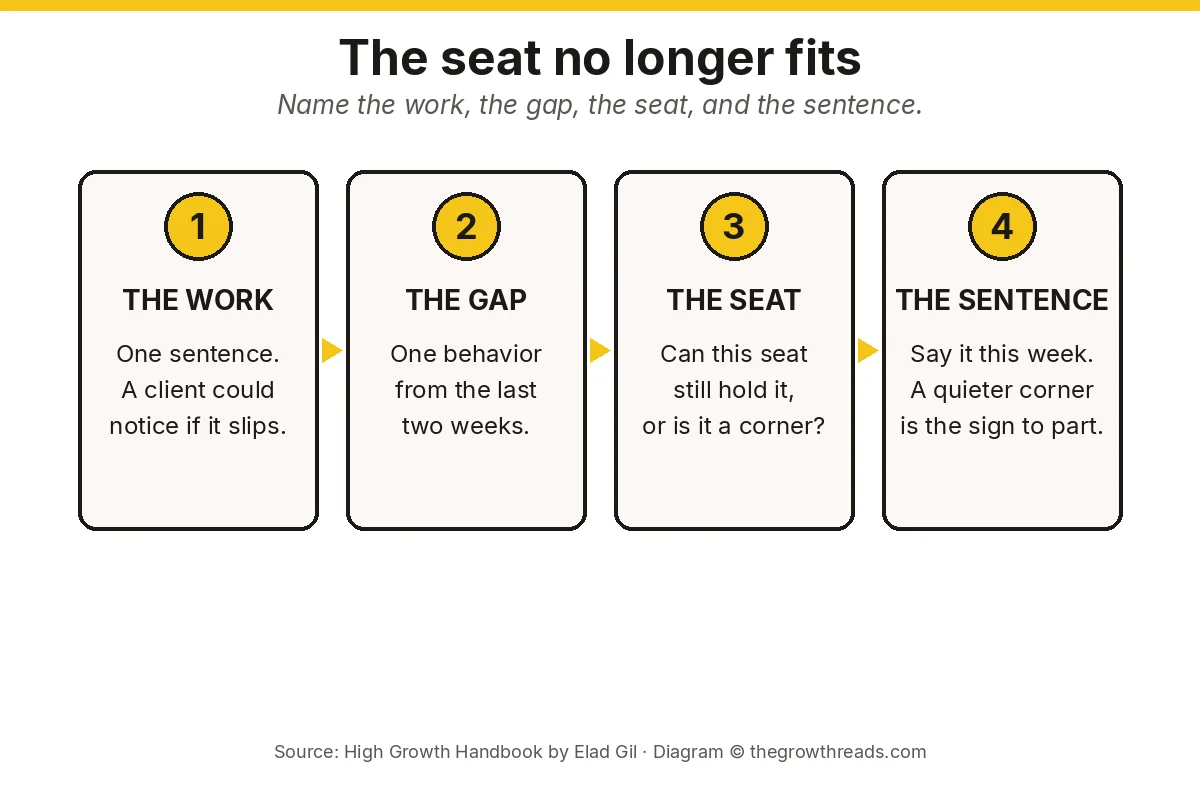
Write four lines before you invent a new title. The morning article uses the same four lines. The chapter does not print the form.
The work. One sentence a client would notice. A title is not this line.
The gap. One of the five shapes, tied to the last two weeks. If you cannot point at it, you are not ready.
The seat. Can the gap close here? If yes, write what good looks like and the date. A hope is not a yes. “Less important” fails this line.
The sentence. Say it this week. Let them describe the fortnight first. Ask them to restate the work and the date.
The work this seat has to finish is [one sentence a client would notice]. In the last two weeks I saw [the behavior]. I owe you this sentence, not a quieter corner. If the seat can still hold the work, good looks like [the picture] by [the date]. If the skills and the seat do not match, we name a seat where you can excel, even if it is smaller, or we part on purpose and with grace.
Only one reply keeps the seat. They take the picture, and you look at the files on the date. Or you name a smaller seat in the same conversation. Or you hear a corner being designed, and you stop. On a small team, grace is a date, a plain account, and a fair reference.
Who is High Growth Handbook best for — and who should read something else first?
Read this chapter if you can name one early person, one seat the work has outgrown, and loyalty as the reason you have not said so. A founder with that person, and a new manager who inherited them, are the readers. You need two weeks of behavior. You do not need his company of a thousand.
Read the first-hire page if they arrived this week. Read the future-problem page if you are designing executives you do not have. If nobody early is in a mismatched seat, this chapter waits.
Questions to reflect on
- What must this seat finish next month, in one sentence a client would notice?
- Which of the five shapes matches the last two weeks?
- Can the gap close here, and what does good look like on a real date?
- Are you designing a seat where they will excel, or where they will do little harm?
- Which reply are you hoping not to hear?
🔥 Ready to say the seat no longer fits?
The Amazon button uses the Stripe Press hardcover ISBN-10 recorded by Open Library. The old-timer chapter is the one to read before the conversation.
How to apply High Growth Handbook (7-day plan)
- Day 1 — Write the work in one sentence a client would notice. A title does not count.
- Day 2 — Attach one of the five shapes to the last two weeks. If you cannot point at it, stop.
- Day 3 — Decide whether the gap can close in this seat. Write the picture and the date, or admit you are designing a quieter corner.
- Day 4 — Read the four lines aloud alone. Cut any line about the kind of person they are.
- Day 5 — Say it. Let them speak first. Ask them to restate the work and the date.
- Day 6 — If they took the picture, leave the seat. If the skills do not match, name a smaller seat. If you are hunting a corner, set the date to part.
- Day 7 — Look at the files on the date, or keep the parting date. Do not open a chart for executives you do not have.
Frequently asked questions
What do you do when the early person is loyal and the seat no longer fits?
Write the work the seat must finish, one behavior from the last two weeks, and whether the gap can close in that seat. Say it this week. Gil’s old-timer chapter, read on the official HTML edition on 18 November 2026, says to name the mismatch, set the owed feeling aside, and discuss it. A frank talk sometimes turns the work around. A real skill mismatch moves them to a seat where they can excel, which may be smaller. If you are looking for a place they will do little harm, he says to part with grace. That 99% line is his judgement, not a study.
What does High Growth Handbook say about an early employee who does not scale?
Gil writes that some early employees overstay, from money, from a skill set that did not grow, or from clinging to a say in every decision. The moves he names are a different role, a resignation, or being managed out. The temptation is more chances, or a less important seat where they are not very productive. He says that usually means the fit is already poor, and that loyalty is often why they stay. His 17 July 2018 note says the book is from Stripe Press, and that advice has to pass through your own company. A small team can use that order without borrowing a thousand-person scene.
Which mismatches does the old-timer chapter name?
The chapter names five shapes. They fight a change the company needs. They cannot scale into the role they want. A first marketer may not be the long-term vice president, and a first engineer may not be the CTO. They feel left out as the daily say disappears, and they block work or go around the owner. An old title still pushes people. His example is a CTO title kept from ten people to a thousand, with no reports. Or they get rich enough, in his words tens of millions, to lose hunger. Leave that last shape unless it is your fact. The list is not a score.
When does the frank conversation fix the seat?
Gil says the issues are sometimes addressable, and the frank conversation turns things around. The sign an early person will scale is humility about learning from people with more experience, and acceptance that their say may shrink for a while and grow again as they learn. On a small team that may be a written standard or a specialist you both respect. Write what good looks like in files and a date. On the date, look at the files. If they match, keep the seat and stop designing an exit. A speech about loyalty is not the picture of good.
What is the quieter-corner test in the chapter?
Gil writes that leaders try to find a place an early employee will do little harm, instead of a place they will excel. If you are thinking that way, he writes that 99% of the time the right answer is to part ways, with grace. The 99% is his judgement, not a study. A seat meant to matter less has already answered the question. On a small team, parting with grace is a date, a plain account of the work that changed, and a reference that matches what they did. Skip any equity line if they have none.
Does this apply to a two-person company?
His 17 July 2018 note says the book comes from companies scaling from a handful of people to hundreds or thousands, and that advice has to pass through your own situation. The Stripe Press subtitle is scaling from 10 to 10,000. A founder with one early person can still name the work, name the behavior, say it, and refuse a harmless corner. If you have no early person yet, the chapter waits. A person in their first week is not this problem, because you do not yet have two weeks of behavior to point at.
Which edition did this review check?
The text read on 18 November 2026 is the official HTML chapter on old-timer syndrome, in full. That page states no year and no ISBN. The print book was not opened, so no printed page number is given. Stripe Press product data gives ISBN 9781732265103, hardcover, 344 pages, and the subtitle on scaling from 10 to 10,000 people. Open Library agrees, dates the edition 17 July 2018, and lists Amazon identifier 1732265100. This network did not render an Amazon product title. The button uses that recorded ISBN-10. Bookshop’s deep link returned a challenge, so the button uses the shop page. The four-line check is our application.
Related summaries
- The Effective Manager summary — a 1:1 that ends in one decision, which is the room this sentence needs
- The Art of Action summary — the written reply, so the picture of good survives the room
- The Great CEO Within summary — a wider operating picture when this one seat is not the issue
- High Output Management summary — when the problem is a whole team’s output, not one early seat
- Best leadership books